







Abstract
This study presents a novel approach towards clay modification via thermal dehydroxylation, for polymer nanocomposite application. The feasibility of modification of clay via thermal dehydroxylation and its influence on the polymer properties was investigated, with reference to the polyproplylene (PP) nanocomposites. In spite of ample available literatures on organophillic clay/polymer composites, use of organic compound for the clay modification has been found detrimental in various aspects. Therefore, in order to corroborate the advantage of the thermal dehydroxylation method over organophillic modification, a comparative aspect of the effect of the organically modified and thermally dehydroxylated clay on the polymer properties has been established. Wherein, remarkably greater mechanical, dynamic mechanical, thermal and microstructural properties were noticed in case of nanocomposites reinforced with thermally dehydroxylated clay. Modification of clay via thermal dehydroxylation method was found to be an effective approach for polymer nanocomposite application.
List of symbols
Fourier transform infrared spectroscopy
Hexadecyl trimethyl ammonium bromide
Hexadecyl trimethyl ammonium bromide modified clay
Maleic anhydride grafted Polypropylene
Montmorillonite clay
Temperature for 10% weight loss
Temperature for 50% weight loss
Temperature for 95% weight loss
Onset temperature for degradation
Onset temperature for degradation
Peak temperature for the degradation
Transmission electron microscopy
Thermogravimetric analysis
Thermally modified (dehydroxylated) clay
Polypropylene
PP nanocomposites reinforced with Na-MMT
PP nanocomposites reinforced with HTAB-MMT
PP nanocomposites reinforced with TMMT
Introduction
The goal of this work was to establish a method for clay modification, without involvement of an organic compound, for polymer nanocomposite application. The exfoliation of the clay layers through its modification is the key to get the uniformly improved properties of the polymer nanocomposites. Most of the previously adopted methods to exfoliate the clay are related to the treatment of clay using organic compounds (namely, Alkyl ammonium/phosphonium/imidazolium compounds). In spite of the abundance of available literatures on the polymer/clay composites, the necessity to improve the performance of polymer/clay has been constantly attracting considerable interest, stemming from the disadvantages of organic compound, present in the organophilic clay.
Alkyl ammonium treatment has been in practice since long time, due to its low cost and well established usage. However, this treatment is thermally unstable above 180–200°C, 1 because, above this temperature, it thermally decomposes to yield an amine and an alpha Olefin via the Hoffman degradation reaction.2, 3 This results in the return of clay to the organophobic status, which leads to polymer de-intercalation in the clay galleries (interlayer area) and subsequent phase separation. And after sufficient thermal decomposition, the well constructed nanocomposite returns to a microcomposite structure and all nanocomposite benefits are lost.4–7
Hence, the use of more thermally stable organic modifier, such as imidazolium8–11 or phosphonium compounds 12 becomes essential. In spite of the effectiveness of these organic treatments, they are not easily available. Also ensuring the good interaction between polymer and these surfactants is the difficult task.13–16 Hence, utilisation of the reinforcing properties of clay (modified with these compounds), becomes difficult and this limits the use of imidazolium and phosphonium compounds for clay modification.
Most often alkyl ammonium does a better job than imidazolium, in rapidly dispersing into the polymer matrix.17–21 However, even though alkyl ammonium disperses very quickly before it degrades sufficiently, if the polymer is kept at elevated temperatures for long periods of time (thermal aging), the clays collapse due to decomposed alkyl ammonium, resulting in a microcomposite structure.22–24
Earlier it was reported that, the dehydroxylation of the clay can also be an approach towards modification of clay,25–26 however, it has not yet come into the practice. Hence, in this study an innovative step has been adopted toward the clay modification (exfoliation) using thermal dehydroxylation method.
Since the Hexadecyltrimethyl ammonium bromide (HTAB) is the mostly used organic compound for the modification of clay, hence the comparison between the properties of HTAB modified and thermally dehydroxylated, clay reinforced polymer nanocomposites has been carried out. The mechanical and thermal properties of the PP and its nanocomposites have been evaluated. Since, the exfoliated morphology is the most desirable property of polymer nanocomposites, hence, the morphology and microstructural properties were investigated. Being an appropriate tool for analysing the microstructural properties, rheological assessment was used for investigation. The results obtained from rheological assessment were further confirmed by TEM images.
Being the mostly used polymer in a wide variety of industrial applications, polypropylene (PP) was used as the base matrix in this study. The necessity of adding compatibiliser in order to incorporate polar group to the non-polar PP has already been reported earlier.27–30 The Maleic anhydride grafted polypropylene (MAPP) was used to introduce polar groups in the Polypropylene. The use of MAPP is the most preferred compatibiliser for this purpose.31, 32
Experimental
Modification of clays
Organophillisation of clays
For organophillisation, clay was first acid activated in the presence of hydrochloric acid (HCl) followed by washing with distilled water. Further the aqueous solution of 1gm of acid activated clay was mixed with an aqueous solution of 0·3 g of hexadecyltrimethyl ammonium bromide (HTAB) followed by overnight stirring. The modified clay was filtered and dried in vacuum oven at 80°C. The HTAB treated clay is represented as HTAB-MMT in further discussion.
Thermal treatment of clays (dehydroxylation)
The treatment of the Na-MMT was carried out, via extensive heating of clay at a temperature above dehydroxylation. Thermal exposure of clay above dehydration, but below dehydroxylation temperature (where the temperature is raised from ambient to that of the onset of dehydroxylation), leads to loss of adsorbed and hydration water. This results in collapse of the interlayer spaces of clay. However, heating of the clay above dehydroxylation temperature (700°C), leads to the exfoliation of Na-MMT by destroying its layered structure. 21 However, at 1000°C, tetrahedral sheets break down and a partial segregation of amorphous SiO2 occurs. Therefore, the temperature for thermal treatment was selected slightly above dehydroxylation temperature (in order to ensure the complete dehydroxylation) and below 1000°C (i.e. 800°C). The Na-MMT was kept at 800°C for 1 h, followed by sudden cooling at room temperature. The thermally treated clay is represented as TMMT in further discussion.
The major effect of dehydroxylation relates to the octahedral sheet, wherein, residual oxygen remains behind in the dehydroxylated structure. Octahedrally coordinated cations in the low temperature form become five coordinated cations in the dehydroxylated structure, with the maintained topological features. Upon dehydroxylation, the two associated OH groups in the low temperature form react to form an H2O molecule, which leaves the structure and one, residual oxygen, moves to the position midway between (which was formerly the OH–OH) shared edges of the octahedral layer in the lower temperature form. The residual oxygen remains much unsaturated with respect to the positive charge and requires a compensation for the disruption of local charge neutrality. When this unsaturated residual oxygen comes in contact with the polar group of matrix polymer, a strong interaction is probably achieved in order to compensate the charge neutrality. 25
Preparation of nanocomposites
The PP nanocomposites reinforced with untreated and treated clay were prepared through melt blending technique using compounder, M/s DSM explore, Netherlands, (micro 15), at a temperature of 180, 185 and 185°C in front, middle and rare zone respectively for 20 min at 60 rev min−1.
Fourier transform infrared spectroscopy (FTIR)
For the confirmation of successful modification of Na-MMT the Fourier transform infrared spectroscopy (FTIR) was carried out using Thermo scientific FTIR (smart orbit ATR 400–4000 cm−1 with a microscope). The heat dried samples of treated clays have been used for analysis.
X-ray diffraction analysis (XRD)
X-ray diffraction (XRD) analysis was used to analyse the intergallery spacing of nanoclays, using Philips X'Pert MPD (Japan), with graphite monochromator and a Cu Kα radiation source operated at 40 kV and 30 mA. The X-ray radiation source having a wavelength of 1·54 A° (copper Kα1, Ni filter), aperture slit having width 0·1 mm, and the scanning rate of 0·01°C s−1 was used.
Mechanical properties
The Izod impact strength of the PP and its nanocomposites has been evaluated using Tinius Olsen, USA, impactometer as per ASTM D 256 and the samples were notched prior to the testing. The notch depth was taken as 2·54 mm with a notch angle of 45°. The injection moulded samples of a dimension 63·5×12·7×3 mm has been used for the testing. Five numbers of samples of each composition have been tested in order to get the accuracy in the result.
Further, the injection moulded dog-bone shaped samples (five samples of each composition) have been subjected to tensile test. Tensile properties of the neat matrix as well as the nanocomposites have been evaluated using Universal Tensile Machine (3382 Instron, UK) as per ASTM D 638. Samples of a dimension 127×12·7×3 mm, were subjected to tensile test at a gauge length of 50 mm and with a crosshead speed of 20 mm min−1.
Dynamic mechanical analysis (DMA)
The samples were tested using dynamic mechanical analyser (TA Instruments Q800) to determine the effects of modifications on the dispersion of clay in the nanocomposites. The samples were tested at −100 to 150°C to obtain information across transition temperature. The DMA analysis was conducted in a dual cantilever mode. The experiment was performed with the injection moulded samples having a dimension of 63·5×12·7×3 mm.
Thermogravimetric analysis (TGA)
The thermal degradation temperatures and thermal stability of the PP and its nanocomposites were studied using a thermogravimetric analyser (Q50 M/s TA instrument, USA). Samples of ≤10 mg were heated from 50 to 680°C at a heating rate of 10°C min−1 and corresponding initial, maximum and final degradation temperature was calculated.
Rheological analysis
The samples were characterized by a modular advanced rheometer system (MARS III, Thermo Fisher Scientific, Germany) in the frequency sweep mode using parallel plate fixtures of 25 mm in diameter at a gap of 1 mm. In order to investigate the formation of silicate network and extensive morphology frequency sweep method is most often used methodology. Hence, the dynamic frequency sweep test was performed at 220°C and frequency sweep from 0·1 to 200 rad s−1 at a constant strain amplitude of 1%. Corresponding storage modulus (G’), loss modulus (G”) and complex viscosity (η*) were determined as a function of frequency and the data were analysed and represented.
Transmission electron microscope (TEM)
The morphological investigation of the samples was carried out using, transmission electron microscope (JEOL 1200EX, Japan). The samples were microtomed under Cryo conditions, using a Lieca EM UC6 microtome (M/s Leica, Germany). The sections, having 50 nm thicknesses, were collected from the water on a 300 mesh carbon coated copper grids. TEM imaging was carried out at an accelerating voltage of 100 kV. Images were captured using a charged couple detector (CCD) camera for further analysis using Gatan Digital Micrograph analysis software.
Materials
Polypropylene was procured from M/s Haldia Petrochemicals, Kolkata, India, having a density of 0·94 g cm−3. The unmodified clay (Na-MMT), having a diameter of about 40–60 nm, was purchased from Southern clay products, Inc. USA. The compatibiliser used in this study was Maleic anhydride grafted PP (MAPP), OPTIM-P425, having a density 0·91 g cm−3 was purchased from M/s Pluss Polymers Pvt. Ltd., Haryana, India. Hexadecyl trimethyl ammonium bromide (HTAB) was procured from Sigma Aldrich (Bangalore, India).
Results and discussion
Fourier transform infrared spectroscopy (FTIR)
Figure 1 represents the IR spectra of unmodified and modified clays. Following three similar regions was clearly visible from the spectrum of all the three clays (Na-MMT, HTAB-MMT, TMMT: 33
absorption below 600 cm−1 belongs to the bending vibration of Si–O–Si bridges
a second region of 800–950 cm−1 reveals bending vibration of OH groups
the absorption band at 1030–1250 cm−1, belongs to stretching vibrations of Si–O–Si bond.
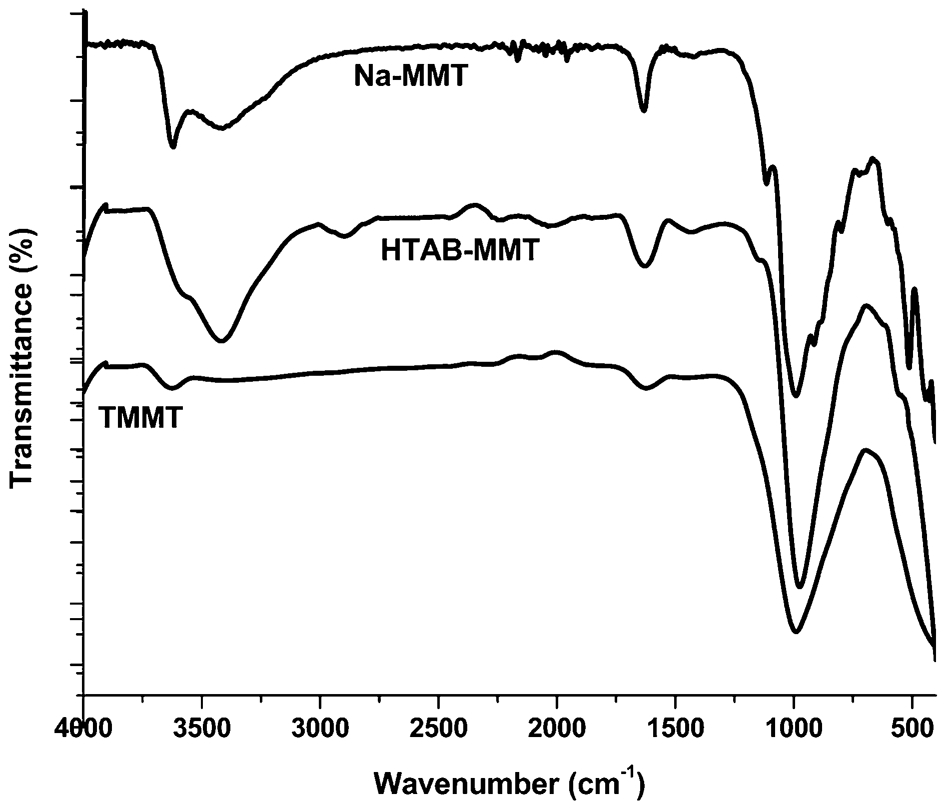
FTIR spectrum of unmodified and modified clay
The absorption band between 3000–3800 cm−1, reveals OH stretching of the structural hydroxyl group and water molecules. In the spectra of HTAB-MMT presence of absorption band at 2925–2850 cm−1 exhibited the CH2 stretching. This was ascribed to the alkyl group incorporated in clay galleries, through HTAB treatment. This confirmed both, the interaction and adsorption of HTAB either on the edges or on the external surfaces of clay layers. 34
However, a diminished absorption band near 3000–3800 cm−1 in the spectra of TMMT was noticed, revealing dehydroxylation of residual water of montmorillonite due to heating. However, the presence of characteristic peaks of montmorillonite revealed the maintained chemical characteristics of clay after thermal exposure above dehydroxylation temperature.
X-ray diffraction analysis (XRD)
Figure 2a represents the XRD spectra of Na-MMT, HTAB-MMT and TMMT. From the spectra it was noticed that the peak corresponding to the intergallery spacing (d001) was almost disappeared, in case of TMMT clay, confirming the exfoliation of TMMT clay layers. This exfoliated morphology is attributed to the steam build up between clay layers, due to extensive heating, which results in, the exfoliation of clay layers in the direction perpendicular to the layers. 35 Hence it can be concluded that TMMT clay does not exhibit any ordered arrangement. This is probably due to the breakdown of the layered structure of clay mineral due to heating above its dehydroxylation temperature.
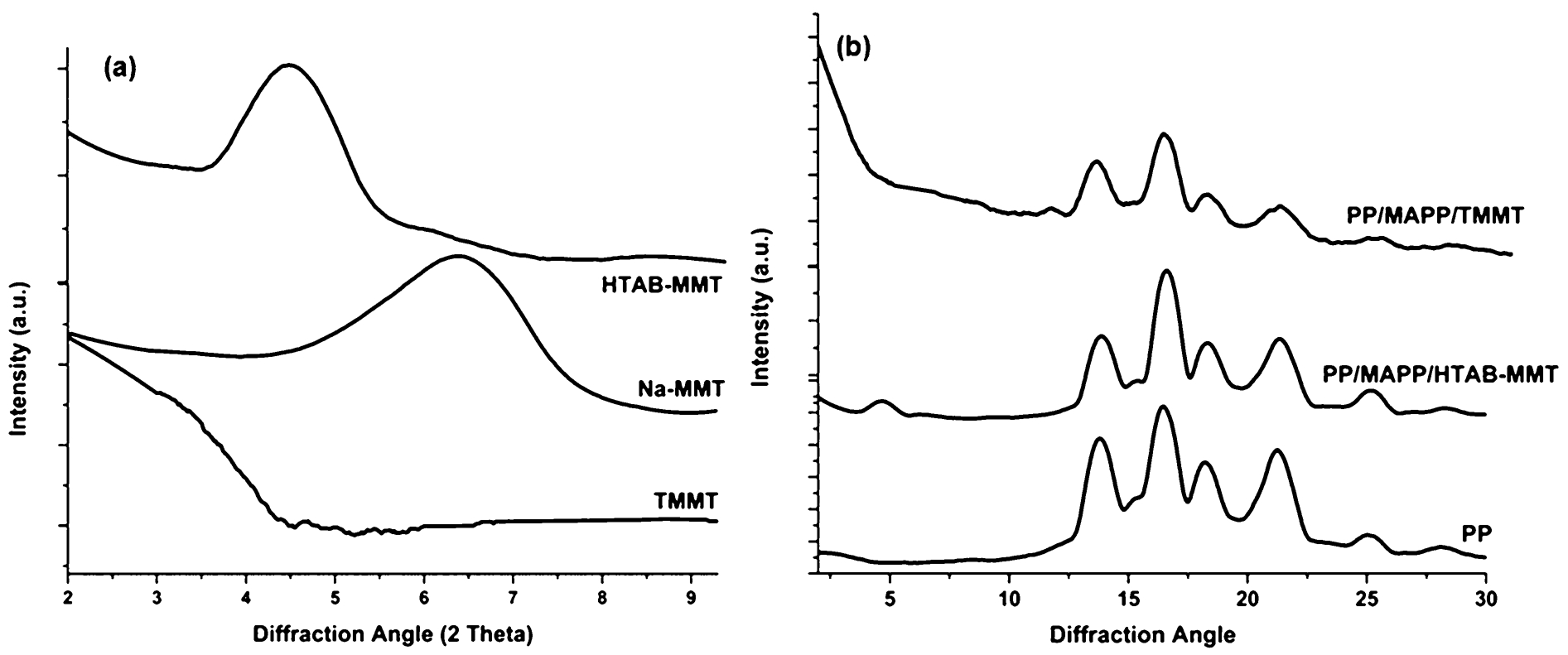
a untreated and treated clay; b PP and its nanocomposites
The fitting of the XRD pattern of the Na-MMT and HTAB-MMT revealed that, there is a shift in the diffraction angle (2θ) value of corresponding d001 peak, after HTAB modification. The intergallery spacing for HTAB treated, clay was found to be 1·96 at corresponding 2θ = 4·69 which was 1·4 nm for Na-MMT at 2θ = 6·5. This increase in the basal spacing might be attributed to the replaced, Na+ ions by C16TMA+ cations, revealing that the efficient interaction between surfactant and clay layers has been achieved. This supports the fact that, the organic modification leads to an increase in interlayer spacing due to the presence of intercalant between the clay platelets. The adsorption of long alkyl quaternary ammonium ions on clay minerals involves at least three reactions: cation exchange; adsorption of ion pairs; and chain–chain interactions. 36 The arrangement and orientation of surfactant, intercalated between clay layers depends strongly on Vander-waal interaction and results in paraffin type arrangement (i.e. bilayered alkyl chain).
However, the comparative aspect of the TMMT and HTAB-MMT exhibited the highest degree of disordered structure in the TMMT. Hence, the relatively higher improvement in the various properties of polymer matrix can be expected after incorporation of TMMT clays.
Further, in order to investigate the morphology and crystalline structure, the XRD diffractogram of the PP and nanocomposites was analysed and represented in Fig. 2b. Wherein, it was noticed that, the corresponding d(001), peak in case of TMMT clay reinforced polymer nanocomposites (PP/MAPP/TMMT) was completely disappeared, revealing the possible exfoliation of clay layers in polymer matrix. 37 This may be a result of strong interaction between polar groups of matrix (PP/MAPP) molecules and unsaturated oxygen present in silicate layers, developed due to dehydroxylation.38, 39 Hence, highly delaminated clay layers of TMMT in PP/MAPP/TMMT nanocomposites were evident.
In case of PP/MAPP/HTAB-MMT nanocomposites, peak corresponding to the basal spacing of the clay galleries (d001) were shifted to lower angle from 2θ = 4·69 (for modified clay) to a 2θ = 3·87 (for clay in nanocomposites) to a corresponding d001 spacing value of 1·96 and 3·8 nm respectively. This clearly indicates that macromolecular chains of polymer, had intercalated into the galleries of HTAB-MMT. This phenomenon might be explained by following two reasons; first the MAPP and PP chains or both, intercalated into the interlayer spacing of the clay. Second, Maleic anhydride grafted PP (MAPP) formed by in situ melt blending played as a compatibiliser between PP and HTAB-MMT by means of the functional group of Maleic anhydride (MA) anchored in the sheet of HTAB-MMT by the strong hydrogen bonding between C = O of MA and –OH groups of the organophillic layer silicate. Further, the non-reactive blocks of the compatibiliser will attempt to gain entropy by pushing the sheets apart under a strong shear field. Hence, the interlayer spacing of clay increases and the interaction among the clay layers is weakened. Therefore, the easy miscibility of PP with MAPP (dispersed at the molecular level) and the exfoliation of the clay takes place.
The slight difference in the intensities of peak α (110) and α (040) was observed for neat PP and both the nanocomposites. However, no shift was noticed in the peak position, indicating the unaffected typical crystalline pattern after incorporation of unmodified and modified clay. Any traces of presence of β crystals were not noticed after incorporation of clay. This result indicates that the crystal type of PP did not change, that is PP remained as a monoclinic crystal type.
Hence, it is noticeable that, the thermal dehydroxylation is a feasible approach towards modification of clay.
Mechanical properties
An investigation of mechanical performance of the PP and its nanocomposites has been carried out to evaluate the effect of clay and clay modification on the mechanical properties polymer matrix. It was noticed that the addition of Na-MMT, results in the slight reduction in the impact strength of PP. This might be attributed to the restricted mobility of the polymer chains due to the agglomeration of the clay particles in the PP matrix. Clay acts a reinforcing agent due to its high aspect ratio and platelet structure, but the agglomeration of clay particles prevents these properties to be utilised in polymer matrix.
Whereas the PP nanocomposites reinforced with, TMMT and HTAB-MMT revealed higher impact strength by 25 and 14% respectively as compared to that of neat PP. In case of PP/MAPP/HTAB-MMT the increase was ascribed to be associated with the functionality of the clay, which promotes the interaction between clay and PP matrix. 40 However, in case of the PP/MAPP/TMMT this improvement might be attributed to the platelet structure and related anisotropy when layers of clay are highly delaminated (exfoliated or intercalated). Hence, in both cases uniform dispersion of clay platelets was achieved.
This in turn supports the nucleating effect of both modified clays, leading to the increase in the interface among spherulites and prevents the development of crack in the matrix, which results in the improvement of the toughness of matrix and leads to improved impact strength. 41 Hence the improved interfacial adhesion could be noticed in the presence of modified clay (HTAB-MMT and TMMT), unlike to unmodified clay (Na-MMT).
In order to evaluate the mechanical performance accurately, tensile properties of the nanocomposites were determined and represented in Table 1. Tensile property such as tensile strength at yield, young's modulus; percentage of elongation at break for PP and its nanocomposites have been investigated. From the tensile stress–strain curve (Fig. 3) the ductile behaviour was observed in all cases. Incorporation of Na-MMT resulted in, decrease in tensile strength of PP matrix. This supported the fact that, no particle–polymer interaction could be achieved in PP/MAPP/Na-MMT nanocomposites. Hence, incoherent nature of clay particle with PP matrix was evident. 42 This leads to the formation of stress concentration effect in some region and leads to the early fracture. Higher young's modulus and tensile strength in case of PP/MAPP/TMMT and PP/MAPP/HTAB-MMT was noticed. This is due to relatively better distribution and delamination of HTAB-MMT and TMMT as compared to Na-MMT. Since, the delamination of nanoscale clay particles in the matrix restricts the mobility of polymer chains under loading.43, 44 Orientation of clay platelets and polymer chains with respect to the loading direction may also contribute to the reinforcement effect. The modulus and tensile strength of PP/MAPP/TMMT was higher than that of PP/MAPP/HTAB-MMT. This is because of randomly dispersed well separated clay platelets in the PP matrix since, the level of delamination of clay layer is responsible factor for improvement in mechanical properties. 45 This can be explained as: the delamination of clay layers leads to the occurrence of high contact area between polymer chain and clays which enables strong interaction between PP (modified with MAPP) chains and clay layers. Hence, from the highest modulus and strength of the PP/MAPP/TMMT nanocomposites as compared to PP/MAPP/HTAB-MMT, relatively more uniform dispersion and exfoliation of TMMT as compared to HTAB-MMT, was evident. This contributes to the improved interfacial stress transfer efficiency and extent of induced deformation in the PP/MAPP/TMMT. 34 Also, as expected compatibiliser acted as a bridge or buffer for the formation of interlock points between polymer chain and clay platelets and resulted in improved material stiffness. 46
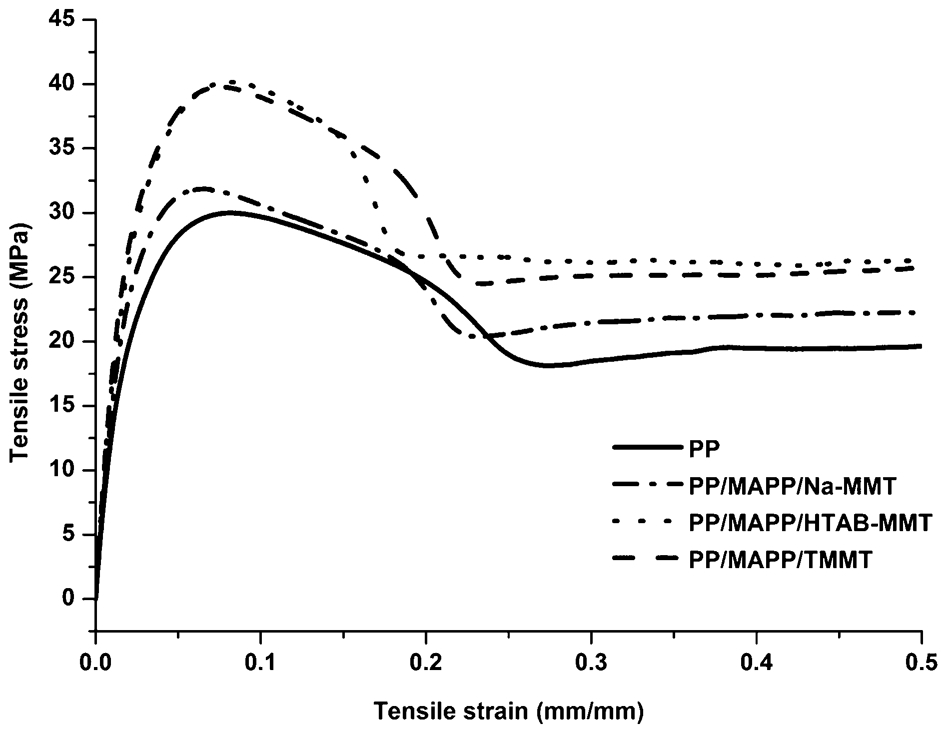
Stress versus strain curve of PP and its nanocomposites
Mechanical properties of PP and its nanocomposites

Further, the elongation at break was found to be lower for all the nanocomposites. This supports the fact that the increase in modulus leads to decreased mechanical ductile nature. However, it is not disadvantageous, since several applications require high stiffness of material and low deformation in order to ensure higher dimensional stability. 43
Based on the mechanical performances, the nanocomposites reinforced with HTAB-MMT and TMMT has been considered for further study.
Dynamic mechanical analysis (DMA)
In order to interpret the unique property variation of PP and its nanocomposites, including melt fluidity, crystallisation habit, thermal stability as well as storage modulus the role of addition of nanofillers on the mobility of PP chains needs to be identified. The DMA is a preferred tool in this context. The storage modulus is related to the stiffness of the material and measures the elastic response of the polymer. The loss modulus denotes the energy dissipated by the system in the form of heat and measures the viscous response of the polymer material. The damping factor (tan δ) is the ratio of the loss modulus to storage modulus. Figure 4a and b represents a variation of storage modulus and loss modulus with respect to temperature. In PP over the entire temperature range; two main mechanical relaxation processes were evident, namely high temp α relaxation, related to the crystalline fraction present and a β process, related to the glass/ rubber transition relaxation. It was noticed that α-relaxation in case of both the nanocomposites (PP/MAPP/HTAB-MMT and PP/MAPP/TMMT) was shifted towards higher temperature as compared to that of neat PP. Further, higher α-relaxation temperature of PP/MAPP/TMMT as compared to PP/MAPP/HTAB-MMT, exhibited the higher surface area of TMMT particles in PP matrix, arising from the relatively finer dispersion of TMMT into the polymer matrix. 47 This might be attributed to the ability of dehydroxylation process, which is able to exfoliate the clay layers due to steam build up in between the clay layers, 35 hence resulting in the relatively more uniform dispersion. This further leads to the relatively much easily transferred applied stresses from matrix onto the TMMT particles. Further, it was also noticed, that in both the nanocomposites (i.e. PP/MAPP/HTAB-MMT and PP/MAPP/TMMT) the curves tend to converge to that of pure PP when approaching the melting temperature of PP. Convergence, at higher temperature reveals the exploitation of both types of fillers as reinforcement for PP.
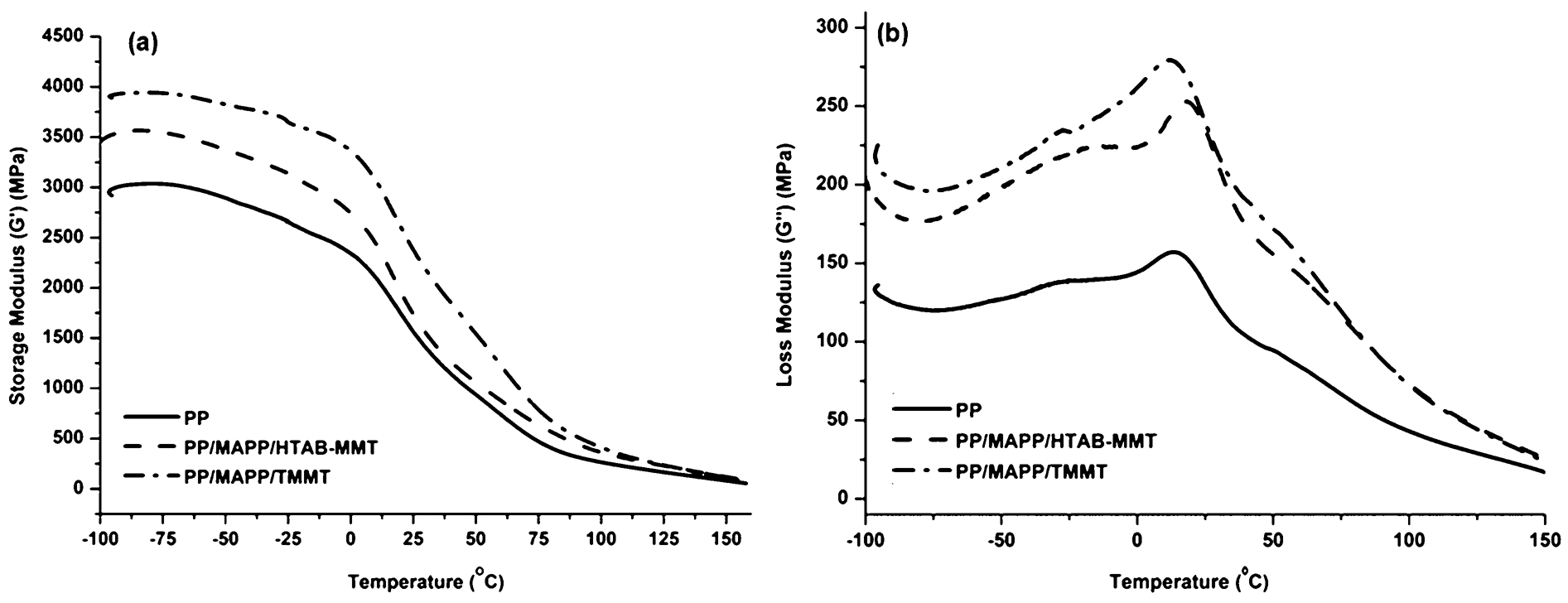
a storage modulus versus temperature; b loss modulus versus temperature
Further, the β relaxation, related to the local motion of amorphous phase, corresponding to the tg of PP was observed at 17°C and there was no further, change could be noticed in that of nanocomposites, revealing the equal level of crystallinity of PP and its nanocomposites. Hence, it is evident that incorporation of HTAB-MMT as well as TMMT, does not alter the relaxation mechanism of macromolecular chains. This may be attributed to the rapid crystallisation of the polymer and thus the anticipated effect of reinforcement is masked.
Figure 5, represents the damping factor of PP and nanocomposites. The damping in the polymeric material is sensitive of segmental mobility of the polymer chains and in nanocomposites, is the indicative of interfacial interaction between the polymer and the filler. Strong interfacial interaction between the polymer and the filler tends to restrict the polymer mobility thereby reducing the damping. The lowest damping factor of PP/MAPP/TMMT as compared to PP/MAPP/HTAB-MMT revealed the relatively strong filler polymer interaction in PP/MAPP/TMMT nanocomposites, which might be attributed to the strong interaction between unsaturated oxygen and polar group of the polymer matrix (PP/MAPP). This in turn increases the steric hindrance of TMMT on the polymer chain mobility.
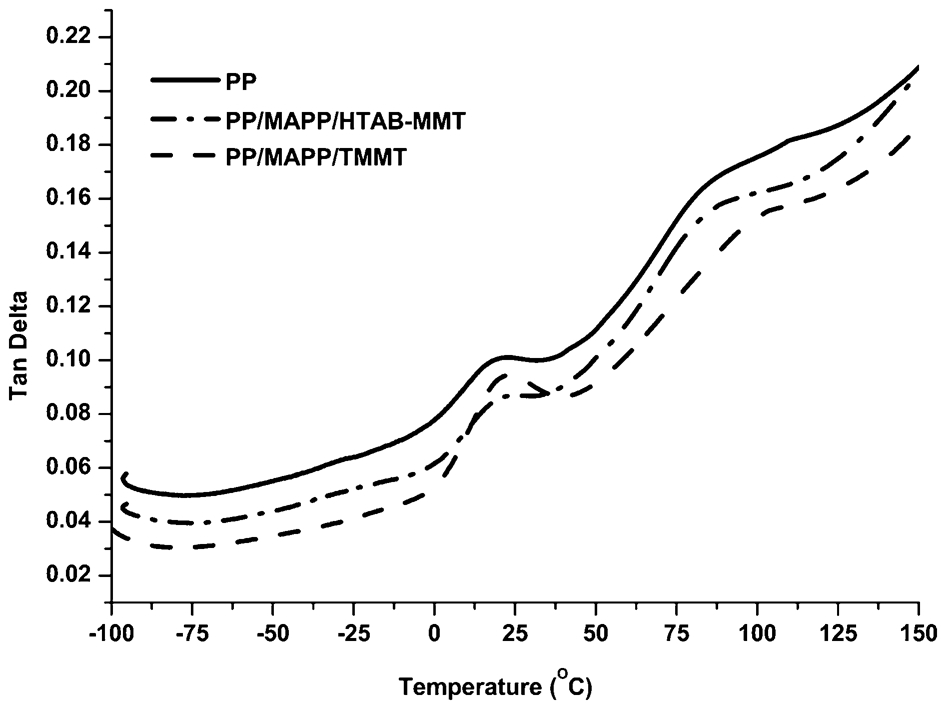
Tan δ versus temperature of PP and its nanocomposites
Thermogravimetric analysis (TGA)
The major purpose of choosing this novel approach (i.e. thermal dehydroxylation), for clay modification, was to improve the thermal stability of the polymer matrix, when exposed to high temperature. TGA is a widely used technique to characterise the thermal stability of polymers. The comparative aspect of the thermal stability of the PP/MAPP/HTAB-MMT and PP/MAPP/TMMT has been established. Figure 6 represents the TGA curve of PP and its nanocomposites.
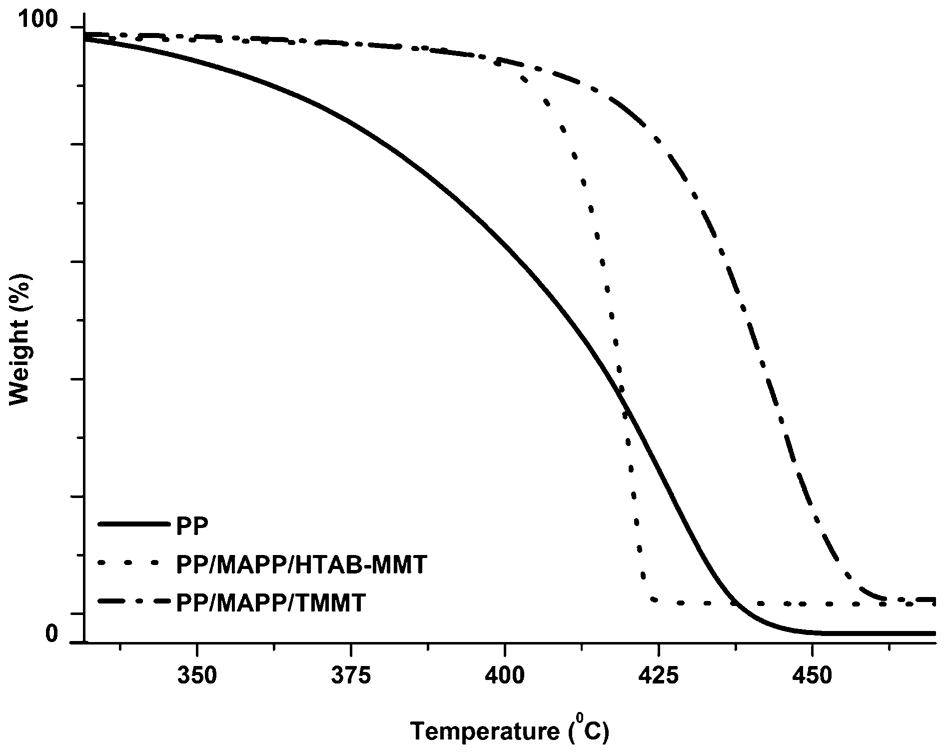
TGA weight loss curve of PP and its nanocomposites
The degradation temperature at different stages has been observed and reported in Table 2. The different temperature, which has been reported is Td(0·1), temperature for 10% weight loss; Td(0·5), temperature for 50% weight loss; Td(0·95), temperature for 95% weight loss; Td(onset), onset temperature for degradation; Td(end), onset temperature for degradation; Td(max), peak temperature for the degradation.
Thermal degradation temperature of PP and its nanocomposites

The values of Td(0·1) and Td(0·5) represents the initial thermal stability, of the material. In case of PP/MAPP/HTAB-MMT, value of Td(0·1) and Td(0·5), was found slightly higher than that of neat PP, revealing the reinforcing effect of HTAB-MMT on polymer. The similar effect has been reported earlier. 48 Similarly the increase in the Td(onset) was also noticed as compared to that of neat PP. However, these increases in the initial thermal degradation temperatures [Td(0·1), Td(0·5), Td(onset)] were not remarkable.
In case of PP/MAPP/TMMT, the increase in the Td(0·1), Td(0·5) and Td(onset) as compared to neat PP, was considerably higher, indicating the higher reinforcing effect of the TMMT, due to a relatively greater degree of exfoliation of nanolayers in the polymer matrix. This might be attributed to the fact that due to heating above dehydroxylation temperature, water molecules present in between the clay layers push the clay layers apart, in order to leave the intergallery space, 35 and therefore results in the delamination of clay layers to the extent of exfoliation.
Further, a decrease in the Td(0·95) and Td(end) was noticed in the case of PP/MAPP/HTAB-MMT as compared to that of neat PP. This supports the fact that, clay act as nucleating agents for thermal decomposition, since it is believed to aid heterogeneous nucleation thus bringing forward the degradation of the polypropylene. 49 This is due to decomposition of organic salt via Hoffman degradation reaction, resulting in the yield an amine and an alpha Olefin. 50 This also corroborates the previously mentioned fact of transformation of nanocomposites to microcomposites and loss of nanocomposites properties,6, 7 hence, exhibiting the limitation of organophillic clay for nanocomposite applications.
However, in case of PP/MAPP/TMMT nanocomposites, much enhanced Td(0·95) and Td(end) as compared to neat PP was evident from the Table 2. This might be due to the thermal stability of the TMMT at higher temperature, due to its thermo-insulating behaviour; arising from the extensive thermal exposure. 35 This is ascribed to the absence of factor i.e. an organic compound, which leads to the Hoffman elimination in case of organophillic clay reinforced nanocomposites. Another important factor, responsible for the degradation of clays is the residual water present in intergallery spacing. 51 However, in this case the TMMT clay is devoid of residual water, since it is dehydroxylated at higher temperature. Hence the absence of several factors responsible for degradation of clay and polymer/clay nanocomposites led to the thermal stability of PP/MAPP/TMMT at high temperature.
Further unlike PP/MAPP/HTAB-MMT, the degradation temperature of maximum weight loss [Td(max)] of the PP/MAPP/TMMT nanocomposites was noticeably higher as compared to that of neat PP. This again supports the greater thermal stability of the TMMT clay at higher temperature, due thermo-insulating properties, achieved via thermal dehydroxylation of the clay. 35
Further, it is worth mentioning that, the thermal stability difference of PP/MAPP/HTAB-MMT and PP/MAPP/TMMT is also attributed to the presence of Fe3+ ion in the clays. In case of the PP/MAPP/HTAB-MMT, Fe3+ ion, catalytically enable the oxidative cleavage of alkene substituents in ammonium compounds to produce aldehydes at elevated temperature, However, in case of PP/MAPP/TMMT, Fe3+ ion is supposed to act as an operative site for radical trapping during degradation, 25 since there is no organic compound present in TMMT.
Further, in order to investigate the thermal stability of PP and its nanocomposites, the activation energy of the materials has been calculated according the integral kinetic equation of Horowitz–Metzger equation method (equation (1))
19


The calculated, values of the activation energy for PP/MAPP/HTAB-MMT and PP/MAPP/MMT was 103 and 115 kJ m−2 respectively which was greater than that of neat PP (having activation energy of 90 kJ m−2). Hence, from this observation, it was depicted that, the thermal stability of the PP/MAPP/TMMT nanocomposites is remarkably greater as compared to that of PP/MAPP/HTAB-MMT nanocomposites and neat PP.
Rheological measurement
Thermal stability of the nanocomposites depends on the networked structure/morphology, which in turn is exhibited by the change in visco-elastic properties. Hence the rheological assessment has been carried out to correlate the observations obtained from TGA analysis with the morphology of the nanocomposites. Determination of linear visco-elastic region (LVR) is essential to confirm that, the shear alignment has no effect on the microstructure of materials. Hence, the relation between storage modulus and strain of PP and its nanocomposites has been established through the strain sweep test, before commencing the frequency sweep run. From the curve of storage modulus and strain % the range of linear visco-elasticity was determined for the PP to evaluate the rheological characteristics at different frequency in linear visco-elastic region. The storage modulus exhibited a linear relationship with strain % up to 0·1%, after that the non-linearity was observed.
The frequency dependent visco-elastic behaviour was investigated at a strain of 0·01% in LVR, in order to investigate the microstructural variations in materials. Figure 7 represents the cole–cole plot of the PP and its nanocomposites. The miscibility of PP and clay could be analysed by cole–cole plot of the rheological data, which represents a relationship between real and imaginary parts of complex viscosity. In case of both the nanocomposites (i.e. PP/MAPP/HTAB-MMT and PP/MAPP/TMMT), a smooth, semicircular shape of the plotted curves represented good compatibility, i.e. phase homogeneity in the melt. This led to the considerable change in structure, mostly to the extent of exfoliation. Hence, in case of both the nanocomposites, presence of delaminated morphology was confirmed, which is the basic desirable property of polymer nanocomposites.
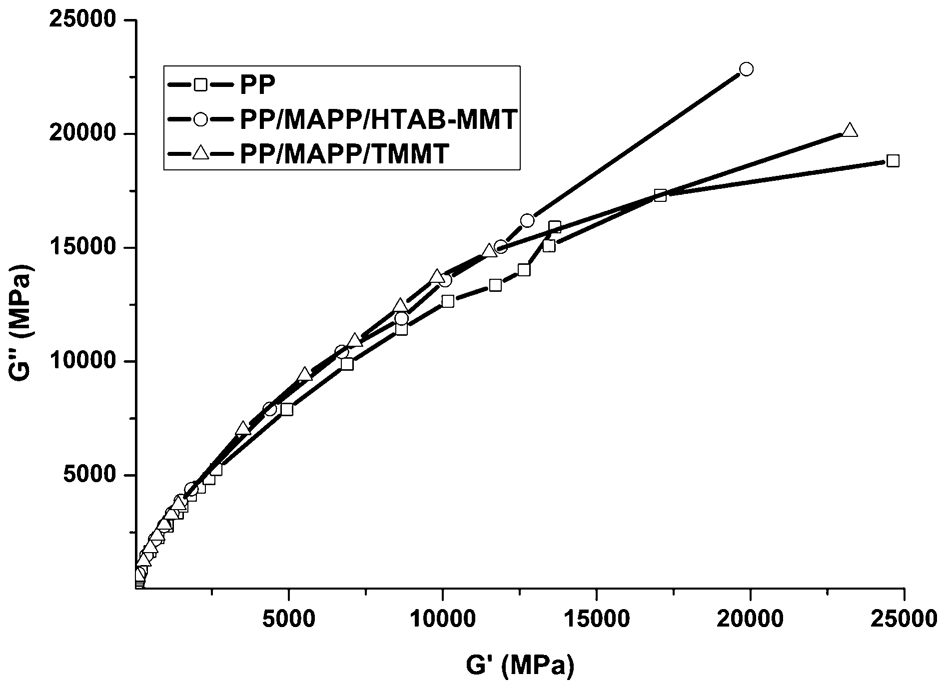
Cole–cole plot of PP and its nanocomposites
The relation between complex viscosity and frequency is represented in Fig. 8a. The complex viscosity revealed a decreasing trend with an increase in the frequency and similar observation was evident for both the nanocomposites. A non-Newtonian behaviour of PP and its nanocomposites in the low frequency region was observed, which indicated the transformation from solid like to liquid like behaviour 52 with an increase in the frequency. Further, the nanocomposites exhibited higher complex viscosities, as compared to neat PP wherein PP/MAPP/TMMT has shown highest viscosities, over the applied frequency region. In case of PP/MAPP/HTAB-MMT, this is a result of exchanging interlayer's inorganic clay cations with organic cations, resulting in strong interaction between polymer chains and clay platelets. However, in case of PP/MAPP/TMMT the higher degree of exfoliation might be a result of increased surface tension between clay platelets of TMMT and polar matrix polymer (PP modified with MAPP). The higher viscosity of PP/MAPP/TMMT as compared to the PP/MAPP/HTAB-MMT was ascribed to the formation of more intense percolated filler network structure in case of PP/MAPP/TMMT, resisting the flow. This further revealed the more uniform dispersion of clay platelets and exfoliated morphology in PP/MAPP/TMMT, as compared to the PP/MAPP/HTAB-MMT. Hence, it can be assumed that, the surface tension between clay and polymer plays strong role in the dispersion of nanoplatelets, as compared to chemical interaction.
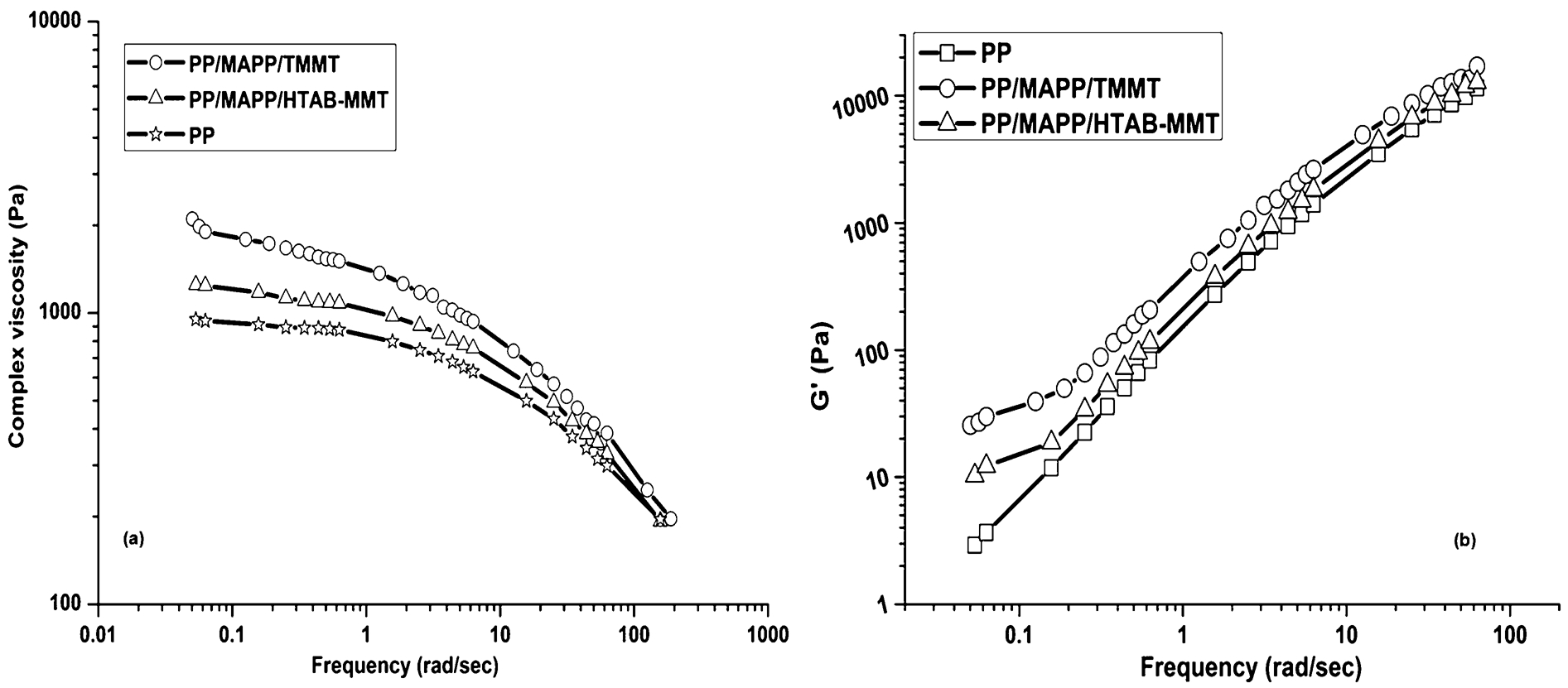
a complex viscosity versus frequency; b storage modulus versus frequency
Further, due to random orientation and entangled molecular chains an early and strong shear thinning behaviour was observed in case of both the nanocomposites as compared to neat PP. Subsequently, at higher frequency, an increased shear thinning behaviour was observed, which is probably due to breakdown of network structure due to shear. More distinct shear thinning behaviour in case of PP/MAPP/TMMT as compared to PP/MAPP/HTAB-MMT revealed better nano-dispersion with exfoliated morphology and strong filler–polymer interaction, in the previous one.
Figure 8b represented the relationship between storage modulus (G’) and frequency (ω). There was not much difference in G’ of PP and its nanocomposites, in the high frequency regime, revealing that movement of partial polymer chains is not affected by the addition of clay.
However, a higher G’ value of both the nanocomposites as compared to neat PP, in the low frequency region was evident. A second plateau was appeared in the low frequency regime between 0·1 to 1 rad s−1 in case of nanocomposites, indicating that nanocomposites sample relaxes at short time scale. The nature of the second plateau of the PP/MAPP/HTAB-MMT and PP/MAPP/TMMT indicated the high degree of exfoliation in later one.53, 35 The reduced slope of G’ versus ω curve in case of nanocomposites as compared to neat PP, indicates that a percolated filler network has been established, leading to the restricted free movement of PP chains, due to spatially confined geometry. Further, the minimal value of the terminal slope of G’ versus ω was noticed in the PP/MAPP/TMMT nanocomposites, indicating most intact percolated networked structure, has been created in it. 49
At a frequency approximately 0·01 Hz the storage modulus (G’) for PP/MAPP/HATB-MMT and PP/MAPP/TMMT was observed as 12 and 17% higher than neat PP as shown in Table 3. This can be ascribed to strong clay–polymer interaction leading to nanodispersion of delaminated clay layers. This results in the formation of physical network structure in nanocomposites. Hence, from the highest G’ value of PP/MAPP/TMMT, it was evident that the physical networked structure of PP/MAPP/TMMT is much more confined as compared to PP/MAPP/HTAB-MMT. This was in accordance with our previous observations
Complex viscosity, viscosity ratio, crossover frequency and relaxation time of pp and its nanocomposites

The, loss modulus versus frequency relation, as represented in Fig. 9a was found similar as storage modulus. It was depicted that all the systems of PP and its nanocomposites followed the trend G′>G″ in the low frequency range, which indicated that the properties of materials were reflected by G’ versus ω more sensitively.
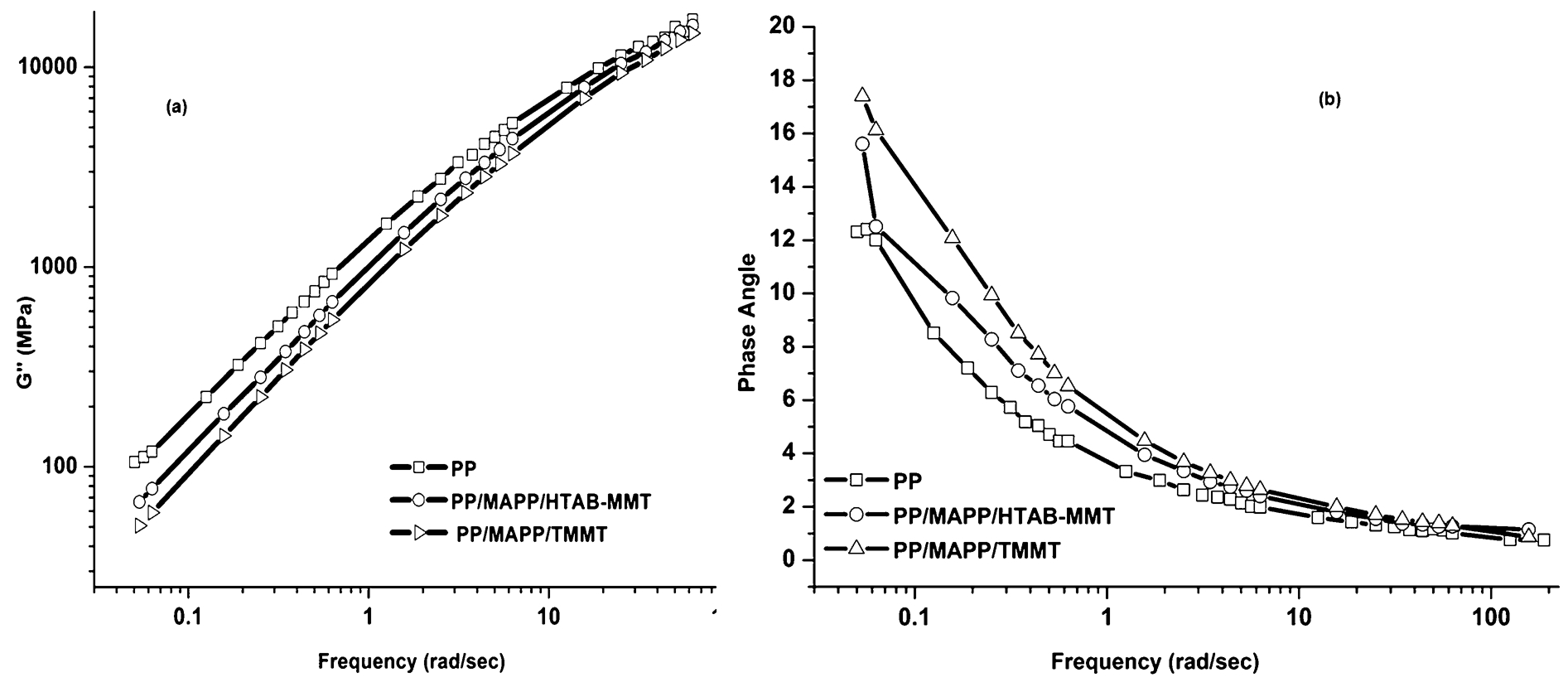
a loss modulus versus frequency; b phase angle versus frequency
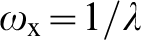
However, after certain point (i.e. cross over frequency) reversed relation (i.e. G″>G′) was seen, revealing the visco-elastic liquid like behaviour of the materials. This was ascribed to disentangled polymer chains oriented in flow direction. The crossover frequency (ω
x
) was, calculated using equations (2) and (3), have been reported in Table 3

In all the cases quicker increase in G’ as compared to increase in G’’, resulted in reduced phase angle. The continuous drop in the phase angle indicated a gradual increase in liquid-like behaviour of the melt, with an increase in the value of applied frequency in case of PP and both the nanocomposites. The phase angle vs ω is represented in Fig. 9b.
Hence, it can be concluded that modification of the clays via thermal dehydroxylation can be used as an efficient alternative for the alkyl ammonium salt modification, in order to achieve the synergism between clays and polymer matrix.
Transmission electron microscope (TEM)
In order to correlate the morphological results obtained by rheological analysis, the transmission electron microscopic images of the nanocomposites have been analysed. The TEM micrographs of PP/MAPP/HTAB-MMT and PP/MAPP/TMMT are depicted in Fig. 10. The clay particles in the micrographs are indicated by dark areas and the grey region represents the continuous PP matrix. TEM micrographs of the PP/MAPP/HTAB-MMT nanocomposites revealed the mixed morphology of intercalated and exfoliated clay galleries.
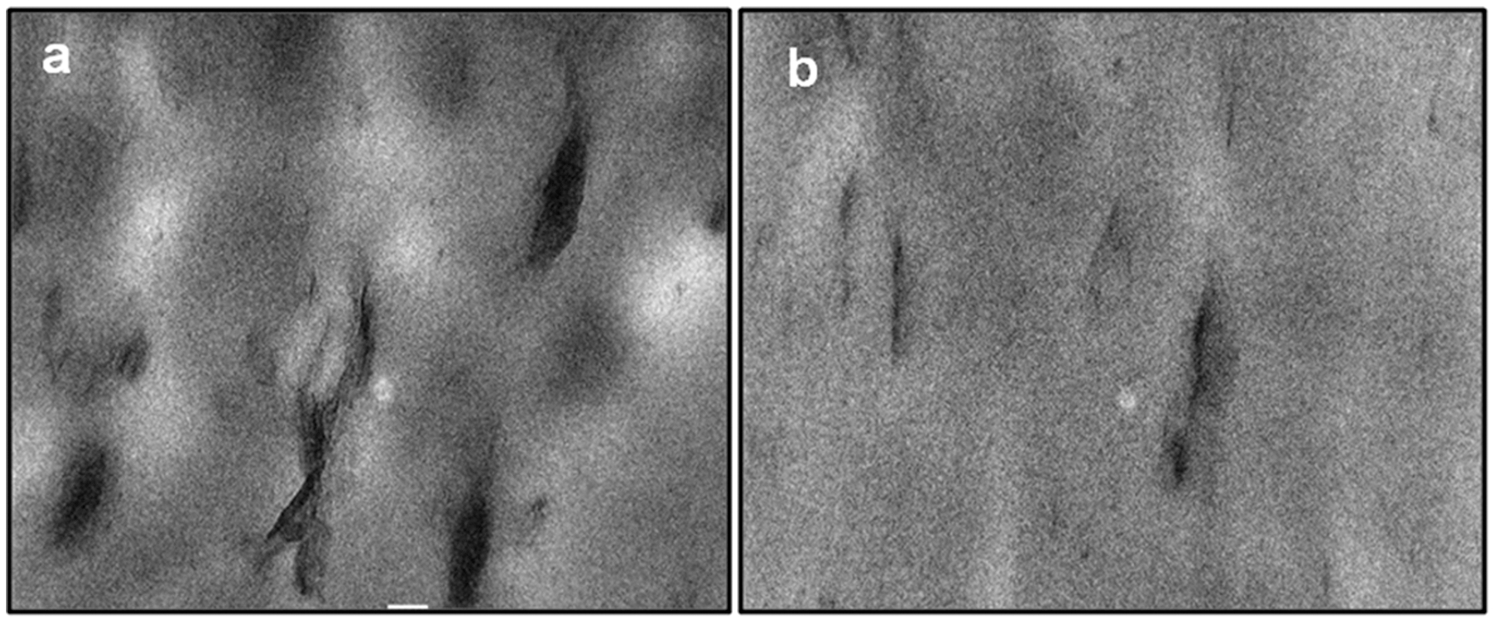
Images (TEM) of PP/MAPP/HTAB-MMT and PP/MAPP/TMMT
On the contrary, TMMT, reinforced nanocomposite revealed more uniform dispersion of the clay layers in the PP matrix as compared to the HTAB-MMT reinforced nanocomposite. A higher degree of exfoliation could be observed in PP/MAPP/TMMT. This phenomenon is attributed to the improved interaction of clay layers and polymer matrix which facilitated the separation of clay stacks from each other thereby resulting in homogenous distribution within the polymer matrix.
Conclusions
A novel modification method via thermal dehydroxylation has been established, as an alternative to organophillic modification of clay. Wherein, it was found that the exfoliation of clay layers can be carried out without incorporation of an organic compound. FTIR analysis revealed the maintained chemical structure of the clay after extensive thermal exposure. The XRD pattern of the clay exhibited the highest degree of delamination of TMMT as compared to HTAB-MMT and Na-MMT, revealing the possibility of relatively easy dispersion of TMMT in the polymer matrix. Relatively much enhanced mechanical properties of the nanocomposites were achieved in the case of PP/MAPP/TMMT as observed from tensile and dynamic mechanical analysis. Much improved thermal stability of the PP/MAPP/TMMT as compared to neat PP and PP/MAPP/HTAB-MMT was evident from the TGA analysis. The microstructural analysis of PP and its nanocomposites, evaluated using rheological performance, revealed relatively more intact network structure in PP/MAPP/TMMT as compared to PP/MAPP/HTAB-MMT. Also the increased solid like behaviour was evident from the rheological assessment. The high storage modulus of the PP/MAPP/TMMT than PP/MAPP/HTAB-MMT indicated the highly exfoliated morphology in the previous one. Further, it was confirmed from TEM micrographs.
Hence, it was concluded that the thermal treatment of the clays may be a useful alternative towards modification of clays for polymer nanocomposite application, with the improved thermal, mechanical, dynamic mechanical and morphological characteristics.