






Abstract
Partial replacement of carbon black (CB) by organically modified montmorillonite (OMMT) in bladder compounds and synergistic effect between OMMT and CB on required properties were studied. X-ray diffraction results revealed intercalation of rubber into OMMT galleries. Mechanical interaction between rubber and filler, mechanical stability in oxidative aging, resistance to permanent set, reduction in permeation to CO2, and resistance to thermal degradation were all in favour of clay containing composites, especially the compound with 45 phr CB and 4 phr OMMT.
Keywords
Introduction
There are extensive worldwide efforts to apply nanofillers for production of polymeric composites with specific characteristics. Polymer nanocomposites are materials with nanometric dispersion of fillers in a polymer matrix. The filler phase may impart required properties that could not be achieved by the neat polymer. There are several techniques used for dispersing nanofillers in a polymer, including addition of the nanofillers during polymerisation (in situ polymerisation) 1 , to a solvated polymer 2 , to a melted polymer3, 4, or to a co-coagulating rubber latex.5, 6 The most practical mixing method employed in the rubber industry is melt mixing. There has been extensive attention to the application of nanoclays in polymer composites prepared by melt mixing. Montmorillonite (MMT) is one of the nanoclays with large specific surface area (750–800 m2 g− 1) and high aspect ratio (lateral dimensions of these layers may vary from 30 nm to several micrometres or larger and a layer thickness ∼0.96 nm).7, 8 Clay containing polymer nanocomposites offer several advantages over the classical composites. The main improvements are in mechanical properties 9 , heat and flame resistance 10 , dimensional stability 11 , barrier properties12–14 and thermal stability.14, 15 These advantages are achieved with low clay loading, typically in the range of 3–5 wt-%, leading to lower weight of the product. In order to have significant reinforcing effect of nanoclays in the rubber matrix, the silicate layers have been modified to render them organophilic nature. Application of MMT modified by different types of modifiers and its effects on physical–mechanical properties of butyl based nanocomposites were studied in our previous work. 16 MMT clay modified by dimethyl-benzyl hydrogenated tallow, quaternary ammonium, commercially known as Cloisite10A, was chosen as the most efficient reinforcing clay in butyl based rubber compounds. 16
Tire curing bladders are normally made of butyl rubber and reinforced by carbon black (CB) as the active filler. Curing bladders are used as a heat transfer and shaping medium during curing of tires. In their service life, bladders are exposed to severe conditions such as high temperature, high pressure, medium-large extensions and oxidative aging. Therefore, performance requirements of the curing bladders include low permeability to gases and vapour, low permanent set, high heat stability, high tensile strength, and low oxidative aging. The unique properties imparted by OMMT to rubber composites have encouraged researchers to develop CB–clay hybrid nanocomposites via partial replacement of CB by OMMT without affecting the critical performance properties. Synergistic effects of clay in application with other fillers such as CB have been reported. 17
The objective of the present work is to introduce already chosen type of OMMT to common bladder compounds and study the possibility of partial replacement of CB by this filler through evaluating required performances such as mechanical properties and their stability in oxidative aging, resistance to permanent set, resistance to gas permeation, and stability in thermal degradation. The results are discussed in terms of dispersion and interaction of this nanoclay with butyl rubber enhancing the required properties.
Experimental
Materials and methods
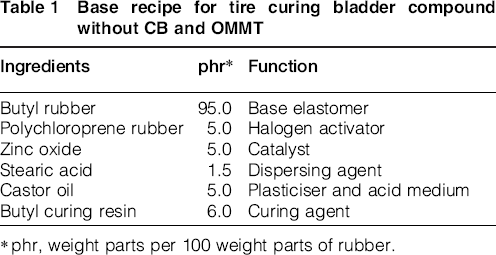
Butyl rubber (Butyl 301, Bayer, Germany), polychloroprene (Baypren 210, Bayer, Germany), zinc oxide (ZnO, Pars Techno, Iran), stearic acid (Palmac1600, Acidchem, Malaysia), phenolic resin (methyl phenol, SP1045, Schenectady, USA), CB (N-220, Ahvaz CB Co., Iran) and castor oil (Pars Oil Co., Iran) were mixed according to the recipe given in Table 1 with 45 or 55 phr CB and with or without 4 phr Cloisite 10A OMMT supplied by Southern Clay Products Inc., USA.
Base recipe for tire curing bladder compound without CB and OMMT
phr, weight parts per 100 weight parts of rubber.
This type of OMMT was selected based on our previous findings about the most compatible one for butyl based compounds. 16
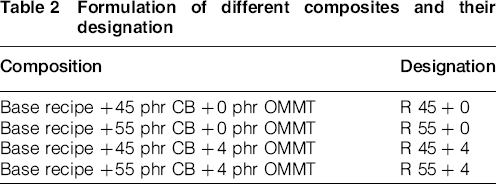
Table 2 reports various compositions used for this investigation and their designations. R 55+0, a typical butyl rubber compound currently used for curing bladders in the tire industry, is the reference compound.
Formulation of different composites and their designation
Melt intercalation mixing method was employed for compound preparation. At first, butyl and polychloroprene rubbers were melt blended in an internal mixer type Brabender WEHT50 at 60 rev min− 1 for ∼5 min at a temperature of 140°C. Then, organoclay, CB, stearic acid and castor oil were added to the mixture on a laboratory two-roll mixing mill Brabender series 835800 with a friction ratio of 1:1.4 and speed of 15 rev min− 1. To avoid thermal degradation of the organic modifier, maximum processing temperature was chosen as 140°C. 18 After 24 h, curing agents were added to the mixture on the laboratory two-roll mill. Vulcanisation characteristics were obtained by Gotech rheometer at 190°C. Rubber samples were vulcanised in an electrically heated hydraulic press at their optimum cure obtained from the rheometer. X-ray diffraction (XRD) in a scan range of 2θ = 1–10° by a Philips X-Pert Pro diffractometer (λ = 1.5418 A) was used to measure the basal spacing of the OMMT before and after mixing with rubber. To evaluate the heat resistance of the vulcanised specimens at various aging times, ASTM D573 test method was adopted. Mechanical properties in tension were studied by an Instron series 5565 uniaxial tensile machine, according to the standard ASTM D412 (three specimens from each sample). Shore-A hardness was measured by a Zwick hardness tester according to the standard ASTM D2240 (three specimens from each sample). Dynamic–mechanical–thermal analysis (DMTA) was performed on the samples in a temperature sweep from ( − 100 to +150°C at a heating rate of 5°C min− 1, frequency of 1 Hz, and strain of 0.2% in a single cantilever bending mode using DMA-Triton, Tritec 2000. Specimens for testing tension set were cut from the vulcanised sheets. Specimens were fixed longitudinally between two clamps according to ASTM D412 and then prestretched to 20% strain in a hot air oven at 110°C for 24, 48 and 72 h at atmospheric pressure according to ASTM D573. Measurements were performed 30 min after samples were released from clamps (three specimens from each sample). Compression set at various aging times was measured using vulcanised cylindrical specimens, clamped longitudinally between two plates according to ASTM D395 (type 2), and then prestrained to 20% compression in a hot air oven at 110°C for 24, 48 and 72 h at atmospheric pressure according to ASTM D573. Measurements were done 30 min after release of samples from pressure (three specimens from each sample). Permeability of vulcanised samples to CO2 gas was performed using permeability test set-up. CO2 was chosen due to its availability and safety compared to other gases. Heat resistance was studied by a polymer laboratory series 1500 thermogravimetric analysis (TGA) in a temperature sweep from room temperature to +600°C at heating rate of 10°C min− 1.
Results and discussion
Vulcanisation characteristics
Vulcanisation characteristics of the rubber composites prepared with different CB content with or without OMMT are shown in Table 3. Minimum and maximum torques for all samples increase as OMMT is added to the butyl-CB compounds. This shows the reinforcing effect of this filler in the rubber compounds. In addition, scorch and optimum cure times are longer when OMMT is present in the compound compared to the same compounds without OMMT. This phenomenon was observed in our previous works when OMMTs were added to butyl rubber compounds without any CB.16, 19 Diffusion limitations introduced by inclusion of MMT platelets was considered as the main physical barrier (confirmed by permeability test in next sections), reducing the accessibility of vulcanisation agents to already limited double bonds in butyl rubber. This physical effect bypasses the chemical effect of amine groups of OMMT in accelerating vulcanisation process of butyl rubber, contrary to what has been seen in other rubbers with large number of double bonds. 20
Cure characteristics of composites

Evaluation of degree of intercalation by XRD
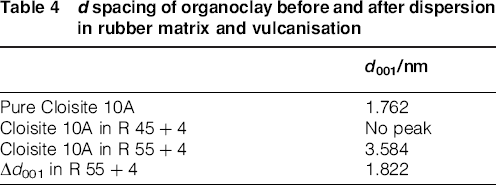
Intercalation of rubber into layer spacing of the silicate platelets was studied by XRD according to Bragg's law 18 . Figure 1 compares the X-ray diffractograms of vulcanised nanoclay containing composites with pure OMMT (Cloisite 10A). As seen in this figure, intercalation of rubber into the layers of the silicate galleries led to increase in d spacing of these layers and shifted or eliminated the position of (001) peaks. The d spacing of the OMMT and its change after dispersing into the rubber matrix are summarised in Table 4. The shift of the (001) peak to lower angles for R 55+4 and its elimination for R 45+4 reveal intercalation of rubber into the clay galleries. As has been mentioned by other researchers 21 and discussed in our previous works16, 19, there is no considerable exfoliated structure of OMMT in melt mixing of rubber compounds. Elimination of the peak for R 45+4 must be due to loss of parallel configuration in intercalated layers (disordered intercalated case).16, 19 These results show that the presence of 45 phr CB in the compound is more effective in intercalation of rubber in clay galleries than increasing amount of CB to 55 phr. Therefore, partial replacement of CB by OMMT seems more advantageous than adding OMMT to original bladder compound in terms of intercalated structure of this nanoclay.
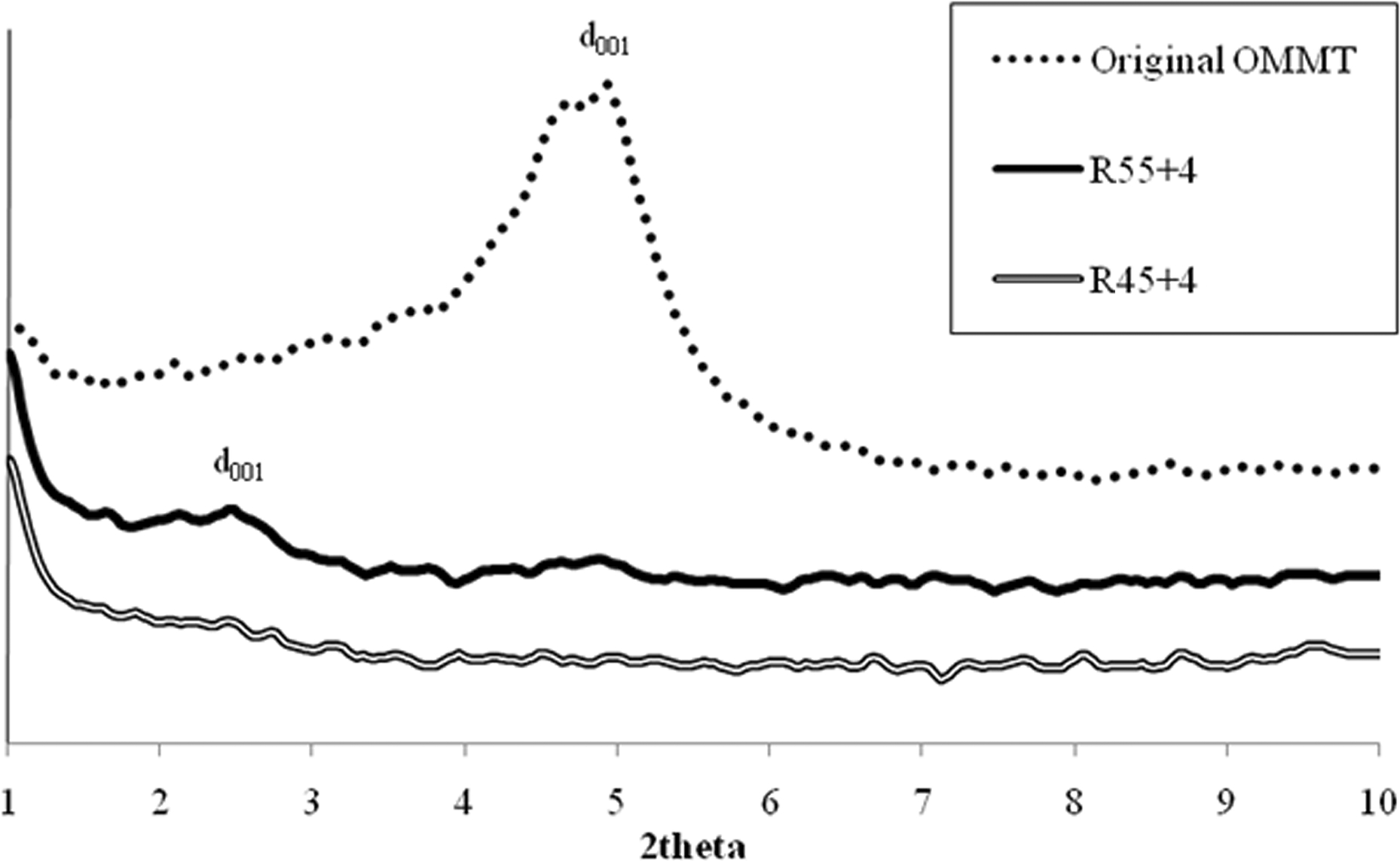
X-ray diffractograms of nano-OMMT containing butyl rubber after vulcanisation
d spacing of organoclay before and after dispersion in rubber matrix and vulcanisation
Dynamics of rubber by DMTA
Interaction between rubber and fillers was studied by dynamic–mechanical properties of the vulcanised compounds in a temperature sweep. Figure 2 shows the loss factor (tan δ) as a function of temperature for all of the composites. The magnitude and position of tan δ peak are summarised in Table 5. Rubber immobilises in the vicinity of active filler or in confinement generated by the filler network. 22 Reduction in magnitude of peak tan δ is quantitatively related to reduction of free rubber as a result of immobilisation in the presence of fillers. Results in Fig. 2 and Table 5 show that both fillers are active in immobilising rubber, but 4 phr OMMT has similar or even higher effect than 10 phr CB in this regard. This synergistic effect can be attributed to closer packing of filler particles, as nanoclay occupies the free spaces between CB clusters. The shift in peak tan δ to higher temperatures is related to the quality of immobilisation, or how stiff the immobilised rubber has become. Increasing CB from 45 to 55 phr does not shift this peak much, whereas addition of 4 phr nanoclay alters the dynamics of rubber and shifts the peak to higher temperatures, as given in Table 5. Other than the reinforcing ability of OMMT in butyl rubber, this can be attributed to synergistic effect of CB and OMMT in improving dispersion of fillers, closer packing and shorter interparticle distances, and thus enhancing confinement of rubber as glassy bridges between filler particles. 23 Synergistic effects of nanoclay with CB in styrene butadiene rubber matrix have previously been reported. 17
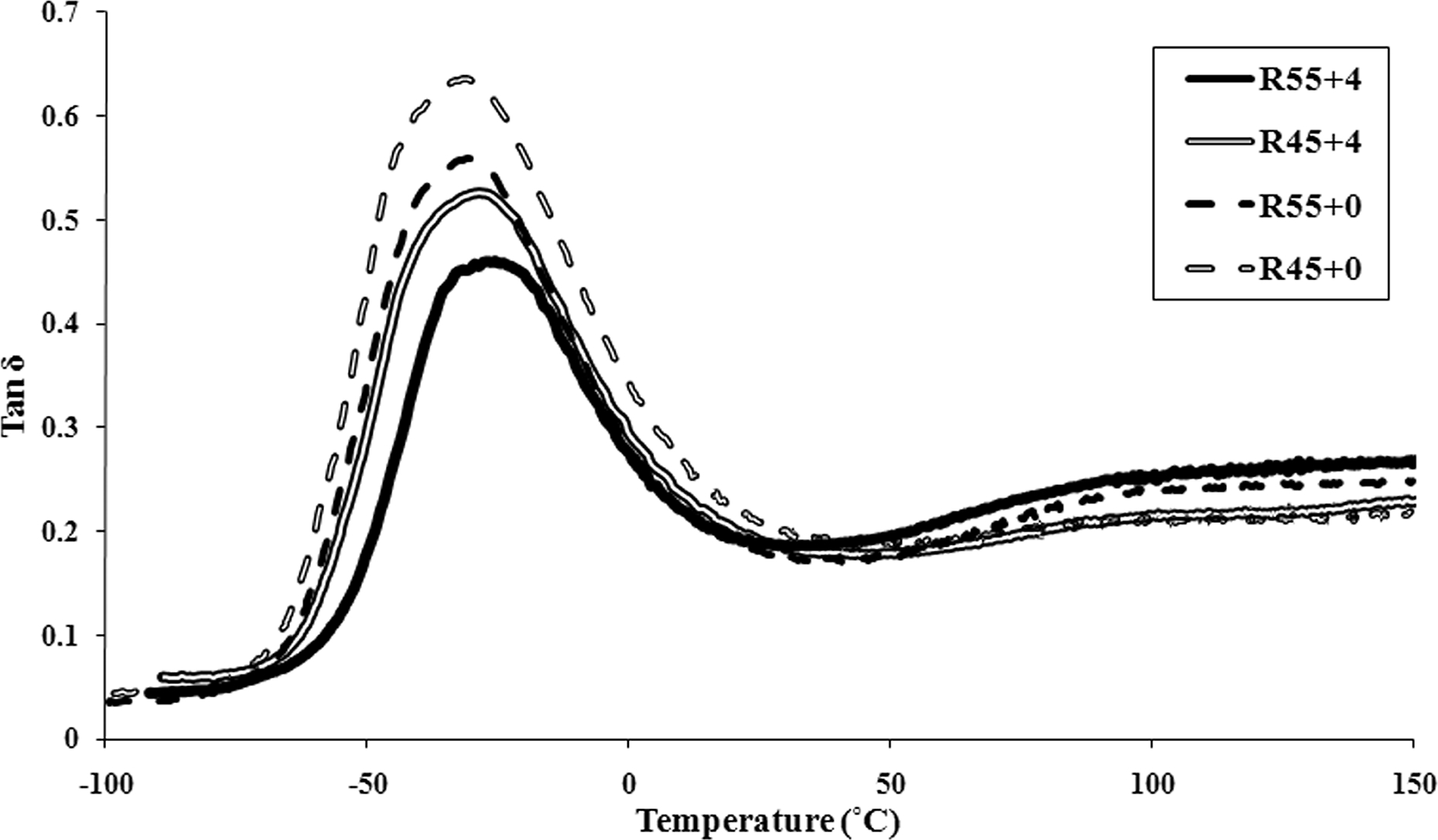
Tan δ for composites in temperature sweep
Magnitude and position of peak tan δ and magnitude of storage modulus at 25°C for composites

The storage modulus as a function of temperature for all of the composites is plotted in Fig. 3. The values of storage modulus in the rubbery region, as shown in the magnified graph, again show the synergistic effect of nanoclay in increasing these values. The magnitude of storage modulus at 25°C for the composites is shown in Table 5. In addition, OMMT has high aspect ratio compared to CB; therefore, it contributes in higher modulus of R 45+4 containing 4 phr OMMT than that of R 55+0 with 10 phr more CB over the whole range of temperature. The mechanical response of these composites in the high temperature (or low frequency) region is dominated by dynamics of the filler network, and the impact of the filler network with thermally activated filler–filler bonds can be deduced from the slope of the storage modulus versus temperature. 23 As a result of adding more filler, this slope, which has been correlated to thermal activation energy of the network, increases. Strong effect of nanoclay and its synergistic effect with CB in R 45+4 can be observed in this case too.
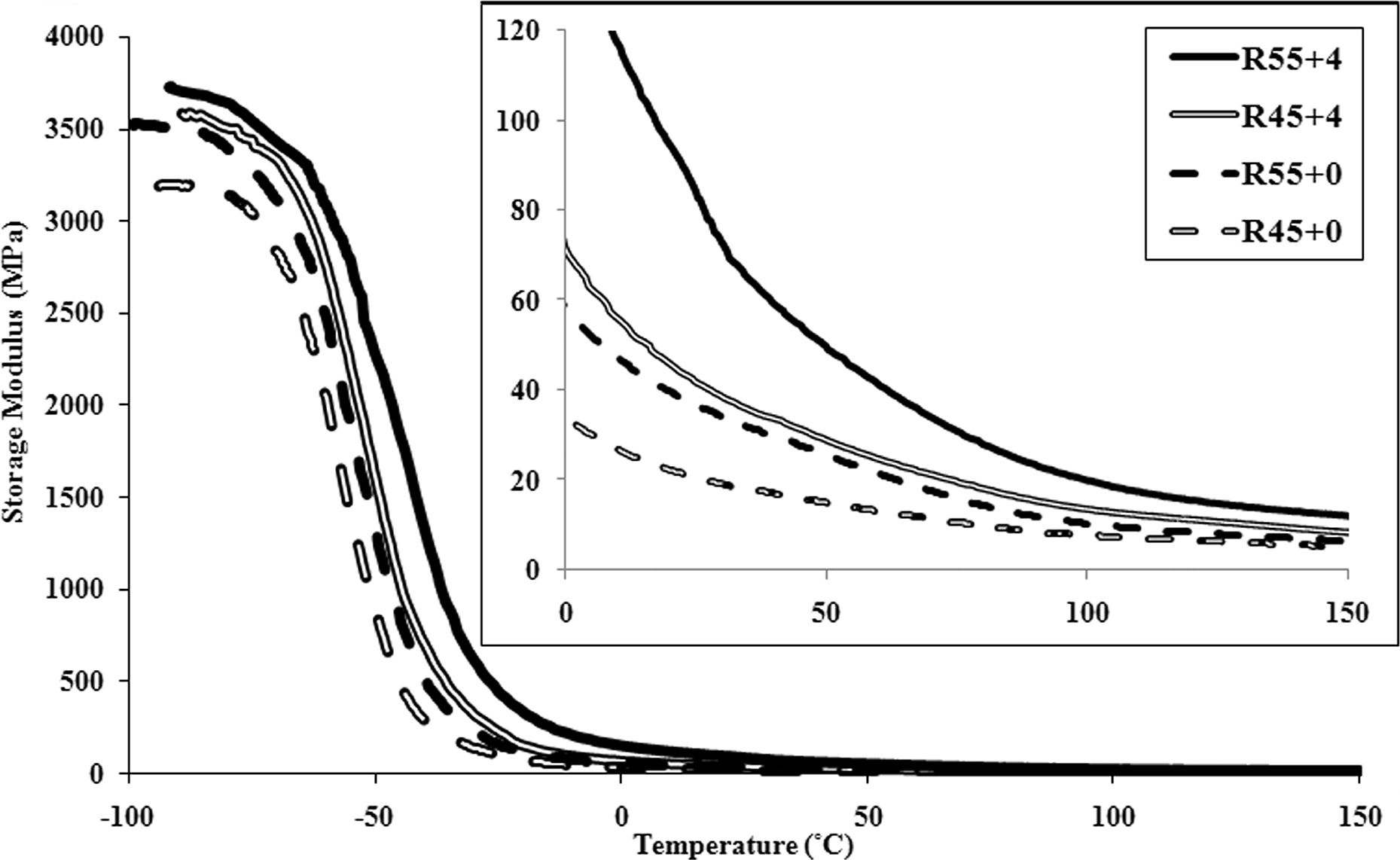
Storage modulus of composites in temperature sweep
Mechanical properties and stability in oxidative aging
Failure of bladders can happen due to oxidative aging, which results in loss of mechanical properties or thermal creep. Therefore, strong mechanical properties and aging stability are necessary in bladder compound design. Typical stress–strain curves obtained from uniaxial tensile test for all vulcanised composites are shown in Fig. 4. It can be seen that similar ranking as storage modulus in Fig. 3 can be observed for modulus of composites up to ∼300% strain, after which composites containing OMMT show a softening behaviour. This softening behaviour has been attributed to the slippage of rubber on clay as well as clay platelets on each other at large strains. 17 At lower strains, the effect of 4 phr OMMT on increasing modulus is higher than 10 phr CB.
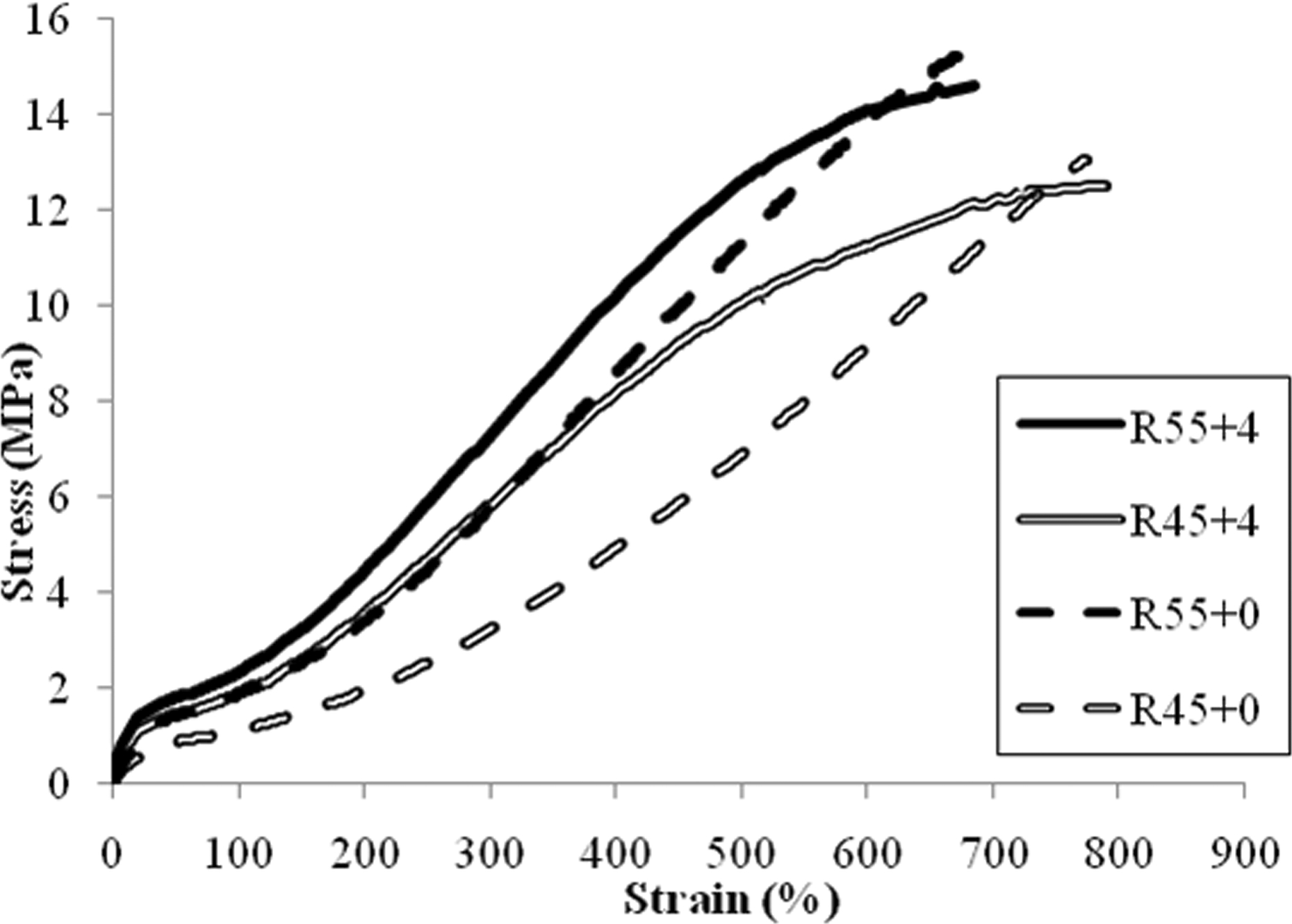
Stress–strain curves for composites
Effects of oxidative aging on stability of mechanical properties are given in Table 6. It can be noticed that aging has increased the modulus of all composites. However, this increase in composites containing OMMT is less than their corresponding composites with no nanoclay. Composite R 45+4 has the lowest increase in modulus among all. Table 6 shows that both stress and strain at break were reduced after aging. Again, the presence of OMMT in the composites has reduced this negative effect, especially for composite R 45+4. Less change in mechanical properties of composites containing OMMT can be correlated to heat stability that resulted from the presence of clay platelets.
Mechanical properties at various aging times at 110°C
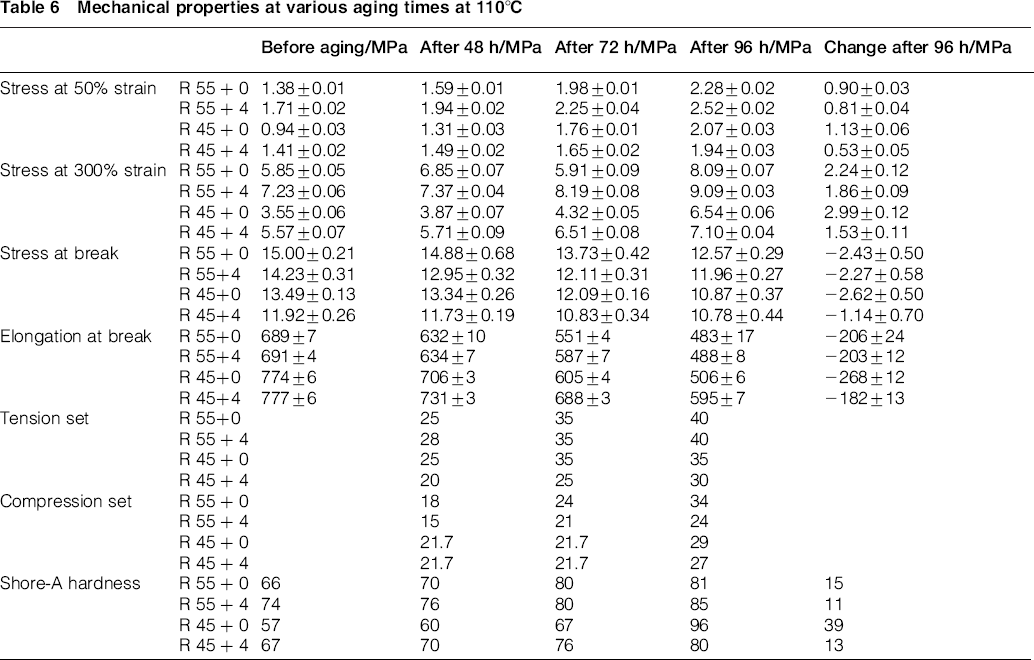
One of the reasons for bladder failure is creep or dimensional growth in service. Therefore, low permanent set is necessary in bladder compounds. Tension set increased in all the composites during aging period. It can be seen that tension set increases with filler content, but this increase was less for addition of 4 phr OMMT in R 45+4 compared to addition of 10 phr CB in R 55+0. Tension set has two main sources: physical and chemical. Physical source of the tension set can be attributed to the viscous effect of filler (Mullin's effect), in which addition of clay may not improve this. On the other hand, chemical degradation during aging in stretched condition is another source of permanent set. This kind of degradation in vulcanised rubber can produce side chain links in rubber while being stretched. Increase in modulus after aging is an indication of such links. Limitation in diffusion of oxygen, introduced by inclusion of MMT platelets (confirmed by permeability test in the next section), can be considered as the main physical barrier in reducing the accessibility of oxygen to butyl rubber chains and reduction in degradation and permanent set.
Minimum compression set was observed in the R 55+4 compound that can be attributed to maximum filler content and barrier effect of clay plates to gases.
OMMT and CB give rise to a noticeable increase in hardness of butyl rubber. In addition, oxidative aging has increased hardness of all composites. Composites containing nanoclay show lower change in hardness as a result of aging than the one without nanoclay. Less change in hardness of composites containing OMMT can be correlated to heat stability that resulted from the presence of clay platelets and their barrier effect.
Permeability of composites to gas
Permeability of composites to CO2 gas is shown in Fig. 5. As seen in this figure, introducing clay to the composites led to decrease in permeability of butyl rubber, whereas addition of 10 phr CB to R45+0 composite increases permeability of CO2. R 45+4 showed the lowest permeability to this gas. Proper dispersion of OMMT with high aspect ratio, formation of shell rubber around filler particles and highly immobilised rubber in the filler network of this composite have led to low mobility of rubber chains and high tortuosity of the gas passing through the thin films of samples. Low permeability of the composites containing OMMT to gases not only improves aging resistance of composites but also enhances the barrier properties of bladders to hot gases and steam employed in curing of tires.
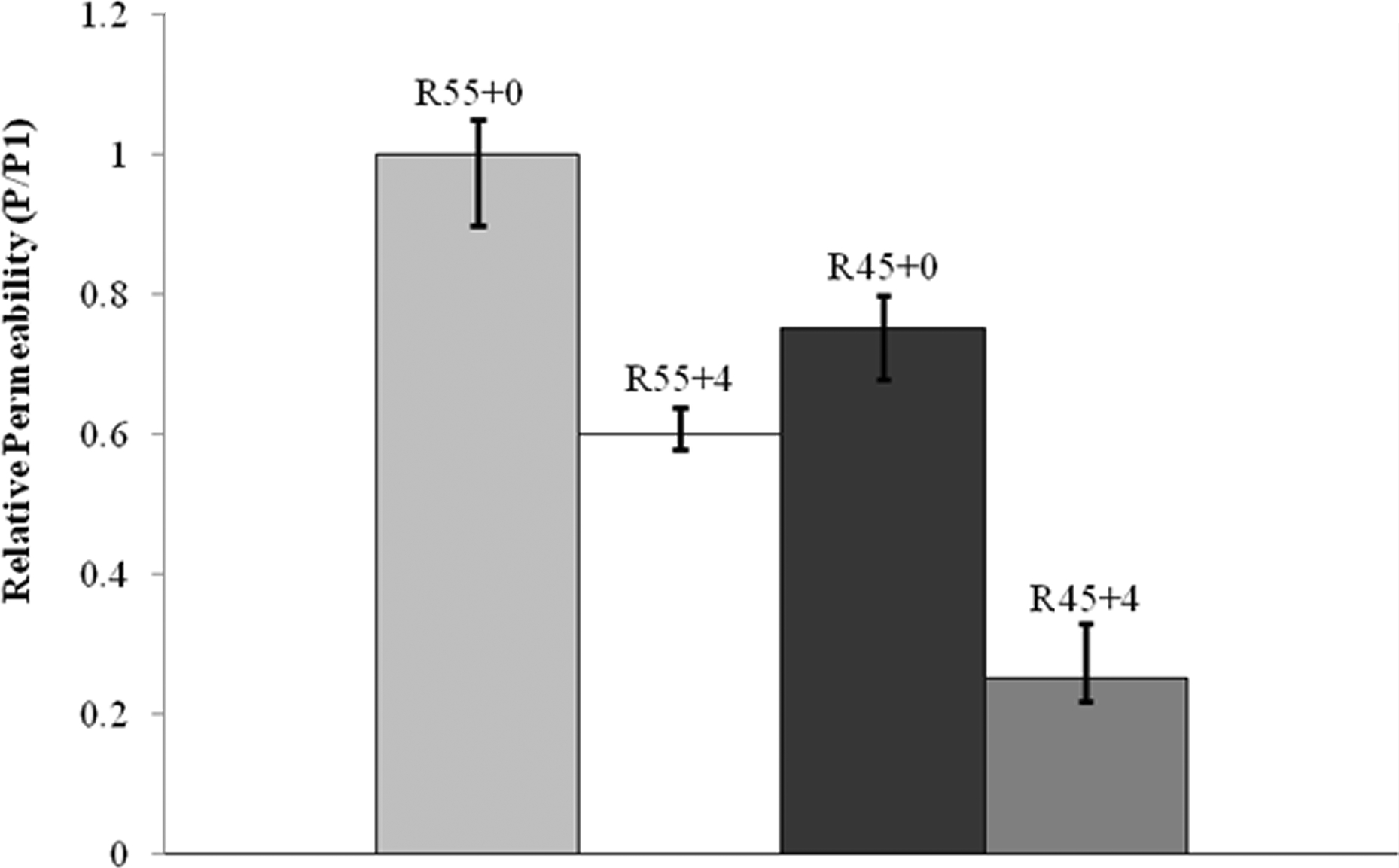
Relative permeability for composites
Thermal properties of composites
The result of TGA of all the vulcanised composites is plotted in Fig. 6. It can be seen that R 45+4 composite loses weight at a higher temperature than other composites. Diffusion limitations introduced by inclusion of well dispersed nanoclay platelets reduced the exchange rate of oxygen and produced degradation gases that, in turn, limit further rubber degradation. It can be seen that the remaining ash content for composites containing nanoclay is more than those with no OMMT. Flame retardant effects of MMT in polymer nanocomposites have been reported previously. 10
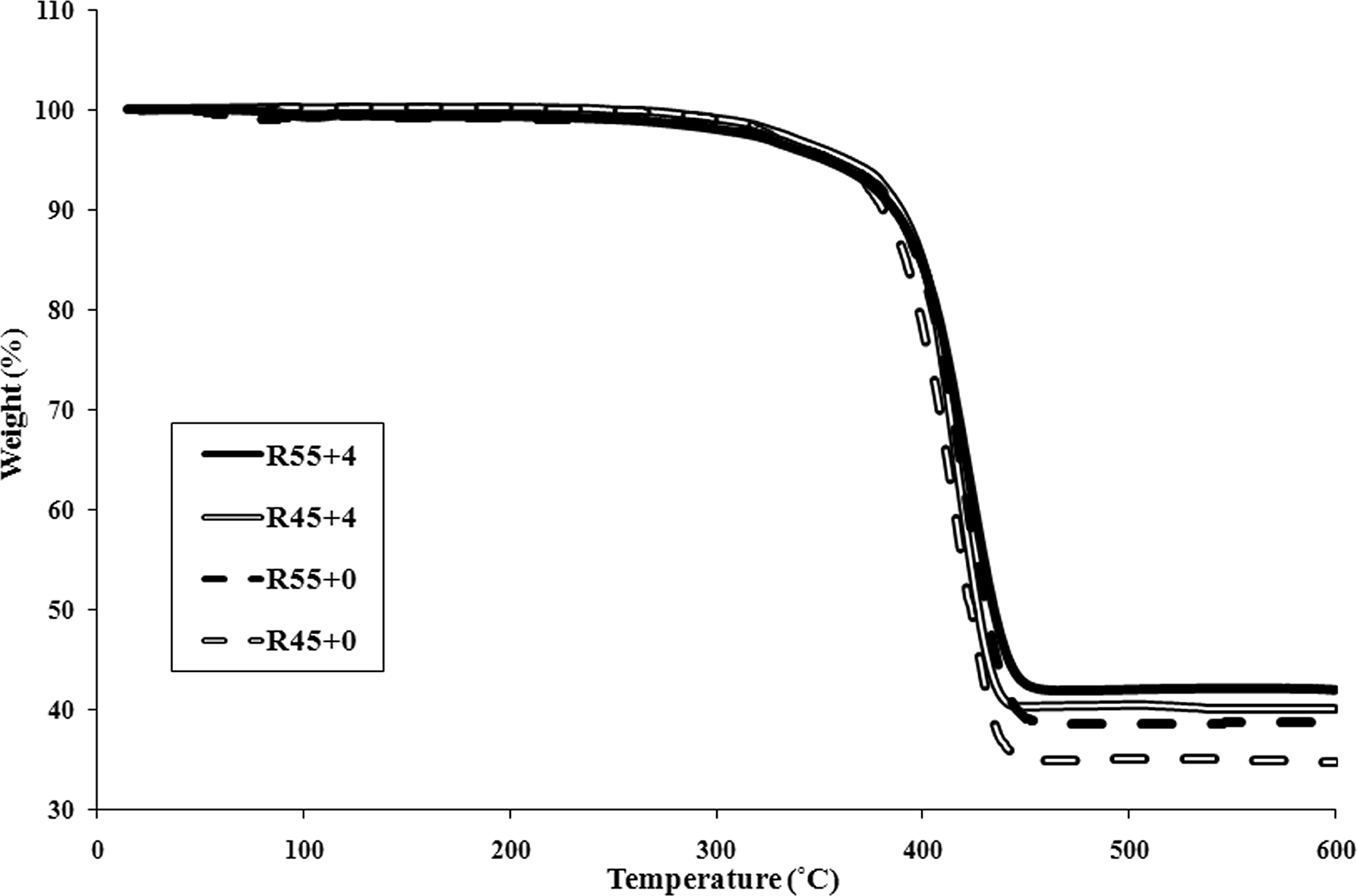
TGA of vulcanised rubber compounds
Conclusions
It was shown that OMMT of choice improved properties of butyl rubber based bladder compounds related to its performance requirements in service. Partial replacement of CB by Cloisite 10A was more effective in improving filler dispersion, interaction with rubber and mechanical reinforcement of such compound than adding the same amount of OMMT to the original bladder compound. This partial replacement enhanced stability of mechanical properties of the composite during oxidative aging and reduced permanent set due to thermal creep, which are important performance requirements for bladders. Reduced permeability of composites containing OMMT to gas was observed and used to explain limited access of oxygen during aging process and its positive effect on reduction of degradation and stability in mechanical properties. Reduced thermal degradation of composites containing OMMT, measured by TGA, confirmed important role of gas permeability in oxidative aging and other properties that resulted from it. A butyl rubber compound containing 45 phr CB and 4 phr OMMT of type Cloisite 10A was considered as a proper compound for tire curing bladder.
Acknowledgements
The authors would like to thank the Iran Tire Manufacturing Co. for its support and contribution in this research work. Special thanks to Mrs. Sazesh and Mr Ghorbani.