







Abstract
The polyaniline (PANI)–polyvinyl alcohol (PVA) conductive composite films [doped with hydrochloride (HCl), dodecylbenzene sulphonic acid and amino sulphonic acid (NH2SO3H) aqueous solution] were synthesised by ‘in situ’ polymerisation, and their conductivities were compared. Among these composite films, HCl–PANI–PVA composite film possessed the highest conductivity that reached 1360 S·m− 1 [w(PVA) = 40%]. Meanwhile, the effects of PVA content, HCl concentration, oxidant ammonium persulphate (APS) dosage, reaction time and film drying temperature on tensile strength of the HCl–PANI–PVA composite films were studied. The tensile strength of the film was improved greatly due to effective mixture of PANI and PVA. When the PVA content was 40%, C(HCl) = 1.0 mol·L− 1, reaction time was 4.0 h, n(APS)/n(aniline) = 1.0 and film drying temperature was 80°C, and the tensile strength of the HCl–PANI–PVA composite film reached the maximum of 60.8 MPa. At the same time, the structure of composite materials was characterised and analysed through ultraviolet spectrum and SEM.
Introduction
Polyaniline (PANI) possesses advantages like good electric properties, excellent environmental stability, easy preparation and low monomer price. As conductive polymers with low raw material price, easy film formation and excellent comprehensive properties, PANI and its modified polymer are considered as one of the most promising conductive polymers in practical applications.1–3 Polyvinyl alcohol (PVA) can be mixed with PANI effectively to obtain the PANI–PVA composite film. 4 Therefore, numerous studies have been conducted for the mixture of PANI and PVA as a conductive material.5–8 However, there are few researches specialising in mechanical properties of PANI–PVA composite film. Moreover, PVA is a non-toxic polymer deriving from polyvinyl acetate through hydrolysis; PVA molecular chain contains lots of hydroxyls, which make it easy to form hydrogen bond among the molecular chains. Therefore, PVA has good mechanical properties such as strong mechanical strength and toughness. 9
The PANI–PVA composite film doped with HCl was prepared by in situ polymerisation. Effects of PVA content, HCl concentration, oxidant ammonium persulphate (APS) dosage, reaction time and film drying temperature on the tensile strength of the PANI–PVA composite films were studied.
Experimental
Materials and instruments
Polyvinyl alcohol (PVA-1799, M = 74 800) was purchased from Sichuan Vinylon Works. Aniline (An) was purchased from Guangzhou Chemical Reagent Factory. Ammonium persulphate [(NH4)2S2O8, APS], hydrochloride (HCl), amino sulphonic acid (NH2SO3H), dodecylbenzene sulphonic acid (DBSA) and ethanol were obtained from Chongqing Chuandong Chemical Reagent Factory.
SDY-4 four-point probe digital resistance meter, tensile testing machine (XL-50A), ultraviolet spectrometer (HITACHI U-3400 spectrophotometer) and scanning electron microscopy (Quanta-200) were used.
Preparation of acid doped PANI–PVA composite films
The mixture solution of PANI and PVA was prepared by dissolving PVA into 85°C water, electric stirring was conducted for 1 h and the solution after stirring was poured into a three-mouth flask together with 100 mL 1 mol·L− 1 HCl (DBSA or NH2SO3H solution). About 5 min later, analytically pure aniline was added, and 1 mol·L− 1 ammonium persulphate [(NH4)2S2O8] solution was dropped into the above mixture solution for 1 h. Reaction was maintained in water bath (25°C) with stirring for 6 h.
Then, the PANI–PVA composite film was prepared by making the mixture solution of PANI and PVA form film on the clean substrate by virtue of latex. It was put in a desiccator for 1 h under room temperature, and dried in an oven under 60°C. Moreover, it was treated with ethanol and dried under 60°C again. 10
Characterisation and performance testing
Conductivity
Conductivity of samples was tested via four-point probe method after they were milled into powder with a mortar and pressed into pieces.11, 12
Mechanical property
The tensile strength and elasticity of samples were studied with tensile testing machine (XL-50A, Guangzhou Precision Instruments Co., Ltd) at the speed of 100 mm min− 1, humidity of 60% and 23°C. 9
Ultraviolet spectrum
The solution before extraction was tested with U-3400 ultraviolet spectrometer of HITACHI as sample.
Scanning electron microscopy
Quanta-200 scanning electron microscopy (SEM) was used to observe the surface appearance of composite film.
Results and discussion
Conductivity of different acid doped PANI–PVA composite films
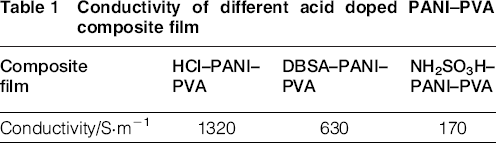
Conductivity of different acid doped PANI–PVA composite films is shown in Table 1. The HCl–PANI–PVA composite film presents the highest conductivity, which reaches 1320 S·m− 1. Thanks to the strong acid of HCl, the content of ionised H+ from HCl is higher than that of DBSA or NH2SO3H when the acid content is the same. As a result, the doped H+ content on nitrogen atom of PANI increased correspondingly. In order to maintain electric neutrality of the composite film, the anionic quantity entering into PANI molecular chain will be increased correspondingly, which makes the conductivity of the HCl–PANI–PVA composite film the highest. Therefore, the optimal doping acid is HCl.
Conductivity of different acid doped PANI–PVA composite film
Effect of PVA content on mechanical property of HCl–PANI–PVA composite film
Effect of the PVA content on the mechanical property of the HCl–PANI–PVA composite film is shown in Table 2. The tensile strength of film increases with the rise in the PVA content. When the PVA content is 0, the tensile strength of the film is the lowest and it becomes hard and brittle at this time. Thanks to the good toughness of PVA, a semi-interpenetrating network (semi-IPN) can be formed between PANI and PVA when PVA is added, which reduces rigid molecules entering cross-linking matrix, so the tensile strength of the HCl–PANI–PVA composite film will be improved with increase in the PVA content. When the PVA content reaches 40%, the conductivity of the HCl–PANI–PVA composite film is the highest and reaches 1360 S·m− 1. In order to get the HCl–PANI–PVA composite film with good conductivity and strong mechanical property, the optimal PVA content should be 40%.
Effect of PVA content on mechanical property of HCl–PANI–PVA composite film*
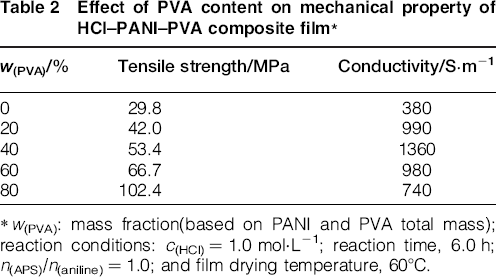
w(PVA): mass fraction(based on PANI and PVA total mass); reaction conditions: c(HCl) = 1.0 mol·L− 1; reaction time, 6.0 h; n(APS)/n(aniline) = 1.0; and film drying temperature, 60°C.
Effect of HCl content on mechanical property of HCl–PANI–PVA composite film
Effect of the HCl content on the mechanical property of the HCl–PANI–PVA composite film is shown in Fig. 1. The tensile strength of the HCl–PANI–PVA composite film increases at the beginning and later declines with the rise in the HCl content. The molecular chain segments of the composite film arrange more closely and form hydrogen bond easily with the increase in HCl content, which greatly enhances intermolecular forces. Then, the mechanical property of the HCl–PANI–PVA composite film is improved significantly. 13 When the HCl content rises to 1.0 mol·L− 1, the tensile strength of the HCl–PANI–PVA composite film reaches the maximum of 53.6 MPa. However, when the HCl content is too high, HCl without doping effect can hardly be removed from the composite film; moreover, it might react with PANI and affect PANI structure in the PANI–PVA composite film. In this way, improvement for the mechanical property of the HCl–PANI–PVA composite film will be hindered, and the mechanical property can even be reduced. Thereby, the optimal HCl content is 1.0 mol·L− 1.
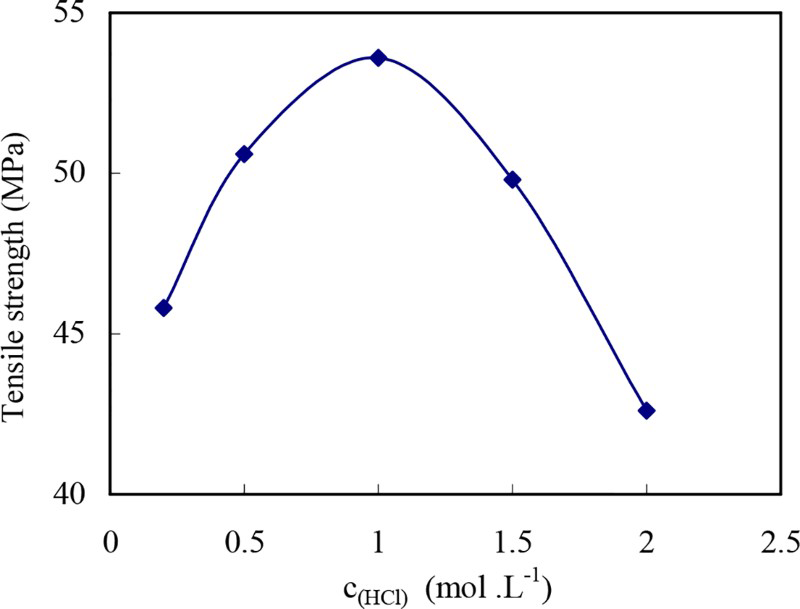
Effect of HCl content on mechanical property of HCl–PANI–PVA composite film [reaction conditions: w(PVA) = 40%; reaction time, 6.0 h; n(APS)/n(aniline) = 1.0; film drying temperature, 60°C]
Effect of reaction time on mechanical property of HCl–PANI–PVA composite film
Effect of the reaction time on the mechanical property of the HCl–PANI–PVA composite film is shown in Fig. 2. The tensile strength of the HCl–PANI–PVA composite film rises at the beginning and later declines with the increase in the reaction time. As for the reason, the polymerisation degree of product will increase, and the mechanical strength of product will rise correspondingly with the increase in the reaction time. 13 When the reaction time rises to 4.0 h, the tensile strength of the HCl–PANI–PVA composite film reaches the maximum of 55.2 MPa. However, too long reaction time will result in excessive oxidation of the aniline monomer, which can change the structure of PANI in the HCl–PANI–PVA composite film. All of those will reduce the mechanical property of the HCl–PANI–PVA composite film. Therefore, the optimal reaction time is 4.0 h.
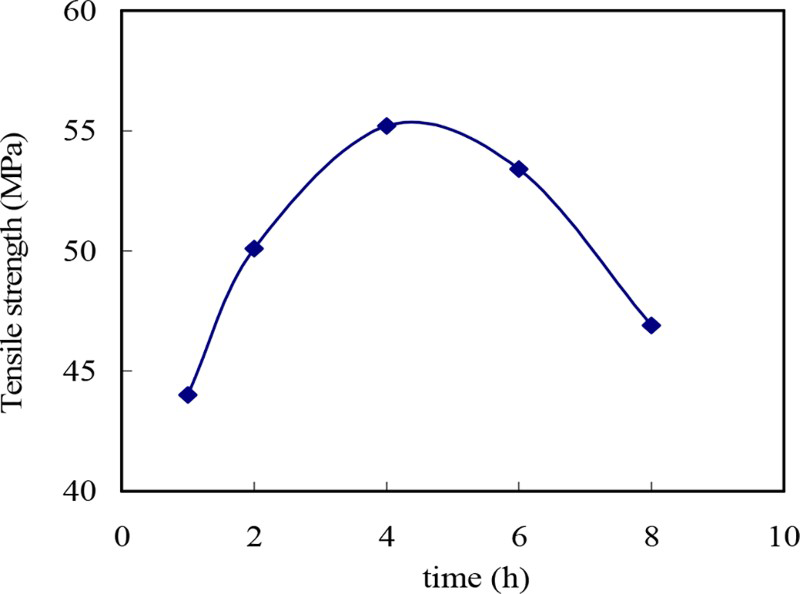
Effect of reaction time on mechanical property of HCl–PANI–PVA composite film [reaction conditions: w(PVA) = 40%; c(HCl) = 1.0 mol·L− 1; n(APS)/n(aniline) = 1.0; and film drying temperature, 60°C]
Effect of n(APS)/n(aniline) on mechanical property of HCl–PANI–PVA composite film
Effect of n(APS)/n(aniline) on the mechanical property of the HCl–PANI–PVA composite film is shown in Fig. 3. The tensile strength of the HCl–PANI–PVA composite film rises at the beginning and later declines with the increase in n(APS)/n(aniline). Improvement for the mechanical property of the HCl–PANI–PVA composite film will be hindered when the content of APS is too high or too low. When the APS content is too low, the network of composite film is not dense and good enough, which will destroy the whole network easily. Therefore, the tensile strength of the composite film is not high. The tensile strength of the HCl–PANI–PVA composite film will be improved with the increase in the APS content. When the n(APS)/n(aniline) rises to 1.0, the tensile strength of the HCl–PANI–PVA composite film reaches the maximum of 56.2 MPa. However, excessive oxidation will happen to the aniline monomer when the APS content is too high, which goes against improvement for the mechanical property of the HCl–PANI–PVA composite film, and might weaken the combining degree between PANI and PVA. All of those will reduce the tensile strength of the HCl–PANI–PVA composite film. Therefore, the optimal n(APS)/n(aniline) is 1.0.
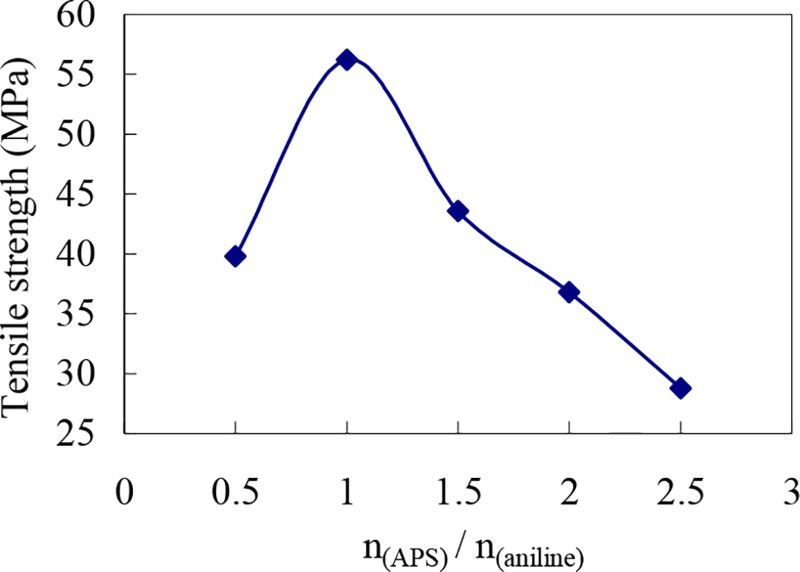
Effect of n(APS)/n(aniline) on mechanical property of HCl–PANI–PVA composite film [reaction conditions: w(PVA) = 40%; c(HCl) = 1.0 mol·L− 1; reaction time, 4.0 h; and film drying temperature, 60°C]
Effect of film drying temperature on mechanical property of HCl–PANI–PVA composite film
Effect of film drying temperature on the mechanical property of HCl–PANI–PVA composite film is shown in Fig. 4. The tensile strength of the HCl–PANI–PVA composite film rises at the beginning and later declines with the increase in the drying temperature. The mixture of PANI and PVA is in a glassy state, which will increase tensile strength of the HCl–PANI–PVA composite film with the rise in temperature at low temperature. When it rises to 80°C, the tensile strength of the HCl–PANI–PVA composite film reaches the maximum of 60.8 MPa. The mixture of PANI and PVA is in a state of soft rubber by reason that its structure will be changed under too high temperature; thus, tensile strength of the HCl–PANI–PVA composite film will decrease. Therefore, the optimal film drying temperature is 80°C.
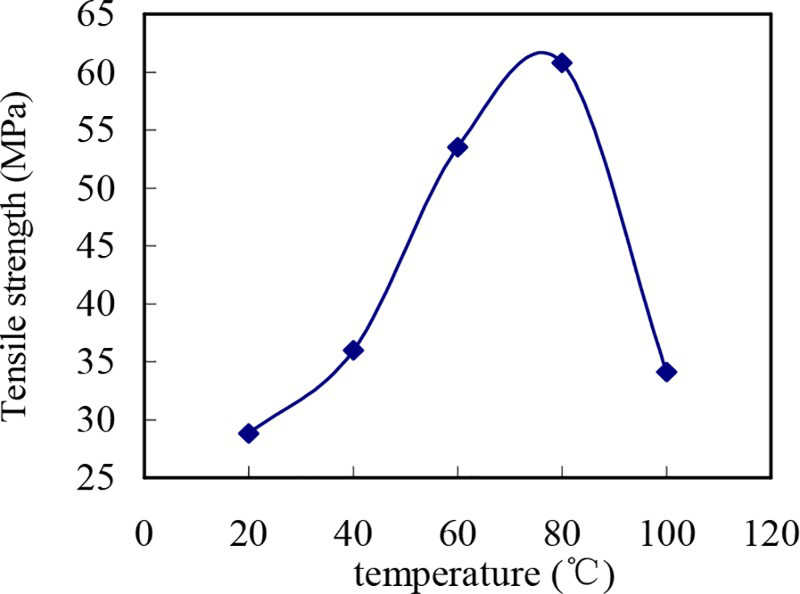
Effect of film drying temperature on mechanical property of HCl–PANI–PVA composite film [reaction conditions: w(PVA) = 40%, c(HCl) = 1.0 mol·L− 1; reaction time, 4.0 h; and n(APS)/n(aniline) = 1.0]
Microscopic analysis of HCl–PANI–PVA composite film
The influence of PVA content in composite film on spectral absorption is shown in Fig. 5. According to the figure, the ultraviolet absorption position will present blue shift gradually with the increase in PVA content (decrease in PANI content). This means that the aggregation state of PANI in composite film has changed under the same grain size and different contents. Under low PVA content (high PANI content), PANI particles will form a network by mutual contact, the blue shift degree is small, it tends to be stable and the spectral characteristic is the same with that of PANI of large particles or eigenstate. However, under high PVA content (low PANI content), PANI particles will disperse in the base material (PVA) with independent material points; owing to the interaction between PVA and PANI, the spectral absorption peak will present obvious blue shift.
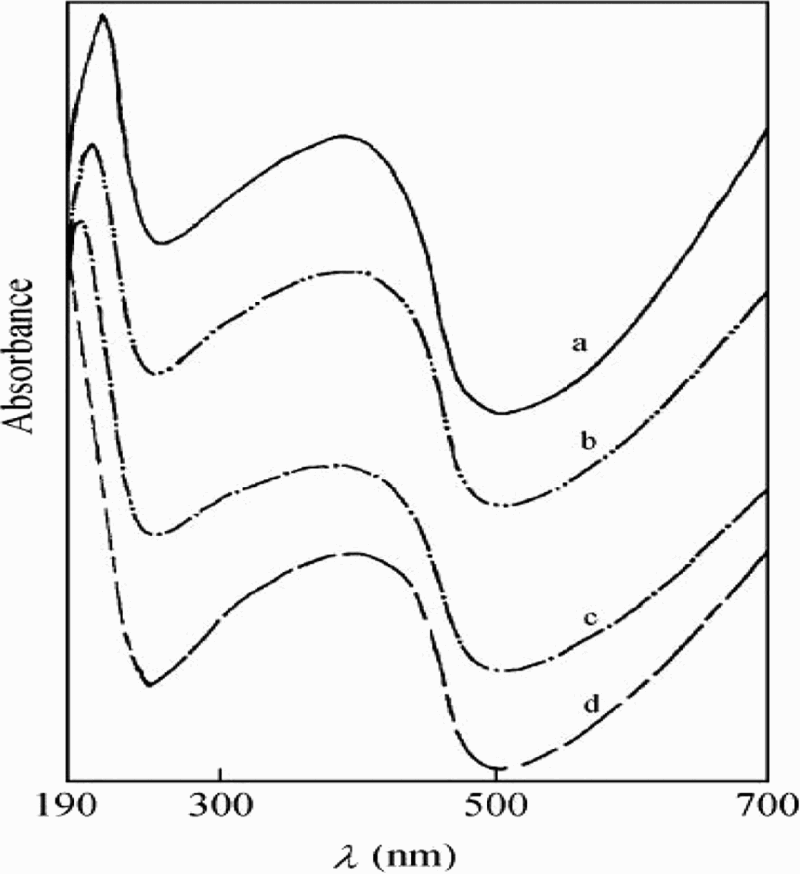
Ultraviolet–visible spectra of HCl–PANI–PVA composite films with different PVA contents a 20%; b 40%; c 60%; d 80%
The surface microtopography at the electrode side of HCl–PANI–PVA composite film is shown in Fig. 6. According to the figure, HCl–PANI–PVA composite film grows in a shape of fibre; the fibre is fine, without branching phenomenon. Therefore, each fibre grows in one direction after coming into being from the electrode, and it presents continuity. The surface of composite film is loose and porous, with low porosity; moreover, fibre breakage is rare. Its orientation will help to form a good electric channel, so the conductivity is high.
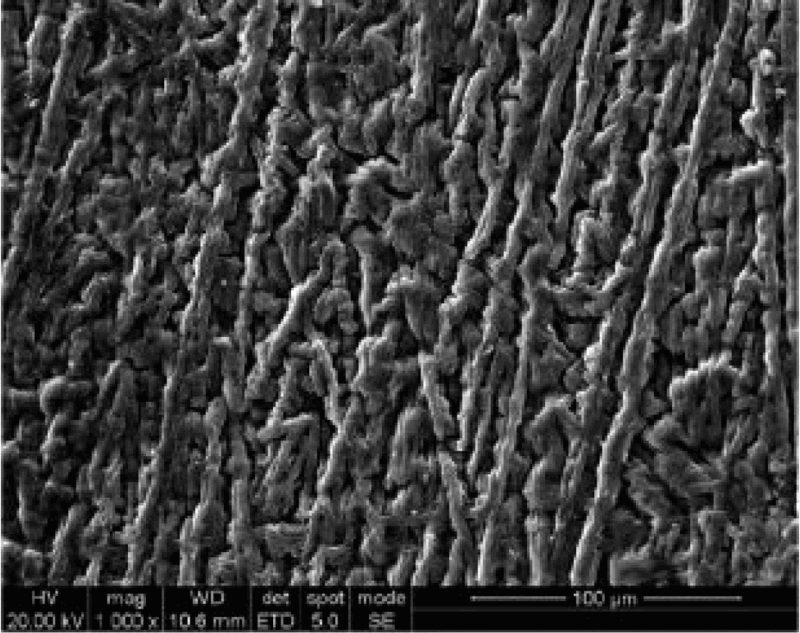
Images (SEM) of back sides of HCl–PANI–PVA composite film
Conclusions
The PANI–PVA composite films doped with HCl or DBSA or NH2SO3H were prepared. The conductivity of the HCl–PANI–PVA composite film doped with HCl is the highest and reaches 1360 S·m− 1 [w(PVA) = 40%].
When the PVA content was 40%, C(HCl) = 1.0 mol·L− 1, reaction time was 4.0 h, n(APS):n(aniline) = 1.0 and film drying temperature was 80°C, the tensile strength of the HCl–PANI–PVA composite film reached the maximum of 60.8 MPa.
At the same time, the structure of composite materials was characterised and analysed through ultraviolet spectrum and SEM. According to the ultraviole–vidible (UV-vis) spectra, the interaction between PVA and PANI will affect the UV-vis absorption spectrum of composite material; compared with PANI, UV-vis absorption spectrum of composite material shows blue shift to varying degrees. According to SEM, the plane of composite film has good electric channel and the conductivity is high.
Footnotes
Acknowledgements
This work was financially supported by the National Natural Science Foundation of China (grant no. 21307168) and the Chongqing Natural Science Foundation (grant no. cstcjja 50016).