







Abstract
Metal injection moulding (MIM) is a good candidate for the economic mass production of complex shaped components. This is especially true for materials that are rather expensive and difficult to form, such as titanium alloys. However, the high affinity for interstitial elements such as oxygen and carbon presents a specific challenge with regard to powder purity, handling and sintering as well as the binder system and its removal. In this paper, three examples of the manufacture of high quality samples of advanced materials are shown in detail. These comprise an optimisation of the well known Ti–6Al–4V alloy with regard to MIM processing and fatigue resistance by adding 0·5 wt-% boron powder in order to effect a reduction in grain size. Second, the MIM processing of an intermetallic alloy Ti–45Al–5Nb–0·2B–0·2C (at-%) is intended for application in turbine engines and turbochargers. Third, the status of MIM of magnesium alloys is presented. In this case, the fabrication of biodegradable implants with adjustable porosity is the main motivation for the application of MIM.
Keywords
Introduction
Metal injection moulding (MIM) is an established technology for the fabrication of components with complex geometry. The injection moulding process offers extraordinary possibilities to design fine structural details, thin walls and holes with nearly any desired shape. For larger quantities, the economic advantage can be dramatic compared to casting or machining. To date, more than 20 years experience is available in terms of MIM processing of stainless steel or Co–Cr alloy powders, and manufacturers all over the world apply this technology commercially. By contrast, titanium and titanium alloy powders are still a speciality in the field of MIM processing,1,2 although, especially in this case, using MIM has several advantages. The casting and machining of titanium materials are difficult, time consuming and costly. In addition, the raw material is expensive; thus, resource efficient, powder metallurgical methods can be beneficial. Furthermore, porous components can also be produced using MIM, e.g. for medical applications to enhance bone fixation or to enable drug delivery.
Despite these advantages, MIM of titanium and other oxygen sensitive materials such as magnesium or aluminium is definitively not standard yet. The sensitivity to oxygen and carbon requires adapted facilities and processes, and the composition of the binder system is crucial. The availability of suitable powders and feedstock is not satisfactory to date. However, MIM of titanium and its alloys has been developed very successfully during the last decade, and excellent properties can be achieved, if processing is performed adequately. Oger et al. 3 demonstrated that commercial production of medical implants from Ti–6Al–4V powder is possible, and the geometrical tolerances are ∼0·2% during serial production. With an oxygen content of 0·20 wt-%, the sintered parts revealed a tensile strength of 841 MPa and an elongation to fracture of 16%. Itoh et al. 4 blended pure Ti powder with a 60Al–40V master alloy powder of different sizes. By using the finer powder, a tensile strength of 931 MPa and an elongation of 15·8% were achieved. The residual porosity was 2·5%. Pure titanium and a master alloy were also used by Zhang et al. 5 After optimising the sintering process, a density of 99·5% was achieved. These authors reported an ultimate tensile strength of 955 MPa and an elongation of 12%. The oxygen content was in the range of 0·232–0·316 wt-%. Pure titanium components were made by MIM using TiH2 powders and a naphthalene containing binder in a study performed by Nyberg et al. 6 The starting powder showed a rather high level of oxygen of 0·55 wt-%. However, there was no additional oxygen pickup during processing, and a tensile strength of 550 MPa was determined on ground samples. Owing to the high oxygen content, the elongation was reduced to below 5%. Shibo et al. 7 processed Ti–6Al–4V by blending together 90% gas atomised and 10% powder produced by the hydride–dehydride technique. The binder system consisted of paraffin wax, polyethylene glycol, low density polyethylene, polypropylene and stearic acid. After sintering, the oxygen content was 0·26 wt-%, the density 97·7%, the tensile strength 835 MPa and the elongation 9·2%. Obasi et al. 8 performed a study of the dependence of microstructure and tensile properties of Ti–6Al–4V on sintering parameters such as heating and cooling rates and temperature. Under optimal conditions, the ultimate tensile strength amounted to 861 MPa and the elongation to fracture 14·3%. The density after sintering was 96·8% and the oxygen content ∼0·22 wt-%. All of these studies show that there are a variety of possibilities using different powders, binder systems and sintering parameters to yield mechanical properties close to those of wrought materials.
In Spring 2011, the ASTM standard F 2885-11 for MIM processed Ti–6Al–4V intended for surgical implants was established, revealing the industrial interest in this technique.
In this paper, two examples of successful MIM processing of titanium based materials are presented, as applied to the well known Ti–6Al–4V alloy and the intermetallic titanium aluminide Ti–45Al–5Nb–0·2B–0·2C (at-%). In particular, the optimisation of the fatigue resistance of the Ti–6Al–4V alloy by adding boron powder is shown.
The sintering of magnesium powder9 and the status of MIM binder development suitable for magnesium are also discussed. Recently, magnesium alloys have been highlighted as appropriate biodegradable materials for future orthopaedic applications,10– 14 because Mg alloys provide elastic moduli and strengths matching those of bone tissue.15 The corrosion products of magnesium, generated during biodegradation, support osteoconductivity.16 Porous structures of novel biodegradable materials would support the ingrowth of bone cells into the degrading implant (osseointegration).17 Via the powder metallurgical processing route, the generation of such parts with open, porous as well as nearly dense structures is possible.18 In this paper, the sintering of Mg–0·9Ca powder and the mechanical properties compared to cast material are presented. Furthermore, the status of binder development is introduced, aiming at MIM processing of Mg based powders in order to manufacture small sized and sophisticated biodegradable implants of specific design with high reproducibility.
Experimental
Sample production
For all the specimens produced in this work, the following MIM processing set-up was employed.
Gas atomised alloy powders with a diameter of <45 μm were used in all cases, produced by the electrode induction melting gas atomisation technique. The Ti–6Al–4V grade 23 powder was provided by TLS Technik GmbH, Bitterfeld, Germany. Pure Mg powder was delivered by SFM-SA Martigny, Switzerland, and the Mg master alloy powders were produced by ZfW, Clausthal-Zellerfeld, Germany. The Ti–45Al–5Nb–0·2B–0·2C (at-%) alloy powder was produced in-house from an ingot provided by GfE Gesellschaft für Elektrometallurgie mbH, Nürnberg, Germany. For producing Ti–6Al–4V–0·5B alloy, boron powder (grade I, 95% purity, <2 μm) was supplied by H.C. Starck, Germany, and mixed with Ti–6Al–4V grade 23 powder before feedstock production.
As binder, a mix of 60 wt-% paraffin wax, 5 wt-% stearic acid and 35 wt-% polyethylene vinylacetate co-polymer (PEVA) was used. Additional polymer components such as polybutadiene or polypropylene-co-1-butene (PPco1PB) were used for Mg feedstock production. Preparation took place inside a glovebox system under a controlled argon atmosphere by means of a z blade kneader. The powder load amounted to 65 vol.-%. The mixing time was 2 h at 110°C.
Injection moulding was performed on an Arburg 320S injection moulding machine. The samples produced for tensile testing were prepared according to ISO 2740 as dogbone specimens. As samples for four-point bending tests, cuboids (44×5·5×3 mm) were produced. All fatigue samples were shot peened after sintering using zirconia particles with a diameter of 200 μm to ensure comparable surface quality.
Sintering of titanium materials was performed at temperatures between 1350 and 1500°C for 2 h under high vacuum in a cold wall furnace with Mo shielding and a tungsten heater. In the following, MIM processed Ti–6Al–4V will be referred to as Ti64 and Ti–6Al–4V–0·5B as Ti64–B respectively. For the investigation of the influence of porosity, some samples were hot isostatically pressed with 100 MPa at 915°C after MIM processing. They are denoted by the suffix ‘+HIP’.
From the Mg powders, cylindrical compression test specimens of 8 mm diameter and 12 mm length were produced by double sided, axial pressing at a surface pressure of 100 MPa in a manual mode press (Enerpac RC55, USA). Sintering of all Mg parts took place in a hot wall furnace (XRetort, Xerion, Germany) at 630°C for 16–64 h under argon gas. Part of the material was solution heat treated (HT) at 515°C for 8 h, followed by fast cooling in water.
Characterisation
Tensile tests were performed on a servohydraulic structural test machine equipped with a 100 kN load cell at a strain rate of 1·2×10−5 s−1 at room temperature (RT) in air. At least three samples of each configuration were tested. In the case of Ti–45Al–5Nb–0·2B–0·2C, additional tests were performed under air at 700°C. The high cycle four-point bending fatigue tests were performed on a resonance machine fabricated by RUMUL. The experiments were carried out in air at RT under load control with a cyclic frequency of ∼95 Hz (sine wave) at a load ratio R = σmin/σmax of 0·2. The fatigue endurance limit was defined as 107 cycles and was determined on typically five samples. Compression tests were performed on a Schenck Trebel RM100.
Light microscopy and scanning electron microscopy (Zeiss, DSM962) were used to investigate the microstructures. The levels of interstitial elements (O, N and C) were determined using a LECO melt extraction system (TC-436AR and CS-444). The residual porosity was calculated from the density of the sintered samples, measured using the Archimedes method. A density of 4·41 g cm−3 for the dense Ti–6Al–4V material was determined by measuring a MIM+HIP sample. The porosity of the Ti–45Al–5Nb–0·2B–0·2C samples was determined by optical pore analysis using an Olympus Analysis Pro software. Grain size was determined according to ASTM E112-96 (linear intercept technique). Electron backscatter diffraction (EBSD) was performed on a Zeiss (ULTRA 55) scanning electron microscope. Spatially resolved EBSD maps were acquired at 15 keV using a step size of 0·2 μm.
Results and discussion
Optimisation of fatigue behaviour of MIM Ti–6Al–4V
The most commonly used and versatile titanium alloy today is Ti–6Al–4V even with regard to MIM processing. It is often used in high load applications; thus, in addition to tensile properties, the fatigue behaviour is usually an important issue. Table 1 compares the microstructural and mechanical properties of MIM samples processed in this study. In the table, the minimum values specified by the ASTM B 348 standard for wrought material and by the new ASTM F 2885-11 standard for MIM processed Ti–6Al–4V are displayed.
Microstructures and mechanical properties of MIM processed samples based on Ti–6Al–4V in comparison to ASTM standards
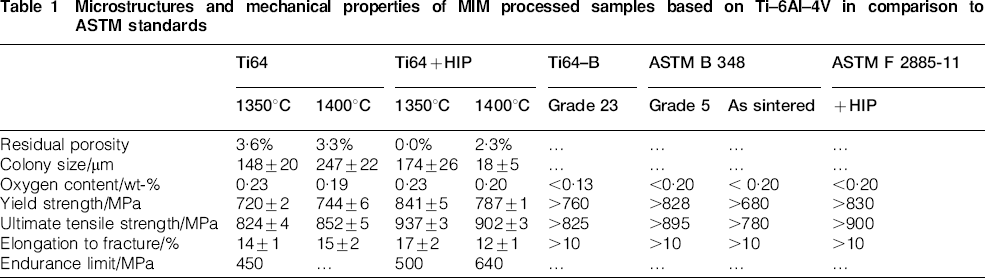
The results reveal that in the case of the Ti64 samples, the sintering temperature influences the resulting colony size significantly, as expected. On the other hand, no deteriorating effects on tensile properties can be observed. In all cases, the ductility exceeds clearly the demands from the standards and the strength fulfils the requirements from the F 2885-11 standard and partly even the standards for wrought material. In addition, it is important to note that especially the yield strength depends on the strain rate applied during tensile testing. This has to be taken into account when comparing different studies. The pickup of oxygen is varied within the typical range for laboratory tests and depends more on the number of sinter parts in the furnace than on temperature. In summary, the tensile properties achieved by MIM are excellent and more than sufficient for most applications.
In terms of fatigue behaviour, the endurance limit of 450 MPa for as sintered Ti64 appears to be high compared, for example, to typical values for stainless steel. On the other hand, for wrought Ti–6Al–4V, a typical range between 500 and 800 MPa exists for the endurance limit. Closing the pores by HIP leads to an increase of just 10%, although the yield strength rises by 17%, indicating that the porosity is not the main reason for the inferior fatigue resistance compared to wrought material. As is well known, the fatigue properties of Ti64 are determined mainly by the grain size.19 Unlike the typical globular microstructure of wrought material, Ti64 reveals α-colonies with β-lamellae due to sintering above the β-transus. Table 1 and Fig. 1 show the much larger colony size compared to the typical 10 μm colony size in wrought material.
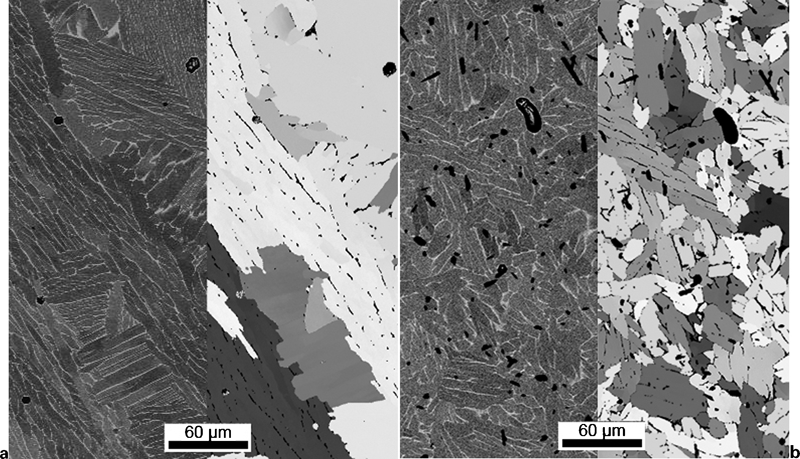
Electron backscatter diffraction images of α-phase illustrating significant reduction in grain size by addition of 0·5 wt-% boron
Refinement of the microstructure of Ti–6Al–4V without thermomechanical treatment is only possible by changing the alloy composition; therefore, Ti64–B samples were prepared. During the sinter process, elemental boron powder and titanium atoms react and form TiB particles. By pinning the grain boundaries during sintering, these particles impede the growth of the β-grains. Furthermore, during cooling, the α-phase nucleates at the particles, leading to more and finer α-grains. As shown in Table 1, the grain size is reduced to below 20 μm, although the samples were sintered at 1400°C. This strong difference is also visible in Fig. 1, showing EBSD images of the alpha phase for samples with and without boron addition, both sintered at 1400°C. Interestingly, the residual porosity is reduced to 2·3% by the addition of boron, probably by the pinning of the grain boundaries. By this mechanism, the pores remain in the region of the grain boundaries where diffusion is much faster than in the volume. The lower porosity causes an increase in yield strength of ∼9% compared to Ti64 sintered at 1350°C, while the ductility is reduced slightly, which is probably due to the titanium boride particles. On the other hand, the effect on fatigue resistance is dramatic: the endurance limit is increased by 42% to 640 MPa. This value is well within the range of wrought material, although considerable residual porosity still exists.
The results show that Ti64–B could be a novel alloy specialised for fatigue loading. Initial corrosion and biological tests have demonstrated good compatibility even for medical applications.20 The biological tests show an accelerated settlement of cells and excellent proliferation. Furthermore, boron reveals no toxic effects for the low concentration used in this alloy.
Metal injection moulding of titanium aluminides
Titanium aluminides consist of two intermetallic phases α2 and γ. The good oxidation resistance, high creep resistance and strength at temperatures up to 800°C make them suitable to replace heavy nickel based superalloys in turbine engines or turbochargers. However, due to the hardness, brittleness and high temperature strength, conventional forming is very difficult and expensive. In addition, the resulting microstructure depends strongly on details of temperatures, holding times as well as heating and cooling rates during sintering and cooling. In Fig. 2, the complicated binary phase diagram Ti–Al is shown,21 which reveals the necessity for keeping precise process control during all thermal processes. Powder metallurgy has to face this challenge, too, but on the other hand, shaping is no problem, and the alloy composition can be optimised without taking into account formability aspects. Thus, MIM is very interesting for processing this alloy class.
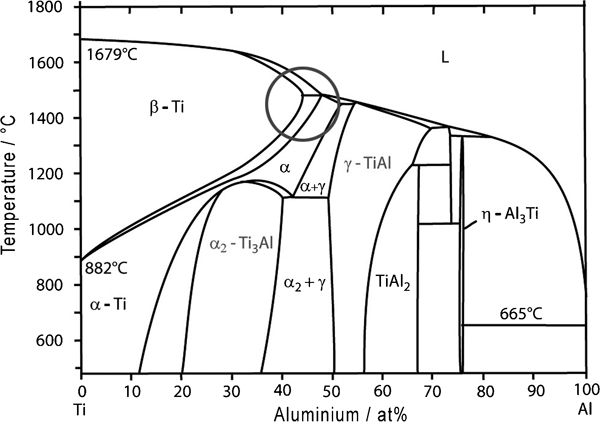
Binary phase diagram of Ti–Al:22 circle marks region where sintering of titanium aluminides takes place
For MIM processing, high temperatures close to the solidus are needed in order to gain sufficient sintering due to the low diffusivity of high temperature materials.22 High sintering temperature implies increased risk for loss of light elements such as Al and for oxygen uptake. A sinter temperature of 1500°C close to the solidus proved to be adequate for achieving high density: the residual porosity amounts to values between 0·2 and 0·5%, and the remaining pores are small and well rounded (Fig. 3). The reason for the low porosity is not clear yet. It cannot be totally excluded that a small amount of liquid phase is already created during sintering, which improves the densification. On the other hand, no distortion or melted surface is visible on the sintered samples. Figure 3 reveals the typical microstructure after sintering for 2 h and furnace cooling and displays a lamellar structure consisting of alternating layers of α2 and γ phase. The average colony size is ∼80 μm, while the oxygen content was limited to 0·12 wt-%. Both values are well comparable to those of typical cast material. The white needle shaped features represent titanium borides.
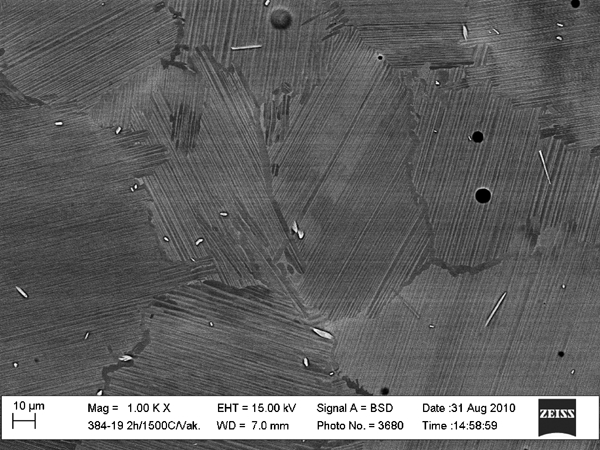
Typical SEM image of Ti–45Al–5Nb–0·2B–0·2C (at-%) processed by MIM
In Fig. 4, the results of tensile tests on Ti–45Al–5Nb–0·2B–0·2C samples sintered for 2 h at 1500°C under vacuum are displayed. At 700°C, the strength is not reduced while plastic elongation increases from 0·2 to 1·0%. This is commonly regarded as sufficient for applications. Nevertheless, the yield point is significantly reduced at 700°C. In Fig. 5, these results are compared with those of cast material. According to the results not shown here, the microstructure and oxygen content of cast and MIM samples appear to be similar. However, the cast material shows better strength, and the reason for this is not clear yet. However, it cannot be excluded that the difference in mechanical properties is at least partly caused by different specimen conditions: The cast samples were HIPped, machined to standard geometry and polished, while the MIM processed specimens were of dogbone geometry and just sintered and ground with fine abrasive paper. Further investigations have to be performed on this matter. However, these first results are very promising, and further improvement is likely.
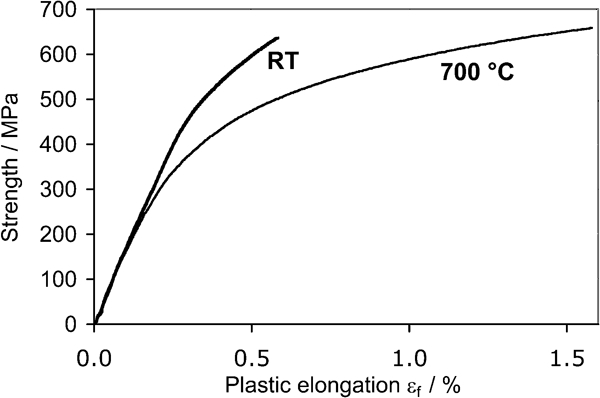
Tensile test results performed on Ti–45Al–5Nb–0·2B–0·2C (at-%) alloy, processed by MIM, sintered under vacuum: measured at RT and at 700°C
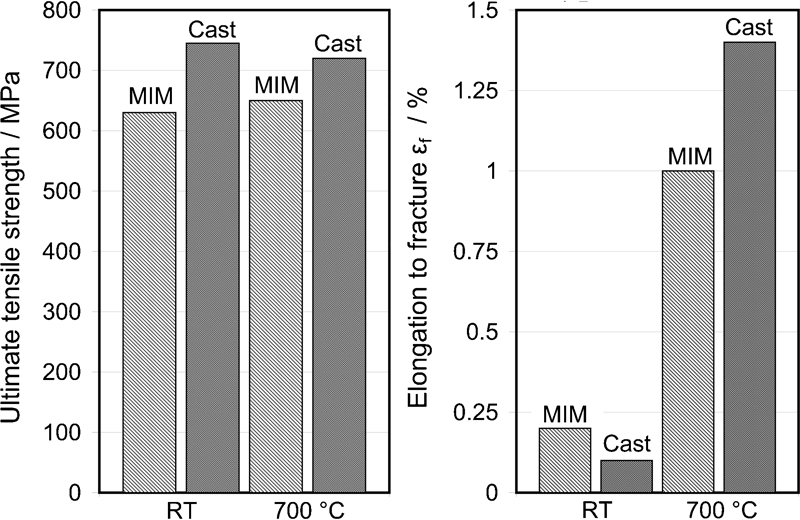
Comparison of tensile test results for MIM processed and cast Ti–45Al–5Nb–0·2B–0·2C (at-%) alloy at RT and at 700°C
Metal injection moulding of magnesium
The development of MIM is performed in two parts. First, the sintering of Mg powder has to be investigated, because the inherent oxide layer inhibits sintering. Prestudies23 showed that the introduction of a temporary liquid phase by the addition of Mg–Ca alloy powder of eutectic composition enhances densification significantly. Second, a binder that does not react with magnesium during sintering has to be found.
Sintering without binder
An SEM image of a sintered sample made from Mg–0·9Ca powder is shown in the left of Fig. 6. The residual porosity amounts to 3%. In the centre, a higher magnification image of the marked region is shown. The arrows point to areas of the brittle phase Mg2Ca. After solution treatment, the porosity remains the same, but the amount of Mg2Ca decreases significantly (right image). Energy dispersive X-ray analyses show a higher oxygen content in the Mg2Ca regions due to the fact that their location seems to be identical with the former oxidised surface of the original powder particles. Table 2 reveals the results of compression tests performed on the as sintered, sintered and HT and cast and HT samples.
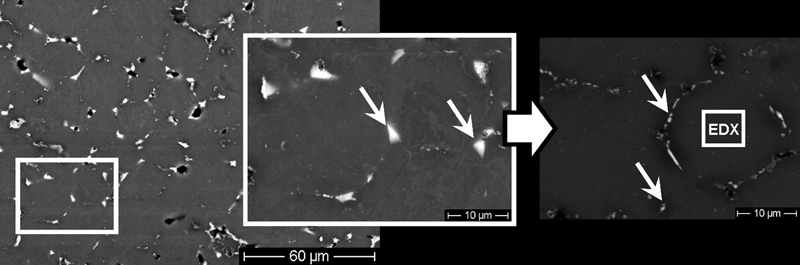
Images (SEM) of sintered Mg–0·9Ca powder: as sintered (left and middle) and after solution heat treatment (right). White arrows indicate Mg2Ca precipitates
Results of compression tests on differently processed Mg–0·9Ca samples
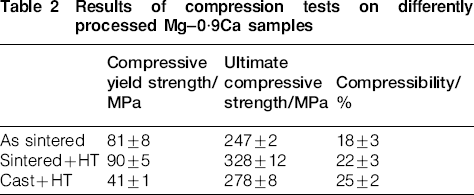
The results show that sintering of Mg alloys to components with properties superior to those of cast material is possible.
Binder development for MIM of magnesium
Because of the high vapour pressure of Mg, thermal debinding and sintering have to be performed under ambient pressure in argon. Therefore, a binder component that evaporates completely under this condition has to be found. As shown in Fig. 7, PPco1BP appears to be a good candidate compared to PEVA used for titanium. The left side reveals the microstructure of samples containing PEVA and PPco1BP respectively after sintering. On the right, reference samples without binder are shown, which were placed next to the specimen during the process. Without polymer containing neighbours, these reference samples show a residual porosity of 15% after sintering at 630°C for 8 h.
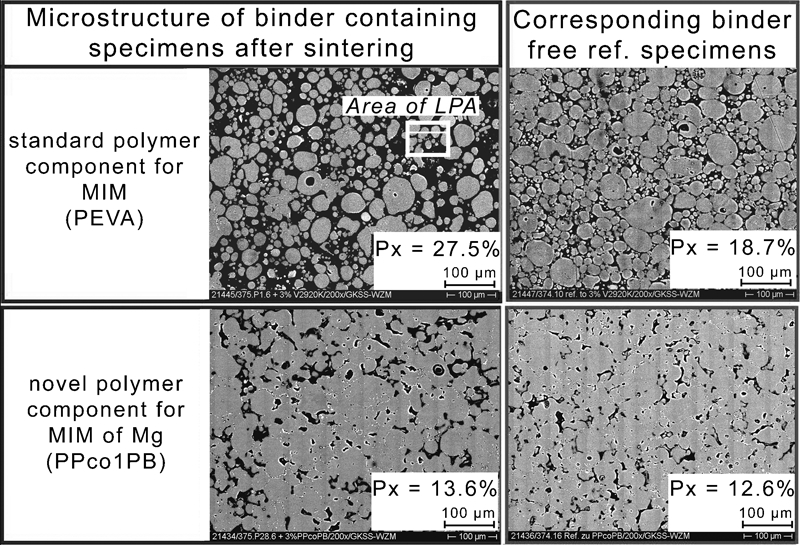
Microstructure after sintering (630°C/8 h) of PEVA and PPco1BP containing Mg specimens and reference specimens without binder
As shown in Fig. 7, the use of PEVA as component for MIM of Mg–0·9Ca results in a residual porosity of 27·5%, exceeding the green porosity. Moreover, the reference specimen shows an increased residual porosity of 18·7%. Carbon residuals in the pores of the PEVA containing sample observed by line profile analysis (see white rectangle) may be a major obstacle to the sintering process.24 Increased carbon content could not be observed on the other specimens. Furthermore, Mg may reduce the molecular chain of the acetate group in the PEVA molecular chain and react with the oxygen present before thermal decomposition of the molecular chain takes place. In contrast, the PPco1BP containing samples and their references sinter successfully to 13·6% porosity and 12·6% respectively. In addition, it could be shown that the additional use of paraffin wax and stearic acid does not influence the sintering result.
Summary
The results show that MIM of oxygen sensitive materials is possible if their specific properties and demands are adequately taken into account. In particular, binder composition and sintering equipment and processing are crucial. Metal injection moulding of commonly used titanium alloys such as Ti–6Al–4V as well as titanium aluminides leads to sound properties, which suggests that MIM could be an alternative manufacturing method for small and complex shaped parts made from these materials.
The tensile properties of MIM processed Ti–6Al–4V alloy are comparable to standard values for wrought material and especially high ductility can be achieved if the interstitial content is limited. Furthermore, applying an additional hot isostatic pressing process that closes the residual porosity leads to excellent properties, exceeding all standard limits by far. In the case of titanium aluminides, a nearly dense material can be achieved just by sintering, and the tensile properties are close to those of the cast material.
For fatigue loading applications, a fine microstructure is decisive, and an example of grain refinement by adding boron powder was given. The modified alloy Ti–6Al–4V–0·5B shows a fatigue limit of 640 MPa, well within the range of wrought material, although 2·3% porosity still exists. This shows the potential of powder metallurgy for optimising the mechanical properties to the needs of the application with low effort by alloy composition tailoring.
The sintering results of Mg feedstock point out the general suitability of Mg alloys for MIM. Using PPco1PB as binder component results in successful sintering of the Mg–0·9Ca powder material.
Footnotes
This paper is part of a special issue on ‘Euromat 2011: powder synthesis and processing for controlled microstructure’