







Abstract
In this study, Ti powder (average size: 45 μm) was plated/coated by electroless Ni with hydrazine hydrate as reductant. The Ni plating was carried out at 85°C and pH 9–10. The influence of process parameters such as plating period as well as reductant concentration was investigated. The Ni plated Ti powder was characterised by scanning electron microscopy, energy dispersive spectrometer analysis and X-ray fluorescence. It is found that a pure/uniform Ni layer may be deposited on the Ti powder particles. The deposited mass increases as plating period/reductant concentration increases.
Introduction
The Ti–Ni alloys have attracted much interest for their good mechanical properties, excellent corrosion resistance, biocompatibility, pseudoelasticity and shape memory effects.1–4 These alloys are used in many applications such as biomedical engineering, smart structures and microelectromechanical systems.5–10
Two major techniques have been developed for production of Ti–Ni alloys. These are known as casting and powder metallurgy (PM). Some problems associated with casting such as segregation or extensive grain growth may be avoided by PM process.11,12 The latter process provides precise control of composition and easier achievement of complex shapes with minimal post-machining treatment.13,14
The Ti–Ni powder is widely used for fabrication of high quality Ti–Ni alloys by PM technique. Different processes have been utilised for preparing Ti–Ni binary powder. These include mechanical alloying, 15 gas atomisation 16 and mechanochemical synthesis. 17 All of the above mentioned methods are attractive but are expensive and complex too. Therefore, developing an effective and economic technique for preparing binary powder with improved sinterability of primary powders during production procedures is important. The electroless plating process is one of the most effective techniques for synthesis of metal–metal binary powders as well as ceramic–metal composite ones. In this technique, deposition of metal from its ionic states in the solution occurs by reductant rather than by electric current. This method provides a uniform adherent metal layer on powder substrate. 18 In addition, the electroless plated powders exhibit a high level of homogeneity after PM processes. 19 According to the literature, various powders can be coated using electroless plating such as Ti, Al, W, Fe and Mo powders20–25 as well as SiC, ZrO2, Al2O3, Si3N4 and diamond powders.26–30
The Ti powder can be coated by electroless Ni plating for preparing Ti–Ni binary powder. The electroless Ni process with sodium hypophosphite/amino–boron reductants provides inclusions such as phosphorus/boron on the Ti powder. However, it is well known that a pure Ni layer can be deposited on the Ti powder particles by hydrazine hydrate reductant that result in synthesis of Ti–Ni binary powder.
The electroless plating is controlled by various parameters (i.e. plating duration, composition, temperature and pH of the bath). In this study, the Ti–Ni powder is prepared using the electroless Ni plating of Ti powder with hydrazine hydrate as reduction agent. In addition, the effect of electroless bath parameters on the deposition rate as well as surface morphology of plated/coated Ti powder is investigated.
Experimental
The commercial Ti powder with an average particle size of 45 μm, supplied by Alfa Aesar, was used as initial powder. The powder particles were first pretreated by soaking in alkaline bath to eliminate the impurities as well as surface activation. Then, the Ti powder was loaded in pretreatment solution 50 g L−1. The composition and operating parameters of the pretreatment bath are shown in Table 1. After pretreatment, the Ti powder was removed from the bath, rinsed in deionised water and dried in an oven at 50°C for 30 min.
Bath composition and operating parameters of pretreatment/electroless processes
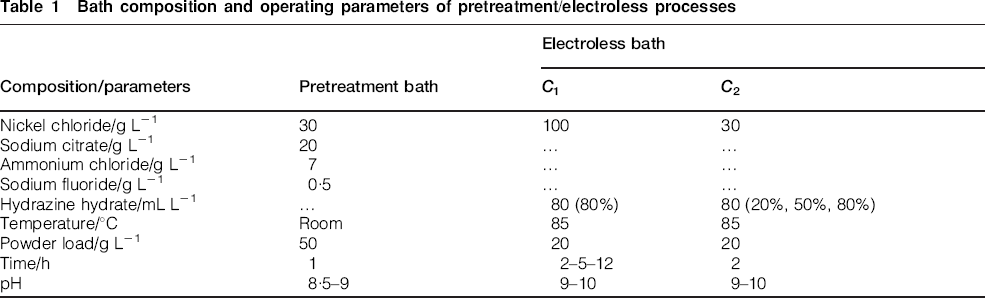
The electroless Ni plating was carried out by suspending the pretreated powder (20 g L−1) in a nickel chloride solution with hydrazine hydrate reductant at temperature of 85°C under pH range of 9–10. Two baths with different compositions were used for electroless plating (C1 and C2 in Table 1). Plating periods of 2, 5 and 12 h were selected (C1 samples), while reductant concentrations of 20, 50 and 80% were considered (C2 samples). Plating process for 2, 5 and 12 h was performed in one, two and three steps (to prevent bath weakness) respectively. During electroless plating, the solution was stirred by a magnetic stirrer to completely disperse the powder particles in the bath. Finally, the plated/coated Ti powders were removed from the bath, rinsed with deionised water and dried in an oven. Surface morphology of the Ti–Ni binary powders as well as initial Ti powder was examined by a VEGA/TESCAN-XMU scanning electron microscope (SEM). Elemental analysis was performed by an ARL8410 X-ray fluorescence (XRF) as well as energy dispersive spectroscopy (EDS).
Results and discussion
Effect of plating time
Images (SEM) of primary Ti powder as well as the Ti–Ni binary powder are illustrated in Fig. 1. As seen in Fig. 1a, the initial Ti powder has irregular shape. The Ti–Ni powder shows a cauliflower shaped morphology after 2 h plating. However, it seems that with short plating time as well as high reductant concentration, the Ni layer is not created on all of the Ti powder particles. The unplated/uncoated regions of Ti particles are marked by circles in Fig. 1b. The morphology of Ti–Ni binary powder after 5 h plating is illustrated in Fig. 1c. It indicates that all Ti particles are uniformly coated as plating time increases. The average size of the particles is increased due to the thick layers of Ni. The cauliflower shaped morphology of Ni layer on the Ti powder particles can be clearly observed after 12 h plating in Fig. 1d. According to Fig. 1, the size of Ti–Ni binary particles increases as plating time increases. In other words, Ni ions are deposited just on Ti particles, so agglomeration degree is very low.
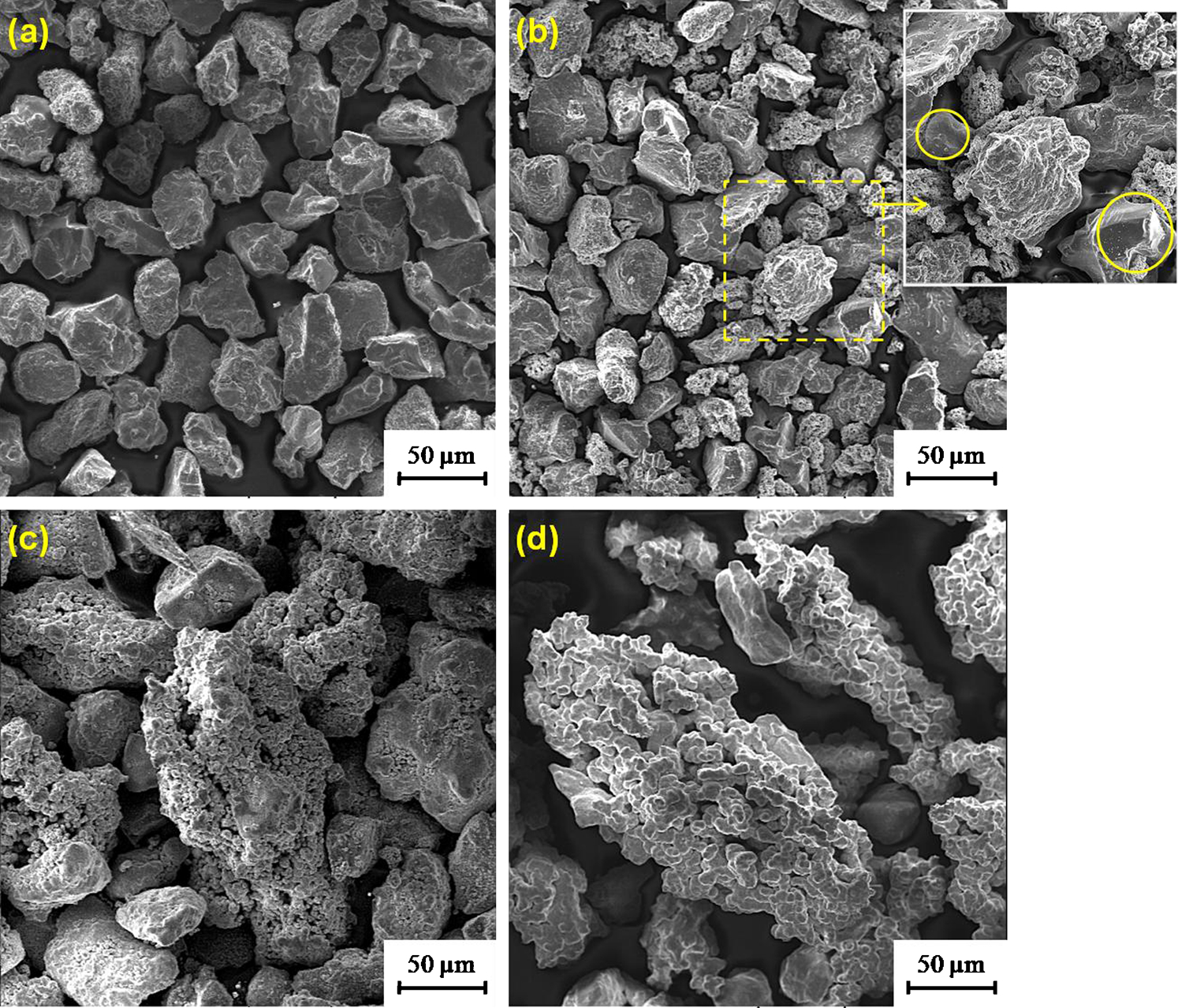
Images (SEM) of a primary Ti powder, b Ti–Ni powder after 2 h plating, c Ti–Ni powder after 5 h plating and d Ti–Ni powder after 12 h plating
The EDS results for powders are exhibited in Fig. 2. As seen, pure Ni is deposited on Ti particles. In addition, deposited Ni mass (or Ni layer thickness) increases with increasing plating time. This is in good agreement with previous work in literature. 23 The EDS analysis is a method based on surface nature, so it identifies lower amount of substrate (Ti) but detects higher value of coating (Ni). The more actual values of Ni and Ti constituents in the powder can be identified by XRF analysis, presented in Table 2. The XRF results confirm the presence of pure Ni on the Ti powder. It can be also predicted that by adjusting the plating time between 2 and 5 h, the atomic percentage of Ni in composition of powder would be around 50%. Further studies confirm that the plating time should be considered about 225 min (3 h and 45 min) to obtain atomic ratio of 1∶1 for Ni–Ti binary powder, which can be used for fabrication of NiTi shape memory alloy by PM technique.
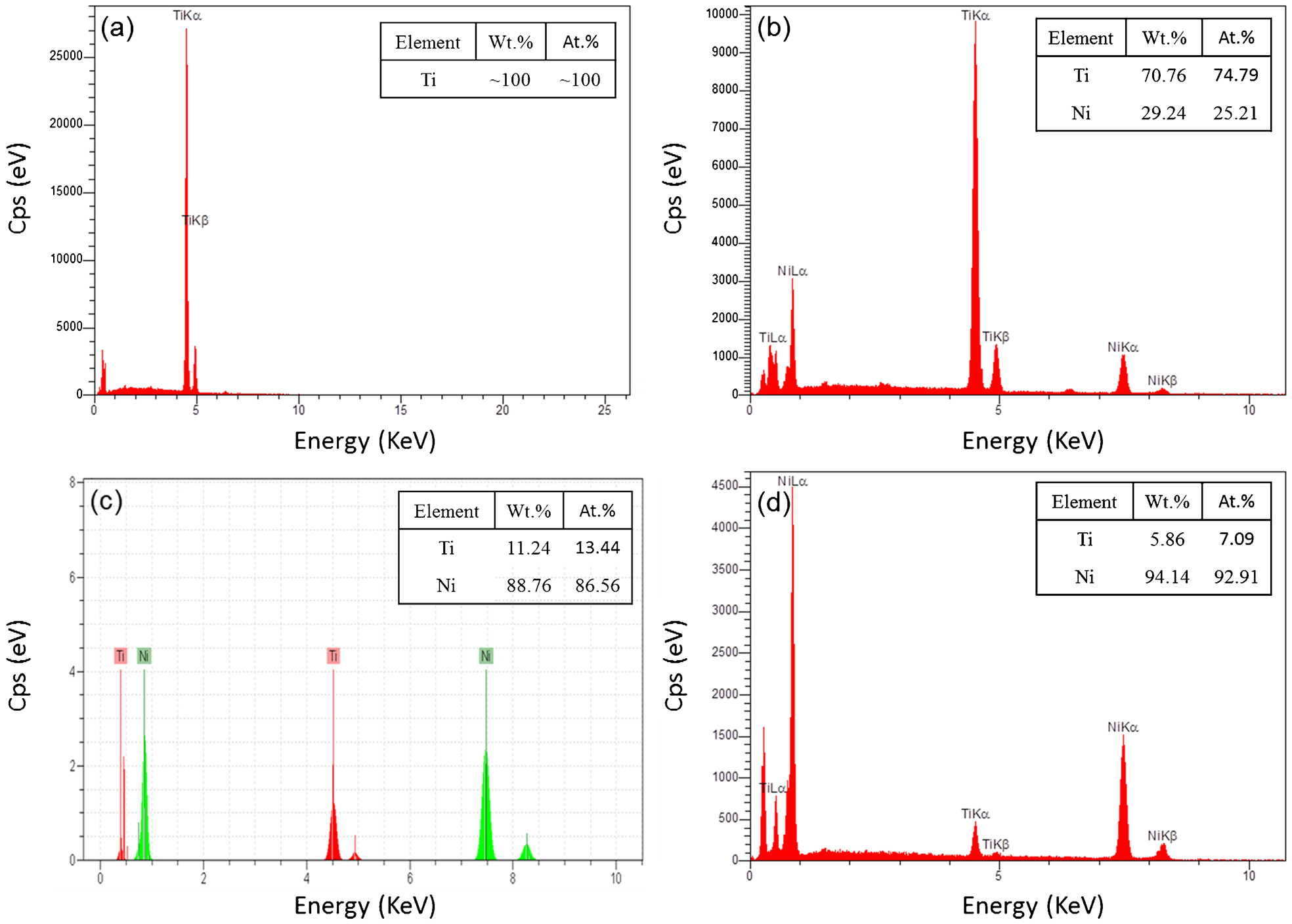
Energy dispersive spectroscopy data for a primary Ti powder, b Ti–Ni powder after 2 h plating, c Ti–Ni powder after 5 h plating and d Ti–Ni powder after 12 h plating
X-ray fluorescence data of Ti–Ni binary powder
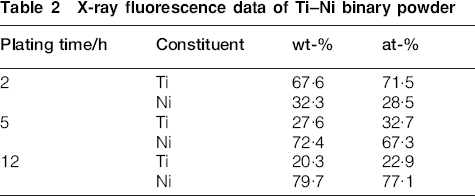
Based on XRF results, deposition rates of Ni for 2, 5 and 12 h plating time are ∼16·15, 14·48 and 6·64 wt-% h−1 respectively. The Ni deposition rate decreases as electroless plating time increases, as illustrated in Fig. 3. This may be due to the growth of powder particles and increasing surface of powder particles. In other words, when powder particles are bigger and the surface of the particles is larger, Ni deposition rate can be decreased. 31
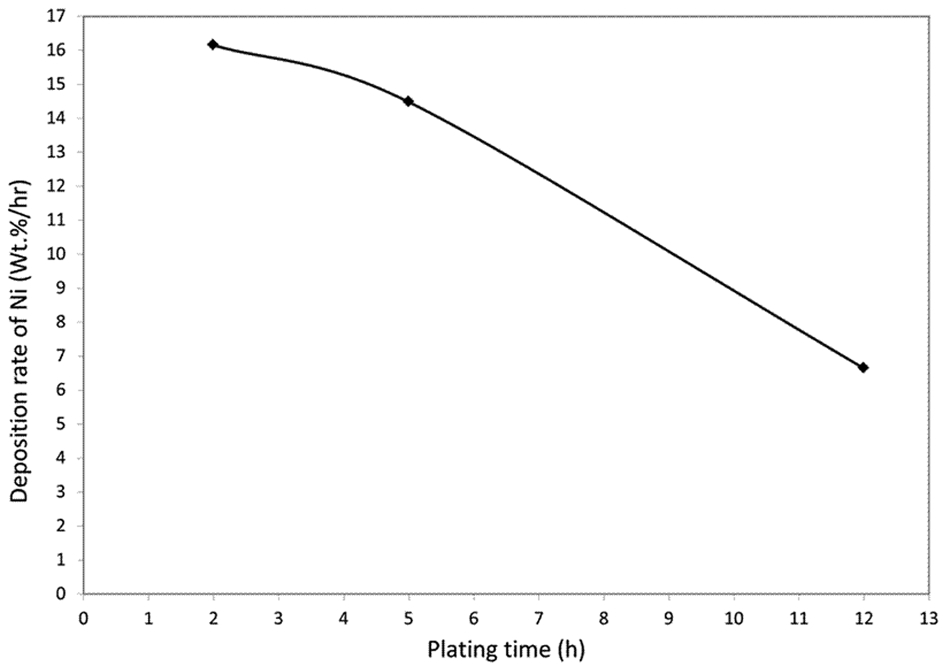
Effect of electroless plating period on Ni deposition rate
Effect of reductant concentration
The SEM images of Ti–Ni binary powders prepared in plating solutions with different reductant concentrations are shown in Fig. 4. Under low hydrazine concentration, a dense Ni layer is deposited on the Ti powder particles (Fig. 4a), whereas with high concentrations, the deposited Ni is heterogeneous (Fig. 4c). Higher reductant concentrations lead to releasing more nitrogen gas, according to the following reaction:

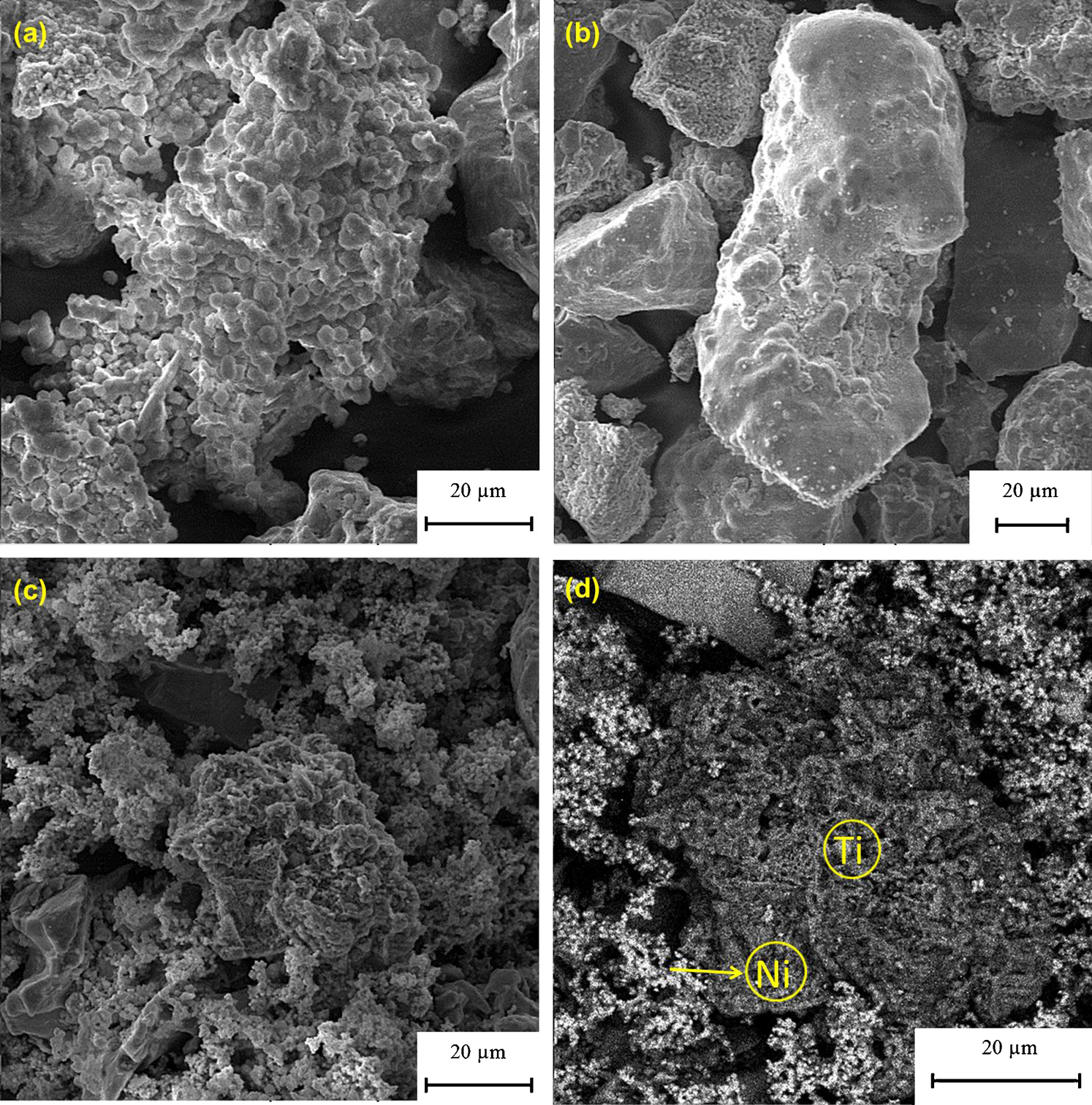
Images (SEM) of Ti–Ni powders prepared in various reductant concentrations a 20%, b 50% and c 80%; and d backscattering electron image of 80%
On the other hand, the Ni crystals grow at direction of released gas (perpendicular to the substrate). Therefore, as released gas increases, the Ni layer cannot laterally grow on the powder particles. In addition, as agglomeration degree of particles increases, powder uniformity decreases and porosity of Ni layer increases. The level of porosity in NiTi shape memory alloy may be controlled by porosity of Ti–Ni binary powder. This is an advantage or a hindrance depending on application of NiTi shape memory alloy. Increasing porosity of Ni layer can be useful, when shape memory alloy is used as hard tissue implants in biomedical engineering,5,6 whereas porosity is undesirable if alloy is utilised in smart structures and microelectromechanical systems.7–10
The EDS results presented in Fig. 5 reveal that the Ni value in Ti–Ni binary powder increases as reductant concentration increases. On the other hand, as seen in Fig. 4, in the plating bath with 80% reductant concentration, size of Ti–Ni particles is smaller. It is also observed in the backscattering electron image of the Ti–Ni powder (Fig. 4d) that the Ni (bright points) cannot deposit on Ti powder particles (dark areas) when the reductant concentration is 80%. Therefore, several agglomerated particles may be formed.
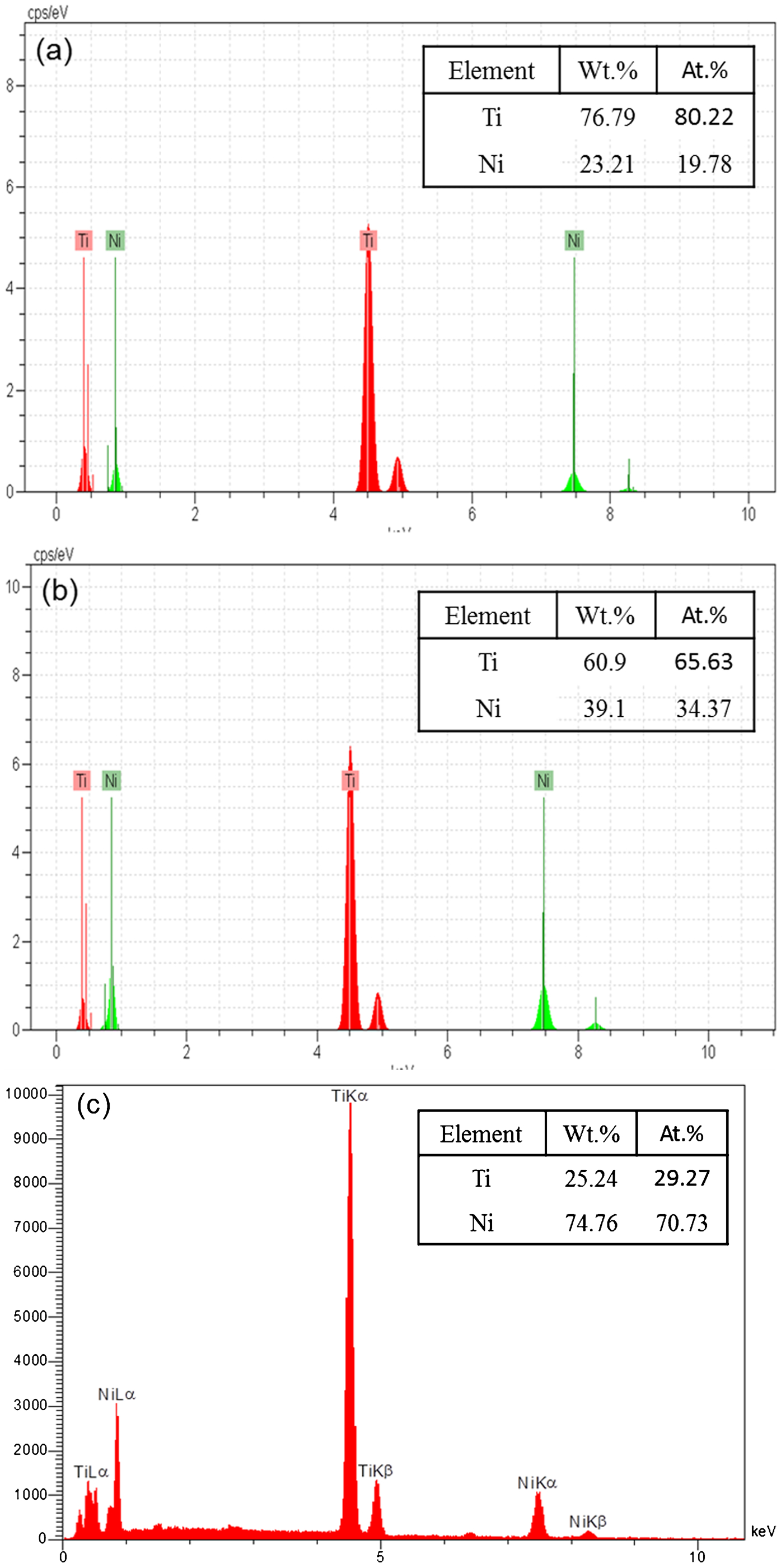
a 20%; b 50%; c 80%
As a result of EDS analysis, the atomic per cent of the Ni in composition of Ti–Ni powder can be ∼50% with adjusting reductant concentration in the range of 50–80%. Additional studies on reductant concentration–powder composition relationship demonstrate that the reductant concentration should be ∼65% to obtain atomic ratio of 1∶1 in the TiNi binary powder. However, this needs more investigations by XRF analysis to obtain more accurate values.
Deposition rates of Ni for 20, 50 and 80% reductant concentration are calculated ∼11·6, 19·55 and 37·38 (wt-% h−1) respectively. Figure 6 illustrates the effect of reductant concentration on Ni deposition rate. As shown, deposition rate increases as concentration increases and it is accelerated when the concentration reaches 80%. In these conditions, some of Ni ions do not deposit on the Ti powder. Instead, agglomerated Ni particles may be created.
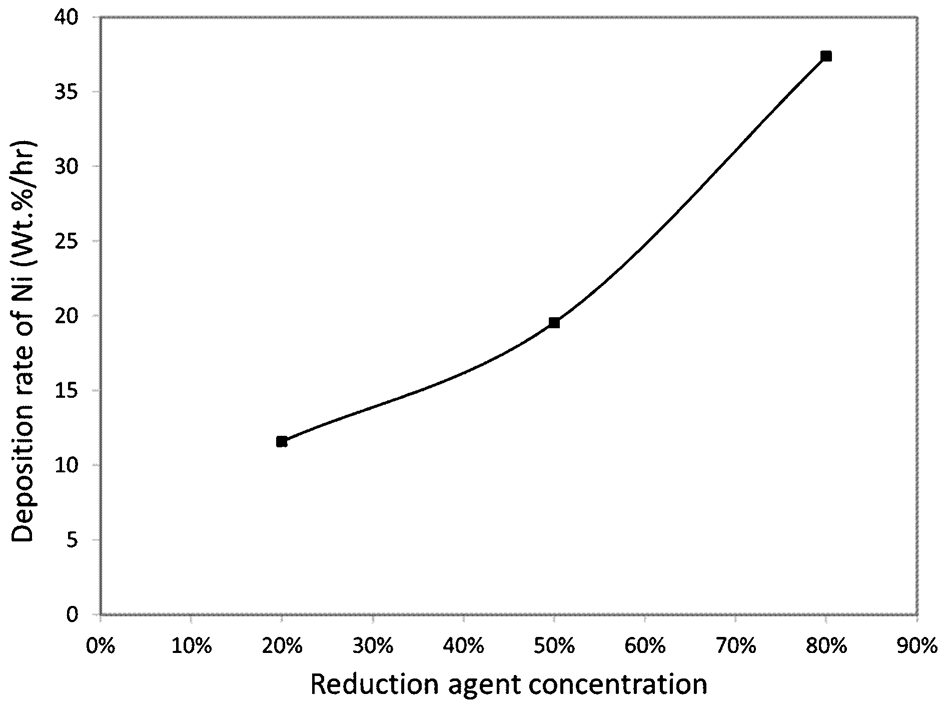
Effect of reductant concentration on Ni deposition rate
Conclusions
The Ni–Ti binary powder was successfully prepared by Ni electroless plating of Ti powder with hydrazine reductant. The main results can be summarised as follows.
The pure Ni layer with cauliflower shaped morphology is deposited on Ti powder particles.
The deposited Ni mass increases with increasing plating time. Subsequently, the thickness of Ni layer on the Ti particles increases. On the other hand, the deposition rate of Ni decreases as the plating time increases.
As hydrazine concentration increases, the Ni deposition rate increases due to releasing more ions in the bath solution.
An increase in hydrazine concentration decreases the uniformity of Ni layer as well as increases porosity of Ni layer; hence, the agglomeration degree of particles is raised.
Optimum concentration of reductant for electroless Ni plating of Ti powder is ∼50%. Under these conditions, a continuous/homogenous Ni layer is quickly formed on the Ti powder particles.