







Abstract
Additives usually affect the electrochemical corrosion behaviours of metals which are immersed in the electrolyte. In this study, five additives including thiourea (TU), thiosinamine (ATU), thiosemicarbazide (TSC), sodium benzoate (Bz) and sodium citrate (SC) were added into the electrolyte respectively to investigate the electrochemical corrosion behaviours of AZ91D magnesium alloy immersed in neutral 0·05 wt-%NaCl solution. Open circuit potential (OCP), potentiodynamic polarisation and electrochemical impedance spectroscopy (EIS) measurements were employed in the electrochemical tests. The results revealed that TSC showed a good inhibiting effect, and TU as well as ATU slightly improved the corrosion resistance of AZ91D magnesium alloy in the studied solutions. A negative inhibiting effect with the addition of Bz or SC was also observed. Moreover, the electrochemical results were analysed by computational chemistry method and ultraviolet absorption spectra, and the possible inhibiting mechanism was also discussed in detail.
Introduction
Among light metals, the density of magnesium alloys (1·74–1·85 g cm−3) is ∼35% smaller than Al based alloys and 65% smaller than that of Ti based alloys.1 As a consequence, the use of magnesium alloys can significantly reduce the weight of automobiles without sacrificing structural strength. Thus, magnesium alloys have wider applications in industrial branches due to its good engineering properties, such as high strength to weight ratio, low density, high dimensional stability, good electromagnetic shielding and damping characteristics, high stiffness, and good machining and recycling ability.2
–
6 Unfortunately, magnesium and its alloys are highly susceptible to corrosion, which greatly restricts their further applications, especially in electrolytes containing Cl−, Br−,
 , etc.7 Therefore, there is a great economic incentive in developing methods and materials to alleviate the corrosion of magnesium alloys. The use of additives is one of the most practical methods for protection against corrosion, especially in solutions. Thus, it is necessary to investigate the corrosion behaviours of the alloys in NaCl solution containing various additives.
As is well known, the lone pair and π bond in the molecule structure are susceptible for the additives to be chemically adsorbed on the metal surface,8 which make the additives act as inhibitors and reduce the corrosion rate of the metal in electrolytes. Thus, five additives containing lone pair or π bond were chosen for the experiments in the present study.
Thiourea and its derivatives are widely used as acid inhibitors to protect metals and alloys in industrial operations, such as pickling, descaling, cleaning and acidisation of oil wells.9 A probable reason for inhibition by thiourea and its derivatives could be found in its coverage of the entire surface sites, and more active in the process of discharge. By covering the surface, the molecules of the thiourea and its derivatives drive away the water molecules and, hence, change the composition of the electrical double layer through which the electron exchange takes place.10 The inhibiting effects of benzoate compounds on aluminium alloys have been studied in some papers. 11 11,12 Benzoate compounds offer interesting possibilities for corrosion inhibition effect, due to their security in the applications and high solubility in water.12 Corrosion inhibition effect of benzoate and benzotriazole on mild steel has been studied by electrochemical measurements.13 Citric acid is a renewable raw material and absolutely non-toxic, and it is naturally occurring, e.g. in lemon juice. It has been studied previously because of its inhibiting effect for aluminium pigments in different publications.14 – 17 However, there are few investigations about the electrochemical corrosion behaviours of AZ91D magnesium alloy in NaCl solution containing different additives.
A Chinese factory has entrusted us to study the corrosion behaviours of AZ91D magnesium alloy in the solutions containing thiourea (TU), thiosinamine (ATU), thiosemicarbazide (TSC), sodium benzoate (Bz) and sodium citrate (SC). In the present work, the electrochemical corrosion behaviours of AZ91D magnesium alloy in 0·05 wt-%NaCl solution with different additives, such as TU, ATU, TSC, Bz and SC, was investigated by electrochemical techniques, including open circuit potential (OCP), potentiodynamic polarisation and electrochemical impedance spectroscopy (EIS). Computational method, as a dependable method to analyse the adsorption properties of the additives, was also introduced to demonstrate the results of the above experiments. This study is focused on the effects of the five additives on AZ91D magnesium alloy; the information can provide references for industrial applications, especially in the automobile industry that it could reduce the weight of cars and save energies. Besides, it can also give a guide for developing other additives against the corrosion of magnesium alloys in electrolytes containing Cl−.
Experimental
Materials
The substrate material used for the present investigation was AZ91D die cast magnesium alloy. The chemical composition of the alloy is given in Table 1. The specimens, which were sealed by epoxy with an exposed area of 1 cm2, were first mechanically polished by SiC papers of successively finer grit down to 1500 grit, degreased by ethanol in an ultrasonic bath for 10 min, rinsed in distilled water and then dried in air. Solutions were prepared using AR grade chemicals except sodium benzoate using CP grade and distilled water. The authors have not used fine polishing to make mirror finish before the experiments.
Chemical composition of AZ91D magnesium alloy studied (wt-%)

Experimental techniques
The effects of the five additives including TU, ATU, TSC, Bz and SC on the corrosion behaviours of the specimens in 0·05 wt-%NaCl solution were investigated by electrochemical tests. The molecular structures of the five compounds are shown in Fig. 1.
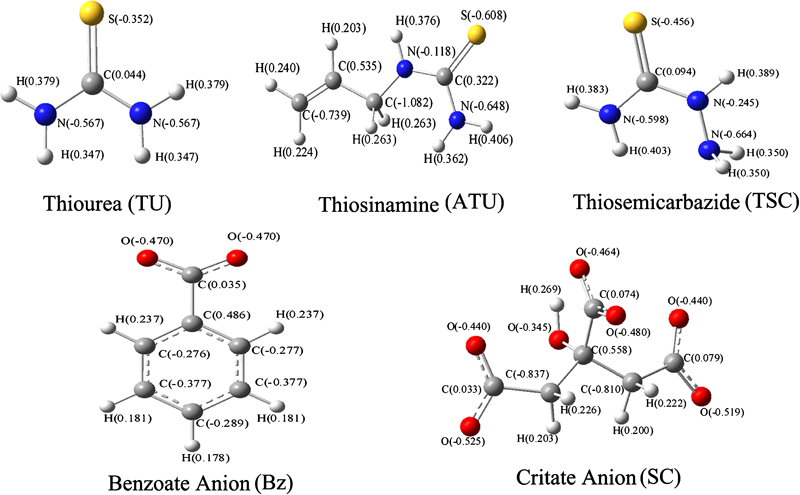
Molecular structures of five additives
The OCP, potentiodynamic polarisation curves and EIS tests were carried out by CHI660c system (Chenhua, Shanghai, China). A conventional three-electrode cell, with the specimens as working electrode, a saturated calomel electrode (SCE) as reference and a platinum sheet as counter electrode, were employed in these tests. The specimens were immersed in the solutions for ∼30 min before each test, allowing the system to be stabilised. The test electrolyte was neutral 0·05 wt-%NaCl solution and the test temperature was maintained at 25±2°C. At least three specimens were measured for each recipe. The potential was scanned from −1·7 to −1·1 V with a scanning rate of 1 mV s−1. The employed amplitude of sinusoidal signal in EIS measurements was 5 mV, and the frequency range studied was from 105 to 10−2 Hz. The acquired data were curve fitted and analysed using ZsimpWin 3·10 software.
The computational method and ultraviolet absorption spectra were introduced to analyse the theoretical facticity. All structures of the five additives were completed by program G03.18 The geometry structure was optimised full degree of freedom at the basis of ‘B3lyp/6-311+g*’ using density functional theory19 of the three-parameter non-local exchange functional B3LYP method,20,21 and also carried out at its vibration frequency analysis at the same level. Ultraviolet absorption spectra of the solution with various additives before and after the immersion of the specimens were recorded using UV-2550 ultraviolet spectrophotometer (Shimadzu Co. Ltd, Kyoto, Japan) and an F-2500 spectrofluorophotometer (Hitachi, Tokyo, Japan) respectively. The slit in the solid fluorescence spectrum tests was 5/5 nm (EX/EM) and PMT was 400 V.
Results and discussion
Open circuit potential
OCP gives information about the ‘natural’ corrosion behaviours of the specimens undisturbed by any external voltage or current source, i.e. in the absence of induced corrosion effects. This technique was introduced to study some aspects of the chemical stability and corrosion process of the surface layers on the specimens. Figure 2 shows the variational trends of OCP as a function of immersion time for the specimens in 0·05 wt-%NaCl solution without and with different additives.
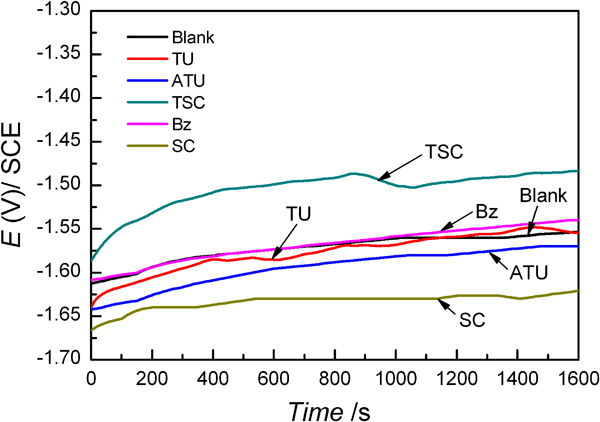
Open circuit potential versus time for specimens immersed in 0·05 wt-%NaCl solution without and with 0·005M selected additives
It can be seen that the OCP in 0·05 wt-%NaCl solution with and without additives increased with increasing immersion time, while the initial potential of each specimen was different, and then a steady state was obtained. Generally speaking, the increase in the OCP value suggests the enhancement of passivation properties and the weakening of the electrochemical corrosion tendency.22 The steady state potential of the specimens immersed in the solution with TSC as an additive was found noble in comparison to the specimens immersed in the blank solution, indicating that the specimens presented lower corrosion susceptibility23,24 in the former solution. The steady state potentials of the specimens in the blank solution and the solutions with TU or Bz as additives remained almost the same level, suggesting that the specimens presented almost the same electrochemical corrosion tendency in these solutions. However, the steady state potential of the specimens in solutions with SC or ATU as additives was negative in comparison to the blank solution, which indicated that using SC or ATU as additives would probably enhance the electrochemical corrosion tendency.
Potentiodynamic polarisation
The polarisation test is a method of investigating the corrosion behaviours of metallic materials from the relation between the current density and the potential scanned artificially. The current density directly indicates the dissolution of metallic ions from the materials into the electrolyte, namely, the state of corrosion.25 The effects of the five additives on the corrosion behaviours of the specimens were investigated by potentiodynamic curves.
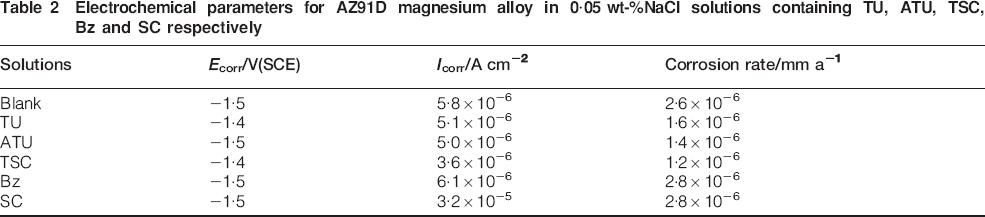
Figure 3 shows the electrochemical results obtained from the polarisation studies for the specimens immersed in 0·05 wt-%NaCl solution with the addition of different additives, and the concentration of the additives is 0·005M. Corrosion current density icorr, corrosion rate and corrosion potential Ecorr calculated from the polarisation curves using CHI660c system (Chenhua) are summarised in Table 2. It is found that the specimens immersed in the solution with TSC as the additive exhibited the noblest Ecorr, the smallest icorr and corrosion rate implying that TSC had the best positive effect on the inhibition of the active corrosion of the specimens. However, with the addition of SC and Bz as the additives, the Ecorr decreased and icorr began to increase indicating the negative effect of SC and Bz, meanwhile a highest corrosion rate was observed for SC, then followed by Bz. From the data listed in Table 2, it also can be seen that the differences of Ecorr and icorr between the specimens in the blank solution and in the solution with ATU and TU as additives were small, but the specimens in the blank solution had a highest corrosion rate among the three solutions, which indicated that the effects of ATU and TU on the electrochemical corrosion behaviours of the specimens in the solution were not obvious. As shown in Fig. 3, two broken lines were seen above −1·3 mV for blank curves, one broken line around −1·2 mV for TSC curve. As far as we know, one broken line around −1·3 mV for blank line may be related to accumulation of corrosion products, and the other broken line around −1·2 mV for TSC may be related to breakdown of the adsorption layer on the metal surface.
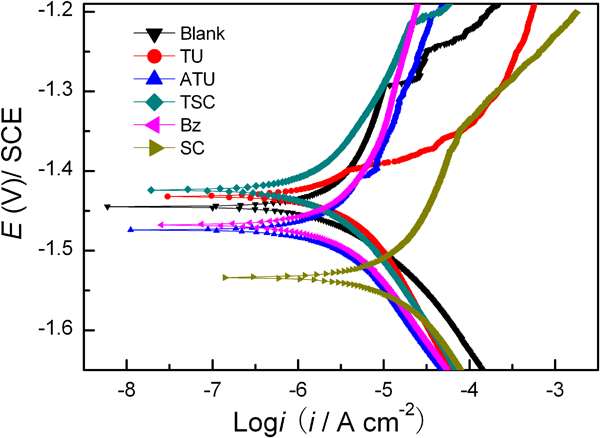
Potentiodynamic polarisation curves for specimens in 0·05 wt-%NaCl solution without and with 0·005M selected additives
Electrochemical parameters for AZ91D magnesium alloy in 0·05 wt-%NaCl solutions containing TU, ATU, TSC, Bz and SC respectively
Electrochemical impedance spectroscopy
EIS is a non-destructive technique which uses an electrochemical cell and an applied alternating potential to determine the dependence between the circuit impedance and the frequency.26 – 29 In this section, in order to further study the effects of these additives on the electrochemical corrosion behaviours of the specimens, different concentrations of these additives were also considered.
The effect of five additives including TU, ATU, TSC, Bz and SC on the electrochemical corrosion behaviours of AZ91D magnesium alloy was displayed in Fig. 4 in the form of Nyquist plots.
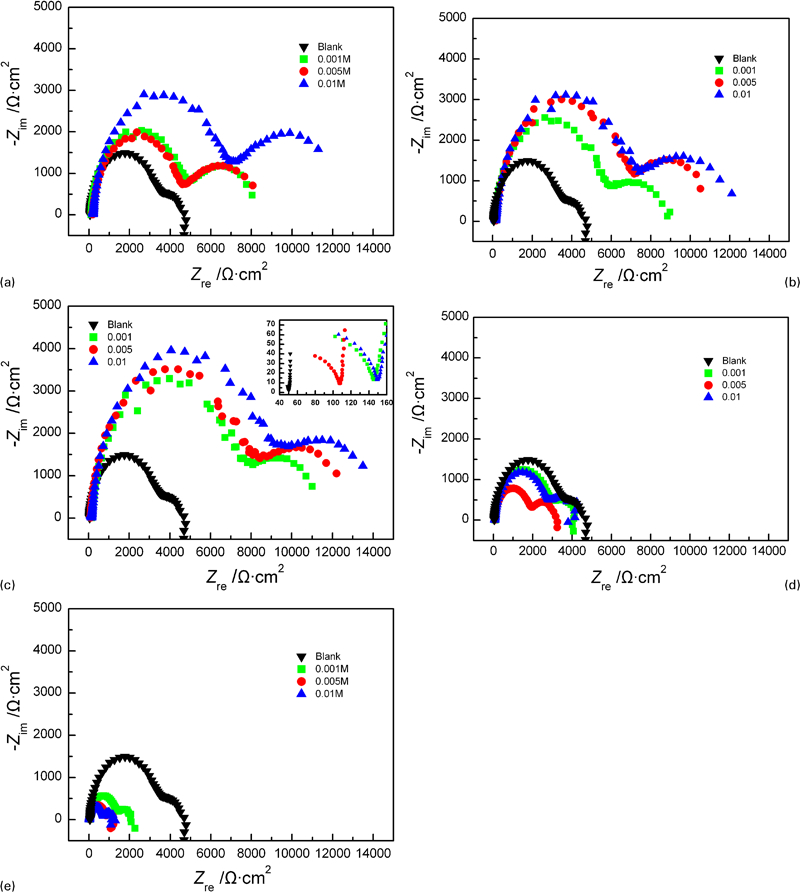
Nyquist plots for specimens in 0·05 wt-%NaCl solution without and with different concentrations of a TU, b ATU, c TSC, d Bz and e SC
It also can be seen from the Nyquist plots that, when TU, ATU and TSC were employed as additives, the total impedance of the corrosion system increased with increasing additive concentration, and the value was higher than that of the specimens in the blank solution, indicating that TU, ATU and TSC can enhance the corrosion resistance of AZ91D magnesium alloy in the 0·05 wt-%NaCl solution. The total impedance of the specimens in the solution containing Bz initially decreased with increasing additive concentration, and with the further increase of the additive concentration, the value began to increase. The total impedance in the solution containing SC initially remarkably decreased with increasing additive concentration, but with the further increase in the additive concentration, the decrease in total impedance was not obvious. Moreover, the total impedance of the specimens in solutions with Bz and SC as the additives was smaller than that of the specimens in the blank solution, suggesting the stimulative effect on the corrosion of AZ91D magnesium alloy.
Two obvious capacitive loops are obviously observed at the intermediate and low frequency ranges of the Nyquist diagrams displayed in Fig. 4. The first capacitive loop at the high frequency range cannot be observed due to its much smaller diameter compared with that of other two capacitive loops, which can be indicated from the enlarged Nyquist diagrams as shown in Fig. 4c. Three capacitive loops represent three constant times which indicate three relaxation processes. The electrochemical equivalent circuits (Fig. 5) and sketch map (Fig. 6) which were used to explain the corrosion behaviours of the specimens in the selected solutions were also present. Rs represents the solution resistance, and a constant phase element Q, which replaces the capacitance of the double layer Cdl due to the roughness and inhomogeneity of the electrode surface as reported elsewhere, 26 26,30 is introduced.
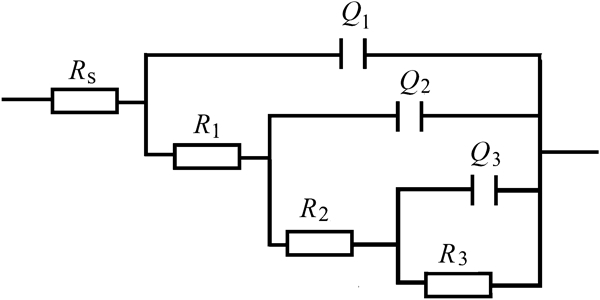
Equivalent electrical circuit used for fitting experimental results
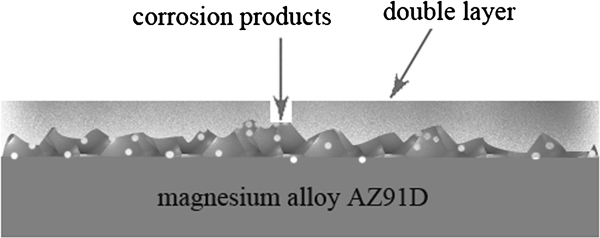
Schematic model of adsorbed layer
The circuit for the blank solution is composed of three time constants: the high frequency range time constant, represented with the combination of R1
Q1, is probably attributed to the formation of a separated physical layer on metals surface,31 and the intermediate frequency range time constant, represented with the combination of R2
Q2, reflects the properties of corrosion product layer. The low frequency time constant, represented with the combination of R3
Q3, may be due to the active corrosion of the specimens.
32
32,33 As to the specimens immersed in 0·05 wt-%NaCl solution containing different additives, the high frequency range time constant, represented with the combination of R1
Q1, corresponds to the adsorption layer and corrosion products layer, and the intermediate frequency range time constant, represented with the combination of R2
Q2, reflects the double layer capacitance and charge transfer resistance. The low frequency time constant, represented with the combination of R3
Q3, may be due to the electrode Faraday process, i.e. dissolution of AZ91D magnesium alloy.26 The impedance of constant phase element (CPE) is given by the following equation
26
26,34

Figure 7 shows the Bode plots for specimens in 0·05 wt-%NaCl solution without and with 0·01M additives. The EIS parameters fitted from Fig. 7 is listed in Table 3. The total polarisation resistance Rp of the corrosion system can be described as follows26

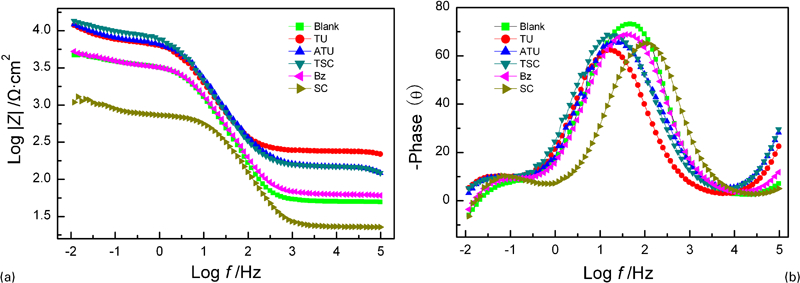
Bode plots for specimens in 0·05 wt-%NaCl solution without and with 0·01M additives
Electrochemical equivalent circuit parameters for AZ91D magnesium alloy in 0·05 wt-%NaCl solution with and without 0·01M additives
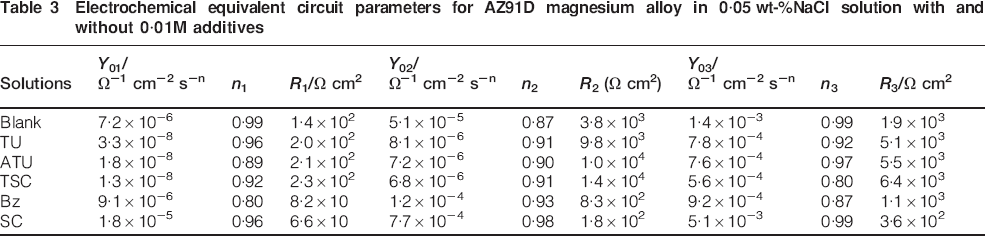
From the impedance analysis mentioned above, it can be concluded that TU, ATU and TSC had positive effects on the improvement in the anticorrosive properties of AZ91D magnesium alloy, whereas Bz and SC showed negative effects.
Explanation of proper mechanism
To further analyse the experimental results obtained from the electrochemical measurements above, the computational method and ultraviolet spectroscopy were introduced to achieve a proper theoretical support. It is proposed that the additives with good adsorb ability will form a compact film directly on the specimens, thus providing a better protective property for the specimens. However, if the additives will react with the specimens and achieving compounds, then it could not accelerate the corrosion of the specimens. Thus, it is allowed to analyse the adsorb ability and reaction properties of the additives on the specimens to deduce their protective properties.
One of the determinants for the additives adsorbing onto the surface is the adsorption sites in the structure of the additives. Table 4 shows the detail information of the computational results for all the structures of the five additives which were completed by program G0318 and the electron structures of the additives have been shown in Fig. 1. From the adsorption sites of each additive in Table 4, it can be seen that N atoms are better coordination sites than S (see TSC and TU), and there is four adsorption sites in TSC, one more than its derivatives ATU and TU, indicating that TSC is propitious to adsorb onto the metal surface. For ATU, which owns the same number of adsorption sites with TU, there is a C = C double bond and it probably facilitates the adsorption. Thus, for thiourea and its derivatives, TSC showed the best protective effects for the specimens than ATU and TU. However, O atoms with smaller electron cloud densities indicated that the adsorption ability of Bz was worse than those of TU and its derivatives.
Computational results for all structures of five additives
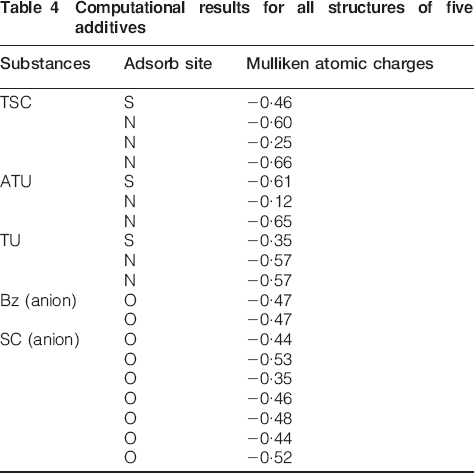
The other determinant on adsorption ability is the radius of the atom conterminous to the specimens, the more semblable radius of the atom to magnesium, the easier for the atom adsorbing onto the specimens. From the data of the radii, only small difference between the atom S (88 pm) and Mg2+ (72 pm) can be seen, compared with that of the atom O (48 pm), which can deduced that the adsorption site S is easier to adsorb onto the specimens than adsorption site O. Consequently, TU should be easily adsorbed onto the surface of the magnesium alloy than Bz and it is also reasonable that the protective effect of TU is better than that of Bz. In addition, the influence of MgO and Mg(OH)2 surface films on the adsorption and inhibition of these additives is a important factor. Bz and SC are strong base weak acid salts and they may facilitate the pitting corrosion because of the porous surface films, whereas TU and its derivatives are neutral.
Ultraviolet spectroscopy was used to investigate the solutions with each additive before and after the immersion of the specimens to understand how the reactions occurred between the additives and the specimens, which is shown in Fig. 8. It can be seen from the insert graph of Fig. 8 that the absorption bands of TSC are of no difference, which are the same as those of TU, ATU and Bz. In contrast, a significant red shift phenomenon of absorption bands in the UV spectra can be seen in the solution with the addition of SC. Furthermore, the absorption intensity is also greatly enhanced, which indicates that SC reacted with the specimen and formed a compound. The formation of the compound between SC and the specimen leads to the dissolution of the specimen which is against the protective property.
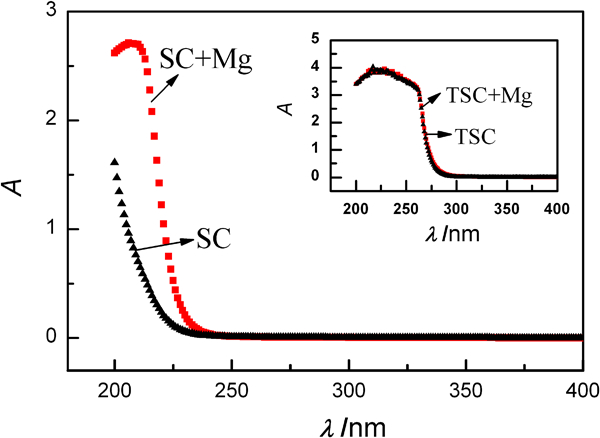
UV-vis absorption spectra of solutions with different additives before and after immersion of specimens
It is obvious from the above analysis that the protective effects of TU and its derivatives can be ordered in the following sequence: TSC>ATU>TU. However, Bz and SC had no protective effect. This protective effect was consistent with the experimental results obtained by electrochemical measurements, and also confirmed by the computational method and ultraviolet spectroscopy in this section.
Conclusion
In this paper, the influences of the five additives on the electrochemical corrosion behaviours of AZ91D magnesium alloy in neutral 0·05 wt-%NaCl solution were examined using OCP, potentiodynamic polarisation and impedance measurements. Computational method and ultraviolet absorption spectra were also introduced to further analyse the experiment results obtained from the electrochemical measurements. As to TU and its derivatives, TSC showed a good positive inhibiting effect, and TU and ATU slightly improved the corrosion resistance of AZ91D magnesium alloy in neutral 0·05 wt-%NaCl solution. A negative inhibiting effect with the addition of Bz and SC was also observed.
The computational method and ultraviolet spectroscopy analysis showed that SC possessed many adsorption sites, but it reacted with the alloy forming ionic compounds and accelerated the corrosion. Among the other four additives, TSC had the most adsorption sites and exhibited the best protective effect, then followed by ATU and TU, whereas Bz had no significant effect.
From this study, it is easy for users to find electrochemical corrosion information about the five additives on AZ91D magnesium alloy, and it can also provide guidance for developing other additives against corrosion in electrolytes containing Cl− so as to improve the implications of magnesium alloys in industry, especially in light weight products. Then we could save the energy and protect our environment.
Footnotes
Acknowledgements
The authors thank the supports of the Natural Science Foundation of Chongqing, China (no. SCTC. 2005BB4055) and High-Tech Cultivation Program of Southwest Normal University (no. XSGX06).