







Abstract
Fluorinated acrylate microemulsion was prepared via co-polymerising methyl methacrylate, butyl acrylate and dodecafluoroheptyl methacrylate that were stabilised by polyethylene glycol mono-p-nonyl phenyl ether and sodium dodecyl benzene sulphonate and initiated by potassium persulphate. Many factors, which had an influence on the particle size and its distribution, had been investigated. It was possible to produce nanoparticles <100 nm and with narrower size distributions using the semicontinuous seeded emulsion polymerisation. Fourier transform infrared spectroscopy confirmed the structure of the microemulsion. The appearance of the microemulsion was translucent and accompanied with blue fluorescence. The stability of the microemulsion was very high. The solid content of the microemulsion was 38·65%. The contact angle of the film was not very high.
Introduction
Microemulsions are at least ternary mixtures of two immiscible liquids stabilised with a surfactant or a mixture of surfactants. They are isotropic, transparent or translucent and thermodynamically stable.1 Microemulsions are widely used in the pharmaceutical, cosmetic and oil industry, as well as for textile finishing, as detergents and as adsorbents in the environmental management. Because of their well defined nature such as lower viscosity, greater stability and transparency due to uniformly dispersed smaller droplets, microemulsions have been used as potential media for polymerisation to prepare nanosize thermodynamically stable polymer latex within the size range of 10–100 nm and with narrow size distribution that are not easily obtained from other systems. This is the reason why microemulsion polymerisation has attracted great interest and becomes an increasingly growing field of research in polymer synthesis.2 – 16
By far, the monomers most extensively studied by microemulsion polymerisation are focused on acrylate,2 – 6 styrene7,8 or their combinations (co-polymers).9 – 15 However, the microemulsion co-polymerisation of methyl methacrylate (MMA) and butyl acrylate (BA) in the presence of fluorinated monomer, such as dodecafluoroheptyl methacrylate (DFMA), has scarcely been reported. This paper presents an attempt to prepare the fluorinated acrylate microemulsion (see Fig. 1). The emphasis is put in the present work on the different parameters influencing the particle sizes and their distribution of fluorinated acrylate microemulsion. The fluorinated acrylate microemulsion with smaller particle size and its distribution is obtained from our present work.
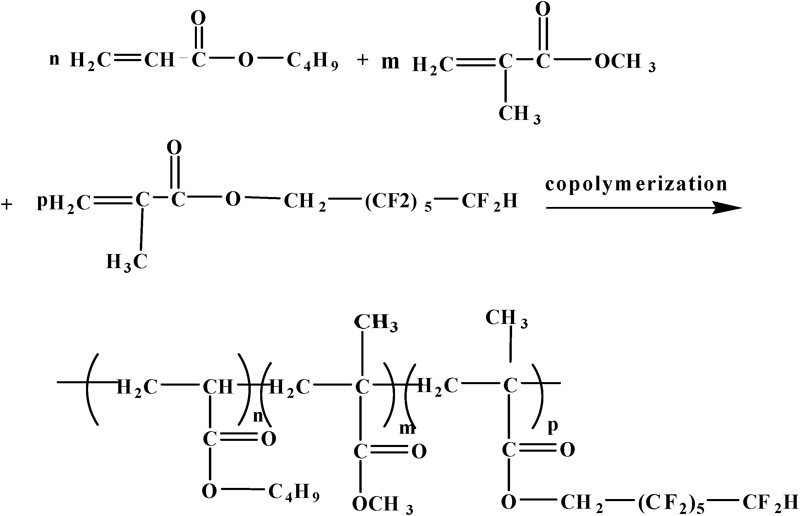
Synthesis pathway of fluorinated acrylate microemulsion
Experimental
Materials
Butyl acrylate and MMA, which were chemically pure grade, were obtained from Wulian Chemical Plant, Shanghai, China. They were purified further by distillation under reduced pressure before use. Dodecafluoroheptyl methacrylate, which was industrial grade, was purchased from Harbin Xeogia Fluorine-Silicon Material Co., Ltd. Potassium persulphate (K2S2O8), which was analytically pure grade, was obtained from the Second Chemical Reagent Factory in Yixin (China). Sodium bicarbonate (NaHCO3), which was analytically pure grade, was purchased from Hongguang Chemical Plant Co., Ltd in Shanghai (China). Polyethylene glycol mono-p-nonyl phenyl ether (OP-10) and sodium dodecyl benzene sulphonate (SDBS) were industrial grade. The water used in this experiment was first distilled followed by deionisation.
Microemulsion co-polymerisation
Microemulsion co-polymerisation via semicontinuous seeded emulsion polymerisation
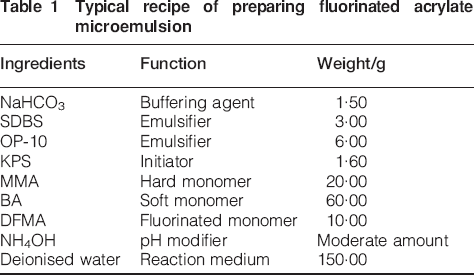
The polymerisations were realised in an oil in water system. The mixed monomers consisted of BA, MMA and DFMA. The typical microemulsion polymerisation recipes are given in Table 1. A homogeneous aqueous solution containing 120·00 g of deionised water, 1·50 g of NaHCO3, 6·00 g of OP-10 and 3·00 g of SDBS was charged into a 250 mL four-neck flask equipped with reflux condenser, mechanical stirrer, dropping funnels and heated with the water bath. The stirring speed was maintained at 200 rev m–1 throughout the runs. The reactor temperature was increased to 80°C within 30 min. An initiator solution containing 0·40 g of potassium persulphate (KPS) and 5·00 g of deionised water and a monomer mixture containing 15·00 g of BA, 6·00 g of MMA and 2·00 g of DFMA were charged to the reactor to form the seed latex within 15 min. The seeded polymerisation was continued for an additional 10 min. At that point, the initiator solution containing 1·20 g of KPS and 25·00 g of deionised water and monomer emulsion stock solutions containing 45·00 g of BA, 14·00 g of MMA and 8·00 g of DFMA were added slowly to the reactor using two separate dropping funnels. The feeding time for the initiator and the monomer emulsion stock solutions were 3·5 and 3·0 h respectively. After the feed was completed, the temperature was raised to 90°C and maintained for another 30 min to increase monomer conversion. The latex was then cooled to below 40°C, and NH4OH (25 wt-%) was added to increase pH to ∼8·0. Finally, the mixture in the flask was cooled and filtered. Thus, the fluorinated acrylate microemulsion was obtained.
Typical recipe of preparing fluorinated acrylate microemulsion
Microemulsion co-polymerisation via batch emulsion polymerisation
The recipe of preparing the microemulsion is the same with Table 1. The mixed monomers, emulsifiers, initiator and deionised water were charged into three-mouth flask equipped with reflux condenser, mechanical stirrer. The reaction temperature is raised to 80°C with water bath under the condition of agitation. The polymerisation continued for 3 h. Then, the temperature was raised to 90°C and maintained for another 30 min to increase monomer conversion. The latex was then cooled to below 40°C, and NH4OH (25 wt-%) was added to increase the pH to ∼8·0. Finally, the mixture in the flask was cooled and filtered. Thus, the fluorinated acrylate microemulsion was obtained.
Characterisation
The average particle size, the particle size distributions and zeta potential were determined using a Zetatrac dynamic light scattering detector (Microtrac Limited Corporation, USA) at 25°C. The power and the wavelength of the diode laser used in the dynamic light scattering measures were 3 mW and 780 nm respectively. Particle size distribution was characterised with the dispersion degree F. The calculated equation was the following

A Fourier transform infrared spectrometric analyser (Thermo Nicolet AVATAR370, USA) was used to analyse the chemical structures of the latex films. The contact angle between film and water was determined with the DataPhysics contact angle meter (OCA-20, Germany) at room temperature.
Results and discussion
Emulsion polymerisation technology
The influence of different emulsion polymerisation technologies on the particle size and its distribution is shown in Fig. 2. Figures of particle size of microemulsion are obtained from Microtrac Software automatically. The solid line in this figure indicates the accumulation of the particle size. Figure 2a is the particle size and distribution of the microemulsion prepared with the semicontinuous seeded emulsion polymerisation. Figure 2b is the particle size and distribution of the microemulsion prepared with the batch emulsion polymerisation. Figure 2 shows that the particle size and distribution of microemulsion prepared with the semicontinuous seeded emulsion polymerisation are smaller than the one of the microemulsion prepared with the batch emulsion polymerisation. This may be explained by the following facts. The monomers are added into the polymerisation system, and the drops of the monomers are formed under the condition of agitation when the batch emulsion polymerisation is used to prepare the microemulsion. The emulsifiers in the water phase can be absorbed by the drops of the monomers, and the emulsifiers on the latex particles nearby are also seized by them. Even part of the latex particles is inhaled and dissolved in the drops of the monomers. At this time, the drops of the monomers become larger and are hard to diffuse quickly. In addition, the coalescence occurs easily among the increased latex particles because there are no sufficient emulsifiers to cover the drops. Thus, the particle size and the distribution of the microemulsion are bigger. However, the polymerisation always advances in the starved monomer addition mode during the course of dripping the monomers when the semicontinuous seeded emulsion polymerisation is used to prepare the microemulsion. At this time, the probability that the droplets of the monomers turn into the monomer storage becomes smaller, and the probability of the droplet nucleation is increased. Therefore, the number of latex particles in the system is increased, and the particle size and the distribution of the microemulsion are smaller. Thus, the semicontinuous seeded emulsion polymerisation is adopted to prepare the microemulsion in our work.
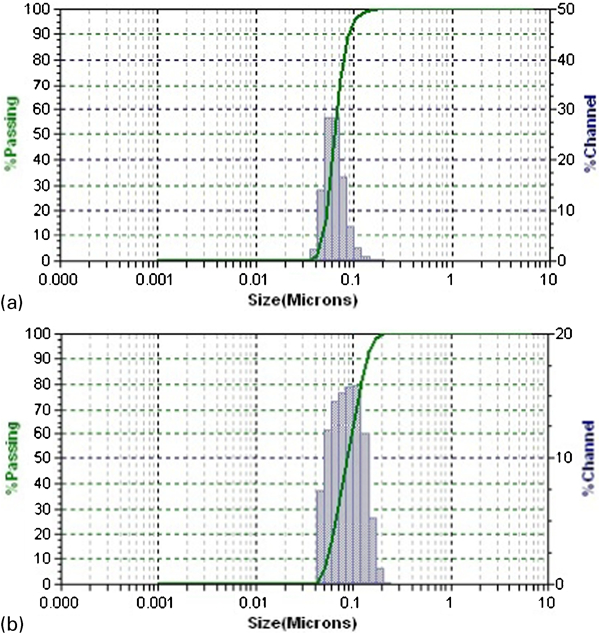
Particle size and distribution of latex: a Mv = 0·0662 μm, F = 1·16; b Mv = 0·0915 μm, F = 1·26
Amount of emulsifier
The effect of the amount of emulsifier on the particle size and distribution of the microemulsion is given in Fig. 3. Figure 3 indicates that the particle size of the microemulsion is decreased with the increase in the amount of emulsifier. However, its distribution is increased with the increase in the amount of the emulsifier. This may be caused by the fact that the higher the micelle concentration in the system is, the more the number of the nucleated latex particles is when the amount of the emulsifier is increased. At the same time, the probability of the collision among the latex particles is increased, and a small amount of the latex particles is easy to aggregate into the latex with the larger particle size. Thus, the particle size distribution of the microemulsion is widened. However, emulsifiers can also have adverse effects on the microemulsion properties. The non-polymerisable emulsifiers adsorbed onto the surfaces of the latexes may desorb, resulting in latex destabilisation when the microemulsion is subjected to freeze and thaw cycles, applied shear stress or high levels of electrolyte. Thus, the amount of the emulsifier should be controlled strictly during the course of preparing the microemulsion.
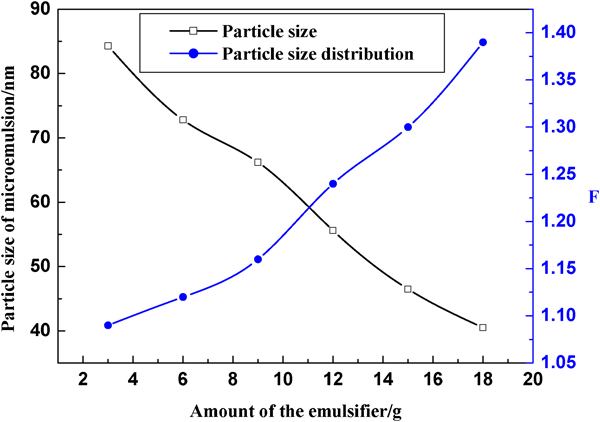
Variation of particle size and distribution of microemulsion with amount of emulsifier
Amount of initiator
The influence of the amount of the initiator on the particle size of the microemulsion is given in Fig. 4. Figure 4 shows that the particle size of the microemulsion is decreased with the increase in the amount of the initiator when it is <1·20 g. However, the particle size of the microemulsion is increased with the increase in the amount of the initiator when it is >1·20 g. This phenomenon can be explained by the following facts. The concentration of the initiator is increased with the increase in the initiator and the concentration of the free radical in the water phase is also increased accordingly, thus, causing the particle size of the microemulsion to decrease when the amount of the initiator is <1·20 g. However, the excessive initiator accelerates the nucleation rate in the system, and the number of the droplet is increased when the amount of the initiator is >1·20 g. It is easy to collide and aggregate among the droplets. In addition, the polymerisation rate is increased by the excessively high concentration of the initiator. The liberated heat of polymerisation accelerates Brownian motion among the latex particles, and the probability of collision among the latex particles is increased, thus causing the particle size of the microemulsion to increase. The corresponding temperature in Fig. 4 is 80°C. From Fig. 4, there exists an optimum point. However, the temperature has an obvious influence on the emulsion polymerisation, which has been studied in our previous work. The conversion rate of mixed monomer is very low when the temperature is <80°C, and the amount of initiator is fewer. It is uncertain that the optimum point exists for all other temperatures.
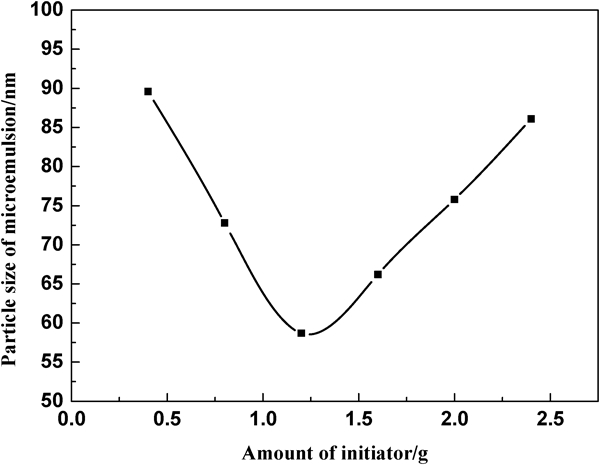
Influence of amount of initiator on particle size of microemulsion (reaction temperature = 80°C)
Polymerisation temperature
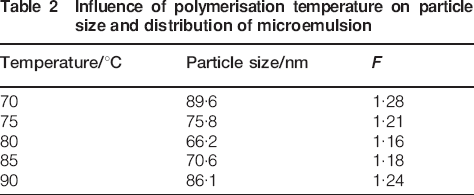
The influence of the polymerisation temperature on the particle size and its distribution is given in Table 2. Table 2 shows that the particle size and its distribution are decreased with the increase in the polymerisation temperature when it is <80°C. However, the particle size and its distribution are increased with the increase in the polymerisation temperature when it is >80°C. This may be probable that the formed reaction centre in the nucleation stage is increased by the increased decomposition rate of the initiator, thus causing the particle size to decrease and its distribution to be uniform when the polymerisation temperature is raised below 80°C. The excessively fast decomposition rate results from the higher polymerisation temperature, which accelerates the formed rate of the free radical and latex particles when the polymerisation temperature is >80°C. Thus, the latex particles with different particle sizes are formed in the nucleation stage. At the same time, the latex particle is easy to soften because of high temperature. The probability of collision among the latex particles during the course of polymerisation is increased, thus causing the particle size of the microemulsion to increase.
Influence of polymerisation temperature on particle size and distribution of microemulsion
Fourier transform infrared spectroscopy of microemulsion
The Fourier transform infrared spectroscopy of the film of the microemulsion is shown in Fig. 5. In Fig. 5, 2957 and 2873 cm−1 were the characteristic stretching peaks of C–H (CH3,CH2), 1731 cm−1 was the stretching vibration of C = O, 1455 cm−1 was the distortion vibration of –COO–, 1386 cm−1 was the flexural vibration peak of C–H in CH3, 1234 cm−1 was the stretching vibration of C–F bond, 1163 cm−1 was the stretching vibration peak of C–H and 842 cm−1 was the stretching vibration absorption peak of C = O in the acrylic group. The Fourier transform infrared spectroscopy data confirm that three kinds of monomer such as BA, MMA and DFMA all take part in the co-polymerisation reaction, and fluorinated acrylate microemulsion has been prepared.
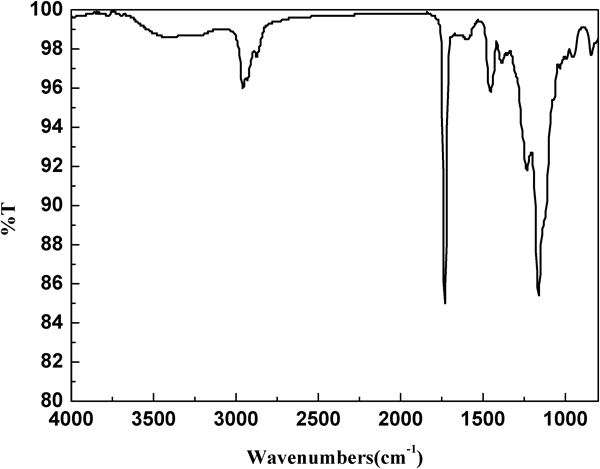
Fourier transform infrared spectroscopy of film of fluorinated acrylate microemulsion
Properties of fluorinated acrylate microemulsion and its film
Properties of the fluorinated acrylate microemulsion, which is prepared with the semicontinuous seeded emulsion polymerisation according to Table 1, are tested. The appearance of the microemulsion is translucent and accompanied with blue fluorescence because of its smaller particle size. The stability of the microemulsion is very high because its zeta potential is −59·76 mV. The solid content of the microemulsion is 38·65%.
Contact angle is a typical property to understand the surface energy of film of the microemulsion. The hydrophobic property of a polymeric film can be estimated in terms of contact angle measurement by depositing a water drop on the surface of film and the value of contact angle depends on the chemical compositions of the film surface.17 – 19 The higher the wetting resistance of film surface, the higher the contact angle. The contact angles are shown in Fig. 6. The contact angle of the film is not very high because of desorption of emulsifiers from the particles of the latex and their migration in the film of the latex. The presence of surfactants in film forming polymers can confer water sensitivity on the film, which is a drawback for protective coatings.
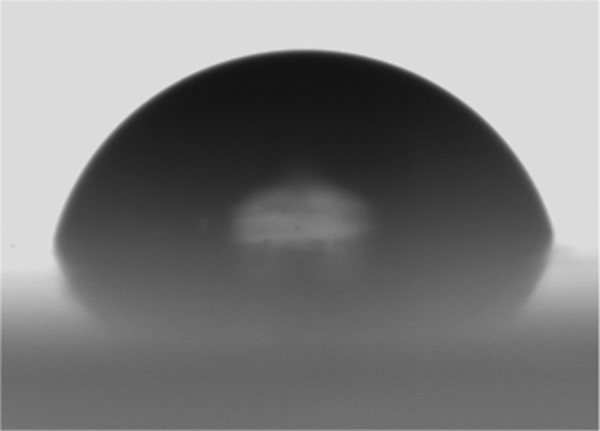
Contact angle of film of microemulsion (contact angle = 80·7°)
Conclusion
The fluorinated acrylate microemulsion with smaller particle size and distribution is prepared successfully with the semicontinuous seeded emulsion polymerisation of BA, MMA and DFMA. The appearance of the microemulsion is translucent and accompanied with blue fluorescence. The stability of the microemulsion is very high. The solid content of the microemulsion is 38·65%. The contact angle of the film is not very high.
Footnotes
Acknowledgements
This work has been supported by the Science and Technology Department of Zhejiang Province under grant no. 2010C31040. In addition, the financial support of Zhejiang Provincial Natural Science Foundation of China (grant no. Y4100152) and Zhejiang University of Technology Natural Science Foundation (grant no. 20100202) are gratefully acknowledged. We are very grateful to all the members of our discussion group for their beneficial comments.