







Abstract
In this study, phytic acid pretreatment is used as a substitute for toxic chromate pretreatment to improve the corrosion resistance of organic coating on AZ91D magnesium alloys. The microstructures of phytic acid conversion films are observed by a transmission electron microscope. The role of phytic acid pretreatment on the corrosion resistance of organic coating is investigated using salt spray test and electrochemical impedance spectroscopy. The experimental results show that the phytic acid conversion film exhibits a dense amorphous structure and phytic acid pretreatment can effectively improve the corrosion resistance of organic coating on magnesium alloys.
Introduction
Magnesium alloys have a widely applied prospect and practical value, but poor corrosion resistance largely limits their real applications.1, 2 Therefore, suitable surface treatments have been used to enhance the corrosion resistance of the magnesium alloys, which are necessary and also important.3, 4 Many kinds of surface treatment processes have been reported up to now, such as chemical conversion coating,5 anodising,6 plasma electrolytic oxidation coatings,7 electroless nickel plating,8 and chemical vapour deposition,9 as well as selected etching surface treatment.10 Organic coating is one of the most important anticorrosion methods with advantages of low cost and simple process.11, 12 However, it is difficult to obtain good organic protective coating on magnesium alloys by directly coating technology because of the electrochemical activity and casting defects of magnesium alloys.13 It is necessary to choose an appropriate pretreatment to ensure good adhesion and good corrosion resistance on the surface of magnesium alloy. Among various surface pretreatment techniques for organic coating, chemical conversion films have attracted special interest due to its uniform deposition, good adhesion and the low cost.5, 13 Therefore, the study of chemical conversion films on magnesium alloys has attracted much more attentions. Many kinds of methods have been proposed for chemical conversion processing of magnesium alloys, such as chromate,14 permanganate,15 silicate,16 titanate,17 rare earth salts18 and organic acid.19 Chemical conversion film treatments such as chromates or permanganates all cause severe pollution to the environment for they contain heavy metal ions although these techniques are comparatively mature. Chromate conversion films contain Cr6+, which not only causes pollution, but also severely affects the recycling of magnesium alloy. The application of phosphate treatment is restricted by its poor stability and liquid waste that cause nutrient enrichment in water body. For the reasons above, it is urgent to find a kind of non-toxic, environment friendly conversion film with excellent protective performance in the industrial application of magnesium alloy. Phytic acid is a kind of natural and non-toxic organic phosphate compound. The peculiar structure of phytic acid has powerful capability of chelating with many metal ions to form chelate compounds. Therefore, it can be used instead of the toxic chromate solution to prepare conversion films.20 The surface of phytic acid conversion film is rich in hydroxides and phosphates, which are significant to improve the bond between magnesium alloy substrate and organic coating. Therefore, phytic acid conversion film is expected to be used as the excellent base of magnesium alloy organic coating system to replace the traditional magnesium alloy/chromate conversion film/organic coating protection system. At present, the relative literatures have not been reported. This paper tentatively discusses the preparation of a new protection system: magnesium alloy/phytic acid conversion film/organic coating, and testifies its protective performance by salt spray test and electrochemical test.
Experimental
Die cast AZ91D [Mg–9Al–1Zn (wt-%)] plates (50×50×3 mm) were used as the substrate. Before the conversion treatment, all samples were grinded with the emery paper to 2000 grit, washed with acetone and deionised water, and then dried with hot air. Phytic acid is a chemical reagent, purity >75%, and other materials are all analytical reagents, purity ⩾99%. The parameters were as follows: concentration of 5 g L−1, pH value of 8, time of 15 min and room temperature, all optimised by the orthogonal test.
In order to simplify the research process, the varnishes without any pigment were used as organic coating on magnesium alloys. Because the corrosion products of magnesium alloys were alkaline, the epoxy varnish coating with good alkaline resistance was adopted. Epoxy varnish consisted of the film forming material and a curing agent. The epoxy varnish was brushed on the surfaces of AZ91D magnesium alloys with and without phytic acid pretreatment respectively. The coatings were fully dried under the relative humidity of 30%. The average thicknesses of the coatings were 40±5 μm.
The structures of phytic acid conversion films were investigated by a transmission electron microscope. All the electrochemical experiments were carried out in a 3·5%NaCl solution at room temperature with the electrochemical system (Parstat 2273, Princeton Applied Research). The surface area of the working electrodes was 20 cm2. Ag/AgCl electrode was used as the reference electrode and a platinum plate with a surface area of ∼9 cm2 was used as the auxiliary electrode. The electrochemical impedance spectroscopy (EIS) measurements were conducted at the open circuit potential of the alloys in a frequency range of 10−2–105 Hz. The perturbation amplitude was 10 mV.
According to ASTM B117, the neutral salt spray was carried out in a 3·5% NaCl solution at the temperature of 40±2°C, and a pH value of 7·2.
Results and discussion
Structural characteristics of phytic acid conversion film
Figure 1 is the typical high resolution transmission electron microscopy (HRTEM) morphology and the corresponding selected area diffraction (SAD) pattern of the phytic acid conversion film. From the HRTEM image (Fig. 1a), it can be seen that the conversion film is compact and uniform. The structure of the conversion film is amorphous as shown in the SAD pattern in Fig. 1b.
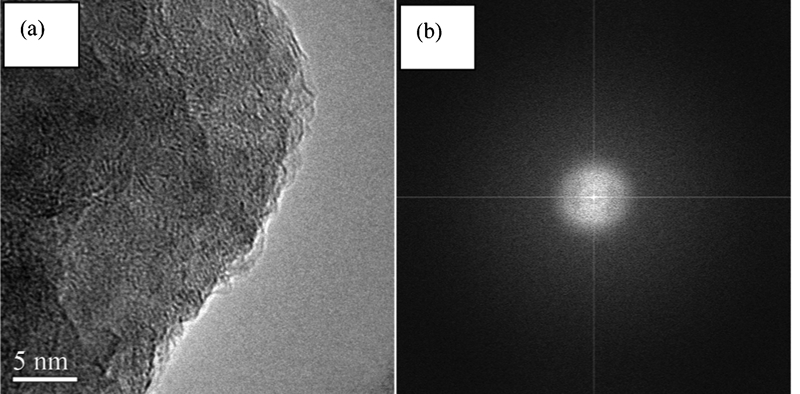
Transmission electron microscopy characterisation of phytic acid conversion film
Salt spray test results of organic coating
The open circuit potentials of organic coatings with and without phytic acid pretreatment on AZ91D magnesium alloys during the salt spray test are shown in Fig. 2. The phytic acid pretreatment makes the open circuit potential of the organic coating shift positively ∼300 mV. In addition, the open circuit potential almost remains stable with the test time prolonging. However, the open circuit potential of the organic coating without pretreatment drops sharply with increasing salt spray time at the initial stage, then stabilises gradually at a relatively low potential. It can be concluded that phytic acid pretreatment can improve the corrosion resistance of organic coating on magnesium alloys.
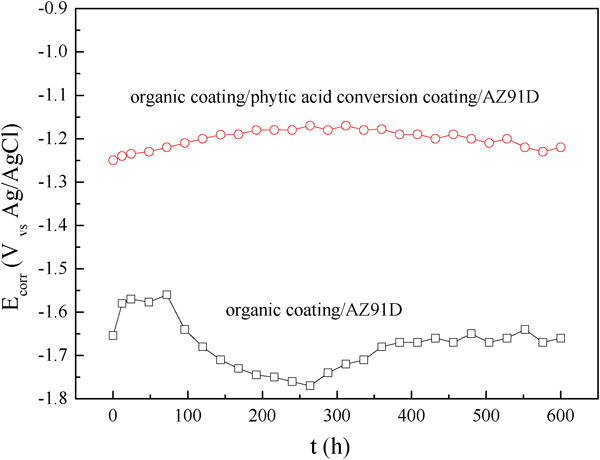
Variation of open circuit potential of organic coating in salt spray test
Electrochemical corrosion behaviour of organic coating
The EIS results of organic coatings on magnesium alloys with and without phytic acid pretreatment immersed in a 3·5% NaCl solution for different times are shown in Figs. 3 and 4. At the initial immersion stage, the organic coatings on magnesium alloys with and without phytic acid films only have a single capacitance loop, but the impedance value of organic coatings with phytic acid films increases about three orders of magnitude, compared with that without phytic films. The results show that phytic acid conversion coating used as a pretreated film can significantly enhance the media shield performance of organic coating system.
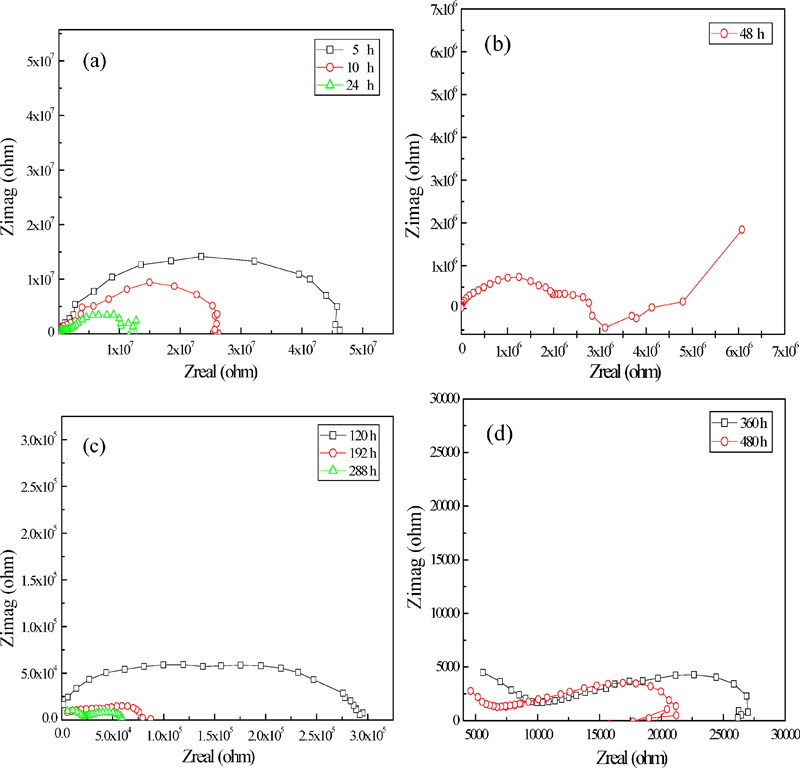
Electrochemical impedance spectroscopy results of organic coatings on magnesium alloy without phytic acid pretreatment in 3·5%NaCl solution for various times
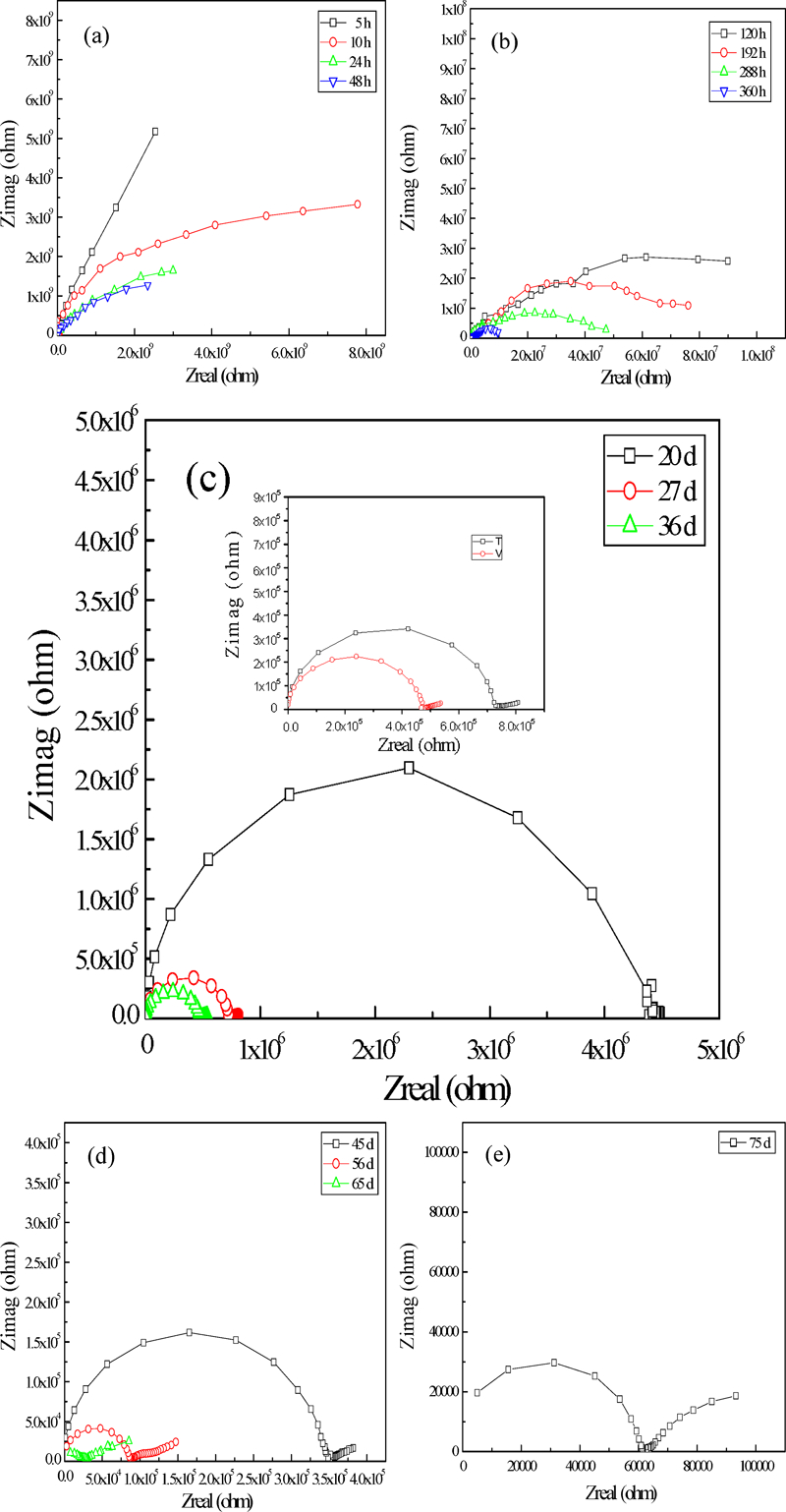
Electrochemical impedance spectroscopy results of organic coatings on magnesium alloy with phytic acid pretreatment in 3·5%NaCl solution for various times
After two days’ soak, the diffusion control characteristics begin occurring on the direct painting samples, which indicates that the corrosive solution has already infiltrated to the interface between the magnesium alloy and organic coating. At the same time, the corrosive reaction begins, leading to the occurrence of corrosive patterns on the surface of direct painting samples by and by. The reasons why diffusion control characteristics emerge are due to the shortage of the reactant, because the chemical and the electrochemical activity of magnesium alloys are very high. However, during the same soak time, the Nyquist figure (such as Fig. 4a) of the painting sample with phytic acid conversion film is still a single capacitive loop, and the impedance value is far bigger than that of the direct painting sample, which indicates that the double protective layer is still effective and the corrosive solution is shielded. The phytic acid conversion film is more compact and has a better cohesion than the autoxidation film of magnesium, which is an important reason why the organic coatings with phytic acid film have more excellent protection effects.
After these two types of painting samples being dipped in a 3·5%NaCl solution for 20 days, the diffusion features occur on the impedance results of the painting samples with phytic acid conversion film, but no corrosion appears. Whereas, the double capacitive loop characteristics come forth on the direct painting samples only after five days’ soak. The occurring of double capacitive loops usually indicates that the shield capability of coating has been weakened, and the accumulation of corrosion products on the interface reduces the activity of matrix metal gradually, and the corrosion process has changed from diffusion control to activation control. Comparing with the painting samples with conversion film, the above mentioned characteristics do not occur until they are dipped for 60 days. The diffusion control time of the painting sample with phytic acid conversion film is much longer than that of the direct painting samples. It also further proves that the painting sample with phytic acid conversion film has more excellent protection ability than the direct painting samples for those corrosive media. For the latter, the corrosive medium has already infiltrated to the interface between organic coating and magnesium.
In order to further clarify the function of conversion film on magnesium alloy, their different equivalent circuits are adopted to express the corrosion reaction process, and the electrochemical impedance spectra data are simulated by the ZsimpWin software. The varieties of the coating capacitance and resistance with time are shown in Fig. 5. The change trends of capacitances are similar for these two coatings, increasing first and then keeping stable. However, the coating capacitances with phytic acid pretreatment are always smaller than those without acid pretreatment. The change trends of resistance are opposite to those of capacitances, decreasing with time, and the coating resistance with phytic acid pretreatment is always bigger than that without phytic acid pretreatment. The coating resistance is usually used to evaluate the coating corrosion resistance. The results show that phytic acid pretreatment can significantly increase the corrosion resistance of the painting samples.
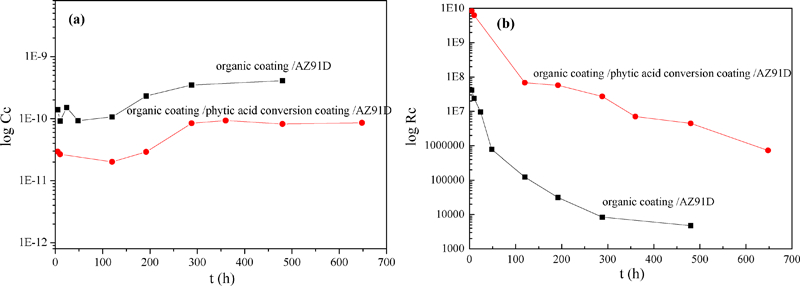
Electrochemical impedance spectroscopy results of organic coating immersed in 3·5% NaCl solution for various times
Conclusions
This paper studies the effect of phytic acid conversion films as pretreatment films on the performance of organic coating on the surface of AZ91D magnesium alloy through transmission electron microscopy, salt spray test and electrochemical test, and achieves the following conclusions after a profound analysis of the mechanism.
Phytic acid conversion film is compact and uniform. The structure of the conversion film is amorphous.
Phytic acid conversion film makes the open circuit potential of coating system increase by 300 mV. The open circuit potential maintains stable with test time going, which can improve the protective performance of coating system to a large degree; while the open circuit potential of magnesium alloy with coating only decreases drastically at the initial stage of salt spray, then keeps steady.
The corrosion resistance of coating samples with conversion film is greatly improved compared with that without film. The coating resistances of the two systems both gradually decrease along with the increase in soak time. However, around the same time the resistance of samples with film is always larger than that without film. The coating capacity of the two systems gradually increases along with the increase in soak time, but the increase in sample capacity with film is slower in comparison and requires more time to achieve stability. This indicates that phytic acid conversion film, as a depositing base, can remarkably improve the media shield performance of coating system.
Footnotes
Acknowledgements
This work was financially supported by National Natural Science Foundation of China (grant no. 50905038) and the Fundamental Research Funds for the Central Universities (grant no. HEUCF 101018).