







Abstract
The annealing parameters play a vital role in determining and understanding the microstructures and mechanical properties of Ta–Mo nanostructured coatings in the annealing processes. This investigation aims at finding the best annealing parameters and predicting the behaviour of the annealing parameters during the preparation of Ta–Mo coatings by cosputtering deposition. This study reveals that phase transformation and grain growth of the coatings were strongly dependent on the annealing processes. Low temperature annealing process within 600°C can increase the hardness H and elastic modulus E due to the increased grain size and decreased crystal defect. However, severe oxidation occurred in the coatings by the high temperature annealing process that exceeded 700°C. Finally, a three stage model related to the low and high temperature annealing mechanisms of Ta–Mo coating was proposed.
Introduction
In recent years, nanostructured materials such as molybdenum and tantalum have attracted a great deal of attention because of its variety of applications.1, 2 The intermetallic compound (metastable Ta–Mo phase) possesses many attractive properties, such as low density, high hardness, high melting point (approximately 1873–2073 K), good oxidation resistance3, 4 and metal-like electrical and thermal conductivity.5
Hence, several attempts have been made to develop highly corrosion resistant and oxidation protection coatings that have been used on Ni based and Ta based superalloys.6 In addition, Ta–Mo coatings have also been used for a wide variety of engineering applications such as under layers in magnetic recording media because of their high electrical and thermal conductivities.7
Despite the fact that the development of Ta–Mo alloy coatings has produced a larger improvement in the corrosion resistance than that of pure zinc coatings,8, 9 further development for getting even better protective properties is of distinct commercial interest. Possibly, a relatively new codeposited method and an annealing process are the possible further routes to enhance the efficacy of simple monolithic Ta–Mo alloy coatings.10
It was reported that the mechanism of Ta–Mo nanostructured materials was strongly dependent on the composition and surface energy11 because of its complex components and low stability. At the same time, the change in the grain size essentially affected their physical properties.12, 13 In this case, the control of process such as the annealing temperatures and time is important for the industrial application of Ta–Mo nanostructured materials, as there is meager information only available in the literature.
In this paper, the annealing mechanisms and models of Ta–Mo nanostructured coatings using different annealing processes were investigated. The acquired results and related models would be feasible for their potential applications.
Experimental
Nanostructured Ta–Mo coatings were prepared through cosputtering of Ta and Mo targets with a diameter of 7·62 cm using magnetron sputtering system (FJL560D2). Silicon (100) wafers with a diameter of 10 mm and a thickness of 0·5 mm were used as substrates. The substrates were ultrasonically rinsed in acetone before deposition. The deposition chamber's base pressure was 2·2×10−4 Pa, and during deposition, the gas pressures were maintained constant at 1·0 Pa. The gas flowrate was set at 5·0×10−7 m3 s−1. The substrate to target distance was 140 mm. Deposition was performed at a substrate temperature of 25°C for 30 min. In this study, all samples of Ta–Mo coatings were prepared at Ta target power (73 W) and Mo power (54 W) in argon atmosphere. Finally, the coatings were annealed in vacuum at different temperatures (300, 500, 600, 700 and 800°C) for 60 min.
The surface morphologies and grain sizes of Ta–Mo coatings were examined by scanning electron microscopy (SEM-3400-N). X-ray diffraction (XRD) with Cu target (Rigaku D/max 2550) was used to determine the structures of Ta–Mo coatings at different annealing temperatures. The mechanical properties were studied with the hardness measurement of nanopress.
Results
Effect of annealing processes on phase transformation
Figure 1 shows the XRD spectra of Ta–Mo coatings at various annealing temperatures (as deposited, 300, 500, 600, 700 and 800°C). In the as deposited coating, the absence of shorter and broader peaks implied that the structure was amorphous. In the case of annealed coatings of 300°C, the formation of minor cubic phase-like Ta–Mo (110), (200) and (211) planes was observed. With the increase in annealing temperature to 500 and 600°C, Ta–Mo (110), (200) and (211) peaks in the spectra became much sharper, which indicated that better crystallinity and larger grain size of Ta–Mo particles were formatted at low temperature annealing processes not exceeding 600°C.14 It was also indicated that the Ta rich Ta–Mo alloy coatings had good thermal stability at low temperature annealing processes. Obviously, annealing processes would have an influence on grain diffusion and grain growth.15 The significant increase in the shape and intensity of Ta–Mo peak with annealing temperature implied that low temperature annealing process had a more obvious effect on the formation and growth of Ta–Mo phase. When the annealing temperatures increased to 700 and 800°C, Ta–Mo (110), (200) and (211) diffraction peaks disappeared completely, and there appeared strong hexagonal MoO2 and Ta2O5 diffraction peaks. It was clear that the high temperature annealing processes had a significant effect on the oxidation of Ta–Mo grain particles. It was due to the fact that the activation energy of oxidation was overcome by the increased thermal energy.
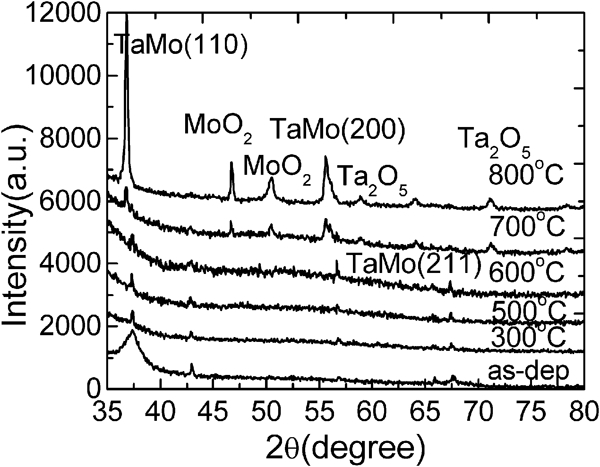
X-ray diffraction spectra of Ta–Mo coatings deposited at various annealing temperatures
Effect of annealing processes on grain growth
Figure 2 shows the surface morphologies of Ta–Mo coatings by SEM at various annealing temperatures. In the as deposited coating (see Fig. 2a), some large grains with well defined grain boundaries scattered in the Si substrate, while the vacancies among the grains were very large, which was due to the lattice mismatch between grains of Ta–Mo coatings and Si substrate. In addition, it can be seen in Fig. 2b that the Ta–Mo grains in the coating at 300°C seemed to be rather compact and dense although the sizes of grains became much smaller. Obviously, low temperature annealing process can make grain refinement and the defects reduced. Moreover, it can be found in Fig. 2c that the grain sizes started to increase when the annealing temperature was increased from 300 to 500°C. Furthermore, as shown in Fig. 2d, a few coarse grains appeared by the aggregates of some small grains at higher annealing temperature (600°C). As a result, it is reasonable to assume that sufficient thermal energy provided by higher annealing process could accelerate the grain growth and recrystallisation in the Ta–Mo coatings. However, it can be found in Fig. 2e and f that crystal defects and cracks appeared on the surface of 700 and 800°C annealed coatings, which implied that severe oxidation occurred in the coatings at the high temperature annealing processes exceeding 700°C. This result may be attributed to the fact that the microstructure would be damaged by the higher kinetic energies, which depend on processing parameters such as annealing treatment.16
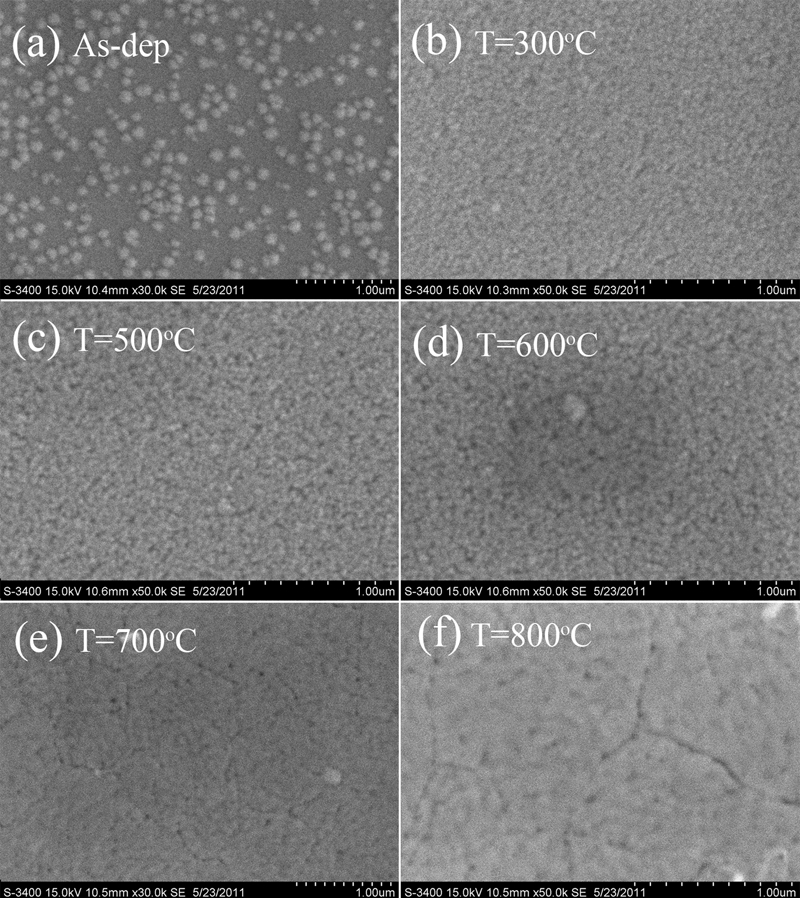
Images (SEM) of Ta–Mo coatings deposited at various annealing temperatures:
Effect of annealing processes on mechanical properties
Figure 3 shows the change in hardness H and elastic modulus E as a function of annealing temperatures. The results revealed that the as deposited Ta–Mo coating had far lower mechanical properties than the coatings annealed within 600°C. This could be due to the existence of amorphous phase, which is known to contribute negatively to the mechanical properties because of its weak localisation effect to nanoparticles. When deposited at 300°C, the film exhibited a hardness H of 11·8 GPa and an elastic modulus E of 166·2 GPa. It can be noted that the presence of recrystallisation and grain growth of cubic phase at this temperature hardly contributes to the high properties because the recovery of strain energy is not enough.17 As the annealing temperature increased to 600°C, the hardness H and elastic modulus E increased to the maximum values of 16·8 and 250·6 GPa, which were due to the increased grain size and decreased crystal defect, as indicated by XRD and SEM results. In addition, it can also be explained by the existing concepts on nanostructured mechanism18 that both dislocation formation and incoherence stress relaxation were suppressed to provide superhardness of the nanosized coatings.
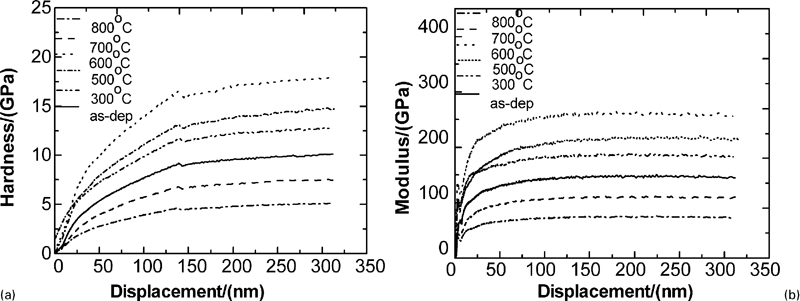
Variation in curves of Ta–Mo coatings deposited at various annealing temperatures:
Moreover, a further increase in annealing temperature at 700 and 800°C causes slight degradation of the mechanical properties. This decrease in hardness H and elastic modulus E is attributed to an increase in the contents of soft Ta2O5 and MoO2, which results in the decrease in hardness. These results are in accordance with the explanation of the possible mechanism proposed from the above result.
Possible model for annealing mechanism
It was reported by Stubicar et al.19 that the phase change of the two element alloy coatings during isochronal annealing proceeded through two stages, including cold and heat processes. However, three stages that occurred in the annealing can be proposed by our analysis in Fig. 4: during the first stage, which occurred at the lower annealing temperature, the process of separation (or segregation) of constituents took place, and as a consequence, metastable multiphase aggregates in the coatings; whereas, during the second stage, induced by annealing at higher temperature, the process of formation of intermetallic stable phases occurred.19 Finally, during the third stage, when the annealing temperature arrived at the oxidation temperature, the process of formation of the metal oxides occurred.
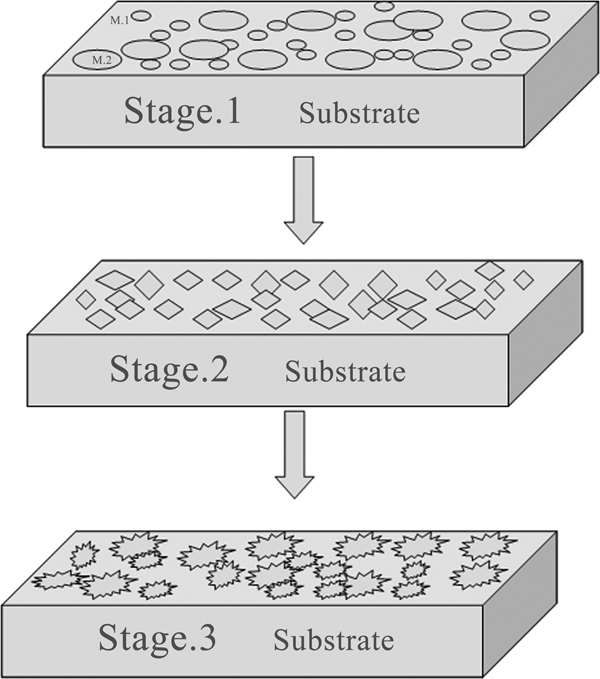
Annealing models of Ta–Mo coatings at various annealing temperatures
Conclusion
On the basis of the results ensuing from the present study on the annealing effect of phase transformation and mechanical properties of Ta–Mo nanostructured coatings, the following conclusions can be drawn.
The phase transformation from amorphous phase to cubic phase happened at low temperature annealing processes. However, the high temperature annealing processes had a significant effect on the oxidation of Ta–Mo grain particles.
The low temperature annealing process was found to be the key parameter on the grain growth and improvement of the crystalline. However, the high temperature annealing processes provide enough kinetic energy to induce severe oxidation.
The combination of cubic phase structures and fine grain size in the low temperature process contributed to the increase in the mechanical properties of Ta–Mo coatings. The annealing temperature of 600°C was believed to be the primary parameter driving the mechanical properties.
A three stage model related to the low and high temperature annealing mechanisms of Ta–Mo coatings was proposed. During the three stages, the formations of metastable multiphase, intermetallic stable phases and metal oxides occurred respectively.
Footnotes
Acknowledgements
This work was supported by the Shanghai Specialized Funds for the Outstanding Young Teachers in High Education Institutions (grant no. shgcjs021) and (grant no. shgcjs031) and the Academic Program of Shanghai Municipal Education Commissions (grant nos. 2011X34 and 11XK11).