







Abstract
Gadolinium based conversion coating, a new chemical protective coating for magnesium alloys, was prepared and its microstructure and corrosion resistance were investigated. The micromorphology, composition and elemental chemical states were observed by scanning electron microscope (SEM), X-ray photoelectron spectroscopy (XPS) and energy dispersive spectrometer (EDS) respectively. The corrosion resistance was evaluated by a potentiodynamic polarisation curve and electrochemical impedance spectroscopy. Nanomechanics integrated test system was used to represent the nanomechanical property and residual stress. The results indicate that the morphology of the coating is a cracked mud structure. The EDS and XPS results reveal that the coating is primarily made of magnesium and gadolinium oxides. Gadolinium coating forming mechanism can be generally divided into two periods: the dissolution of the substrate, the codeposition of Gd(OH)3 and Mg(OH)2. The potentiodynamic polarisation curve and electrochemical impedance spectroscopy (EIS) show that the coating can improve the corrosion resistance of magnesium alloys.
Introduction
Gadolinium is, with magnetic property, a trivalent metallic element of the rare earth group. It exists in silicon–beryllium–gadolinium ore, niobium–gadolinium ore and some other ores with the form of combination. It is also widely used in microwave technology, atomic energy industry, and making phosphor and special alloy.1 – 3 In dry air systems, gadolinium has good superconducting properties, high magnetic moment, room-temperature Curie points and better stability than other rare-earth elements.2, 3 The oxide of gadolinium, Gd2O3, has excellent oxidation resistance, corrosion resistance, flexural resistance, shear resistance and seismic performance.4 – 9 At present, gadolinium oxidation is mainly used to create an additive to improve the high temperature strength, tensile strength, corrosion resistance, resistivity and antioxidant capacity of alloys.8 – 11 Gadolinium can improve the mechanical properties and corrosion resistance of block magnesium alloys. Now, the applications and research on gadolinium for magnesium alloys are focused on the morphology, organisation, thermal stability and strengthening mechanism of gadolinium alloy phase, while an attempt to apply a Gd2O3 coating on a magnesium alloy as a surface protective coating has not been reported.10 – 13
In order to further expand the application of gadolinium in metal corrosion protection, a new surface treatment was proposed, with gadolinium oxides as an alternative to the toxic chromate based system. The microstructure, chemical composition and elemental and chemical states of the conversion coating were examined by scanning electron microscope (SEM), energy dispersive spectrometer (EDS) and X-ray photoelectron spectroscopy (XPS). The corrosion behaviour of the gadolinium coating in 3·5% NaCl solution was carried out using potentiodynamic polarisation and electrochemical impedance spectroscopy (EIS). Moreover, it is difficult to observe surface of the coatings in ordinary measures due to its lower hardness. Therefore, in this paper, nanoindentation properties and residual stress were studied via nanomechanics integrated system. Then the forming mechanism of gadolinium conversion coating was discussed based on the experimental results and analysis.
Experimental methods
Preparation of samples
The gadolinium conversion coating was deposited on the substrate of die cast AZ91. The test samples (15×10×5 mm) were polished using waterproof abrasive paper from 360 to 2500 grits, then fine polished using 3·5 μm diamond paste, subsequently degreased with absolute ethanol in an ultrasonic bath for 15 min and, finally, dried by cold air at room temperature.
The optimal technical parameters determined by the orthogonal experiment involved the gadolinium nitrate, Gd (NO3)3, with concentrations of 5 g L−1 and 20 mL L−1 of hydrogen dioxide solution, H2O2 (30%; Fisher Scientific), used as the accelerant. The obtained solution had been mixed for 5 min with a magnetic stirrer before deposition. The samples were immersed in the conversion solution at 50°C for 20 min. After all of these treatments, the samples were thoroughly rinsed with deionised water and then dried in cold air.
Testing of nanomechanical properties
The load–displacement variation of coatings was measured by TriboIndenter nanoindentation tester. And nanohardness, elastic modulus and surface morphology in three dimensions were obtained in this way. Meanwhile, indentation depth and contact area were obtained while the pressure head impressed were achieved through software equipped in the system. All these data were substituted in empirical formula and, at last, values of residual stress in gadolinium conversion coatings were investigated.
Characterisation of microstructure and corrosion resistance
The micromorphology was observed by an FEI Quant200 SEM equipped with EDS. The elemental chemical states of the conversion coating were studied by XPS. The anticorrosion performance was evaluated by recording the corrosion potential and corrosion current density of the samples in 3·5% sodium chloride (NaCl) solution upon immersion, which was conducted on a CHI660B electrochemical workstation. The electrochemical cell used a classic three-electrode system that consists of a reference electrode (a saturated calomel electrode), a counter electrode (a platinum foil) and a working electrode. The potentiodynamic polarisation curves were performed at a scanning rate of 1 mV s−1. EIS measurements were carried out on the corrosion potential in the frequency range between 0·01 and 100 000 Hz using a 10 mV amplitude perturbation.
Results and discussion
Morphology and composition of conversion coatings
The morphology and composition of the gadolinium conversion coating are shown in Fig. 1. The conversion coating was compact, except for some homogeneous fine cracks and some randomly distributed elliptical white tesserae that can be found on the surface of the conversion coating. It can be confirmed from EDS that the white elliptical substances were mainly composed of O, Gd, Mg and Al with the atom percentages of 66·41, 22·75, 7·94 and 2·90 at-% respectively. The white particles might be small crystals of the oxide or hydroxide of gadolinium. The coexistence of Mg and Gd proved that the coating forming process involved the substrate after it dissolved.
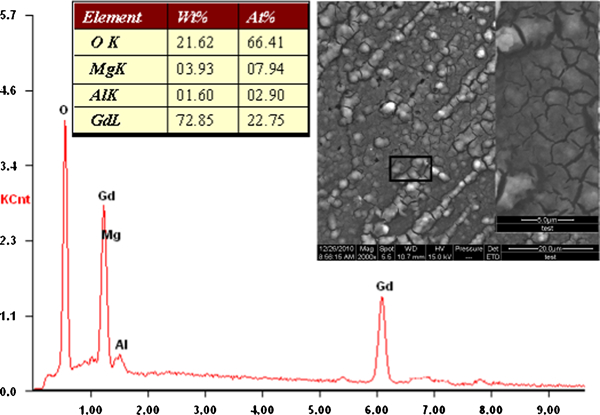
SEM morphology and EDS of surface for gadolinium conversion coating (magnified map is placed at lower right corner)
Figure 2 displays the cross-sectional morphology and elemental area profile of the conversion specimen. The morphology analysis of the cross-section shows that the conversion coating was compact and the thickness was approximately 4–5 μm. The results of the elemental area profile shows that Mg and Al concentrated mainly in the substrate, and simultaneously, and there was a little Mg in the coating that decreased as the thickness of the coating increased. The detection of gadolinium and oxygen by EDX suggested that the gadolinium conversion coating was successfully grown on the surface of AZ91 alloy by the gadolinium ion bath. The results indicate that there was a homogeneous gadolinium conversion coating formed on the surface of magnesium alloy that may be the product of an oxidation reaction between the solution containing Gd3+ and magnesium alloy. Meanwhile, the result also confirms that it was well combined with the substrate.
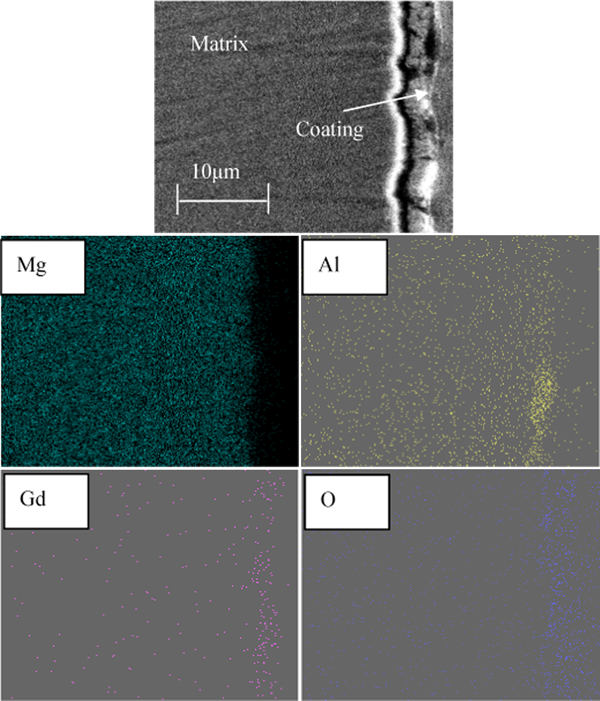
SEM morphology and elemental area profile of cross-section of gadolinium conversion coating
Structure of conversion coatings
In Fig. 3, the XPS spectra of the gadolinium conversion coating are depicted, and the high resolution spectra of a single element are shown in Figs. 3. As shown in Fig. 3a, the Gd4d3/2 and Gd4d5/2 peaks are measured elaborately. They correspond to Gd2O3 and the binding energy of the oxides at 147·4 and 142·5 eV respectively. The binding energy of the two peaks is almost coincident with the reference value. The Mg 1s peak is assigned to a large amount of MgO and a little Mg(OH)2, which were labelled in Fig. 3b. The typical O1s peak can be consistently fitted by three nearly Gaussian distributions, as is shown in Fig. 3c. The first peak of the fitted O1s centred at 529·9 eV corresponds to Gd2O3, and the second peak for O1s centred at 530·8 eV corresponds to an oxide of Al. Another fitted peak for O1s centred at 532·1 eV corresponds to the oxide and hydroxide of Mg at 531·9 eV. All these results reveal that the gadolinium conversion coating is mainly composed of Gd2O3, MgO, Mg (OH)2 and Al2O3.
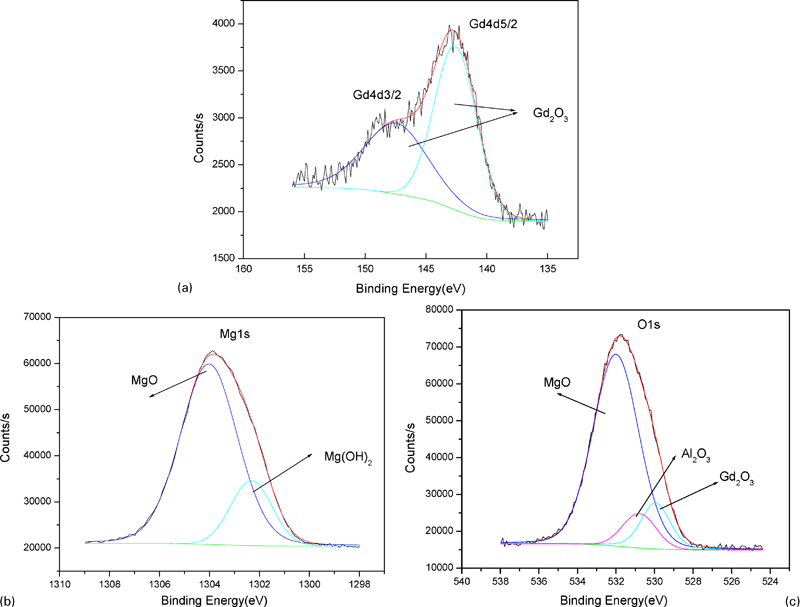
XPS patterns of gadolinium conversion coating on magnesium alloy: (a) the high resolution of Gd, (b) the high resolution of Mg, (c) the high resolution of O
Corrosion resistance of conversion coating
The impedance spectra of the untreated magnesium electrode and the gadolinium treated electrode recorded in 3·5% NaCl solution are shown in Fig. 4. Only a capacitive loop appears in the EIS of the treated sample, but a capacitive loop in the high frequency range and an inductive loop in the intermediate frequency range appear in the EIS of the untreated sample. The total impedance value of the treated sample is 8·37×103 Ω cm2, and that of the untreated one is 1·3×103 Ω cm2.
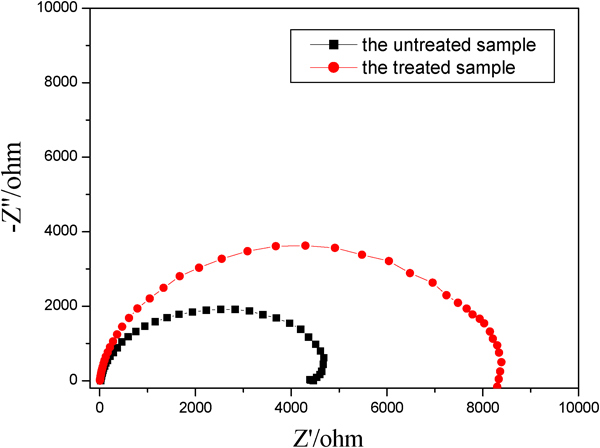
EIS spectra of treated and untreated samples in 3·5% NaCl aqueous solution
Figure 5 shows the potentiodynamic polarisation curves of the treated and untreated sample in 3·5% NaCl aqueous solution at room temperature. In a typical polarisation curve, lower corrosion densities correspond to lower corrosion rates and better corrosion resistance. The gadolinium conversion coating on the magnesium alloy surface decreases the corrosion current density Icorr by approximately two orders of magnitude compared with the substrate, partially blocking the cathodic reaction and shifting the polarisation curves towards lower current density values. It is obvious that the corrosion potential Ecorr of the coating is approximately 150 mV higher than that of the substrate. These results demonstrate that the anticorrosion capability of the magnesium alloys can be increased through the gadolinium conversion treatment.
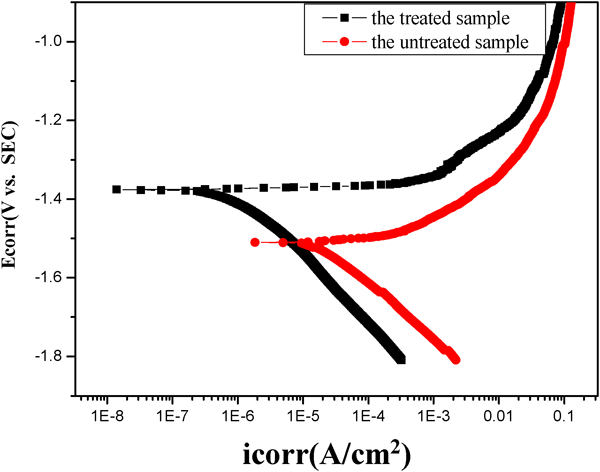
Potentiodynamic polarisation curves of treated and untreated samples in 3·5% NaCl aqueous solution
Nanomechanical properties of conversion coatings
The formation of conversion coatings is coexistent with the dissolution of substrate metal and disposition of rare earth oxide ions. In initial state, dissolution is faster than disposition and this procedure brings about the increase in pH value near surface and then it boosts precipitation of rare earth oxides. Therefore, the content of rare earth oxides in conversion coating gradually increases with increasing times. It is beneficial to regulate internal stresses in conversion coating because of the component gradient. When obtained conversion coatings get dried, the interface between substrate and conversion coatings will shrink. However, contraction volume of the interface will be constrained by coating–substrate bonds. Therefore, certain interior stress emerges inevitably during formation of coatings. The coating cracks when stress is higher than binding force and the internal stress releases partly in this way. Finally, there is a new balance in coatings.
It is unsure about the influence of press-in load owing to few reference materials of nanomechanical properties concerning about conversion coating. Three types of loading (50, 100 and 150 μN) were employed to conduct nano indentation test. Curves of load–displacement are shown in Fig. 6. Indentation reference and mechanical properties are listed in Table 1. Load–displacement curves were influenced definitely by micropores and cracks which were associated with variation of thickness and microstructure of conversion coatings. For this reason, the repeatability of load–displacement curves was low.
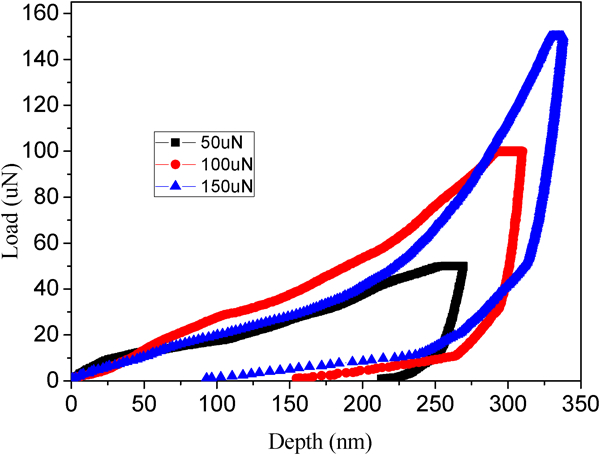
Load–displacement curves of gadolinium conversion coating under different loads
Nanomechanical properties of gadolinium conversion coating
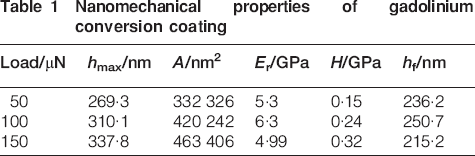
According to Table 1, the in-press depths and projected areas added with the increasing in-press loads. And the nanohardness also increased slightly. The in-press depth was 267–337 nm and hardness and elastic modulus of conversion coating were 0·24 and 5·5 GPa on average. On the basis of the discussion, the residual stress in conversion coating was tensile stress. The residual stress of gadolinium conversion coating was 0·17 MPa and it was figured out by adopting Suresh model14 based results of indentation tests.
Discussion about gadolinium conversion coating forming mechanism
The following is the discussion about gadolinium conversion coating forming mechanism based on testing results. Dissolution is the first step for metal to achieve complete structure conversion coating in solution containing activator. Therefore, the initial reacting process of gadolinium conversion coating is similar to that of chromate one.
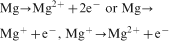
When Mg alloy is immersed into gadolinium solution, the natural oxide layer is soon dissolved and the substrate appears due to the acid solution. There are some potential differences among the main substrate phases due to the different contents of metal elements, such as Al and Zn, so many corrosion micro cells come into being on the surface of the substrate. Therefore, at the initial stage, the positive electrode of the substrate begins to dissolve, and generates a large amount of Mg2+. Meanwhile, hydrogen evolution happens at the negative electrode and generates OH− (according to equations (1) and (2)). With the continuing reaction, the pH value of the solution gradually increases and the addition of H2O2 accelerates the increase of the pH value. When the concentration of OH− reaches a certain value, Mg2+ and OH− react and generate Mg(OH)2, which deposits on the substrate surface (according to equations (3) and (4)). Therefore, the initial reactions are mainly between Mg2+ and OH−. The processes are as follows





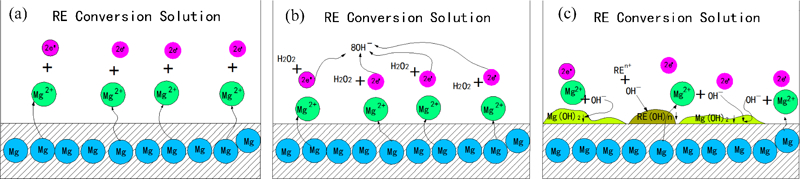
Reaction mechanism sketch of gadolinium conversion coating
Therefore, gadolinium conversion coating can improve the corrosion resistance of Mg alloy from two aspects. On the one hand, Gd2O3 can improve the density of coating composed of Mg hydroxide or oxide only; on the other hand, due to the continuous reaction of gadolinium, coating thickness is improved, which strengthens shielding effect and hinders positive electrode dissolution.
Conclusion
The gadolinium conversion coating deposited on the AZ91 magnesium alloys is uniform and compact, and it is well combined with the substrate. The thickness of the coating is approximately 4–5 μm, and the main compositions of the coatings are Gd2O3, MgO, Mg(OH)2 and Al2O3.
The results of the electrochemistry experiments indicate that the gadolinium conversion coating can evidently improve the corrosion resistance of the AZ91D magnesium alloy in 3·5% NaCl aqueous solution. The residual stress in gadolinium conversion coating was about 0·17 MPa.
Gadolinium coating forming mechanism is quite different from those of chromate and cerium cerate. Based on experimental results, the coating forming process can be generally divided into two periods: the dissolution of the substrate, and the codeposition of Gd(OH)3 and Mg(OH)2 on the surface of the substrate.
Footnotes
Acknowledgements
This work was financially supported by the National Basic Research Program of China (973 Program) (No. 2011CB013404), the National Natural Science Foundation of China (No. 50905038, 51275105), the Foundation of Heilongjiang (No. QC2010108, E201026).