







Abstract
It is known that the physical properties and the conservation rate of a wooden artefact are strictly related to its surface treatment, especially in order to control mechanical and rheological properties and to increase the durability of the wood. The pictorial film of painting forms a structure that, adhering to the wood surface, plays both a protective and an aesthetic role. In order to restore artefacts, it is important to know the original function of the external coating. The aim of this paper is to define the nature and the function of a white coating covering all the surface of a bas relief made by Giacomo Bertesi, one of the most important artists and wood carvers in northern Italy, in the second half of the seventeenth century. Three microsamples were taken from the surface. Micro-Fourier transform infrared and scanning electron microscopy–energy dispersive X-ray spectroscopy analyses were performed to characterise the materials and the different layers.
Introduction
The preparation of a conservation and restoration plan concerning wood artefacts must start with an exhaustive study of the artwork because the object may contain information that could be deleted by the restoring intervention. This is particularly true for the works of art with an organic substrate and a low durability, as wood for example.1 To realise an artefact, the artists in general used a wide range of organic and inorganic products with different purposes and roles.2 The application of painted films on the surfaces had mainly an aesthetical role but at the same time performed a protective behaviour due to chemical characteristics of the materials, e.g. hydrophobicity, hardness or flatness of the surface. These characteristics could have influenced, and in some cases delayed, the deterioration process affecting the artwork, caused by the interaction with the environmental agents, especially biological for the wood materials.3 In order to plan the correct restoration and conservation of an artwork, it is necessary to understand the function of the pictorial layers on the wood surface on the basis of its compositional features.4
The object of this paper is a Bertesi's wooden bas relief, representing a religious scene, owned by the ‘Fondazione Città di Cremona’. This artwork is very similar for working technique and size to those representing different episodes of the life of Jesus Christ, held by the ‘Musei Civici’ of Cremona. Giacomo Bertesi was born in 1643 in Soresina di Cremona and died in Cremona in 1710. He was a famous artist and carver, and practised his activity in northern Italy (Lombardy, Parma and Genoa) and in Spain, following the ‘Cremonese Baroque’ artistic trend. Bertesi realised several statues, decorations and furniture, too, and his style took inspiration from classical themes. The subject and the carving technique of the artwork here considered, as well as the use of poplar wood, can be compared to that of the other bas reliefs, except for a white coating covering all the surface (Fig. 1), usually not present in the Bertesi's artworks. The singularity of this works of art in the survey of the Bertesi's artistic production makes it an extremely interesting case and for the first time is object of a scientific study.
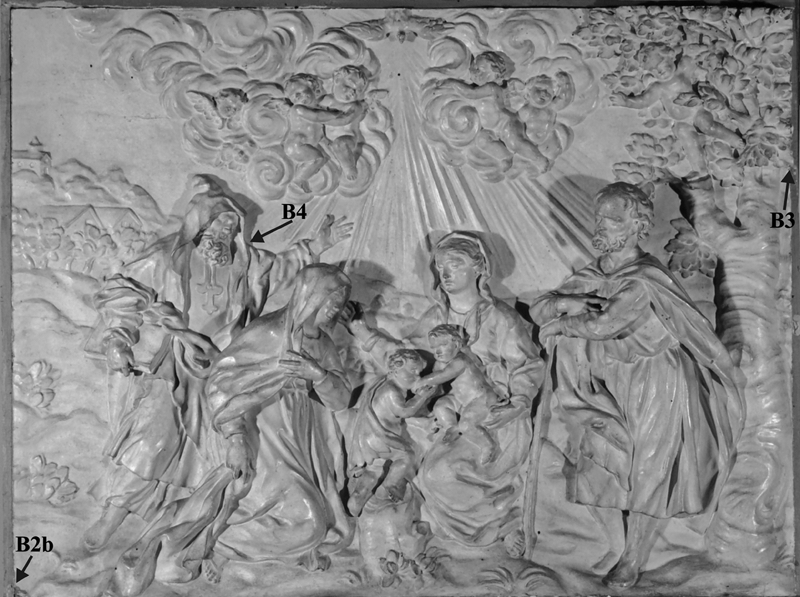
Picture of white coated bas relief (black, sampling points)
This research focuses on the origin and the function of this coating, starting by some hypotheses. First, the white surface coating could have been directly applied by Bertesi. The use of white pigments is well documented in the history of art, even on wood artworks,5 and perhaps, the artist wanted to confer a ‘stucco effect’ to the wood surface, similar to marble or ivory.6 Second, as an alternative, the coating could have been applied in later times, probably to protect the original surface: in this case, the function of the coating would be conservative, probably because the wooden support of the artwork showed a degradation effect as well as chromatic changes or an increase in the surface roughness.7
In order to understand the state of conservation of the artwork and to attribute a painting to a specific artist or period, it is necessary to identify the pigments, the application technique and the binding medium.8 This can be performed by determining the chemical composition and the stratigraphy of the painted layers through a multidisciplinary approach commonly used in the cultural heritage field.
Experimental
Three microfragments including the complete stratigraphy have been collected from different points of the artwork in order to characterise the pictorial technique and the nature of each superimposed layer. Two samples come from the right edge (B3) and the bottom of the artwork (B2b); the third one comes from the centre (B4). The sampling procedure has been carried out using a biopsy needle in order to gather microsamples <1 mm in size. On the non-embedded samples, Fourier transform infrared (FTIR) spectroscopy analyses have been performed with a Nicolet iN10 Thermo Fischer micro-FTIR spectroscope in attenuated total reflectance (ATR) mode with germanium crystal. The spectral range was 4000–700 cm−1, and spectral resolution was 4 cm−1. Measurements were carried out with a minimum of 32 scans. The microsamples have been then embedded in epoxy resin and cut using a diamond blade. The cross-sections were polished first with abrasive papers (800–500 mesh) and then with diamond pastes of decreasing grain size (6, 3, 1 and 0·25 μm). The cross-sections were sputtered with a Pt/Pd coating using a Cressington 208HR sputter. A field emission scanning electron microscope (FE–SEM) Tescan Mira 3XMU series, equipped with an energy dispersive spectrometer (EDAX), was used for the morphological and chemical characterisation of the samples. The microanalyses were performed maintaining the current electron beam at 20 kV, with counts of 100 s per analysis. The semi-quantitative data were obtained by processing the measurements with the EDAX Genesis software.
Results and discussion
The painting fragments have been investigated by micro-FTIR spectroscopy, scanning electron microscopy and EDS microanalysis. The micro-FTIR analyses were performed on the different layers of the sample B2b (Fig. 2) in order to discriminate the presence of an organic binder and to get a first characterisation of the white pigment. The external layer of the sample was analysed in ATR mode: the absorption bands due to sulphate groups (
 at ∼1120 cm−1) and to the water of hydration (ν O–H at 3407 and 3541 cm−1 and δ O–H at 1620 cm−1) are indicative of the presence of gypsum (Fig. 2a). The peaks at ∼1680 and 1540 cm−1 are typical of amide group (C = O stretching and NH bending respectively) in the proteins and could be related to the use of an animal glue as organic binder of the layer, even if the peaks at 2920 and 2850 cm−1 expected for the stretching of C–H bond are lacking.4 It is important to highlight the weak peak at ∼1450 cm−1, associated to the absorption at 879 cm−1, typical of the
 group.9 The low rate of the absorption seems to indicate the presence of carbonate just as a trace. The ATR analysis performed on the inner layer of the sample shows a different absorption spectrum (Fig. 2b), with a strong peak at ∼990 cm−1 ascribable to silicate group, always associated to the typical absorptions of gypsum (even if the peaks are weaker than in the external layer) and carbonate. The low resolution and intensity of the absorption bands at 3400–3500 cm−1 and 1621 cm−1 seem to indicate the transformation of gypsum in bassanite and/or anhydrite because of the loss of water of hydration.10 Moreover, the absorption bands at 1680 and 1540 cm−1, which could be ascribed to amide groups, are lacking in this case, even if absorption shoulders are present in the same regions, suggesting the presence of protein binder traces.11
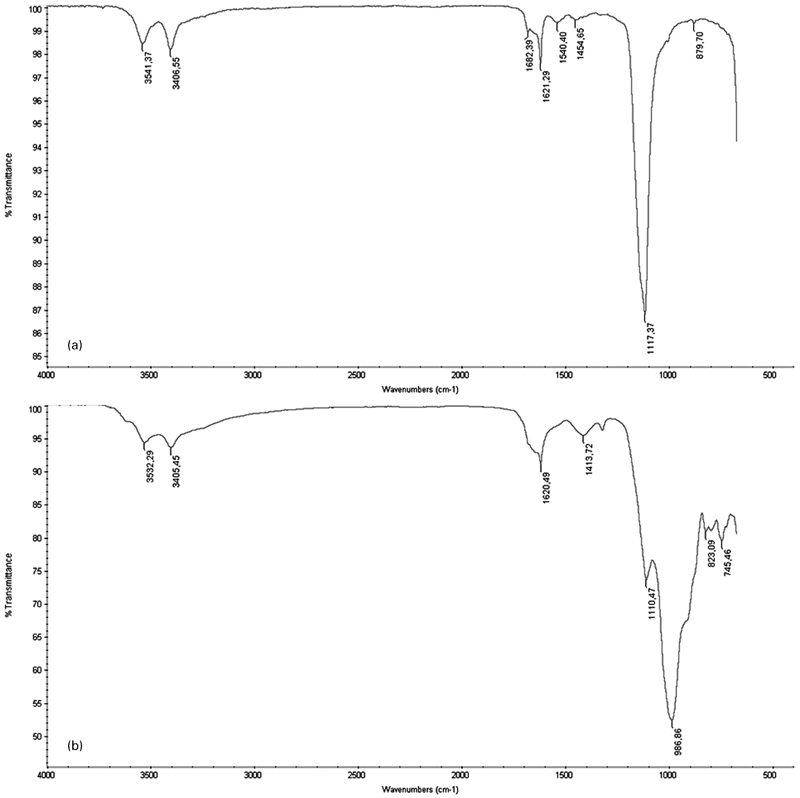
Micro-FTIR spectrum of section layers collected from sample B2b
SEM–EDS analyses were performed on the cross-section of sample B3 in order to observe the texture of each layer and to characterise the chemical composition of the constituent materials. This sample displays a stratigraphy composed of three layers (Fig. 3): a finishing coating, an intermediate layer and an inner layer.
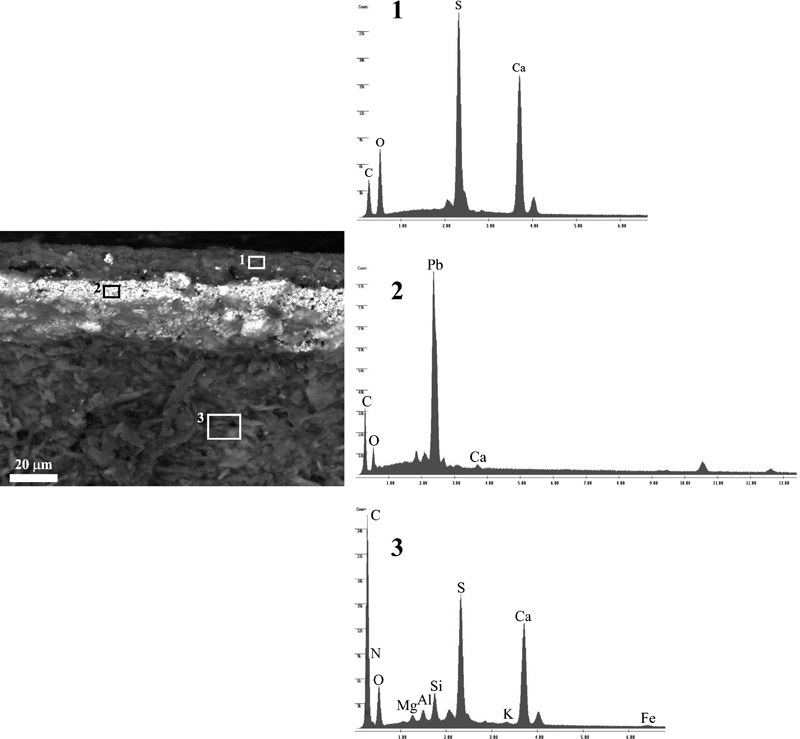
Backscattered image of cross-section of sample B3; spectra 1–3 have been collected from finishing, intermediate and preparation layers respectively
The finishing coating is <20 μm thick and covers homogeneously the whole surface. It consists of an entanglement of crystals of different shapes and sizes, not exceeding 5 μm, and a low porosity (Fig. 4a). The EDS spectrum obtained on this layer (Fig. 3, spectrum 1) shows that the main peaks correspond to S and Ca, together with O. These elements are consistent with the use of gypsum for the preparation of the final layer. The intermediate layer is ∼40 μm thick and is composed of very little particles (1–2 μm in size), often tabular and hexagonal in shape, having white colour in BSE images (Fig. 3). Analyses by EDS revealed Pb, C and O as the main chemical elements in this layer (Fig. 3, spectrum 2). This result, together with the carbonate absorptions detected by IR analysis, suggests the use of white lead pigment, which is one of the most important white pigments used in the history of art.12 The inner layer, representing the preparation, reaches 500 μm of thickness, and the grains, tabular in shape, are coarser than in the upper layers (up to 20 μm, Fig. 4b). As for the finishing coating, EDS data reveal the presence of S, Ca and O as main elements, but low amounts of Si, Al and Mg have also been detected (Fig. 3, spectrum 3). The higher intensity of the C peak and the trace of N, with respect to the spectra of the finishing and the intermediate layer, could be related to the use of an organic medium, probably animal glue: the composition of this layer results as a typical preparation layer on the wooden surface.13, 14 The use of glue mixed with a coarse grained gypsum in the deepest preparatory layer is a well known practice.15 This recipe comes from a very ancient tradition and has been attested since the ancient Egypt time, thanks to the ease of application and the high workability.16
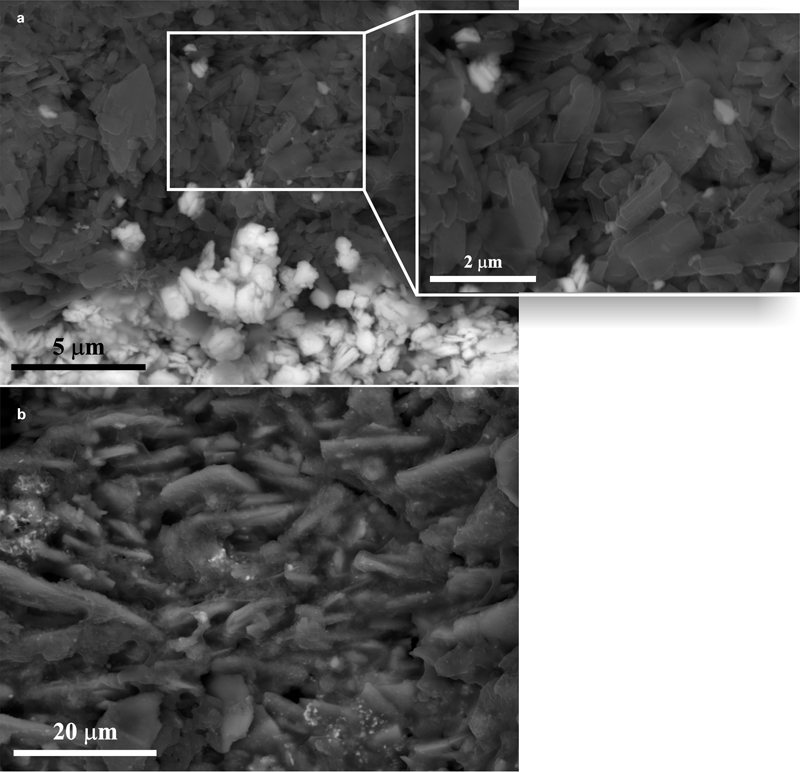
Back scattered images of sample B3: a details of gypsum finishing layer; b details of preparation layer
The SEM–EDS data are in agreement with the IR results, which revealed the presence of gypsum in the final coating, associated to traces of protein groups, and the presence of silicate and sulphate groups in the inner layer. The mixture composed of gypsum and animal glue in preparation layers is attested on wooden polychrome carvings,17 as well as in oil paintings:18 covering the wood surfaces with a white coating had the purpose to confer to the artwork a homogeneous and more precious material effect (e.g. ivory or marble) and to hide the natural alterations of the wood, conferring a ‘stucco effect’ to the artifact surface, in order to imitate natural stones such as marble.14 The first examples date back to ancient times when stucco was used as a preparation for wall paintings in ancient Greece, as protective coating or as imitation of marble in sculptures and ornamental coverings. The technique becomes more relevant during the Middle Ages, when it was used as preparation layer in painting and sculpture techniques, as reported by Cennini.16 During the next centuries, different kinds of organic compounds were commonly added to the stucco recipes in order to enhance the resistance and the hardness of the coating.19
The uncommon superimposition of the very fine gypsum on the white lead layer, which is a higher quality material,20 is surprising, and two hypotheses were formulated. First, the lead white layer was supposed to cover the whole surface, and probably underwent an alteration process (e.g. colour change and/or thickness decreasing): for instance, the blackening of lead white is a well known phenomenon.21 As a consequence, the application of a gypsum coating could be interpreted as a conservative intervention, made using a low cost material. Second, between the eighteenth and the nineteenth century, the original frame of this work of art was substituted, and the contact line between the frame and the edge of the artwork probably filled with gypsum, covering the lead white pigment only along the edges of the bas relief. The sampling strategy was devoted to minimise the aesthetic impact on the artwork (accordingly, the samples have been taken from the edge), but the stratigraphic analyses did not give information on the actual origin and function of the gypsum final coating. To settle the question, SEM–EDS analyses have been performed on the cross-section of a third sample (B4), taken from the centre of the artwork. This sample consists of only two layers: the finishing is represented by a very thin layer, 20–25 μm thick, made of very little grains, white in BSE images (Fig. 5). The high peaks of Pb and C (Fig. 5, spectrum 1) indicate the use of lead white as finishing layer. The preparation layer is made of coarse grained fragments of impure gypsum (Fig. 5, spectrum 2). The size of gypsum fragments ranges from 20 to 25 μm, with a high angularity and tabular shapes. The preparation layer exhibits the same fabric and composition of the samples from the edge (B2b and B3). These data seem to support the hypothesis of the use of gypsum just as filling the space between the new frame and the bas relief surface, and consequently, we could consider that the external white coating was prepared with the white lead pigment.
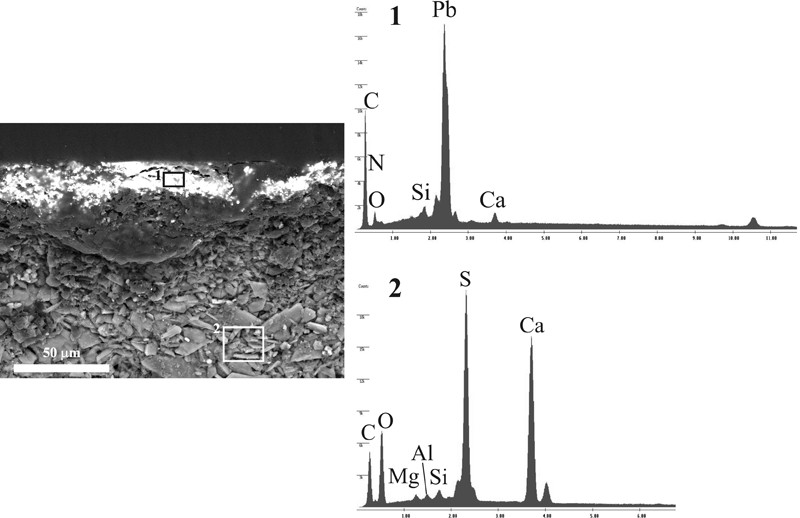
Backscattered image of cross-section of sample B4; spectra 1 and 2 were collected from finishing and preparation layer
The choice of the artist to use the lead white as pigment of the final coating is very important because of the value of this kind of material and the technique of ‘stucco effect’. Historically, white lead is the most important of all white pigments and was the main pigment used in European easel painting up to the nineteenth century.22
In paintings, mixing of lead white with other white inorganic materials, gypsum in particular, was a common practice for making the opaque colour.23 This technique was used in central Europe during the sixteenth and seventeenth centuries, indicating a widespread practice that could have influenced the artistic techniques even in northern Italy.
Conclusion
The analytical investigations carried out in the present study provided some insights about the execution of the bas relief made by G. Bertesi and allowed to formulate a hypothesis about the role of the surface coating.
The results, obtained using a physical–chemical analytical approach, have given some information useful for the identification of the employed materials and the painting technique, with an important outcome on the carving techniques and the materials used in the second half of the seventeenth century in northern Italy.
The presence of two layers covering the whole wooden surface was proved: the first layer consists of a mixture of coarse gypsum and animal glue, while the coating layer is made of lead white.
The artist used the lead white pigment, an expensive material, as finishing layer of the coating, probably with the aim of conferring peculiar aesthetic characteristics to the artwork surface, such as a stucco or ivory effect.
The presence of a further gypsum coating on the lead white found on the edge of the bas relief has been interpreted as the filler used to stick the frame changed between the eighteenth and the nineteenth century.
Footnotes
Acknowledgements
We would like to thank Dr E. Arrighetti and Dr R. Bonomi of the Restoration School of Botticino for their cooperation during the sampling and results discussion, the Conservator of Musei Civici ‘Ala Ponzone’ of Cremona, Dr M. Marubbi, for the precious recommendations and the Fondazione Città di Cremona for the authorisation to study the bas relief.
This paper is part of a special issue on Arts and Surfaces