






Abstract
In this study, two kinds of micrometre sized SiC powders (as received and ball milled) were used as the starting materials to investigate the effect of ceramic surface morphology on the coating characteristics. Determined optimised electroless deposition bath values of pH (9) and bath temperature (70°C) were used. It was found that etching pretreatment was very effective on the coating quality for both types of SiC powders. The experimental results indicated that milling of the powders led to the formation of multimodal sized ceramic powders with sharp edges and rough surfaces, which resulted in a uniform adhesive metallic layer on the powders without any crack formation. Finally, the effect of cobalt coating on the incorporation of ceramic particles into the molten aluminium during fabrication of aluminium matrix composite was studied, and it was revealed that a significant improvement in incorporation could be obtained using cobalt coated ceramic particles.
Introduction
Metallic coating of ceramic powder particulates is a process that is commonly performed in order to alter the specific properties of ceramics such as their wetting behaviour by molten metals. Electroless deposition (ED), which represents one of the liquid preparation routes, has been widely used for preparing metallic coatings onto various surfaces. It provides a means for metallic coating of ceramic reinforcement without the requirement for costly electrolytic bath or other electroplating equipment and associated electrical running costs.1–12 In the past few decades, many research works have been carried out on electroless plating of Cu2,3,5,8,11 and Ni1,6,7,10 on ceramic particles, carbon nanotubes and fibres to increase the wettability of the reinforcement phase with molten aluminium. Such coatings could also avoid the detrimental formation of weak phases between the reinforcement and the matrix material.
Recently, electroless plating of Co onto the surface of the ceramics particles has been examined for the development of composite material production.12–20 In comparison to Ni, Co has a slightly higher melting point and better wetting ability with ceramics.18,21 Jiang et al.13,16 and Zhang et al. 18 reported the formation of a cobalt layer on ceramic particles and whiskers by changing the initial pH, bath temperature, chemical composition of bath and heat treatment parameters. Liu et al. 15 successfully coated a thick layer of cobalt onto submicrometre WC particles with fixed electroless bath conditions. To the best of our knowledge, no attempt has been made to study the morphology effect on ED coating efficacy of cobalt onto micrometre sized ceramic particles. In this study, micrometre sized SiC particles were used as the substrate, and the effect of etching process and ball milling of the powders on the coating quality was evaluated.
Experimental
Starting materials
In order to investigate the effect of ceramic morphology and surface roughness, two kinds of SiC powders were used in this study: (i) 99·5% purity with an average particle size of 80 μm)Shanghai Dinghan Chemical Co. Ltd, China(and (ii) SiC powders obtained via milling of the SiC powders (form i) using a planetary high energy ball mill. For this purpose, alumina balls with a diameter of 7 mm were used with a ball/powder weight ratio of 5:1. The powders were milled for 1 h using a high purity argon (99·99%) atmosphere with a rotating speed of 250 rev min− 1. Figure 1 shows the morphology of the two kinds of SiC powder forms used in this study. As can be seen from Fig. 1a, as received SiC powders had sharp edges and almost smooth surfaces. Ball milling resulted in fracturing of the SiC powders, leading to the formation of multimodal sized powders, shown in Fig. 1b.
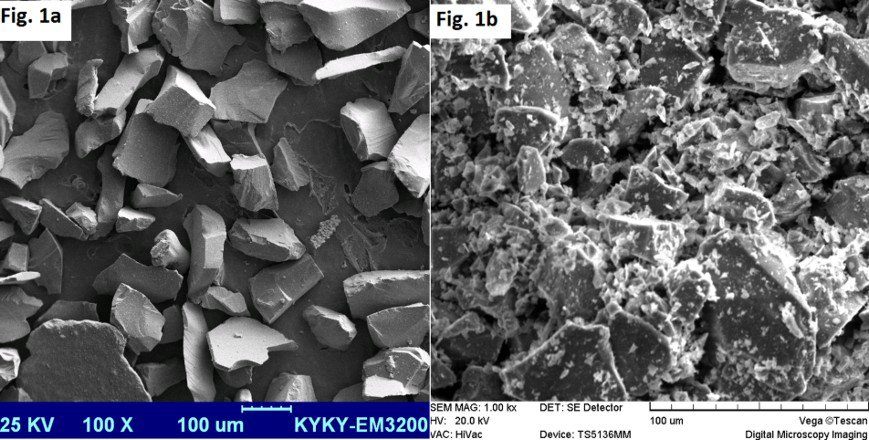
SEM morphology of a 80 μm average particle size SiC powders and b ball milled powders
Coating of SiC particles
The flow chart of cobalt coating procedures, which consisted of three process steps, was detailed in our previous study. 11 The composition and concentrations of materials used within the Co ED bath is tabulated in Table 1. The ED was carried out with a speed of 400 rev min− 1 magnetic stirring at pH value of 9 and bath temperature of 70°C. It should be noted that both these values were determined to be optimal from a pH range of 8–10 and bath temperature range of 50–70°C.
Material bath parameters used with ED bath for deposition of cobalt onto SiC particles
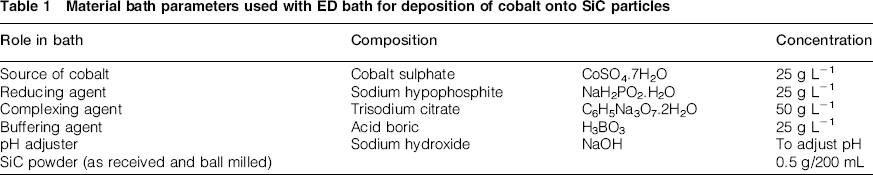
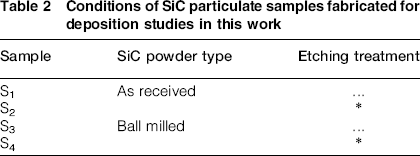
Table 2 summarises the four applied preparation methods for the SiC samples fabricated in this study corresponding to samples S1 to S4. Two as received samples (S1 and S2) and two ball milled samples (S3 and S4) were prepared. In order to investigate the effect of etching pretreatment, samples S2 and S4 were etched via an etching pretreatment, as previously described. 11
Conditions of SiC particulate samples fabricated for deposition studies in this work
Characterisation
The percentage of mass gain was calculated in accordance with equation (1):

In order to investigate the phase analysis of Co coated SiC particles, the powders of sample S2 were exposed to X-ray phase analysis (Bruker's D8 Advance System, Germany) using Cu Kα (λ = 0·15405 nm) radiation. As the cobalt layer might be formed in an amorphous condition, these powders were heated at 350°C for 2 h. After cooling, these powders were examined with the X-ray phase analysis. Microstructural investigations of the SiC particles before and after coating were performed using two kinds of scanning electron microscopes (SEM; Cam Scan Mv2300 and KYKY-EM3200).
In order to investigate the effect of cobalt coating on the wettability of SiC particles by molten pure aluminium, the stir casting method at 680°C was used to incorporate uncoated and coated ceramics into the molten pure aluminium. Full details of this casting process were reported in our previous studies.12,22 An optical microscopy (Olympus equipped with digital camera model DP73) was used to evaluate the composite microstructure after the casting process.
Results and discussion
Figure 2 shows the obtained values of deposition time and mass gain % for the samples. It should be noted that the time of deposition was evaluated after the pH reached a constant value. This figure shows that there is a positive correlation relationship between the values of deposition time and mass gain %. Decreased deposition time resulted in a lower amount of cobalt deposited onto the SiC powder surfaces. Jiang et al.
16
reported the main reactions that occur during cobalt deposition when hypophosphite is used as the reducing agent. Equations (2) and (3) show these main reactions:


 is consumed during this reaction (equation (3)). Figure 2a and b indicates that the etching process led to a decrease in deposition time and mass gain % for all the samples. In fact, this process (named coarsening) makes a rough surface on the SiC particles (because of using HF acid) and therefore increases the catalytic surfaces and deposition velocity.
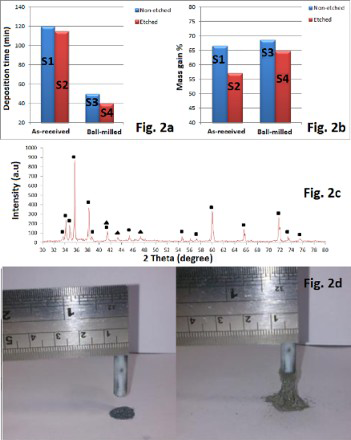
Effect of etching process and powder morphology on a deposition time, b mass gain % values, c X-ray phase analysis of sample S2 and d magnetic properties of SiC powders before and after ED process
In contrast with the as received powders, the milled powders were coated by cobalt after about just 40–50 min. The ball milling process increased the catalytic surfaces due to the high surface area resulting from the fractured surfaces, leading to a substantial increase in the deposition velocity. Figure 2b also shows that the as received powders had a lower amount percentage mass gain compared with the milled powders. It is important to note that for coated particle quality determination, the morphology of the coated powders needs also to be considered. Figure 2 also shows the X-ray diffraction pattern of the selected sample S2. In addition to the SEM results, the presence of cobalt peaks between 2θ between 40° and 50° verified the formation of cobalt coating on the ceramic particles.
Sample S2 was also exposed to the magnetic field of a magnet. As can be seen from Fig. 2d, the as received SiC powders were not collected around the magnet, while green coloured powders of sample S2 after the ED process were collected around the magnet, indicating that the Co coated SiC powders had functional magnetic properties.
Figure 3 shows the morphology of the coated particles after the ED process. Figure 3a shows the morphology of etched as received powders of sample S2. The uncoated parts are obvious in the morphology of this sample. The presence of microcracks is also evident in this sample, and it seems that the coating thickness is submicrometre in scale.
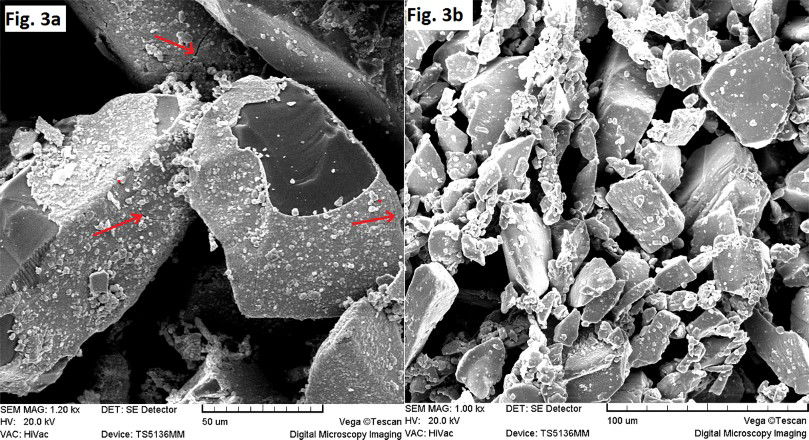
SEM images of samples S2 (a) and S4 (b)
The best results as regard the coating characteristics were revealed for the milled powders with multimodal sized particles. Figure 3b shows the morphology of sample S4, in which milled powders were exposed to the Co ED process. No surface cracks and completely cobalt coverage of the SiC particles could be seen for this sample. It seems that almost all the powders were coated by a cobalt layer. This figure indicates that even submicrometre sized SiC particles were coated uniformly. Both fine and coarse SiC powders of this sample could be uniformly covered by cobalt using the bath, which was used for ED in this study (see Table 1). As mentioned, the milling process produced sharp edged powders with activated surfaces, and it seems that this process could be suitable for achieving a better metallic coating. The deposition time of this sample was ∼40–50 min, much lower than those of the as received samples.
As mentioned, one of the metallic coating applications on ceramic particles is wettability improvement. Ceramic particles on their own were not wetted by molten aluminium,23–25 and therefore, the cobalt layer was used to improve the wetting behaviour. Figure 4a shows the microstructures of the pure aluminium matrix composite reinforced with 3 wt-% as received, and Fig. 4b shows that of the entrained 3 wt-% of coated SiC particles (sample S2) within the aluminium matrix. As it can be seen, the wettability of the uncoated SiC particles by molten aluminium was very poor (see Fig. 4a), while the metallic layer was very effective to incorporate the micrometre sized ceramic particles into the molten aluminium (see Fig. 4b). Agglomeration of ceramic particles could be seen in both samples. For the coated SiC particles, even ceramic particles with a mean diameter of < 20 μm could be easily incorporated into the matrix via the Co ED method.
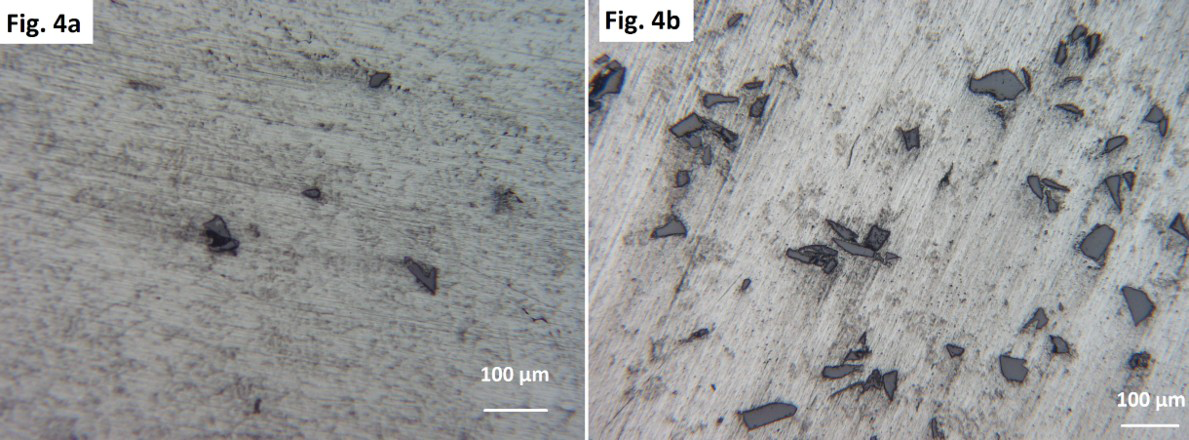
Microstructure of aluminium matrix composite reinforced with 3 wt-% as received SiC powders (a) and Co coated SiC powders (b)
Conclusion
The effect of morphology of SiC particles on cobalt coating characteristics was examined in this study. Two kinds of micrometre sized SiC particles were used, including as received and ball milled powders. From the experimental results, the following conclusions could be drawn:
Etching pretreatment as performed was not effective for enhancing the cobalt coating. No significant improvement could be seen as regard coating characteristics after the etching process for all the samples. Ball milled powders containing fine and coarse powders were well covered by a uniform defect free layer of cobalt. Mass gain % and deposition time were two important process factors that were studied for the samples. It was found that the milled powders were quickly coated by cobalt. Although the deposition time of ball milled powders was lower than 50 min, a considerable amount of mass gain % was obtained for these powders. The effect of cobalt coating on the wettability improvement of SiC particles by molten pure aluminium was studied using an optical microscopy. The cobalt coating was found to result in a considerable enhancement of particle entrapment during fabrication of cast aluminium matrix composites.