







Abstract
Sc doped AlN (ScAlN) films were prepared by dc reactive magnetron sputtering. The crystal quality, surface topography, cross-sectional view and the resistivity of ScAlN thin films grown on Si (100) substrates at various substrate temperatures from room temperature to 650°C have been investigated. Results show that the temperature has a significant effect on the properties of ScAlN thin films. According to the research, the crystal quality of ScAlN film first increases and then decreases, reaching the best crystalline state at 600°C. The best surface morphology and cross-sectional view of ScAlN thin film was obtained at 600°C. The resistivity first increased to a maximum value of 3·36 × 1012 Ω·cm and then decreased with the temperature increasing.
Introduction
Recently, the rapid development of communication system acquires greater mobility and higher data transfer rate, leading to a demand for filters or resonators with higher frequencies, smaller sizes. 1 Then, the film bulk acoustic resonator has been developed to meet these demands. 2 In terms of its piezoelectric materials, AlN has become a standard electronic material because it has presented many excellent properties, such as high hardness (>20 GPa), wide energy band gap (6·2 eV) and high thermal conductivity [3·9 W cm− 1 K− 1 at room temperature (RT)].3,4
Not long ago, Sc doped AlN (ScAlN) have been researched, which presented a 400% increase in piezoelectric modulus d33 for ScxAl1 − xN alloys with x = 0·43, and an increase from 7 to 10% in
 for ScxAl1 − xN alloys with x = 0·20. Thus, ScAlN thin film has the potential to be the best piezoelectric material.5,6
As with the piezoelectric devices, thin film's crystal quality and the surface topography are also closely linked to surface acoustic wave device's performance.7,8 The substrate temperature is a key factor in the preparation of ScAlN thin film by dc magnetron reactive sputtering system, directly affecting film's crystalline quality and piezoelectric quality. Jin et al. 2 and Akiyama et al. 9 investigated the influence of the substrate temperature on the film preparation. However, there is still no research that investigated the influence of substrate temperature using scandium aluminium (ScAl) alloy target and the resistivity of ScAlN films. In this paper, the effects of substrate temperature on the crystal structure, surface topography and resistivity were investigated systematically, using ScAl alloy target (Al/Sc = 0·9:0·1).
Experimental
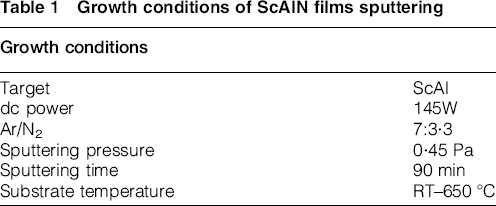
ScAlN films were deposited on (100) silicon substrates using dc magnetron reactive sputtering. Substrate temperature was varied from RT to 650°C. The other sputtering parameters are shown in Table 1. The silicon substrates were cleaned successively by acetone and absolute ethyl alcohol to keep the surfaces clean to ensure film growth. A pure scandium aluminium (AlSc) alloy target (110 mm in diameter, quality component proportion Al/Sc = 0·9:0·1, 99·99% pure) was applied to keep scandium concentration constant in ScAlN thin film. The sputtering chamber was evacuated to a pressure below 2·0 × 10− 3 Pa, and then high purity nitrogen (99·999%) and argon (99·999%) were introduced. For ensuring uniformity, the substrate was rotated at 20 rev min− 1. The crystal structures and crystal orientations were investigated by a scanning electron microscope (SEM, JSM-6490LV) and X-ray diffraction (XRD, Bede D1). The surface topography was investigated with an atomic force microscope (SPA-300HV). The resistivity was analysed by standard ferroelectric test system (Radiant Precision LC 2000).
Growth conditions of ScAlN films sputtering
Results and discussion
Crystal orientation
It is generally known that the piezoelectric properties of piezoelectric thin film strongly depend on crystal orientation. The crystal structures of ScAlN films were investigated by XRD to clear the influence of substrate temperature. Figure 1 shows the relationship between the preferential orientation of the ScAlN films and the substrate temperature. The peak of all ScAlN films has a relative deviation to the lower angle when compared with the pure AlN film, which is because the Sc ions with larger radius have doped into the wurtzite structure of AlN lattice.10,11 As shown in Fig. 1a, the XRD intensity of (002) oriented peak increases as the substrate temperature changes from RT to 600°C. When the temperature increased to 650°C, the ScAlN (002) peak deceases and the (100) peak appears, similar to the conclusion of Medjani et al. 12 Meanwhile, the full width at half maximum of X-ray rocking curves decreases gradually when the temperature is lower than 600°C, and then increases when continue heating up the substrate, as shown in Fig. 1b.
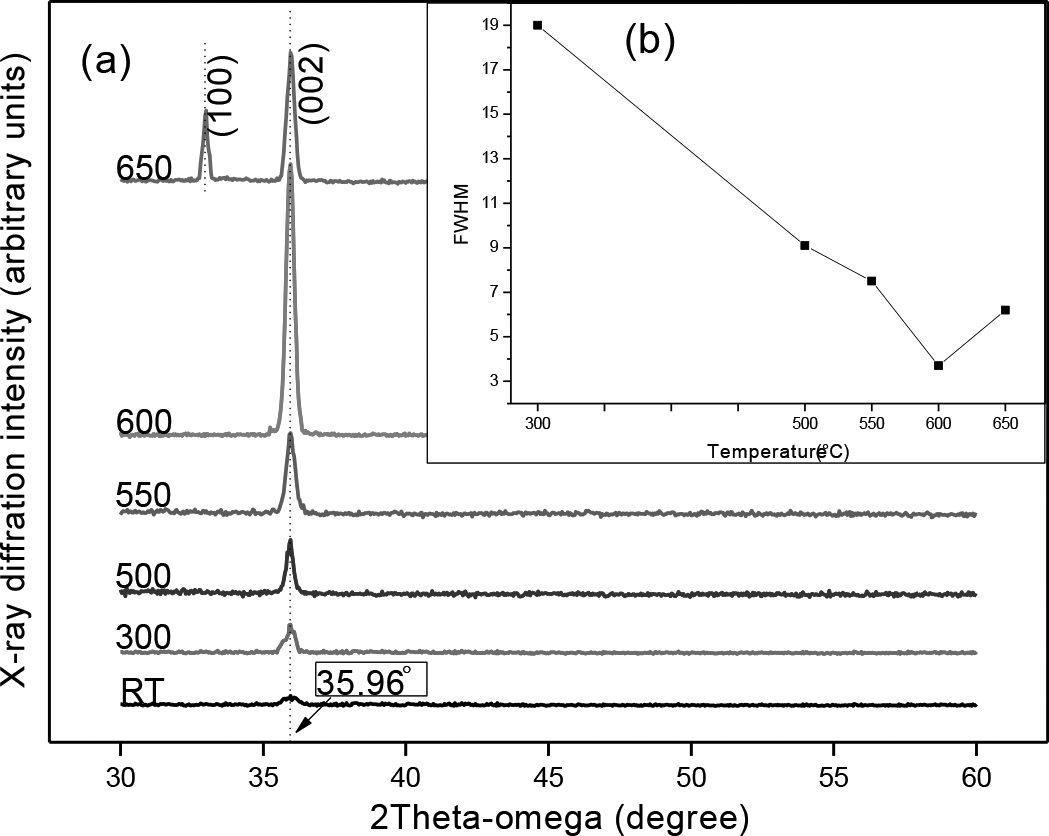
a X-ray diffraction patterns and b full width at half maximum of X-ray rocking curves of ScAlN films prepared at various substrate temperatures
It indicated that the crystal orientation strongly depends on the substrate temperature. For ScAlN film, the lowest surface energy plane is the (002) plane because it is the most densely packed basal plane. 13 Thus, when the surface diffusion occurs, (002) plane parallel to the substrate will preferentially grow, which contributes to minimise the entire surface energy. Increasing the substrate temperature leads to the enhancement of the kinetic energy of the atoms, leading to surface diffusion. However, if the substrate continues to heat up, the crystalline lattice structure of AlN could be introduced to explain the experiment phenomenon. Two kinds of Al–N bonds exist in wurtzite AlN, named B1 and B2. The (002) plane is composed both of B1 and B2 bonds, while (100) plane is composed only of B1 bonds. At high temperature, B2 bonds of the Al–N, which is weak compared to B1 bonds, can easily be dissociated, leading to the weakening of (002) peak and a relatively increase in (100) peak, which is the same as was observed Kuang et al.12,14,15
Figure 2 shows the cross-section view of ScAlN films prepared at 600 and 650°C. It can be seen from the photograph that the thickness of the ScAlN films was ∼1·91 and 1·60 μm, presenting low sputtering rate at high temperature. We introduce the theory of Jin et al. 2 High temperature leads to few ions and gases around the substrate, with the resulting atoms impacting the substrate directly; this bombardment will lead to crystal damage. Moreover, excellent columnar crystals perpendicular to substrate was obtained when the temperature is 600°C, which was identical with the result of XRD pattern and full width at half maximum.
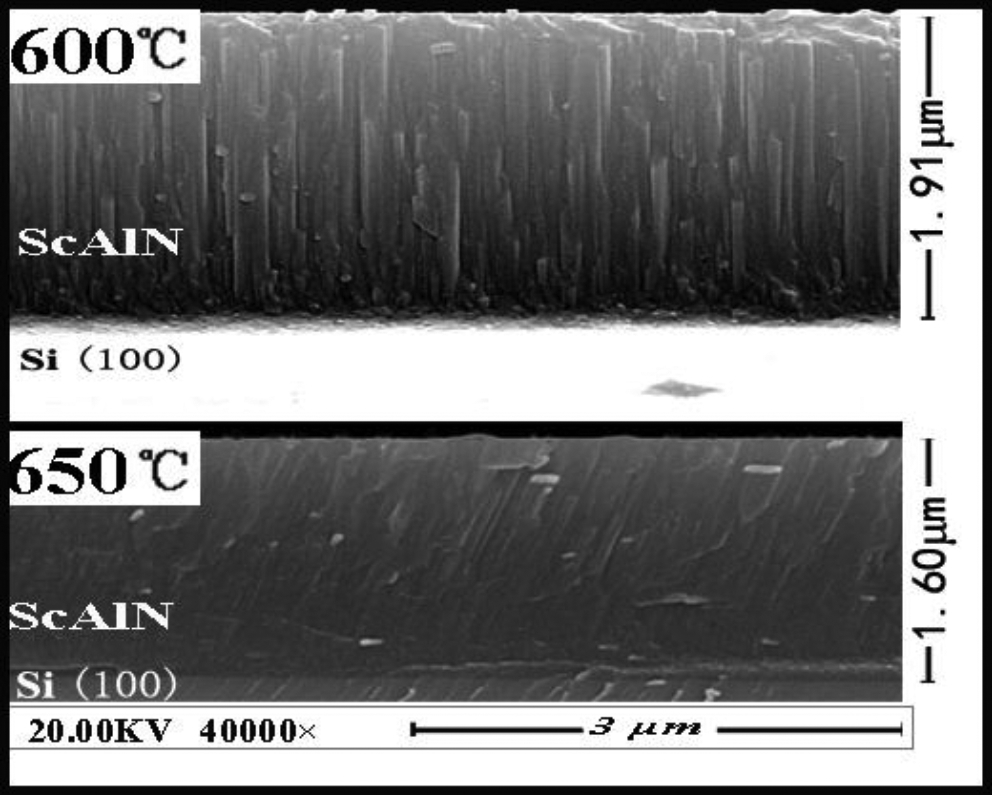
Cross-section view of ScAlN films prepared at 600 and 650°C
Surface topography
When used in the surface acoustic wave devices, the crystal quality and surface roughness of ScAlN films strongly influence the properties of devices. Generally, the root mean square (rms) roughness should be < 30 nm. 16 The atomic force microscopy morphology is shown in Fig. 3a, and its rms roughness is shown in Fig. 3b. It indicated that the surface morphology of ScAlN films is very different when prepared at different temperatures. When the temperature is lower than 500°C, the grain size is very small and non-uniform. With increasing temperature, the grain size grows up gradually and becomes uniform; the rms roughness decreases to 2·624 nm when the temperature is 600°C. However, when the temperature increases to 650°C, the rms roughness attaches to 4·272 nm.
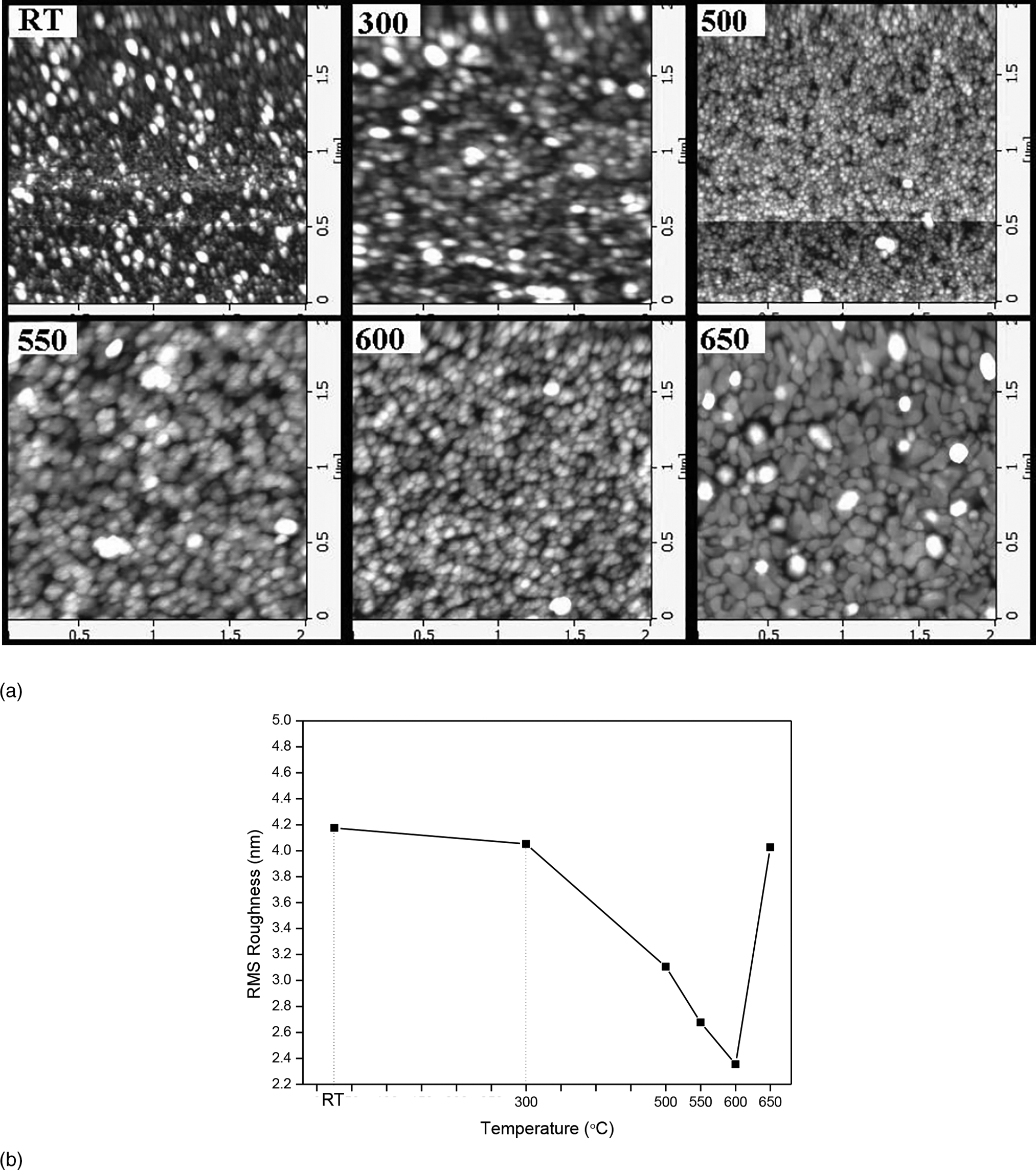
a atomic force microscopy morphology of ScAlN film surfaces prepared at various substrate temperatures and b rms roughness of ScAlN film surfaces prepared at various substrate temperatures
The reason is because the atoms absorbed on the substrate could migrate to other places under appropriate substrate temperature. Under low temperature, the atoms could not achieve enough energy to migrate, leading much to lattice imperfection and small grain size, which contribute to roughen the surface. With increasing temperature, the atoms have enough kinetic energy to diffuse to defect position and improve the crystal quality, getting the best rms of 2·354 nm. However, the rms roughness increases suddenly when the temperature increase from 600 to 650°C because the bombardment of atoms causes poor crystal quality. 2 Thus, the best temperature in our research to prepare the ScAlN thin films is 600°C.
Resistivity
The resistivity of ScAlN thin film is a critical performance indicator for piezoelectric devices. The dielectric insertion loss of piezoelectric devices could be decreased with the increase in the resistivity. Figure 4 shows the dependence of resistivity on substrate temperature. The substrate temperature obviously influences it. The mean resistivity first increases and then decreases with increasing substrate temperature. The maximum of resistivity of 3·36 × 1012 Ω·cm was obtained at the substrate temperature of 600°C. At lower temperature, much lattice imperfection occurs for insufficient kinetic energy of the atoms. At higher temperature, much crystal damage occurs for direct bombardment of sputtered atoms. We think that the better resistivity can be attributed to the better crystal quality of ScAlN film.
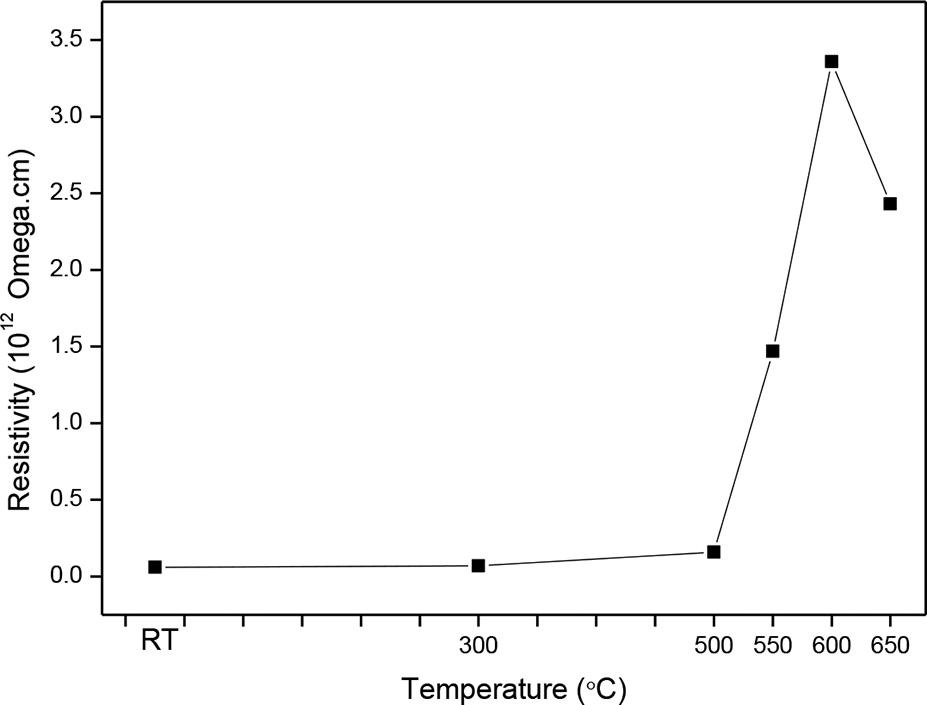
Resistivity of ScAlN film surfaces prepared at various substrate temperatures
Conclusion
A series of ScAlN films were prepared by dc reactive magnetron sputtering at different substrate temperatures. The substrate temperature could extremely influence the crystal quality, surface topography and the resistivity of ScAlN thin films. When the temperature is varied from RT to 650°C, the films exhibit different qualities. The crystal quality first increases because of more kinetic energy that the sputtered atoms obtained when the temperature is increased from RT to 600°C, and then decreases because of bombardment when the temperature is increased to 650°C. The best surface topography was obtained with the rms of 2·624 nm, and the maximum resistivity of 3·36 × 1012 Ω cm was obtained at 600°C.
Acknowledgements
This article is supported by a project supported by the Fundamental Research Funds for the Central Universities of Ministry of Education of China.