






Abstract
Lotus leaves are a typical example of superhydrophobic surface. Numerous studies have confirmed that surface morphology possessing micro- and nanoscale roughness along with a low surface energy material coating leads to apparent water contact angle (WCA) ⩾150°. In nuclear power plants, modified 9Cr–1Mo ferritic steel is the favoured steam generator tubing material. During transit, storage and installation, SHP surface on modified 9Cr–1Mo ferritic steel can impart good corrosion resistance to retain the integrity of the specimen during operation. In this study, SHP surface of modified 9Cr–1Mo ferritic steel with a WCA of 150±1° was successfully achieved by polishing, etching, perfluoro octyl triethoxy silane coating and baking. The WCA and contact angle hysteresis were measured. The surface morphology and the composition were characterised by atomic force microscopy and attenuated total reflection–infrared spectroscopy respectively. Superhydrophobicity and its related theories are also discussed in this paper.
Introduction
Lotus leaves exhibit excellent superhydrophobic (SHP) surface with a high apparent water contact angle (WCA) of ⩾150° and a low contact angle hysteresis (CAH) with self-cleaning effect. In 1997, Barthlott and Neinhuis revealed for the first time the unique dual scale micro- nanostructures of the lotus leaves and the chemical material with a low surface energy epicuticular wax crystalloids present on it.1 This revolutionary research provided two important guidelines for researchers to reactivate the research on SHP surfaces. For instance, the first approach depends on producing geometrically controlled rough surfaces and reducing the surface energy by adding low surface energy materials, and the second approach solely involves tailoring the low surface energy material by creating roughness at micro- and nanoscales.2 Proper design of surface topographical feature is required to support aforementioned criteria for superhydrophobicity. In this case, the water droplet rests on the top asperities of the dual scale surface structure and results in Cassie–Baxter regime in which air is supposed to be trapped in rough structure underneath the water droplet and in turn gives a higher WCA.3
Like lotus leaf, some other surfaces in nature such as butterfly wings, rice leaves, mosquito eyes, cicada wings, desert beetle, spider silks, fish scales and gecko feet4–8 also exhibit excellent superhydrophobicity. From the afore- mentioned discoveries, plenty of research articles and reviews9 have appeared on the SHP surfaces describing their various potential applications ranging from self-cleaning coatings for windshields of automobiles,10 anti-icing,11 window glasses and solar panels,12,13 paints,14 anti-fogging and anti-corrosive coatings15 and so on. Many methods had been discussed in the literature to fabricate artificial SHP surfaces including electrodeposition process,16,17 sol–gel method,18–20 chemical vapour deposition,21–23 wet chemical method,24–26 electrospinning,27–29 simple solution–immersion process30–33 and so on.34–36 Some of the fabrication techniques presented in the literature for making SHP surfaces are costly and time consuming for practical implementation in applications. Thus, the significance of this study was the adaptation of a simple and cost effective method for SHP surface modification.
Modified 9Cr–1Mo ferritic steel is the favoured steam generator tubing material in fast reactors. The material is selected for steam generator applications due to its corrosion resistance in the required operating conditions. Even though these classes of steels have good corrosion resistance, they are susceptible to localised corrosion in humid coastal environments during transit, storage and installation in the coastal power plant. However, we are modifying the specimen to get an SHP surface, which can impart good corrosion resistance to retain the integrity of the structural material.37,38
Thus, the present work focused to study a simple method of fabricating SHP surface on modified 9Cr–1Mo ferritic steel specimen by polishing and etching to create micro- and nanoscale features and subsequently coating with perfluoro octyl triethoxy silane (PFOTES) to achieve high apparent WCA and low CAH.
Experimental
Materials
Modified 9Cr–1Mo ferritic steel specimen was cut into small pieces in dimensions of 25 mm×15 mm×5mm, and its composition was analysed by inductively coupled plasma optical emission spectrometry (ICP-OES) and given in Table 1. 1H, 1H, 2H, 2H PFOTES (Alfa Aesar), ethyl alcohol (Chinachangshu Yangyuan Chemicals, AR), hydrochloric acid (HCl) (Emparta), and nitric acid (HNO3) (Emparta) were used without further purification Deionised (DI) water was used in all the experiments.
Chemical composition of modified 9Cr–1Mo steel.


Surface pretreatment
All the specimens were subjected to mechanical polishing using different grades of SiC grit emery papers from 80 to 800. Then, the samples were cleaned ultrasonically with DI water for ˜ 10 min and air dried. The specimen polished from 80 to 800 grit SiC emery paper is defined as specimen I throughout the text.
Polished and ultrasonically cleaned specimens were etched in two different types of etching solutions: ‘HNO3/HCl/H2O’ (etchant I) in the ratio of ‘1:3:10′ and (ii) ‘FeCl3/H2O/HCl’ (etchant II) in the ratio of ‘10:10:1’. After etching for 60 s, the specimens were subsequently rinsed with DI water.
Chemical modification
PFOTES has a long fluoro alkyl chain (R) and three hydrolysable ethoxy (–OEt) groups along with silicon. In the first step, the three ethoxy groups were hydrolysed by eliminating three molecules of ethanol. The ethanolic PFOTES solution was prepared by adding 0.5 wt-% PFOTES to a solution mixture of 88 wt-% ethanol, 10 wt-% DI water and 1.5 wt-% 0.1N HCl.39 It can be seen that under acidic or basic conditions, the rates of both hydrolysis and condensation reaction are high. Therefore, HCl was added to catalyse the reaction. The solution was stirred at room temperature for ˜ 4 h to ai4d0 the reactions like hydrolysis and condensation. Hydrolysis followed by condensation results in the formation of oligomers, and this process is described in Fig. 1.
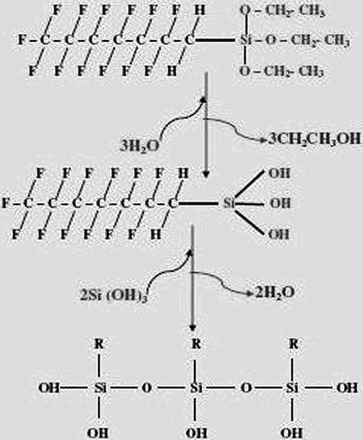
Reaction process of alkoxy PFOTES
Then, the etched specimens were immersed in ethanolic PFOTES solution containing silanol oligomers for 30 min. The specimens were dipped and lifted up at a speed of 50 mm min21 using dip coating unit. Then, the coated specimens were baked at 110uC for 30 min to form a stable covalent bond with the metal surface by the liberation of water. Figure 2 describes the hydrogen and covalent bond formation of silane with the metal surface.
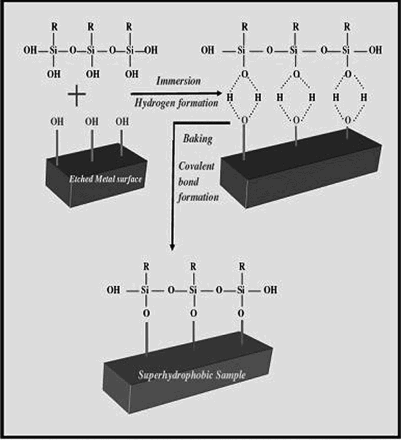
Hydrolytic deposition of PFOTES
The specimen polished with 800 grit SiC emery paper, etched in etchant I and chemically modified, is defined as specimen II, and the specimen polished with 800 grit SiC emery paper, etched in etchant II followed by chemical modification, is defined as specimen III. Polished and ultrasonically cleaned specimen followed by chemical modification without etching is defined as smooth surface specimen throughout the text.
Specimen characterisation
The WCA of all the four specimens were measured using contact angle goniometer (OCA15EC, Data Physics Instruments, Germany). The WCA measurements were taken in five different places, and its average has been taken as the WCA of the specimen. The WCA was measured using DI water of 10 ml dosing volume with a dosing rate of ˜ 1 μl s−1. The sessile drop needle in method was used to determine the maximum possible WCA value by increasing the volume of the liquid, whereas solid–liquid interfacial area remains unchanged. The maximum WCA value was called hadv. The volume was removed slowly to produce the smallest possible angle called the hrec. The difference between hadv and hrec is the CAH. Self-cleaning effect results in a lowest Tilting Angle (TA) value.
NT-MDT atomic force microscopy (AFM) (Solver ProEC/Electrochemical STM/AFM, Russia) in contact mode was used to image the morphology of all the four specimens. Surface roughness was measured for specimens I, II and III using AFM and surface profilometer (Make-Taylor Hobson, Model-Talysurf C1000).
Attenuated total reflection–infrared (ATR-IR) spectroscopy with a Perkin Elmer Spectrum Two spec-trophotometer was used to analyse the chemical composition of the organic structures by the interatomic bonds observed in the region of ˜4000–400 cm−1. The wavenumber range v2000 cm−1 consists of many peaks with varying intensities producing unique patterns of organic compounds. Thus, this region is generally called as the fingerprint region. The chemical composition of specimens II and III were analysed in these regions v2000 cm−1.
Results
WCA measurement
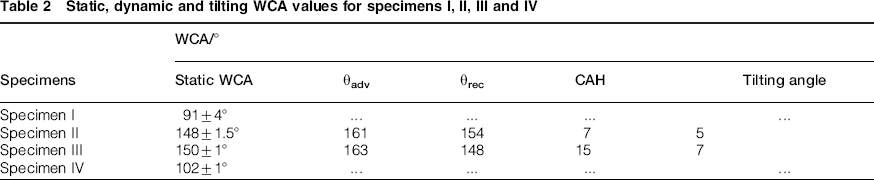
The static WCA for all the four specimens was measured by sessile drop method and was shown in (Fig. 3a–d). The static and dynamic WCA were measured and tabulated in Table 2. The static WCA value showed a transition from hydrophobicity to superhydrophobicity. The hadv, hrec, CAH and the TA values for specimen II were found to be 161u, 154u, 7u and 5u, whereas for 7specimen III, they were found to be 163u, 148u, 15u and u respectively. The smooth surface specimen without significant roughness exhibited hydrophobicity with WCA of 102+1u, and this smooth surface specimen was used to calculate the interfacial area using Cassie–Baxter equation.
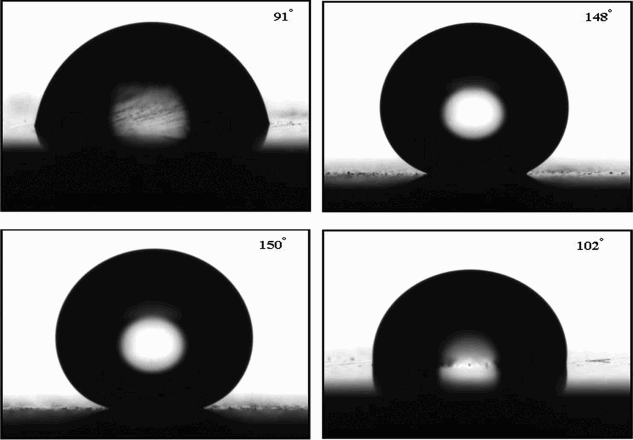
WCA images of a specimen I, b specimen II, c specimen III and d specimen IV
Static, dynamic and tilting WCA values for specimens I, II, III and IV

Surface morphology and roughness of SHP surfaces by AFM and surface profilometer
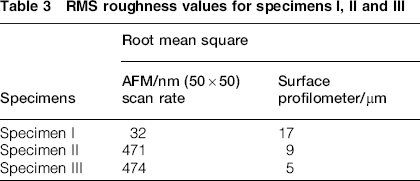
The surface morphology of all the four specimens was obtained using AFM, and the images were shown in Fig. 4 a–h. The surface morphology of specimens II and III showed micro- and nanoscale textured projections having valleys, whereas specimen I and the smooth surface specimen did not show any micro- and nanoscale projection.41 By using AFM and surface profilometer, the root mean square (rms) roughness values for specimens I, II and III were calculated and tabulated in Table 3.
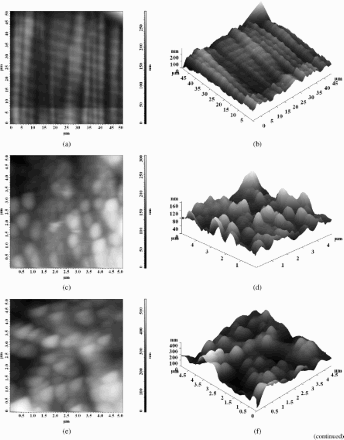
Two- and three-dimensional AFM images of a and b specimen I, c and d specimen II, e and f specimen III, and g and h specimen IV
RMS roughness values for specimens I, II and III
ATR-IR spectroscopy of SHP surfaces
Figure 5a and b shows the ATR-IR spectra of specimens II and III respectively. The broad band at 1068 cm21 was attributed to asymmetric stretching vibrations of Si–O– groups due to covalent bond formation with other PFOTES molecules through Si–O–Si bonds. The intensity, position and width of these bands depend on the structural parameters like nature of alkyl substituent on the silicon, hydrogen bonding of unreacted silanols and extent of polymerisation. The band at 980–890 cm21 was assigned to the Si–OH band.42 The peaks observed ˜700–800 cm−1 were due to the vibrations of Si–O groups in the PFOTES solution. Moreover, peaks ˜1145 cm−1, 1242 cm−1 and 1147 cm−1, 1244 cm−1 were attributed to the vibrations of CF2 and CF3 groups of specimens II and III respectively.43,44 Thus, the ATR-IR analysis confirmed the presence of PFOTES solution on the SHP specimens.
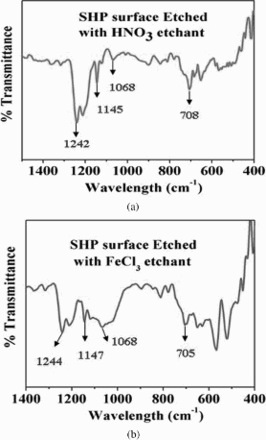
ATR-IR spectra of a specimen II and b specimen III.
Discussion
The chief thrust is to modify the specimen with surface pretreatment to get the ideal micro- and nanoscale roughness by chemical etching. Then, the super-hydrophobicity was enhanced by introducing CF3 groups, which have the lowest surface free energy.45,46 So, in this study, attempts were made to achieve SHP surface by employing aforementioned method for the first time.
The specimens polished from 80 to 800 grit SiC emery paper were etched in etchants I and II for 60 s. Etching played a vital role in tuning the required surface roughness. Etching is one of the chemical processes used in removing a layer of contamination, and it also gives better adhesion47 on a metal surface. In the chemical modification procedure, 30 min of immersion and 30 min of baking gave the highest static WCA. Smooth surface specimen without significant roughness was prepared in order to explain the importance of surface roughness.
The surface morphology of specimens II and III observed in AFM showed micro-nano projections. From rms roughness values, it was observed that specimens II and III showed higher micro- and nanoroughness respectively. From the above observations, the presence of micro- and nanosized structures were confirmed in specimens II and III, which in turn give higher WCA values, which can be correlated with lotus leaf and many other artificial SHP surfaces.48–50 Thus, it was concluded that geometrical surface developed by pretreatment using mechanical polishing and chemical etching along with a PFOTES coating was responsible for the transition from hydrophilic to SHP surface as proved by increase in WCA values. From the roughness values, it was believed that the dominating microroughness feature for specimen II was the cause for decrease in WCA value of ˜2° than specimen III. Specimen III shows CAH of 15°, which may be due to the effect of pinning. The ATR-IR analysis clearly indicated the presence of silanol groups and also CF stretching frequency, which is shown in Fig. 2. Along with the micro-nanoroughness, the presence of low surface energy CF3 groups present in the range of 1145–1242 cm-1 was responsible for the superhydrophobicity of the SHP specimen.
The surface topographic structure is also an important factor that influences the surface wettability.46 As described by Cassie–Baxter equation,51,52

where θ* is the apparent WCA value of rough surfaces, θs and θv are the intrinsic WCA values of smooth flat surfaces of solid and air respectively, and fs and fv are the fraction contact area of the solid and air. If θv is considered to be the surface fraction area of air (θv = 180°) and fs + fv = 1, then equation (1) can further be modified as

By using equation (2), the fs value can be calculated where θ* = 150 and 1488 and θs = 1028. With reference to equation (2), the values of fs were, ˜0.17 and 0.1953 for specimens III and II respectively, which further demonstrate that the air interfacial area of 0.17 and 0.19 is responsible for the SHP property.54 From this value, it can be concluded that the small fraction of contact area between the liquid droplet and solid surface allows the droplet to roll off easily over the surface.55–57 The large fraction of air gaps trapped within the interstices of microtextured surface by increasing the air/water interface, which in turn effectively prevented the penetration of water droplets into the grooves, resulting in the WCA of 150° with very low TA of, <8° in this study.58 Hence, decrease in WCA value for specimen II was due to the decrease in fs value along with the roughness parameter.
Conclusion
(i) The SHP modified 9Cr–1Mo ferritic steel specimen with a WCA value of 150±1° had been developed by a simple and novel method involving mechanical polishing, chemical etching and coating with PFOTES. This result is a direct implication of the well established fact that superhydrophobicity results from the combined effect of surface roughness and low surface energy material coating.
(ii) The WCA value of ˜150±1° was obtained for SHP specimen. An excellent statistical difference was obtained for specimens I, II and III and smooth surface specimen. AFM images of SHP specimens showed micro-nano protrusions. The surface roughness values were obtained from surface pro-filometer and AFM. ATR-IR analysis confirmed the presence of silane on the SHP surfaces.
(ii) Cassie-Baxter model was used to measure the heterogeneity of the SHP specimens. The presence of air pockets confirmed by Cassie-Baxter regime will act as an effective block for the penetration of water molecules and also the presence of dual micro-nano protrusions resulting in the increasing WCA value with lower TA values. These results indicated that the surface pretreatment involving etching resulted in a suitable surface morphology, which in turn has enhanced the superhydrophobicity of the specimen.
(iii) Modified 9Cr–1Mo ferritic steel specimen has been used as structural material in nuclear industries, which are susceptible to localised corrosion in humid coastal environments during transit, storage and installation. Therefore, SHP coating on modified 9Cr–1Mo ferritic steel can impart good corrosion resistance to retain the integrity of the structural material during operation.
Footnotes
Acknowledgement
M. Ezhil Vizhi acknowledges the University Grants Commission-Department of Atomic Energy (UGC-DAE) Consortium for Scientific Research for the financial assistance through Junior Research Fellowship.