







Abstract
Organophosphonic acid derivatisation on aluminium surfaces had been demonstrated to be effective for surface energy control. By following the surface energy control strategy, surperhydrophobic Al surfaces had been achieved via microcolumn pattern and dodecylphosphonic acid (DDPA) derivatisation. The water contact and sliding angles of the superhydrophobic Al surfaces were respectively 156 and 5°. Measurements confirmed that the linkage between DDPA and Al are mainly bidentate P–O–Al. The wetting properties as well as the mechanical durability of the superhydrophobic Al surfaces were tested and discussed.
Introduction
Surface wettability depends both on surface energy and geometrical structures.1–4 Therefore, superhydrophobic surfaces can be fabricated via two different strategies: creation of rough structure on hydrophobic surfaces or modification of rough surfaces with low surface energy coatings.2,5–7 Superhydrophobic Al surfaces have generated extensive interests because of their potential applications in architectures, electric cooker liners, microelectronic mechanical systems and so forth.8–13 Since clean Al surface is intrinsically hydrophilic, both appropriate surface structure and low surface energy modification are necessary to make it superhydrophobic. In the surface construction strategy, by electrolytic and chemical etching, micro/nanostructured Al surfaces had been fabricated to achieve superhydrophobicity.14–16 The etching process has the benefits of convenience and low cost. However, the procedure control is difficult and, thus, limits quantitative analyses. Hence, in order to study the impact of surface structure on the wetting properties, accurate surface pattern has obvious science significance. In the surface modification strategy, Fluoroalkyl silane,14,15 Teflon, 17 Perfluorooctyltriethoxysilane 18 and other materials had been used to lower Al surface energy to achieve superhydrophobicity, and functions such as anti-icing and anticondensation were obtained. However, without chemical bonds linkage, the adhesion between Al and these materials is limited. In the present work, surperhydrophobic Al surfaces were prepared by microcolumn pattern and dodecylphosphonic acid (DDPA) derivatisation. We demonstrated that DDPA bonded to Al surfaces through mainly bidentate P–O–Al linkage via condensation reaction between the hydroxyl of Al and the acid headgroups. The covalent bonds between Al and organophosphonic acid headgroups provide potential applications of superhydrophobic Al surfaces due to their durability.19–21
Experimental
Materials and sample preparation
Semiconductor grade single crystal n type Si (100) wafers were cut into 15 × 15 mm coupons. The coupons were cleaned by sonication in acetone for 15 min and followed by sequentially rinsing with deionised water (18.2 MΩ; Milli-Q), drying in a N2 stream and treating by a ultraviolet (UV)/ozone to remove residual organics.
A layer of SU-8 photoresist was spin coated onto cleaned Si substrates and patterned to microcolumn arrays via standard procedures of exposing, developing, washing and drying. Detailed processes are described in Refs. 22 and 23. An ∼100 nm Al film was deposited on the patterned SU-8 surface by radio frequency magnetron sputtering. The samples were treated by a UV/ozone before DDPA derivatisation to remove residual organics and to oxidise the Al surfaces to a depth of ∼3 nm simultaneously.
Crystalline DDPA powder [CH3(CH2)11P( = O)(OH)2, purity >97%] purchased from Polycarbon Industries (Devens, MA, USA) was heated to 100°C for 10 min to eliminate moisture before use. A 2 mM DDPA solution in tetrachloroethane was used to derivatise DDPA on the patterned Al surfaces. In the derivitisation procedure, the microcolumn structural Al surfaces were immersed into the DDPA solution for 5 min and followed by successive alcohol and deionised water rinsing and a final N2 stream drying. It is worth to mention that the cleaned Al surfaces were used immediately for DDPA derivatisation since possible contamination will weaken or even block the interaction between the DDPA headgroups and the Al surfaces.
Surface roughness characterisation
Scanning electron microscopy and dynamic force mode atomic force microscopy (AFM) were conducted to characterise the morphology of Al and DDPA/Al surfaces. Since it is difficult to measure these microcolumn surfaces by AFM, we adopted flat control samples, which were prepared under the same procedure except column patterning. The AFM images were obtained at a scan rate of 5 μm s− 1 in ambient with relative humidity of 50%. The data points in an AFM image were typically 256 × 256.
Surface chemical analysis
X-ray photoelectron spectroscopy (XPS) (Kratos AXIS ULTRA) was carried out in ultrahigh vacuum (base pressure below 10− 9 mbar) with monochromatic Al Kα radiation under 15.0 kV and 150 W. Detailed experimental methods are described in Ref. 21. The binding energy was calibrated by the contaminated C 1s photoelectron peak (obtained from blank cleaned Si surface) at 284.8 eV. The deconvolution of high resolution XPS peaks has been obtained by the mixed Gaussian–Lorentzian fit after Shirley background subtraction. The XPSPEAK processing software was used to curve fitting and analyses.
Surface wetting property measurements
Sessile drop static water contact angle (WCA) measurements were conducted with a Rame’–Hart's Model 100-00 Digidrop contact angle measurement system to determine the surface wetting properties. All measurements were performed using deionised H2O in 50% relative humidity ambient at room temperature. On each sample, at least three spots were tested, and the averaged WCA was obtained.
Results and discussion
Surface morphology
SU-8, Al/SU-8 and DDPA/Al/SU-8 surfaces showed no obvious differences in SEM images under the order of micrometre. For simplicity, we only show the images of DDPA/Al/SU-8 in Fig. 1a. The diameter and height of each column and the period of the column pattern are 16, 19 and 25 μm respectively. Figure 1b shows the cross-section of an Al film coated on a flat SU-8 surface. The Al film was prepared under the same conditions as those in the column patterned cases. The Al/SU-8 interface is clearly seen in Fig. 1b, and the thickness of the Al film was measured to be 111 nm. Hence, the thickness of the Al film was too small to influence the morphology of the column pattern.
Images (SEM) of a DDPA/Al/SU-8 surface and b profile of sputtered Al coated flat SU-8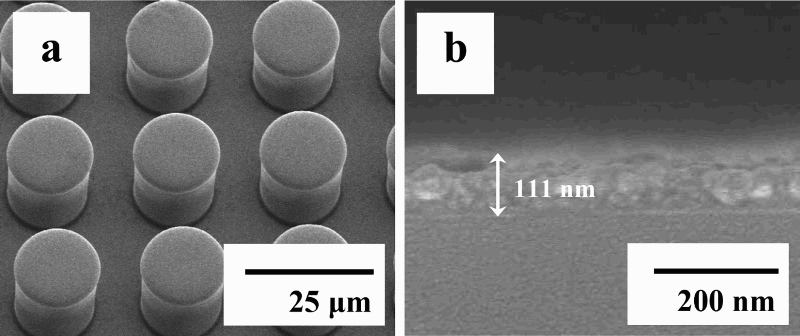
Parts a and c in Fig. 2 are topographic images (rendered in 3D) obtained in an area of 10 μm × 10 μm for the bare Al and DDPA/Al surfaces, respectively. Typical profiles, extracted from Fig. 2a and c, are shown in Fig. 2b and d. No significant morphological changes were observed between the blank Al/SU-8 and the DDPA derivatised Al/SU-8 surfaces. The ‘droplets’ seen in Fig. 2a and c are aggregates of Al particles. The largest aggregate seen in panel c reaches 300 nm in height and 3 μm in diameter. The overall root mean square roughness of the two samples was estimated to be 30–40 nm.
Images (AFM) of a flat Al and c DDPA/Al surfaces and b and d are their corresponding profiles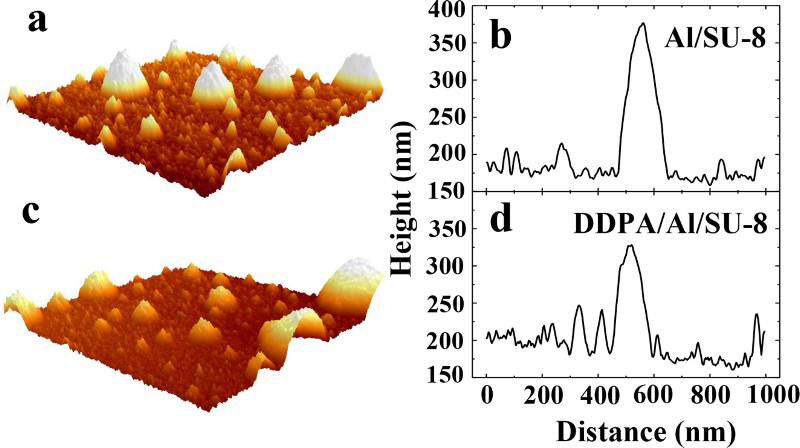
Surface chemical states
Figure 3 provides the XPS spectra of the DDPA/Al/SU-8 surface. In the range of 284–289 eV, the C 1s peak (Fig. 2a) was satisfactorily fitted and separated to two components: a tiny state at 284.86 eV with full width half maximum (FWHM) of 1.27 eV accompanied with a main state at higher binding energy of 286.49 eV with FWHM of 1.15 eV. The components correspond to adventitious carbon and C–C/C–H bonds of DDPA CH2 groups respectively. 24
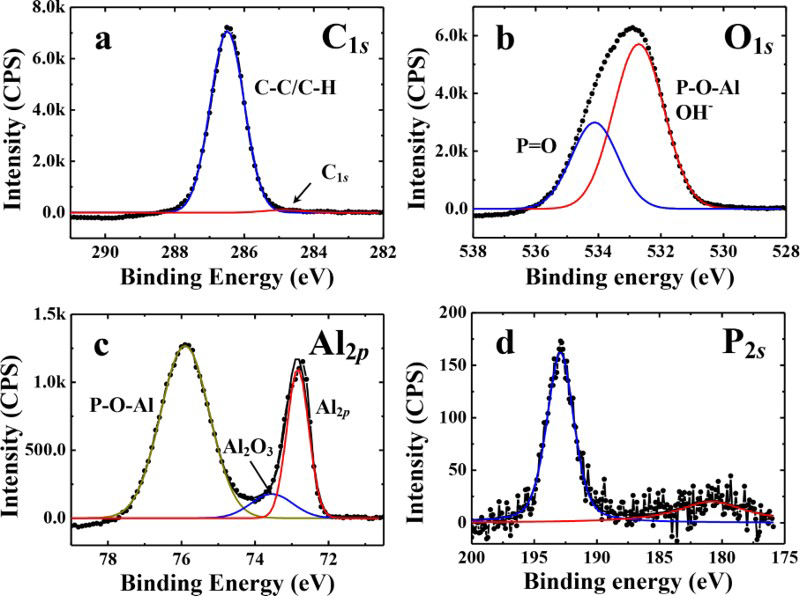
X-ray photoelectron spectra obtained for DDPA/Al surface: peaks of a C 1s, b O 1s, c Al 2p and d P2s
Multiple curve fitting solutions were used when analysing the O 1s core level lines in Fig. 3b. According to Refs. 19–21 and 25, a reasonable scheme was adopted in which O 1s was separated to two peaks: a stronger peak at 532.71 eV with FWHM of 1.90 eV represents the main contribution of the P–O–Al bonds; a peak at 534.12 eV, with FWHM of 1.74 eV, is attributed to P = O bonds. The existence of P = O bonds suggests that the bonding configuration of P–O–Al is either mono- or bidentate, rather than tridentate. The O 1s line in this spectrum does not show the highest binding energy component at ∼538 eV, which is due to organophosphonic acid hydrogen bonding to the silicon oxide surface or to neighbouring molecules in the case of bulk octadecylphosphonic acid (which has the same headgroups as DDPA) on silicon oxide surfaces. 19 The lack of this component here indicates the DDPA monolayer derivatisation on Al surfaces.
Figure 3c shows an Al metal peak at 72.84 eV, an Al2O3 peak at 73.54 eV and Al–O bond peak at 75.9 eV. The Al–O bond peak corresponds to the P–O–Al component at 532.71 eV in the O 1s peak. The results agree well with the reported peak separation of ∼2.8 eV.20,26 Furthermore, in consideration of the sensitive factors, the integral intensities of the P–O–Al component in O 1s and Al 2p are 15.8 and 10.6 k CPS respectively suggesting that the bonding configuration of the P–O–Al bonds are mainly bidentate. 27 The corresponding schematic diagrams are shown in Fig. 4. Besides, the Al oxide layer is essential to DDPA derivatisation since it provides O to form P–O–Al bonds.
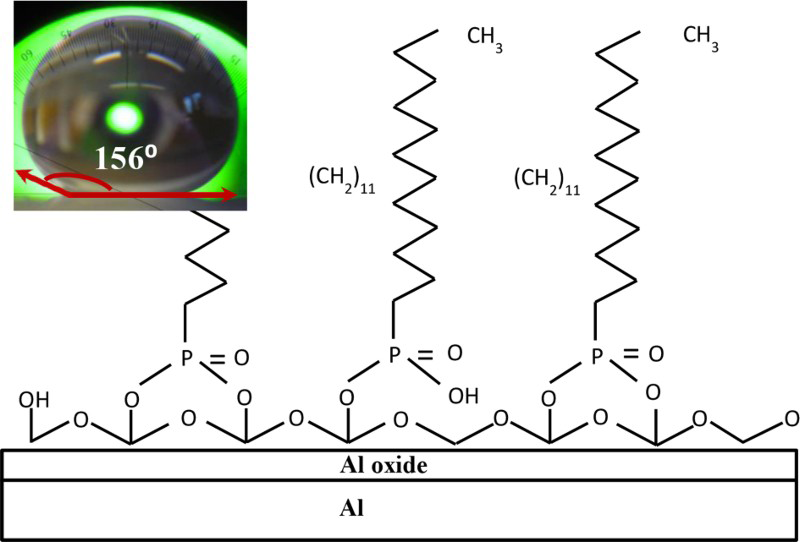
Schematic illustration of DDPA monolayer derivatisation on Al surfaces; inset shows water droplet beading up on column patterned DDPA/Al surface
Figure 3d is the spectrum of P 2s. The observed P 2s binding energy is 192.91 eV. The lower binding energy peak at 180.84 eV is attributed to Al plasmon loss. 19
Atomic per cent concentration (APC, in percentage) was quantitatively measured and used to determine the surface chemical composition. The APC of C, O, Al and P were 43.42, 32.08, 21.36 and 3.14 respectively. The APC ratio of C 1s/P 2s is 13.83, which approaches the expected value of 12; the deviation comes from the adventitious carbon.
Surface wetting properties
The inset in Fig. 4 is a deionised water droplet beading up on the DDPA derivatised, column patterned Al surface and shows a WCA of 156 ± 3°. Meanwhile, the water sliding angle (WSA) is ∼5° (not shown). For a DDPA derivatised flat Al film, we detected a WCA of 115 ± 3°. Therefore, the superhydrophobicity observed in this case is attributed to both a hydrophobic surface and a patterned surface, which would trap air in gaps among the columns when a water droplet is placed.
In order to elaborate the impact of the surface chemistry and roughness on superhydrophobicity,28,29 we discuss the homogeneous wetting (Wenzel model) and heterogeneous wetting (Cassie–Baxter model) regimes. The Cassie–Baxter equation relating the WCA on a rough surface
 and an idea surface
 is as follows

 >90°,
>90°,
 will become larger. However, only the Cassie–Baxter equation allows
 to be larger than 90° for
 < 90°.
We found that the flat Al surface had a WCA < 10° immediately after the UV cleaning, which is characterised as a hydrophilic surface. The column patterned Al surface, after UV cleaning, also showed a WCA < 10°, suggesting that water wets both the top surface of the columns and the surface at the bottom. This is due to the fact that the surface energy was very high immediately after the UV cleaning so that water wets the whole surfaces, leaving no air pockets in the gaps between columns. Therefore, the wettability of water on such a rough surface should follow the Wenzel equation. However, since the WCA on the flat Al film was already very small ( < 10°), the roughness effect was thus undetectable experimentally.
Interestingly, we found that aged flat Al films had a larger contact angle of ∼83°, which is due to hydrocarbon adsorption. For this WCA (83°), the Wenzel equation predicts a WCA < 83° on the aged column patterned Al surface. On the other hand, the Cassie–Baxter equation predicts a metastable state with a WCA >90°. 30 In fact, the WCA we obtained on this aged, column patterned Al surface was 140°. Thus, the water droplet followed the Cassie–Baxter equation, rather than the Wenzel equation. Nevertheless, the water droplet, despite its high contact angle, was pinned on the surface, suggesting that the surface of the top of the Al coated columns was hydrophilic, with a surface energy much smaller than the cleaned one before the hydrocarbon adsorption took place. Owing to this observation, we believe that the water droplet (with WCA of 156 ± 3° and WSA of 5°) beading up on the freshly cleaned DDPA derivatised, column patterned Al surface is in the Cassie–Baxter state, which means that there are air pockets trapped among the columns.
Cycled pressure water flushing was conducted to test the mechanical durability of the superhydrophobic Al surfaces. In each cycle, the samples were continuously flushed for 5–10 min with 0.1 mPa waterspout and dried at 80°C for 1 h followed by WCA and WSA measurements. The results are shown in Fig. 5. The WCA slightly increased from 156 to 157° in the beginning 5 min. Meanwhile, the WSA has a decrease from 5 to 4°. From 5 to 45 min, the curves maintain smooth except a slight decrease in WCA from 156 to 155° at 30 min. After 45 min, the WCA decreased to 155°, while the WSA was maintained at 5°. The curve fluctuation is due to the DDPA layer changes in the flushing process. During the first 5 min, superfluous DDPA molecules residual from the rinsing process were continuously removed. As a consequence, the surfaces showed a higher WCA and lower WSA at 5 min. In the second cycle, from 5 to 10 min, DDPA molecules located at the edge of the columns, which bonded relatively weaker to the Al surface, were removed. Up to 10 min, all unstable factors were erased, and the curves remain unchanged. The slight decrease in WCA at 30 min was tentatively attributed to measuring error since the WSA did not change at that time, and the WCA remain unchanged at 20 and 35 min respectively. Although the DDPA monolayer became to be slowly destroyed after 45 min, the durability of the superhydrophobic Al surface was great due to the tight chemical bonds between the DDPA headgroups and the Al.
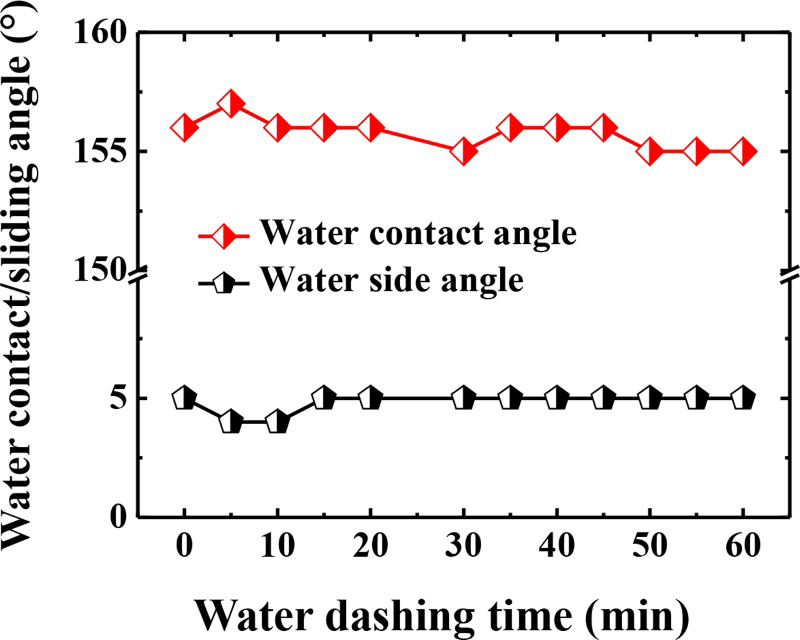
Water contact angle and WSA of prepared Al surfaces after pressure water flushing
The column pattern approach adopted in the present work has its significance because of its easy control and excellent reproducibility, which may benefit fabrication of novel surface structures to achieve anisotropic WCA, superoleophobicity, etc. With an extremely rapid dip coating method recently reported, 31 we expect that the approach to use organophosphonic acid as the surface energy control agent derivatised on Al films will accelerate the applications in making superhydrophobic surfaces.
Conclusion
Periodic microcolumn patterned Al surfaces were hydrophobilised via DDPA self-assembled monolayer derivatisation. This structured surface displayed superhydrophobicity with WCA and WSA of 156 and 5° respectively. We demonstrated that the organophosphonic acid derivatised Al film is a useful method to control the surface energy of a rough surface, which renders superhydrophobicity. The combination of Al film and organophosphonic acid derivatisation provides a simple and high throughput approach to hydrophobilise any surface as long as the Al films can be coated on it.
Acknowledgements
The authors thank Dr D. Yang for the helpful discussion. This work was supported by the National Natural Science Foundation of China (NSFC) under grant no. 21104028, the 2014 Competitive Grant Program of Oversea Returnees Research Projects and the Natural Science Foundation of Yunnan Province (grant nos. 2011FZ015 and 2011FZ051).