







Abstract
This paper investigates the effect of nanostructured and micrometre size YSZ powder coated plasma spray coating on high temperature oxidation resistance of Inconel (IN 718) substrate. The oxidation rate and reaction kinetics are studied, and the post-corroded scales are characterised in SEM, field emission SEM and X-ray diffraction. The results clearly indicate that there is an improvement of oxidation resistance in the case of nanostructured YSZ coating as compared to the micrometre size YSZ coated specimen. The detail mechanism of the significant improvement of the oxidation resistance of nanostructured coating is discussed in this paper.
Introduction
The yttria, partially stabilised zirconia (YSZ) is used as thermal barrier coatings (TBCs) in different industrial applications. This coating is used for providing thermal insulation to the high temperature zone of gas turbine and also in aeroengine. This coating can also be used to protect them from any degradation due to thermal load and also to increase the operating temperature of the engine. The YSZ coating cannot be directly applied over the substrate due to its poor adhesion properties. In order to improve the adhesion, an McCrAly bond coat is applied on the substrate before the use of final YSZ coating. These bond and top coats provide high temperature oxidation and corrosion resistance along with thermal insulation as reported in several literatures [1–5]. This coating can also be successfully used in wear and thermal insulation of different industrial applications [6,7]. The coating microstructure formed during the plasma spray coating is a key issue for protection against thermal shock, oxidation and corrosion. Thus, by controlling the microstructure retained in the coating, it is possible to improve the resistance against thermal shock, oxidation and corrosion resistance. The properties like porosities, cracking and residual stress on the microstructure can affect the high temperature oxidation and corrosion properties [8–11]. The different plasma sprayed ceramic oxide coating employed for oxidation/corrosion resistance has been reported by many researchers [12–16].
Nanomaterials are significantly used for improving the different material properties in the past two decades. Nanosize materials show different physical and chemical properties in comparison to micrometre size materials. The superior mechanical and thermal properties shown by nanostructured YSZ coatings over the conventional micrometre size YSZ coating is reported in some literatures [17–23].
The present investigation, therefore, attempts to bring forward the understanding related to the effect of nanostructured YSZ coating over Inconel superalloy (IN 718) on high temperature corrosion/oxidation behavior under air oxidation environment at 1000°C (1273 K). At the same time, the studies are also carried out for micrometre size YSZ coated specimen to compare the oxidation rate. The estimation of the corrosion rate and the study of reactions kinetics are necessary supplement in this investigation along with post-corroded scale characterisation.
Materials and methods
Substrate material
The substrate material used for these experimental studies was Inconel 718 superalloy. The chemical composition of the Inconel superalloy, used in the present study, is 55.80Ni–16.20Cr–17.23Fe–1.01Co–2.92Mo–4.75Nb–1.01Ti–0.52Al–0.56W (wt-%). Specimens of 20 × 10 × 5 mm were cut from a plate. The edges of the specimens are ground properly to provide adhesion of plasma spray coating with the substrate. The specimens were subjected to grit blasting with alumina powder (grit 60) at a pressure of 5 kg cm− 2 in a pressure air blasting machine.
Preparation of nano-YSZ powder
The initial material for preparation of the nanopowder is the micrometre size of 8 mol.% YSZ powder of 20 ± 5 μm size, supplied by Powder Alloy Corporation USA (PAC 2008P). The powders are provided with more or less uniform size with some variations. The variation of size is not much pronounced and considered to be more uniform. The same powder is subjected to planetary ball milling (model, Res PM 200, Retsch Ltd, Germany) to obtain the nanosize powder. The preparation of milling method (wet milling with toluene) provides nanosize powder. The milling time for this size and shape of the powder is standardised ∼10 h to get the desired nanosize. After milling operation, the powders are dried to produce the nanosize. The size of the milled powders is then measured in particle size analyser (model, Zeta Nano Zs, Malvern, UK). The nanopowders are also examined in SEM to reveal the morphological characteristics. The size and shape of nanosize powders are shown in Figure 1. Both the micrometre size and nanosize powders are used for plasma sprayed coating over the Inconel substrate.
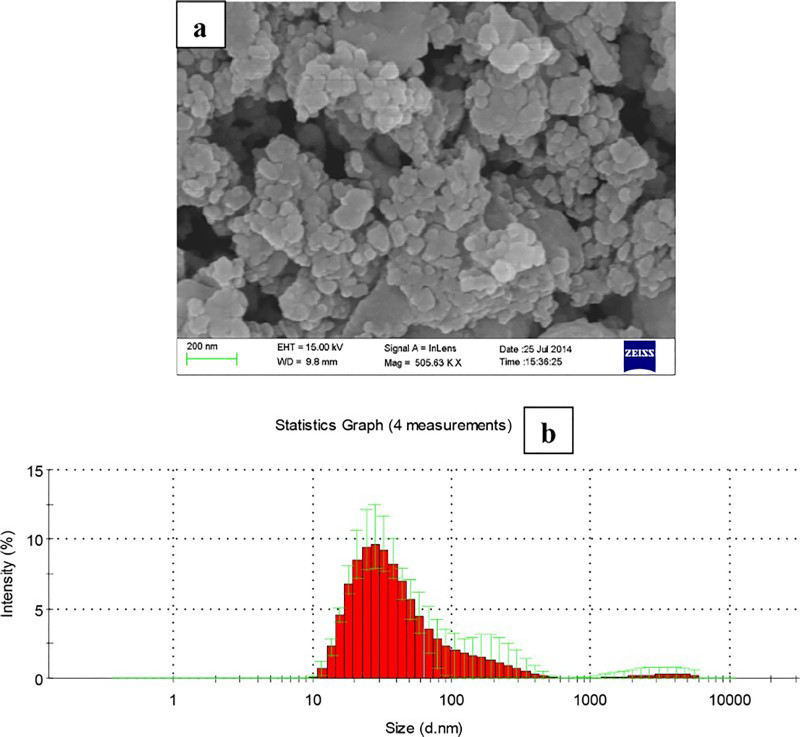
(a) powder morphology and (b) particle size analysis of YSZ powder.
Development of coatings
The micrometre size YSZ powder is directly plasma sprayed to the substrate material using atmospheric plasma spray unit (model, SG-100, Paraxair USA). A robotic arm (Kuka Robots, Germany) is used for uniform coating in all sides of the specimen over the substrate. The NiCrAlY powder is used as bond coat, which is plasma sprayed on Inconel substrate before final coating of YSZ powder. The plasma coating set-up for the experimental study is shown in Figure 2.
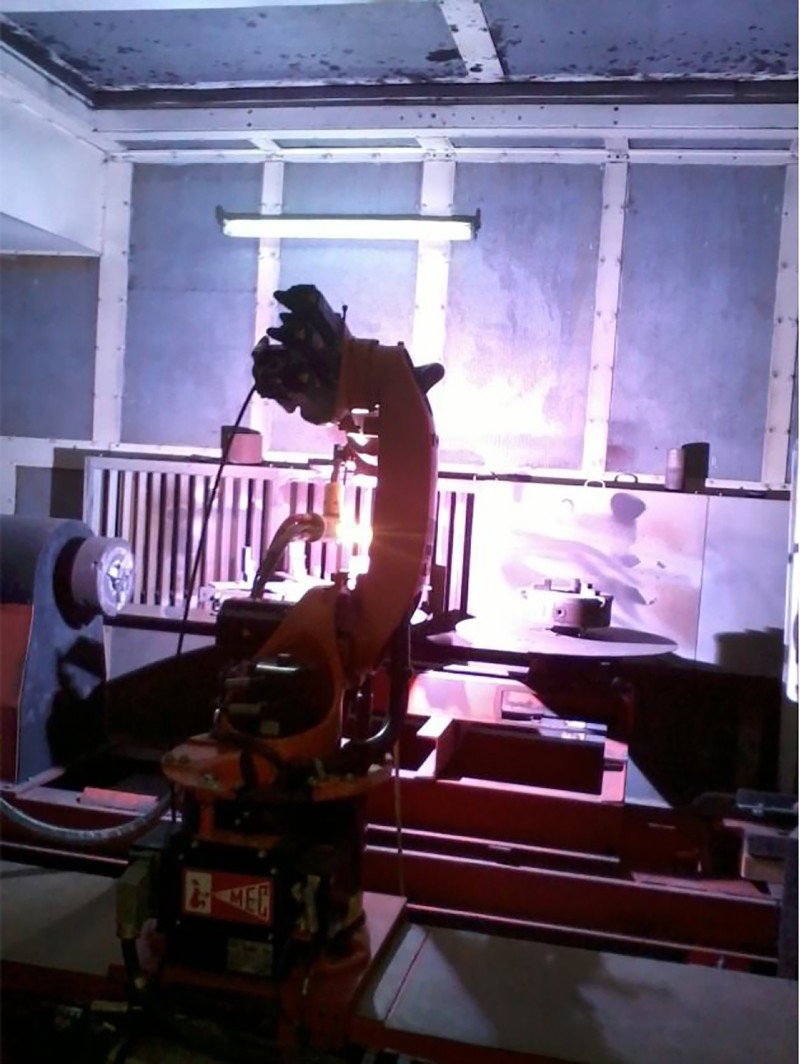
Experimental set-up for plasma spray coating process with robotic arm.
The nanosize powder due to extremely fine size does not have adequate flowability for plasma spray coating on the substrate. Thus, before coating operation, the nanosize powders are first subjected to agglomeration through spray drying. The nanopowders are agglomerated into micrometre size powder through spray drying. The micrometre size powders are finally thrown to the substrate during plasma spray coating operation. The agglomerated powder is then sprayed through plasma coating process to form the adherent coating. The agglomerated nanopowder on the substrate shows the nanofeatures in the coating and often referred as nanostructured coating. The same weight of micrometre size and nanosize powder is used in the coating for comparison purposes. The plasma spraying parameters for the coating are given in Table 1.
Spray parameters as employed during atmospheric plasma spray YSZ coating.

Coating microstructure
Figure 3a depicts the field emission SEM (model, SIGMA HD; make, Zeiss Ltd, Germany) image of surface morphology of the micrometre size YSZ powder coated specimen. The figure indicates the presence of porosities and cracks on the top surface. At the same time, the surface morphology of nanostructured coated specimen shows also few porosities and cracks on the top surface (Figure 3b). At higher magnification, dense packing of nano-YSZ particles on the coating surface is also detected (Figure 3c).
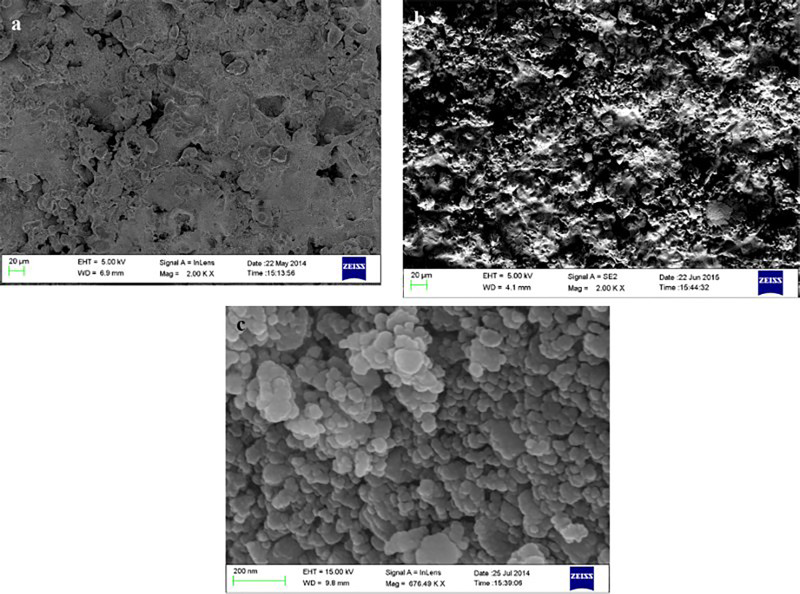
Top surface of as received (a) micrometre size YSZ coating, (b) nanostructured YSZ coating at low magnification (micrometre scale) and (c) nanostructured YSZ coating at high magnification.
High temperature corrosion test
The corrosion/oxidation test is carried out in a high temperature furnace attached with digital weighing balance. Specimens for corrosion tests are placed in the central heating zone of the furnace before heating the furnace to the desired temperature. Oxidation test is carried out in dry air under isothermal conditions at 1000°C (1273 K) up to 24 h. The weight change was measured at the end of each time interval with the help of an electronic balance (Metler Toledo) with a sensitivity of 0.01 mg. After 24 h duration, the specimen inside the furnace was subjected to cooling at the rate of ± 4°C.
Results and discussion
Corrosion rate and kinetic behaviour
Three samples for both the micrometre size and nanostructured YSZ coated specimens are taken for kinetic study. The corrosion rate and kinetic behaviour of micrometre size and nanostructured YSZ coated specimen are presented in Figure 4. The figure reveals that the reaction rate of nanostructured YSZ coated specimen is much lower than the micrometre size YSZ coated specimen. The figure also suggests the drastic improvement of oxidation rate in the case of nanostructured YSZ coated specimen. The reaction kinetics of both the coated specimen follows the parabolic growth rate (Figure 4), which indicates that the oxidation process is diffusion controlled and governed by the outer cation and inner anion migration.
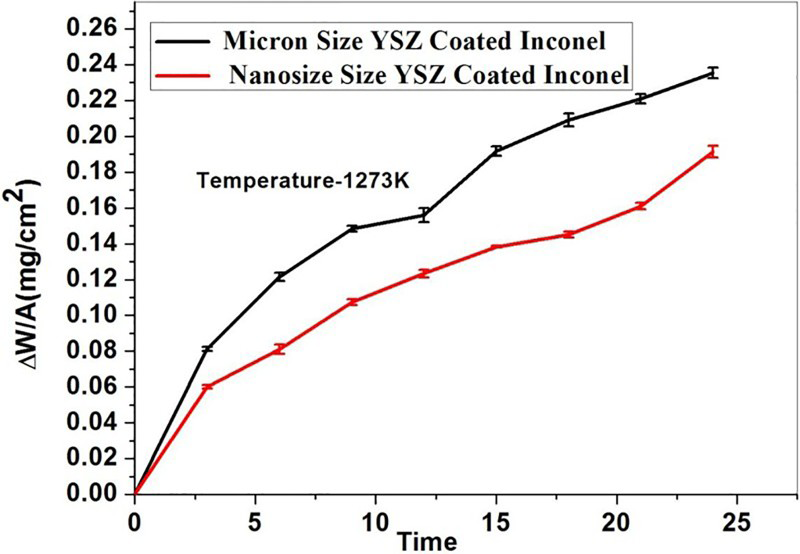
Kinetic behaviour of nanostructured and micrometre size YSZ coated specimen.
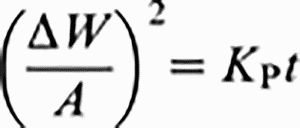
The parabolic rate constant KP is calculated by the following equation
 (1)
(1)
where ΔW/A is the weight gain per unit area (mg cm− 2), KP is the parabolic rate constant (mg2 cm− 4 s− 1) and t is the time (s).
The parabolic rate constants of micrometre size and nanostructured YSZ coated specimens are calculated and found to be 6.2296 × 10− 7 and 3.3606 × 10− 7 mg2 cm− 4 s− 1 respectively. The result indicates that there is significant reduction of parabolic rate constant in the case of nanostructured YSZ coated specimen.
Characterisations of post-corroded specimens
Surface morphology
The top surface of the post-corroded specimens is characterised in field emission scanning electron microscope (model, SIGMA HD; make, Zeiss Ltd, Germany). The surface features of micrometre size YSZ coated specimen consists of fully molten and some unmelted YSZ particle (Figure 5a). The figures also show some porosities and cracks in between the molten and unmelted zone (Figure 5a). The coating are not so adherent due to presence of unmelted zone. On the other hand, the coating microstructure of the nanostructured YSZ coating showed mostly fully molten zone along with semimolten zone without cracks and porosities on the top surface of the coating (Figure 5b and c). At higher magnification, the packness of the nanostructured particles are observed in fully molten and semimolten zones (Figure 5c). The semimolten zone at higher magnification shows the presence of nanosize YSZ particle (Figure 5d ). The top surface of the coating is packed densely by nanosize YSZ particle. This nanostructured coating is formed by mixture of full and semimolten zones in the plasma spray jet. This type of structure is called bimodal structure.
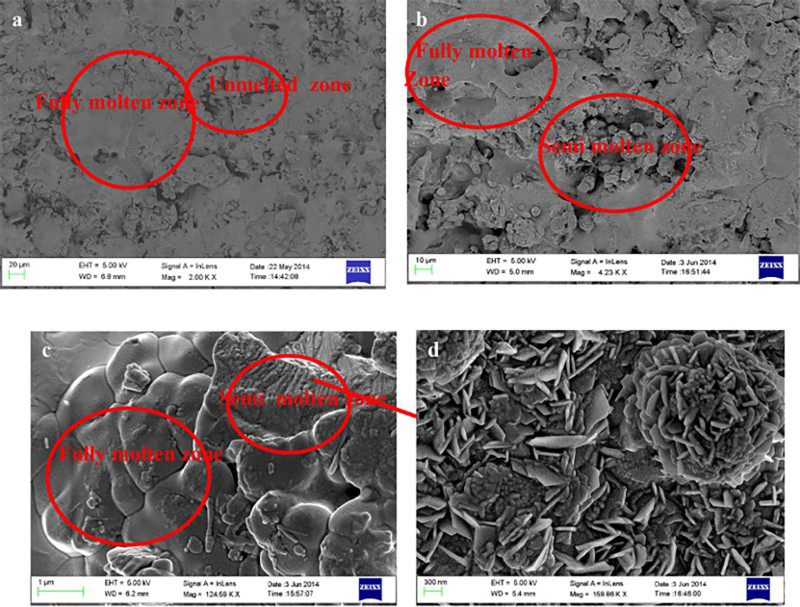
Surface morphology of post-oxidised (a) micrometre size YSZ coated specimen, (b) nanostructured YSZ coated specimen at lower magnification, (c) nanostructured YSZ coated specimen at higher magnification and (d) semimolten zone of nanostructured YSZ coating showing typical nano-YSZ particles (rod shaped).
Cross-sectional analysis
The cross-sectional analysis of micrometre size and nanostructured YSZ coating is characterised in SEM (model, S-3000N; make, Hitachi Ltd, Japan). The SEM image of the cross-sectional surface of both the coating is shown in Figure 6. The figure shows that both the YSZ coated specimens show lamellar structure containing some pores over NiCrAlY bond coat. This is a typical feature of plasma spray coating structure. Figure 6a shows the pores and microcracks on YSZ top coat of the micrometre size YSZ coated specimen, while the nanostructured coating (Figure 6b) shows considerably less pores and microcracks in comparison to micrometre size coated specimen. The packness of the nanoparticles in the case of nanostructured TBC results in less pores and microcracks in the coating. Absence of voids or microcracks in nanostructured YSZ coating indicates proper cohesion of the two layers. The presence of pores and microcracks in the plasma spray coating is reported in different literatured [24,25]. The cross-sectional view of both the coating also conforms to the presence of TGO at the coating substrate interface.
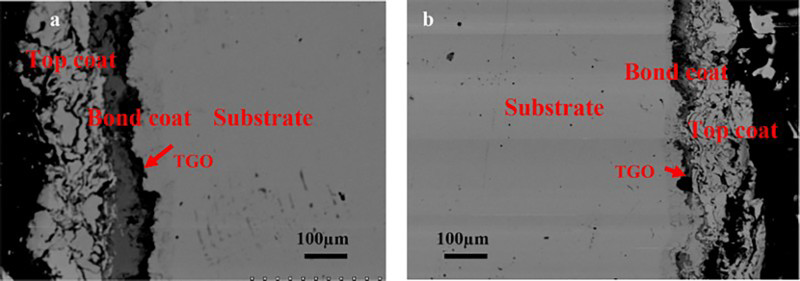
Cross-sectional view of post-oxidised a micrometre size YSZ coated and b nanostructured YSZ coated specimen.
X-ray diffraction (XRD) analysis
Figure 7 shows XRD pattern of the existing phases on the surface of the top coat after oxidation. The XRD analysis of micrometre size YSZ coated specimen shows the tetragonal zirconia as the strong phase and monoclinic zirconia and tetragonal YO4 as weak phase (Figure 7a). In contrary, the XRD analysis of nanostructured YSZ coating indicates the presence of tetragonal zirconia (main phase) along with monoclinic zirconia and tetragonal YO4 as oxidation products. The only difference is that the formation of monoclinic zirconia and tetragonal YO4 is much less in the case of nanostructured coatings (Figure 7b).
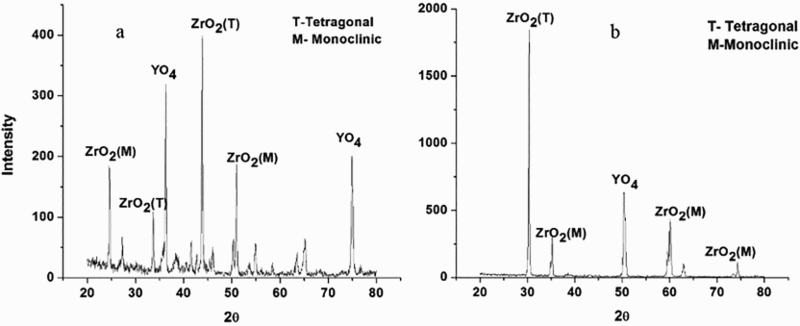
X-ray diffraction analysis of post-oxidised (a) micrometre size YSZ coated and (b) nanostructured YSZ coated specimen.
In this paper, the oxidation resistance of nanostructured YSZ coating is compared with micrometre size YSZ coated specimen. The reaction kinetics follows parabolic growth rate for both the specimen, which indicates that oxidation growth is diffusion controlled. Further, the growth kinetics is governed by the inner migration of oxygen, whether the outer migration of cation is restricted in presence of TBC coating. The parabolic rate constant in the case of nanostructured coating is much lower in comparison to the micrometre size YSZ coating. This further shows the significant improvement of oxidation resistance, in the case of using nanosize powder in the plasma spray coatings.
The morphology of the nanostructured YSZ surface indicates the needle shape oxidation products (Figure 5c). The needle shaped oxidation products are perhaps tetragonal YO4 as indicated from XRD analysis (Figure 7b). The intensity peaks of monoclinic zirconia and YO4 are less in nanostructured coating in comparison to the micrometre size YSZ coating. This indicates lesser oxidation products in nanostructured coated specimen. Formation of YO4 crystals causes extraction of yttrium from YSZ with a consequence of destabilisation followed by phase transformation [26]. The YO4 formation is much less in nanostructured YSZ due to packness of nanostructure.
The per cent of monoclinic zirconia unstable phase is key issue for controlling oxidation process. The following equation is used to determine the volume fraction of monoclinic phase (%) [27,28].
 (2)
(2)
where M is the volume percentage of monoclinic zirconia phase, T is the peak intensity peak of tetragonal zirconia (101) phase, M1 is the peak intensity of monoclinic zirconia (
 ) and M2 is the peak intensity of monoclinic zirconia (111) in the XRD plots after oxidation. Using equation (2), the monoclinic zirconia phase volume per cent is calculated using the equation. According to the calculation, the per cent of monoclinic zirconia in the case of nanostructured YSZ coating is much less than that of the micrometre size YSZ coating.
One of the major reason for the better high temperature corrosion resistance of nanostructure coating can be due to the fact that the former forms a stable zirconia, which does not crack as the temperature is cooled down, while the micrometre size YSZ coating forms tetragonal zirconia, which transforms to monoclinic phase change and hence further results in the volume change and cracking of the scale. Figure 5a clearly suggests the cracks on the top scale of the post-corroded micrometre size YSZ coated specimen, while Figure 5b and c shows the adherent scale without cracking of the scale in the case of nanostructured coatings. The formation of stable phase (tetragonal zirconia) in the case of nanostructured YSZ coating shows resistance to cracking of the scale. So in absence of crack, the migration of cation/anion is minimum and improves the high temperature corrosion resistance to a significant extent. In this context, the chemical compositions of YSZ powder is important. In that particular studies, 8 mol.% Y2O3 is used along with 92% zirconia (ZrO2). However, the formation of tetragonal ZrO2 phase depends on the particle size of this type of YSZ powder. The nanosize YSZ powder is extremely fine in size, and this size of the YSZ powder during plasma coating process may help to stabilise the tetragonal ZrO2 phase during oxidation. While the micrometre size powder during coating process results in conversion of some partially stable tetragonal zirconia to monoclinic zirconia phase. The formation of TGO as a result of the oxidation test in both micrometre size and nanostructured YSZ coating as seen from cross-sectional analysis (Figure 6) confirms TBC, which can be used as oxidation protection in gas turbine applications.
The results of the oxidation tests indicate that nanostructured YSZ coating decreases oxygen diffusion towards NiCrAlY bond coat and acts as a strong barrier for outward cation migration and to some extent inner anion migration, while the micrometre size YSZ coating shows more migration of oxygen towards the substrate and finds more oxidation rate. The formation of oxidation products (monoclinic zirconia and tetragonal YO4) as a result of oxidation is suggested from the XRD analysis (Figure 7). This clearly indicates that the micrometre size YSZ coating suffers more oxidation than nanostructured coating.
Conclusion
The following conclusions can be made on the basis of the results and discussion.
The nanostructured YSZ coating over Inconel substrate offers more resistance to oxidation than the micrometre size YSZ coated specimen at air oxidation environment at 1000°C (1273 K) for 24 h.
Both the micrometre size and nanostructured YSZ coated specimens follow parabolic rate kinetics, which indicates that the corrosion is governed by diffusion growth (i.e. outer cation and inner anion migration) during oxidation process. The parabolic rate constant KP of the nanostructured specimen is much lower than that of the micrometre size coated specimen.
The surface morphology of the post-corroded micrometre size YSZ coated specimen shows fully molten zone, unmelted zone and cracks and porosities in between the two zones. The cracks and porosities provide the short circuit diffusion path for inner anion migration and enhance the corrosion rate. The cross-sectional view of the coating also confirms the presence of TGO in between the coating and substrate.
The surface morphology of the nanostructuted YSZ coated specimen consists of molten and semimolten zones. The nanosize YSZ particle exists in the semimolten nanozone. The nano-YSZ particles, by easy migration at the grain boundaries, effectively block the short circuit diffusion path for cation and anion migration and improve the corrosion resistance to a significant extent.
The better oxidation resistance of nanostructured YSZ coating can be attributed to the formation of stable tetragonal zirconia (ZrO2), which does not crack the scale during cooling. At the same time, the micrometre size YSZ coating forms tetragonal zirconia during oxidation, which transforms to monoclinic zirconia phase change and hence further results in the volume change and cracking of the scale. The XRD analysis of both the coating justifies the stable and unstable phases after oxidation of both nanostructured YSZ and micrometre size YSZ specimens.