







Abstract
The effect of anodic inhibitors [calcium nitrate Ca(NO3)2, calcium nitrite Ca(NO2)2 and potassium nitrate NaNO2] has been evaluated using cylinders with steel rebars exposed to the following environments: in the marine tidal zone, at roof top and in air of 38°C and 90% relative humidity for 4 years. The experiments showed that the half cell potentials were more negative than the visual inspections proved when anodic inhibitors are used. Inhibitor dosage on 3–4% of cement weight seems sufficient to protect the rebar against corrosion. Capillary absorption experiments showed that the concrete porosity was unaffected by the inhibitors. The concentration profiles of chloride, nitrite and nitrate were investigated with respect to leaching. However, it was difficult to find the background level of nitrite due to possible chemical alteration.
Introduction
Chloride induced corrosion of rebars is perhaps the most common deterioration of reinforced concrete. The chloride intrusion in high performance concrete (e.g. bridges) exposed to the marine environment can in practice1 be much faster than that expected from laboratory trials. Concrete road structures also suffer the corrosion damage due to the use of de-icing salts. The addition of an inhibitor to the concrete recipe for structures prone to chloride attack is one measure that may enhance service life or time for necessary expensive repair.
A corrosion inhibitor should either raise the level of chlorides necessary to initiate corrosion or decrease the rate of corrosion after it has started, or both. Therefore, an inhibitor could either delay the corrosion initiation time or slow down the corrosion propagation rate or both. Since it does not necessarily prevent corrosion from happening altogether, some people prefer to refer to such compounds as corrosion retarders rather than inhibitors. With the above definition, the phrase inhibitor is maintained.
The corrosion process on a rebar consists of a cathodic area where an electrochemical half reaction reduces oxygen to hydroxyl ions



Corrosion inhibitors may either affect the cathodic (equation (1)) or the anodic (equation (2)) half reactions, and are consequently denoted cathodic and anodic inhibitors respectively. However, only anodic inhibitors are treated in the present paper. Readers interested in the chemistry of inhibitors in general are referred to the reviews by Gaidis2 and Söylev and Richardson.3
Among anodic inhibitors, inorganic nitrites (
 ) are well known to be efficient. Calcium nitrite, Ca(NO2)2, is preferred over sodium nitrite, NaNO2, since high dosages of sodium salts will lower long term concrete strength and also increase the risk of alkali aggregate reactions. Calcium nitrite has been used for more than 25 years as an inhibitor against chloride induced corrosion of rebars. It was pioneered in Japan4 in the 1970s and has been a popular subject for studies as a corrosion inhibitor in the last decades (for instance, Berke and Hicks5).
Since the anodic corrosion inhibitor effect of inorganic nitrates (
 ) is not as well known as that of nitrite (
 ), and it was only discovered in 1994,6 nitrate is emphasised in this paper. Note that since there is only one letter (a versus i) or a number (3 versus 2) between nitrate and nitrite, there has been some confusion in the literature. Hopefully this is clarified here.
It is generally accepted among scientists that nitrates do not promote steel corrosion (Alonso and Andrade,7 D'yachenko et al.8 and Goetz9). Meland et al.10 investigated the reinforced concrete of a 22 year old calcium nitrate (containing some ammonium) production plant where the concrete was deteriorated due to external calcium nitrate/ammonium attack (probably since concentrated calcium nitrate will form the expansive double salt with calcium hydroxide). However, the concrete with up to 1·5%
 showed no damage. They found that the reinforcement in severely nitrate polluted areas was in a perfect condition with only surface rust and no signs of brittleness. Holm11 noted an inhibiting effect of calcium nitrate with respect to steel corrosion, but subscribed the effect to other minor components in this commercial admixture. Vogelsang12 proved that calcium nitrate and nitrite had identical corrosion inhibiting properties by cyclovoltametry, and explained their inhibiting effect by precipitation of a calcium hydroxide layer in the alkaline solution (i.e. they would only function in an alkaline environment such as concrete).
The claim that calcium nitrate works equally well as calcium nitrite as treated in the present paper was verified by Justnes13 and also confirmed by Al-Amoudi et al.14 and Al-Methel et al.15
Experimental
Concrete cylinders of 100 mm diameter and 200 mm height were cast with a 20 mm rebar in the centre, leading to an effective concrete cover of 40 mm. A total of 14 concrete mixes were made and 24 cylinders with embedded rebars were cast for each mix to ensure sufficient cylinders for several termini. The basic 50 L concrete mix consisted of 17·5 kg ordinary Portland cement, 52·0 kg 0–8 mm sand, 21·3 kg 8–11 mm crushed gravel, 21·3 kg 11–16 mm crushed gravel, 8·25 kg water (w/c = 0·47) and 0·24% naphthalene based superplasticiser. The other variable admixtures were denoted that A-Ca(NO3)2 is the commercial technical grade calcium nitrate containing ∼1·5% ammonium, K-Ca(NO3)2 is the commercial technical grade calcium nitrate where ammonium is replaced with potassium to avoid ammonia smell when large dosages are mixed into concrete, Ca(NO2)2 is the commercial available calcium nitrite, NaCl is the sodium chloride (laboratory grade) and NaNO2 is the sodium nitrite (laboratory grade). Table 1 gives a summary of the 14 mixes with the additional admixtures. Dosages of NaNO2 and Ca(NO2)2 give equivalent molar nitrite dosages to the nitrate level in 3% A- and K-Ca(NO3)2.
Overview of additional admixtures (percentage of cement weight) for all mixes

The 24 cylinders of the 7 mixes without intermixed chlorides (1, 2, 3, 7, 8, 9 and 13) were split into two groups: 12 cylinders were stored in open boxes in the marine tidal zone so they were totally submersed and exposed to air twice every 24 h, while the other 12 cylinders had chlorides intruded by three drying and wetting cycles with sea water followed by storage at 38°C and 90% relative humidity (RH) with air access. Each cycle consisted of 4 days drying at 105°C followed by 3 day submersion in sea water at 20°C.
The 24 cylinders of the 7 mixes (4, 5, 6, 10, 11, 12 and 14) that had intermixed 3·2% NaCl of cement weight were also split into two groups: 12 cylinders were exposed to the changing weather of Trondheim, Norway, on a roof top (average yearly temperature is +5°C with a typical span from −10 to +22°C), while the other 12 cylinders were stored at 38°C and 90% RH with air access.
The profile of added chlorides, nitrate and nitrite for concrete at the roof top with single sided exposure to rain water was analysed by grinding dust from the exposure side inwards layer by layer, dissolving the dust in acid and analysing the respective ions by chemical methods.
A slice of the top of several cylinders from all three different exposure sites (marine tidal zone, roof top and 38°C and 90% RH with air access) was cut to expose the cross-section of the steel. The potential between the steel and a Cu/CuSO4 electrode in contact with the concrete at three places (i.e. 50 mm from each end and in the middle) was measured to assess the corrosion risk. Thereafter the same cylinders were split open to inspect the reinforcement steel visually. The plane polished cross-section of the steel with an oxide layer was in some cases also inspected by a scanning electron microscope in the backscattered electron mode. These tests were performed after 4 year exposure.
Carbonation depths were checked by the common phenolphthalein test when the concrete was split to inspect the rebars.
In order to check the level of intruded chloride, concrete was ground to powder, dissolved in nitric acid and analysed with a photospectrometric technique.
Results and discussion
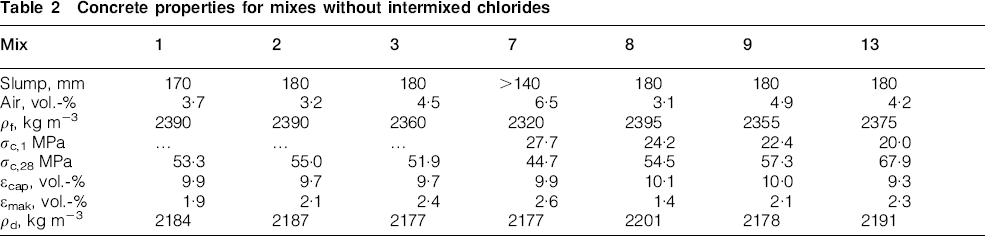
The following concrete properties of the 14 mixes are summarised in Table 2 for mixes without intermixed chlorides and in Table 3 for mixes with intermixed sodium chloride: slump, air content in fresh state (air), fresh density ρf, 1 day compressive strength σc,1, 28 day compressive strength σc,28, capillary porosity from water suction ϵcap, macroporosity from water saturation under pressure ϵmak and dry density ρd.
Concrete properties for mixes without intermixed chlorides
Concrete properties for mixes with intermixed sodium chloride
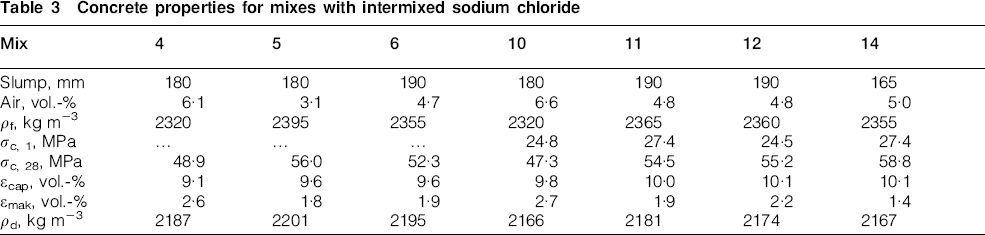
From Tables 2 and 3 it can be seen that although 28 day compressive strengths vary from 44·7 (mix 7) to 67·9 MPa (mix 13), the capillary porosity only varies from 9·1 (mix 4) to 10·1 vol.-% (mixes 8, 12 and 14) for the 14 mixes. The relative low variation in capillary porosity is comforting since then it can be assumed that the permeability will be comparable and the true difference in the chemical environment on corrosion can be evaluated.
A general argument against adding inhibitors to combat chloride ingress is that if chloride can diffuse in, the inhibitor may leach out. The leaching of added chloride, nitrate and nitrite are compared in Figs. 1–3, for concrete stored outdoor at the roof top for 4 years. The leaching profiles of nitrate and chloride are comparable as that expected from the similarity in porosity in Tables 2 and 3, but the background level could not be retrieved for the nitrite. It is not expected that all is leached, but rather that the speciation of nitrite may have been chemically altered to escape the analysis.
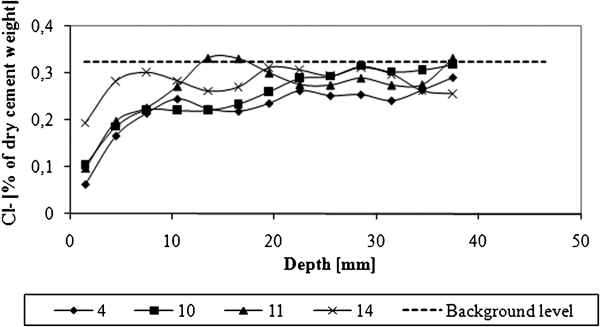
Chloride leaching profiles from different concrete mixes (4, 10, 11 and 14) added NaCl (see Table 1) when stored outdoor at roof top for 4 years
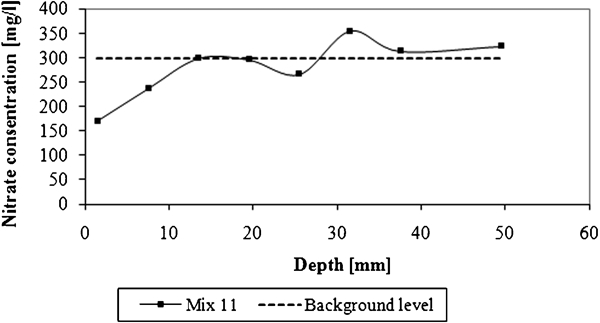
Nitrate leaching profile from mix 11 added 3% calcium nitrate of cement mass (see Table 1) when stored outdoor at roof top for 4 years
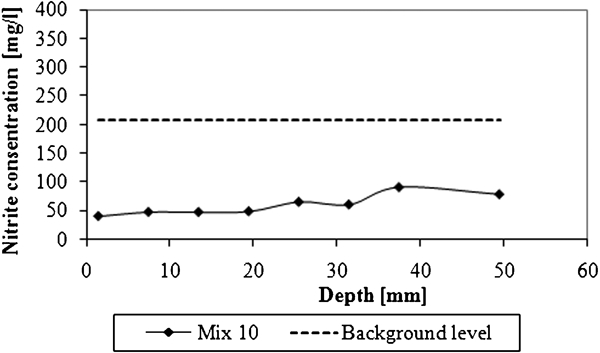
Nitrite leaching profile from mix 10 added 2% sodium nitrite of cement mass (see Table 1) when stored outdoor at roof top for 4 years: note that analysed level is significantly lower than calculated background level
However, the potential leaching of inhibitor does not pose a problem if the mechanism is to make a protective layer or surface complex from the beginning.
The behaviour of nitrate (
 ) as a corrosion inhibitor can be understood through the mechanism of the related ion nitrite (
 ) which is a well known steel corrosion inhibitor (Alonso and Andrade,16 Andrade et al.,17 El-Jazairi and Berke,18 Sagoe-Crentsil et al.19 and Yilmaz et al.20). Andrade et al.17 have suggested that steel corrosion is inhibited at Cl−/
 <1·5. Several hypotheses have been advanced for steel passivation by nitrite (El-Jazairi and Berke18) although without much experimental proof. Sagoe-Crentsil et al.19 claimed that nitrite ions readily form complexing agents with Fe2+ that are competitive with Cl− complexation, and thereby prevent the formation of soluble chlorocomplexes, which appear to be an essential component of the anodic corrosion processes (Sagoe-Crentsil and Glasser21). Sagoe-Crentsil et al.19 also proposed a sacrificial reduction of nitrite (
 ) to nitrogen (N2) and a simultaneous oxidation of ferrous (oxidation state +II) to ferric (+III) iron. The formation of FeOOH (or a similar product) on the anode would then decrease iron migration as ferrous/ferric chlorocomplex, and thereby stifle iron dissolution.
The proposed mechanism (Sagoe-Crentsil et al.19) may be analysed by the two half reactions in equations (4) and (5) with standard electrode potentials E0 (the equilibrium is shifted towards the right side for a positive potential)





 , is easily reduced to nitrite,
 , by ferrous iron in an alkaline solution as seen in equation (10) obtained by combining the half reaction in equation (9) with equation (5)


 , should be an even better inhibitor than nitrate,
 , since three more moles of ferrous iron are oxidised to ferric per mole nitrogen oxide added (i.e. nitrate is three times as effective at an equimolar dosage). Unlike nitrite, nitrate does not appear to work when tested in a rapid solution test (e.g. Brown et al.23). Even though equation (10) has a greater driving force (i.e. potential) than equation (8), the kinetics may be slower and a longer term test is required. However, corrosion in practice is a slow process, and thus this does not matter in a real structure. Another hypothesis is that nitrite acts as an oxygen scavenger since
 may be oxidised in an alkaline environment, as seen from the two half reactions (equation (11)) and the reverse of equation (9)


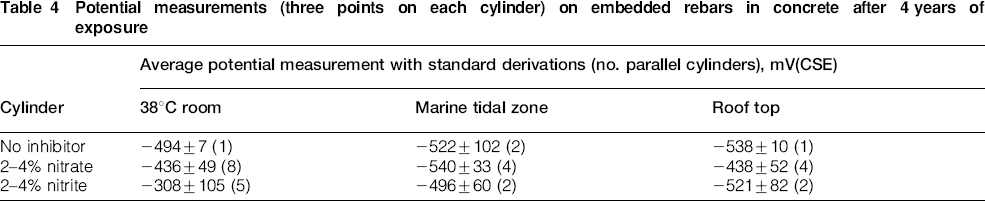
A common way to assess the corrosion is to measure the potential between the rebar and a Cu/CuSO4 electrode. There is a chance of active corrosion if the potential is less than −350 mV as illustrated in Fig. 4.25 However, in general when anodic inhibitors are added, the potentials were so low that corrosion should be expected, as illustrated by average/typical values listed in Table 4, but when the concrete cylinders were split to inspect the rebar, they looked quite unaffected to the naked eye, or with a dull, silvery layer (protective oxide layer), as depicted in Fig. 5 as opposed to a reference with chlorides without inhibitor added.
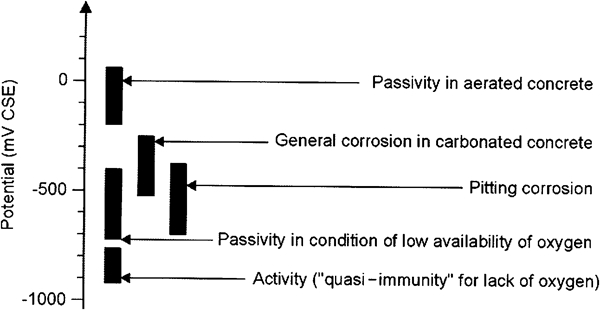
Corrosion state of rebars versus potential25
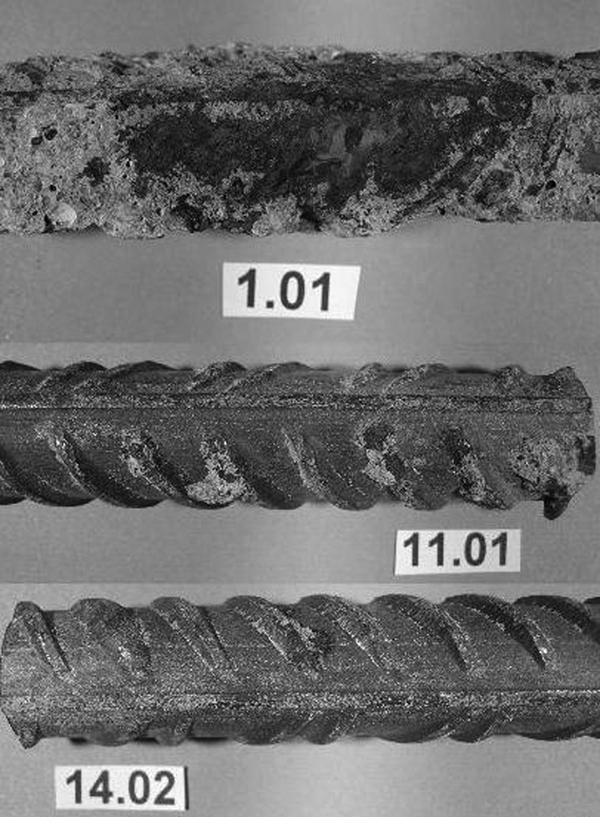
Rebars split out of concrete cylinders with added chloride without inhibitor (mix 1), with calcium nitrate (mix 11) and with nitrite (mix 14) stored at 38°C and 90% RH with air access for 4 years
Potential measurements (three points on each cylinder) on embedded rebars in concrete after 4 years of exposure
Analysis of the concrete that have been exposed to sea water in the tidal zone showed a high amount of chloride, as plotted in Fig. 6, well above 0·1% by mass of concrete considered to be sufficient to initiate corrosion. The rebars in cylinders with inhibitors showed no corrosion of the rebars, while the rebars were heavily corroded in the mix with no added inhibitor.
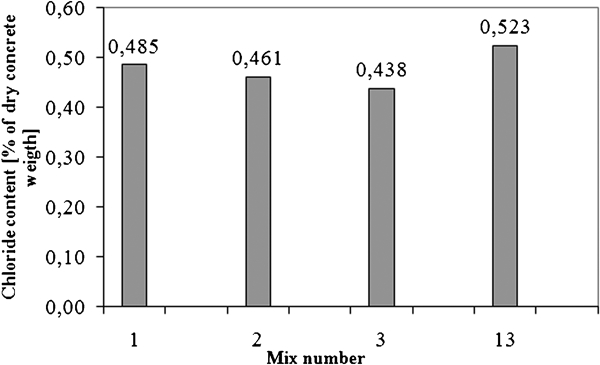
Chloride concentration in bulk concrete of cylinders stored in tidal zone for 4 years
The cross-section of the rebars investigated by a scanning electron microscope is shown in Figs. 7–9 for concrete with added chlorides, but without inhibitor, with nitrate and with nitrite respectively. The rebar with chlorides only has apparently been corroded inwards into the steel body (i.e. pitting), the one with nitrate has an ‘even’ dense iron oxide layer but no pitting into the rebar body, while the one with nitrite has a thinner iron oxide layer going partly, a few micrometres into the steel body. These microscopic observations seem to be in line with the proposed anodic inhibitor mechanisms outlined in the preceding text.
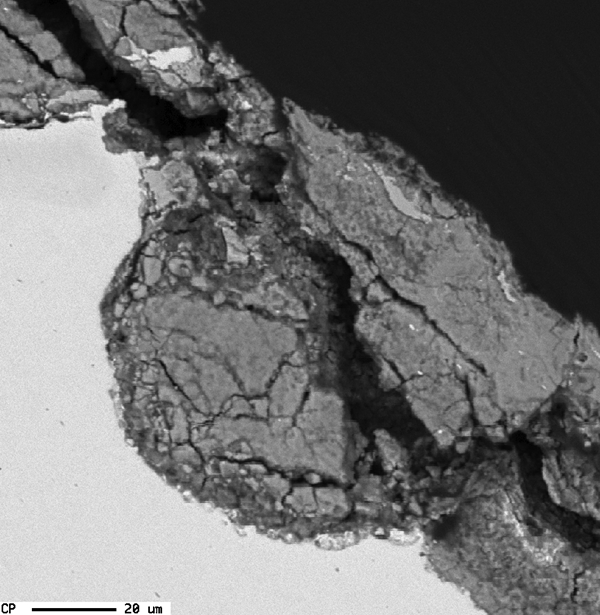
Porous corrosion products at surface of rebar embedded in concrete (mix 4) with added chlorides and stored at 38°C and 90% RH for 4 years: corrosion products eat into steel body (i.e. kind of pitting)
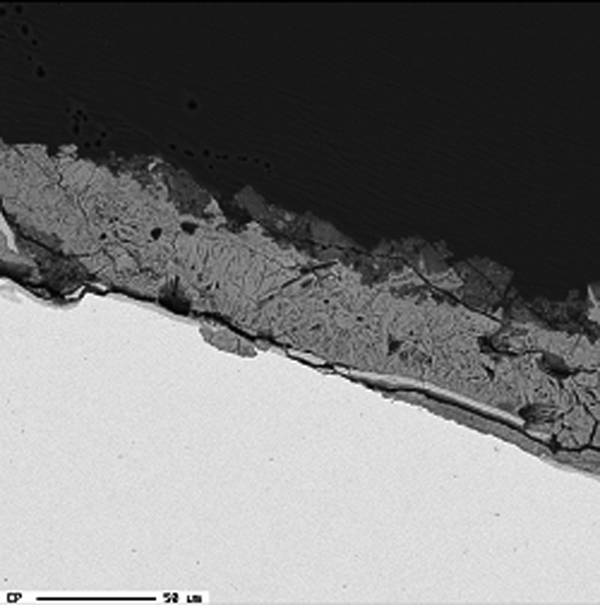
Dense iron oxide layer along steel body of rebar embedded in concrete (mix 5) with chloride and nitrate inhibitor added and stored at 38°C and 90% RH for 4 years
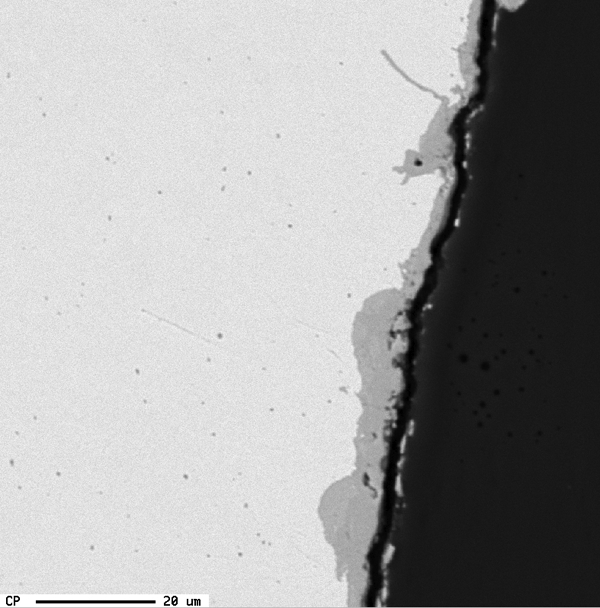
Thin iron oxide layer going a few micrometres into steel body of rebar embedded in concrete (mix 14) with chloride and nitrite inhibitor added stored at 38°C and 90% RH for 4 years
Conclusion
Adding 3–4% of cement mass of an anodic inhibitor such as calcium nitrate or calcium nitrite seems to be sufficient to protect rebars embedded in concrete against chloride induced corrosion.
The corrosion inhibitor mechanism for nitrate is analogous to the accepted mechanism for the well known anodic corrosion inhibitor nitrite. However, according to theory calcium nitrate provides a higher buffer as a corrosion inhibitor than calcium nitrite at an equivalent dosage. An additional benefit for calcium nitrate is that it is less harmful, available in larger amounts and cheaper than calcium nitrite.
Even though long-term leaching of anodic inhibitors is documented at the surface layer, they still perform well according to their mechanism. This is because the protective oxide layers on the steel were established long before the inhibitors began to leach out of the concrete.
Corrosion potentials cannot be trusted in evaluating corrosion when anodic inhibitors are included in the concrete mix since their oxidation abilities will shift the potential to lower values without actually having an on-going severe corrosion of the rebar.
Footnotes
This paper is part of a special issue on Cement and Concrete Science