







Abstract
The pressureless sintering behaviour of gelcast zirconia toughened alumina (ZTA) containing the total 5 wt-% additives of MgO and TiO2 was investigated. The effects of four combinations of MgO and TiO2 on the bulk properties, morphology and phase composition of the ZTA composites were evaluated in comparison with pure ZTA in the temperature range of 1150–1600°C. Four combinations of MgO and TiO2 initiated effective densification and enhancement at 1450°C, as indicated by the relative density and three-point bending strength measurements and fracture morphological observations by using scanning electron microscopy. X-ray diffraction analyses confirmed that the difference in the bending strength among four groups of ZTA composites was due to the MgO dependent formation of minor MgAl2O4 and TiO2 induced polymorphic transformation of tetragonal phase to monoclinic ZrO2. These results are useful to further develop dental ceramics, including glass infiltrated ZTA.
Introduction
The selection of an adequate material with high mechanical strength and toughness, good biocompatibility and aesthetics for dental restoration has long been a key research topic in dentistry. Metal alloys, porcelains, glass ceramics and structural ceramics have been used as dental inlays, crowns, onlays, bridges and core build-ups.1–3 Among these, glass ceramics and high performance ceramics have excellent mechanical properties, inertness and improved optical qualities, and are replacing metal alloys and porcelains in recent years as dental restoration frameworks.2–5 Zirconia toughened alumina (ZTA) ceramics exhibit superior fracture properties due to the phase transformation of tetragonal zirconia (t-ZrO2),5,6 and nowadays extensive studies have focused on sintering ZTA ceramics, either glass infiltrated or pure and dense, as all ceramic crowns.7–9
However, to achieve desired properties, ZTA powder compacts require a higher sintering temperature (>1600°C). Sintering aids based on MgO and/or TiO2 have been widely reported to enhance the densification of ZTA ceramics at a lower sintering temperature. MgO as an effective additive was validated in the ZTA system.10,11 In the presence of a small amount of TiO2,12,13 some Ti ions were found to diffuse to the grain boundary and into the Al2O3 grains, thereby enhancing the densification of hot pressed ZTA at 1350°C. The densification of ZTA was also achieved at a temperature as low as 1400°C by codoping with small amount of TiO2–MnO2 or MgO and CaO–Al2O3–SiO2 glass.8,13 Most of these studies involved the preparation of sintered samples by using uniaxial pressing and subsequent isostatic pressing or even hot pressing or post-hot isostatic pressing techniques. These fabrication processes are quite complicated, expensive and incapable of obtaining ZTA based dental restoration frameworks with complex shapes.
The present study focuses on pressureless sintering and mechanical properties of gelcast ZTA containing the 5 wt-% additives of MgO and TiO2. Gelcasting involves casting the aqueous slurry of ceramic powder and water soluble organic monomer, cross-linker and dispersant. It is suitable for fabricating various complex shaped ceramic parts.14 Four combinations of MgO and TiO2 were mixed with pure ZTA powder to prepare ZTA composites. The bulk properties, morphology and phase composition of the ZTA composites were investigated in comparison with pure ZTA in the temperature range of 1150–1600°C.
Experimental
Materials
High purity commercial (99·9%) 3Y-TZP and Al2O3 were used as starting powders. Reagent grade micromagnesium oxide (MgO) and titanium oxide (anatase TiO2, D50 = 10 nm) were used as sintering additives (Zhejiang Hongsheng Technology Co., Ltd). Acrylamide (CH3CONH2, AM) was chosen as organic monomer, N,N-methylene bisacrylamide (C7H10N2O2, MBAM) as a cross-linking agent, ammonium persulphate [(NH4)2S2O8, APS] as an initiator, N,N,N’,N’-tetramethyl ethylenediamine (C6H16N2, TEMED) as a catalyst and SD-07 as a dispersant. These chemicals were purchased from Beijing BioDee BioTech Corporation Ltd.
Preparation of ZTA composites
Sintering behaviour of gelcast ZTA composites containing the 5 wt-% additives of MgO and TiO2 was investigated in this study. For this purpose, ZTA, MgO and TiO2 powders were first dispersed in the 25 wt-% precursor solution formed by dissolving AM and MBAM (24∶1 by weight) in deionised water. Then SD-O7 (0·8 wt-% of the powders) was added and the pH of the slurry was adjusted to 9·5 by strong ammonia. After ball milling for 12 h, APS and TEMED were ultrasonically mixed with the slurry. Subsequently, the degassed slurry was cast into the moulds, in situ polymerised and dried, forming a ceramic green body. Finally, the green bodies with the standard dimension of 30×6×4 mm were sintered at 1150, 1200, 1300, 1400, 1450, 1500 and 1600°C for 2 h. Four ZTA composites with varying combinations of MgO and TiO2 as total 5 wt-% additives were prepared, and designated as 1%MgO, 2%MgO, 3%MgO and 4%MgO. Pure ZTA was used as a control. The detailed sample compositions and designations of the total five groups of ZTA composites are presented in Table 1. At each sintering temperature, five samples for each group were applied for subsequent bulk density and bending strength measurements.
Sample composition and designation of ZTA containing MgO and TiO2 additives
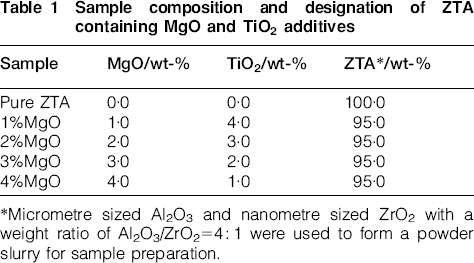
*Micrometre sized Al2O3 and nanometre sized ZrO2 with a weight ratio of Al2O3/ZrO2 = 4∶1 were used to form a powder slurry for sample preparation.
Characterisation
Bulk density of the sintered sample was measured by the Archimedes method. Three-point bending strength was tested on an NDN-100 versatile mechanical test machine with a span of 20 mm and a crosshead speed of 0·5 mm min−1. Fracture morphologies of typical tested samples were observed on a Hitachi S-3000N/H scanning electron microscope. The phase composition was identified on a Y-2000 automated X-ray diffractometer system (XRD, Cu Kα radiation, λ = 0·15406 nm) operating at 40 kV, 40 mA with the scanning range from 20 to 75° (2θ). The fraction of monoclinic ZrO2 was determined using the integrated intensity of the tetragonal (111) and two monoclinic (111) and (11
 ) peaks.13
Results and discussion
The effect of sintering temperatures on the relative densities of five groups of ZTA composites is shown in Fig. 1. The relative densities were calculated on the basis of the theoretical densities of 6·05, 3·91, 3·581 and 4·261 g cm−3 for 3Y-TZP, Al2O3, MgO and TiO2 respectively. Sintering at <1300°C showed no difference among five groups of sintered ZTA composites. At 1450°C, the relative densities of ZTA composites containing additives quickly increased to 92%, and a complete sintering of 1%MgO, 2%MgO, 3%MgO and 4%MgO composites achieved at 1500°C, as indicated by the measured relative densities of >99%. In contrast, pure ZTA samples gave the relative density of 57% at 1450°C. The significant densification of pure ZTA samples appeared at 1500°C with the relative density of 66%. At 1600°C this value was increased to 92%. Therefore, these relative density data confirmed that the introduction of the 5 wt-% additives of MgO and TiO2 to ZTA ceramics greatly reduced the densification sintering temperature.
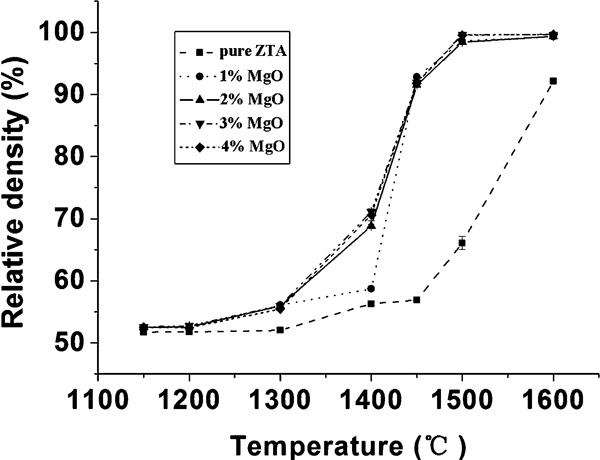
Relative densities of ZTA composites sintered at different temperatures
The three-point bending strengths of five groups of samples sintered at different temperatures are shown in Fig. 2. The measured results further confirmed that pressureless sintering of pure ZTA required a high sintering temperature to obtain dense compacts with desired mechanical strengths. The mean strength of pure ZTA samples sintered at 1600°C was 380 MPa while this value was only 140 MPa at 1500°C. Sintering of ZTA composites containing the 5 wt-% additives at 1600°C yielded comparable bending strengths to that of pure ZTA ceramics, but four combinations of MgO and TiO2 caused enhanced mechanical properties of ZTA ceramics at low sintering temperatures. In agreement with the initial densification effect induced by MgO and TiO2 at 1450°C (Fig. 1), four groups of ZTA composites exhibited a much higher mean bending strength than the pure ZTA sample. This value was 130 MPa for 1%MgO, 230 MPa for 2%MgO, 280 MPa for 3%MgO and 280 MPa for 4%MgO.
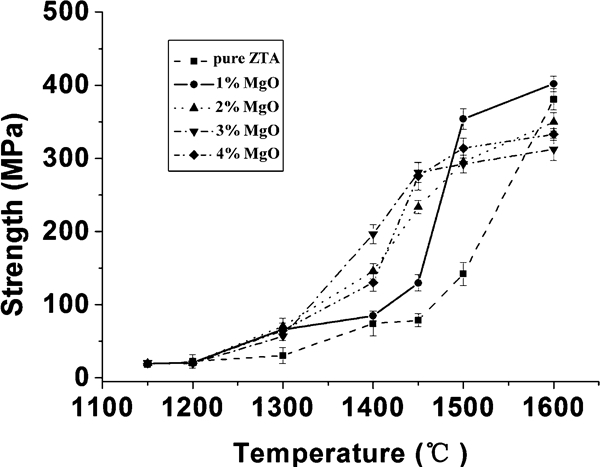
Three-point bending strengths of ZTA composites sintered at different temperatures
The fracture morphologies of typical pure ZTA, 1%MgO and 3%MgO composites sintered at 1450°C are shown in Fig. 3. In the case of pure ZTA sample (Fig. 3a), the microstructure is primarily featured with fine particles of ingredients and obvious porosity. The interconnected growth of ingredient particles appears at this temperature, but is still in the early stage. This premature sintering corresponds to a low three-point bending strength value (80 MPa) (Fig. 2). In contrast, scanning electron micrographs of 1%MgO (1 wt-%MgO and 4 wt-%TiO2, Fig. 3b) and 3%MgO (3 wt-%MgO and 2 wt-%TiO2, Fig. 3c) reveal a much denser microstructure composed by faceted grains. Those faceted grains suggest that a significant portion of fracture occurs in the transgranular mode. Fine heterogeneous grains are located in both samples at the junctions of coarse prismatic and equiaxed grains.
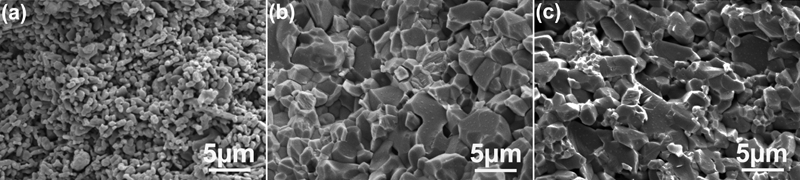
Images (SEM) revealing fracture morphologies of typical samples sintered at 1450°C:
An effective sintering aid, such as MgO or TiO2, acts as multiple roles in solid solution to accelerate the densification of alumina, primarily including lowering the grain boundary mobility, enhancing surface diffusions and promoting lattice and boundary diffusions.10,11,13 The reported studies of sintered ZTA with either MgO or TiO2 based additives were conducted mostly by using uniaxial pressing and subsequent isostatic pressing or even hot isostatic pressing techniques. In contrast, the present study focused on evaluating the pressureless sintering behaviour of ZTA containing MgO and TiO2. Four combinations of MgO and TiO2 as the total 5 wt-% additives were applied to obtain four groups of ZTA composites. Compared with pure ZTA, four groups of ZTA composites gave rise to effective densification and enhancement at 1450°C. However, the measured bending strengths showed an obvious difference among them, dependent upon the relative ratio of MgO to TiO2 and the sintering temperature (Fig. 2). Therefore, the phase compositions of sintered samples were further analysed by using XRD.
In addition to the main phase of α-Al2O3, the reflections attributable to t-ZrO2, m-ZrO2 and MgAl2O4 were also recorded in the sintered samples. Generally, the reflections of MgAl2O4 increased in intensity with a higher content of MgO contained in ZTA composites. The XRD patterns of 4%MgO composites sintered at elevated temperatures are given in Fig. 4, which contained the highest amount of MgO (4 wt-%). The transformation of t-ZrO2 to m-ZrO2 followed a temperature dependent fashion. However, a significant amount of m-ZrO2 formed at 1450°C in 1%MgO composites, and this transformation was suppressed at 1500°C (Fig. 5). The polymorphic transformation of t→m ZrO2 occurred during cooling from sintering temperature to room temperature, accompanying with the volume expansion.5 Accordingly, it is believed that the low bending strength of 1%MgO composites, relative to those of 2%MgO, 3%MgO and 4%MgO composites sintered at 1450°C, was related to the body's previous thermal history of a larger amount of t-ZrO2 to m-ZrO2 transformation.
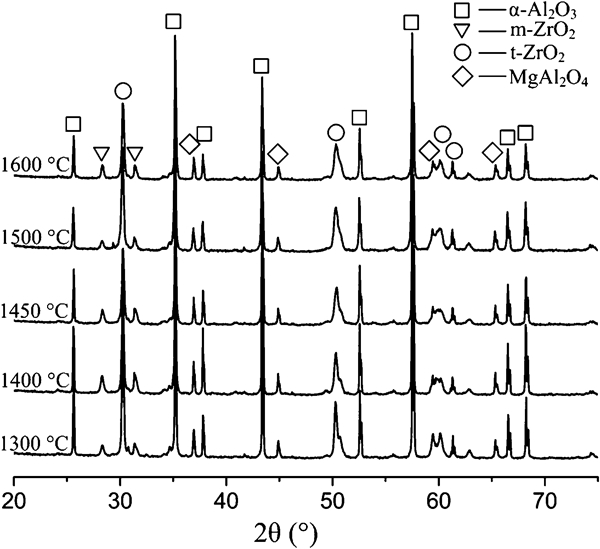
X-ray diffraction patterns of 4%MgO composites sintered at different temperatures
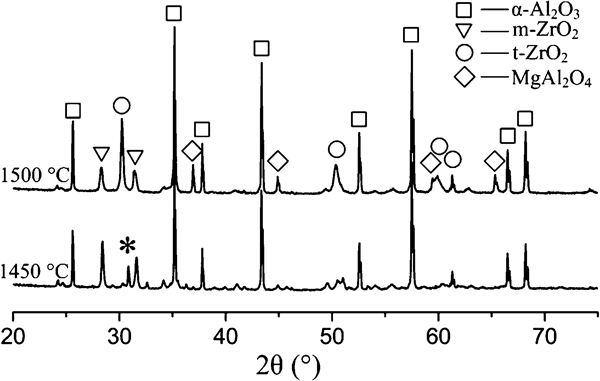
X-ray diffraction patterns of 1%MgO composites sintered at 1450 and 1500°C
Figure 6 shows the monoclinic ZrO2 fraction of pure ZTA, 1%MgO and 4%MgO composites sintered at elevated temperatures. The gradual increment of m-ZrO2 fraction with the sintering temperature suggests the enhanced transformability of t-ZrO2. Compared with 1%MgO composites, 4%MgO composites gave rise to a low m-ZrO2 fraction at room temperature. A high fraction of tetragonal phase retained at room temperature is known advantageous in achieving a high transformation toughness of sintered ZTA composites.5,15,16 Therefore, the mechanical properties of 4%MgO composites, i.e. containing 4 wt-%MgO and 1 wt-%TiO2, should be superior to 1%MgO composites containing 1 wt-%MgO and 4 wt-%TiO2. Especially, this comparative result achieved at 1450°C is useful to further develop glass infiltrated ZTA dental ceramics with enhanced properties.7,9
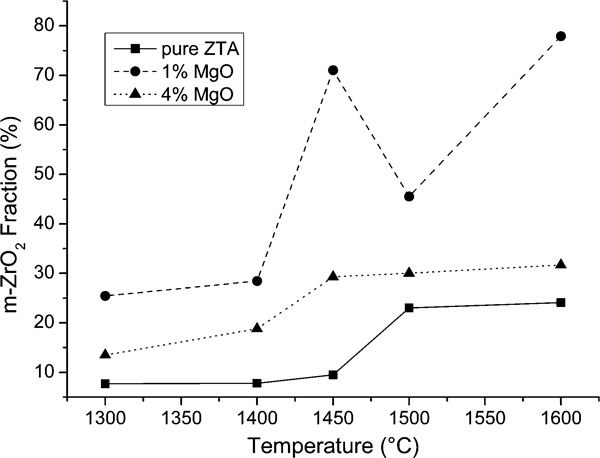
Calculated monoclinic ZrO2 fraction of pure ZTA, 1%MgO and 4%MgO composites sintered at different temperatures
The abnormal t→m ZrO2 transformation at 1450°C in 1%MgO composites corresponded to the presence of 4 wt-%TiO2. A small amount of TiO2 is reported to enter Al2O3 substitutionally (Ti4+ replaces Al3+), thereby enhancing the aluminium ion diffusion by a vacancy mechanism, and MgO was usually added to retard grain growth.17 In the present study, the abnormal transformation of ZrO2 was concomitant with the appearance of the new reflections at 1450°C, marked with ‘*’ in Fig. 5, attributable to ZrTiO4. The existence of (Zr,Ti)O2 has previously been demonstrated in hot pressed ZTA ceramics.13 Considering that TiO2 may also form a solid solution with MgO and Al2O3,18 the TiO2 induced polymorphic transformation of ZrO2 should be dependent upon the relative ratio of TiO2 to MgO and the sintering temperature. The suppression of t→m transformation in 1%MgO composites at 1500°C was actually a temperature dependent case, consistent with the formation of MgAl2O4 (Fig. 5).
Conclusion
The pressureless sintering behaviour of gelcast ZTA composites containing the total 5 wt-% additives of MgO and TiO2 was investigated in the present study in order to develop dental ceramics. The bulk properties, morphology and phase composition of ZTA composites with four combinations of MgO and TiO2 were characterised in comparison with pure ZTA in the temperature range of 1150–1600°C. Additives (5 wt-%) of MgO and TiO2 caused effective densification of ZTA at low sintering temperatures. At 1450°C, the relative density was >92% for all the ZTA composites, but only 57% for pure ZTA. Correspondingly, ZTA composites exhibited much higher bending strength values, but a significant difference existed among four groups of ZTA composites. This value measured with sintered samples at 1450°C was 280 MPa for 4%MgO composites containing 4 wt-% MgO and 1 wt-%TiO2, and 130 MPa for 1%MgO composites containing 1 wt-%MgO and 4 wt-%TiO2, in contrast to 80 MPa of pure ZTA. Their fracture SEM morphologies confirmed the achievement of a much denser microstructure in ZTA composites than pure ZTA. In addition to the main phases of α-Al2O3 and ZrO2, X-ray diffraction analyses also confirmed the MgO dependent formation of minor MgAl2O4 and TiO2 induced polymorphic transformation of tetragonal phase to monoclinic ZrO2. The latter was dependent upon the relative ratio of TiO2 to MgO and the sintering temperature. The t→m transformation of ZrO2 was accompanied with the formation of zirconium titanium oxide. The present results are supportive to further develop dental ceramics, including glass infiltrated ZTA.
Footnotes
Acknowledgements
This work is supported by the National Natural Science Foundation of China (grant no. 30870632).