







Abstract
Combustion synthesis of Ti2AlN was carried out in air and pressurised N2 respectively. The reaction atmosphere had an evident effect on the phase composition and microstructure of the products. By combustion synthesis in 2 MPa N2, Ti2AlN was synthesised as the major product, but in the samples prepared in air, Ti2AlN was obtained only as a minor phase, and the predominant phases were Ti–Al intermetallics. The reaction mechanism has been studied, suggesting that TiN is a key intermediate in the formation of Ti2AlN. It is proposed that, in the combustion synthesis of Ti2AlN, the flux of N2 plays an important role in determining both reaction kinetics and phase composition of the products.
Introduction
Ternary carbide or nitride compounds are a new class of inorganic materials with merits of both ceramics and metals, such as low density, high thermal and electrical conductivity, good resistance against chemical corrosion and oxidation and easy machinability.1–3 These ternary compounds have a general chemical formula of Mn+1AXn, where n = 1, 2 or 3, M is an early transition metal, A is an A group (mostly IIIA and IVA) element and X is C or N, and a layered hexagonal lattice structure with two formula per unit cell. In each unit cell, near close packed M layers are interleaved by A layers, and X atoms fill in the octahedral interstitial sites of M octahedra. The M6X octahedra are edge sharing and identical to those in the rock salt structure of the corresponding binary carbides.
Among the Mn+1AXn compounds, several carbide phases like Ti3SiC2, Ti3AlC2 and Ti2AlC have been extensively studied,4–7 and a variety of preparation methods have been reported, including reaction sintering, chemical vapour deposition, mechanical alloying and combustion synthesis (also known as self-propagating high temperature synthesis). Compared with carbides, fewer results have been reported on ternary nitrides, such as Ti2AlN and Ti4AlN3. It was reported that the electric conductivity of Ti2AlN is nearly 50% higher than that of Ti2AlC.8 In this case, Ti2AlN can be superior to Ti2AlC for applications such as electrodes and electric brushes.
In previous studies, ternary nitride phases were mostly prepared by reaction sintering.8–10 As an example, Ti2AlN was prepared by hot pressing or spark plasma sintering of (Ti+Al+TiN) or by hot isostatic pressing of (Ti+AlN) powders, and the sintering temperature was in the range of 1200–1400°C. Recently, Yeh et al.11 reported the combustion synthesis of Ti2AlN in a N2 atmosphere of 0·45–0·79 MPa with TiN and AlN as diluents, where the pressure of N2 had a strong effect on the phase composition of the products.
In order to further investigate the effect of reaction atmosphere, this paper reports the combustion synthesis of Ti2AlN in air and N2 with a pressure of 2 MPa respectively. The phase composition and microstructure of the products obtained in the two different atmospheres are examined, and the effect of reaction atmosphere is discussed in detail. According to the experimental results, the formation mechanism of Ti2AlN in combustion synthesis is proposed.
Experimental
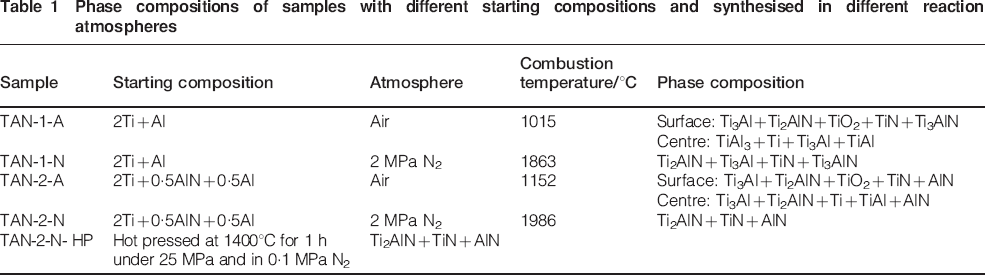
Commercial Ti (99%, 300 mesh), Al (99%, 300 mesh) and AlN (O<1·5%, d50 = 1·8 μm) powders were used as raw materials. Two starting compositions, which are noted as TAN-1 and TAN-2 respectively in Table 1, were prepared according to the following chemical reaction equations


Phase compositions of samples with different starting compositions and synthesised in different reaction atmospheres
The reactant powder mixture was naturally loaded in a porous graphite crucible with an inner diameter of 26 mm and a height of 45 mm. The porosity in the green powder compacts was nearly 70%. For combustion synthesis in air, the crucible was directly exposed to air. For combustion synthesis in pressurised N2, the crucible was placed into a closed steel reaction chamber. The chamber was evacuated to a vacuum of <20 Pa and then filled with N2 up to a pressure of 2 MPa. By passing an electric current of ∼20 A through a tungsten coil closely above the reactant powder, combustion reaction was triggered. The reaction temperature was measured by a W–Re thermocouple directly inserted into the centre of the samples. After the reaction was over and the samples were cooled down, the products were collected.
The reaction product of the sample TAN-2-N was pulverised into fine powders by ball milling for 6 h. Then, the power was hot pressed at 1400°C for 1 h in 0·1 MPa N2 protective atmosphere to prepare dense bulk ceramic samples. During the hot pressing, the heating rate was 20°C min−1, and the applied mechanical pressure was 25 MPa. After hot pressing, the power was switched off, and the sample was naturally cooled down with the furnace.
The phase composition of the as synthesised products was identified by X-ray diffraction (D8 Focus; Bruker, Germany) using Cu Kα radiation and with a scanning rate of 4° min−1. The microstructure was examined by scanning electron microscopy (SEM; S-4300; Hitachi, Japan) and transmission electron microscopy (TEM; 2010F; JEOL, Japan). Chemical analysis of selected areas was carried out by energy dispersive spectroscopy (EDS; INCA; Oxford Instrument, UK). Vickers hardness was tested with a load of 49 N, and for each sample, at least eight separate tests were made.
Results and discussion
After combustion synthesis in air, the synthesised samples were very loose like the starting green powder compacts and could be readily pulverised into powders. At the surface layer and at the centre part of the samples, different phases were obtained. For example, in the sample of TAN-1-A, at the surface, the target product Ti2AlN was synthesised, but the major phase was Ti3Al, as shown in Fig. 1. At the same time, minor TiN, TiO2 and Ti3AlN were also found. At the centre of the sample, neither the ternary phase Ti2AlN nor the simple nitrides such as TiN and AlN were synthesised, and only a variety of Ti–Al alloys (TiAl3, Ti3Al and TiAl) and elemental Ti were produced. Similar results were observed for the sample TAN-2-A, as shown in Table 1, except that some Ti2AlN was obtained at the centre.
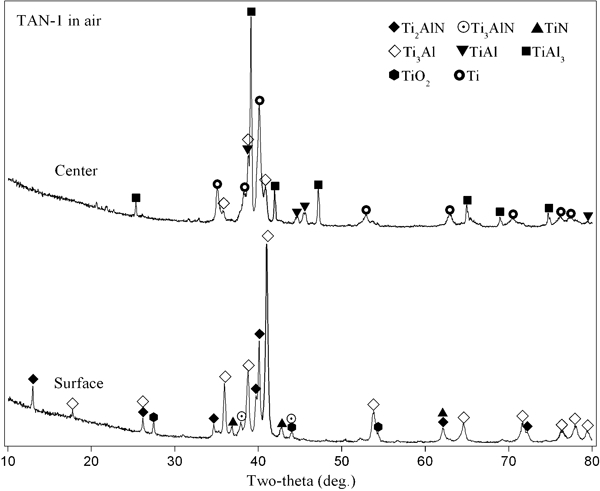
X-ray diffraction patterns of products collected from surface and centre of TAN-1-A synthesised in air
Compared with those produced by combustion synthesis in air, the samples synthesised in 2 MPa N2 were much stronger and difficult to be pulverised. Moreover, the samples prepared in N2 showed a higher uniformity in phase composition, where same phases were obtained at the surface layer and at the centre. In contrast to those prepared in air, in samples prepared in N2, the target product Ti2AlN was the major product, as shown in Fig. 2. That is to say, for the combustion synthesis of Ti2AlN, it is desirable to improve the phase purity by changing the reaction atmosphere from air to pressurised N2. In addition, Ti2AlN, Ti3Al, TiN and Ti3AlN were produced in the sample TAN-1-N, and TiN as well as minor AlN was obtained in TAN-2-N (Table 1).
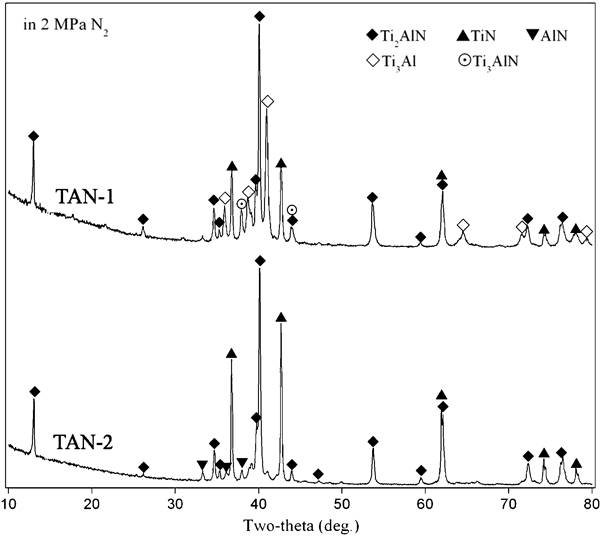
X-ray diffraction patterns of samples of TAN-1-N and TAN-2-N synthesised in 2 MPa N2
According to the experimental results, the formation mechanism of Ti2AlN in combustion synthesis is proposed as follows. At first, the combustion reaction begins with the nitridation of Ti





From reactions (7)–(9), TiN is an important intermediate for the formation of Ti2AlN. TiN is produced by the nitridation of Ti, where the reaction rate strongly depends on the pressure of N2. At a pressure of 2 MPa, the N2 present in the starting porous green powder compacts is absolutely not adequate for full nitridation of Ti, and the infiltration of N2 is necessary. The flux of N2 depends on the difference between the concentration or pressure of N2 in the sample and that in the reaction chamber. During the combustion reaction, N2 is consumed quickly, and thus, the pressure of N2 in the sample is very low. Therefore, the flux of N2 is mostly determined by the pressure of N2 in the chamber, which plays a key role in the combustion synthesis of Ti2AlN. For samples TAN-1-N and TAN-2-N synthesised in 2 MPa N2, the flux of N2 is enough to feed the nitridation reaction. Therefore, the Ti particles were fully nitridised, and no free Ti was found in the product (Fig. 2). For samples TAN-1-A and TAN-2-A synthesised in air, however, the partial pressure of N2 is only ∼0·08 MPa, and the flux of N2 is not adequate for the nitridation reaction. Consequently, the nitridation reaction was incomplete, and much free Ti remains (Table 1). Another problem involved in the combustion synthesis in air is the oxidation of Ti because of the presence of O2 in air. The oxidation reaction will cause the formation of TiO2, which was verified by experimental observations (Table 1). It is noticed that the oxidation was limited at the surface layer of the samples, and no TiO2 was detected at the centre (Fig. 1). This is probably attributed to the retarded infiltration of O2 in comparison with the fast combustion reaction rate. Similar results were observed for the combustion of pure Al, Ti and (Al+C+Si3N4) powders.12–14
In the combustion reaction, the nitridation of Ti is a major source of the generation of heat energy. Hence, the combustion temperature is determined to a large extent by the nitridation reaction. In this way, for the samples synthesised in 2 MPa N2, the combustion temperatures were much higher than those for the samples synthesised in air, as shown in Table 1. A higher combustion temperature will accelerate the nitridation reactions. Especially, when the temperature exceeds the melting point of Ti (1670°C), the nitridation of Ti takes place by gas–liquid mode instead of gas–solid one, and thus, the reaction rate can be greatly increased. As discussed before, TiN is an important intermediate for the formation of Ti2AlN. A sufficient supply of TiN will speed up the consumption of Ti–Al intermetallics (such as Ti3Al and TiAl) and promote the formation of Ti2AlN by reactions (7)–(9). For this reason, the samples synthesised in 2 MPa N2 showed a higher content of Ti2AlN compared with the samples prepared in air. For comparison, the combustion temperature for the reaction 2Ti+Al+0·5N2 = Ti2AlN under a N2 pressure of 0·79 MPa was reported to be nearly 1680°C,11 which is between the temperatures observed here in air and in 2 MPa N2 respectively (Table 1).
In addition to the pressure of N2, the structure of the powder impacts also affects the infiltration of N2, which can be facilitated with the presence of a high fraction of porous channels. In this aspect, the melting and coalescence of the metallic particles will hinder the infiltration of N2. This negative effect is probably not so severe for combustion synthesis in pressurised N2 but crucial for combustion synthesis in air because of the low partial pressure of N2 (∼0·08 MPa). In fact, even for the samples synthesised in air, the reaction temperatures were much higher than the melting point of Al (660°C). In this case, the melting of Al will certainly take place during the combustion reaction, where the coalescence of liquid Al droplets can delay the infiltration of N2. For example, in the sample TAN-1-A, Ti2AlN and TiN were obtained only at the surface layer but not found at the centre (Fig. 1) without sufficient N2 supply because of slow infiltration. The coalescence of metallic droplets can be reduced by the addition of refractory nitride powders as diluents. In contrast to TAN-1-A, in sample TAN-2-A with AlN diluents, Ti2AlN and TiN were also produced at the centre (Table 1).
Figures 3 and 4 show the SEM images of the samples synthesised in air and those in 2 MPa N2 respectively. The samples synthesised in air showed a loose structure like the starting green powder compacts, where coarse unreacted Ti particles were visible. In sample TAN-2-A with AlN diluents, the average particle size was smaller, and the fraction of coarse Ti particles was lower than TAN-1-A, which can be attributed to the higher reaction temperature (Table 1) and larger reaction extent in the former, as discussed above. The samples synthesised in 2 MPa N2 showed a porous network structure. In this structure, although huge pores of >50 μm and cavities of up to 500 μm occurred, the solid part was relatively dense and continuous. Such continuous network was rigid and difficult to be destroyed, offering the samples a high mechanical strength. The average grain size in the samples was below 2 μm.
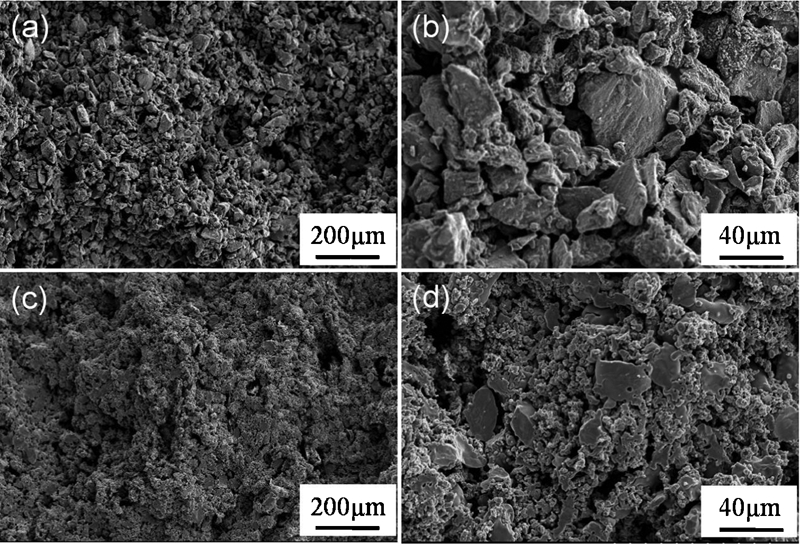
Images (SEM) of samples synthesised in air: a, b TAN-1-A; c, d TAN-2-A

Images (SEM) of samples synthesised in 2 MPa N2: a–d TAN-1-N; e–h TAN-2-N
In order to prepare bulk ceramics, the sample TAN-2-N was pulverised into fine powders by ball milling for 6 h and then consolidated by hot pressing. From the SEM observation, as shown in Fig. 5, after milling, the particles were well dispersed, and most of them have a size of 1–3 μm. No abnormal grains or agglomerates larger than 5 μm were observed. Characterisation by TEM confirmed the presence of Ti2AlN phase with a hexagonal lattice structure. The power was hot pressed at 1400°C for 1 h under a mechanical pressure of 25 MPa and in 0·1 MPa N2 atmosphere. After hot pressing, there was no clear change in phase composition, and the hot pressed bulk sample consisted of Ti2AlN, TiN and minor AlN. This means that the as synthesised Ti2AlN is stable and will not decompose at least below 1400°C. In SEM images of fracture surface shown in Fig. 6, few pores were found, revealing that the sample had a relatively low porosity. The bulk sample showed a microstructure mainly composed of equiaxed TiN and lamellar Ti2AlN grains. The average size of the TiN grains was below 3 μm, and the thickness of most lamellar Ti2AlN grains was nearly 1 μm. The EDS spectra for TiN and Ti2AlN are shown in Fig. 6d and e respectively. To determine the semiquantitative chemical composition of Ti2AlN phase, EDS analysis was carried out for eight individual Ti2AlN grains, giving an average of Ti/Al = 2·07±0·11 (in molar ratio), which was in good consistence with the nominal composition of Ti/Al = 2.
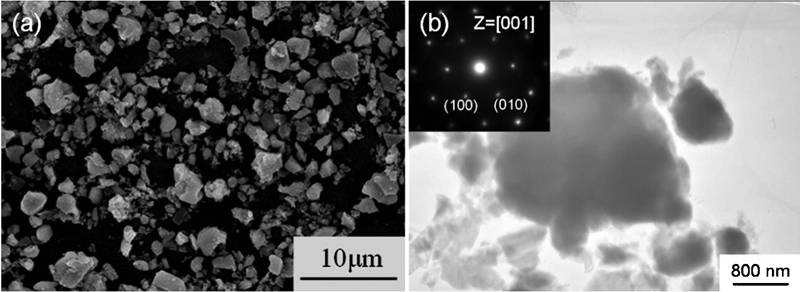
Micrographs of pulverised powder of TAN-1-N: a SEM; b TEM
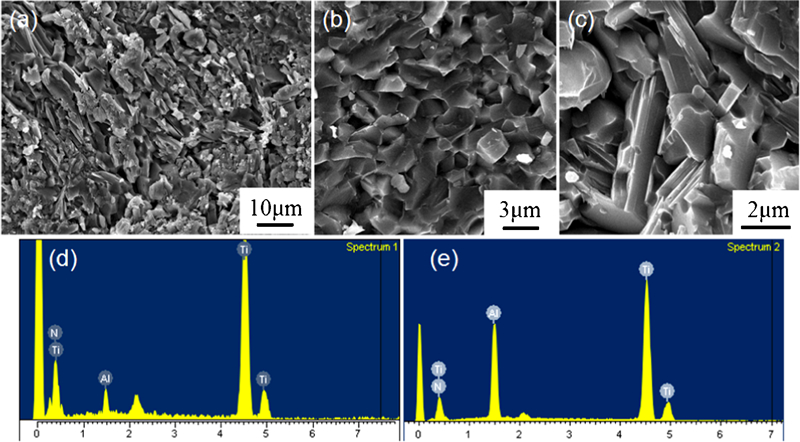
Images (SEM) and EDS spectra for sample TAN-2-N-HP: a overview of fracture surface of sample; b, c SEM images of equiaxed TiN and lamellar Ti2AlN grains; d, e EDS spectra of TiN and Ti2AlN respectively
The hardness test showed that the Vickers hardness of the hot pressed sample (TAN-2-N-HP) was 5·8±0·6 GPa. This is higher than the results (nearly 4 GPa) previously reported for the hardness of Ti2AlN ceramics,8, 9 which is probably caused by the co-existence of a much harder TiN phase in the sample.
Conclusion
In the combustion synthesis of Ti2AlN, the reaction atmosphere had an evident effect on the phase composition and microstructure of the products. By combustion synthesis in 2 MPa N2, Ti2AlN was synthesised as the major product. By combustion synthesis in air, however, the predominant phases were Ti–Al intermetallics, and Ti2AlN was only a minor product. At the same time, the phase composition of the samples prepared in air was not uniform, where different phases were obtained at the surface layer and at the centre. The reaction mechanism in the combustion synthesis of Ti2AlN was studied, suggesting that TiN acted as a key intermediate in the formation of Ti2AlN. It was proposed that, in the combustion synthesis of Ti2AlN, the flux of N2 played an important role, affecting both the reaction kinetics and the phase composition of the products, which can probably explain the experimentally observed effect of reaction atmosphere.
Footnotes
Acknowledgements
This work was supported by the National Natural Science Foundation of China (grant no. 50932006 and 51002163) and Beijing Natural Science Foundation (grant no. 2112043).