






Abstract
Single phase ceramics in the vicinity of CaNdAlO4 in CaO–Nd2O3–Al2O3 ternary system, such as ternary oxide compound CaNdAl3O7 and binary oxide compounds NdAlO3, CaAl2O4, Ca3Al2O6 and Ca12Al14O33, were prepared by the standard solid state reaction route. The phases and structure of the ceramics were analysed through X-ray diffraction and scanning electron microscopy. The microwave dielectric characteristics of the ceramics were studied using a network analyser. High Qf values were obtained in CaNdAlO4, CaNdAl3O7, NdAlO3 and CaAl2O4, while the Qf values in Ca3Al2O6 and Ca12Al14O33 were much lower. The best microwave dielectric characteristics (ϵr = 8·9, Qf = 90 800 GHz at ∼9·40 GHz and τf≈−55·2 MK−1) were achieved for CaAl2O4 ceramics sintered at 1425°C in air for 3 h. It could be expected as a promising new candidate for microwave dielectric ceramics. Moreover, the present results showed the direction for modification of CaNdAlO4 microwave dielectric characteristics through composition tailoring.
Introduction
Microwave dielectric ceramics have wide applications in the microwave communication systems as the key materials for microwave resonators, filters and antennas.1 So far, a large number of microwave dielectric ceramics have been investigated and developed, such as Ba6−3xR8+2xTi18O54, (Zr,Sn)TiO4, Ba2Ti9O20, Ba(Mg1/3Ta2/3)O3, Ba(Zn1/3Ta2/3)O3, etc.1–4 With the development trend of microwave communication towards millimetre wave range, the microwave dielectric ceramics with low dielectric permittivity and low dielectric loss have attracted increasing scientific attention.4, 5
Recently, MRAlO4 (M = Sr and Ca; R = La, Nd, Sm and Y) ceramics with the tetragonal K2NiF4 structure have been proposed and investigated as promising candidates for high band microwave applications.6–12 The MRAlO4 compounds with K2NiF4 structure consist of the stacking of rock salt layer and perovskite layer.10, 13 According to previous work,10 the measured Qf values for MRAlO4 ceramics are much lower than the calculated ones, and this suggests that the microwave dielectric characteristics, especially the Qf value for the present ceramics, should be significantly improved by microstructure modification. Actually, the microwave dielectric characteristics for CaSmAlO4 ceramics largely depend on the microstructures, especially the phase constitution.11 However, the microwave dielectric characteristics of the phases in the vicinity of MRAlO4 in the MO–R2O3–Al2O3 ternary systems have been rarely reported before. Therefore, it should be an important issue to investigate the phase equilibrium and the microwave dielectric characteristics for the compositions in the vicinity of MRAlO4 in the MO–R2O3–Al2O3 ternary systems.
Researches on the phase equilibrium of CaO–Al2O3, Nd2O3–Al2O3 and the isothermal section of CaO–Nd2O3–Al2O3 ternary system at 1300°C were reported before.14–16 It was indicated that the compounds of NdAlO3, CaAl2O4, CaNdAl3O7, Ca3Al2O6 and Ca12Al14O33 in the vicinity of CaNdAlO4 were all stable phase. In the present work, these compounds and CaNdAlO4 in the CaO–Nd2O3–Al2O3 ternary system were prepared, and then, their structures were determined together with the microwave dielectric characteristics.
Experimental
Figure 1 gives the tentative phase diagram of the CaO–Nd2O3–Al2O3 ternary system,14–16 where one can find the previously reported compounds in the vicinity of CaNdAlO4. CaNdAlO4, NdAlO3, CaNdAl3O7, CaAl2O4, Ca3Al2O6 and Ca12Al14O33 ceramics were synthesised by a standard solid state reaction process using high purity CaCO3 (99·99%), Al2O3 (99·99%) and Nd2O3 (99·9%) powders as the raw materials. Because rare earth oxides, such as Nd2O3, are easily hygroscopic,17 the preheat treatment for Nd2O3 raw powders was carried out at 900°C in air for 2 h before weighting to remove any hydroxides. The process conditions including calcination and sintering conditions are listed in Table 1. The raw materials with the corresponding stoichiometric compositions were ball milled in a polyethylene jar for 24 h with zirconia media and ethanol. After drying, the mixtures were put in corundum crucible and calcined in air at the relevant temperature for 3 h, and then, the calcined powders with zirconia media and ethanol were again ground by the ball mill for 24 h. Then, the powders, with 6–16 wt-%PVA as the binder, were pressed into discs that are 12 mm in diameter and 2–6 mm in thickness under a uniaxial pressure of 98 MPa. These discs were placed on sacrificial powder of the same composition and sintered at the relevant temperature in air for 3 h to yield the ceramics. After cooling from the sintering temperature to 800°C at a rate of 2°C min−1, the sintered ceramics were further cooled with the furnace.
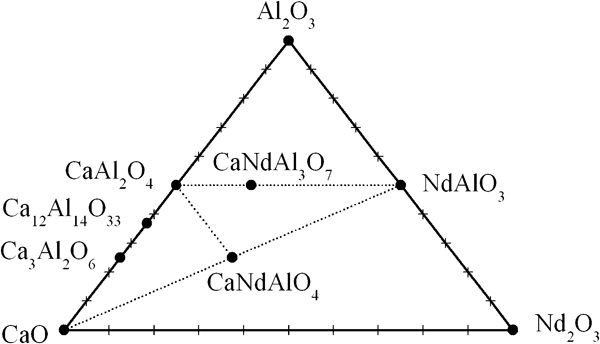
Tentative phase diagram of CaO–Nd2O3–Al2O3 ternary system
Process conditions for present ceramics

The bulk density of the sintered ceramics was determined geometrically. The phase constitutions of crushed and ground powders of the sintered ceramics were identified by powder X-ray diffractometry using Cu Kα (λ = 0·15406 nm) radiation (Rigaku D/max 2550PC; Rigaku Co., Tokyo, Japan) operated at 40 kV and 250 mA with 2θ increments of 0·02°. The scanning electron microscopy (SEM) images of the surfaces of sintered discs were observed with a scanning electron microscope (FE-SEM; Sirion-100; FEI, USA). The relative dielectric constant ϵr and quality factor Q were evaluated by the Hakki–Coleman method18,
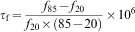
19 and the cavity method20 respectively, where a vector network analyser (E8363B; Agilent Technologies, Palo Alto, CA, USA) was used. Because the Q factor generally varied inversely with frequency f in the microwave region, the product Qf was used to evaluate the dielectric loss instead of Q. The temperature coefficient of the resonant frequency τf at microwave frequency was calculated with the following formula
Results and discussion
As shown in Fig. 2, the room temperature powder X-ray diffraction patterns for the present ceramics sintered at different temperatures all indicate the single phase structures, and they can be assigned into the compounds of CaNdAlO4, NdAlO3, CaNdAl3O7, CaAl2O4, Ca3Al2O6 and Ca12Al14O33 in space groups of I4/mmm,
 ,
,
 , P21/n,
 and
and
 , according to the Joint Committee on Powder Diffraction Standards cards 81-0743, 71-1596, 50-1807, 70-0134, 38-1429 and 70-2144 respectively. The CaNdAlO4 and CaNdAl3O7 ceramics crystallised in a tetragonal structure, the Ca3Al2O6 and Ca12Al14O33 ceramics crystallised in a cubic structure and the NdAlO3 and CaAl2O4 ceramics crystallised in rhombohedral and monoclinic structures respectively. For CaNdAl3O7 and CaAl2O4, since there are no data for 2θ >60° in the Joint Committee on Powder Diffraction Standards cards, the rest relevant indices of crystallographic planes are not shown here.
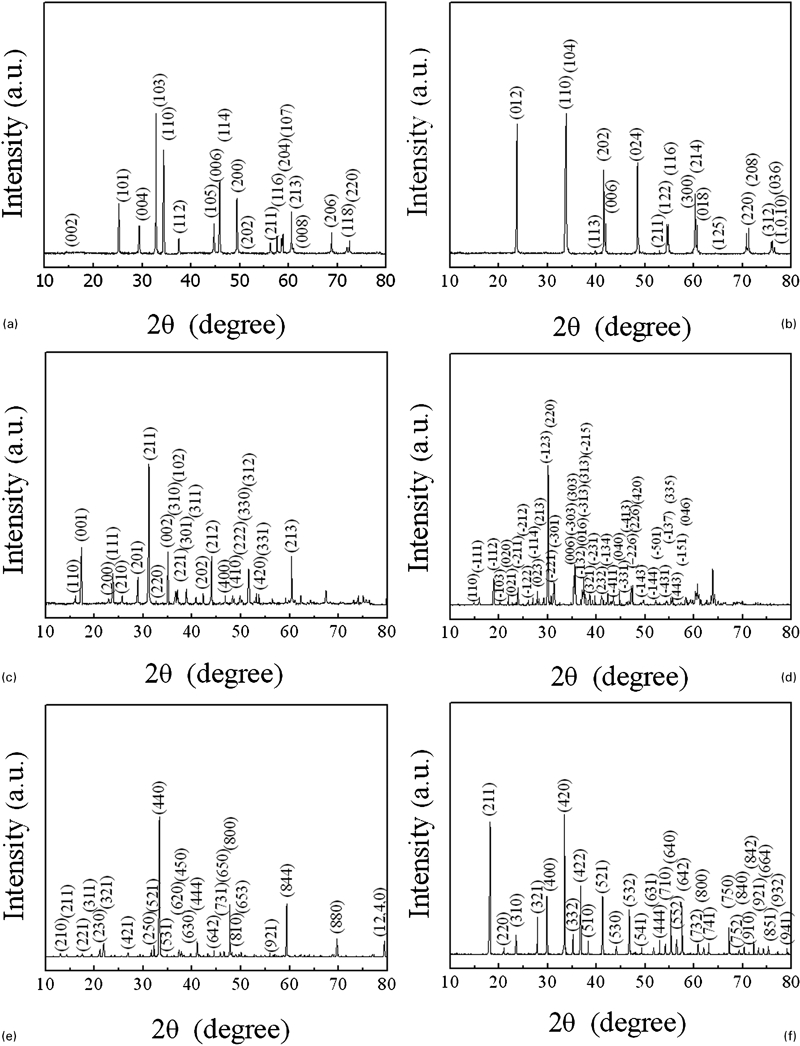
X-ray diffraction patterns of crushed powders of a CaNdAlO4, b NdAlO3, c CaNdAl3O7, d CaAl2O4, e Ca3Al2O6 and f Ca12Al14O33 ceramics sintered at 1425, 1500, 1600, 1425, 1375 and 1350°C for 3 h in air respectively
Figures 3 and 4 show the densification curves of CaNdAlO4, NdAlO3, CaNdAl3O7, CaAl2O4, Ca3Al2O6 and Ca12Al14O33 ceramics and their SEM images. With increasing sintering temperature, the relative densities of the first three compositions all increase gradually, and the values of their densification are all above 96% theoretical density (TD) at last. However, for CaAl2O4 ceramics, the relative densities turn to decrease slightly to ∼94·45% TD at sintering temperature of 1475°C. As shown in Fig. 4a–f, the grains of the ceramics grow gradually with increasing sintering temperature in the CaNdAlO4, NdAlO3 and CaNdAl3O7 compositions, which is especially observed in the latter two compositions. In NdAlO3 ceramics, the obvious ledges are observed in the grain, which indicates the type of growth of crystal. As shown in Fig. 4g, there may be a layer of glass phase with many microcracks on the surface of the CaAl2O4 ceramic, and these microcracks may develop during the specimen cooling. It seemed that the densification of Ca3Al2O6 is very difficult, and only 88·25% TD can be reached for the ceramics sintered at 1375°C, and further increasing the sintering temperature will lead the ceramics to partial melting. According to the SEM images of the Ca3Al2O6 ceramics (see Fig. 4h–i), lots of pores are observed, which is in accordance with the densification. The relative densities and the growth of crystal of the Ca12Al14O33 ceramics (see Fig. 4j–k) exhibit a similar evolution as in CaNdAlO4, but between the grain boundaries, there are fewer gaps. In addition, the value of its densification can reach 99·85% TD at sintering temperature of 1350°C. It must be noted that all the theoretic densities are calculated from the X-ray data.
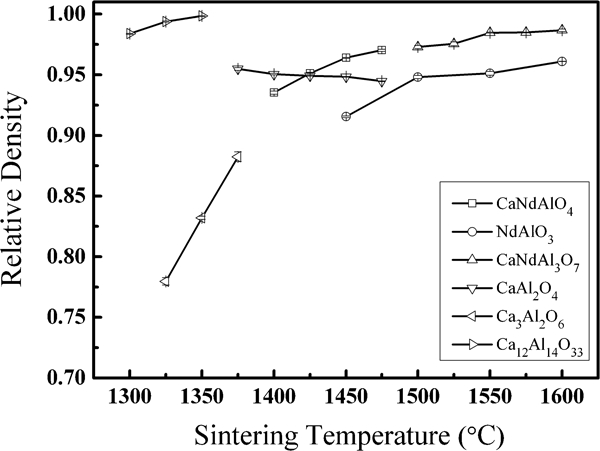
Relative density of ceramics as functions of sintering temperature
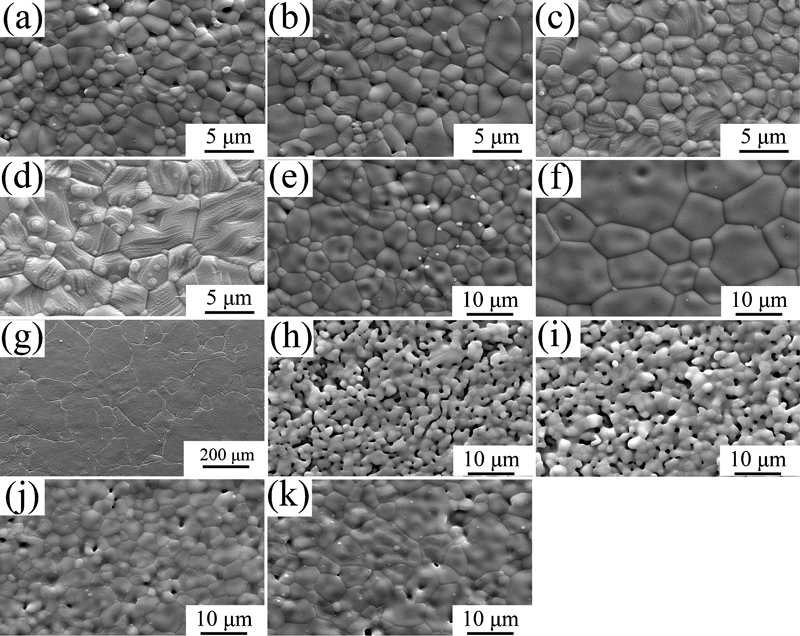
Secondary electron images of sintered surface of a CaNdAlO4 sintered at 1400°C, b CaNdAlO4 sintered at 1425°C, c NdAlO3 sintered at 1500°C, d NdAlO3 sintered at 1550°C, e CaNdAl3O7 sintered at 1500°C, f CaNdAl3O7 sintered at 1550°C, g CaAl2O4 sintered at 1475°C, h Ca3Al2O6 sintered at 1325°C, i Ca3Al2O6 sintered at 1350°C, j Ca12Al14O33 sintered at 1300°C and k Ca12Al14O33 sintered at 1325°C
Figure 5 shows the microwave dielectric properties of the CaNdAlO4, NdAlO3, CaNdAl3O7, CaAl2O4, Ca3Al2O6 and Ca12Al14O33 ceramics as functions of the sintering temperature. The microwave dielectric properties of the CaNdAlO4 ceramics as observed in Fig. 5a are much better than those reported in the previous work.8 The improved properties are possibly due to the better densification and the usage of high purity raw materials and preheat treatment for Nd2O3 raw powder in the present work. It is observed that ϵr increases from 17·5 to 18·4 with sintering temperature increasing from 1400 to 1475°C, while the Qf value at ∼6·9 GHz increases first, reaches the maximum of 65 200 GHz at 1425°C and then turns to decrease slightly with further increasing sintering temperature. The negative τf decreases in quantity with increasing sintering temperature, reaches the minimum at 1425°C and turns to increase again with further increasing sintering temperature. The best combination of microwave dielectric properties of CaNdAlO4 ceramics is obtained at the sintering temperature of 1425°C: ϵr = 17·9, Qf = 65 200 GHz and τf = −12·3 MK−1.
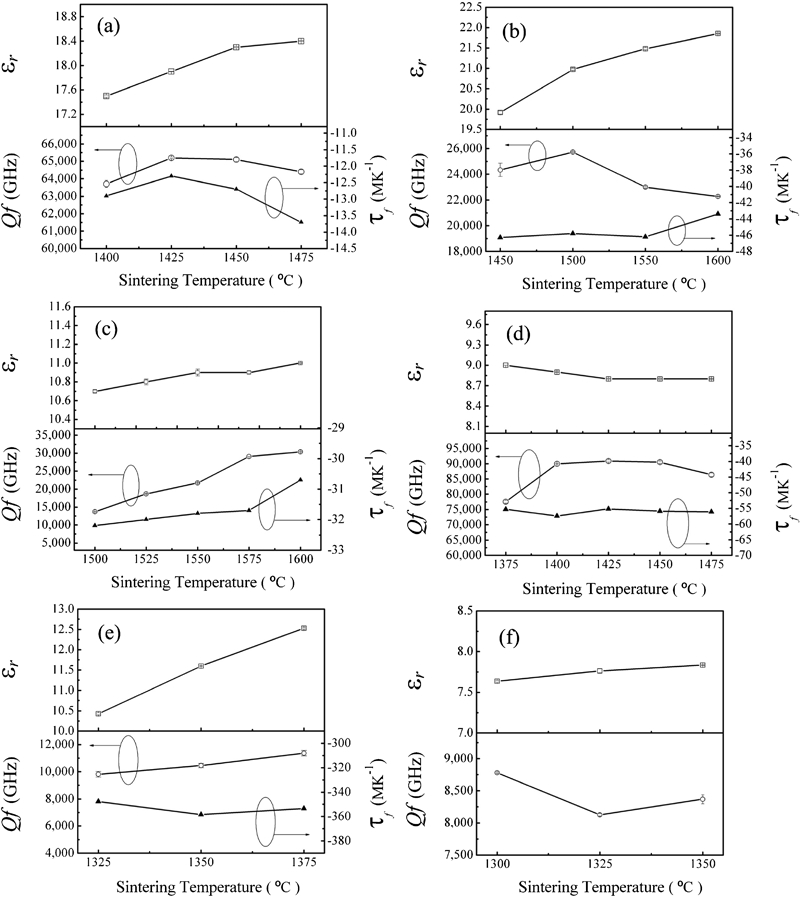
Microwave dielectric properties of a CaNdAlO4, b NdAlO3, c CaNdAl3O7, d CaAl2O4, e Ca3Al2O6 and f Ca12Al14O33 ceramics as functions of sintering temperature
Figure 5b shows the variation of microwave dielectric properties with the sintering temperature for NdAlO3 ceramics. As the sintering temperature increases, ϵr increases from 19·9 to 21·8, and Qf indicates the highest value of 25 700 GHz at ∼6·3 GHz at the sintering temperature of 1500°C, while τf varies in the range of −46·3 to −43·4 MK−1. The best combination of microwave dielectric properties of NdAlO3 ceramics is obtained at the sintering temperature of 1500°C: ϵr = 21·0, Qf = 25 700 GHz and τf = −45·8 MK−1. It should be noticed that the decreased Qf value for NdAlO3 with increasing sintering temperature above 1500°C should be caused by the inhomogeneous microstructures such as the ledges (see Fig. 4c and d), while the influence of grain boundaries on the microwave dielectric loss is complex, and it needs further investigation.
As shown in Fig. 5c, the good microwave dielectric properties are also revealed in the CaNdAl3O7 ceramics, which have been rarely reported before. When the sintering temperature increases from 1500 to 1600°C, ϵr increases slightly from 10·7 to 11·0, Qf soars linearly from 13 600 to 30 400 GHz at ∼8·60 GHz and τf changes from −32·2 to −31·7 MK−1. Deduced from the chemical formula, CaNdAl3O7 is the combination of NdAlO3 and CaAl2O4 with 1∶1 ratio, which both exhibit good microwave dielectric properties (see Fig. 5b and d). Therefore, the better microwave dielectric properties of CaNdAl3O7 are expected. The best combination of microwave dielectric properties of CaNdAl3O7 ceramics is obtained at the sintering temperature of 1600°C: ϵr = 11·0, Qf = 30 400 GHz and τf = −31·7 MK−1.
CaAl2O4 is one of the most interesting compounds in the CaO–Nd2O3–Al2O3 ternary system because of its promising microwave dielectric properties (see Fig. 5d). With increasing sintering temperature from 1375 to 1475°C, ϵr decreases slightly from 9·0 to 8·8, and Qf increases from 77 500 GHz at 1375°C to the maximum value of 90 800 GHz (sintered at 1425°C) and then decreases to 86 300 GHz with the measurement frequency between 9·30 and 9·50 GHz. For the τf value, it varies between −57·5 and −55·2 MK−1. The best combination of microwave dielectric properties of CaAl2O4 ceramics is obtained at the sintering temperature of 1425°C: ϵr = 8·8, Qf = 90 800 GHz and τf = −55·2 MK−1. It should be noted that the microcracks are observed on the surface of the CaAl2O4 ceramics (see Fig. 4g), and further improved microwave dielectric properties are expected for crack free CaAl2O4 ceramics. Furthermore, it is an important issue to investigate the intrinsic loss of CaAl2O4 ceramics and improve the temperature stability in particular. For CaAl2O4 ceramics and the others, it is observed that the dielectric constant has a similar evolution as the relative density with increasing sintering temperature. This can be explained by the lower dielectric constant of pores existing in the ceramics and the similar analysis also reported by Penn et al.21 Considering the excellent microwave dielectric properties and the low cost of raw materials, CaAl2O4 will be a new promising candidate for low loss microwave dielectric ceramics, especially for millimetre wave applications.
Compared with the above compositions, the poor microwave dielectric properties are indicated in the Ca3Al2O6 and Ca12Al14O33 ceramics (see Fig. 5e and f ). With increasing sintering temperature for the Ca3Al2O6 ceramics, ϵr increases from 10·4 to 12·5, Qf increases from 9800 to 11 370 GHz with the measurement frequency ∼8·5 GHz and τf varies in the range of −347·7 to −358·4 MK−1. According to Ref. 21, the effect of porosity on dielectric loss can be expressed by

For Ca12Al14O33 ceramics, the permittivity between 7·6 and 7·8 with a low Qf of 8780–8130 GHz at ∼11 GHz is obtained at room temperature, and the τf is difficult to determine since the resonant peak at 85°C is too weak to be identified. It is indicated that the low Qf value of the Ca12Al14O33 ceramics is mainly attributed to its high intrinsic loss since the density is near to the TD.
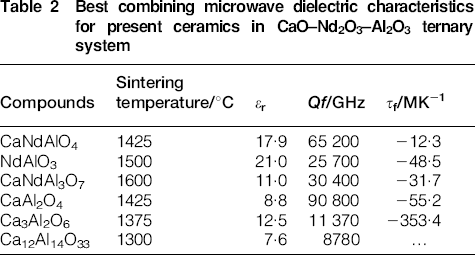
From the above discussion, in the vicinity of CaNdAlO4 in the CaO–Nd2O3–Al2O3 ternary system, high Qf values were obtained in CaNdAlO4, CaNdAl3O7, NdAlO3 and CaAl2O4, while the Qf values were much lower for Ca3Al2O6 and Ca12Al14O33; the best combinations of microwave dielectric characteristics were shown in Table 2. These results could provide the guideline for property optimising in CaNdAlO4 based ceramics by composition tailoring. Moreover, further investigation of the CaAl2O4 and CaNdAl3O7 ceramics and their structure and property modification should be carried on.
Best combining microwave dielectric characteristics for present ceramics in CaO–Nd2O3–Al2O3 ternary system
Conclusion
The following ternary or binary oxide compounds were confirmed in the vicinity of CaNdAlO4 in the CaO–Nd2O3–Al2O3 ternary system: CaNdAl3O7, NdAlO3, CaAl2O4, Ca3Al2O6 and Ca12Al14O33. High Qf values were obtained in CaNdAlO4, CaNdAl3O7, NdAlO3 and CaAl2O4, while the Qf values were much lower for Ca3Al2O6 and Ca12Al14O33. The excellent microwave dielectric characteristics (ϵr = 8·9, Qf = 90 800 GHz at ∼9·40 GHz and τf≈−55·2 ppm °C−1) suggested CaAl2O4 as a promising new candidate for low loss microwave dielectric ceramics for the millimetre wave applications. It should be an important issue to investigate the intrinsic loss of CaAl2O4 ceramics to improve its microwave ceramics properties and improve the temperature stability in particular. Moreover, the present results showed the direction for modification of CaNdAlO4 microwave dielectric characteristics through composition tailoring.
Footnotes
Acknowledgements
The present work was supported by the Chinese National Basic Research Program under grant no. 2009CB623302. The authors gratefully acknowledge Ms L. Q. Peng and X. L. Zhu for their assistance in the Qf measurement and discussions.