







Abstract
Building codes and wood preservation standards are gradually taking more account of variations in climate within and across national boundaries. In Canada, the NRC-IRC Moisture Index (MI) has been used to delineate the boundary of zones where above ground wood exposed to precipitation or conducive to moisture accumulation needs to be preservative treated to Canadian Standards Association wood preservation standards. However, the older Scheffer Index is more widely recognised in wood science circles. Above ground field test data were reviewed for experiments where matched material had been exposed at more than one test site for a sufficient period for decay to occur. The relative condition of this material at two sites was compared to the Scheffer Index values for the sites and whether the MI values were below or above 1·0. The Scheffer Index was found to be a more reliable predictor of decay condition for above ground outdoor wood applications.
Keywords
Introduction
Building codes and wood preservation standards are gradually taking more account of variations in climate within and across national boundaries. The American Wood Protection Association (AWPA) standards (AWPA 2010) delineate five deterioration zones for wood poles, and an AWPA decking standard with a reduced penetration requirement excludes states partially or entirely within Zone 5. Morris (1994) suggested that international wood preservation standards should be related to the risk of decay based on climate zones. Anticipated revisions to the Chinese building code for wood construction will reference a biological hazard map with both decay and termite hazard (Ma et al. 2011) using decay hazard zones based on the Scheffer Index (SI; Jiang et al. 2008). Researchers in Europe are also developing climate maps for performance based models (Brishke et al. 2011) which could be used in performance based codes.
In the 2005 National Building Code of Canada, a requirement was added for preservative treatment to Canadian Standards Association standards of above ground wood ‘not protected from exposure to precipitation or the configuration is conducive to moisture accumulation, where the NRC-IRC Moisture Index is greater than 1·00’. This came about as a result of discussions on a proposal to require use of treated wood for wood components exposed to precipitation where the deterioration of such components could cause a safety issue. The original proposal would have covered the whole of Canada, but it was suggested that there were large regions of Canada with a low risk of decay and the requirement for treatment should be limited to areas of high risk. The Moisture Index (MI) developed by Canada's National Research Council, Institute for Research in Construction, was already being proposed as a means to delineate in the code regions where specific moisture management systems should be used on buildings. Consequently, it was also picked to define areas of high decay risk for wood outdoors. The MI was developed as a means of assessing the moisture load on building envelopes (Cornick and Dalgleish 2003). The MI combined a Wetting Index (WI) and a Drying Index (DI) into single number and gave equal weight to wetting and drying. The WI was defined as the average annual rainfall for each locality. The DI was defined as annual evaporation based on the differential vapour pressure between ambient air and saturated air at a given temperature. Both indices were normalised, on a 0–1000 scale for WI and a 0–32 scale for DI. In order to make both indices change in a positive direction with increasing severity of climate, the value used in the calculation was 1−DI. Thus

The SI (Scheffer 1971) adapted for Canada by Setliff (1986), was specifically developed to model the decay risk for wood above ground. It was based on climate normals for frequency of recorded precipitation and temperature for each month of the year. The calculation was as follows


The SI was originally calibrated using field test data from three test sites in the contiguous USA (Scheffer 1971). Recent work (Larkin and Laks 2008) has shown a reasonable correlation between the previously published SI values and decay rates of untreated southern pine stakelets exposed above ground at a large number of test sites across the USA. Morris and Wang (2008) updated the SI for Canada and the USA, and added locations for Hawaii and Alaska, using the latest climate normals, and found substantial increases in SI at a large number of recording sites, particularly in Canada over those calculated by Setliff (1986). They suggested that severe decay on untreated pine shakes in Edmonton during the 1980s compared to anecdotal evidence of good prior performance in dry areas of the Prairies could be linked in part to the increase in the SI in the last 30 years. This increase puts Edmonton just into the moderate decay hazard zone (Morris and Wang 2008). Carll (2009) and Lebow and Carll (2010) in parallel work found some increases and some decreases in SI values for the contiguous USA.
In order to determine the relative merits of the MI and the SI to delineate such zones within Canada, it was necessary to evaluate the degree to which they were capable of predicting the relative rates of decay in different climate zones.
Materials and methods
FPInnovations’ above ground field test data were reviewed for experiments where matched material had been exposed at more than one test site for a sufficient period for decay to occur. Three experiments were identified: two contract decking tests for FPInnovations’ clients and a naturally durable decking test funded by the Canadian Forest Service. Twenty 38×140 mm (nominal 2×6 in.) deck boards of 60 mm in length were mounted in two rows of ten on a 1·2×1·2 m frame with a central support. Each deck was supported on concrete decking blocks. The material was visually inspected on a 10–0 scale with 10 indicating no signs of decay and zero indicating decay to the point of easy breakage. Since decay in wood products above ground is primarily internal, the inspection focuses on the ends and on checks on the top surface. Areas suspected of being softened by decay are gently probed with a spatula. The underside of the deck is also inspected for fruitbodies of decay fungi. Commonly, the first sign of decay is a fruitingbody on the end on the underside, more rarely emerging from a check on the top surface. The original rating scale had five points.
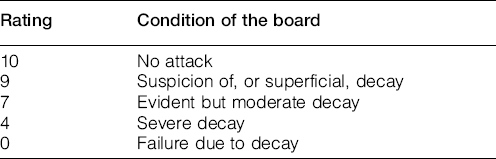
This was revised to a more detailed eight-point scale in 2008. In the new scale, boards with a fruiting body of a recognised decay fungus, typically Gloeophyllum sepiarium Fr. (Karst), are given a rating of no higher than 8 since a considerable volume of wood must have been decayed to produce the fungal biomass in a fruitbody.
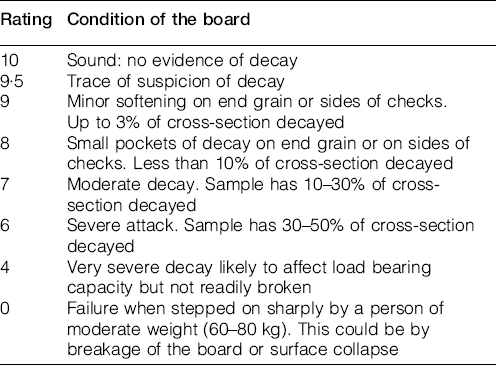
This test method has since been standardised as AWPA E25 (AWPA 2009). The degree of decay at the two sites was then compared to their relative updated SI values (Morris and Wang 2008) and whether their MI values (Cornick and Dalgleish 2003) were greater or less than 1·0.
A decking test of a wide range of wood species, untreated and treated with various penetration depths of chromated copper arsenate, with a replication of 40 (two decks per species), was set up for the Canadian Institute for Treated Wood (now Wood Preservation Canada) by Forintek Canada Corp. (now FPInnovations) in the laboratory back yards in Vancouver and Ottawa in 1991. When the Ottawa laboratory was closed down in 1994, the test was moved to the nearby Central Experimental Farm in Ottawa. All these locations were situated close to airports where climate data are recorded. The inspection results after nine years exposure using the old AWPA rating scale were reported to the client and later published by Morris and Ingram (2002).
Untreated decking of three species, Pacific silver fir, jack pine and white spruce, with 20 replicates for each, was installed as controls for tests of new wood preservatives for FPInnovations’ contract clients at test sites in Petawawa, Ontario and Maple Ridge British Columbia in October 2004.
Untreated decking made from a range of naturally durable species plus ponderosa pine sapwood controls was set up at the Petawawa and Maple Ridge test sites and two other sites in collaboration with Michigan Technological University (Laks et al. 2008).
Results and discussion
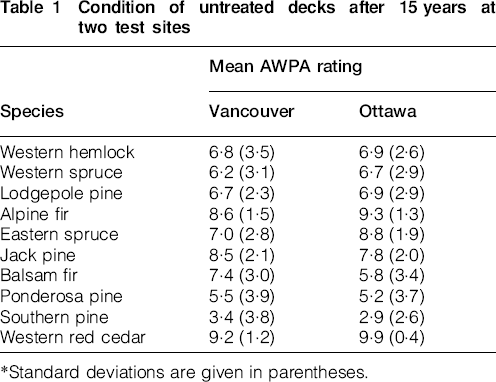
Results from the CITW/WPC decking test for the untreated samples after 15 years exposure (Table 1) are reproduced here by permission of Wood Preservation Canada. Since, in some species, decay rates appeared slightly faster in Vancouver and in other species, decay rates appeared slightly faster in Ottawa, no hypothesis could be developed on which to base statistical analysis of the data. In general, similar decay ratings were found for a range of untreated wood species at the two locations. It seems that the combination of warm dry summers and cool wet winters in Vancouver gave a similar decay rate to the combination of hot wet summers and cold dry winters in Ottawa. The SI did a good job of parsing the climate data to predict this. Ottawa and Vancouver have updated SI values of 48 and 50 respectively for the climate normals from 1971 to 2000 (Morris and Wang 2008), both sites being within the moderate decay hazard zone. More specific SI values calculated for the exposure period from September 1991 to August 2006 were 49 and 52 respectively. In contrast, the MI is greater than 1 for Vancouver (1·44) and less than 1 for Ottawa (0·84) (National Research Council Canada 2005).
Condition of untreated decks after 15 years at two test sites
*Standard deviations are given in parentheses.
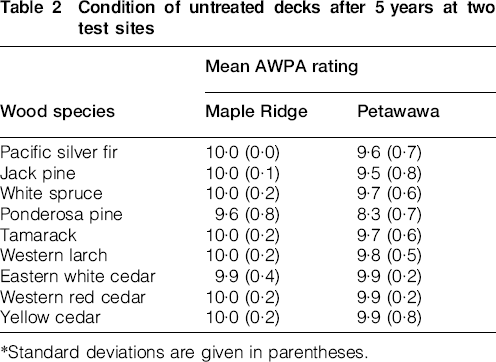
The inspection data for the untreated samples from contract testing using the new AWPA rating scale are reproduced here by permission of the clients (Table 2). Inspection at 5 years showed faster decay in Petawawa (Ont., Canada) than Maple Ridge (BC, Canada). At Petawawa, on the Pacific silver fir, there were three boards rated 8 for moderate decay, one rated 9 for slight decay and one rated 9·5 for possible incipient decay. The mean rating was 9·6. At Maple Ridge, no detectable decay was found on the comparable Pacific silver fir boards. The white spruce deck at Petawawa had two boards rated 8 and three boards rated 9 for a mean rating of 9·7, while just one board at Maple Ridge was rated 9 and the mean rating was rounded to 10. On the jack pine deck at Petawawa, four boards were rated 8 and two boards were rated 9 and the mean rating was 9·5. At Maple Ridge, one jack pine board was rated 9·5 for a suspicion of attack and the mean rating was rounded to 10·0.
Condition of untreated decks after 5 years at two test sites
*Standard deviations are given in parentheses.
Inspection of the decks constructed from naturally durable species after 5 years using the new AWPA rating scale (Table 2) again showed similar decay at Petawawa to Maple Ridge for ponderosa pine, tamarack, western larch, eastern white cedar, western red cedar and yellow cedar. Petawawa and Maple Ridge have updated SI values of 48 and 63 respectively using the methods of Morris and Wang (2008). More specific SI values were calculated for the exposure period from October 2004 to September 2009. There were some missing data from the data files provided by Environment Canada and therefore for these months the most recent climate normal data were used. The resulting values were 58 for Petawawa and 57 for Maple Ridge. The higher SI values in Petawawa may be due to two particularly wet summers in Ontario during this period. Both sites are in the moderate decay hazard zone according to the SI; however, the MI is less than 1 for Petawawa (0·8) and greater than 1 for Maple Ridge (approximately 1·7; Cornick 2010, personal communication).
One reason why the SI is better than the MI at predicting decay of wood outdoors above ground may be that SI includes a temperature factor (though the MI does involve temperature as part of its drying component) and the SI links temperature and moisture together. Temperature was considered as the second most important factor, following moisture content, for decay prediction of above ground wood elements (Brischke et al. 2006; Brischke and Rapp 2010). The MI was designed to assess moisture load only and outdoor temperatures would have less of an impact on decay of wood within building envelopes.
All climate zone boundaries have to be considered as guidelines since the indexes they are derived from on are continuous and the boundaries are defined based on the expertise and experience of the researchers, not on hard data. However, for locations on the zone boundaries, prudence dictates adoption of durability recommendations for the higher zone if climate change is truly directional and above ground decay hazards are increasing (Morris and Wang 2008).
Conclusions
The SI is a more reliable indicator of decay potential for wood outdoors above ground in Canada than the MI.
The areas covered by the high and moderate decay hazard zones are appropriate to define the region where preservative treated wood should be required in conditions unprotected from precipitation or conducive to moisture accumulation.
Footnotes
Acknowledgements
FPInnovations would like to thank its industry members, Natural Resources Canada, and the Provinces of British Columbia, Alberta, Saskatchewan, Manitoba Ontario, Quebec, New Brunswick, Nova Scotia, and Newfoundland and Labrador, for their guidance and financial support for this research. FPInnovations would also like to acknowledge its contract clients, Wood Preservation Canada, Timber Specialties Co. and Arch Wood Protection for permission to reproduce some of the data presented here. The authors would like to thank Steve Cornick for invaluable assistance in understanding the MI.