







Abstract
Steam distilled essential oil extracts from Port Orford cedar (Chamaecyparis lawsoniana) cones were evaluated for their ability to inhibit the growth of Aspergillus niger and a Trichoderma spp. as well as for their ability to inhibit fungal degradation of wood by Gloeophyllum trabeum, Postia placenta or Trametes versicolor. The extract limited growth by A. niger at the highest dilution level tested (5%) but failed to limit fungal degradation. The results suggest that cone extracts from this species have limited potential for producing bioactive compounds.
Introduction
Increasing public concerns about chemicals in the environment have fostered interest in the use of natural products for a variety of applications, including protecting wood from biological degradation. A variety of extracts from various plant parts have been explored for their effects on moulds, stains and decay fungi. While some products have shown promise, most have been unable to provide the broad scale protection typical of traditional wood protectants. In addition, many of these products would be difficult to procure at the scale required for industrial applications. Despite these drawbacks, continued exploration of the properties of various extracts may provide important clues concerning how to create less broadly toxic, but effective wood protectants.
One plant part that is often overlooked as a possible source of bioactive compounds is the cone. Trees make major energy investments in seed production and an important aspect of that process is insuring that fungi and insects do not adversely impact seed development. It makes sense, therefore, that cones should contain some bioactive protective compounds. While cones may be inadvertently included in foliage extracts, there are few reports on the bioactivity of cone extracts.
Essential oil extracted from Pinus armandii cones were shown to have anti-oxidant activity (Yang et al. 2010). Cones could be a ready source of essential oils (Tumen et al. 2010). Anti-oxidants have been implicated in some wood protection strategies and may enhance protection of cones against microbial colonisation (Schultz et al. 2004). Condensed tannin extracts of Picea glauca, Pinus banksiana, Pinus nigra, Pinus ponderosa, and Pinus taeda cones exhibited activity against selected decay fungi in agar plate tests, but failed to protect wood in more conventional decay tests (Eberhardt et al. 1994; Eberhardt and Young 1994). Tannins have been explored for wood protection with limited success, but their presence in cones may provide some limited protection against fungal attack (Laks et al. 1988).
The species explored to date primarily have limited resistance to fungal attack. It might be fruitful to explore cones of species whose wood or foliage are known to be bioactive. One such species is Port Orford cedar (Chamaecyparis lawsoniana (A. Murray) Parl.) which grows within a narrow band along the southwest coast of Oregon in the western United States. The wood of this species has been reported to be resistant to fungal attack in field and laboratory tests (Scheffer and Morrell 1998; Morrell et al. 1999; Morrell and Sexton 1987) and a variety of bioactive compounds have been found in steam distilled extracts from the heartwood including limonene, camphor, and α and β terpineol (Tucker et al. 2000). A number of other compounds have been isolated using organic solvents; however, the use of costly solvents may make extraction less economical (Gao et al. 2008; Manter et al. 2007; Liu 2004; McDaniel 1989). Steam distillation represents a simple method for recovering essential oils without the risk of inducing heat damage.
The previous results on heartwood suggest that cones of this species might be potent and easily collected sources of bioactive compounds (McDaniel 1989). Mature trees of this species tend to produce an excess of cones in areas subjected to prior pruning and this would provide a simple method for stimulating cone production in easily collected areas. In this report, we describe the bioactivity of steam distilled extracts from cones collected from three Port Orford cedar trees against selected mould and decay fungi.
Materials and methods
Cone collection and extraction
Immature cones that were approximately 4 weeks old were collected from three trees growing near Corvallis, Oregon. The cones were kept cool until they could be extracted. The cones were cut into approximately 5 mm cubes before being weighed and placed in distilled water. The water was heated to boiling and held at that temperature for approximately 6 h. Vapours were condensed and collected. The weight of oil extract was compared with the original weight of material added to provide an approximate oil yield.
The extract (oil) was then stored at 5°C until needed.
Mould testing
The extract was diluted in ethanol to concentrations of 0·5, 1·0, or 5% (wt/wt basis). One hundred microlitre aliquots of these extracts were then applied to 15 mm diameter Whatman no. 1 filter paper discs under a sterile transfer hood. The discs were allowed to air dry before being placed on the surface of a petri dish containing approximately 25 mL of 1·0% potato dextrose agar that had been seeded with a spore suspension of either Aspergillus niger or Trichoderma spp. Each extract concentration was tested on three plates for each fungus. The plates were then incubated at room temperature until the fungus had thoroughly colonised the agar surface, then the degree of fungal colonisation of the filter paper was visually assessed on a scale from 0 (no fungal growth) to 4 (completely covered).
Decay testing
Ponderosa pine (Pinus ponderosa) sapwood blocks [3 (thick)×10×20 mm] were oven dried (60°C) and weighed before being immersed in a solution of the extract. Blocks were treated with the three extract concentrations from each of the three trees described above as well as ethanol alone and water alone. The solutions were then subjected to a 20 min vacuum, and then the vacuum was released. The blocks were wiped clean and weighed to determine net solution absorption. The blocks were then air-dried to allow the ethanol to dissipate before being dried at 60°C and reweighed. The blocks were then sterilised by exposure to 2·5 Mrad of ionising radiation from a cobalt 60 source. Decay chambers consisted of 115 mm diameter plastic petri dishes containing 1·5% malt extract agar to which an agar disc containing one of three decay fungi had been added along with a sterile plastic mesh screen on the agar surface. The plates were incubated until the test fungus had covered the agar surface, then the test blocks were added on top of the screen (2 per plate). At total of six blocks were evaluated per extract concentration/fungus combination. The fungi evaluated in these procedures were Postia placenta (Fr.) M. Larsen et Lombard (Madison 698), Gloeophyllum trabeum (Pers.ex. Fr.) Murr. (Isolate Madison 617) and Trametes versicolor (L. ex Fr.) Pilát (Isolate no. FP-101664-Sp). The blocks were incubated for 12 week at 28°C, and then the blocks were removed, wiped clean of any adhering mycelium and weighed to determine wood moisture content. The blocks were then oven dried and weighed. Mass loss was used as the measure of wood durability.
Results and discussion
Extract yields
Total oil yields range from 0·27 to 0·51% (wt oil/wet cone wt) for the three tree sources with an average yield of 0·39% (Standard deviation: ±0·12). The variability was not surprising given the potential for genetic differences in individual trees. The overall oil yields were fairly low, but similar to those found with cones of various Pinus species (Tumen et al. 2010).
Mould tests
The extracts provided little protection against A. niger at the two lowest concentrations tested, but did begin to protect the paper at the 5% dilution (Table 1). Aspergillus niger is tolerant of many chemicals and is used in an ASTM bioassay (ASTM 2010), so its ability to resist the cone extract was not surprising. Trichoderma spp. was unable to grow to any extent on the filter paper in the presence of ethanol and only grew slightly on discs treated with water. The results suggest that the cone extract had some potential for limiting mould, although more fungi would need to be evaluated to confirm this effect.
Effect of Port Orford cedar cone extracts from three different trees on ability of two mould fungi to colonise filter paper discs
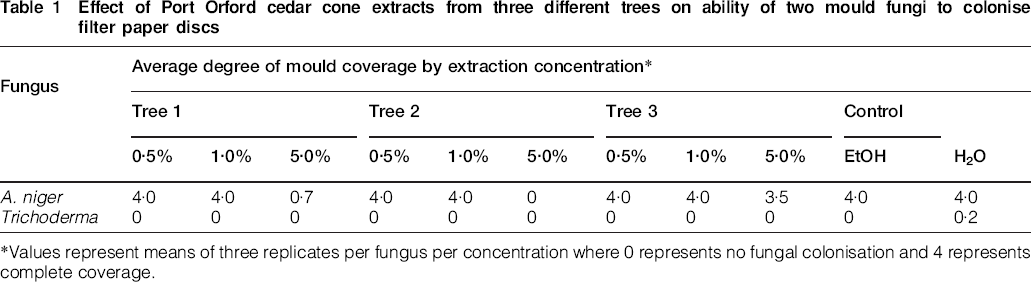
*Values represent means of three replicates per fungus per concentration where 0 represents no fungal colonisation and 4 represents complete coverage.
Decay resistance
Weight losses of blocks treated with either water or ethanol ranged from 10·5 to 25·2% (Table 2). While the weight losses were lower than typically seen in other tests, they were sufficient for comparative purposes. Weight losses for blocks treated with the diluted extracts were generally similar for each tree so the data were combined for comparison to the water and ethanol treated controls. Weight losses for extract-treated blocks did not differ from those found with the controls regardless of concentration or the fungus. These results suggest that steam distilled extracts of the Port Orford cedar cones had no noticeable effect on wood durability under the conditions tested.
Ability of Port Orford cedar cone extracts to limit fungal decay by three decay fungi in agar block test
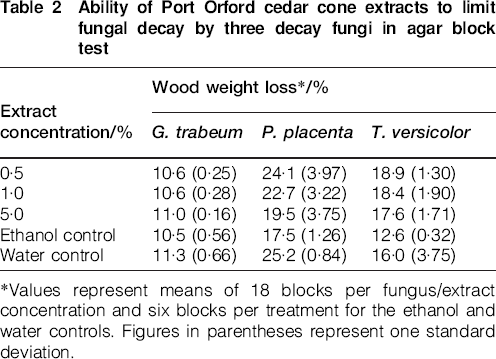
*Values represent means of 18 blocks per fungus/extract concentration and six blocks per treatment for the ethanol and water controls. Figures in parentheses represent one standard deviation.
Conclusion
Steam distilled extracts of Port Orford cedar cones provided limited protection against A. niger growth at higher concentrations, but failed to enhance the resistance of pine sapwood blocks to decay fungi. The results suggest that, despite the known bioactivity of Port Orford cedar heartwood, extracts from cones of this species had limited potential as bioactive compounds. The lack of activity may reflect an absence of bioactive compounds in the oils or an inability of compounds present to function in the same manner once removed from the original plant. The results indicate that seed cone extracts have limited potential as sources of bioactive compounds.