







Abstract
This paper describes a study on the use of a soy adhesive system as a substitute for melamine urea formaldehyde adhesive in plywood production. Results are presented on bonding quality and formaldehyde emission of laboratory scale panels bonded with different mixes of formaldehyde based resins substituted with a soy adhesive system. This study demonstrates that the addition of soy adhesive system significantly reduces formaldehyde release from plywood. Based on the results, the optimum amount of the soy addition depends on the requirements of use of the final product and formaldehyde emission. The highest substitution level recommended is 25% for the production of panels with very low formaldehyde emission for use in class 2 or 3 conditions, whereas up to 75% substitution would seem possible for class 1 panels.
Introduction
Formaldehyde condensed resins have been used as wood adhesives for many years. Wood composites made with such resins liberate formaldehyde during the production and during their service lives. Although formaldehyde based resins may be efficient as adhesives, the toxicity and carcinogenicity of formaldehyde to humans is a serious health concern, according to the International Agency for Research on Cancer (IARC 2006). Therefore, the concentration of formaldehyde in air is limited in many countries.
To solve the problem of formaldehyde emissions in wood based panels, intensive research work is being conducted around the world on the development of environmentally friendly wood adhesives based on natural raw materials. Adhesive technology is advancing and there is the possibility of replacing adhesives derived from fossil fuels with those obtained from renewable resources (Liu and Li 2007; Irle et al. 2008; Kim 2010). As an alternative to petroleum based adhesives, protein based glues, such as casein, blood and soy glues, have been employed for production wood composites. Soy based adhesives have been used primarily for plywood prior the advent synthetic resins (Lambuth 2002; Liu and Li 2007).
In recent years, increased demand for adhesives, increasing cost of petroleum based binders and greater interest in developing environmental friendly products have resulted in expanded application of soybean based adhesives (Pizzi 2006). Soy and others protein based adhesives do not offer better moisture resistance than synthetic resins without modifying the chemistry of the protein. Soy protein could be an alternative to formaldehyde based resins for the bonding of wood if a suitable modification to the formulation can be developed to improve the mechanical and physical properties of the resultant wood composite panel (Liu and Li 2002; Zhang and Hua 2007; Huang and Li 2008).
An alternative approach is to use soy based adhesives as a partial substitute for formaldehyde based resins and this is the subject of this paper. More precisely, a soy adhesive system is used as a substitute for a melamine urea formaldehyde (MUF) adhesive in the production of plywood.
The work described in this paper was an investigation of the bonding quality and formaldehyde emission of laboratory scale panels bonded with different mixes of formaldehyde based resins substituted with a soy adhesive system.
Materials and methods
In this laboratory study, industrially cut and dried 2·5 mm thick Okoume (Aucoumea klaineana) veneers were used to make laboratory scale plywoods 450×450 mm in size. The glue spread used for all panels was 200 g·m−2 per single glueline. Three plies were used for each plywood, which were assembled and hot pressed under 1·2 MPa pressure at 140 °C. A relatively long press time of 5 min was used to ensure full crosslinking. The press temperature and press time were fixed for all plywood manufacturing.
The two adhesives used were:
a melamine urea formaldehyde MUF resin that was being used by an industrial partner at the time of the laboratory trial for the production of class E1 plywood
a soy based adhesive system (Soyad), supplied by Ashland Hercules Water Technologies. This system is a combination of modified soy flour with a polyamide based crosslinking agent.
The formulations of adhesive mixtures used for plywood manufacturing ranged from 100% MUF to 100% soy with three intermediates of 75∶25, 50∶50 and 25∶75. Two replicate panels were manufactured for each board type.
Formaldehyde emission was determined according to European standard EN 717-2 within 3 days after production. Four replicate samples were tested for each panel type.
Bonding quality was assessed according to EN 314, which involves the measurement of the shear strength and the percentage of wood failure over the bonding area of samples cut from the panel. Typically, ten replicates were used to assess the mechanical properties of each type of board after each pretreatment.
Results and discussion
The changes in formaldehyde emission values of the plywood panels in relation to the substitution of MUF are given in Fig. 1. Formaldehyde emission is seen to fall with increasing soy content in the adhesive formulation. The lowest formaldehyde emission values were obtained in the plywood panels bonded with the pure soy adhesive system. Depending on the substitution level in the formulation, the formaldehyde emission values ranged from 70% to 95% lower than the panel bonded with MUF. It would appear that when soy adhesive system is used to substitute MUF resin, there is a statistically significant reduction in formaldehyde emission, even with only 25% substitution. Clearly, the change is not linear and therefore is unlikely to be due to a dilution effect.
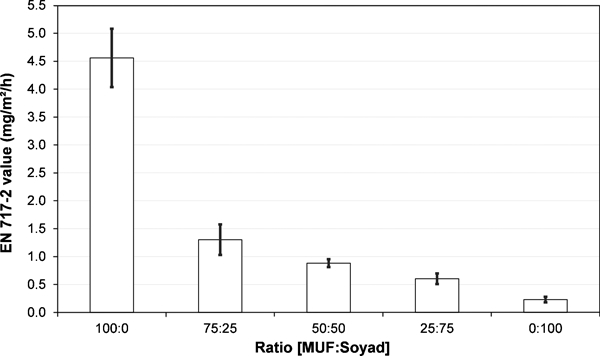
Formaldehyde emission values observed from specimens bonded with different mixtures of MUF and Soyad
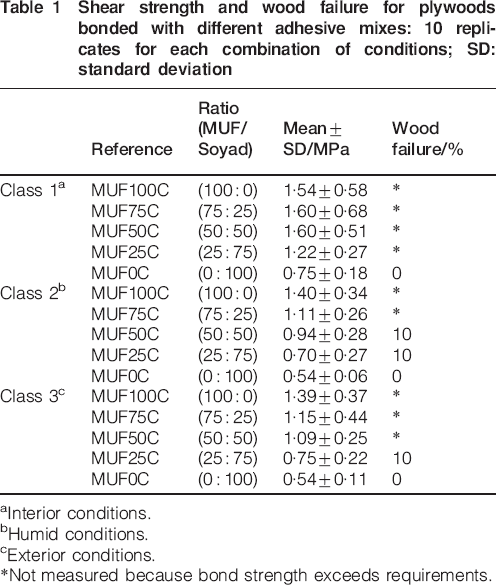
As shown in Table 1, the shear strength values of plywood panels manufactured with the MUF adhesive were higher than those manufactured with mixtures of soy and melamine urea formaldehyde glues. However, since the minimum shear strength required in EN 314-2 is 1 N·mm−2, many of the MUF–soy mixtures surpassed the requirement.
Shear strength and wood failure for plywoods bonded with different adhesive mixes: 10 replicates for each combination of conditions; SD: standard deviation
aInterior conditions.
bHumid conditions.
cExterior conditions.
*Not measured because bond strength exceeds requirements.
From the results in Table 1, it would appear that plywood for interior use can be manufactured when up to a 75% of the synthetic resin is substituted with Soyad. Lower substitution levels of 25% and possibly 50% might permit the commercial manufacture of plywood for humid and exterior applications (see classes 2 and 3 results in Table 1). Experience has shown that the properties of laboratory panels are often inferior to commercial panels using the same glue formulation. Therefore, the optimum amount of the soy addition depends on the requirements of use of the final product and formaldehyde emission.
The results were sufficiently encouraging to warrant an industrial trial, which was conducted in a plywood factory using poplar veneers. For economic reasons, only 100% MUF and 100% Soyad were tested. The relevant results of the industrial trial are shown on the Table 2. According to these results, a 100% substitution level allows the production of panels with very low formaldehyde emission with acceptable mechanical properties. It is noticeable that the properties are significantly better than those of the laboratory trial. The results confirm that the soy based adhesive could be used for manufacturing standard plywood for use in dry conditions.
Summary of industrial trial results of plywood

*Not measured because bond strength exceeds requirements.
Conclusions
This study investigated the use of a soy based adhesive system as a replacement for MUF adhesive in the production of low formaldehyde emitting plywood.
The results show that:
It is possible to produce plywood using mixture of MUF adhesive and soy adhesive system.
The addition of soy adhesive system greatly reduces the formaldehyde emission of plywood.
The optimum amount of the soy addition depends on the requirements of use of the final product.
The highest ratio recommended is [MUF/S] = ?>[75∶25] for the production of panels with very low formaldehyde emission for use in class 2 or 3 conditions, whereas up to 75% substitution would seem possible for class 1 panels.
The partial substitution of formaldehyde based adhesives with soy based ones could be an intermediate solution for the manufacture of plywoods, and potentially other wood based panels, giving them very low formaldehyde emissions. Further developments of the soy-based system could lead to a more water resistant version permitting greater substitution of MUF. Further research is needed, however, to achieve this.
Footnotes
Acknowledgements
The authors wish to thank Drouin S.A and Ashland Hercules Water Technologies for the material and technical support.