







Abstract
The effect of thermal modification and extracts of Scots pine sapwood and heartwood, and Norway spruce on the colonisation by the bacterium, Escherichia coli was studied. All wood samples caused more rapid decrease of bacterial numbers compared to glass, which was used as reference material. Pine sapwood caused somewhat faster decrease of bacterial count than the other wood types. On the other hand, both thermal modification and extraction increased the bacterial count on all the samples compared to untreated wood samples. Neither the amount of extractives nor the faster drying of the surface, to which the bacterial inoculum was added, could alone explain this result; rather it is likely that this is due to a combination of both factors.
Introduction
Antimicrobial properties of wood play an important role in product development and use of wood materials. However, even though wood has superior qualities for many industries and is a highly functional material, it has traditionally been viewed as an unhygienic surface and difficult to clean (Welker et al. 1997; Gough and Dodd 1998). Therefore, it has previously not found use as, for example, a surface for handling foods or in the hospital setting. On the other hand, wood is often perceived as warm and natural (Masuda 2004), and more recent research has brought forth the antimicrobial properties of wood, which has prompted many new uses of functional wood products, including microbial hygiene (Milling et al. 2005b). Antimicrobial properties vary greatly among different wood species (Schönwälder et al. 2002; Milling et al. 2005a, b). Consequently, choosing the right material is important for each particular purpose as different species, their heartwood and sapwood and variations produced with different treatments all have unique properties.
Antibacterial properties of certain wood species, such as pine, oak (Milling et al. 2005a), fir (Filip et al. 2012) and white ash (Miller et al. 1996) are not well understood; it is currently assumed that they are due to a combination of several factors such as the drying of wood surfaces and their chemical composition (Schönwälder 2002). Some researchers claim that the antibacterial effect of wood surfaces is due to the fact that bacteria may physically become entrapped in the porous structures of different wood species (Gilbert and Watson 1971; Abrishami et al. 1994; Gough and Dodd 1998). If this were the case, bacteria would still be alive and could cause contamination of wood and products thereof, but would not be detected by standard testing procedures. On the other hand, we have recently demonstrated, that adherence does not explain the antibacterial effect of pine heartwood (Vainio–Kaila et al. 2011), as the method used in our studies revealed bacteria whether it was being trapped in wood structures or not. The survival of two bacteria, Escherichia coli and Listeria monocytogenes, was demonstrated on both pine heartwood and glass surfaces. The results showed that wood has certainly antibacterial properties and this test method was shown to reveal also possibly adhered bacteria.
Some of the antimicrobial agents of wood have been studied in more detail. Abietic acids have been shown to possess antibacterial activity against Bacillus subtilis, Bacillus ammoniagenes and Staphylococcus aureus (Himejima et al. 1992). Lindberg et al. (2004) found the concentration of pinosylvin to correlate with antibacteriality against B. coagulans, Burkholderia multivorans and Alcaligenes xylosoxydans. Mourey and Canillac (2002) found α-pinene to inhibit the growth of L. monocytogenes. Also the resin of Norway spruce (Picea abies) has been found to have antibacterial effect against several Gram positive bacteria (Sipponen et al. 2007).
The aim of the present study was to investigate the effect of extractives on the antibacteriality of Scots pine and Norway spruce. As several wood extractive compounds have been found to have antibacterial properties, the present study aims to elucidate how the absence of extractives might influence the antibacteriality of pine heartwood and sapwood and spruce heartwood. Moreover, as it is also known that the chemical composition of wood changes during thermal modification (Manninen et al. 2002), thermally modified samples were included in the present study.
Materials and methods
Wood and glass cylinders
The wood material used in this study was the sapwood and heartwood of kiln dried Scots pine (Pinus sylvestris L.) and Norway spruce (Picea abies L.) having average densities (RH 65%, 20°C) of 500, 500 and 460 kg cm−3 respectively. The boards (n = 8) were machined to 14 mm (thickness), 95 mm (width) and 400 mm (length) and half of the boards were thermally modified prior to machining, and finally all specimens were conditioned at RH 35%, 20°C to their equilibrium moisture content. The boards were further planned to 10 mm thickness and then cylinders drilled to a diameter of 15 mm. Glass cylinders with the same diameter and thickness of 3 mm were used for comparison.
Thermal modification
Four boards from each group were thermally modified at atmospheric pressure for 4 h at a target temperature of 220°C in the presence of steam. Before thermal modification the boards were oven dried overnight and weighed, and then weighed again after thermal modification to determine percentage of mass loss.
Extraction
Half of the untreated and thermally modified oven dried cylinders were additionally extracted with acetone using a Soxhlet apparatus for 6 h. Acetone soluble extractive content was measured from approximately 10 g of drilled wood cylinders at ambient temperature. Acetone was evaporated from the samples using a rotary evaporator. Extractive content was calculated based on dry wood weight.
Contact angle
The contact angle measurements were carried out at room temperature (20°C) at approximately RH 50% using sessile drop technique with contact angle measuring instrument (KSV Instruments, model CAM200) on wood with different treatments and on glass. A drop of distilled water was placed on the surface and the contact angle determined with the help of a camera and CAM 200 software. Contact angle was measured every 10 s over 10 min. Five parallel specimens were measured except for glass, where two parallel specimens were measured.
Bacterial strains
Escherichia coli (MG 1655; Guyer et al. 1981) was used as the test bacterium. It was stored in skimmed milk at −70°C. Before use, E. coli was subcultured at least twice on nutritient broth agar plates. The plates were incubated at 37°C overnight. Bacterial colonies were moved directly from agar to physiologic NaCl solution. The concentration of the bacterial dilution used in the tests was 1·5×106 CFU mL−1. The concentration was adjusted using Hitachi U-2000 photometer.
Cultivations
Bacterial solution of 100 μL was placed with a pipette on the top surface of the wooden and glass samples, which is equivalent to 1·5×105 CFU per sample. Five parallel samples were used for each of the four incubation times. The samples were placed in Petri dishes, five parallel samples in each. After incubation at 25°C for 2, 4, 7 and 24 h, the samples were tested for recoverable bacteria. To remove possibly adhered bacterial cells from the surface of the samples, they were vortexed in 15 mL physiological salt solution for 5 s. Immediately after that 400 μL of the solution with E. coli was spread onto nutrient broth agar plates. After overnight incubation at 37°C, the CFUs on the plates were counted. In cases where the bacterial colonies formed a lawn on the plates and, thus were impossible to count separately, the CFUs were estimated to correspond to the original number of cells at 0 h (i.e. 1·5×105). The average and the standard deviation of the five parallel results were calculated and the results are shown as CFU/plate in a logarithmic scale.
Results and discussion
Weight loss and extractive content of wood specimens
The weight loss of wood during thermal modification is mainly caused by degradation of hemicellulose, but also the evaporation of extractives. The ratio of weight loss also depends on many process variables, such as wood species, process type, temperature, duration and atmosphere. In this study, wood was thermally modified for 3 h at 220°C in steam atmosphere. The weight losses were 8·2%, 8·4% and 6·9% for pine sapwood, pine heartwood and spruce respectively.
The acetone soluble extractive contents are shown in Table 1. The extractive contents of untreated wood correlate fairly well with literature (Sjöström 1981; Martínez–Iñigo et al. 1999). Pine sapwood and heartwood extractive content decreased with thermal modification, but the relative extractive yield from spruce was stable. It is known that the absolute content of extractives decreases during thermal modification due to volatilisation and degradation. The relative extractive content can vary (Nuopponen et al. 2004) and also increase (Esteves et al. 2008) after thermal modification, caused by major degradation of carbohydrates. It was earlier found (Nuopponen et al. 2004) that lignin becomes partly acetone soluble after a thermal modification above 180°C, which could explain the extractive content for thermally modified spruce, since the extracted material was most probably a mixture of acetone soluble extractives, lignin and degradation products.
Extractive contents for untreated and thermally modified specimens

Contact angle
Surface wetting behaviour was measured by dynamic contact angle measurements using sessile drop technique. Contact angle was measured every 10 s over 10 min. The contact angles were plotted 10, 30 and 120 s after droplets were placed on the surface. Figure 1 shows the results for untreated and thermally modified spruce, pine sapwood and heartwood. The results show that thermal modification increases the contact angle on pine sapwood and heartwood, but decreases it for spruce. According to the literature (Pétrissans et al. 2003; Hakkou et al. 2005a, b; Kutnar et al. 2012), thermal modification generally increases the contact angle (decreased wettability) on both softwood and hardwood. It has been suggested that one of the reasons could be an increase in hydrophobic cellulose crystallinity (Pétrissans et al. 2003). Metsä–Kortelainen and Viitanen (2012) found in their studies that contact angle on thermally modified Norway spruce and Scots pine varies depending on sapwood, heartwood and modification temperature and there were no clear evidence for the reason. However, Hakkou et al. (2005a) have questioned whether thermal degradation is the origin of the hydrophobic character of thermally modified wood.
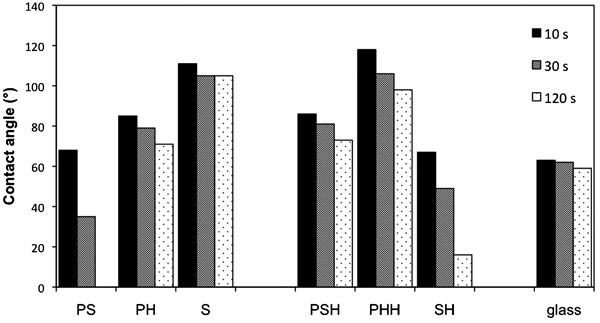
Measured contact angles for untreated and thermally modified wood 10, 30 and 120 s after water droplet is placed on the surface: PS = pine sapwood, PH = pine heartwood, S = spruce, PSH = pine sapwood thermally modified, PHH = pine heartwood thermally modified, SH = spruce thermally modified
Half of the specimens were also extracted with acetone using a Soxhlet apparatus for 6 h in order to see the affect of the acetone soluble extractives on both contact angle and antibacteriality. Contact angle results of untreated, but extracted specimens and thermally modified and extracted specimens are presented in Fig. 2. The extraction of unmodified wood resulted surprisingly in an increase of contact angle, when compared to (Fig. 1) unextracted and unmodified specimens. In an earlier study, Wålinder (2002) found that extraction for Scots pine sapwood and heartwood decrease the contact angle. This was most probably caused by the contact angles being measured by Wilhelmy rather than sessile drop method. Moreover, the extraction was performed using Soxlet apparatus with several solvents (ethanol, acetone, petroleum ether and deionised water) and not only with acetone.
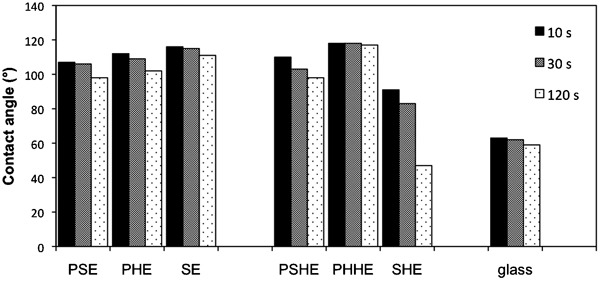
Measured contact angles for extracted and both extracted and thermally modified wood 10, 30 and 120 s after water droplet is placed on surface: PSE = pine sapwood extracted, PHE = pine heartwood extracted and SE = spruce extracted, PSHE = pine sapwood thermally modified and extracted, PHHE = pine heartwood thermally modified and extracted and SHE = pruce thermally modified and extracted
Contact angle of thermally modified and extracted pine sapwood and heartwood was increased by both extraction and thermal modification. Contact angle of spruce was decreased by thermal modification and at the same time increased by extraction. The results therefore depend on a combination of both thermal modification and extraction.
The decrease in contact angle on glass surface (Figs. 1 and 2) is caused purely by both droplet spread and evaporation.
Cultivations
The cultivations were with E. coli. Five parallel samples were used and the cultivation times were 2, 4, 7 and 24 h. The results for untreated wood are shown in Fig. 3. The reduction of the bacterial count on all the wooden samples can be clearly seen already after 2 h incubation. This is well in accordance with our earlier study where pine sapwood was compared with glass (Vainio–Kaila et al. 2011). Pine sapwood was slightly more antibacterial than other wood types. Of untreated samples, pine sapwood showed the smallest contact angle, which indicates fast drying of the surface. This leads to unfavourable conditions for the bacteria. In these results, the differences between pine heartwood and spruce are so little and variation so large that conclusions could not be made as to which of these materials is more antibacterial. Several other studies (Koch et al. 2002; Schönwälder et al. 2002; Milling et al. 2005a) have found pine more antibacterial than spruce. None of these report pine sapwood as being the sample material, instead Koch et al. (2002) do not mention whether they used sapwood or heartwood, Schönwälder et al. (2002) used heartwood and Milling et al. (2005a) used mixed heartwood and sapwood. Since the larger amount of extractives causes pine heartwood to be more resistant to fungi than pine sapwood (e.g. Gref et al. 2000; Blom and Bergström 2006), it is surprising that in these results, the bacteria decreases faster on sapwood than heartwood. Possibly, the composition of extractives in pine sapwood coupled with fast surface drying gives best antibacterial effect of these species. The results seem to have very little correlation when comparing fungal resistance and the surveillance of bacteria on wooden surfaces. Metsä–Kortelainen and Viitanen (2009) found pine heartwood to be more resistant to fungi than pine sapwood or spruce, whereas our studies found sapwood to be more antibacterial than pine heartwood or spruce. Pine has also shown good resistance to amoebae (Yli–Pirilä 2009) though only when fresh pine wood was used. On old pine, amoebae survived longer. Yli–Pirilä (2009) suggested that the reason could be previous evaporation of volatile organic compounds from old pine material.
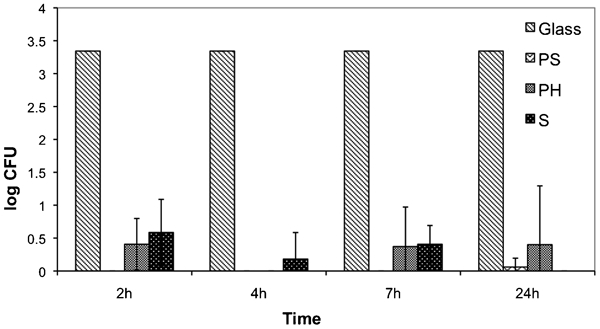
Amount of CFUs of E. coli recovered from untreated wooden and glass surfaces after four different incubation times: PS = pine sapwood, PH = pine heartwood and S = spruce; average of five parallel samples is shown and error bars show standard deviation
Also within thermally modified samples, pine sapwood had the fastest decrease in bacterial count, but here it was spruce that had smaller contact angle (Figs. 3 and 4). Thermal modification increased the fungal resistance in Metsä-Kortelainen and Viitanen's studies, when our studies show thermal modification to decrease the antibacterial effect.
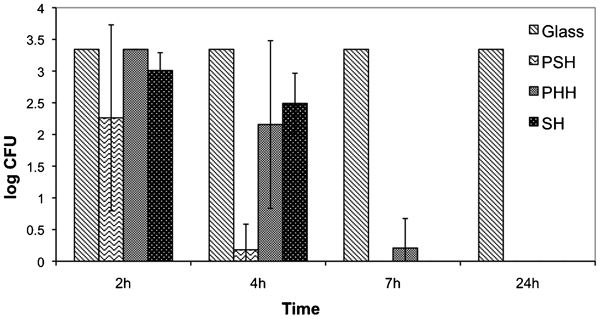
Amount of CFUs of E. coli recovered from heat treated wooden and glass surfaces after four different incubation times: PSH = pine sapwood thermally modified, PHH = pine heartwood thermally modified and SH = spruce thermally modified; average of five parallel samples is shown and error bars show standard deviation
The antibacterial effect was decreased with both thermal modification (Fig. 4) and extraction (Fig. 5). Pine sapwood shows most effective reduction of bacterial count compared to other types of wood samples with both treatments. The reduction of bacterial count after four hours incubation is clear for all timbers compared to glass samples.
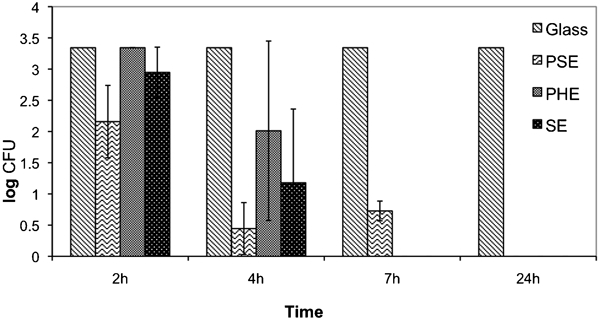
Amount of CFUs of E. coli recovered from extracted wooden and glass surfaces after four different incubation times: PSE = pine sapwood extracted, PHE = pine heartwood extracted and SE = spruce extracted; average of five parallel samples is shown and error bars show standard deviation
When testing thermally modified wood which also has been extracted (Fig. 6) the effect of decreasing antibacteriality seems to accumulate and the difference between wooden and glass samples gets smaller. After four hours incubation only spruce shows some reduction of bacterial count and even that reduction is fairly small. Only after seven hours incubation did the bacterial count start to decrease on wooden samples.
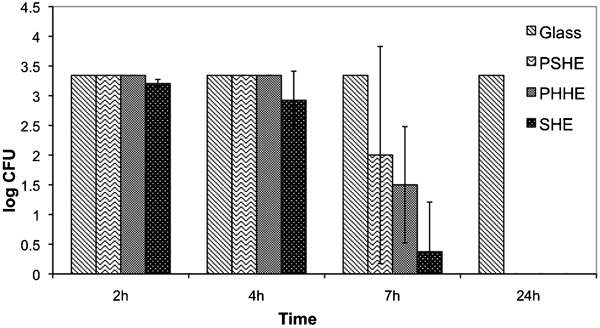
Amount of CFUs of E. coli recovered from heat treated and extracted wooden and glass surfaces after four different incubation times: PSHE = pine sapwood thermally modified and extracted, PHHE = pine heartwood thermally modified and extracted and SHE = spruce thermally modified and extracted; average of five parallel samples is shown and error bars show standard deviation
For some reason, extracted samples seemed to be much slower than others to absorb the water drop in which the bacteria was placed on the surfaces. This was further studied with help of contact angle measurements (Figs. 1 and 2.). The results showed this observation to be correct, but did not explain why after four hours incubation the extracted samples had still greater bacterial count than untreated samples had after 2 h. These results support the presumption that extractives have an important role in the antibacteriality of Scots pine and Norway spruce.
Conclusion
The survival of E. coli on pine heartwood and sapwood and spruce sapwood, untreated, thermally modified, extracted and both thermally modified and extracted was studied. Both pine and spruce performed well compared to glass, which was used as reference material. Surprisingly, pine sapwood had the fastest decrease in bacterial count despite the lesser amount of extractives and durability compared to pine heartwood or spruce. This might be due to fast drying of the surface and good combination of extractives. Both heat treatment and extraction decreased the antibacteriality of all samples. This on the other hand speaks for the importance of extractives on decreasing the time bacteria survive on a surface. Besides drying of the surface, the composition instead of purely the amount of extractives seems to play important role on the antibacteriality of wood surfaces.
So far, most of the studies regarding wood's antibacterial effects have been made in laboratory, with untreated new surfaces. To reach more practical importance, studies should be performed in real environments and with older wooden surfaces.
Footnotes
Acknowledgements
The authors would like to thank Miss C. Leitch for technical support.