







Abstract
The benefits from acetylation of wood to enhance resistance against fungal decay and dimensional stability have been known for many years. Since 2007 Accsys Technologies has been commercially producing Accoya wood that is based on acetylation of Radiata pine. Accoya has shown its potential for many applications, even for structural use. However, due to limited engineering data each project had to be evaluated on a case-by-case basis. Based on research at various universities and institutes, Accsys Technologies has in combination with TimberSolve and ARUP, developed a handbook to assist designers and structural engineers produce reliable, durable and consistent designs utilising Accoya wood in structural applications.
Introduction
Acetylation of wood to enhance its resistance against wood decaying fungi, as well as improving its dimensional stability under varying moisture conditions, has been studied extensively over the last decades (Homan and Jorissen 2004; Hill 2006; Rowell 2006; Jones 2007). Accsys Technologies introduced acetylated wood, named Accoya wood (www.accoya.com), into the market in 2007. Accoya wood is based on the acetylation of radiata pine (Pinus radiata D. Don) and is mainly used for non-structural applications such as joinery, cladding, decking and (light) civil works in the Netherlands, UK and Germany (Kattenbroek 2005; Alexander 2007; Bongers et al. 2009).
On account of the aforementioned properties there is much interest in using acetylated wood for structural applications, particularly in view of the success of a heavy load bearing traffic bridge constructed using Accoya wood at Sneek in the Netherlands (Tjeerdsma et al. 2007; Tjeerdsma and Bongers 2009; Jorissen and Lüning 2010).
A summary of the extensive research on the structural properties of acetylated wood was given by Bongers et al. (2010). It was concluded that, in spite of the extensive scientific research on physical and mechanical properties of acetylated wood, further testing and model development is required to take the product forward through to an accepted structural approval.
This paper describes the new research conducted at SHR Timber Research, Edinburgh Napier University's Centre for Offsite Construction and Innovative Structures, University of Brighton and collaboration with TimberSolve and ARUP to establish products of Accoya Radiata pine and Accoya SYP equivalent to strength class C24. This paper reports the results for Accoya Radiata pine, but the testing program for Accoya SYP has been rather similar (see Crawford et al. 2012).
Strength grading
For the study machine strength graded Radiata pine (Pinus radiata D. Don) specified for application within the second Sneek bridge was used. Timber of the dimensions 38×138 mm (thickness×width) was cut out of specially selected logs based on acoustic grading by the sawmill in New Zealand. After processing and drying the timber was graded with a Microtec Viscan to produce timber with a modulus of elasticity of 8000 N mm−2 and more. The initial settings for the Microtec Viscan were developed in conjunction of SHR, Microtec, Van Wessem and Ingenieursbureau Evan Buytendijk.
Forty-eight boards of structural sizes (4–5 m length) untreated Radiata pine of different bundles, were measured by a Microtec Viscan without density measurement and a Brookhuis MTG. The bending strength (modulus of rupture – MOR) and stiffness (local shear free modulus of elasticity – MOE) was determined according to EN 408. A correlation coefficient R2 of 0·79 was found between the MOE determined by EN 408 and the Microtec Viscan MOE prediction based on average density (470 kg m−3). By using actual board density the correlation could be improved to R2 of 0·91. Similar correlations were found for the Brookhuis MTG. For the grading of the Sneek bridge the initial Microtec Viscan settings were obtained by using the 95% confidence interval of the regression between prediction (based on average density) and actual MOE (see Fig. 1). At this MOE level a bending strength of ∼40 N mm−2 is found (see Fig. 2). During the grading for the Sneek bridge (∼600 m3), in total 50 boards were randomly tested for bending stiffness and strength. The results confirmed the correctness of the grading; all boards had a MOE of 8000 N mm−2 or more.
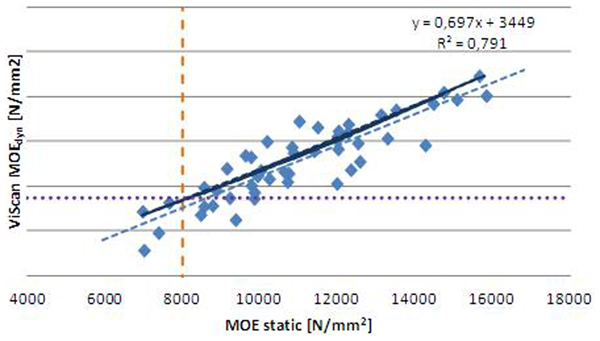
Microtec Viscan MOE prediction based on average density compared with actual MOE
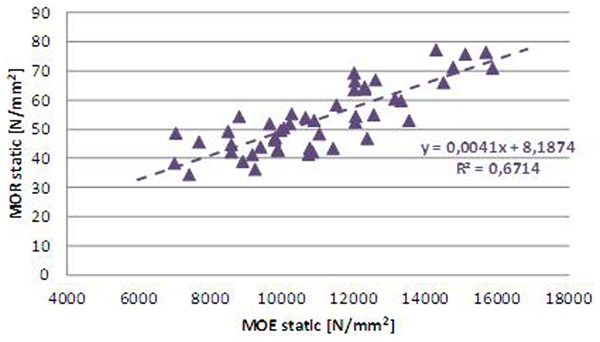
Correlation of bending stiffness (MOE) with bending strength (MOR)
Mechanical properties
Test set-up
Sixty strength graded boards of the dimension of 38×138×4500 mm (thickness×width×length) were cut in half. Half of each board (2·25 m) was acetylated in Accsys Technologies factory in Arnhem. The bending stiffness (MOE) and strength (MOR) were determined according to EN 408 for the untreated and acetylated paired boards. After the bending test, the boards were used to prepare samples for compression and tension tests according to BS 373 (see Fig. 3). Of each ‘test type’ an amount between 15 and 35 samples was tested. Dimensions of the samples are shown in Table 1.
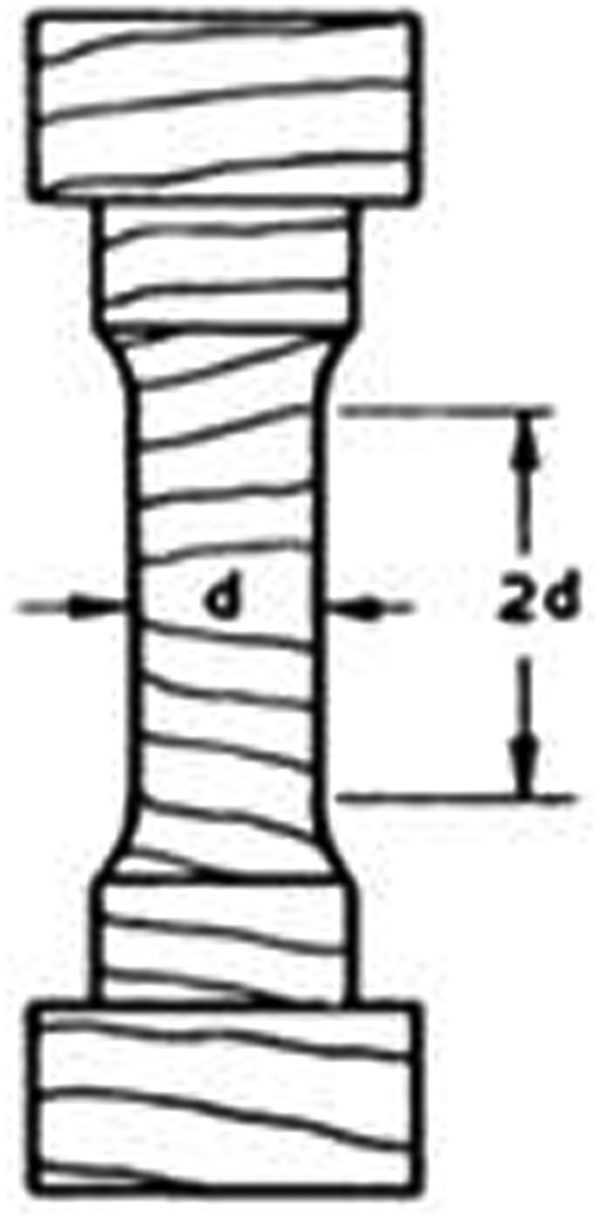
Tension perpendicular to the grain sample
Compression and tension sample dimensions and loading rate according with BS 373

*Sample details as shown in Fig. 3.
The shear modulus of untreated (48 samples) and acetylated (43 samples) Radiata pine with MSG8 strength grade was determined using the Torsion test method in accordance with EN 408. In order that the samples were not stressed beyond their elastic limit each specimen was tested to a maximum load of 0·4fmax,est – the test apparatus used in this instance was Tinius Olsen.
Results
A summary of the results of acetylated Radiata pine compared with the values for strength class C24 defined in EN 338 is shown in Table 2. Not all values for Accoya wood (marked with asterisk) are determined according to EN 408 and making it difficult to perform a comparison, but in general the mechanical properties of acetylated Radiata pine comply at least with the values mentioned for C24.
Mechanical properties of Accoya structural
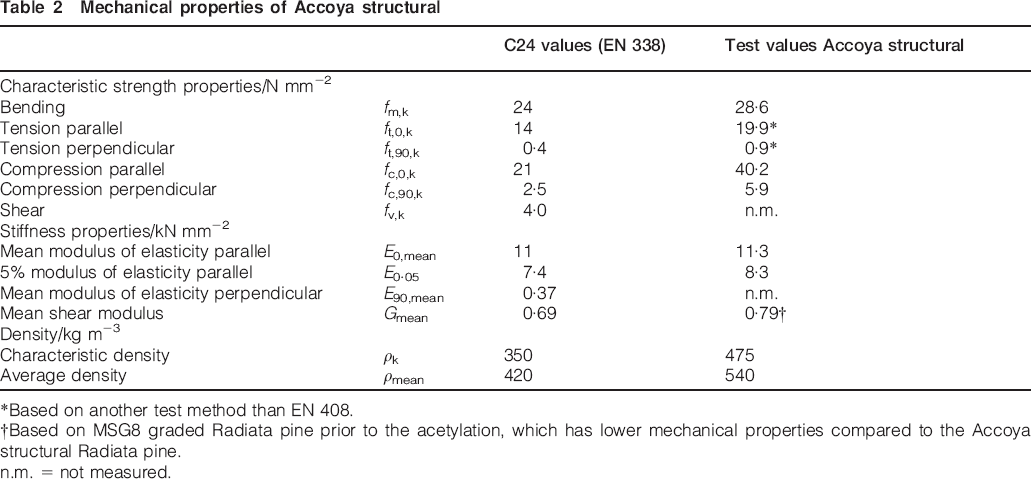
*Based on another test method than EN 408.
†Based on MSG8 graded Radiata pine prior to the acetylation, which has lower mechanical properties compared to the Accoya structural Radiata pine.
n.m. = not measured.
Study to compare strength properties of Accoya wood under service class 1 and 3 conditions
Test arrangements
At Brighton University the following mechanical properties were determined on paired samples of Accoya radiata pine under service class 1 (65% RH/20°C) and service class 3 (immersed under water for 4–6 weeks) conditions:
Embedment strength parallel to grain according to EN 383 of 15 paired samples. The specimen's parallel to grain dimension was nominally 150 mm with the dowel projecting from the centre point of the 150×100 mm specimen face. The 10 mm diameter bolt was inserted into a predrilled 11 mm diameter hole.
Embedment strength perpendicular to grain according to EN 383 of 15 paired samples. The specimen's parallel to grain dimension was nominally 400 mm with the dowel projecting from the centre-point of the 400×100 specimen face. The 10 mm diameter bolt was inserted into a predrilled 11 mm diameter hole.
Compression strength parallel to the grain according to EN 408 of 15 samples of nominally 240 mm long and 38×89 mm in cross-section
Compression strength perpendicular to grain of 15 samples of 38×89 mm in cross-section and 70 mm length. Although the test specimen size deviates slightly from that stipulated in EN 408, the test procedure of EN 408 was followed.
Shear strength of a notched end of Accoya determined from a central three-point load test on short span beam (see Fig. 4) of 38×89 mm in cross section. Details of the support arrangement at the end notch are shown in Fig. 5. Sixteen paired samples were utilised.
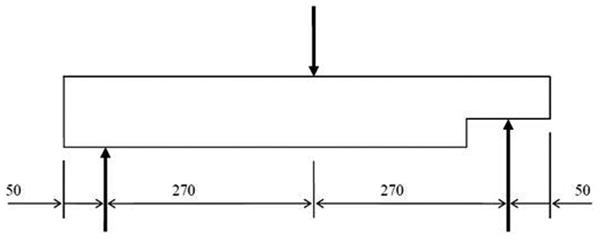
Set-up for shear tests on notched beams
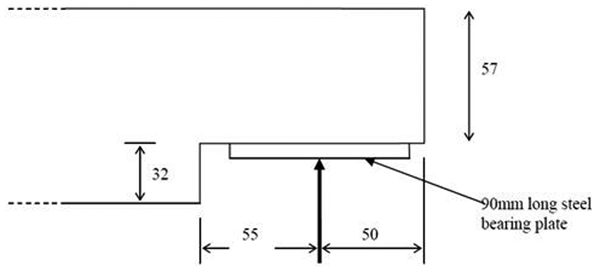
General arrangement at notched support
Determination of characteristic values was carried out according to EN 14358 and, in the case of the embedment strengths and shear strength at the notched end, calculations were made in conjunction with EN 1995-1-1.
Results
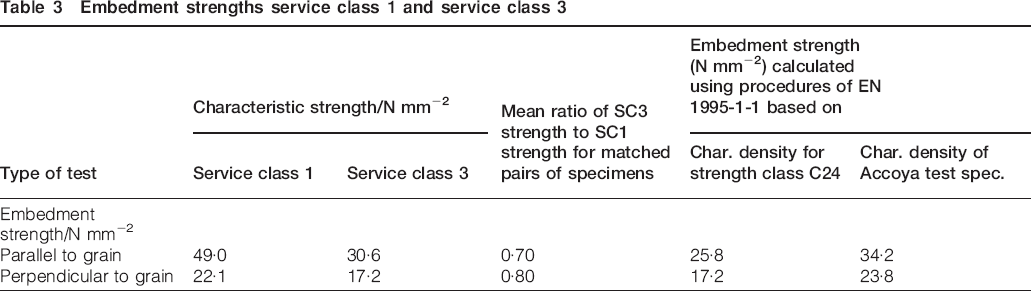
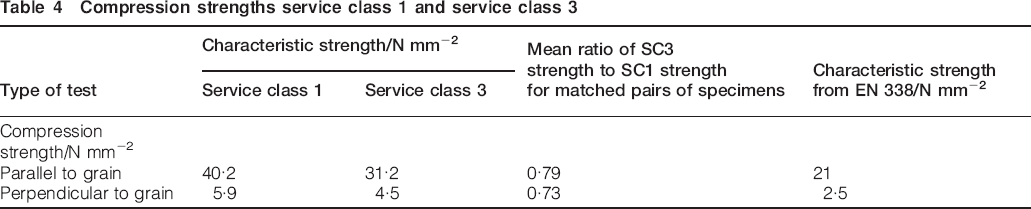
In Tables 3–5 the results of the tests at service class 1 condition (65% RH/20°C) and service class 3 condition (immersed under water for 4–6 weeks) are given for the embedment, compression and shear strength respectively.
Embedment strengths service class 1 and service class 3
Compression strengths service class 1 and service class 3
Shear strengths at notched end service class 1 and service class 3

The overall mean ratio between service class 3 embedment strengths and service class 1 embedment strengths is 0·80 for specimens loaded perpendicular to grain and 0·70 for specimens loaded parallel to grain. This is similar to ratios of kmod given in EN 1995-1-1, which range from 0·78 to 0·83 depending on the load duration class being considered. When it is considered that, unlike in some National Codes (e.g. BS 5268-2), EN 1995-1-1 gives a single set of kmod values for all stress types it is concluded that the modifications embodied in the solid timber kmod factor to account for service class are appropriate also for modifying Accoya embedment strengths.
The characteristic embedment strengths output by EN 1995-1-1 pertain to service class 1 condition and have been calculated by using the characteristic density given by EN 338 for strength class C24 and the actual density of the Accoya test specimens. Higher actual characteristic embedment strengths are found compared to calculation values by EN 1995-1-1 for characteristic densities of strength class C24. When the EN 1995-1-1 characteristic embedment strengths are calculated using measured characteristic densities from the Accoya test specimens, whilst the characteristic value from embedment tests parallel to grain remained greater than the corresponding calculated characteristic value, the characteristic value from the embedment tests perpendicular to grain was slightly (7%) less than the corresponding calculated characteristic value.
The overall mean ratio between service class 3 compression strengths and service class 1 compression strengths is 0·79 and 0·73 for specimens loaded parallel and perpendicular to grain respectively. Again this is thought to be in acceptable agreement with the ratios of kmod described in EN 1995-1-1. The characteristic compression strengths found by test for Accoya radiata pine comfortably exceed the characteristic compression strengths (parallel and perpendicular to grain) given in EN 338 for strength class C24.
Unlike for most strength properties of Accoya or solid timber, no decrease in shear strength was found for saturated Accoya relative to the shear strength of Accoya conditioned in a service class 1 environment. For Radiata pine Accoya in service class 1 conditions the characteristic shear strength of a beam at a notched support found from test was in reasonable agreement (+15%) with the equivalent characteristic shear strength calculated in accordance with EN 1995-1-1 and utilising the solid timber values for the factors kcr (0·67) and kn (5).
Structural design
Effect of acetylation on strength and stiffness
Any chemical modification process that affects the chemistry of the wood cell wall polymers and/or their interactions will also affect the physical and mechanical properties of the wood. The key effects of acetylation are:
Accoya has a lower equilibrium moisture content than the parent wood
Accoya has a higher density than the parent wood due to the weight of the added acetyl groups; however, because the wood swells during acetylation, there are actually fewer fibres per cross-section compared with the unmodified wood
Accoya has a slightly lower tensile and bending strength than the parent wood.
Solid Accoya members
Solid Accoya members may be designed in accordance with EN 1995-1-1:
the characteristic strength and stiffness properties given for C24 in EN 338 may be assumed
These shall be modified in accordance with the factors for solid wood in EN 1995-1-1 to obtain appropriate design values
Since Accoya will mainly be used in external applications, the kmod and kdef values for solid timber in service class 3 will generally apply
note that in service class 3 under instantaneous or short term load duration, the characteristic values for modulus of elasticity and shear modulus should be multiplied by 0·9.
Laminated Accoya members
The physical and chemical changes associated with acetylation, can affect the strength of the glue line; in particular adhesives which require moisture for hardening can be affected by the particularly low moisture content of Accoya. Testing has so far been undertaken by two large multinational wood adhesive manufacturers, in accordance with EN 302-1 and EN 301 (PRF adhesives) or EN 15425 (PU adhesives), to confirm that their adhesives are suitable for gluing Accoya. It may be possible to use other adhesives, but these would need to be confirmed by the relevant manufacturers.
Laminated Accoya members may be designed in accordance with EN 1995-1-1
the characteristic strength and stiffness properties given for GL24h in EN 1194 (shortly to be replaced by EN 14080) may be assumed
these shall be modified in accordance with the factors for laminated wood in EN 1995-1-1 to obtain appropriate design values
since Accoya will mainly be used in external applications, the kmod and kdef values for solid timber in service class 3 will generally apply
note that in service class 3 under instantaneous or short term load duration, the characteristic values for modulus of elasticity and shear modulus should be multiplied by 0·9.
Design of connections
Connections may be designed in accordance with EN 1995-1-1. Advantage may be taken of the higher density of Accoya due to the weight of the added acetyl groups. For dowel type fasteners (nails, screws, dowels and bolts) this will generate higher embedment, and where applicable withdrawal and head pull-through, strengths. The following characteristic densities ρk may be assumed: solid Accoya, 380 kg m−3; laminated Accoya, 410 kg m−3.
The dimensional stability of Accoya will also be of advantage when using large bolt groups. Many other species have risk of splitting due to the restraint provided by the steel plate or cross-grain timber to which the bolts are often connected.
Fixings and steel flitch plates shall be stainless steel minimum grade A2 and A4 (304 and 316) since Accoya contains a small amount of residual acetic acid from the modification process that can impact corrosion rate of metals.
Footnotes
Acknowledgements
The authors are very grateful of the pleasant cooperation with University of Brighton (Dr Dave Pope), SHR (Professor Dr André Jorissen) and ARUP (Andrew Laurance) to develop a Structural Design Guide for Accoya Wood.