







Abstract
The aim of this work was to achieve a better understanding of the wettability, i.e. liquids wetting and sorption characteristics (or penetrability), of acetylated Southern yellow pine (SYP) including probable differences in such characteristics between early- or latewood. Matched samples of acetylated and untreated SYP boards were prepared. The wettability of the samples were measured by the Wilhelmy technique using standard probe liquids as well as two different sample coatings, a cationic knot sealer and an acrylic based dye. The results showed that latewood regions of the acetylated wood had a noticeably lower uptake of the non-polar low surface tension liquid octane as well as the polar high surface tension liquid water compared with latewood of the untreated controls. Contact angle analysis based on the Lewis acid–base concept indicated that the acetylated wood is predominantly Lewis basic. A preferential wetting of the knot sealer was observed on the acetylated wood.
Introduction
When wood is used as a building and construction material, careful attention must be paid to its inherent susceptibility to a number of degradation factors. In outdoor and moist conditions, wood is for example sensitive to microorganisms attack, dimensional unstable and the surface is sensitive to UV light and mould growth. Several of these features can be controlled efficiently by wood acetylation (Hill 2007), even though some remains uncontrolled, especially the affinity to surface mould growth. A way to overcome this is to apply a surface treatment, e.g. in the form of a stain or a film forming coating. Such treatments can further increase the performance, refinement and value of acetylated wood.
A chemical modification of the bulk substance of wood also most likely alters its surface chemistry and, hence, its wettability and adhesion ability related to so called intermolecular (or interfacial) forces. Wetting phenomena can be defined as ‘macroscopic manifestations of molecular interactions between liquids and solids in direct contact at the interface between them’ (Berg 1993). Contact angles and surface free energy are parameters that relates to the wettability of materials. From these parameters, a theoretical work of adhesion can be determined, i.e. a measure of interfacial forces which contribute to the adhesion between different materials, for instance between a wood substance and a coating or adhesive.
The understanding of materials wetting characteristics must be traced to the origin and nature of intermolecular forces (Berg 1993). Intermolecular forces can be divided into physical and chemical related forces, the former referred to as ‘van der Waals’ (LW) forces, and, in case of wetting-related phenomena, the latter can be considered as Lewis acid–base (AB) interactions (Fowkes 1983; van Oss et al. 1987; Berg 1993; Good 1993). Hydrogen bonding is one type of such acid–base interactions where an electron pair is donated by the base (electron donor) and is shared with the acid (electron acceptor), together forming an ‘adduct’. The Lewis acid-base concept for condensed phases was introduced by Fowkes (1983). van Oss et al. (1987) and van Oss (1994) further developed contact angle analysis methods for estimations of solid/liquid and solid/solid interfacial forces, including such acid–base interactions, here referred to as the van Oss–Chaudhury–Good (vOCG) approach. Chang and Chen (1989) and Qin and Chang (1995) proposed a semiempirical acid–base approach, here referred to as the Chang–Qin–Chen (CQC) approach, which is similar to the vOCG model, but allows both attractive and repulsive acid–base contributions to the work of adhesion.
The basic idea in this work is to ‘tailor’ new efficient coating systems suitable for acetylated wood. As the basis for this, a better understanding of the wettability of acetylated wood is necessary, including also its Lewis acid–base characteristics. Our experimental approach is based on some recently developed wettability and adhesion analysis methods suitable for wood (Wålinder et al. 2010; Bryne and Wålinder 2010). In particular, it is crucial to pay careful attention to the fact that wood substrates are heterogeneous, hygroscopic, porous and have rough and irregular surfaces, i.e. wetting phenomena on wood substrates is a complex matter. Foremost, this means that the wetting involves capillary actions, e.g. penetration of liquids into the structure and/or along the surface structure of wood. The affinity of the wood substance to polar liquids like water also results in bulk sorption and swelling effects. Therefore, no static or equilibrium states exist for liquids in contact with wood. Another complicating feature is related to the presence of extractives which strongly influence the intermolecular forces at the wood/liquid interface. In summary, because of this complexity, wetting parameters on wood substrates must be referred to as apparent parameters, for example, apparent contact angles. Morphological heterogeneity, especially related to the early- and latewood regions, rays and pits, also plays an important role for the penetrability and anchoring ability of coatings in a wood substrate.
The main objective of this work is to add some new insight about the wetting characteristics and coatings penetrability in acetylated Southern yellow pine, especially related to its early- and latewood regions. The wetting study also includes a Lewis acid–base characterisation. The work is based on the preliminar results and paper presented at the Sixth European Conferenxe on Wood Modification (ECWM6), see Wålinder et al. (2012). A related wettability and penetrability study on acetylated Scots pine was also presented at ECWM5 in Riga (Wålinder et al. 2010).
Experimental methods
Preparation of acetylated and control wood samples
Acetylated Southern yellow pine (SYP) boards were produced in a pilot plant at Eastman Chemical Company (Kingsport, TN, USA), in spring 2010. The acetylation level was approximately 21% expressed as wood acetyl content. Matched untreated boards, originally from the same board as for the acetylated one, were selected as controls. Wood blocks, one acetylated and one untreated, were then prepared with dimensions of 140×30×30 mm (width×thickness×length in the fibre direction) from the ‘meeting’ ends of the matched boards. To eliminate liquid sorption through the specimen's end grain during the wetting experiments, one cross-section of the wood blocks were sealed with a polyurethane coating. From the blocks, smaller samples with dimensions of about 10 mm in the radial (R) direction, about 160 mm in the tangential (T) direction (following a band of approximately one annual ring), and about 30 mm in the longitudinal (L) direction were prepared with a hand veneer saw. Finally, radial sectioned veneer specimens of the dimensions 4·5–6×30×1 mm (R×L×T) were prepared using a wood chisel, including also a separation of the late- and earlywood regions.
All wood samples were before the wetting experiments conditioned to an approximate equilibrium condition corresponding to a laboratory climate of about 22°C and about 50% relative humidity. Based on the dry weight of the wood, the moisture content of the acetylated and control specimens was approximately 2–3% and 6–7% respectively. This sample preparation technique to produce wood veneer replicates from the same series of annual rings is based on earlier experience to achieve more rigorous and reproducible wood wetting measurements as described in Bryne and Wålinder (2010) and Wålinder et al. (2010).
Wetting and penetrability experiments and analyses
The Wilhelmy method was applied to estimate the wetting and sorption properties of the veneers both in a series of standard contact angle analysis probe liquids as well as in two different wood coatings in liquid state. The main principle of the Wilhelmy method and a so called Wilhelmy test cycle is shown in Fig. 1. Figure 1 also defines the constants, wetting parameters and force balance relations used in this study: m = mass of the specimen, g = gravitational constant, P = perimeter of the specimen, γ = surface tension of the liquid, θ = apparent contact angle (A denotes advancing and R receding), Fw(t) = sorbed liquid at time t, Fb = buoyancy force, h = immersion depth, Ff = final weight change due to liquid sorption and v = velocity of immersion and withdrawal. At low velocities, it is assumed that a dynamic contact angle is approximately equal to the corresponding static contact angle. The procedures of the Wilhelmy technique used for these wood wetting experiments, i.e. the determination, or rather estimation, of apparent probe liquid contact angles on the veneers, the perimeter of the veneers P, as well as the liquid or coating sorption, are described in more detail in Bryne and Wålinder (2010).
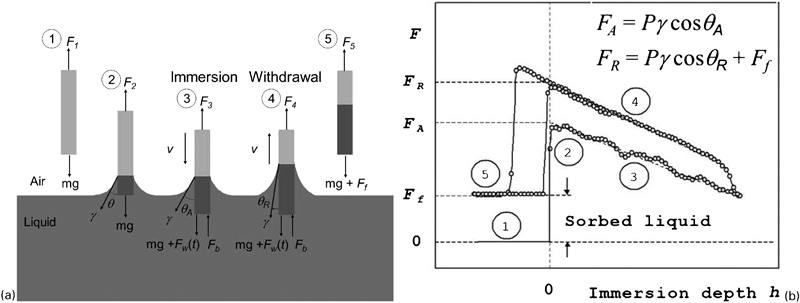
a schematic illustration of Wilhelmy method and corresponding force F balances for studying wettability of porous and hygroscopic material such as wood veneer and b Wilhelmy method illustrated by schematic plot of recorded weight change (or force change F) versus immersion depth h during test cycle when wood veneer is immersed in and withdrawn from liquid
Used probe liquids were three polar liquids: distilled water (WA) with a surface tension γ = 72·0 mN m−1, ethylene glycol (EG) with γ = 48·8 mN m−1 and formamide (FA) with γ = 59·1 mN m−1; and one apolar liquid: diiodomethane (DIM) with γ = 50·5 mN m−1; and finally a low surface tension (‘wetting out’) liquid: octane (Oct), γ = 21·5 mN m−1. All probe liquids were of chromatographic grade, i.e. of high purity. In addition, two coating systems (or primers) were included in the study, a cationic knot sealer, γ = 39·2 mN m−1 and an acrylic based dye, γ = 30·7 mN m−1, both supplied by Akzo Nobel Industrial Coatings in Malmö, Sweden. Five replicates of each sample were immersed (advancing stage) along the grain in the probe liquids and coatings to a depth of 10 mm, and then withdrawn (receding stage) to about 4 mm above the surface. The immersion and withdrawal velocity was 12 mm min−1, and the experiments were performed at a surrounding laboratory climate of about 22°C and about 50% relative humidity. All wood samples were also conditioned and in an approximate equilibrium condition similar to the laboratory climate.
Estimation of interaction parameters by CQC approach
The Lewis acid–base characteristics of the wood samples were estimated by applying the CQC approach, that is a systematic analysis of the measured apparent contact angles on the wood veneers for the series of polar and apolar liquids (Bryne and Wålinder 2010; Chang and Chen 1989; Qin and Chang 1995). In this model, work of adhesion Wa is defined as the work required to separate a unit area of the solid/liquid interface, which can be estimated by the Young–Dupré equation



Furthermore, the CQC approach (Chang and Chen 1989) can be expressed as



Positive value(s) of the acidic and/or basic parameter describe the acidic character of the surface, and negative value(s) the basic character. The surface is called ‘acidic’ if both parameters are positive, and ‘basic’ if both are negative, and hence, if they are of opposite sign, the surface is bipolar. Note that equation (5) allows the acid–base interaction to be negative, in contrast to the vOCG approach (van Oss et al. 1987; van Oss 1994) where only positive values is valid.
Equation (5) can be rearranged into
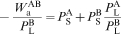
Hence, the intercept and slope of a plot
 versus
 correspond to
 and
and
 respectively. In other words, the measurement of finite contact angles on the solid material of interest for a series of three or more probe liquids with known γLW,
 and
and
 parameters, where at least one liquid need to be completely apolar (i.e. both
 and
and
 equals zero) enables the determination of the
 and
and
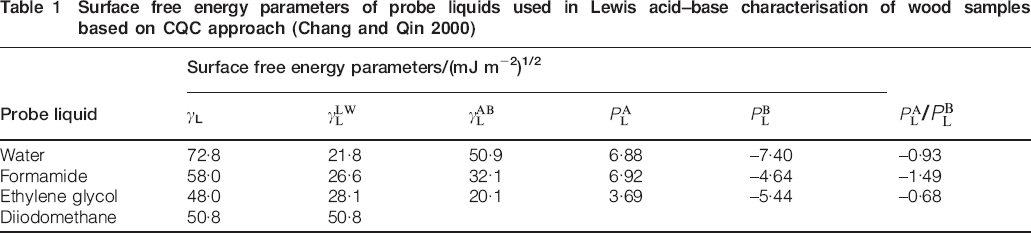
 parameters of the solid. Based on published contact angle data for different probe liquids on solid surfaces, Chang and Qin (2000) determined the different surface free energy parameters of some probe liquids by a best least squares fit to their model. Table 1 presents their obtained PA and PB parameters for a series of probe liquids. Finally, it is important to note that in this work the probe liquid diiodomethane was considered to be completely apolar when used in the CQC model.
Surface free energy parameters of probe liquids used in Lewis acid–base characterisation of wood samples based on CQC approach (Chang and Qin 2000)
 /
/


Micromorphological studies of wood/coatings interface
To study penetration depth and pathways and micromorphology of the wood/coating interphase (or interfaces), transverse sections of two specimens tested in each of the two sample coatings were prepared by a contact free cutting technique, i.e. a surface micromachining procedure based on UV laser irradiation. More details of this sample preparation technique suitable for studying the micromorphology of soft substrates such as wood can be found in Wålinder et al. (2009). Scanning electron microscopy was used to evaluate the microstructure of the prepared samples. The apparatus was a Hitachi Tabletop Microscope TM-1000.
Results and discussion
Figures 2 and 3 show some example Wilhelmy plots from the wetting and sorption experiments in octane and water for matched samples of radial sectioned acetylated and untreated latewood and earlywood. A number of features can be observed from these plots. On the one hand, the measurements in the wetting-out liquid octane result in no clear differences between the acetylated and the control specimens, as can be seen in the two graphs to the left in Figs. 2 and 3. This is mainly illustrated by the shape of the advancing curves and the absence of hysteresis effects when the advancing mode is changed to the receding mode, indicating that no finite contact angle exists. On the other hand, the measurements in the high surface tension and highly polar liquid water result in clear differences between the acetylated and the control specimens, as can be seen in the two graphs to the right in Figure 2 Figs. 2 and 3. This is mainly illustrated by that the acetylated sample exhibits a distinctly lower level of the advancing part of F/P (force/specimen perimeter) versus depth plot and much greater hysteresis effect, which proves that the acetylated wood has a distinctly higher contact angle and lower water wettability than the unmodified control. Similar results for Scots pine have also been reported by Wålinder et al. (2010) and Bryne and Wålinder (2010).
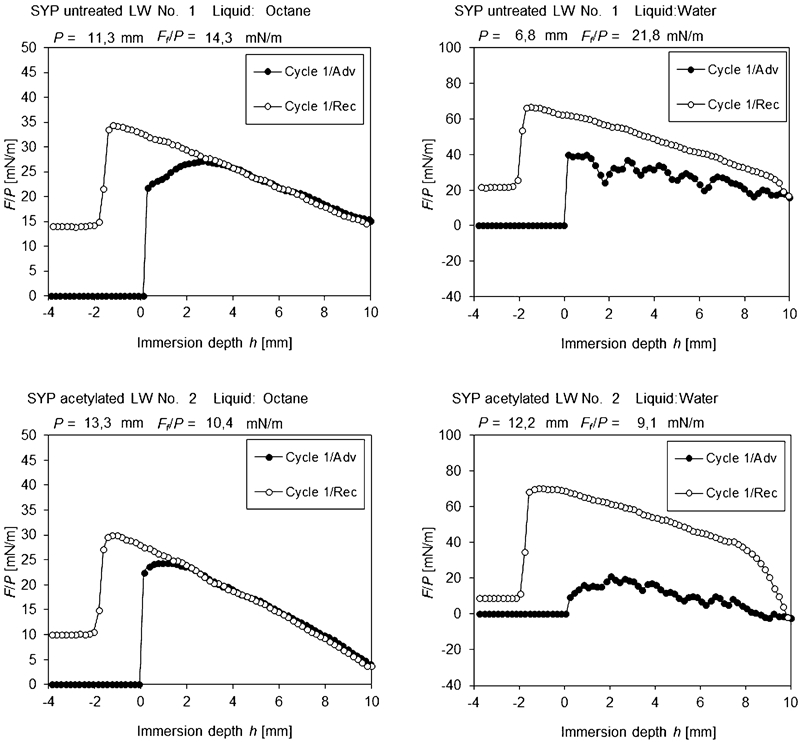
Examples of Wilhelmy test cycles in wetting-out liquid octane (two left diagrams) and in water (two right diagrams) for untreated (two upper diagrams) and acetylated (two lower diagrams) latewood (LW) samples
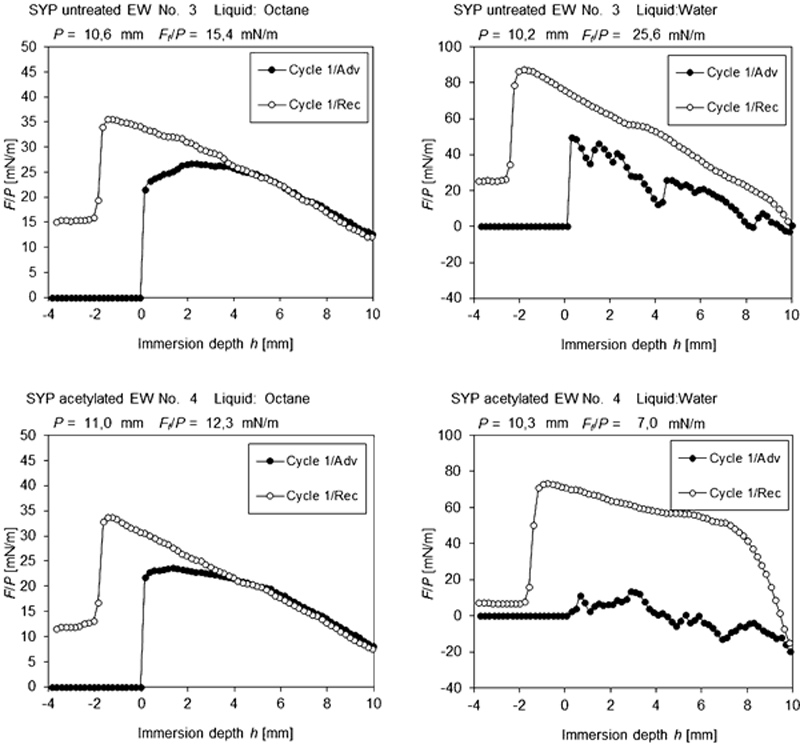
Examples of Wilhelmy test cycles in wetting-out liquid octane (two left diagrams) and in water (two right diagrams) for untreated (two upper diagrams) and acetylated (two lower diagrams) earlywood (EW) samples
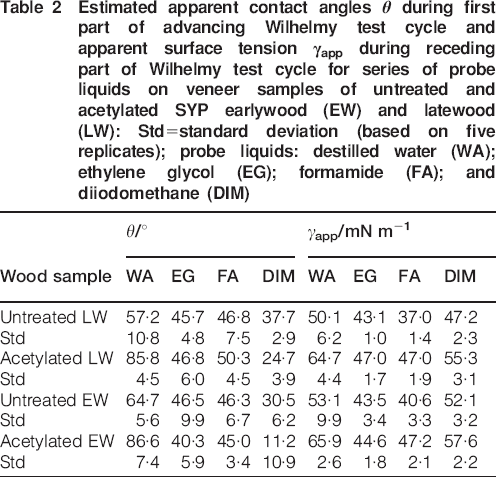
Table 2 and 3 summarises the wetting and sorption experiments in all probe liquids. From these measurements the following trends can be seen when comparing the acetylated and untreated SYP samples:
Estimated apparent contact angles θ during first part of advancing Wilhelmy test cycle and apparent surface tension γapp during receding part of Wilhelmy test cycle for series of probe liquids on veneer samples of untreated and acetylated SYP earlywood (EW) and latewood (LW): Std = standard deviation (based on five replicates); probe liquids: destilled water (WA); ethylene glycol (EG); formamide (FA); and diiodomethane (DIM)
Estimated sorption parameter Ff/P, i.e. final force change Ff normalised by specimen perimeter P, for ‘wetting-out’ liquid octane (Oct) and series of probe liquids on veneer samples of untreated and acetylated SYP earlywood (EW) and latewood (LW): Std = standard deviation (for octane based on 20 replicates, and for other liquids based on five replicates). Probe liquids: destilled water (WA); ethylene glycol (EG); formamide (FA); and diiodomethane (DIM)
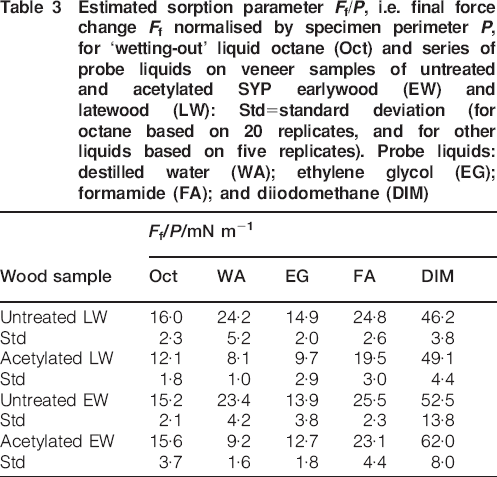
distinctly lower sorption of the low surface tension liquid octane in acetylated latewood compared with untreated latewood, see the different final sorption level Ff/P for octane in Table 3. Possible explanation: the swollen state of acetylated latewood means less void volume and/or ‘blocked’ flow paths for capillary uptake of octane
distinctly lower sorption of the polar high surface tension liquids (water, ethylene glycol and formamide) in acetylated latewood compared with untreated latewood, see the different final sorption level Ff/P for these liquids in Table 3. Possible explanation: a combination of the following effects: (1) explanation as above in (i); (2) the fact that acetylated wood substance is less hydrophilic (less amount of accessible hydroxyl groups) than untreated wood which results in higher contact angles that suppress capillary uptake of the liquid; and (3) acetylated wood has more ‘stable’, and possible less amount of, extractives than untreated wood, i.e. acetylated wood contain extractives, and acetylated extractives, which have lower solubility in the polar liquids
compared with untreated and acetylated latewood, untreated and acetylated earlywood show less difference in uptake of the low surface tension liquid octane. Possible explanation: The swollen state of acetylated earlywood has less effect on its liquid permeability for non-polar low surface tension liquids
compared with untreated earlywood, acetylated earlywood showed a distinctly lower uptake of water. Possible explanation: (1) the fact that acetylated wood substance is less hydrophilic (high water contact angles suppress capillary uptake of the liquid); and (2) ‘more stable/less water soluble’ extractives in acetylated wood
distinctly higher uptake of the non-polar liquid DIM in acetylated early- and latewood. Possible explanation: preferential wetting due to the less hydrophilic character of acetylated wood.
Figures 4 and 5 show the results from analysis of the contact angle in Table 2 based on the CQC approach, i.e. the resulting Lewis acid–base character of the different wood samples. As can be seen, these results indicate that acetylated SYP is more Lewis basic than the untreated SYP. Similar results for Scots pine have also been reported by Bryne and Wålinder (2010). One explanation for this increased Lewis basic character of the acetylated could be related to the fact that extractives play a key role in wood surface characteristics. Any extraction or alternation of the extractives due acetylation may lead to this changed surface characteristic.

Contact angle analysis using CQC approach:
is Lewis acid–base contribution to work of adhesion;
 and
and
 are acid (A) and base (B) surface free energy parameters of used probe liquids (L); LW = latewood, EW = earlywood

Estimated
and
 interaction parameters, i.e. acid (A) and base (B) surface free energy parameters, of wood samples (S) respectively: LW = latewood, EW = earlywood
Figure 6 shows examples of Wilhelmy test cycles in the cationic knot sealer primer for untreated and acetylated SYP latewood samples. As can be seen, a preferential wetting (increased wettability/lower apparent contact angles) can be observed for the knot sealer on the acetylated sample. No such trend could be observed for the acrylic based dye. Based on the findings as presented in Fig. 5, these results suggest that the knot sealer possible could have a more Lewis acidic character compared with pure water and also compared with the acrylic based dye. However, no clear differences could be observed based on the micromorphological studies of the wood/coatings interface and penetration depth in the veneers as a result from the wetting and sorption experiments in the two coating systems.
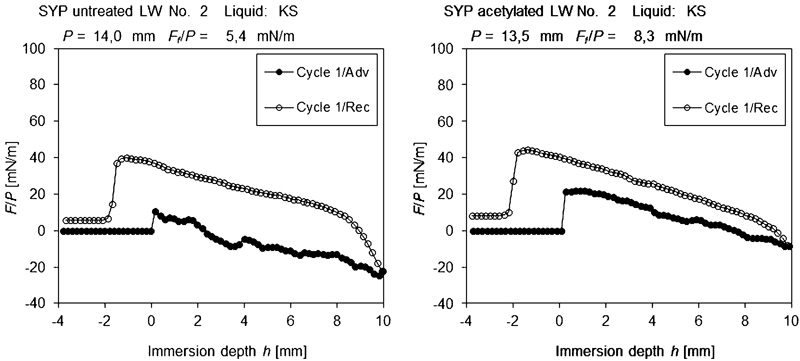
Examples of Wilhelmy test cycles in cationic knot sealer (KS) for untreated (the left diagram) and acetylated (the right diagram) SYP latewood (LW) samples
Conclusion
The wetting and sorption measurements based on the Wilhelmy method suggest that radially sectioned latewood in acetylated SYP has a significant lower liquid penetrability than the corresponding earlywood. No such differences could be observed in the untreated controls. The contact angle analysis based on the Lewis acid-base approach suggests that acetylated SYP is more Lewis basic than the untreated controls. A preferential wetting could be observed for the cationic knot sealer primer compared with the acrylic based dye which leads to the conclusion that the former has a more Lewis acidic character than the latter. These results suggest that a preferential wetting with increased wood–coating adhesion/intermolecular forces could be achieved on acetylated SYP with a primer system designed to have predominately Lewis acidic wetting characteristics.
Footnotes
Acknowledgements
Financial support from the EcoBuild Institute Excellence Centre established by VINNOVA, The Knowledge Foundation and the Swedish Foundation for Strategic Research is greatly acknowledged.