







Abstract
The paper describes refinements of rapid laboratory assessment of the mechanical performance of timbers used in the marine environment as regards their resistance to indentation, impact abrasion from smooth and sharp abrasives and to dynamic impact loads when wet. Ten tropical and home-grown hardwoods, five softwoods and a wood–polymer compound were examined. Brinell hardness, dynamic hardness, abrasion resistance, and the structural integrity in high-energy multiple impact tests were determined comparatively on dry and wet specimens. A trend was shown where softwoods show a decrease in abrasion resistance with wetting, whilst hardwoods did not. In dry conditions, impact abrasion using steel balls was higher than when using sharp grit. It is suggested that when wet, water in the cells has a hydraulic energy absorbing effect.
Keywords
Introduction
Timber and timber products are used for structural applications in a wide range of environments and their properties need to accommodate this. For load-bearing applications, tensile, compression, bending and torsion strength as well as modules of elasticity and shear play an important role. However, mechanical loads may for some applications be restricted to the surface of non-structural timber materials, such as with flooring and decking that may suffer from wear as a result of abrasion and indentation from point loads. When wood is exposed outdoors moisture content can be significantly increased and timber is often exposed to a combination of biological, chemical and physical agents which weather the wood surface. Wood used in permanent structures in the marine environment is exposed to weathering and a wide range of wood deteriorating organisms. In addition it needs to be sufficiently strong to withstand periodic forces exerted through wave action.
Wood is traditionally used for many marine applications such as bridges and jetties, piers, lock-gates, groynes and other shoreline stabilisation structures. In marine applications, those portions of timbers exposed to the air are often exposed to high wind loads and air with high salt content which leads to increased erosion (Harrowfield 2006; Brischke 2010). The sea itself has a significant impact on timber structures exposed to the water. Wood moisture content is increased; wood is constantly wet under water, frequently wet in the tidal zone, and occasionally wet above the tidal zone through high relative humidity and splash water. While wetting has an indirect effect on the mechanical performance of marine timber structures, the wave action in combination with erosion by sand, shingles and other particles borne by the water directly impacts on the wood surface (Oliver and Woods 1959; Perdok 2002; Sawyer et al. 2005). Finally, various marine borers colonise and degrade wood immersed in seawater, therefore resistance to shipworms (Teredo spp.) and gribble (Limnoria spp.) is often required (Cragg et al. 2007).
Often, tropical wood species that have high density, hardness and silica content have been used for marine structures, because they provide sufficient combination of durability against marine borers as well as mechanical strength (e.g. Dupray et al. 2009; Sen et al. 2009). As shown in a survey by Williams et al. (2005) the most important criteria for selecting wood species for marine structural use are their resistance to Teredo navalis, resistance to abrasion and impact bending strength. Also, Brazier (1995) pointed out the importance of mechanical performance of wood used in the marine environment. However, a significant relationship between shipworm resistance and abrasion resistance was not found by Williams et al. (2010a).
Mechanical properties of timbers used for marine construction may be divided into two groups:
those referring to their load bearing capacity, e.g. compression strength, bending strength, or impact bending strength
those referring to the integrity of the wood surface and its resistance to loss through erosion.
While numerous standard tests are available to determine bending strength, stiffness or fracture toughness of wood, there is no standard method to determine wear resistance of wood in marine applications as occurs when wood is exposed to the sea, in particular close to the shore line, where waves and moving sediments have an impact. In the past several approaches have been made to develop test protocols that mimic real in-use conditions. For instance, Williams et al. (2010a) developed an abrasion test using beach shingles as abrasive in a machine designed to simulate wave action on solid timber specimens. The method compared abrasion of different species and included reference species currently used in marine applications, such as Greenheart and Bongossi. These species have successful track record of performance in the marine environment. It was intended that the method might be used to provide indication of likely service life. However, recognising where shingle scour occurs is very difficult and it is different from abrasion by wave action. It was recognised that the method had limitations and that abrasion in wet conditions can occur at a more basic level wherever surfaces get wet, be they floors or decking externally.
Within this study different methods to measure the mechanical resistance of wood have been applied to various timbers traditionally used in the marine environment, but also to some alternative timber species and materials. The study aimed to compare the structural integrity of the wood surface under typical in-use conditions. Therefore specimens have been tested dry and wet.
Materials and methods
Timber and wood–polymer composites
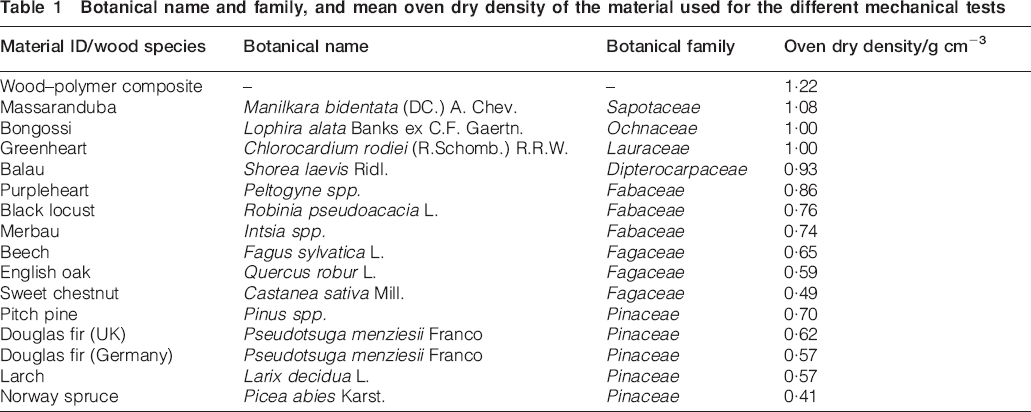
For all the mechanical tests, specimens were prepared from five softwoods, 10 hardwoods and a wood–polymer composite (commercially produced full profile made from softwood particles and polypropylene PP) as shown in Table 1.
Botanical name and family, and mean oven dry density of the material used for the different mechanical tests
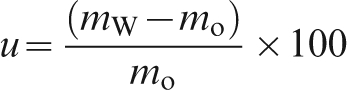
Half of the specimens were tested dry and therefore dried at 103°C till constant mass was achieved. The other half were tested wet and therefore vacuum-pressure impregnated with water (vacuum −23 kPa for 30 min, pressure 800 kPa for 2 h) and afterwards immersed in water for 24 h to achieve wood moisture content significantly above the fibre saturation point. The wood moisture content (u) was determined according to the following equation (1)
Determination of oven-dry density
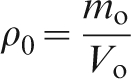
Since all specimens were axially matched the oven-dry density was determined on the abrasion specimens only. The specimens were oven dried at 103°C till constant mass, weighed to the nearest 0·01 g and the dimensions were measured to the nearest 0·01 mm. The oven dry density was calculated according to the following equation (2)
Abrasion resistance tests
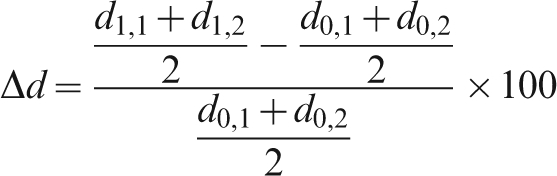
The resistance against abrasion was determined according to the Shaker method described by Brischke et al. (2005). Five specimens of 35 (ax.)×8·5×8·5 mm were laced in polyethylene flasks (V = 500 mL) together with 400 g of a particular abrasive and moved in an overhead shaker at 28 revolutions min−1 for 72 h. Stainless steel balls of 6 mm diameter and chilled cast iron grit (2·0–2·8 mm diameter) were used as abrasives. Deionised water of 50 mL was added to prevent drying during abrasion testing of wet specimens. Twenty-five specimens of each species were tested against each abrasive when wet and dry. Distances between opposite corners of the oven-dried specimens were measured to the nearest 0·01 mm before and after abrasion. The percentage loss in dimension Δd was determined as a measure of abrasion according to the following equation (3) for each block and an average determined
High-energy multiple impact (HEMI) tests
The development and optimisation of the high-energy multiple impact (HEMI) test have been described by Rapp et al. (2005) and Brischke et al. (2006a, b). In the present study, the following procedure was applied: twenty oven-dried specimens of 10 (ax.)×5×20 mm were placed in the bowl (140 mm in diameter) of a heavy-impact ball mill (Herzog HSM 100-H; Herzog Maschinenfabrik, Osnabrück, Germany), together with a set of steel balls. For crushing of hardwoods two balls of 35 mm diameter, for softwoods one ball of 35 mm diameter was used. Furthermore three balls of 12 mm diameter and three of 6 mm diameter were added to soft- and hardwoods to ensure impact with smaller wood fragments. The bowl was shaken for 60 s at a rotary frequency of 23·3 s−1 and a stroke of 12 mm. The fragments of the 20 specimens were fractionated on a slit sieve according to ISO 5223 (1996) with a slit width of 1 mm using an orbital shaker at an amplitude of 25 mm and a rotary frequency of 350 min−1 for 2 min. The following values were calculated. The degree of integrity I is the ratio of the mass of the 20 biggest fragments m20 to the mass of all fractions mall after crushing
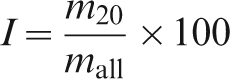
The fine fraction F is the ratio of the mass of fragments <1 mm to the mass of all fractions mall multiplied by 100

Finally, the resistance to impact milling (RIM) as a measure for the structural integrity of the material was calculated from I and F as follows
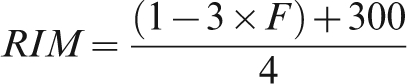
Sixty specimens of each species were tested when wet and dry, whereby 20 specimens were impact milled at the same time. No extra water was added to the wet samples because of the short test duration of 1 min. The fragments of the wet samples were oven-dried before sieving and fractionating.
Brinell hardness tests
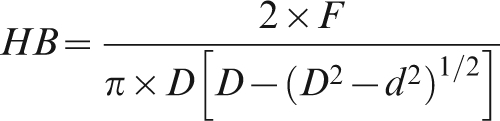
Static hardness (Brinell hardness) was determined according to EN 1534 (2011) with a universal testing machine (Zwick Z100). A steel ball of 10 mm diameter was applied with a maximum force of 500 N for 25±5 s on specimens with a minimum cross-section of 400 mm2 and a minimum length of 900 mm. The imprints of the indentations were measured using a digital microscope (Keyence VHX) to calculate the Brinell hardness according to equation (7). Brinell tests were conducted at four measurement points on non-axial surfaces on n = 5 replicates
Dynamic hardness tests
Dynamic hardness was determined according to Meyer et al. (2011) on the same specimens, which were used for the Brinell hardness tests. Indentation was generated on the specimen surface by a steel weight of 500 g dropped down on a steel ball from 300 mm height (see Fig. 1). The steel ball was placed into a height-adjustable ball-collet with a recess in it. A carbon paper was inserted between the steel ball and the specimen, in order to make the indentation visible. While dropping down, the weight was controlled by two laterally flushed eyebolts which enclose two steel shafts. For differently dimensioned specimens, the distance between the ground plate and the steel ball could be varied. As for the Brinell hardness tests, dynamic hardness tests were conducted at four measurement points on non-axial surfaces on n = 5 replicates. The specific impetus as a measure of dynamic hardness has been determined according to equation (8)

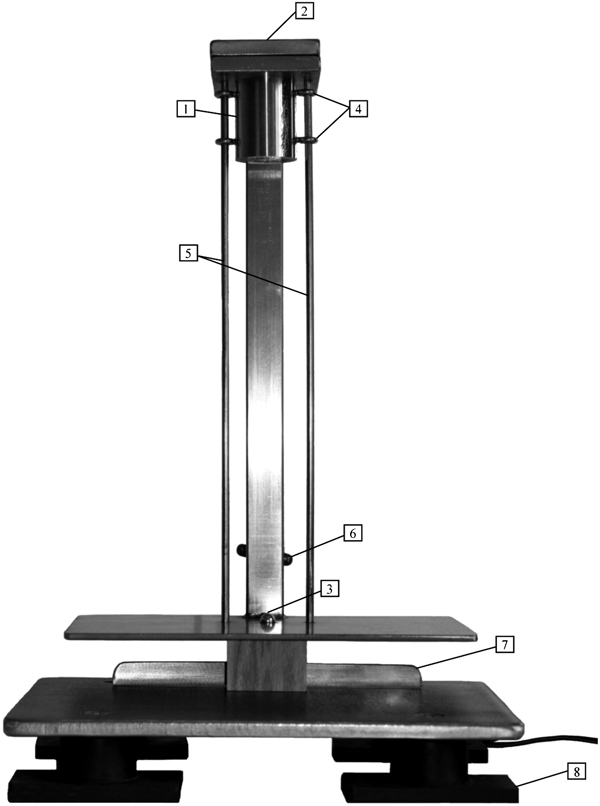
Front view of device for testing dynamic hardness: 1: drop weight; 2: push button; 3: 10 mm steel ball; 4: eyebolts; 5: steel shaft; 6: wing bolt; 7: fence; 8: gummed base
Microscopy
To characterise the effects of various loads applied to the wood surfaces using the different test methods, microscopic studies were conducted on selected samples using a reflecting light microscope with ×10 to ×100 magnifications. Distinctive features in terms of deformation and surface compression after testing were recorded.
Results and discussion
Oven-dry density and wood moisture content
The 15 wood species examined within this study covered a density range between 0·41 and 1·08 g cm–3 oven dry. The density of the wood–polymer compound was even higher at 1·22 g cm–3 (Table 1). As expected, the wood moisture content of the wet specimens after vacuum-pressure impregnation with water differed significantly between wood species (u = 35–166%, moisture content of the wood–polymer composite = 8%), but also between the four different test methods (Table 2).
Moisture content of the material used for the different mechanical tests after vacuum-pressure impregnation with water
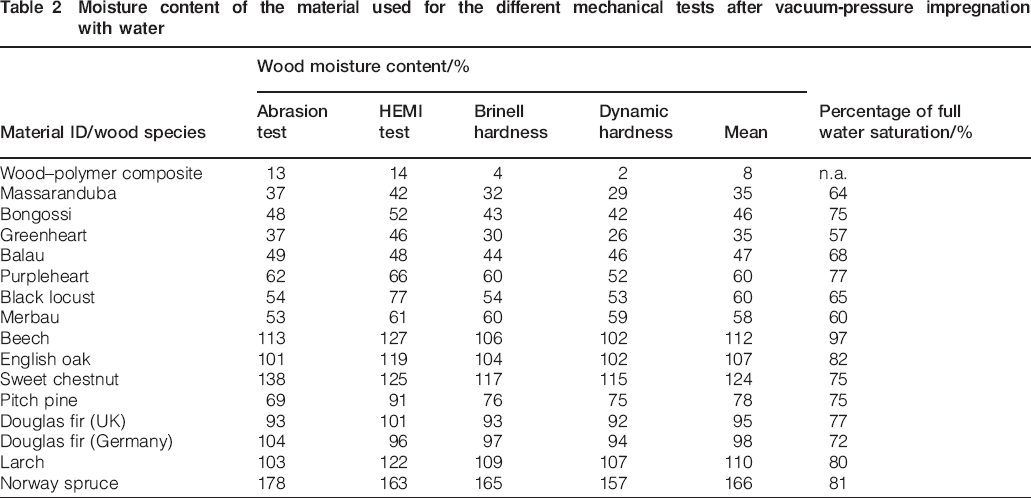
Full saturation was obviously achieved for none of the wood species. The smaller the specimen, in particular in axial direction, the higher the moisture content. However, all specimens achieved sufficiently high moisture content and were considered to be wet. This becomes evident from the different oven-dry densities (Table 1). With increasing density the moisture content at full saturation decreases, because of the reduced cell wall lumina. For the material examined, the percentage of full saturation was between 60 and 97% according to the following equation (9) after Kollmann (1951)

Abrasion resistance
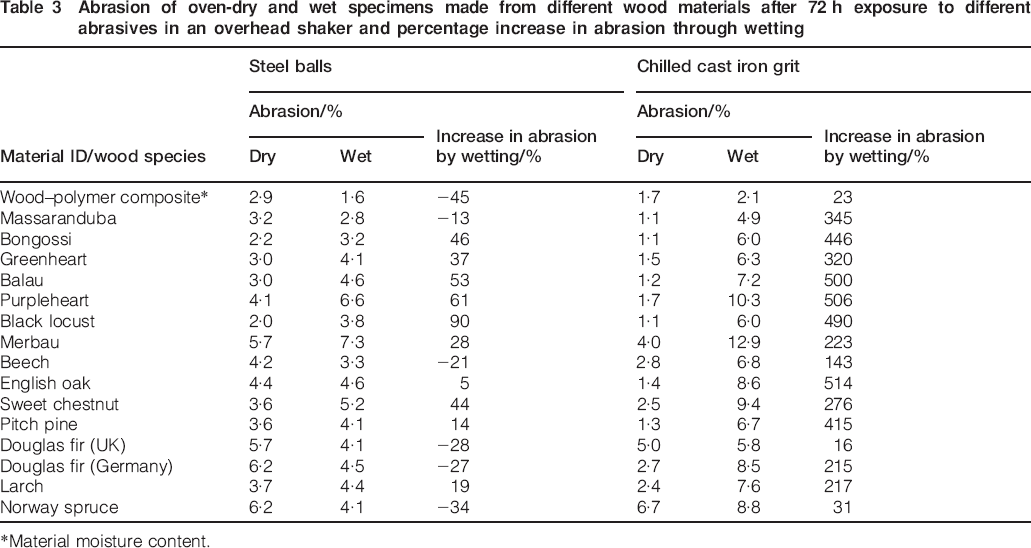
The resistance to abrasion of the various wood species differed between oven-dry and wet specimens (Table 3), but differences were not consistent for both abrasives. While abrasion by chilled iron grit provoked remarkably higher abrasion on wet specimens, no clear effect of moisture was observed for abrasion with steel balls. Abrasion by grit increased through wetting between 16% for Douglas fir (UK) and up to 506% for Purpleheart. In contrast, two-third of the wood species suffered from increased abrasion by steel balls when tested wet, the other third showed decreased abrasion (increased resistance to abrasion) when wet. However, for both abrasives abrasion resistance often increased with increasing density, which correlates with findings of Brischke et al. (2005).
Abrasion of oven-dry and wet specimens made from different wood materials after 72 h exposure to different abrasives in an overhead shaker and percentage increase in abrasion through wetting
*Material moisture content.
Eventually two phenomena were believed to be interfering with each other:
hydraulic effects as described by Megnis et al. (2002) and Ulvcrona et al. (2006) led to increased compression strength of linseed oil impregnated wood, which might also explain here the increased resistance to abrasion in samples where cell lumens at outer faces contained large quantities of liquid water. Since all liquids are considered to be incompressible a hydraulic effect can also be expected for water filled lumina
below fibre saturation, a general decrease in wood strength properties with increasing wood moisture content has been described by numerous authors (e.g. Küch 1943; Kollmann 1951; Ranz 2007). Thus, hardness and abrasion resistance decrease with rising moisture content over the range 0–28% where water is cell-wall bound, and will increase as a result of hydraulic effects at higher moisture contents when water fills lumens.
Some species showed surprisingly high resistance against abrasion such as the softwood species with lower oven-dry densities compared to most of the tropical hardwood species. Similarly, Williams et al. (2010b) reported on high abrasion resistance of Douglas fir compared to tropical timbers typically used in the marine environment and suggested a shock absorbing effect of its relative wide early wood portions might be the reason for this. Consequently, diffuse-porous hardwood would exhibit less abrasion resistance, because of the negligible differences between early-wood and late-wood, which might explain the relatively high abrasion of Merbau and Purpleheart, both of high density but with little density variation across the section.
Unexpectedly, abrasion of oven-dry specimens using steel balls led to significantly higher abrasion than using sharp-edged iron grit. Only oven dry Norway spruce showed similar abrasion resistance against both abrasives. By contrast, the wet specimens were without exception more susceptible to abrasion by grit. While the chilled iron grit revealed sharp edges having the potential to cut and scratch the specimens (Brischke et al. 2005; Welzbacher et al. 2009), the steel balls (∼875 mg) are heavier (∼59 mg), which might lead to impacts 15 times greater on the wood surface. Consequently, the specimen edges were either compressed or were broken from the specimens due to higher impact of the heavier steel balls. The latter cause was suggested by the microscopy studies performed with English oak, European beech and larch. All showed increased abrasion by steel balls compared to iron grit when tested oven dry. As can be seen from the cross-sections in Fig. 2a–d, the specimen edges of both species stayed undensified (uncompressed) after abrasion by steel balls, but longitudinal edges were broken (Fig. 2e–h). In contrast, the longitudinal edges stayed intact (Fig. 2i and j) when grit was used for abrasion signifying less abrasion.
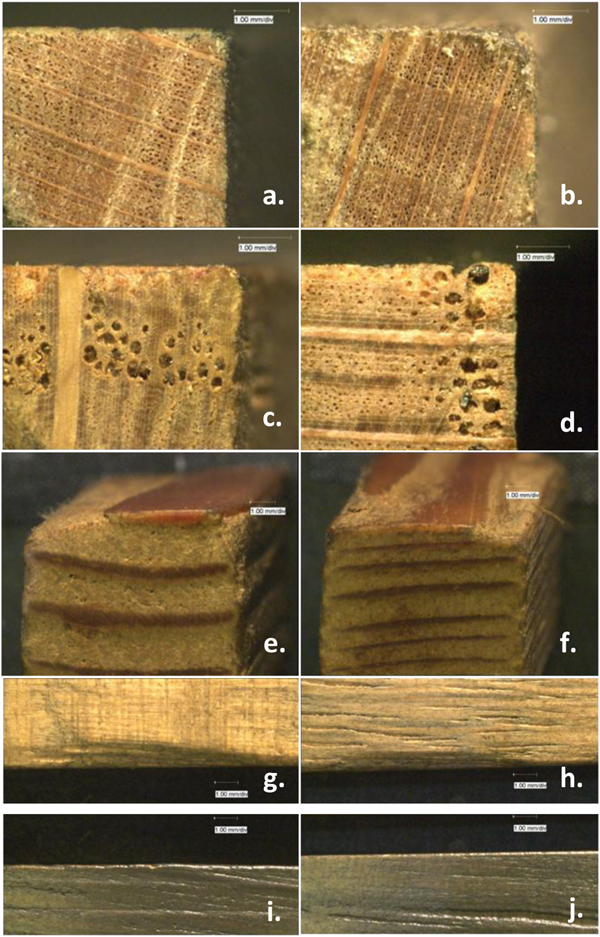
Cross-section of oven-dried specimens after abrasion by chilled iron grit: a beech – iron grit; b beech – steel balls; c oak – grit; d oak – steel balls and longitudinal edges of e, f larch – steel balls, g, h oak – steel balls, and i, j oak – grit (50-fold magnified)
Compared to timbers traditionally used for marine constructions, e.g. Greenheart, Bongossi, and Balau, the wood–polymer composite and Massaranduba revealed best performance after wetting in terms of abrasion resistance using both, steel balls and iron grit, followed by black locust, pitch pine, and Douglas fir (UK).
Structural integrity
The RIM as a measure of structural integrity of wood differed significantly between wood species and was generally increased after wetting (Fig. 3). The absolute RIM values need to be considered separately for hard- and softwoods, because of the different test parameters applied to both groups. Among the softwoods Douglas fir from UK showed the highest structural integrity. Beech, black locust and Greenheart showed the highest RIM among hardwoods when tested dry; after wetting beech, black locust, oak and chestnut revealed the highest structural integrity. The wood–polymer composite showed no significant difference in RIM between dry and wet condition, probably because of its low susceptibility to wetting (Table 2) as also described by Khan and Ali (1992), Bledzki and Faruk (2004) and Krause (2012).
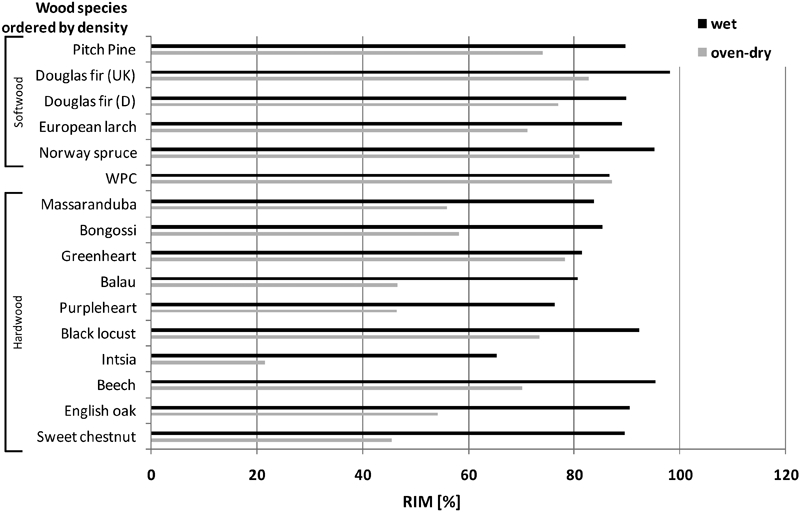
Resistance to Impact Milling determined in high-energy multiple impact tests using wet and oven-dry specimens
The hydraulic effect, which has been observed during the abrasion tests with steel balls (e.g. for Purpleheart), also became evident during the HEMI test. Impregnating the softwoods with water led to an increase in RIM of 17–25%. The wet hardwoods showed remarkably higher increase in RIM apart from Greenheart; RIM was increased between 3% (Greenheart) and 201% (Intsia) depending on the wood species. The increase in structural integrity over the range 0–28% MC has been described earlier by Schuh (2008). Furthermore, Kollmann (1967) reported on increasing plasticity and compressibility of wood with increasing moisture content, which explains the higher resistance of wet wood against compression loads during the HEMI tests as described by Welzbacher et al. (2011).
Considering the whole range of materials tested no significant correlation between RIM and oven dry density became apparent, which agrees with earlier finding of Brischke et al. (2006a) and Schuh (2008). In contrast, the abrasion resistance as well as static and dynamic hardness was significantly correlated with density.
Static and dynamic hardness
Brinell hardness varied widely between wood species. The static hardness of Bongossi was 5 times higher than Norway spruce (Fig. 4). In contrast the range of dynamic hardness was significantly lower, with the difference between lowest and highest a factor of 2·5 (Fig. 5), which coincides with findings of Meyer et al. (2011). However, the greatest differences between hardness tests occurred following wetting. While dynamic hardness was hardly affected, static hardness was decreased through wetting for all wood species; even the wood–polymer compound revealed a reduction of hardness after wetting. Some wood species suffered from a reduction of static hardness of up to 65% on wetting. Again, the hydraulic effect as described for instance by Megnis et al. (2002) plays an important role in explaining the differences between both types of indentation load. During static hardness tests, a steel ball is pressed into the wood surface for up to 30 s, during which time the majority of liquid water near to the surface is squeezed out of the lumens allowing for cell compression, whilst the water-filled lumina have a full hydraulic effect when a dynamic impact is applied (i.e. short load duration) which does not allow for water to be ‘squeezed’ out of the lumens. Squeezing out liquid water is most likely negligible: consequently the reduction of dynamic hardness can be ignored once the outer layers are saturated with water. Thus, dynamic hardness tests seem to be the most relevant method for determining surface strength properties and wear resistance of wood exposed to the marine environment, because they allow the consideration of hydraulic effects and the period of time over which impact forces are encountered in service are likely to be short-lived.
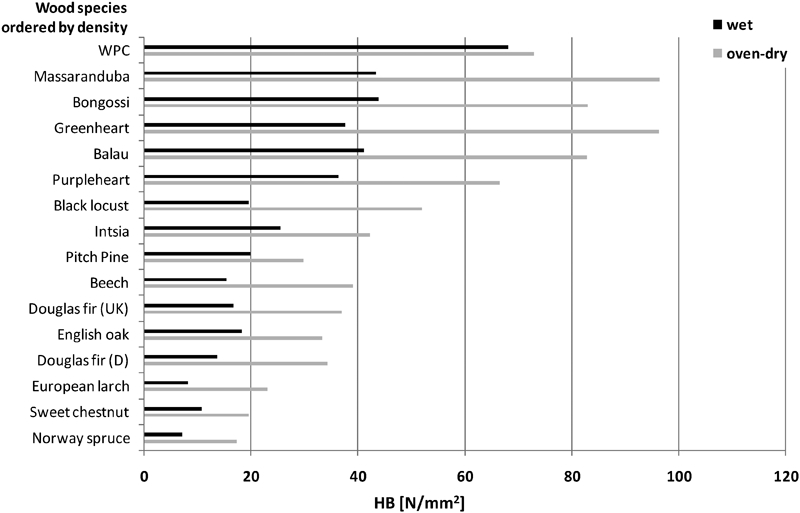
Static Brinell hardness HB of wet and oven-dry specimens
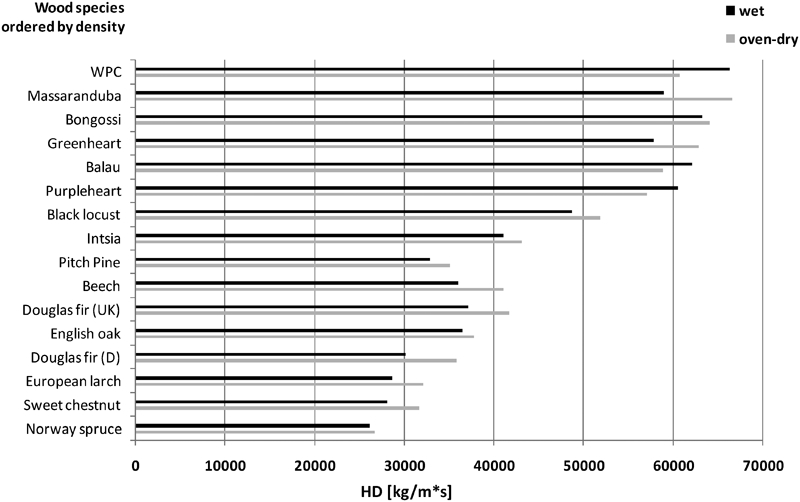
Dynamic hardness HD of wet and oven-dry specimens
Impact of density on surface strength
The five different methods for testing mechanical characteristics of wood surfaces were influenced differently by wood density. As shown in Figs. 6 and 7 a poor correlation was established between abrasion and density and between RIM and density. In contrast, both static and dynamic hardness were positively correlated with density. These general tendencies were observed for both wet and oven-dry specimens and coincide with results from earlier studies by Dumail et al. (1998), Holmberg (2000) and Meyer et al. (2011) on hardness as well as studies by Brischke et al. (2006b) on structural integrity of wood. The differences between results are most likely attributed to the strong influence of the respective loads applied during the different tests, which points to the importance of further impact parameters besides density. In particular, differences in anatomy, such as distribution and size of vessels, parenchyma rays and the general homogeneity of the xylem tissue could be considered as a selection tool when evaluating the suitability of wood species for severely exposed timber structures in the marine environment where there is a known abrasion hazard. Furthermore, the relationship between density, pore volume and the resulting capacity to take up liquid water should be considered, because the resulting hydraulic effects had an important influence on the performance of the wood surface.
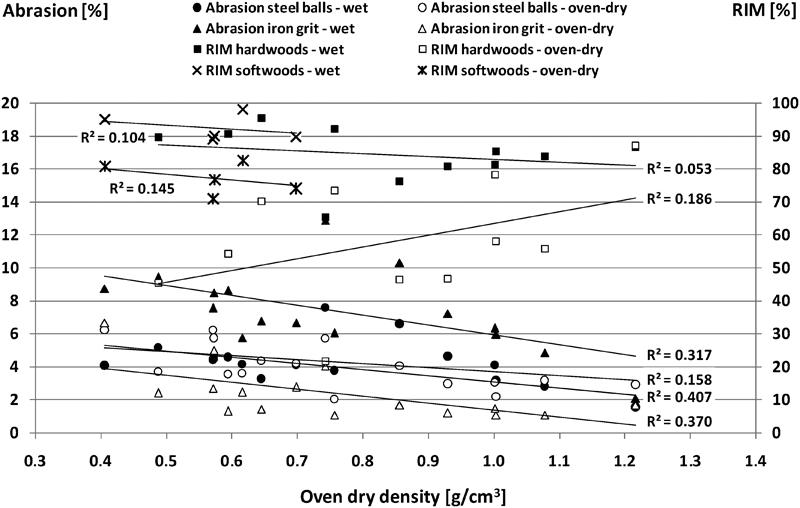
Relationship between resistance to impact milling (RIM), and abrasion by steel balls and cast iron grit of oven-dry and wet specimens of various timber species and their oven-dry density
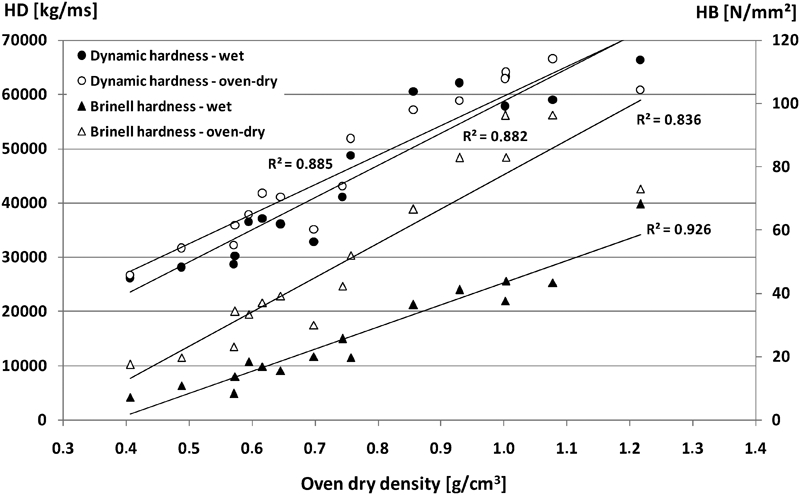
Relationship between static Brinell hardness (HB) and dynamic hardness (HD) of oven-dry and wet specimens of various timber species and their oven-dry density
Conclusion
From the results obtained with the various test methods the following conclusions were drawn.
The use of density as an indicator for mechanical wood surface integrity performance of wood in the marine environment (including marine borer resistance) is limited.
Hydraulic and shock absorbing effects were identified as potential reasons for good mechanical surface performance.
Variety of load types (in the sea) is adequately addressed only when different methods are applied in combination.
Surprisingly, some softwoods showed good performance in these short-term tests, although further field testing is required to confirm whether this is reflected under actual service conditions.
Permanent wetting leading to saturation of the outer layers of wood improves resistance of wood when exposed to dynamic loads as might be expected to occur when wood is exposed in intertidal zones.
Evaluation of field performance is required to confirm whether actual performance in service correlates with the laboratory testing so that these can be used to evaluate performance of species being considered for these applications in the future.