







Abstract
Chemical modification of fast growing poplar was carried out by impregnating wood with styrene (ST) as an impregnating monomer and in combination with a cross-linking monomer glycidyl methacrylate (GMA). In situ polymerisation was performed by a catalyst thermal procedure. Monomer retention by volume (MRv) and monomer retention by weight (MRw) were investigated and the results showed that MRv of ST-GMA is somewhat more than that of ST, which indicated that the permeability into fast growing poplar of GMA is a little better than that of ST under vacuum pressure process. However, the MRw of ST was significantly less than that of ST-GMA, which can be ascribed to different monomer density. Then, FTIR spectroscopy analysis showed that cross-linking reaction had happened between wood, ST and GMA due to the presence of both terminal double bond and the epoxy group of GMA. Thermogravimetric and differential thermal analysis (TG-DTA) indicated that the thermal stability of fast growing poplar has been significantly improved after modification by polymer. Scanning electronic microscopy (SEM) observation showed that the vessels and lumens of wood samples were not only uniformly filled by polymers, but also the interface was difficult to distinguish (between cell wall and polymer) after modification by the ST and ST-GMA.
Introduction
Plantation cultivation of fast growing species has been developed in tropical and subtropical countries. It arrests the downward trend of tropical forest areas, because the rate of growth or biomass production in fast growing tropical species is often several times or even 10 times greater than that of commercial species in temperate zones (Brown et al. 1986). Plantations of fast growing species were initially developed mainly for the rapid supply of raw material to the charcoal or pulp industries (Zobel 1981). Consequently, fast growing species may not produce benefits as satisfactory as those of traditional timber species (Cossalter and Pye-Smith 2003). Thus, the resources of fast growing species remain underutilised, and it is suspected that the growth in plantation planting of fast growing species may plateau in the near future. If this view is correct, the key lies in how to increase economic incentives for the development of plantations of fast-growing species (Kojima et al. 2009). The change becomes possible if the resources harvested from such plantations can be supplied to the global market as added valued products, such as timber materials for building or for furniture. But a number of studies showed that the high growth rate of fast growing species had some negative effects on wood qualities, e.g. decreased xylem density, decreased mechanical strength and susceptibility to fungal attack, among others, which limited the utilisation of fast growing species as timber materials (Wahyudi et al. 1999). So how to improve the qualities of fast growing species has become an attractive point of research for many scientists and engineers.
One of the techniques used to improve the properties of solid wood, which has received considerable attention in past decades, is the formation of wood polymer composites (WPC) by impregnating wood with polymeric monomers [such as methacrylates, acrylates, styrene (ST) or unsaturated polyesters] or with thermoset resins (such as epoxy resin, phenol formaldehyde, urea formaldehyde and melamine–formaldehyde resins), followed by in situ polymerisation by radiation or catalyst thermal treatment. In thermoset resin impregnation, the chemicals are able to enter the cell wall or react with the hydroxyl groups of wood components, such as phenol formaldehyde resin, and thus improve the dimensional stability of wood (Klueppel and Mai 2013; Lu et al. 2013). However, these treatments generally reduce the bending strength and toughness of wood. For the commonly used polymeric impregnation monomers, such as methyl methacrylate and styrene, the WPC generally exhibits enhanced strength properties and hardness while displaying relatively poor dimensional stability because these monomers are mostly confined to the lumen and are not in the cell wall (Li et al. 2013; Xie et al. 2013).
WPC made with combinations of hexanediol diacrylate, hydroxyethyl methacrylate, hexamethylene diisocyanate and maleic anhydride has reduced the rate of swelling in water as well as in water vapour (Rowell and Knokol 1987). Chemical modification of rubber wood with glycidyl methacrylate (GMA) and diallyl phthalate has enhanced the properties of rubber wood significantly (Rozman et al. 1986; He et al. 2011a). Cross-linking of material in wood samples provides better dimensional stability to the wood polymer composite. Wood treated with styrene and GMA as the cross-linking monomer has shown improvements in properties (He et al. 2011b). The glycidyl group of GMA is capable of reacting with groups containing active hydrogens such as amino, hydroxyl and carboxyl groups. The glycidyl group and terminal double bond of GMA can be exploited for reaction with hydroxyl groups of cellulose in wood and for copolymerisation with vinyl or acrylic monomers (Li et al. 2011).
Encouraged by the above stated studies, in this work, ST and GMA was used to modify the fast-growing poplar, the monomer retention by volume (MRv) and monomer retention by weight (MRw) were measured to investigate the impregnatability of ST and GMA, then, the thermal property, FTIR spectra and micromorphology of modified samples were checked to examine the effect of ST in the presence of GMA on properties of fast growing poplar.
Experimental
Materials preparation
Fast-growing poplar, Populus euramericana (from a 12-year-old plantation) was collected from the county of Shiyang, Jiangsu Province, China. The wood specimens were cut into blocks of 25×10×25 mm (radial ×tangential×longitudinal) for impregnation.
ST was used after purification and GMA and the 2,2′-azobis-2)-(methylbutyrontrile) used by initiator were made by Wako Pure Chemical Industries, Ltd (Japan). All other chemicals and solvents used in this study were of analytical grade W.
Methods
All samples were oven dried at 105°C to have constant weight before treatment. Before placing them in the impregnation chamber, the dimensions and weights were measured. The samples were placed in the impregnation chamber followed by the application of a load over each sample to prevent them from floating during the addition of monomers. Vacuum of 346 mmHg was applied for 15 min to remove the air from the pores of the wood before addition of monomers. Then, a sufficient mixture of styrene and GMA (1∶1, v/v), and initiator (1·5 wt-%), or mixture of styrene and initiator (1·5 wt-%) was added from a dropping funnel to completely immerse the wood samples. Subsequently, compressed air was applied to the system at a pressure of 550 kPa for another 30 min. The samples were then kept in the chamber at room temperature (25°C) for another 3·5 h after attaining atmospheric pressure. This was the minimum time to get a polymer loading, which showed maximum improvement in properties (He et al. 2011a, b). After impregnation, samples were taken out of the chamber and excess chemicals were wiped from wood surfaces; the samples were then wrapped in aluminium foil and cured at 90°C for 24 h in an oven (Devi and Maji 2006). Next, the WPC samples were impregnated in the solvent of methylene chloride in order to remove the residues of monomers, and then were oven dried at 100°C to eliminate the solvent. Finally, the samples were sanded to remove excess polymer from the surface. All data on weight and dimensions of wood samples were recorded before impregnation and after polymerisation. A minimum of 10 specimens were used for the impregnation of each combination.
Measurement
The monomer retention by volume (MRv) and monomer retention by weight (MRw) were calculated as following


FTIR study
The treated and untreated samples were ground with a mill and FTIR spectra were recorded by using a KBr pellet in a Nicolet Impact 410 spectrophotometer (Nicolet Company, USA).
Thermal stability study
Thermogravimetric and differential thermal analysis (TG-DTA) of the untreated and treated wood samples were characterised by using a TA Instrument DTG-60AH (Shimadazu Corporation, Japan) thermogravimetric analyser at a heating rate 10°C min−1 up to 500°C under the production of nitrogen.
Scanning electron microscopy (SEM)
SEM was used to examine the treated and untreated wood samples. The interior portions of cross section plane were exposed by cutting with a scalpel, carbon coated, gold sputter coated and examined with a FEI Quanta 200 SEM (FEI Company, The Netherlands) at 400 and 2000 magnifications.
Results and discussion
Monomer retention
MRv and MRw were calculated using equations (1) and (2). Figure 1 depicts the MRv and MRw of ST and ST-GMA,respectively. From Fig. 1, it can be seen that the difference in mean MRw was greater than that for MRv. The MRv of ST-GMA are somewhat higher than that of ST, which indicated the permeability into fast growing poplar of GMA is a little better than that of ST under vacuum pressure process. There are many factors that affect the impregnatability of wood apart from wood structure, such as the molecular size or molecular weight and viscosity of the impregnates, and the polarity of impregnated molecules. The viscosity values found were 0·725 mPa s for ST (25°C) and 2·0 mPa s (25°C) for GMA, and the molecular weight values found were 104·14 for ST and 142·16 for GMA in this study; however, it can be found that the viscosities of monomer and structure of ST and GMA have a little impact on MRv under the application of vacuum pressure impregnation procedure. However, the MRw of ST-GMA is significantly higher than the value of ST, which can be ascribed to the different monomer density, 0·905 g mL−1 for ST and 1·073 g mL−1 for GMA respectively, which corresponds to the result of Zhang et al. (2005).
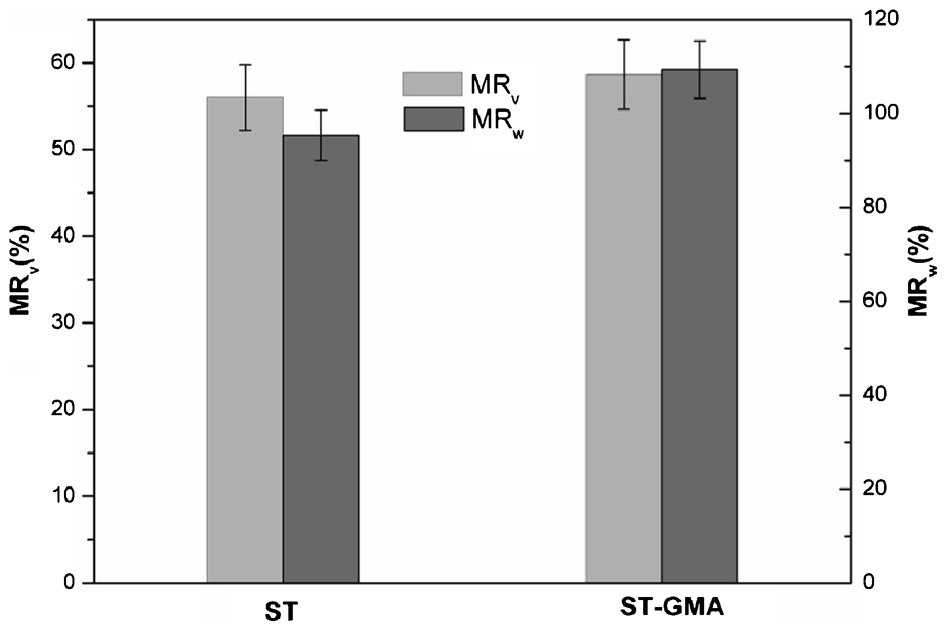
MRv and MRw of ST and ST-GMA
Figure 2 depicts the relationship of MRw and wood density. From Fig. 2, it can be seen that the higher the density of fast growing poplar, the lower the MRw, which corresponds to the results of studies by Moore et al. (1983)17 and Zhang et al. (2005).
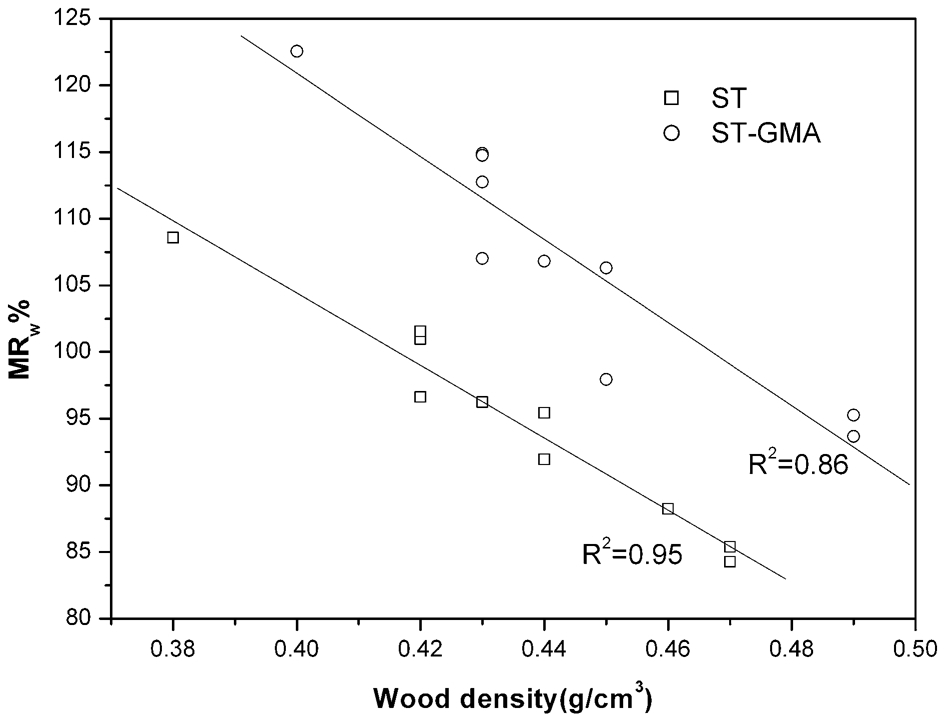
MRv as function of wood density
FTIR study
The FTIR spectra of untreated and treated wood samples are presented in Fig. 3. It was found that the peak at 1730 cm−1, corresponding to carbonyl stretching vibration, became more pronounced on wood treated with the combination of ST and GMA, which was confirmed by Devi and Maji (2008) and Mathias et al. (1991). The position of the peak at 3440·59 cm−1 (OH stretching) for untreated wood remained unchanged by incorporation of ST, the peak shifted to 3449·20 cm−1 for ST-GMA, and at the same time, the intensity significantly decreased, which agreed with the result of Li et al. (2011). The peak at 1050·66 cm−1 of untreated wood was also found to shift to 1114·98 cm−1 on treatment with the combination of ST and GMA due to the increasing of C–O stretching vibration (Devi and Maji 2006). All these, as stated above, confirmed the interaction between wood, ST and GMA; the chemical reaction is shown in Scheme 1.
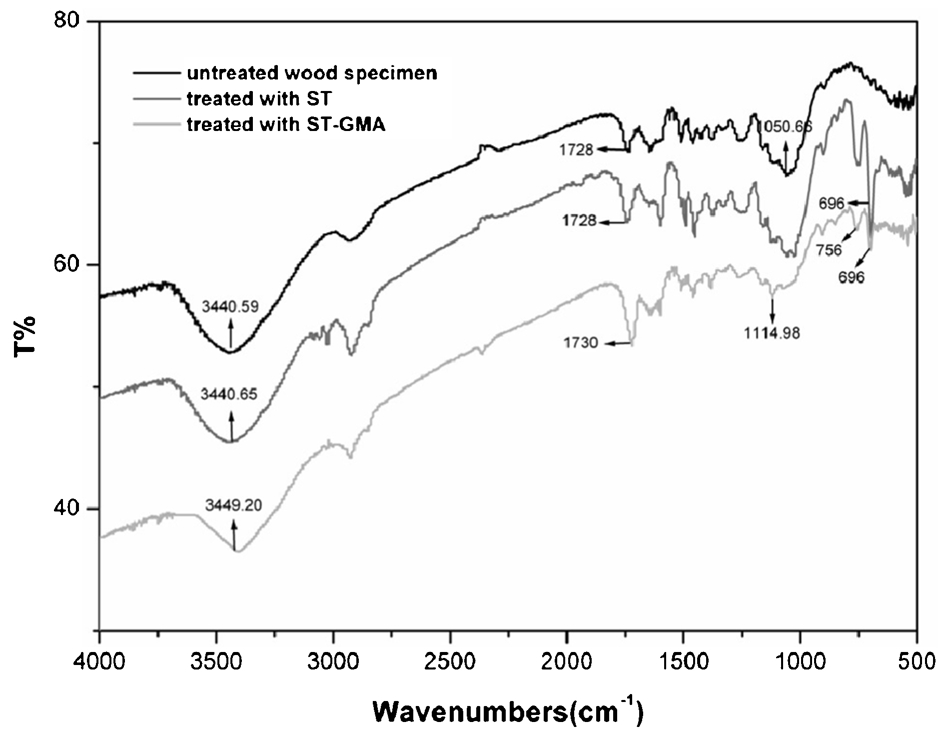
FTIR of treated and untreated fast growing poplar
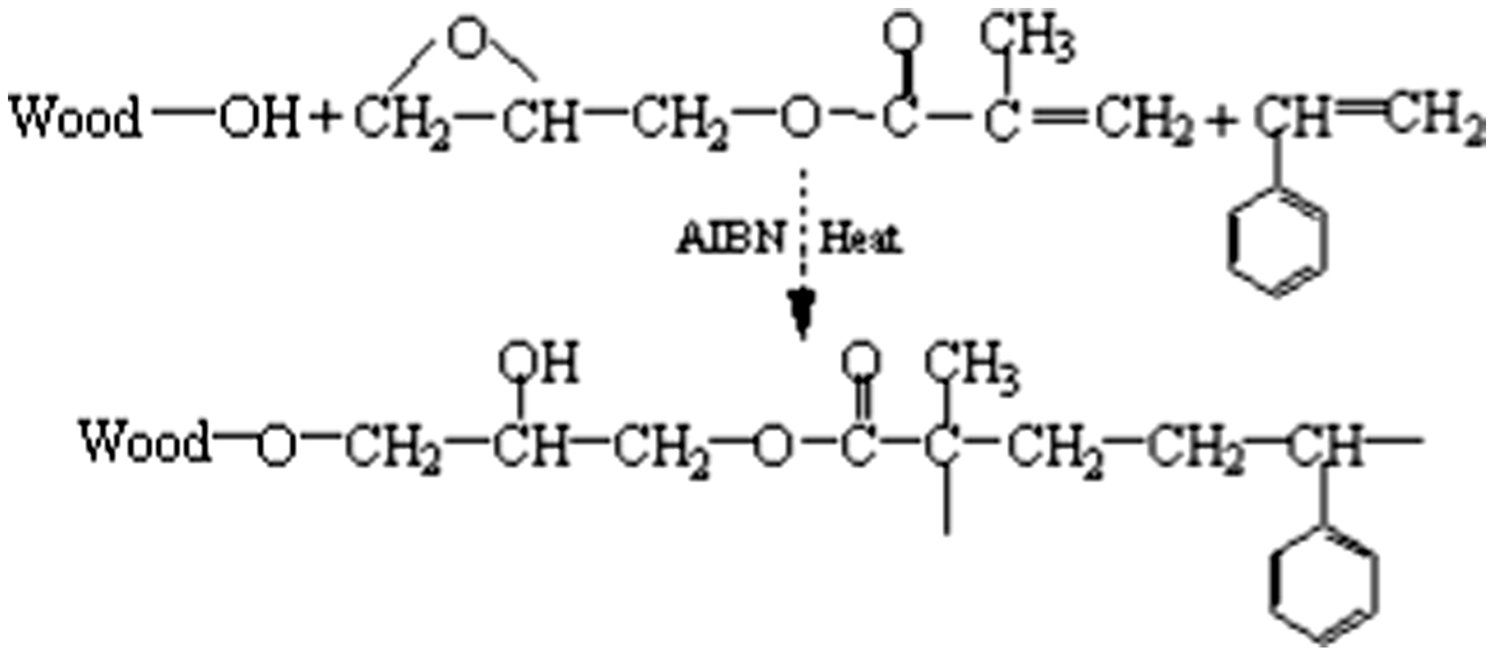
Chemical reaction among wood, ST and GMA
TG-DTA study
Figuire 4 shows the TG curves of untreated and treated wood samples. It clearly indicates that treated samples showed lower mass loss than that of untreated samples during the same temperature area. All the TG curves show an initial small mass loss around 95°C, which could be attributed to the evaporation of absorbed moisture (approximately 5%). According to White and Dietenberger (2001), from 200 to 300°C, hemicelluloses begin to undergo significant pyrolysis to produce additional CO2 and high boiling point tar. Cellulose begins a significant depolymerisation in the range 300–350°C. Lignin is pyrolysed in the range 225–450°C. The carbon–carbon bonds between lignin structural units are cleaved from 370 to 400°C.
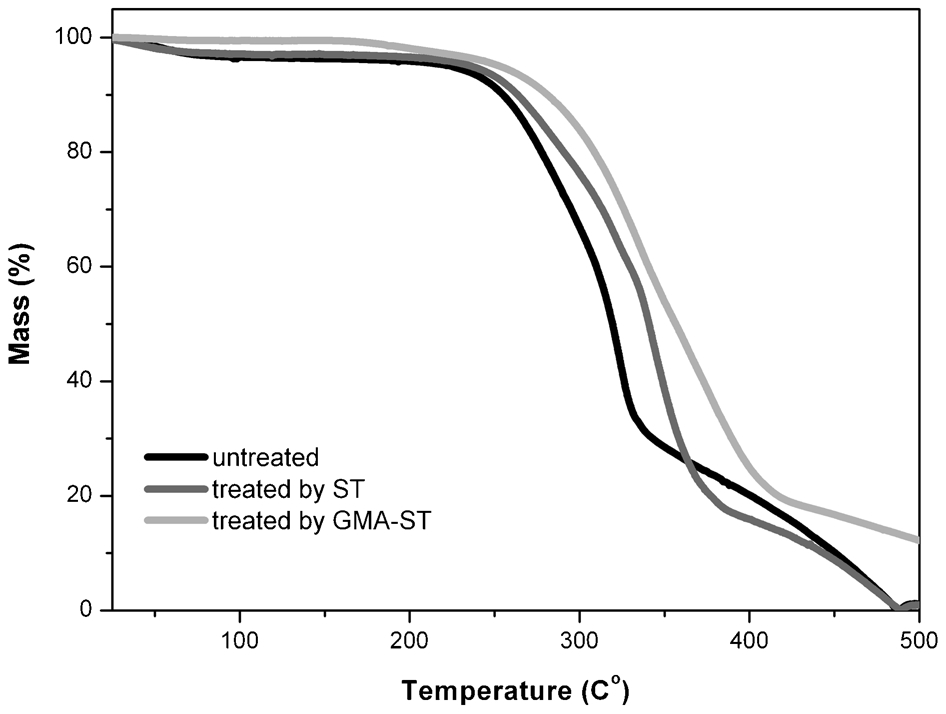
Thermogravimetric curves of polymer treated wood and untreated wood
Figure 5 shows the DTA results of untreated and treated wood samples. Untreated wood shows three endothermic peaks at 317, 329 and 387°C, marked as P1, P2 and P3 respectively. Combined with the TG analysis stated above, they could be explained as the decomposition of hemicelluloses and a part of lignin, the decomposition of celluloses, the decomposition of the remaining lignin and other components, such as extractives respectively. Similarly, wood samples treated by ST also show three endothermic peaks at 341, 370 and 405°C, marked as P1, P2 and P3 respectively. Obviously, the treatment with ST improved the thermal stability of fast growing poplar. However, in accordance with Fig. 5, there are only two endothermic peaks in wood treated by ST-GMA: one is at 390°C, marked as (P1+P2), while the other is at 434°C, marked as P3. The reduction of endothermic peak and the increase in decomposition temperature further demonstrate the formation of cross-linking of wood treated by ST-GMA.
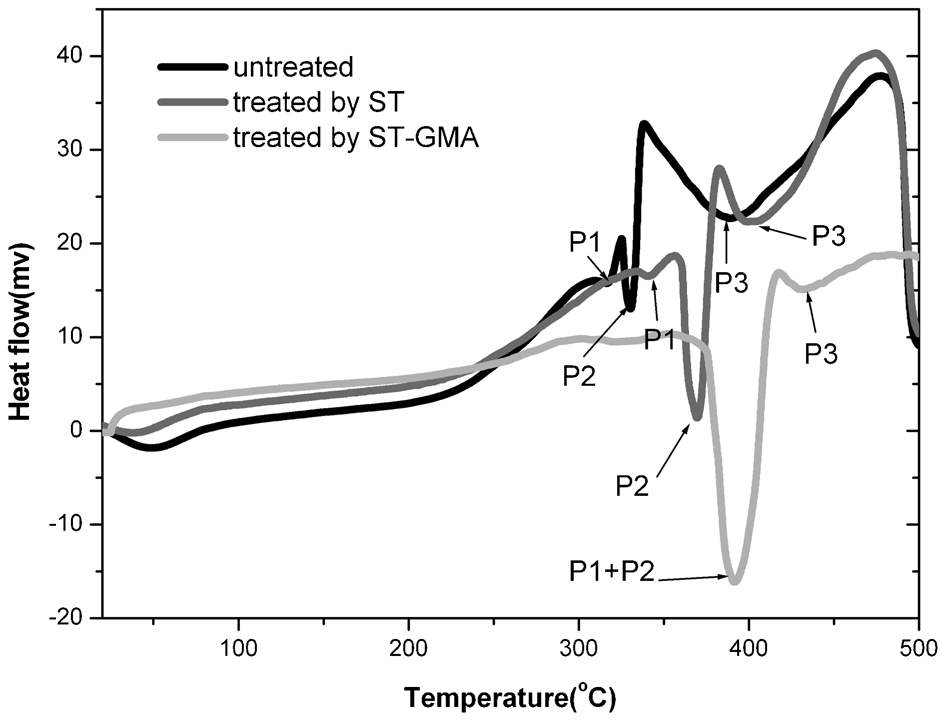
Differential thermal analytic (DTA) curves of treated and untreated fast growing poplars
SEM observation
Figure 6a shows vessels and lumens in untreated poplar wood cells available for chemical filling. SEM observation (Fig. 6b and c) showed the vessels and lumen have been uniformly filled after modification with polymer of ST and ST-GMA, respectively. Figure 6d and e showed the status of lumen filled by polymer of ST and ST-GMA under ×2000 magnification. We can clearly see the interface between cell wall and polystyrene from Fig. 6d; however, it was difficult to see the interface between cell wall and polymer after modification with ST-GMA from Fig. 6e. This may be due to the addition of GMA, which can penetrate into the cell wall and react with the hydroxyl of wood, so we could not easily find the interface between cell wall and polymer.
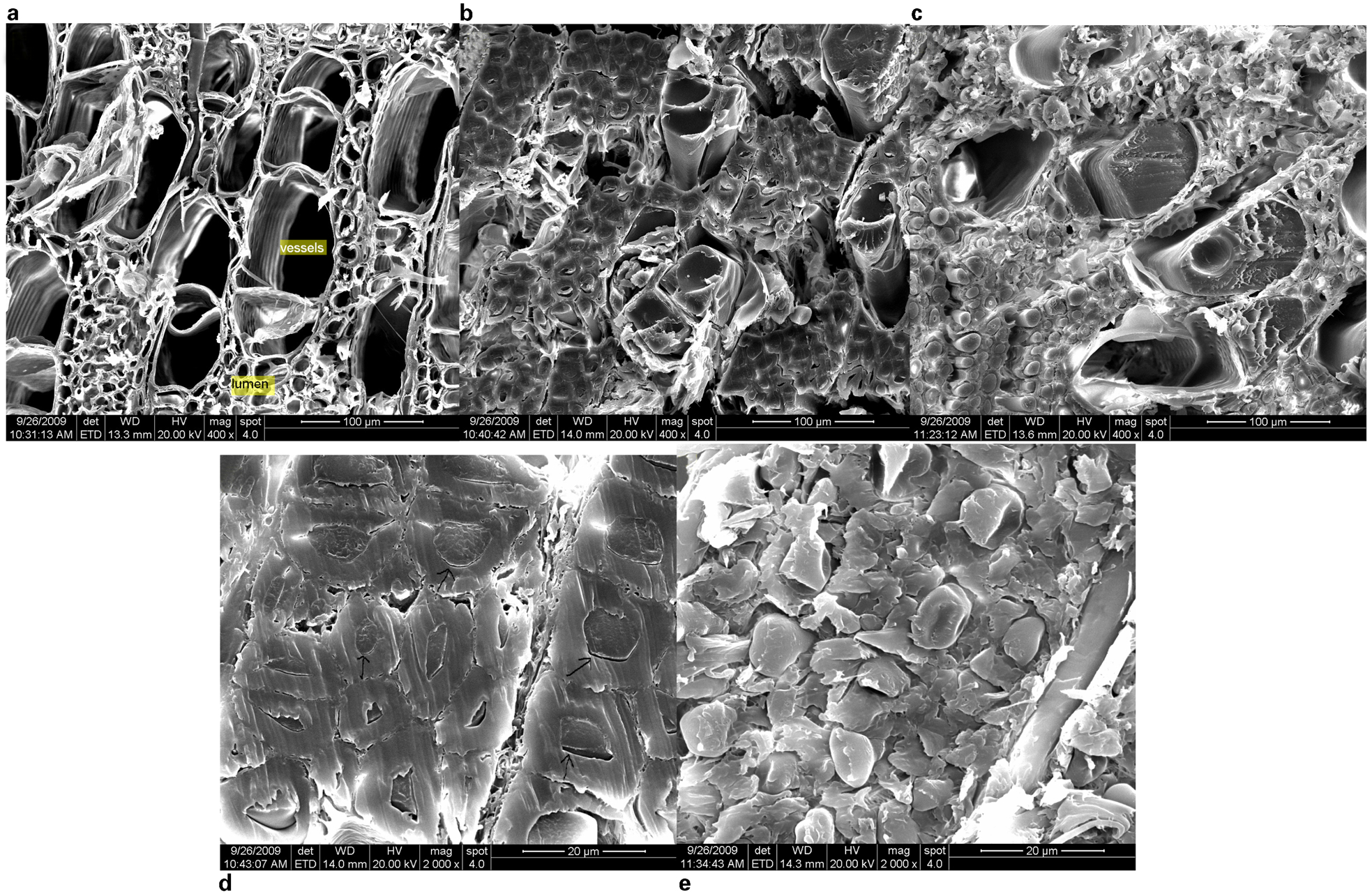
SEM images of a untreated, b, d ST treated and c, e ST-GMA treated fast-growing poplars
Conclusion
From the present study, the results of impregnation of fast growing poplar showed that MRv of ST-GMA is somewhat higher than that of ST, which indicated the permeability into fast growing poplar of GMA is a little better than of ST under vacuum pressure process. However, the MRw of ST was significantly lower than that of ST-GMA, which can be ascribed to different monomer density.
Thermal stability of wood samples modified by ST and ST-GMA has been improved by TG-DTA analysis. FTIR spectroscopy analysis proved that cross-linking reaction has happened between wood, ST and GMA. SEM observation shows the vessels and lumens of wood samples are uniformly filled by polymers; moreover, the interface between cell wall and polymer after modification with ST-GMA was difficult to distinguish. Further research will be carried out to investigate the effect of ST and GMA on dimensional stability, mechanical properties and biodegradation of fast growing poplar.
Footnotes
Acknowledgements
This work was financially supported by the High-level Talent Fund of Nanjing Forestry University (Fund Number 013020186) and preponderant subject of Jiangsu Province. The authors would like to acknowledge the support of Mr Nakai. Thanks go also to Professor B. S. Wu of Nanjing Forestry University for giving access to SEM and to Ms F. Chi for determination of TG-DTA. The assistance of associate professor Y. F. Wu and Ms S. M. Wang in the laboratory test work is much appreciated.