







Abstract
Antifungal activity of coconut shell pyrolytic oil against wood decay fungi was explored. Poisoned food technique was employed to indicate the antifungal effect of coconut shell pyrolytic oil against wood decay fungi. The results indicate that there was 81·5% inhibition on the growth of Polyporus sanguineus (L.)G. Mey, (white rot) and 90% inhibition on the growth of Tyromyces palustris (Berk M & A Curtis) (brown rot) at a concentration of 0·25%. This can be attributed to high phenolic content of coconut shell pyrolytic oil.
Introduction
Antifungal effectiveness of many bio oils, including biomass-derived products like pyrolytic oil has been reported and many of them have been found to possess diverse antifungal effects (Okutucu et al. 2011; Bakkali et al. 2008; Tiilikkala et al. 2010). Antifungal activity of essential oils against wood degrading fungi and use of many natural products as wood protectants have been reviewed (Singh and Singh 2012; Singh and Chittenden 2011). The antifungal activity of coconut shell pyrolytic oil against wood decay fungi has not been explored so far. This short communication deals with the antifungal activity of coconut shell pyrolytic oil and is the first study to report a novel anti-fungal effect for coconut shell pyrolytic oil, focusing on its inhibitory activity on wood decay fungi.
Materials and methods
Collection of samples
Coconut shell pyrolytic oil was supplied by AVT Natural Products, Karnataka, India. Coconut shell oil is produced as a by-product from the gasifier which uses coconut shells as fuel. Coconut shells are burnt (incomplete combustion) under limited supply of air (30%) at a temperature of 950–1000°C to generate producer gases and coconut shell oil, which is a dark thick liquid collected at the bottom of the gasifier.
Test Fungus and media
Test fungi used were Polyporus sanguineus (L.) G. Mey (white rot) and Tyromyces palustris (Berk M & A Curtis) (brown rot) respectively from the culture maintained at IWST. Plates were prepared by 2% malt and 1·3% agar media as per standard procedures.
Poisoned food technique
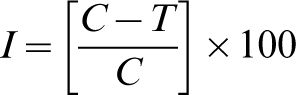
Poisoned food technique was conducted as per standard procedures (Nene and Thapilyal 2000; Das et al. 2010). 100ml of malt agar media was prepared with different concentrations of CSO ranging from 0·25, 0·5, 1, 2, 3, 5, 7·5 and 10% dissolved in minimum quantity of ethanol. This was equally distributed in three petri plates which served as replicates. A mycelial disc of 6 mm diameter, cut out from the periphery of 7 day old culture, was aseptically inoculated onto the centre of agar plates containing the samples. Three replicates were prepared for each concentration and for each fungus. Malt agar plates with 1000 μL of ethanol solvent and distilled water were used as negative and positive controls respectively. The inoculated plates were incubated at 25°C and the colony diameter was measured daily. The percentage mycelia inhibition was calculated according to the following equation
The total phenol content of the coconut shell oil was analysed by the method of Maurya and Singh (2010).
Results and discussion
Growth was initiated in plates infested with Polyporus sanguineus (L.) G. Mey (white rot) and Tyromyces palustris (Berk M & A Curtis) (brown rot) on seventh day for sample concentration of 0·25%. On the 10th day the experiment was terminated as the both control plates showed complete growth (Figs. 1 and 2). The percentage of inhibition for Polyporus sanguineus (L.) G. Mey (white rot) and Tyromyces palustris (Berk M & A Curtis) (brown rot) was calculated (Table 1). There was complete inhibition of fungal growth for concentrations 0·5, 1, 2, 3, 5, 7·5 and 10% in all the plates till the end of the experiment. 81·5% inhibition on the growth of Polyporus sanguineus (L.)G. Mey, (white rot) and 90% inhibition on the growth of Tyromyces palustris (Berk M & A Curtis) (brown rot) was observed at the end of experiment at a concentration of 0·25%. So for further studies 0·5% of the sample was taken as MIC.
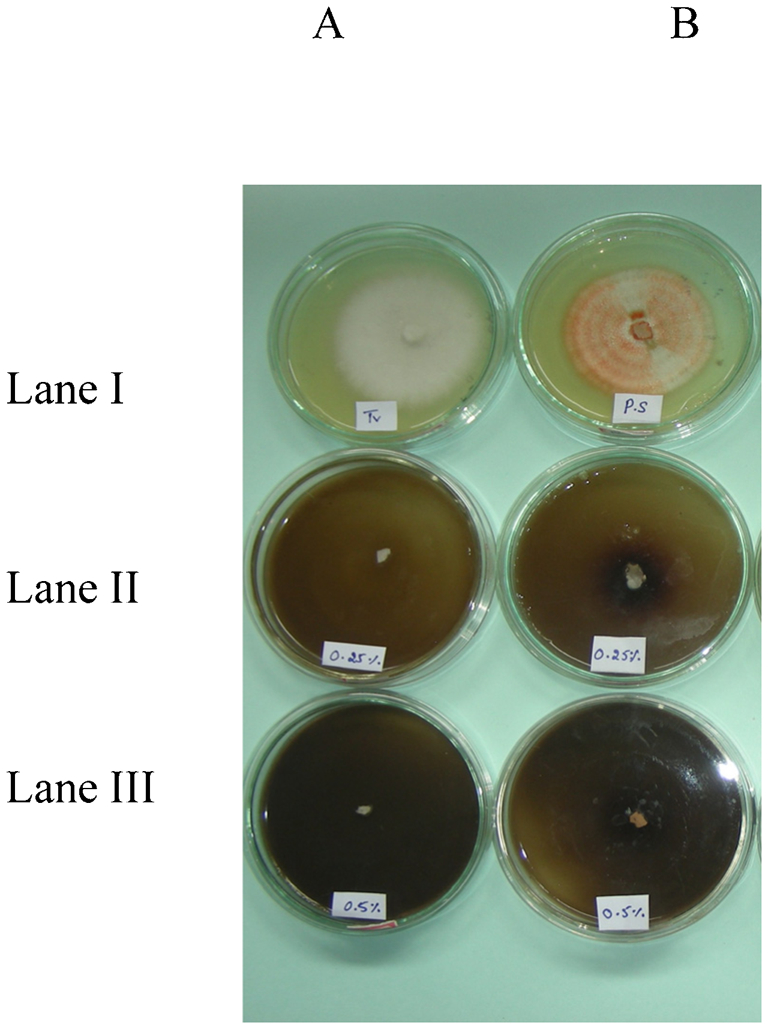
Seventh day (culture initiated): Tyromyces palustris (Berk M & A Curtis) (brown rot) A, Polyporus sanguineus (L.) G. Mey (white rot) B, Lane I: control; Lane II: 0·25%; Lane III: 0·5%
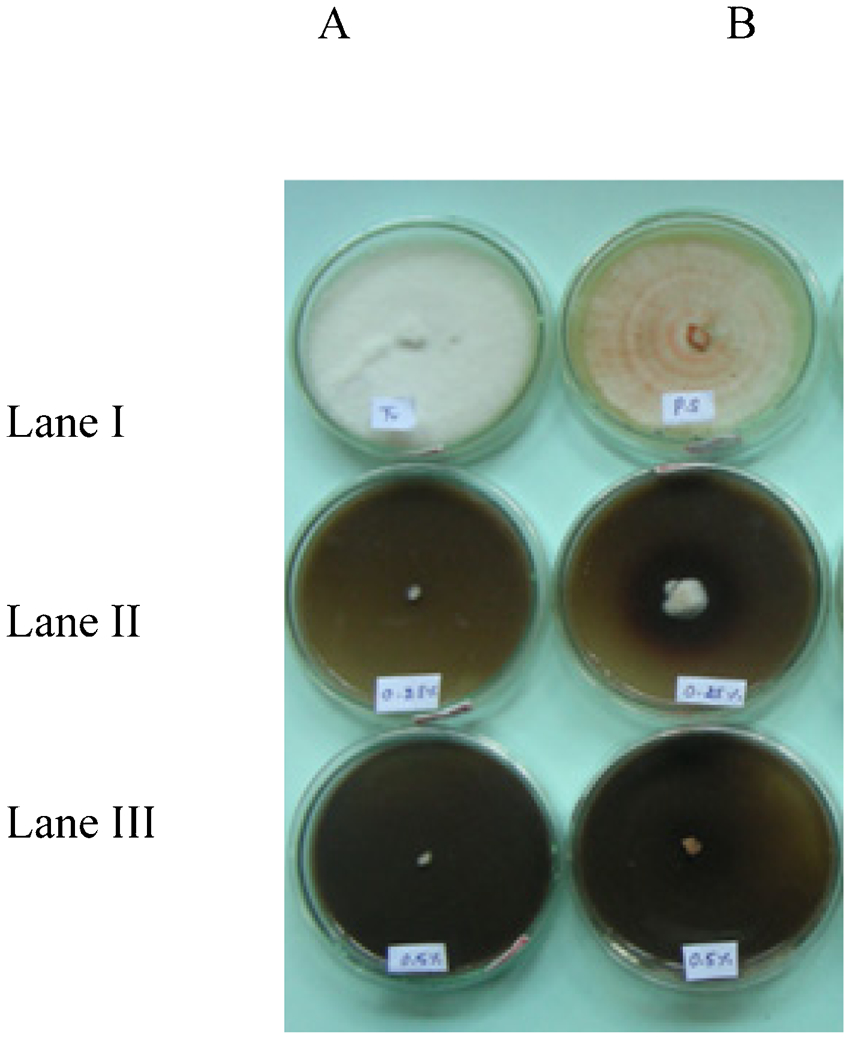
Tenth day (end of experiment)
Effect of coconut shell pyrolytic oil against wood decay fungi (both white rot and brown rot)*
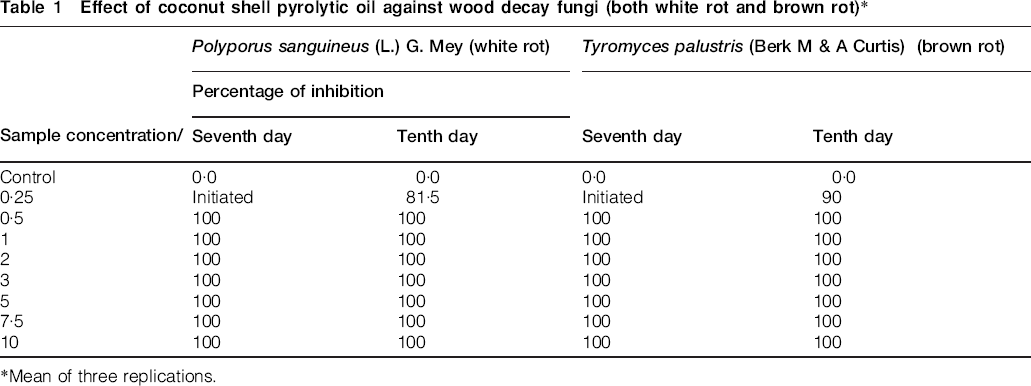
*Mean of three replications.
This is in accordance with earlier reports, as antifungal properties of many pyrolytic oils have been tested and the results indicated that the bio-oils were effective against fungal growth (Osorio et al. 2010; Kartal et al. 2011). It has been shown that wood vinegar made from bamboo and broad-leaved trees are effective against sap staining fungi (Velmurugan et al. 2009). Pyrolytic oils derived from softwood bark and bio-oil from tobacco leaves also showed antifungal properties (Mourant et al. 2000; Booker et al. 2010). Reports by Mohan et al. (2008) have shown that certain phenolic compounds are responsible for the fungal inhibition. The antifungal efficiency of wood vinegars was reported to be strongly dependent on their phenolic compound content (Baimark and Niamsa 2009). The total phenol content of coconut shell oil was found to be 15·6 (%w/w). Manjula et al. (1985) have also reported the high phenol content of coconut shell tar which may be the reason for the antifungal activity of coconut shell pyrolytic oil. Studies are moving ahead in this regard to develop a wood preservative formulation from coconut shell pyrolytic oil which is a by-product that would otherwise have little value except as a fuel oil diluent in India. Toxicity data has yet to be determined.
Conclusion
Present investigation demonstrates the antifungal effect of coconut shell pyrolytic oil against wood decay fungi. Further studies are therefore progressing to confirm the antifungal effect of coconut shell pyrolytic oil which has a wide scope for commercial utilisation as a wood protectant.
Footnotes
Acknowledgements
The authors are grateful for the financial assistance provided by KSCSTE, Govt. Kerala, India, in the form of KSCSTE-Post Doctoral Fellowship and The Director, Institute of Wood Science and Technology (IWST), India, for providing the necessary facilities.