







Abstract
This paper presents the European initiatives, strategies, and directives that must be considered in future development of thermally modified timber and when optimising the existing, commercialised processes and discusses the next steps in developing thermally modified timber needed to meet the requirements of the European low carbon economy. The standards for assessment of environmental impacts of processes and products with the focus on Environmental Product Declarations (EPDs) for materials used in the built environment are presented and followed by discussion about the need to consider the environmental impacts on sustainably aspects of thermally modified timber. This includes: determination of environmental impacts of processing and resulting products; design of processes and products towards minimal environmental impacts; and acquisition of EPDs and of Product Category Rules (PCR) for products of thermally modified timber.
Introduction
In the future, the world's political and economic decisions will be increasingly determined by resource and energy scarcity and by climate change as a topic related to the consumption of fossil energy. In these circumstances, a balance has to be achieved between economics, ecology and social welfare that can be summed up as sustainability, which was put forward at the end of the twentieth century and has been inseparably linked to forestry ever since.
The forest sector and wood based industries are challenged by this change and feel that it is important to participate in the sustainability debate. It is essential that the forest sector is placed at the centre of the developing bio-based economy and has a strong voice within Europe. Indeed, the forestry sector first put forward the concept of sustainability that is nowadays related to the global economy and is a word unfortunately used inappropriately in many industrial sectors. The value of the forest for mankind and the environment is irrefutable, and the value of the multitude of products made of wood is of great importance, socially, economically and environmentally.
The forest based sector can considerably contribute to the European Commission's ambitious CO2 emissions reductions goal (80% by 2020, Roadmap 2050 [European Commission 2011)] with innovative production technologies, reduced energy consumption, increased wood products recycling, and the reuse and refining of side-streams. Furthermore, the European Union has set a goal of becoming a recycling society. The latest waste directive from 2008 contains an article requiring expanded re-use and recycling of materials, in addition to products (European Parliament, Council 2008), which will directly influence forest based industries.
Forest based industries are continually developing advanced processes, materials and wood based solutions to meet evolving demands and increase competitiveness. One way of reducing the emission of carbon dioxide is to use more wood products and to increase the life of these products so that the carbon is bound over a longer period of time. Another possibility is to replace energy intensive materials with wood and wood based products. However, for timber as a material to be competitive against other materials, its environmental advantages alone are not enough. Wood must also be competitive for its technical qualities, show a high material utilisation during further processing and, not least, a competitive economic yield during usage. One emerging processes is thermal modification of timber, which applies heat, moisture and in some cases also mechanical action to improve the material properties, and provide desired form and functionality. However, a more detailed consideration reveals several issues which lead to the question: Do we really know if the global environmental impact of thermally modified timber and further uses of the resulting products is comparable with the impact of native, untreated wood? This values new advanced wood based materials with improved intrinsic properties that promote efficient product reuse, recycling and end-of-life use, and pave the way to a low carbon economy. The relationship between thermal modification of timber, properties of the products, and the associated environmental impact should be taken into account when developing new processes and products, as well as when optimising the existing commercialised processes. Interactive assessment of process parameters, product properties, and environmental impact should be used to aid development of innovative thermal modification technologies. Furthermore, product design must enable efficient product reuse, recycling and end-of-life use. However, in order to develop and optimise thermally based timber processing to minimise environmental impacts, more information of relevant process factors must be gathered.
The objective of this paper is to discuss the next steps in developing thermally modified timber needed to meet the requirements of the European low-carbon economy. This includes:
determination of environmental impacts of thermally modified timber and resulted products
design of processes and products towards minimal environmental impacts
acquisition of Environmental Product Declarations (EPDs) and of Product Category Rules (PCR) for products of thermally modified timber.
European policy: Low carbon economy
The EU Environmental Action Programme (European Parliament, Council 2014) gives a strong influence on European Policy, which is affecting and, indeed, directing current research, development and marketing in the EU. The current, seventh EU Environmental Action Programme, adopted in November 2013, come into full force is January 2014 is guided by the long term vision, where the EU wants to be in 2050: ‘In 2050, we live well, within the planet's ecological limits. Our prosperity and healthy environment stem from an innovative, circular economy where nothing is wasted and where natural resources are managed sustainably, and biodiversity is protected, valued and restored in ways that enhance our society's resilience. Our low carbon growth has long been decoupled from resource use, setting the pace for a safe and sustainable global society.’
The main policies with direct impacts on the forest-based sector are the EU Sustainable Development Strategy ‘SDS’ (European Commission 2009), which was published in 2006, and reviewed in 2009, the EU Roadmap 2050 (European Commission 2011), and the recycling society directive ‘Directive 2008/98/EC’ (European Parliament, Council 2008).
EU sustainable development strategy ‘SDS’
The SDS sets out a single, coherent strategy detailing how the EU will more effectively live up to its long standing commitment to meet the challenges of sustainable development. It constitutes the overarching policy framework for all EU policies and strategies. It recognises the need to gradually change our current unsustainable consumption and production patterns and move towards a more integrated approach to policy-making. The overall intent of the SDS is to identify and develop actions to enable the EU to achieve continuous long term improvement of quality of life. Specifically, the SDS calls for the creation of sustainable communities able to manage and use resources efficiently, able to tap the ecological and social innovation potential of the economy and in the end are able to enjoy prosperity, environmental protection and social cohesion.
Roadmap 2050
The Roadmap 2050 breaks new ground by outlining plausible ways to achieve an 80% reduction in greenhouse gas emissions from a broad European perspective, based on the best available facts elicited from industry members and academia, and developed by a team of recognised experts rigorously applying established industry standards. Roadmap 2050 determines five priorities that must be established between 2010 and 2015 in order for Europe to progress towards implementation of an 80% reduction target for greenhouse gas emissions by 2050:
energy efficiency (through aggressive energy efficiency measures in buildings, industry, transport, power generation, agriculture, etc.)
low carbon technology (development and deployment of offshore wind, biomass, electric vehicles, fuel cells, integrated heat pump and thermal storage systems, and networked high voltage, direct current (HVDC) technologies, including adoption of common standards, etc.)
advanced electricity grids and integrated market operation (e.g. an increase in regional integration and interconnection of electricity markets; effective transmission and distribution regulation, the development of regionally integrated approaches to planning and operation of grids and markets)
fuel shift in transport and buildings (fossil fuels are replaced in the building and transport sectors by decarbonised electricity and low CO2 fuels (e.g. second generation biofuels)
markets (a massive and sustained mobilisation of investment into commercial low carbon technologies).
EU recycling society directive
The latest waste directive from 2008 contains an article for the re-use and recycling of all consumer and industrial materials. Amongst other things, it requires member countries to proceed with actions necessary to recycle materials as well as products. To fulfil these requirements, products should be developed with simple recycling as a product feature.
In the wood products sector, the waste hierarchy is presently underdeveloped and largely ignores the EU's preferred option of maximising the carbon storage potential of wooden materials by their reuse in solid form, with subsequent downcycling of reclaimed wood in as many steps of a material cascade as possible (Leek 2010). In Europe, at present, recovered wood volumes total approximately 55·4 million m3. One third of this volume is burned for energy conversion, and one third is down-cycled and used for the production of particleboard, thus losing the favourable material properties of solid wood. The remaining fraction of waste wood (20·4 million m3) is not used at all at the moment in the EU27 and is landfilled (Leek 2010). However, this ignores the environmentally preferred option to maintain wood materials in a maximum quality level by reuse in solid form, therefore extending the carbon storage duration. This shortfall presents an opportunity for the forest based sector to become a leader in achieving the European Commission's ambitious target of reduced CO2 emissions with innovative production technologies, reduced energy consumption, increased wood products’ recycling, and the reuse and refining of side-streams (e.g. manufacturing byproducts such as sawdust as planer shavings).
Thermally modified timber
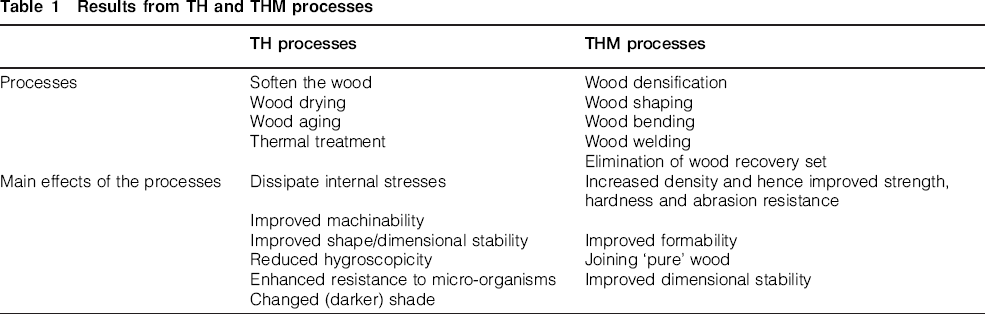
Thermal modification of timber is one emerging process technology which does not add any toxic or other harmful substances and that can be divided into two broad categories: Thermo-Hydro treatments (TH) and Thermo-Hydro-Mechanical treatments (THM). Thermally based timber processing, applies heat, moisture, and in the case of THM, mechanical action to improve material properties, such as bendability, hardness, above ground durability and shape stability. Furthermore, THM treatments may produce new materials and will allow new forms and functionality desired by engineers to be produced. Engineered densified wood products, moulded veneer products, and wood products modified through ageing, frictional welding or laser treatment are areas in which the development of TH/THM technology is especially concentrated. This is especially true when we are looking at the modification of solid wood and veneer. The development of THM techniques and produces has been covered in detail by Kamke (2013), Sandberg et al. (2012), and Militz (2002). Most of thermal modification technologies have been developed in Europe. In 2011, European production reached 250 000 m3 and global production was 350 000 m3, which was produced at approximately 100 thermal modification plants worldwide (Tetri 2011). The main differences between the treatments are based on the materials used (e.g. wood species, fresh or dried wood, moisture content, dimensions), process conditions applied (e.g. one or two process stages, wet or dry process, steaming, heating medium, oxygen or nitrogen as sheltering gas, heating and cooling rate and the equipment necessary for treatment (e.g. process vessel, kiln).
TH and THM treatments differ in the properties of the resultant product (Table 1). Wood composite production can be counted among TH/THM processes, where, in addition to TH/THM action, other materials such as adhesives and thermoplastics may be included. Examples of such products are laminated veneer products, wood plastic composites (WPC), and different board materials. There are numerous thermal modification techniques and new processes are regularly introduced.
Results from TH and THM processes
Markets for thermally modified timber have developed considerably over the last decade. Initially, thermal modification was viewed as an alternative to chemical preservatives to increase the resistance of biological degradation. Today, focus is also on the colour change, improved dimensional stability, and improvement in durability compared to other naturally durable wood species or chemical treated wood products. However, a more detailed consideration reveals that the global environmental impact of thermal modification of timber and further uses of the thermally modified timber products are not yet included in the development of processes and products. In fact their environmental impacts are to a large extent still unknown, which must change to meet the demands of increasingly conscientious business and consumer markets desiring to make environmentally responsible decisions regarding the purchase of goods and services. Furthermore, due to the European Union's continuing transition to a recycling society (Directive 2008/98/EC), thermally modified timber product design should include efficient product reuse, recycling and end-of-life use (cradle to cradle) to more effectively contribute to a low carbon economy. Consequently the need has emerged to develop methodologies that allow for informed purchasing decisions to be made regarding environmental impacts.
Environmental impact assessment
As sustainability becomes a greater concern, the environmental impact of construction and furnishing materials should be included in planning by considering the life cycle and embodied energy of the materials used. Therefore, Life Cycle Assessment (LCA) should be used to reveal the environmental and energy performances of the used materials throughout their whole life cycle. The common LCA methodology is defined in ISO 14040 (1997) and ISO 14044 (2006). Since the 1980s, when LCA analysis was first developed, numerous methodologies to classify, characterise, and normalise environmental effects have been developed. The most common [e.g. CML 2 (2000), IPCC Greenhouse gas emissions, Ecopoints 97 and Eco-indicator 99] are focused on the following indicators: acidification, eutrophication, ozone layer depletion, various types of ecotoxicity, air contaminants, resource usage and greenhouse gas emissions. Furthermore, these processes continue to be improved to provide greater consistency and enhanced communication (as in ISO/TS 14067 2013). LCA is performed for various stages of a product's life span. The LCA methodology involves four steps (ISO 14040 2006). First, the goal and scope definition step spells out the purpose of the study and its breadth and depth. The second step, Life Cycle Inventory (LCI), quantifies the environmental inputs and outputs associated with a product over its entire life cycle or during the time frame, which is being considered. Inventory analysis entails quantifying the inventory flows for a product system. Inventory flows include inputs of water, energy, and raw materials, and releases to air, land, and water. Third, impact assessment (LCIA), characterises these inventory flows in relation to a set of environmental impacts as identified in LCI. Finally, the interpretation step combines environmental impact in accordance with the goals of the study.
A product life cycle starts with procuring the raw material, and follows the product through primary processing, secondary processing or manufacturing, packaging, shipping and handling, installation, in-use energy consumption, maintenance, and end-of-life scenarios. LCA analyses products over specific periods of a products life cycle, for example, cradle-to-gate refers to life cycle assessment from raw material stage to the point directly before the product is shipped. Similarly, cradle-to-grave involves LCA of all stages of the product or the material, starting from raw material procurement to its end-of-life.
For wood products, the life cycle generally starts with extraction of raw resources from the natural environment or recovery of materials from a previous use. The raw resources are then manufactured into useable products. The finished products are shipped to a site, consuming energy in the process. During the service life of the product, it may consume energy based on its use (e.g. energy used to maintain the product). Over time renovations or retrofitting may be performed on the products, which may require additional materials and energy. Finally, the product is removed/ demolished and its materials disposed of either as construction waste or recycled for reuse. Each of these steps consumes energy and materials and produces waste. The purpose of LCA is to quantify how a product or system affects the environment during each phase of its life. Examples of parameters that may be quantified include: energy consumption, resource use, greenhouse gas production, solid waste generation, and pollution generation. The results of LCA studies depend on the system boundaries, which phases of the life cycle are included in the analysis. The results are different if parts of life cycle (cradle to gate) or a full life cycle of products (cradle to grave or cradle to cradle) are considered.
With regard to greenhouse gas emissions, wood is a better alternative than other materials. Werner and Richter (2007) reviewed the results of ∼20 years of international research on the environmental impact of the life cycle of wood products used in the building sector compared to functionally equivalent products from other materials. The study concluded that fossil fuel consumption, potential contributions to the greenhouse effect and quantities of solid waste tend to be minor for wood products compared to competing products. Impregnated wood products tend to be more critical than comparative products with respect to toxicological effects and/or photo generated smog depending on the type of preservative. Furthermore, although composite wood products such as particleboard or fibreboard make use of a larger share of the wood of a tree compared to products out of solid wood, there is a high consumption of fossil energy associated with the production of fibres and particles/chips as well as with the production of glues, resins, etc. However, treated wood, adhesively bonded wood and coated wood, might have toxicological impacts on human health and ecosystems. Hill and Norton (2014) discussed the environmental impact of the wood modification process in relation to life extension of the material. A comparison among different wood modification treatments was made. By determination of carbon neutrality they determine at which point the benefits of life extension compensate for the increased environmental impact associated with the modification. The effect of increased maintenance intervals with the modified woods could be a powerful argument in favour of the use of modified wood products with increased maintenance intervals. Unfortunately, the number of LCA studies of wood–based composites is relatively limited, geographically specific, and utilise of a variety of databases and impact assessment protocols.
Environmental product declaration (EPD)
In order to ensure comparability of environmental performance between products, product classification, standards and transparent methods for assessment were introduced in ISO 14025 (ISO 2009). This standard describes the procedures required in order to produce Type III environmental declarations (also known as environmental product declarations, EPDs). Hill and Norton (2013) provided an overview of the current situation developing in Europe with respect to EPDs and, in particular, the emerging standards in this area. An EPD is an LCA based tool to communicate the environmental performance of a product. EPDs are based on the principle of developing product category rules (PCR), which specify how the information from an LCA is to be used to produce the EPD. A PCR will typically specify the functional unit of an EPD calculation for the product. Within the framework of ISO 14025, only the production phase (cradle to gate) of the life cycle is required in the EPD, forming what is known as an information module. It is also possible to include other lifecycle stages, such as the in-service stage and the end of life stage, but this is not compulsory. ISO 14025 also gives guidance on the process of managing an EPD program with the aim to harmonise PCRs. It requires transparency as to how the program works and there must be a mechanism for the verification of a PCR as well as the means to allow for consultation with interested parties. Standards are increasingly removing the flexibility that was once available when determining the environmental performance of products and services.
Standards have been issued that apply to the construction sector in order to ensure greater comparability of the environmental performance of products. Recently, EN 15804 (CEN 2012) was issued. It is a core PCR for building products. Further guidance is given in EN 15942 (CEN 2011), which gives information regarding the format of an EPD for business-to-business communication in the construction products sector. The primary purpose of an EPD, according to ISO 14025, is for business-to-business communication, but an EPD can be used for business-to-consumer communication as well. EPDs can be registered with different programs. Del Borghi (2013) provided a list of main Asian, European, and North America existing programs. For example, the main European schemes are: The International EPD System – EPD; The Norwegian EPD Foundation – EPD; French Agency on Environment and Energy Management (ADEME) – Product Environmental Footprint; BRE Global Environmental Profiles Scheme (EPD) for construction products – EPD; and German Institute of Construction and Environment (IBU). In order to ensure the mutual recognition of EPDs from different schemes, Global Environmental Declaration Network (GEDnet 2014) aims to foster co-operation and encourage information exchange among its members and other parties operating or developing EPD programs. Therefore, the GEDnet plays an important role in harmonisation of EPDs programs.
Conclusion: Next steps in developing thermal modified timber
The low carbon economy aims to mitigate climate change and promote sustainable development in Europe, by reducing energy consumption, pollution and emissions while increasing performance. Thermal modification of timber is an assortment of the innovative processes currently being adopted. Though many aspects of these treatments are known, the fundamental influence of the process on product performance, the environment, and end of life scenarios remain unknown. It is essential to integrate interactive assessment of process parameters, developed product properties, and environmental impacts. To optimise modification processing to minimise environmental impacts, much more information must be gathered about all process related factors affecting the environment (VOC, energy use, end of life use, etc.). Therefore, research of thermal modification of timber and the resultant products must place more emphasis on the interactive assessment of processes parameters, developed product properties, and environmental impacts. Energy consumption considerably contributes to the environmental impact of thermally modified wood. However, the improved properties during the use phase might reduce the environmental impact of the thermally modified timber. Furthermore, to achieve sustainable development, certain criteria within a framework of economic, environmental and social systems must be followed. It is important to note that effective use of wood throughout its whole value chain from forest management, through multiple use cycles, and end-of-life disposal can lead to truly sustainable development. Therefore, in order to contribute to the low carbon economy thermal modification of timber should implement as follows.
Establish a base line of environmental impacts. Identify and quantify the environmental loads involved, i.e. the energy and raw materials used, and the emissions and wastes consequently released. Then evaluate the potential environmental impacts of these loads, which should be followed by assessment of the opportunities available to bring about environmental improvement.
Reduce emissions with re-designs of existing technologies.
Demonstrate a manufacturer's commitment to sustainability and showcase the manufacturer's willingness to go above and beyond. Therefore, PCRs, which include the requirements for EPDs for thermally modified timber, should be defined in an internationally accepted manner based on an open, transparent and participatory process. Furthermore, EPDs in which relevant, verified and comparable information about the environmental impact of products resulting from thermal modification of timber should be acquired. The EPDs can then be used as a proof of environmental claims in the public procurement arena.
Develop an ‘upgrading’ concept for recovered products resulting from thermally modified timber as a source of clean and reliable secondary wooden products for the industry. This will further strengthen their market competitiveness and sustainability and mitigate climate change by longer storage of captured carbon in wooden materials.
The goals of sustainable development to increase economic efficiency, protect, and restore ecological systems and improve human well being, or a combination of the three are expected to lead to new concepts, products, and processes optimising the multiple utilisation/ recycling of forest based resources. The life cycle analysis, industrial ecology and cradle-to-cradle concepts used as key tools also in economic developments can lead to new business opportunities through innovative products with properties optimised to the end use requirements and the sustainable use of resources. Therefore, the implementation of listed activities will only lead to low carbon economy, but also enable that thermally modified timber will contribute to the aims of the EU 7th Environment Action Programme (European Parliament, Council 2014) to protect nature and strengthen ecological resilience, boost resource efficient, low carbon growth, and reduce threats to human health and wellbeing linked to pollution, chemical substances, and the impacts of climate change.
Footnotes
Acknowledgements
The authors would like to acknowledge COST Actions FP0904 and FP1303. Additionally, Andreja Kutnar would like to acknowledge the Slovenian Research Agency for financial support within the frame of the project Z4-5520.