







Abstract
The effect of nano-copper oxide treatment on the colour change and loss of droplet contact angle on the sapwood of eastern cottonwood (Populus deltoides) after 180 days of natural weathering was investigated. Small clear samples were prepared, and vacuum impregnated with an aqueous suspension of nano-copper oxide at concentrations of 0·5, 1 and 1·5% nano copper. Treatment with nano-copper oxide decreased colour changes and loss of contact angle due to weathering. Colour change and contact angle loss decreased with increasing retentions of nano-copper oxide.
Introduction
Wood in outdoor applications can be damaged by biological agents such as bacteria, fungi, insects and marine borers and also by physical agents such as ultraviolet light and fire.
Copper is an algaecide, bactericide, fungicide, and insecticide. Copper based preservatives have been used for wood protection since the eighteenth century. Production of wood treated with copper based preservatives grew substantially during the 1970s and 1980s (Freeman and McIntyre 2008).
Temiz et al. (2005) reported that treatment with chromated copper arsenate (CCA) or alkaline copper quat (ACQ) stabilised the colour of wood against weathering. Copper amine treatment can retard photodegradation and decrease changes of contact angle on weathered wood (Zhang et al. 2009).
Stirling et al. (2008) and Kartal et al. (2009) reported that micronised copper quaternary (MCQ) and nano-copper oxide had significant resistance to leaching. Recent research has studied the possibility of applying nanobiocides for wood protection and has shown that nano metals such as nano-copper offer good protection against termites, fungi, and moulds. Nano-copper has very low leaching compared to other nano metals (Kartal et al. 2009; Sahin and Mantanis 2011; Clausen et al. 2010; Kartal et al. 2009).
Exposure to ultraviolet light makes wood discolour, the extractives leach from the surface and the wood surface becomes less water repellent (Williams 2005). Destruction and loss of lignin also makes the surface more hydrophilic and decreases the contact angle of distilled water droplets on the surface (Williams 2005; Kang et al. 2002).
In this study, the effect of nano-copper oxide treatment on colour change and contact angle due to natural weathering was investigated.
Materials and methods
Poplar (Populus deltoids) sapwood from the north of Iran was used to prepare the experimental samples. Three 150 cm long logs were cut from three 40 cm diameter trees (from the height of between 130 to 280 cm. Density was measured as 438 kg m3. The sapwood zone of the logs was sawn into boards and then air dried. Finally, samples with dimensions of 50×50×2 mm (tangential×longitudinal×radial) were prepared. A nano-copper oxide suspension with particle size 40 nm, prepared by Nanotechnology Company of Iran, was used to treat the samples at concentrations of 0·5, 1 and 1·5% nano copper. Each treatment group consisted of 12 samples.
For treatment, the samples were conditioned at 20°C and relative humidity of 65% for 1 week. The conditioned samples were then vacuum impregnated in the aqueous suspensions and then left for an absorbtion period of 120 min in each suspension at atmospheric pressure. Retention was calculated by using the following formula according to ASTM Standard D 1413 (1)

The treated and untreated samples were exposed to natural weathering on a test fence inclined at 45° and facing south to ensure maximum solar ultraviolet radiation during 180 days in Gorgan city in the north of the Islamic Republic of Iran. The site receives an annual rainfall of over 300 mm (Meteorological Organization of Iran, http://www.irimo.ir/wd/720-Products-Services.html). Before and after this period, droplet contact angle and colour coordinates of each sample were measured.
Colour measurement was carried out using colour guide 45/0 according to ASTM Standard D 2244. For this purpose, L*, a* and b* parameters were measured for both treated and untreated samples before and after weathering. Afterwards, colour change was calculated by following equation

Drop contact angle was calculated by using a contact angel analyser PG-X according to ASTM Standard D 5946. Drop contact angle of the surface of the treated and untreated samples was measured during the first 10 seconds from the moment of deposition of the drop on the samples’ surface. Each treatment group consisted of 12 samples.
Colour change and droplet contact angle loss data were subjected to an analysis of variance (ANOVA). The means were compared using Duncan's Multiple Range Test (DMRT) to determine the differences between the treatments.
Result and discussion
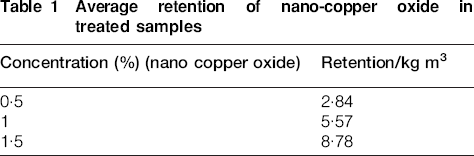
Nano-copper oxide retentions increased with increasing concentrations of nano-copper oxide (Table 1).
Average retention of nano-copper oxide in treated samples
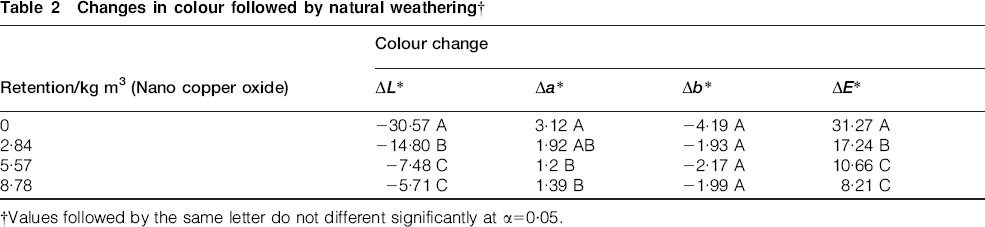
The nano-copper oxide treatment decreased colour change of cottonwood (Table 2). Colour change also decreased as retention increased. Low retentions of nano-copper oxide significantly reduced colour change due to weathering, whereas there was no significant effect of higher retentions.
Changes in colour followed by natural weathering
Values followed by the same letter do not different significantly at α = 0·05.
ΔL* values were highest for untreated samples. Nano-copper oxide treatment reduced brightness change. With increasing retention ΔL* values of treated samples were decreased 51·59, 75·53 and 81·32% at retentions of 2·48, 5·57 and 8·78 kg m3 respectively. Temiz et al. (2005) reported that ΔL* of alder wood decreased 95 and 55% with CCA and ACQ treatment at a retention of about 7 kg m3. The growth of mould and blue stain fungi on the surface of weathered wood reduces the lightness of wood (Williams 2005). The fungicidal properties of copper may be the main reason for the reduction in the brightness change. Change in parameters of a* and b* also decreased for the treated samples (Table 3). Greenness of the treated samples was reduced after weathering, which may be due to copper removal from the sample surface. Reduction in ΔE* caused by the preservatives has also been reported (Zhang et al. 2009).
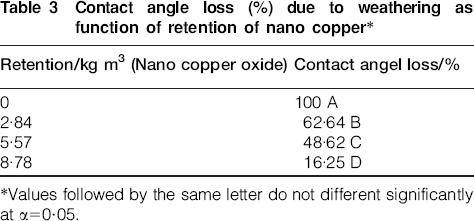
Contact angle loss (%) due to weathering as function of retention of nano copper
Values followed by the same letter do not different significantly at α = 0·05.
Droplet contact angle
Drop contact angle of samples was reduced after natural weathering. Contact angle losses (%) were calculated based upon contact angle measurements 3 s after drop placement on the samples (Table 3).
The results of decreasing contact angle showed that nano-copper oxide treatment improved the weathering resistance of wood. As can be observed in Table 3, nano-copper oxide treatment and increasing retentions significantly reduced contact angle loss.
The contact angle of untreated and treated samples, before and after exposure to natural weathering, is shown in Fig. 1. Contact angle after weathering was lower than that for before weathering. Drops were absorbed within 3 s after being placed on untreated samples (Table 3). The difference in contact angle between before and after weathering was reduced with increasing retention (Fig. 1a–c).
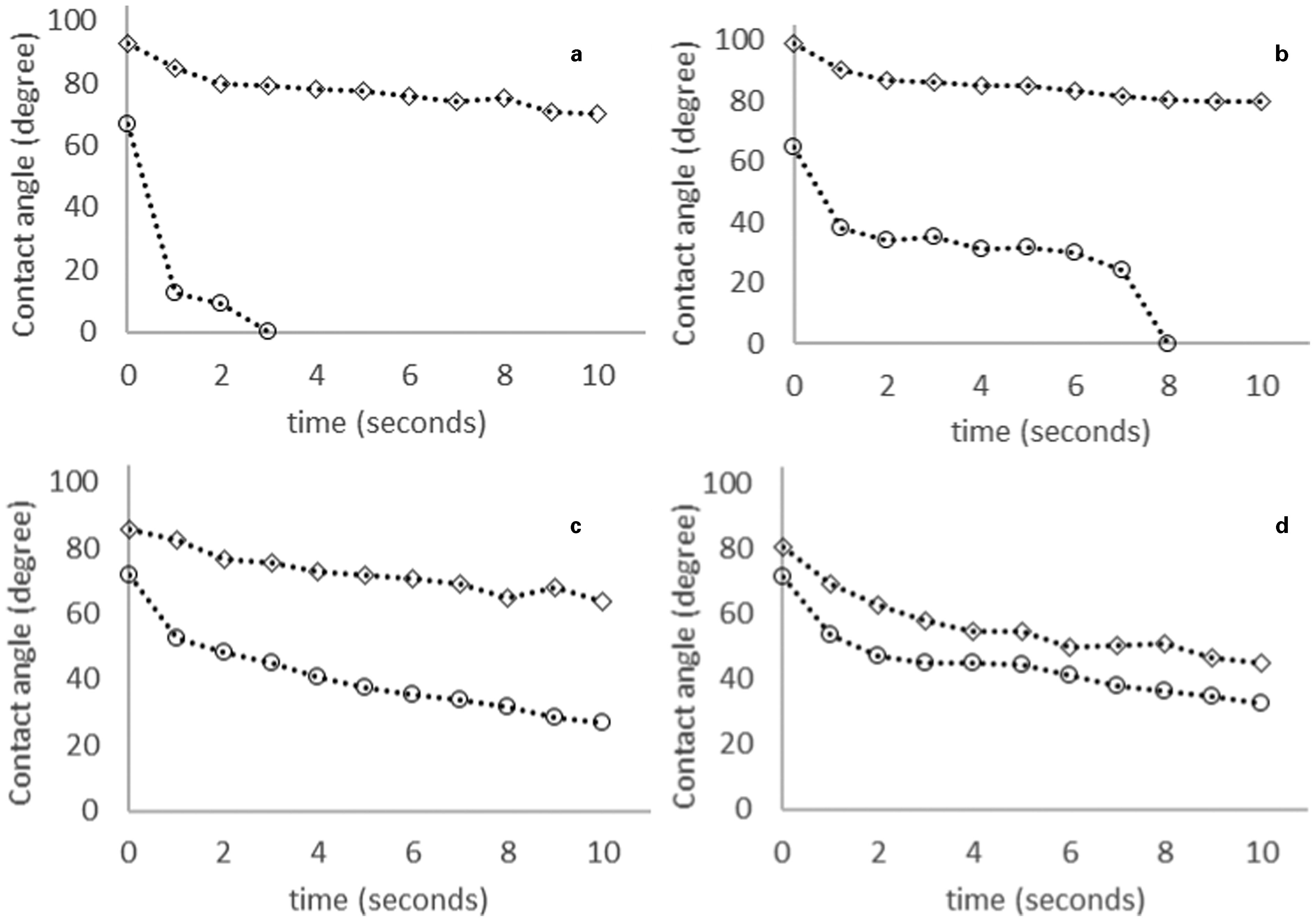
a contact angle up to 10 s after droplet application for untreated samples, nano-copper oxide treated samples at retentions of b 2·84, c 5·57 and d 8·78 kg m3 before (◊) and after (○) natural weathering
Reductions in contact angle signify an increase in water absorption of wood (Williams 2005). When the wood is exposed to weathering, extractives are leached from the wood surface, and lignin is degraded and lost; these changes made the wood more hydrophilic (Williams 2005; Kang et al. 2002). The untreated samples experienced the greatest losses in contact angle after weathering. This suggests that lignin degradation and leaching of extractives occurred during weathering. The decrease in contact angle changes of the treated samples compared to untreated samples may be due to less lignin degradation. Zhang et al. (2009) reported that treatment with copper ethanolamine reduced drop contact angle changes due to weathering.
The results indicated that there is a correlation between increased retention and changes in colour and drop contact angle, so that, colour and contact angle changes were reduced with increasing retention.
Conclusion
Nano-copper oxide treatment reduced colour change and drop contact angle loss due to weathering. With increasing retention, colour change and contact angle loss were decreased. Thus, it can be concluded that nano-copper oxide treatment improves the weathering resistance of wood.