







Abstract
This study was performed to determine if several moderately utilised Peruvian hardwoods had potential for spalting applications. Authors applied a modified decay jar methodology with six native Peruvian woods and three fungi, with a period of incubation of 6 weeks. Results showed that Nigrospora sphaerica and marupa (Simarouba amara) showed the highest significant internal pigmentation (black), followed by congona (Brosimum alicastrum) and zapote (Matisia cordata) tested with Cladosporium herbarum. No spalting occurred on woods with darker sapwood.
Introduction
Peru is one of the 10 countries considered as megadiverse. Ninety-nine per cent of the forest industry in Peru is based upon the natural wood species of the country (Sánchez et al. 2001). Although Peru's forests contain more than 693 species per hectare (Pitman et al. 2002) only 100 species are used for timber, and from this 25 meet 80% of the commercial demand. Of primary importance is mahogany (Swietenia macrophyla King), which has experienced a decrease in export volume in recent years because of overharvesting.
Of the primary commercial timbers in Peru, most have a red or brown colour to their wood. Consumer interest in these wood species remains high because of the desire for these specific colours (Yang and Gignac 2011); the least viable commercial timbers are the ones that are white or light yellow. There is growing interest in Peru to develop markets for these moderate and low value wood species. This is both an effort to increase forest revenue and to help prevent overharvesting of the current high value trees.
One proposed method for increasing the value of Peruvian woods is through controlled spalting. Research interest into the spalting potential of South American woods is currently gaining traction, especially in Chile and Peru, where the forest industry brings in substantial money to the country.
Spalting, also known as the coloration of wood by fungi, occurs in all wood species. In the United States and Europe, spalted wood is considered as a premium product because of its unique visual characteristics. Consumers in these areas are willing to pay above standard market prices for spalted and other character type wood (Donovan and Nicholls 2003). In Peru, spalted wood is relatively unknown and as of yet there is no well-defined market; however, spalting occurs with frequency in Peruvian rainforests and is common to see in standing dead and fallen trees, as shown in Figs. 1 and 2.
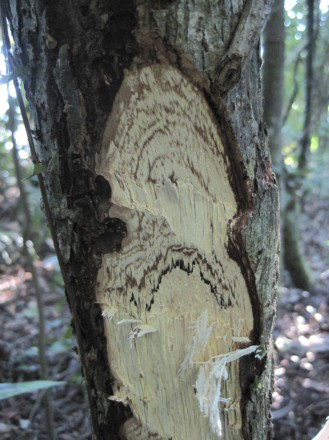
Brown zone lines on pashaco (Macrolobium sp.)
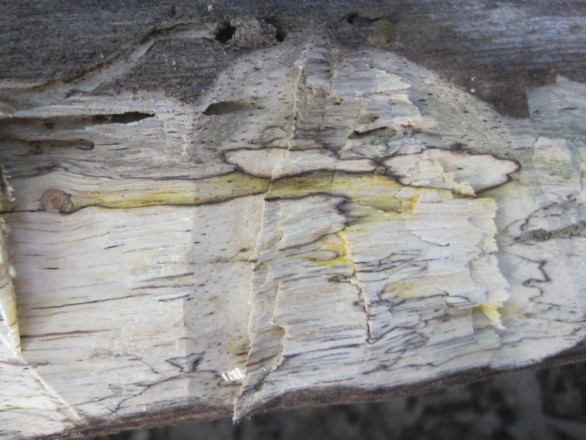
Yellow pigment and black zone lines on pashaco (Macrolobium sp.)
The purpose of this study was to determine if any of the moderate-use timbers commonly available in Peru could be spalted with native Peruvian fungi. There is currently very little known about staining fungi in Peru and how such fungi interact on Peru's native wood species. While it is the authors’ long-term goal to increase the value of non-commercial woods that have medium to low density and no commercial value, our first step, as illustrated in this paper, was to begin preliminary testing on moderate-use timbers and the most commonly available staining moulds found in Peru. The information gained from this study will be used as a baseline for the development of spalting as a commodity product within Peru in the future.
Materials and methods
Six native Peruvian wood species were used for testing. Cachimbo (Cariniana domestica (Mart.) Miers, specific gravity = 0.59) was harvested from the premountain rainforest and the tropical rainforest. Cumala (Virola sp., specific gravity = 0.45) was harvested from the lower rainforest and in the secondary forest, in altitudes between 80 and 1000 m above sea level. Copaiba (Copaifera officinalis Linnaeus, specific gravity = 0.61) was harvested in the lower rainforest in Peru in well-drained soils. Congona (Brosimum alicastrum Swartz, specific gravity = 0.68) was harvested in the dry forest and in the rain forest of Peru. Marupa (Simarouba amara Aublet, specific gravity = 0.36) was harvested from the area of ecological transition of cloud rainforest to the mountain rainforest. Zapote (Matisia cordata Bonpland, specific gravity = 0.43) was harvested from the lower primary rainforest.
Three common Peruvian, airborne mould fungi known to cause staining in wood were used for testing: Lasiodiplodia theobromae (Pat.) Griffon & Maubl., Cladosporium herbarum (Pers.) Link, and Nigrospora sphaerica (Sacc.) E.W. Mason. The fungi used in the test were wild type and identified based upon morphology. Each of the three fungi species was applied independently to each one of the six wood species selected for this experiment. These fungi were selected only because of their prevalence in Peru and their known staining ability. Their pathogenicity towards crops was not a deciding factor in their use, as this work was meant to be a preliminary study in spalting potential.
Modified wood decay jars were set up using the procedure in Robinson, Richter and Laks (2009a). Inoculated jars were placed in an incubator (28 ± 2°C, 60% ± RH) in dark conditions for 6 weeks.
After 6 weeks, the blocks were removed from the jars, cleaned, and analysed following the procedure in Robinson, Laks and Turnquist (2009b). Data were analysed with a two-way ANOVA followed by Tukey's HDS using SAS version 9.2.
Results and discussion
Results for the two-way ANOVA found wood species to be significant (P < 0.0001) and the interaction of wood and fungus to be significant (P < 0.0001). Results of the Tukey's HSD found that marupa and N. sphaerica (Fig. 3) showed significantly more internal spalting than any other combination (average 27%). Congona with C. herbarum (average 12.9%) and zapote with C. herbarum (average 11.9%) (Fig. 4) had the next highest internal spalting amounts, although the amounts did not differ significantly from the combinations of zapote with L. theobromae (9%) (Fig. 5), N. spaherica (8%), and marupa with C. herbarum (6%). No other combinations showed any internal spalting.
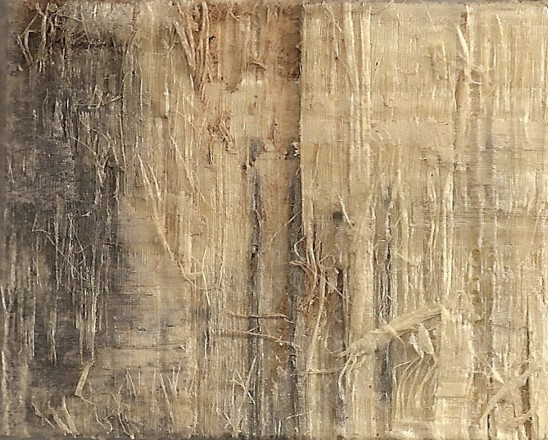
Internal section of a block of marupa with Nigrospora sphaerica
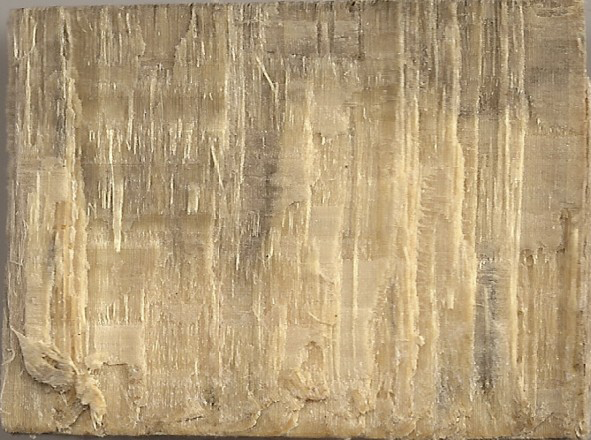
Internal section of a block of zapote with Cladosporium herbarum
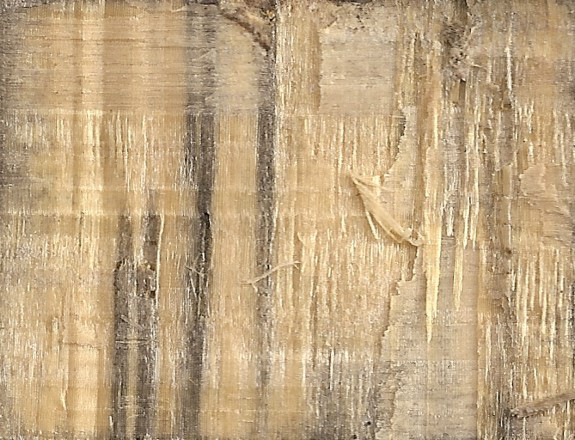
Internal section of a block of zapote with Lasiodiplodia theobromae
It was observed that marupa, a light yellow coloured wood, had the highest degree of spalting with N. sphaerica. This could be because this wood is non-resistant to blue stain fungi (Cáceres 2008). N. sphaerica is considered both a mould and a blue stain, and is most commonly found on seeds and leaves (Starratt and Loschiavo 1974; Osono 2010). It has also been reported on wood pieces associated with decaying fungi (Fazio et al. 2010), and in the test, it presented an intense dark coloration on the wood of marupa. It is assumed that this coloration is because of melanin deposits in the fungal hyphae (Robinson et al. 2009a).
Congona, a light yellow coloured wood that is non-resistant to the attack of blue stain fungi (Cáceres 2008), showed the next highest amount of internal spalting when inoculated with C. herbarum. This fungus is a dark mould that is similar to Trichoderma and Penicillium, and lives on the nutrients of sapwood's parenchyma cells of hardwoods and softwoods (Lee, Jang, Kim and Kim 2012). Similar results were achieved with zapote, also a light coloured wood that is moderately resistant to biological attack (Cáceres 2008) with C. herbarum.
The least significant spalting was produced between zapote and L. theobromae, a sap stain fungus that causes a bluish black stain in many tropical hardwoods (Apetorgbor, Darkwa, Frimpong and Agyeman 2004), and it is also known as a plant pathogen in the tropics, affecting primarily grapes, bananas and mango crops (Úrbez-Torres et al. 2008; Ploetz, Thomas and Slabaugh 2003; Khanzada, Lodhi and Shahzad 2004). This fungus is widely distributed in the tropics and subtropics (Mohali, Burgess and Wingfield 2005), and must be handled within adequate laboratory facilities. Marupa with C. herbarum had similar results.
Woods with darker tones, such as cumala, a light red coloured wood, copaiba, a medium red, and cachimbo, a light red (Cáceres 2008), did not show any spalting. This could be because of the presence of extractives in these hardwoods. The wood of cumala presents an ethyl acetate extract (Pung 2000) that is cytotoxic (Gottlieb and Mors 1980). In the case of copaiba, it is possible that the presences of terpenoid oleoresins, predominantly located in the parenchyma of the wood, are responsible for giving the wood resistance to microbial attack (Plowden 2003). Cachimbo is known to have a high concentration of triterpenoids extractives in the barque (Janovik et al. 2012), but little is known about the extractives on the wood. In the Carianana genre, species, such as Cariniana legalis (Mart.) O. Ktze., and Cariniana estrellensis (Raddi) O. Ktze., are known to have antimicrobial compounds in the wood (Cury and Tomazello-Filho 2011).
The results obtained with the six tropical hardwoods tested can be compared with previous studies (Robinson, Tudor and Cooper 2011a) developed on hardwoods from temperate forests on which a significant colour change occurred. On these hardwoods, the most susceptible and therefore the best for spalting tests is sugar maple (Acer saccharum Marsh) that has a SG = 0.68, similar to congona, but has a better performance in spalting trials (Robinson, Tudor and Cooper 2011b). However, the dark staining ability of sugar maple is comparable to the results obtained from N. spaherica and C. herbarum on zapote and marupa, which are woods with lower specific gravity. However, these woods showed a higher susceptibility to pigmentation compared to the other woods used in this test. This result can likely be related to the density and the porosity of the wood (Shmulsky and Jones 2011). As zapote and marupa are less dense than congona, this means that there are more void spaces where the mycelium of the fungi can develop and colonise the wood faster than in a wood with a higher specific gravity.
In addition, the amount and type of sugars present in the wood is likely a determining factor. Robinson et al. (2011a) hypothesised that the higher amounts of sucrose in sugar maple is responsible for said wood species’ prevalence in terms of spalting. Unfortunately, nothing is known about the sucrose and other sugar levels in marupa, zapote, and congona. Further studies on Peruvian wood species in terms of sugar content could offer an early screening system to determine which woods are mostly likely to perform well in spalting trials.
Previous literature supports the 6-week time frame for incubation of these test blocks to obtain internal pigmentation, based upon studies done with Ophiostoma spp. and Scytalidium cuboideum (Robinson et al. 2011a; Behrendt, Blanchette and Farrell 1995). Interestingly, previous spalting experiments with the blue stain fungus Ophiostoma piceae failed to produce significant internal pigmentation in the wood during an incubation time of 12 weeks, although S. cuboideum is quite successful at producing pink stain internally in this time frame (Robinson et al. 2011a). In this experiment, N. spaherica and C. herbarum produced significant internal pigmentation in 6 weeks. This is likely because of the medium to low natural durability that marupa, zapote and congona. It is possible that the melanin pigmentation originated by the airborne moulds can be more effective for spalting, in terms of growth rate, than the one produced by blue-stain fungi.
It is apparent from the results that some Peruvian wood species are susceptible to spalting. Future research in this area should focus on spalting these low to moderate value woods with non-pathogenic, established spalting fungi, such as Chlorociboria aeruginascens, which has worldwide appeal and distribution.
Conclusions
Nigrospora sphaerica produced the most internal spalting when applied to marupa, giving it a significant colour change. Meanwhile, the pigmentation originated by C. herbarum was less significant in internal area pigmentation when applied to congona and zapote. More studies are needed to compare if greater incubation time is needed to increase the pigmentation to the wood. Marupa and zapote appear to be the best suited from the test wood species for application of fungi to induce spalting.
Footnotes
Acknowledgements
The authors would like to thank the Laboratory of Wood Protection of Universidad Nacional Agraria La Molina and Dr Magdalena Pavlich for their support to this work.