







Abstract
We compared the results of equivalent linear (ELA) and nonlinear site response analyses (NLA) and found that the differences between the values of the peak ground acceleration (PGA), peak ground velocity (PGV), Arias intensity (I a ), significant duration (D5–75), and response spectrum for periods between 0.025 s and 2 s predicted by each method are non-negligible for maximum shear strain values predicted by ELA (γmax,ELA) greater than 0.04% to 1.0%. As γmax,ELA increases, ELA in general predict smaller shear strain and D5–75 values, and larger PGA, PGV, I a , mean period, and response spectral values for periods less than 0.1 s and periods near the natural site period than NLA. To help researchers and practitioners decide when to use ELA and/or NLA, we developed a model to estimate γmax,ELA before conducting a site response analysis.
Introduction
Site response analyses are a crucial part of estimating the seismic hazard at a given site. The two most common site response analysis methods are one dimensional total stress equivalent linear analyses solved in the frequency domain (ELA) and one dimensional total stress nonlinear analyses solved in the time domain (NLA). Engineers often perform ELA rather than NLA because of their simplicity of use and low computational requirements (Matasovic and Hashash 2012). However, because ELA use the same stiffness and damping properties for the entire duration of the acceleration time series they cannot accurately capture nonlinear soil behavior, especially at large shear strains. Therefore, it is important to understand when to use ELA and when to use NLA when performing a seismic site specific investigation.
To address this issue, previous studies have followed one of two approaches. In the first approach, researchers compared the predictions of ELA and/or NLA with measured data from vertical array recordings. Kim and Hashash (2013) conducted ELA and NLA for long duration ground motions recorded at nine Kiban-Kyoshin network (KiK-net) vertical array seismometers in Japan. They noted that the difference between the response spectra predicted by the two methods was significant for maximum shear strains (γ max ) greater 0.3%. Kaklamanos et al. (2013, 2015) compared the predicted response spectra of linear analyses, ELA, and NLA at KiK-net sites as well. They found that the linear analyses were accurate up to γ max = 0.01% to 0.1%, ELA were accurate up to γ max = 0.1% to 0.4%, and that for γ max > 0.05% the NLA gave a slightly better fit to the observed data than ELA.
In the second approach, researchers have investigated directly the differences between ELA and NLA without comparison to observed ground motion records. Snow (2008) compared the response spectra predicted by the two methods for three soft and deep soil sites with high levels of ground motion intensity on the Wasatch Front near Salt Lake City, Utah. Snow (2008) found that ELA predicted larger peak ground acceleration (PGA) and peak response spectral values than NLA.
Rathje and Kottke (2011) compared the results of ELA and NLA for two sites using a suite of 15 spectrally matched ground motions scaled to three peak ground acceleration (PGA) values. They found that NLA predict less amplification than ELA for periods less than 0.04 s because of incoherence in the phase of the ground motion produced by the nonlinear stress strain response. For periods between 0.04 s and 0.2 s they found that NLA predict greater amplification than ELA because of amplification created by the instantaneous change of soil stiffness when a stress reversal occurs, and because of over damping in ELA. At periods close to the natural site period Rathje and Kottke (2011) found that NLA predict less amplification than ELA because the soil stiffness and therefore the natural site period continuously changes.
Assimaki and Li (2012) performed linear analyses, ELA, and NLA for downhole array sites and synthetic ground motions in the Los Angeles Basin. They calculated the difference between the analysis methods as the average log ratio of the spectral acceleration values between 0.2 s and 2.0 s. They found that the parameters controlling the nonlinear response are the PGA, the frequency index, the first mode amplification of the site, and the time averaged shear wave velocity of the top 30 m of the site (VS30). Kim et al. (2013) used the database created by Assimaki and Li (2012) to develop a model to predict the difference between response spectral values estimated by ELA and NLA. They recommend that for periods less than 1 s and between estimated shear strain values of 0.1% to 0.4% engineers should transition from using ELA to NLA.
In this study, we follow the second approach and investigate the difference in the predicted results of ELA and NLA without direct comparison to observed ground motion records. Both numerical analysis methods could still deviate from observed responses, however, the second approach allows more control over input parameters and removes uncertainty due to site properties. In addition, we compare the results of this paper with those from studies that do investigate the differences between results of ELA and NLA with measured data to ensure consistency.
This study is unique from prior investigations in several ways. First, we use a large database of 189 ground motions, nine hypothetical sites, and seven actual sites. Six of the seven actual sites contain organic, high plasticity, or deep soft soil deposits (i.e., they are non-liquefiable NEHRP F sites). Many building codes require site specific investigations for these types of sites and these sites are the most likely to generate large shear strains, therefore, it is crucial that these sites be included in comparison analyses. Second, we corrected the shear modulus reduction and damping curves of the ELA and NLA site models to account for soil shear strength at large shear strains. If this correction is not made, site response models may give erroneous results at large shear strains (Yee et al. 2013). Third, in contrast to other studies, we investigate not only the difference between the response spectra (Sa) and PGA, but also the peak horizontal ground velocity (PGV), peak horizontal ground displacement (PGD), Arias intensity (I a ), duration between when 5% and 75% of the Arias intensity is reached (D5–75), mean period (T m ; as defined by Rathje et al. 2004), and maximum shear strain (γ max ). Fourth, we perform a systematic investigation of what parameter is the best predictor of the difference between results of ELA and NLA and develop a model to estimate that parameter before conducting a site response analysis. This model allows the differences between the predicted results of ELA and NLA to be considered for all of the parameters mentioned above and not just Sa. Finally, we use a consistent, logical, and objective method to specify when the magnitude of the differences between the predicted results are non-negligible. This will help researchers and practitioners to understand the relative importance of the difference.
Site Response Analyses
This investigation uses results of two site response analysis databases. We describe the first database in detail below. The second database is from the results of Carlton (2014), who conducted site response analyses for sites with organic, high plasticity, and deep soft soil deposits. We give a brief description of this database at the end of this section. Initially we conducted the investigation for both databases separately. However, because the results for both databases were similar, we combined them into one large database.
First Database of Site Response Analyses
For the first database we selected 127 ground motion record pairs from the PEER NGA-West2 online database (Ancheta et al. 2014) that have VS30 values between 760 m/s and 1,500 m/s (i.e., NEHRP B sites), PGA values larger than 0.01 g, and are not classified as pulse like motions. We chose a random horizontal component from each pair of ground motion records. Figure 1 shows the magnitude (M), distance (R), PGA, and VS30 of each of the ground motion records used in the site response analyses.
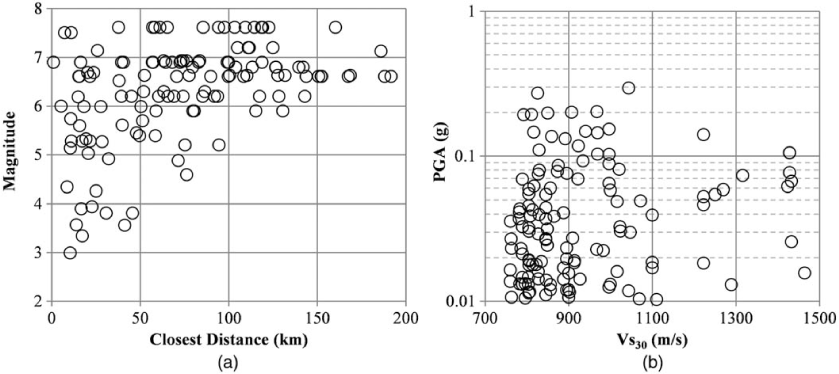
Characteristics of ground motions used in the first site response analysis database.
We developed nine sites for the site response analyses. Sites C1, C2, and C3 have VS30 = 441 m/s (i.e., NEHRP C); sites D1, D2, and D3 have VS30 = 263 m/s (i.e., NEHRP D); and sites E1, E2, and E3 have VS30 = 148 m/s (i.e., NEHRP E). We calculated the shear wave velocity (V S ) profiles for each site to depths of 30 m using the correlations developed by Carlton and Tokimatsu (2014) for generic sites. For the D and E sites, we added 4 m of soil that increase in V S with depth to give about the same impedance contrast at the soil/rock interface for all sites. This was done to simplify the investigation and make it easier to analyze the effect of the other parameters. We modeled the underlying rock layer as an elastic half-space with V S = 760 m/s, unit weight of 23 kN/m3, and damping ratio of 1% for all nine sites. Figure 2 shows the shear wave velocity profiles, overconsolidation ratio (OCR), and unit weight with depth for each of the sites. The unit weights and OCR values were the same for all nine sites.
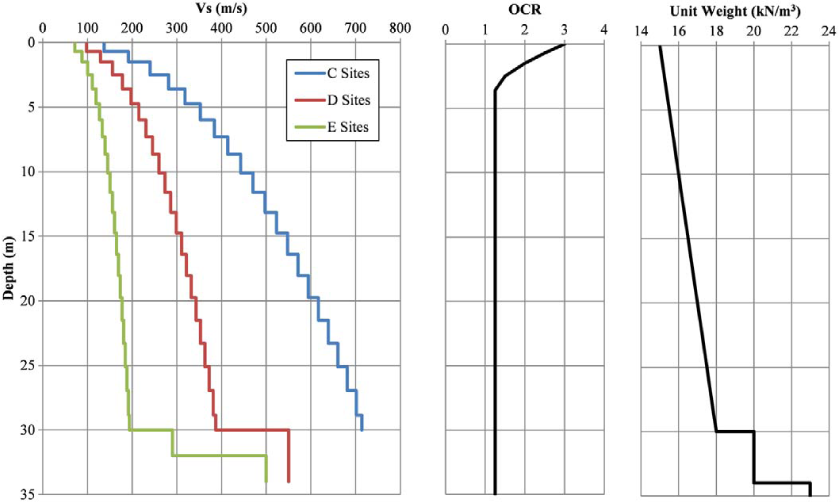
Site characteristics used in the first site response analysis database.
We calculated the shear modulus reduction and damping curves for each soil layer using the model developed by Darendeli (2001), which depends on the plasticity index (PI), OCR, mean effective confining pressure (σ′ m ), loading frequency (f), and number of loading cycles (N). We modeled soil layers from 0 m to 30 m at sites C1, D1, and E1 with PI = 0; sites C2, D2, and E2 with PI = 20; and sites C3, D3, and E3 with PI = 52. We selected these PI values to give a range of soil types and shear modulus reduction and damping curves. The soil layers from 30–34 m for the D and E sites we modeled with PI = 0. We set f = 1 and N = 10 for all sites and all soil layers.
Shear modulus reduction and damping curves estimated from laboratory tests often do not predict the correct soil shear strength at large shear strains (Stewart et al. 2008). Therefore, we adjusted the shear modulus reduction and damping curves of all soil layers to match their respective shear strengths at large shear strains following the procedure outlined in Yee et al. (2013). We estimated the shear strength of the soils with PI > 0 using the SHANSEP method proposed by Ladd and Foott (1974), and assuming a shear strength ratio for normally consolidated soils of (Su/σ′ v ) NC = 0.25 and OCR coefficient of m = 0.8. We estimated the shear strength of the soils with PI = 0 using Mohr Coulomb failure criteria assuming zero cohesion, a friction angle ϕ = 35° for soils above 30 m, and ϕ = 45° for soils below 30 m. We multiplied the static shear strengths by 1.1 to adjust for rate effects, cyclic softening, and progressive failure.
We conducted all ELA and NLA in the computer program DEEPSOIL (Hashash et al. 2012). Based on the recommendations of Stewart et al. (2008), we performed the site response analyses using the outcrop motions as recorded, with no deconvolution, and with an elastic half-space underlying the soil profile. We adjusted the thickness of the soil layers so that the maximum frequency propagated through the site for the NLA was 50 Hz (0.02 s). We used the same soil layer thicknesses in the ELA as the NLA.
We used the MRDF constitutive model (Phillips and Hashash 2009) and the frequency independent damping formulation in DEEPSOIL proposed by Phillips and Hashash (2009) for all of the NLA, with the shear modulus reduction and damping curves calculated from the strength adjusted Darendeli (2001) model as described above for the reference curves. DEEP-SOIL has a built-in subroutine that determines the nonlinear parameters that give the shear modulus reduction and damping curves that best match the reference curves input by the user. The matched curves are slightly different than the strength adjusted Darendeli (2001) curves. Therefore, we used the curves generated by DEEPSOIL for the NLA to define the discrete points of the shear modulus reduction and damping curves of the ELA. This ensured that both analysis types had the same dynamic soil properties. We set the strain ratio value as 0.65 for all ELA.
Second Database of Site Response Analyses
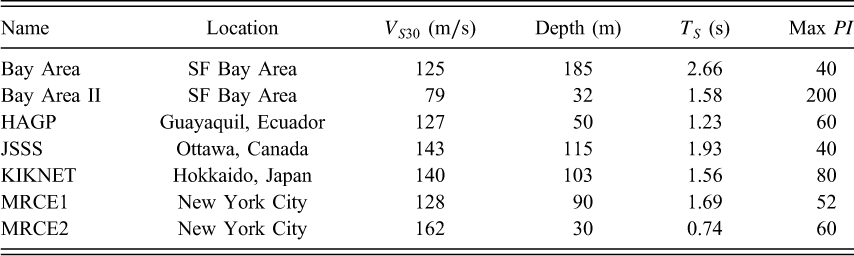
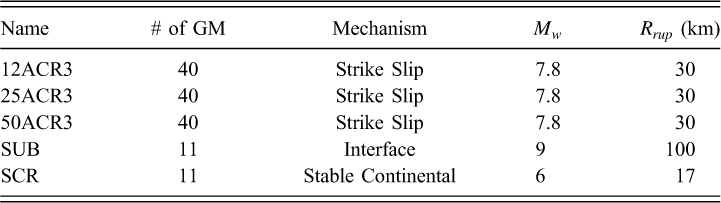
In addition to the above-mentioned database, we also included ELA and NLA from Carlton (2014). We included the results of site response analyses from seven sites, which are listed in Table 1, and five scenarios, which are listed in Table 2. The seven sites are based on actual sites with organic, high plasticity, or deep soft soil deposits (i.e., non-liquefiable NEHRP F sites) from the United States, Canada, Japan, and Ecuador. Table 2 lists the number of ground motions in each scenario, as well as the target mechanism, magnitude, and distance. Carlton (2014) selected rock ground motions with similar characteristics to the target values and then scaled the ground motions so that the mean and standard deviation of their response spectra matched those calculated by ground motion prediction equations. Carlton (2014) conducted the site response analyses in the program DEEPSOIL using a similar methodology as outlined above.
Sites from
Ground motion scenarios from
Best Predictor Variable of the Difference between Ela and Nla
We calculated the difference (δ) between the predicted results of the two analysis methods as:

We calculated the Pearson product-moment correlation coefficient ρ between the value of δ for 6 output parameters (Y) and 14 input parameters (X) to determine which input parameter was the best predictor of δ for each output parameter. Table 3 describes the 6 output and 14 input parameters. In addition, we calculated ρ between the RMSES and the 15 input parameters, where RMSES is the root mean squared error of the spectral accelerations calculated at the surface using 75 periods between and including the periods of 0.05 s and 5 s of the ELA and NLA.
Description of the input and output parameters used to estimate the best predictor of difference between ELA and NLA
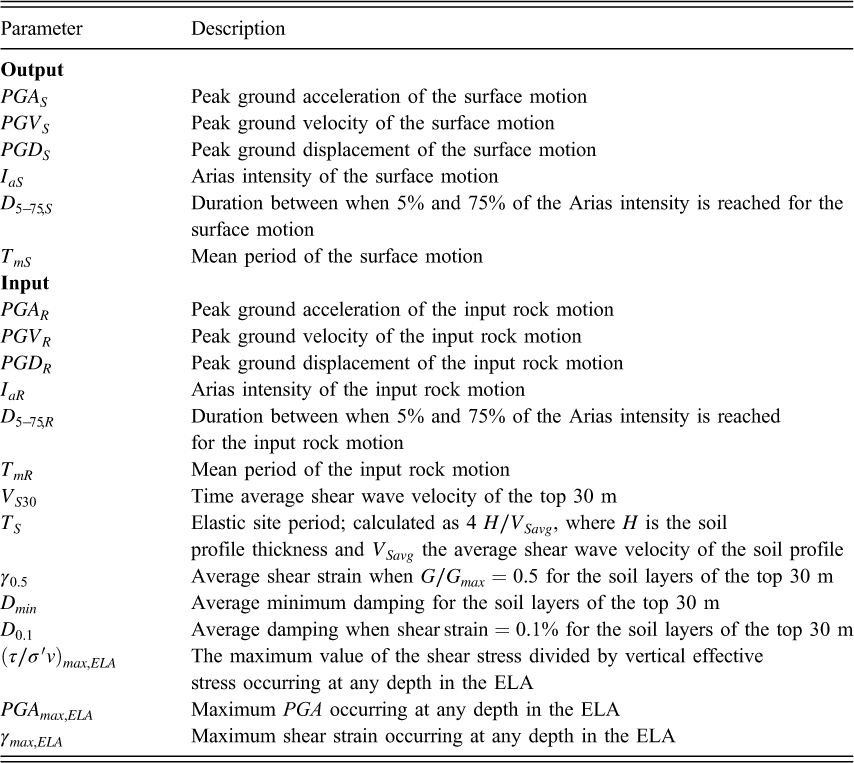
Table 4 lists the absolute values of ρ calculated between the 14 input parameters and the seven output parameters. The values in Table 4 are the larger absolute value of ρ calculated using both the arithmetic and natural log value of the input parameters. The value in parentheses next to each ρ value is the rank, where 1 signifies that the input parameter is the best predictor of δ or RMSE S for the corresponding output parameter, and 14 is the worst. Table 4 shows that γmax,ELA is the best predictor of δ for PGA S , PGV S , I aS , and D5–75,S, as well as the best predictor of RMSE S . These results agree with those of Kaklamanos et al. (2013), who found that γmax,ELA was the best predictor of the residual between observed response spectra and response spectra predicted by ELA. The shear strain is the best predictor of the difference δ between results of ELA and NLA because it directly controls the stiffness and damping values used in the analyses. Other parameters such as PGA R or VS30 are good predictors because they are correlated with γmax,ELA, however, individually they are not as good of predictors as γmax,ELA. In this paper we use γmax,ELA instead of γmax,NLA because it is customary to perform ELA first, then NLA if necessary; therefore, we measure change using the results of the ELA as a baseline.
Pearson coefficient ρ between 14 input parameters and the difference δ of six predicted output parameters and the RMSE S , the number in parentheses is the rank, where 1 is the best predictor
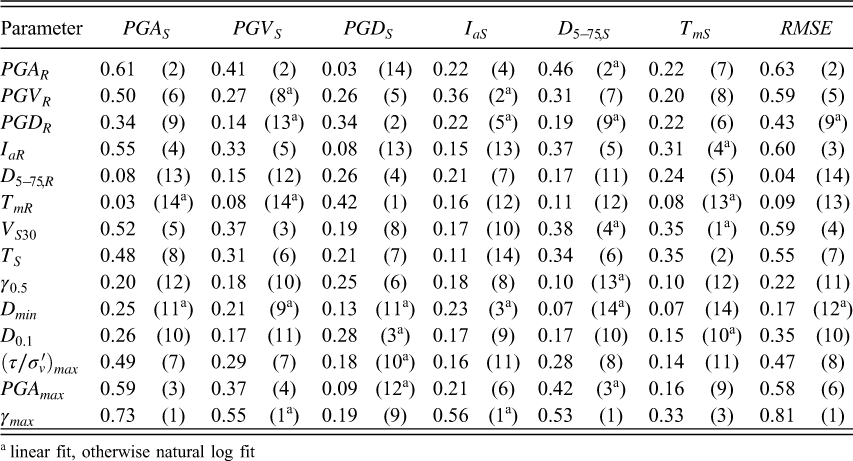
linear fit, otherwise natural log fit
Model to Predict Maximum Shear Strain
The previous section showed that γmax,ELA is the best predictor of the difference between ELA and NLA of the 14 parameters investigated in this study. This section describes the development of a model to estimate γmax,ELA that will aid engineers in the decision of which analysis type to perform. Assimaki and Li (2012) and Kim et al. (2013) developed models to estimate the difference between the response spectral values predicted by linear and nonlinear analyses, and equivalent linear and nonlinear analyses, respectively. The advantage of developing a model for γ max is that it can be used to predict the difference for multiple ground motion parameters instead of only spectral acceleration values.
For shear waves in an unbounded homogeneous medium the shear strains are directly proportional to the particle velocity at all times. As a result, the shear strain time series of an earthquake can be calculated as the velocity time series divided by the shear wave velocity. The maximum shear strain can then be estimated as (Tokimatsu et al. 1989):


We used VS30 as a proxy for VS0 because it is an average value of the shear wave velocity over the soil layers most likely to experience the maximum shear strain and it is widely available for most sites. We investigated using the shear wave velocities averaged over the top 20 m (VS20) and the top 10 m (VS10) instead of VS30, however, these did not improve the fit. We used PGV R instead of PGV max because they are highly correlated.
We used a mixed-effects regression model (Pinheiro and Bates 2000) with Equation 3 to solve for α. Mixed-effects regression is a maximum likelihood method that accounts for correlations in the data within specified groups. The total residual (δ Total ) is composed of two parts: the between-group residual (δB) and the within-group residual (δW), where δB is the mean value of the residuals for a specific group, and δW is the observed value minus δB and the predicted value. The within-group and between-group residuals are assumed to be independent normally distributed with standard deviation ϕ and τ, respectively. The total standard deviation (σ T ) for the model is then computed as σ T = (ϕ2 + τ2)0.5. In this paper, we group the data by site, similar to Kaklamanos et al. (2013, 2015). In addition, using a mixed-effects regression allows the influence of site effects (between-group) and ground motion effects (within-group) to be more easily observed.
When we examined the residuals from Equation 3, we found a strong dependence of δW on T
mR
and of δB on T
s
. Figure 3a and Figure 3b show this dependence. This occurs because PGV
max
is not completely described by PGV
R
, but also depends on other site and ground motion parameters. When we include the effects of T
mR
and T
s
, the equation for γmax,0 becomes:

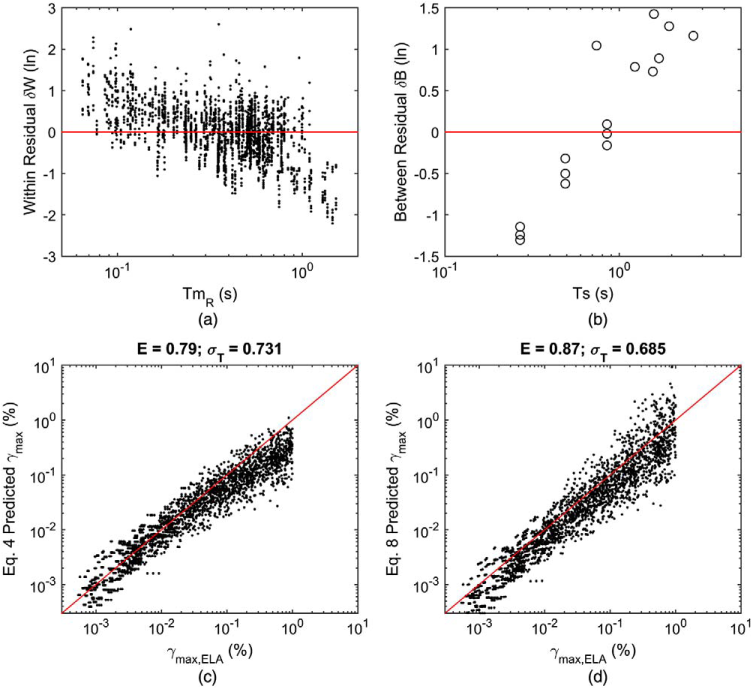
(a) Within residual and (b) between residual for Equation 3; (c) maximum shear strain calculated by equivalent linear analyses versus the maximum shear strain predicted by Equation 4, which does not account for V S degradation, and (d) Equation 8, which does account for V S degradation.
Figure 3c plots the predicted values using Equation 4 versus the calculated γmax,ELA values. Figure 3c shows that at large shear strain values Equation 4 under predicts the value of γmax,ELA. This is because at large shear strains, V
S
decreases due to degradation of the soil matrix. Therefore, to calculate the maximum shear strain at large shear strains (γ
max
), the degraded shear wave velocity (V
S deg
) should be used instead of VS0:




We performed mixed effects regression using Equations 4 and 8 and calculated α = 0.71. This value is similar to the value of 0.6 found by Tokimatsu et al. (1989). In Equation 8 we defined γ ref as γ0.5, which is the average value of γ when G/G0 = 0.5 over the top 30 m of the soil profile. We found that the average value of γ0.5 gave a better fit than the maximum or the minimum value. Figure 3d plots the γmax,ELA values versus the predicted values for Equation 8. Figure 3d shows that by including the effect of V S degradation the model is able to predict γmax,ELA values at large shear strains better than when it does not include the effects of V S degradation (Figure 3c). The total standard deviation is σ T = 0.685 natural log units, or slightly less than a factor of two, and the coefficient of efficiency, E, is 0.87.
Comparison of the Difference between Ela and Nla
In this section, we present the differences δ between ground motion parameters calculated from the results of ELA with those from NLA. The previous sections showed that γ max is the best predictor of δ, therefore, Figure 4 presents δ values versus γmax,ELA. In Figure 4 the black dots are the individual differences, and the solid red line in each plot is calculated using the loess function (Cleveland and Devlin 1988). The loess function is a locally weighted polynomial regression line calculated at each point using a specified number of closest data points. The loess function provides an estimate of the general trend of the data. We compare the δ values found in this study with standard deviations from established ground motion prediction equations (GMPEs) to better understand the relative importance of the difference. We define the difference as non-negligible (δ nn ) when the trend line predicted by the loess function is greater than one quarter the value of the total standard deviation for a GMPE of the same parameter. The shear strain where δ nn occurs is called the non-negligible threshold shear strain (γ nn ). We also show the mean and one standard deviation bars of the δ values for 10 bins equally spaced on a log scale.
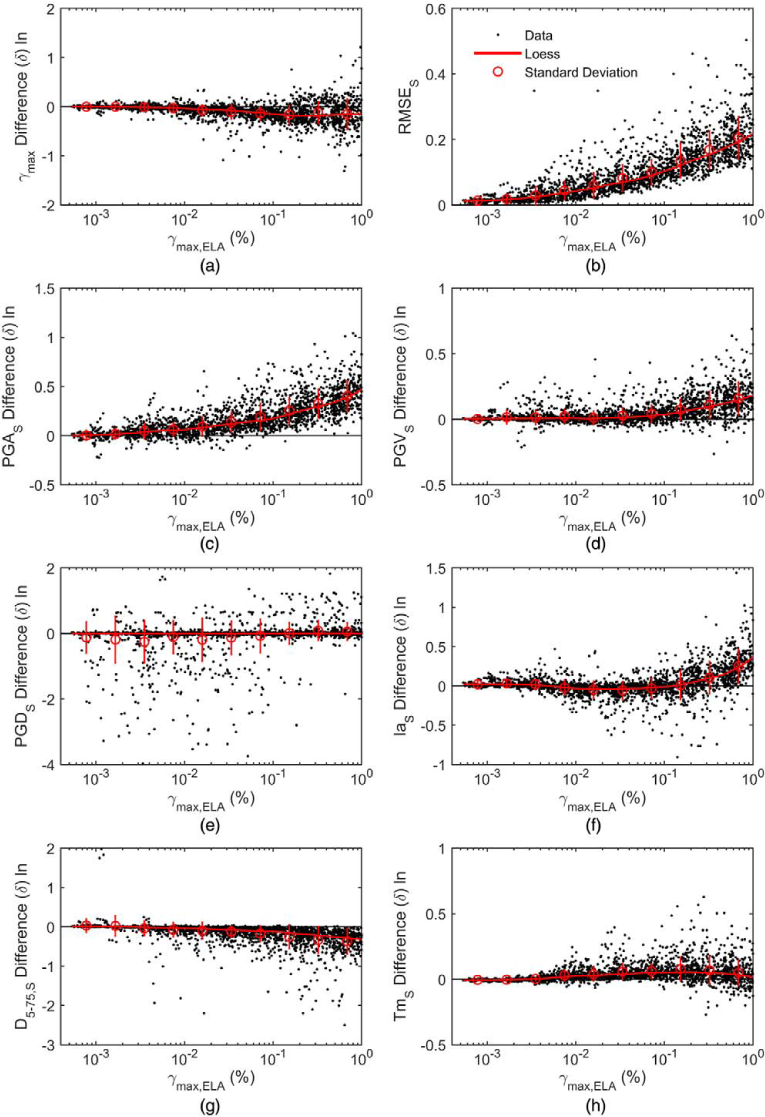
Differences δ for (a) γ max , (b) RMSE S , (c) PGA S , (d) PGV S , (e) PGD S , (f) I aS , (g) D5–75,S, and (h) T mS versus γmax,ELA, where the black dots are the individual differences, the red lines are the trend lines predicted by the loess function, and the circles and error bars give the mean and standard deviation of the data for ten equally spaced bins.
Figure 4 shows that as γmax,ELA increases, ELA in general predict smaller γ max and D5–75 values (negative loess line), larger PGA S , PGV S , I aS , and T mS values (positive loess line), and similar PGD S values as NLA. ELA use one value of stiffness and one value of damping for each soil layer for the entire duration of the ground motion. The value of the stiffness and damping correspond to an effective shear strain that is a fraction of the maximum shear strain. As a result, the equivalent linear transfer function will use a lower stiffness and higher damping for parts of the ground motion with strains smaller than the effective shear strain, and higher stiffness and lower damping for parts of the ground motion with shear strains larger than the effective shear strain.
Because ELA over predict the stiffness for shear strains larger than the effective shear strain, they will estimate smaller maximum shear strains than NLA. For example, when the same external force is applied to a stiff object such as a rod of metal, it will deform less than a ductile object such as a rod of rubber. Earlier in this paper we developed a model for γmax,ELA and calculated a standard deviation of 0.685 ln units, which gives δ nn = 0.17 (0.685/4 = 0.17) and γ nn = 0.136%. In other words, the absolute δ values of γ max predicted by the loess line are non-negligible for γmax,ELA values of 0.136% and larger.
As γmax,ELA increases, Figure 4 shows that the RMSES values increase as well. The RMSE S values increase as the shear strain increases because the soil behaves more nonlinearly, with a greater change in the stiffness and damping properties over the duration of the ground motion. As a result, the absolute differences between the predicted acceleration response spectra of the ELA and NLA increases. Figure 4 shows this same trend for γ max , PGA S , PGV S , I aS , and D5–75. At γmax,ELA = 0.1% the RMSE S values are 0.104 natural log units, and at γmax,ELA = 1.0% the RMSE S values are 0.22 natural log units.
Integration from acceleration to velocity and velocity to displacement tends to dilute the high frequency components of a record and augment the low frequency components (Stewart et al. 2001). As a result, PGA, PGV, and PGD are most affected by high, mid-range, and low frequency energy, respectively. Long-period seismic waves (low frequencies) sample deeper and generally stiffer layers of a site profile and have wavelengths longer than the thickness of the soft soil layers. Therefore, they are not as affected as short period seismic waves by shallow soft soil layers that typically experience the greatest nonlinear effects. As a result, Figure 4 shows that the PGA S δ values have the greatest trend, with ELA predicting larger PGA S values than NLA. The PGV S δ values show the same trend, but the bias is not as large as for the PGA S δ values. Finally, the PGD S δ values show no trend with γmax,ELA because they are controlled by the longest period seismic waves. ELA estimate larger PGA S and PGV S values than NLA because they over predict stiffness and under predict damping for shear strains greater than the effective shear strain. Abrahamson et al. (2014) calculated standard deviations for PGA and PGV of 0.6 to 0.9 and 0.6 to 0.8 natural log units, respectively. The γ nn value for the PGA S is 0.067%, and for the PGV S it is 0.70%. Even though the trend line for the PGD S δ values is zero, the standard deviations range from 0.27 to 0.71 natural log units, which are significant when compared with the standard deviations of 0.825 and 0.90 natural log units calculated by Campbell and Bozorgnia (2008) and Alavi et al. (2011). Figure 4 shows that even though there is no bias in the prediction of PGD S between the two analysis methods, the difference in the predicted value of PGD S could be significant.
The trend line predicted by the loess function for I a in Figure 4 is zero at small shear strains, negative from γmax,ELA = 0.003% to 0.1%, and positive for γmax,ELA > 0.1%. For γmax,ELA < 0.003% the soil behaves almost linearly so the difference between ELA and NLA is negligible. The trend for γmax,ELA > 0.003% is due to two opposing effects. ELA over damp ground motions for shear strains less than the effective shear strain, which reduces the total energy in the ground motion. However, for shear strains larger than the effective shear strain, ELA use smaller damping than NLA, which allows more energy to propagate to the ground surface. Because the Arias intensity is defined as the sum of the squares of the acceleration values, it gives more weight to larger acceleration values. At lower acceleration values the difference between the largest and smallest squared acceleration values is not that great, so the effect of larger damping on shear strain cycles less than the effective shear strain is dominant. At higher acceleration values, however, the large acceleration values dominate the calculation of I a . Therefore, at higher acceleration values, the effect of under damping shear strains greater than the effective shear strain dominates, and ELA predict greater values of I a than NLA. Travasarou et al. (2003) and Foulser-Piggot and Stafford (2011) calculated standard deviations for I a between 0.85 to 1.3 and 0.95 to 1.3 ln units, respectively. The value of γ nn value for I aS is therefore 0.61%.
Figure 4 shows that ELA predict smaller values of D5–75,S than NLA. This is because ELA use only one value of stiffness and damping so they under predict the accelerations at the beginning and end of a time series when the shear strain values are small, and over predict the acceleration values in the middle of the time series when the shear strain values are large. This causes the ratio of the energy to shift from the ends of the time series to the middle. This effect reduces the duration because D5–75,S is calculated as the time between when 5% and 75% of the Arias intensity occurs. Figure 5 shows this graphically using a Husid plot for one pair of ELA and NLA. A Husid plot portrays the cumulative fraction of the Arias intensity that has occurred versus time. Figure 5 shows that the ELA have a steeper curve than the NLA, which means that more of the energy of the ground motion occurs in a shorter time span. The NLA calculate that the energy is more distributed in time, and thus predict a longer duration. Kempton and Stewart (2006) and Ghanat (2011) calculated standard deviation values for D5–75 of 0.53 and 0.56 ln units, respectively. Therefore, the γ nn value for D5–75,S is 0.124%.
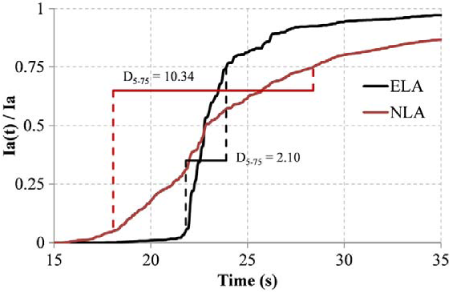
Husid plot showing the difference in the distribution of energy and duration (D5–75) between equivalent linear (ELA) and nonlinear analyses (NLA).
Figure 4 shows that the trend line predicted by the loess function for the T mS δ values is positive, which means that the ELA predict larger T mS values than the NLA. The mean period as defined by Rathje et al. (2004) is the period corresponding to the centroid of the Fourier amplitude spectrum. This study found that ELA tend to predict more peaked response spectra than NLA, with larger amplifications near the natural site period. This change in the ratio of short period to long period amplitudes relative to those predicted by NLA is why ELA predict larger values of T mS than NLA. This phenomenon is explained in more detail later. Rathje et al. (2004) calculated standard deviations for T m of 0.35 for NEHRP D sites and 0.49 for NEHRP C sites. The maximum absolute value of the trend line for the T mS δ values is 0.054, which is less than 25% of 0.35. Therefore, we conclude that the difference in the predicted T mS values between the two analysis methods is negligible.
Table 5 summarizes the non-negligible threshold differences (δ nn ), the shear strains where δ nn occurs (γ nn ), and the largest absolute values of the loess predicted trend line (δ max ) up to a shear strain of 1% for the parameters discussed above. PGA S has the smallest value of γ nn at 0.039%, with the other values ranging from 0.124% to 0.700%.
Results of the site response analysis comparison, where δ nn is the δ value defined as the non-negligible threshold, γ nn is the shear strain where δ nn occurs, and δ max is the largest absolute value of δ for γ max, ELA < 1%
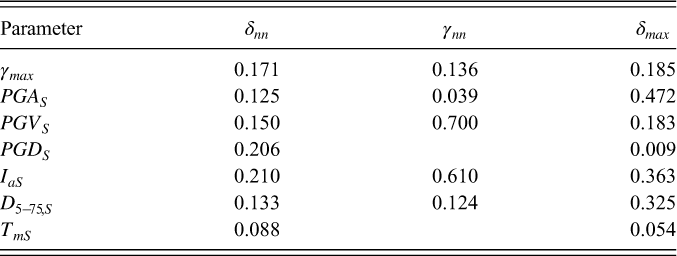
Figure 6 shows trend lines predicted by the loess function for the δ values of spectral acceleration versus period and γmax,ELA. Figure 6 shows that at large shear strains the ELA predict larger spectral acceleration values than the NLA at short periods and periods near the natural site period, which agrees with the results of Rathje and Kottke (2011). For periods longer than 2 s, Figure 6 shows that the spectral acceleration difference is less than 0.05 natural log units. There is little difference at long periods because, as mentioned earlier, long period seismic waves are not as affected as short period seismic waves by shallow soft soil layers that usually experience the greatest nonlinear effects. These results are similar to Kaklamanos et al. (2013) and Kim et al. (2013), who found negligible nonlinear effects for periods longer than 0.5 s and 1 s, respectively. The reason for the difference in period where nonlinear effects become negligible is most likely due to the difference in the natural site periods of the sites investigated and the level of ground motion intensity. Deeper and softer soil sites have longer natural site periods that may show nonlinear effects at long periods, especially for larger intensity motions that induce larger maximum shear strains.
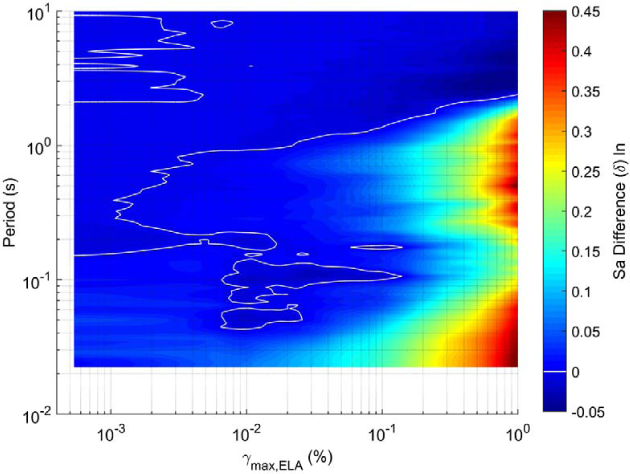
Sa δ values predicted by the loess trend line by period and γ max, ELA , white line shows the zero contour.
Figure 6 also shows that for periods between 0.1 s and 0.2 s and γmax,ELA values less than 0.1% the ELA predict similar or smaller spectral acceleration values than NLA, which agrees with the results of Rathje and Kottke (2011) and Kaklamanos et al. (2015). For γmax,ELA > 0.1% and periods between 0.1 s and 0.2 s Figure 6 shows the opposite trend, with ELA predicting larger spectral accelerations than NLA. There is very little energy in ground motions at periods less than the peak period of the response spectrum, so a single degree of freedom oscillator follows the response of the ground more than its own natural period (Carlton and Abrahamson 2014). The response at short periods is therefore controlled by the dominant period of the acceleration time series more than the response at its own period, where the dominant period is manifested as the peak period of the response spectrum. Because ELA over predict the response spectrum near the natural site period, they predict a higher response spectral value at the peak period, which increases the response of all of the spectral acceleration values at shorter periods. At large shear strains this effect is greater than the over damping of ELA and the amplification of NLA due to stress reversals explained earlier. As a result, ELA may predict larger values of spectral acceleration than NLA for periods between 0.1 s and 0.2 s.
Figure 7 shows the combination of these effects graphically. Figure 7a shows the mean surface response spectrum of the 40 ground motions for scenario 50ACR3 at site HAGP, and Figure 7b shows the mean surface response spectra divided by their peak response spectral values. Figure 7a shows that the ELA predict larger absolute spectral accelerations than NLA for periods less than the peak period, which contradicts the findings of Rathje and Kottke (2011). However, Figure 7b, which plots the response spectra normalized by their peak values, shows that the NLA predict a broader response spectrum with larger relative Sa values for periods less than the peak period than ELA. This is why NLA predict slightly smaller Tm values than ELA. The results shown in Figure 7 are similar to a majority of the sites investigated, however, there is much variance in the results, as show in Figure 8.
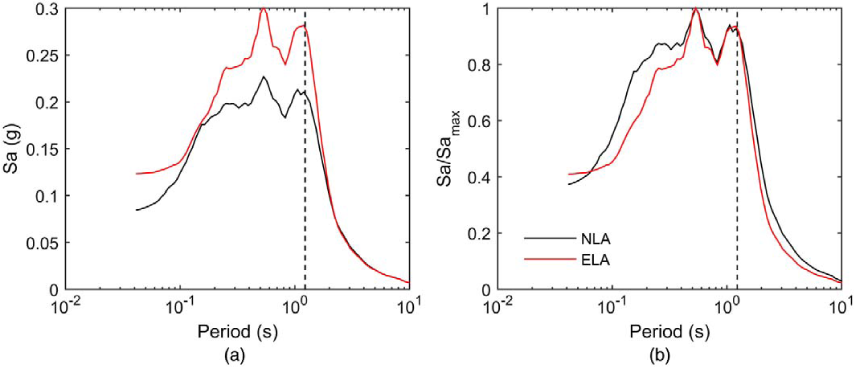
Comparison of the (a) mean response spectrum and (b) normalized mean response spectrum for the 40 ground motions in scenario 50ACR3 at site HAGP predicted at the soil surface by equivalent linear (ELA) and nonlinear analyses (NLA), dotted vertical line is the elastic site period (T S = 1.23 s).
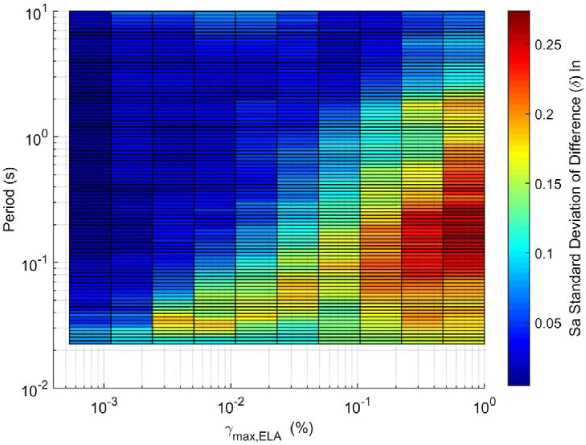
Standard deviation of Sa δ by period and γmax,ELA.
Figure 8 shows the standard deviations of the δ values of spectral acceleration by period and γmax,ELA for the same bins as shown in Figure 4. The trend lines shown in Figure 4 give the bias between ELA and NLA, whereas the standard deviations of the δ values show the uncertainty in that bias. The largest standard deviations in Figure 8 are for periods between 0.1 s and 0.2 s with γmax,ELA > 0.1%. This shows that even though the loess predicted trend line is positive for these periods and shear strains, the uncertainty and scatter of the Sa δ values is large. This is further confirmed by the fact that the largest standard deviations are 0.27 natural log units, which are greater than the 0.20 to 0.25 natural log units of the trend lines shown in Figure 6.
Figure 8 also shows that as γmax,ELA increases the standard deviations of the Sa δ values increase, with long periods showing the smallest standard deviations. The standard deviations of δ increase as γmax,ELA increases because at larger shear strain values the difference in stiffness and damping values over the duration of the ground motion increases, which leads to greater variation in the difference between the two analysis methods. The standard deviations are smallest for long periods because, as mentioned earlier, long periods are not as affected by soil nonlinearity as short periods, therefore, the difference in the predicted results between the two analysis methods is smaller and the variation in that difference is reduced.
The standard deviations of Sa values predicted by the NGA-West2 GMPEs are between 0.5 and 0.8 natural log units, with larger standard deviations at longer periods, greater distances, and smaller magnitudes (Gregor et al. 2014). Figure 9 shows the γmax,ELA value for each period where the Sa δ values from Figure 6 are greater than 0.125 natural log units, which we define as the non-negligible threshold. Figure 9 shows that the Sa δ values are non-negligible at γmax,ELA values of 0.05%, 0.5%, 0.2%, and 1.0% for periods of 0.3 s, 0.1 s to 0.2 s, periods near the natural site period, and 2 s, respectively. These shear strain values are similar to those found by Kaklamanos et al. (2013, 2015) for predictions compared with measured vertical array data.
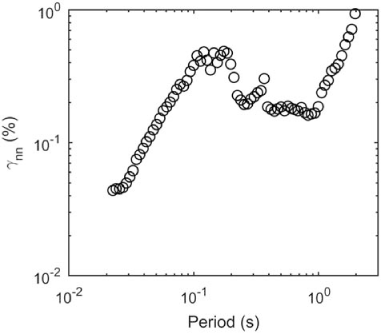
The value of γmax,ELA when the trend line predicted by the loess function for the Sa δ values is non-negligible (γ nn ; i.e., the γmax,ELA value when the Sa δ > 0.125 natural log units).
Summary and Conclusions
We conducted ELA and NLA in the program DEEPSOIL using 189 ground motions, nine hypothetical sites, and seven actual sites. Six of the seven actual sites contain organic, high plasticity, or deep soft soil deposits. These types of sites are the ones most likely to require a site response analysis and to generate large shear strains, therefore it is crucial that these sites be included in comparison analyses. We also corrected the shear modulus reduction and damping curves of the ELA and NLA site models to account for soil shear strength at large shear strains. If this modification is not performed, site response analyses could give erroneous results at large shear strains.
We investigated when the two methods predict different results and the magnitude of the difference (δ). We found that the best predictor of δ was the maximum shear strain (γmax,ELA) induced in the soil column in ELA. To help engineers decide when to use ELA or NLA we developed a model to estimate γmax,ELA values. The model predicts that as PGV R or T S increase, γmax,ELA increases, and as VS30, T mR , or γ0.5 increase, γmax,ELA decreases. The advantage of developing a model for γmax,ELA instead of directly for δ is that it can be used to predict the difference for multiple ground motion parameters. All of the input parameters necessary for the model are site and ground motion parameters, therefore the value of γmax,ELA and the difference between results of ELA and NLA can be estimated before performing a site response analysis.
The results of the comparison between ELA and NLA show that as γmax,ELA increases, ELA in general predict smaller γ max and D5–75 values, larger PGA S , PGV S , I aS , and T mS values, and similar PGD S values as NLA. In addition, as γmax,ELA increases, ELA predict larger spectral accelerations than NLA for periods less than 0.1 s and periods near the natural site periods of the sites investigated (0.2 < T < 2.0 s). For periods between 0.1 s and 0.2 s ELA predict similar or slightly larger spectral accelerations than NLA, and for periods greater than 2 s the differences are negligible.
We compared the δ values found in this study with standard deviations calculated from GMPEs for similar parameters. We define the difference as non-negligible when the trend of the δ values calculated by the loess function is greater than one quarter of the standard deviation calculated by a GMPE for the same parameter. Using this method, we can objectively evaluate the magnitude of the differences between the results predicted by ELA and NLA. We found that the differences between the predicted values of PGD S and T mS are negligible for γ max values up to 1%, and that the differences for the other investigated parameters are non-negligible for γ max values ranging from 0.04% to 1%. The findings of this study will allow engineers to predict what the difference will be between the results of ELA and NLA for different output parameters, and will help them decide which analysis method to use based on the needs and priorities of their specific project.
Footnotes
Acknowledgments
This first author conducted this research while supported by a Japanese Society for the Promotion of Science (JSPS) Fellowship. This support is gratefully acknowledged.