






Abstract
The state-of-the-practice in seismic network reliability assessment of highway bridges often ignores bridge failure correlations imposed by factors such as the network topology, construction methods, and present-day condition of bridges, among others. Additionally, aging bridge seismic fragilities are typically determined simply using historical estimates of deterioration parameters. This research presents a methodology to estimate bridge fragilities using spatially interpolated and updated deterioration parameters from a limited set of instrumented bridges in the network, while incorporating the impacts of overlooked correlation factors in bridge fragility estimates. Simulated samples of correlated bridge failures are used in an enhanced Monte Carlo method to assess bridge network reliability, and the impact of different correlation structures on the network reliability is discussed. The presented methodology aims to provide more realistic estimates of seismic reliability of aging transportation networks and to potentially help network stakeholders to more accurately identify critical bridges for maintenance and retrofit prioritization.
Introduction
Highway bridges are critical for the reliability of transportation networks and yet are rapidly deteriorating, with nearly one in four bridges declared as structurally deficient or functionally obsolete (ASCE 2013). Furthermore, many of these aging bridges are located in regions characterized by medium to high seismicity, spurring recent studies on the impact of aging and deterioration on seismic vulnerability (Choe et al. 2008, 2009; Ghosh and Padgett 2010, 2012). However, most of the recent seismic vulnerability estimates that account for aging mainly rely upon historical evidence of deterioration parameters available in region-specific databases or on limited laboratory test data. Such estimates may lead to potential under- or overestimation of bridge fragilities because most environmental degradation mechanisms, such as corrosion deterioration, are not static processes, but are influenced by changes in the atmosphere, such as temperature and moisture content, among others (Stewart 2004, Moncmanová 2007). Recent advances in monitoring and sensor technology have enabled field instrumentation of bridges to estimate in-situ deterioration parameters. While several researchers have demonstrated the importance of updating service load reliability using field instrumented data (Marsh and Frangopol 2008, Strauss et al. 2008, Stewart and Suo 2009), such emphasis is limited in seismic reliability predictions of highway bridges coupled with aging effects. Only recently, Huang et al. (2009) has highlighted the potential to incorporate nondestructive testing data from bridge monitoring to compute fragility estimates of reinforced concrete bridge columns. Nevertheless, the field measurement of bridges is an expensive and labor-intensive task, which makes it impractical to obtain sensor measurements of every bridge in an aging transportation network. Spatial interpolation techniques may address this issue by approximating deterioration parameters at non-instrumented bridge locations from nearby instrumented bridges in the network. While these spatial interpolation techniques have been used to predict deterioration parameters across a single bridge (Gassman and Tawhed 2004), such applications are lacking with respect to predictions across a portfolio of highway bridges distributed over a region. The interpolated or instrumented deterioration parameters can then be used to assess individual aging bridge fragilities across the network after updating the historical aging parameters using Bayesian methodologies. While updating the deterioration parameters improves upon the state-of-the-art methods to assess individual bridge fragilities and subsequently provides a more accurate estimate of the bridge network reliability, such estimates may be further enhanced by considering correlations among bridge failures.
The prevalent practice in seismic reliability studies of bridge networks assumes independent failures among bridges. However, recent research has shown that correlated failures stemming from correlations in seismic intensities result in significant changes in both network reliability and seismic loss estimates (Wesson and Perkins 2001, Kiremidjian et al. 2007, Kang et al. 2008, Jayaram and Baker 2009, Bocchini and Frangopol 2011). The failure correlations from seismic intensity are triggered by factors such as the geographical proximity of the bridges in a transportation network. Intensity correlations affect the bridge failure probabilities by an error term in computing the intensity measure at bridge locations throughout the network, as in Equation 1:

Unlike intensity correlations, the impact of bridge failure correlations originating from correlated bridge structural capacities has not received much attention. The structural vulnerabilities of bridges may be correlated due to factors such as the structural conditions of the bridges, similar construction detailing, traffic flows, fatigue, and proximity to deteriorating environments, among others (Kiremidjian et al. 2007). The impact of such sources on correlated seismic response of structures is not always known, nor have all potential sources of correlations been identified.
This research focuses on quantifying the impact of correlations that stem from bridge structural capacities under joint seismic and aging threats. Since the influence of intensity correlations has been presented elsewhere (e.g., Jayaram and Baker 2010), this study considers a single seismic scenario analysis for which the error term in Equation 1 can be set to zero (Wesson et al. 2009). The reason is that a single seismic scenario analysis does not involve the inter-event error, while the intra-event error is set to zero since the mean intensity measure value will be used in the analysis. Moreover, some of the factors affecting the structural vulnerability of bridges (such as the effects of the corrosive agents) are directly modeled in bridge fragility models. This study, therefore, is concerned with the contributing factors to the correlation structure among bridge failures, which are not integrated into bridge fragility models, and are referred to as “extra correlations” in this article.
The proposed bridge reliability assessment in networks (BRAN) methodology improves upon the state-of-the-art in two ways: (1) by evaluating seismic fragilities for aging highway bridges in a network after Bayesian updating of spatially interpolated/measured deterioration parameters; and (2) by estimating the network reliability considering correlated bridge failures. This integrated methodology is summarized in Table 1 and is explained and exemplified throughout this two-part paper. Individual bridge failure probabilities are determined in Stage A by a parameterized fragility formulation approach after considering the updated statistical distributions of the deterioration parameters, while bridge network reliability is assessed in Stage B by incorporating the extra correlations among individual bridge failure probabilities. While the presented methodology is generally applicable to evaluate the bridge network reliability with correlated bridge failures, the companion Application paper proposes methods to determine the correlation values when direct estimates are not available. For this purpose, the aggregated effects of several available information sources on the level of correlations among bridge failures are examined and combined to form a correlation structure.
The BRAN methodology to assess network reliability, including aging bridge instrumentation data and correlated bridge failures
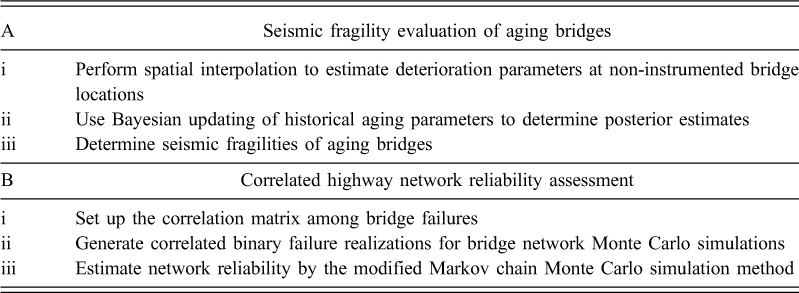
The following section explains spatial interpolation using Kriging and subsequent Bayesian updating of field measurable bridge deterioration parameters (Stages A.i and A.ii). This discussion leads to the development of parameterized fragility formulations to express the seismic vulnerability of aging bridges as a function of the seismic intensity and critical bridge parameters (Stage A.iii). Prior to Stage B, the impact of extra correlations on the reliability of bridge networks is discussed through closed-form network reliability calculations to emphasize their potential significance in network reliability evaluations. Stages B.i and B.ii detail the simulation of correlated bridge failures, utilizing their parameterized fragility functions and the estimated extra correlation values. The modified Markov chain Monte Carlo (MCMC) simulation method is then introduced in Stage B.iii to estimate the reliability of bridge networks based on the simulated correlated bridge failures. The final section provides a summary of the BRAN methodology and offers conclusions.
Spatial Interpolation and Bayesian Updating of Deterioration Parameters in Bridge Networks (Stages A.I and A.Ii)
Environmentally dependent deterioration parameters or degrading agents, such as chloride concentration, diffusion coefficient, corrosion rate, etc., are strongly correlated across bridges located within close proximity. Consequently, spatial interpolation techniques can be employed to assess deterioration parameters for non-instrumented highway bridges from sensor monitoring data of a limited number of instrumented bridges within the network. In the absence of instrumentation, aging bridge reliabilities are often computed using historical estimates of the degrading agents available in region-specific databases (Enright and Frangopol 1998, Ghosh and Padgett 2010) or from limited laboratory test data (Choe et al. 2008, 2009). Hence, the field-measured and interpolated deterioration parameters can be used to statistically update available probability distributions of aging parameters and make better predictions of seismic bridge fragilities. The following sections elaborate further on the spatial interpolation and statistical updating techniques of deterioration parameters.
Spatial Interpolation of Deterioration Parameters
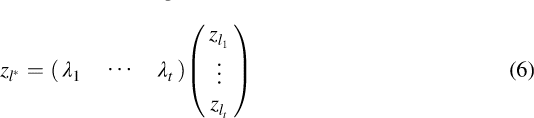
While several interpolation procedures are available in spatial data analysis, this study employs Kriging (Krige 1951), a widely popular method in the field of geostatistics. Although several strategies, such as polynomial fittings, trend surface analysis, etc., exist for spatial interpolation, Kriging has several clear advantages over these methods. First, Kriging incorporates the correlation structure among observations while making predictions at unobserved locations. Second, while such methods as trend surface analysis can be significantly affected by the location of data points and produce extreme fluctuations in predicted estimates in sparse areas, Kriging predictions are more stable over sparsely sampled regions (Mackaness and Beard 1993). However, user discretion is recommended with respect to using Kriging for spatial interpolation when localized effects or other discontinuities are present in the spatial process. Under such circumstances, the Kriging procedure is known to perform poorly and use of alternative spatial interpolation techniques, such as Bayesian partition modeling is recommended. It is assumed in this study that sudden discontinuities are rare for deterioration parameters distributed across a region, and hence, the Kriging procedure is adopted. The Kriging method belongs to the family of linear least squares estimation algorithms and helps to determine the magnitude of influence of neighboring observations when predicting values at unobserved locations (Trauth et al. 2010). Although different Kriging methods exist, the popular ordinary point Kriging method is adopted in this study, owing to its simplicity while retaining the key advantages of the Kriging procedure (Mount et al. 2008, Trauth et al. 2010). While details of this method can be found elsewhere (Cressie 1993, Olea 1999), the main steps involved in this procedure are provided in the context of inferring deterioration parameters across a bridge network.




Statistical Updating of Deterioration Parameters
Statistical procedures, such as the Bayesian updating method, have emerged in infrastructure engineering as a powerful tool to rationally combine the information available on deterioration parameters from historical databases and new inspection data from field measurements (Enright and Frangopol 1999, Congdon 2006, Straub and Kiureghian 2010). This updating technique preserves previously available information and systematically incorporates new field measurements of deterioration parameters. The general Bayesian updating procedure is presented in Equation 7:

Parameterized Seismic Fragility Formulation for Aging Bridges (Stage A.Iii)
The vulnerability of highway bridges under seismic shaking can be conveyed through seismic fragility curves. These conditional probabilistic statements were traditionally developed to predict the probability of meeting or exceeding a particular damage state of a bridge component or system given the intensity of ground motions (im), as shown in Equation 8:

A major disadvantage of such single-parameter fragility curves lies in their inability to assess the impact of any deteriorating bridge component on bridge performance during earthquakes, or to incorporate new information on deterioration parameters without the need for costly re-analysis. Hence, these single-parameter fragility curves can only be used to represent the seismic vulnerability of a non-deteriorating bridge or a bridge with an assumed level of deterioration using historical estimates.
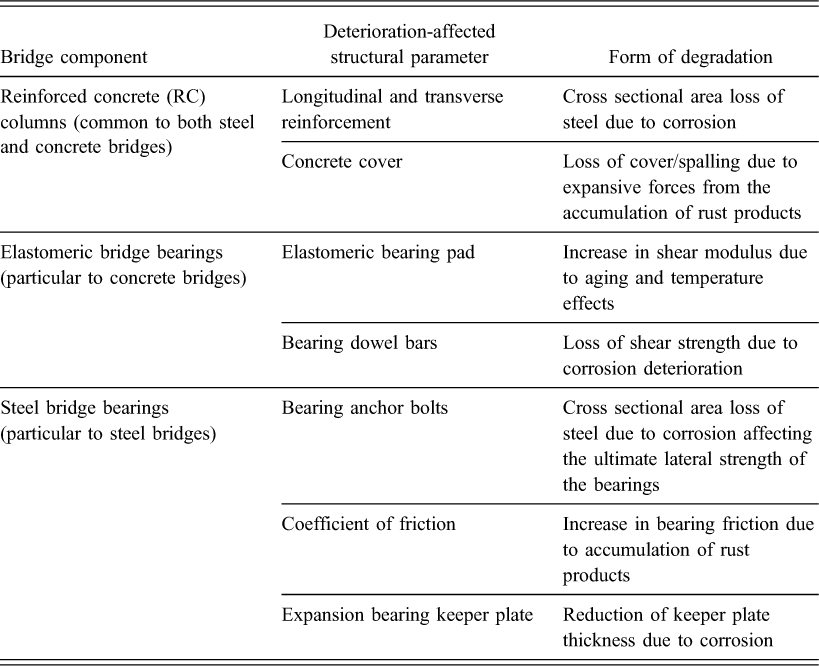
Many researchers have recently demonstrated the importance of considering deterioration of critical bridge components such as reinforced concrete (RC) columns and bridge bearings for deriving aging bridge seismic fragility curves (Choe et al. 2009, Ghosh and Padgett 2010, Alipour et al. 2010, Rokneddin et al. 2011). Additionally, Nielson (2005) identified several critical bridge structural modeling parameters for a variety of bridge types within the Central and Southeastern U.S. bridges inventory. Hence, the bridge fragility models derived in Stage A.iii are conditioned on deterioration-affected structural parameters, as well as on the critical structural modeling parameters identified by Nielson (2005). Consequently, Equation 8 is modified to represent bridge fragility as:

The deterioration-affected structural parameters and forms of degradation corresponding to materially different bridge types are shown in Table 2. The deterioration mechanisms associated with each form of degradation are discussed in further detail in Ghosh and Padgett (2010, 2012). The following subsections elaborate on the approach to construct the new parameterized fragility estimates using the set of conditioned parameters
Deterioration-affected structural parameters and forms of degradation corresponding to different bridge types
Phase 1: Develop Surrogate Demand Models for Component Responses Using Response Surface Methodology
The computational demands of complex three dimensional finite-element simulations of bridge models subjected to seismic shaking can be prohibitive for probabilistic analysis across a full parameter space. Hence, in order to reduce this computational burden, surrogate models or metamodels can be formulated to provide an analytically sound relationship between the predicted values (such as column curvature ductility, bearing deformation, etc.) and the predictor variables (such as earthquake intensity, reinforcing steel area, bearing pad shear modulus, etc.; Simpson et al. 2001). For the case at hand, the response


Traditionally, development of surrogate models/metamodels from computer simulations primarily consists of three main steps as outlined in Simpson et al. (2001) and summarized here:
Choose an efficient experimental design strategy to generate a sequence of experiments (finite-element simulations) to be performed. Each experimental design run in the sequence is expressed in terms of the factors (predictor variables) set at specified levels. For instance, if the entire sequence of experiments is represented by the matrix
Conduct the three dimensional finite-element analysis simulations of bridge models to obtain the data (
Choose a functional form of the surrogate model g(
Pertaining to the experimental design strategy, each of the critical bridge parameters (xi for i = 1, 2, …, m) is analyzed at five different levels to gain an in-depth understanding of the influence of the interaction between parameter levels that may be experienced throughout a bridge's lifetime on its seismic response. To overcome the curse of dimensionality, a special class of computer aided experimental design called D-Optimal design (Kiefer and Wolfowitz 1959) is adopted which is particularly useful when classical/“non-optimal” design strategies such as fractional factorial design, central composite design, etc., are impractical (Step 1 of surrogate model development). The most significant advantage of the D-Optimal design lies in its ability to maximize the amount of information generated in a limited number of runs besides being more efficient than classical design strategies in exploring the entire sample space of different parameter combinations (Kazmer 2009). This design methodology typically generates experimental designs using numerical optimization techniques and an iterative search algorithm that seeks to minimize the variance of parameter estimates (or maximize the determinant
In Step 3, the results obtained in the previous step are used to fit a model between each of the dependent predicted variables

Phase 2: Use the Surrogate Demand Models to Develop Bridge Fragilities via Logistic Regression
In this phase, the surrogate demand models are used to develop seismic fragility estimates. It should be noted herein that the seismic demands of the different components are correlated, and such component correlations are considered while drawing component demand samples. The component demand correlations are calculated by computing the pairwise correlations of the seismic response of bridge structural components obtained from the finite-element simulations of bridge models (Nielson and DesRoches 2007, Ghosh and Padgett 2010). These component correlations aid in the construction of the covariance matrix, which is used to establish the joint multivariate normal distribution of component demands. The individual bridge component demands are then sampled from this multivariate normal distribution to derive aging bridge fragility curves. Fragility estimates represent the probability of the demand exceeding the capacity of components or systems given a set of conditioned parameters as evident from Equation 9. Fragility curves are generated in this study via logistic regression using the Monte Carlo simulation approach. In this approach, a large number of demand samples (Nlogistic) are first generated using the surrogate demand model

This vector of binary elements is used to develop component-level fragility curves through the logistic regression method which has been used in the past for constructing multi-dimensional fragility surfaces particularly for vector valued earthquake intensity measures (Baker and Cornell 2005, Koutsourelakis 2010). In this study, the concept of logistic regression for fragility modeling is extended to include the ground motion intensity measure and the critical and field measurable bridge parameters. In this case, bink represents the dependent binary variable and let the probability that bink,
i
= 1 given a set of parameter combinations of im, x1, x2, …, xm for the ith Monte Carlo trial be represented by pk. Then, according to the logistic regression formulation the following equation can be derived for the kth bridge component as:


Recognizing that bink, i = 1 is a statement equivalent to Demand > Capacity, it should be noted that the above equation is equivalent to Equation 9 for the fragility estimate at the component level.
The system-level fragility estimate is obtained using the series system approximation following Nielson and DesRoches (2007) such that failure of one or more of the bridge components represents system-level failure and can be represented as:


Following the series system assumption, the ith element of the binary vector of the system (binsys) will equal 1 (representing failure) if at least one element in the ith row of the matrix BIN equals 1. However, if all the elements in the ith row are 0 (representing survival), then the ith element of vector binsys is also 0. Establishing vector binsys is followed by fitting a logistic regression model at bridge system level as:


Bridge failure probabilities are evaluated as point estimates of individual aging bridge fragility curves for corresponding seismic intensity levels and are employed to estimate the network-level reliability, that constitutes Stage B of the BRAN methodology.
Impact of Extra Correlations on Network Reliability Assessments
The reliability assessment of bridge networks integrates the evaluated bridge failure probabilities from Stage A with estimated correlations stemming from the extra correlation sources. While the subsequent sections elaborate on the steps in Stage B for network reliability evaluation, this section demonstrates the positive or negative impacts of accounting for extra correlations on network reliability estimates prior to implementing a quantitative network reliability assessment by Monte Carlo simulations.
Although other many failure criteria are available in the literature, the adopted network failure definition in this study is the failure to retain connectivity between a predefined set of origin and destination (O-D) nodes in the network, also known as connectivity reliability. The destinations nodes are typically the densely populated, critically important parts of the bridge network, which benefit from relief operations and emergency assistance, or require access. The origin nodes can be supply points or the designated regions in the network from which resources deploy. Retaining connectivity among origin and destination nodes in a seismic event is the minimum necessary condition to fulfill the objectives of a transportation network, as discussed in the literature (Chen et al. 2002, Rokneddin et al. 2011). This section demonstrates that the connectivity reliability of bridge networks depends on the bridge failure probabilities, the correlation structure among failures, and the topology of the network, which defines the paths from the origin to the destination.
To illustrate the correlation effects, first consider a network consisting of merely two nodes where both nodes must survive for the network to remain functional. The network probability of failure may be written as:



It is readily inferred that a positive correlation among Events A and B increases the probability of their joint occurrence, which in turn induces a decrease in the left-hand side of Equation 21 and a decrease in the left-hand side of Equation 22 by the same amount. Now, let's consider the simple network presented in Figure 1. The network failure probability may be expressed by mutually exclusive collectively exhaustive events as in Equation 31:

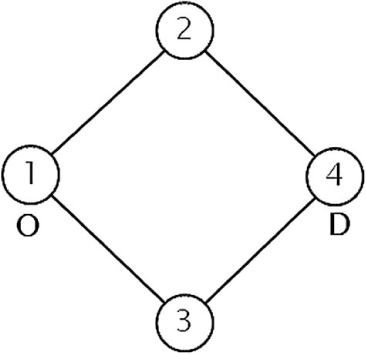
Simple example of network topology for performance and correlation assessment.
Equation 23 may be derived, or bounded for large networks, by a recursive decomposition algorithm, similar to that presented in Liu and Li (2012). Based on Equations 21–23, the network reliability in Figure 1 is favorably affected by a positive correlation between Events F1 and F4, and a negative correlation between F2 and F3. The first term in the right-hand side decreases and the increase in P(
These arguments may be expanded to more complicated networks. The network connectivity reliability is favorably affected by negative correlations among nodes on a cut-set (e.g., Nodes 2 and 3 in Figure 1), as well as positive correlations among nodes on a chain (where nodes are in series), which may include the origin and destination nodes. In small networks, where full network decomposition can be carried out to identify all cut-sets and shortest paths in the network, the impact of correlations on the network reliability may be qualitatively assessed by examining correlations among nodes on cut-sets or chains. In actual bridge networks with hundreds or thousands of nodes, a full decomposition may not be practical, but simulations-based methods can still quantify the impact of correlations, as presented in a case study in the companion Application paper. For quantitative assessments, realizations of bridge failures consistent with their correlation values are simulated and used in Monte Carlo simulations. This process is discussed in Stages B.i and B.ii of the BRAN methodology, which is elaborated on in the following section.
Generating Realizations of Correlated Bridge Failures (Stages B.I and B.Ii)
The extra correlations are represented by a correlation matrix among bridge failure probabilities whose entries present the correlation ratios. The bridge failure probabilities and the correlation matrix combine into a probability matrix describing joint bridge failure probabilities, which is in turn used to generate realizations of correlated bridge failures for Monte Carlo simulations to evaluate the network connectivity reliability.
The extra correlations must ideally be estimated from sufficient number of detailed post-earthquake reconnaissance reports that offer correlations among bridge failures based on similarities in factors such as maintenance and retrofit schedule, construction methods, and traffic loads. However, unlike correlations among seismic intensities for probabilistic seismic hazard analysis, extra correlations are often overlooked in the literature of transportation network reliability, and data-driven estimates are not currently available due to a lack of data. Therefore, and without the loss of generality, this study exploits three sources of information to estimate extra correlations in the form of bridge condition ratings, the functional level of roads in the network, and the topological information from the layout of the network. The companion Application paper explains how the three sources represent factors affecting the structural vulnerability of bridges. The rest of this section assumes that an estimated correlation matrix is already formed.
Generating realizations of correlated bridge failures is equivalent to simulating samples from an n-dimensional (n being the number of bridges in the network) binary random variable, as the state of each bridge takes a value of 0 for survival and 1 for failure. The expected value of the n-dimensional binary random variable, therefore, is also the vector of marginal probabilities (bridge failure probabilities from Stage A) while its covariance matrix can be established from a correlation matrix (
The DGM procedure forms an associated n-dimensional normal random variable from the binary random variable. The covariance matrix (
Prior to applying DGM or any method of choice to simulate samples from the multidimensional binary random variable, the correlation matrix



If the joint probabilities in the probability matrix do not satisfy the necessary compatibility conditions (Equations 24 and 25), they need to be modified accordingly to be within the admissible range, which is a range of values that comply with the compatibility conditions. Equation 26 may then be used to back-calculate the admissible ranges for the correlation ratios when solved for Rij. The incompatibility of estimated correlation values with the admissible range has been reported in the literature, for example in Bocchini and Frangopol (2011).
The compatibility modification is performed by mapping the elements of the correlation matrix into their respective admissible range. Two auxiliary matrices,


Although modifying the correlation matrix to satisfy the compatibility conditions is necessary for its applicability, such modifications may result in deviations from the originally estimated correlation values. The difference in correlation matrix 2-norm before and after the compatibility adjustments offers a metric to quantify the level of modifications. Equation 29 introduces the error metric based on matrix 2-norm:

The admissible range for Pij (and consequently Rij) can be very tight for extreme probabilities of failure. In particular, the difference between Pij and PiPj becomes negligible in extreme cases and therefore, the binary random variables representing bridges i and j can be treated as independent random variables. Appendix A provides a proof for the rationality of this assumption when the failure probabilities are either very large or very small. Independent treatment of extreme failure probabilities reduces the dimensionality of the binary random variable since the correlated samples only need to be generated for correlated bridge failures. In addition to enhancing the computational efficiency, the reduction of dimensionality prevents numerical errors produced by the narrow admissible ranges in establishing matrix
Table 3 illustrates the steps to simulate correlated bridge failures. Extreme failure probabilities are considered as values larger than 0.95 or smaller than 0.05. The open source statistical package Bindata (Leisch et al. 1998) written in R (R Development Core Team 2010) is used to simulate samples of correlated binary failures after forming matrix
Generating realizations of correlated bridge failures for Monte Carlo simulations

Network-Level Reliability Assessment (Stage B.Iii)
The data-frame of correlated bridge failure samples from Stage B.ii are used to evaluate the network reliability by Monte Carlo simulations. This study evaluates the connectivity reliability of the aging bridge network subjected to seismic loading by the Markov chain Monte Carlo simulation approach (MCMC). The MCMC system reliability method is described in detail in Ross (2007), Ching and Hsu (2007), and Rokneddin et al. (2011), although for independent failures. The bridge network is modeled as a graph where each bridge is a node and the connecting highway segments represent the connecting links. MCMC models the network connectivity reliability by assuming a Markov Chain with transition probability matrix

The original MCMC algorithm requires modification in order to accommodate correlated binary samples simulated by the DGM. The modified algorithm is summarized in Table 4. In particular, simulating wj in Equation 30 is modified to comply with the correlated failures (note that bj is directly derived from Stage A and is not impacted by extra correlations):

Algorithm for MCMC network reliability method with correlated bridge failures

Network connectivity reliability, as described in this section, applies to bridges with binary states (failure and survival), and therefore, bridges in extensive damage state and beyond are considered out of service, as described in Stage A.iii. However, multi-state bridges (partially functional) can be considered with other types of network reliability analysis, for example, if the network limit state is defined based on the overall travel time throughout the network instead of connectivity between (O-D) pairs. Examples of network reliability analysis with multi-state bridges exist in the literature (e.g., Lee and Kiremidjian 2007).
The network probability of failure (Pf in Table 4) represents the outcome of applying the BRAN methodology and help stakeholders of the transportation system to assess risks to the functionality of the network in the event of a strong ground motion. The network reliability method with correlated failures also enables ranking the criticality of bridges for preventive measures and disaster relief (Rokneddin et al., 2011). Assessing such criticalities enables owners to make more informed decisions when allocating funds for necessary maintenance and seismic retrofitting actions.
Conclusions
This paper proposes a two-stage bridge reliability assessment in networks (BRAN) methodology to allow the incorporation of data available from field instrumentation of bridges and different sources affecting simultaneous bridge failures in assessing the seismic reliability of aging bridge networks. In Stage A, the seismic fragilities of aging bridges within a bridge network are evaluated using parameterized fragility models and field instrumentation data. Since it is impractical to instrument every bridge in the network, Kriging, a spatial interpolation procedure, is implemented to determine the values of aging parameters at non-instrumented bridge locations from a limited number of instrumented bridges. The updated posterior estimates of the deterioration parameters are obtained by Bayesian updating of historical estimates of deterioration parameters with the interpolated values. The updated values are then used to determine bridge specific failure probabilities through the parameterized fragility models. However, such factors as the structural conditions of bridges, type of the roads they carry, traffic, and topological implications of the bridge network impose extra correlations among the failure probabilities that are often impractical to include in the analytical bridge modeling, particularly on a structure-by-structure basis. Nevertheless, the impact of extra correlations on network reliability estimates may be significant, depending on specific correlation ratio signs and the topology of the network. Therefore, extra correlations are included in Stage B, which estimates the connectivity reliability of the bridge network between critical origin and destination nodes. This paper shows that the favorable or adverse impact of accounting for the extra correlations on network reliability may be identified trend-wise by studying cut-sets and paths from the origin to the destination, even without a simulation-based network reliability assessment. The more realistic network reliability estimates achieved by enhanced fragility evaluations of aging bridges and by considering extra correlations may also influence the prioritization of bridges for maintenance and seismic retrofitting.
To facilitate the inclusion of extra correlations in future studies, a practical approach based on the general dichotomized Gaussian method (DGM) is used in Stage B to simulate correlated bridge failures, which become the input for the modified Markov chain Monte Carlo (MCMC) reliability method to assess network-level performance. Regardless of the approach to evaluate pairwise correlations among bridge failure probabilities, the established correlation matrix needs modifications to comply with the necessary conditions which impose an admissible range for the correlation ratios based on bridge failure probabilities. Accordingly, the elements of the correlation matrix are modified to comply with their respective admissible ranges. Such modifications may result in deviations from the originally estimated correlation values, especially in large networks.
The companion Application paper demonstrates the BRAN methodology applied to an existing large aging transportation network in the state of South Carolina, consisting of structurally different bridge types with varying aging mechanisms. The fragility estimates corresponding to each of these bridges are evaluated for a scenario earthquake, and the construction of the extra correlations matrix from available data sources is discussed. The network reliability is assessed for a range of correlation values—including the values established from the available data sources—to study the impact of extra correlations. The correlated network reliability estimates are also compared to the reliability estimates for the same network without accounting for correlations to highlight the impact of such extra correlations and their relevance in decision support for distributed systems.
Footnotes
Acknowledgements
This research was partially supported by the National Science Foundation under Grant No. CMMI-0923493. Any opinions, findings, and conclusions or recommendations expressed in this material are those of the authors and do not necessarily reflect the views of the National Science Foundation.
Appendix A
Please refer to the Electronic Supplement in the online edition of this paper.
References
Supplementary Material
Please find the following supplemental material available below.
For Open Access articles published under a Creative Commons License, all supplemental material carries the same license as the article it is associated with.
For non-Open Access articles published, all supplemental material carries a non-exclusive license, and permission requests for re-use of supplemental material or any part of supplemental material shall be sent directly to the copyright owner as specified in the copyright notice associated with the article.
