







Abstract
Following the 2008 Wenchuan (China) earthquake, the civil engineers association from Taiwan immediately dispatched a team to the affected region to collect information about the structural and geotechnical damage, and to provide information for seismic assessment, retrofitting and reconstruction planning. This team reached the damaged areas close to the epicenter—including Chengdu, Dujiangyan, Pongzhou, Xiaoyudong, Mianzhu, Zhiulong, Wudu, Hanwang, Hsuanko, Yingxiu (epicenter), and Highway 213—to survey the affected schools, hospitals, residential buildings, landslides, and bridges. More than 5,000 photos were taken to document the damage that resulted from the catastrophic earthquake (http://www.ncree.gov.tw/eng/index.htm). It is hoped that the information obtained can help us to develop a disaster mitigation plan. This paper focuses on the damage to different types of bridges, including those with simple support, arch, and continuous elements. The information shared in this study can help us build a community that will be safer in the future.
Introduction
An earthquake with a magnitude of MS 8.0 struck the Sichuan province, China, on 12 May 2008 at 14:28 local time. This catastrophic event destroyed millions of houses, making approximately 4.5 million people homeless. Around 69,200 people lost their lives (with 18,000 still missing), and 374,000 people were reported injured by the Chinese government. The Center for Research on Earthquake Engineering (NCREE) in Taiwan dispatched several teams to the affected region to collect information about structural and geotechnical damage and to provide the necessary assistance in seismic assessment, retrofitting and reconstruction planning. The authors reached the damaged areas—including Chengdu, Dujiangyan, Pongzhou, Xiaoyudong, Mianzhu, Zhiulong, Wudu, Hanwang, Bailu, Hsuanko, Xanzhao, Yingxiu (near the epicenter), and Highway 213—to survey the affected schools, hospitals, residential buildings, landslides, and bridges. Thousands of photos were taken to document the damage caused by the catastrophic earthquake, with the hope that the investigation would help us in preparing a disaster mitigation plan. This paper focuses on the damage to different types of bridges, including simple support bridges, arch bridges, and continuous girder bridges (Lin et al. 2008).
Bridge Damage
Compared to the damage incurred by structures, bridges seemed to have suffered relatively less damage. A total of 33,370 km of road was reported damaged by the officials. In addition, there were 4,840 bridges and 98 tunnels that were totally or partially damaged (there are in total 18,358 bridges in Sichuan province and 1,782 highway tunnels in China). Several of the more severe cases—including (a) Baihwa Bridge, (b) Xiaoyudong Bridge, (c) Miaotzuping Bridge, (d) Gaoyuan Bridge, (e) Bailu Bridge, (f) bridges at Yingxiu, and (g) bridges on Highway 213—are covered in this paper. The geographic location of each bridge, as well as recorded peak ground accelerations, are shown in Figure 1. The photos and the amount and type of damage sustained by the above-mentioned bridges are described in the following sections.
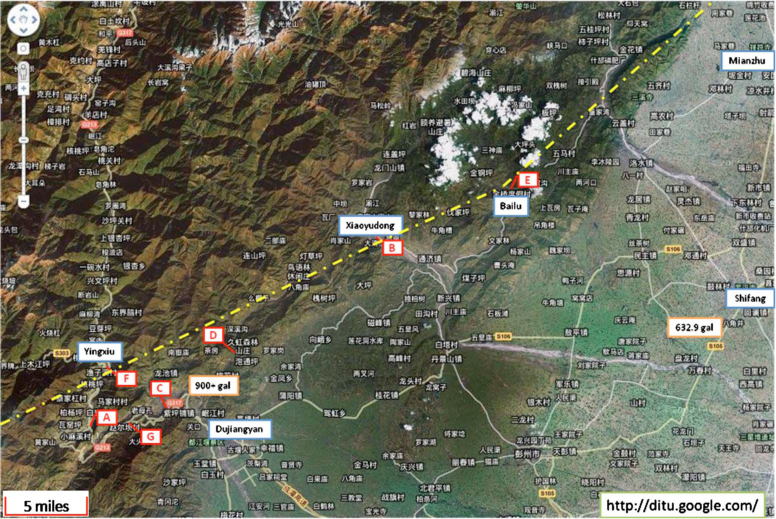
Location of the damaged bridges (the dotted line shows the likely fault location; the numbers show the recorded peak ground acceleration).
Baihwa Bridge
Baihwa Bridge is a 500 m-long viaduct with a height of 30 m. It plays an important role on the route from Dujiangyan to Wenchuan and was completed and opened to traffic in 2004. It is a reinforced-concrete (RC) continuous span bridge supported by twin column piers, with a cap beam on expansion joint and twin columns without a cap beam for the rest of the supports. The connections of the slabs were designed as a hinge (Figure 8), and there were also tie-beams connecting some of the high-rise pier columns. As shown in Figures 2–5, there are about five spans (100 m) of bridge slab that collapsed in the location of the turning section due to the earthquake, possibly because of the narrow seating on the cap beam, the buckling pier, and the coupling effect of bending and torsion. The pier seemed to be too brittle (not sufficiently ductile). The main rebar was not adequate and the size of the stirrups was relatively undersized (Figures 6 and 7). The connection between the tie beam and pier columns seemed to contain insufficient rebar as well (Figure 9). In addition, the bearing and the connection of the bearing was not strong enough (Figure 10). There was no shear key or restraint found between the bridge slabs and the bridge abutment or piers (Figures 11–13). There are also inadequate cut-offs and lap-splices of the longitudinal reinforcements found in the columns causing weak surfaces. Accompanied with the torsion failure induced by the moment coupling effect and pull-off failure of the bearings, this should be the main reason for the fallen spans in the curved section of the Baihwa Bridge. Since there was other damage—cracks, fractures, buckling, and tilting—found on the remaining piers, the uncollapsed part of the Baihwa Bridge was demolished for safety reasons by explosion in order to reduce the threat to the emergency road constructed underneath the bridge on May 28.
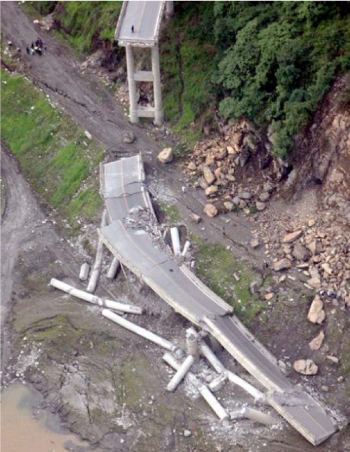
A aerial photo of Baihwa Bridge (www.chinamil.com.cn).
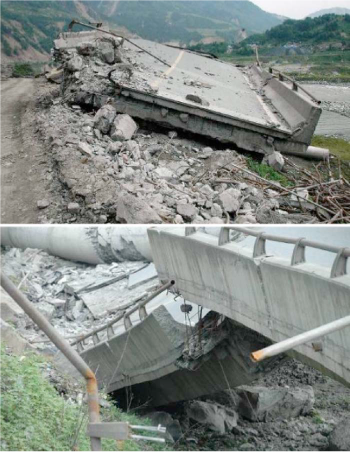
Fallen slab of Baihwa Bridge.
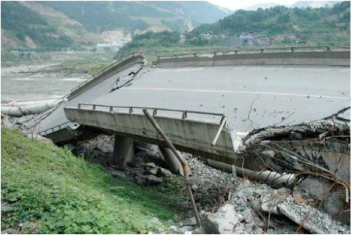
Fallen slab of Baihwa Bridge.
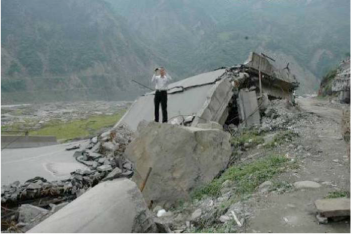
Fallen slab of Baihwa Bridge.
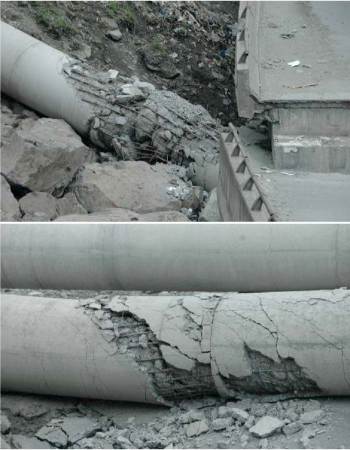
The damage on the pier shows the placing of the rebar.
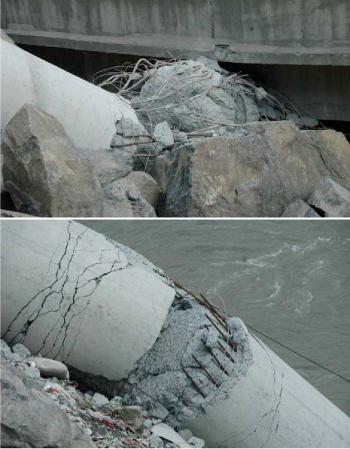
The rebar and stirrups of the broken pier.
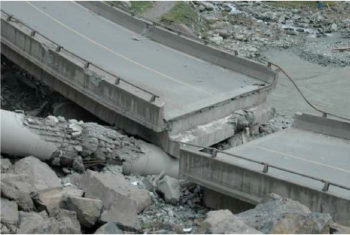
The hinge connection of the continuous bridge slabs.
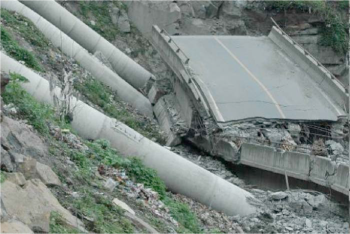
The broken tie-beam of the pier column.
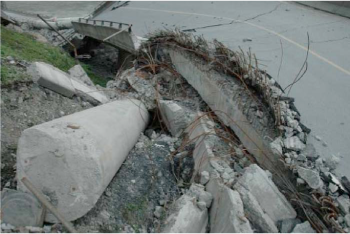
The bearing and its connection on top of the pier.
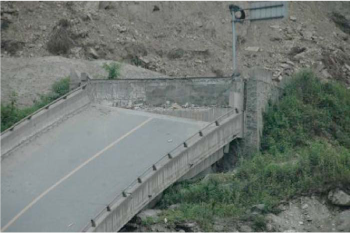
Abutment of Baihwa Bridge.
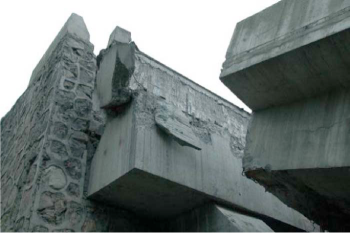
Abutment of Baihwa Bridge.
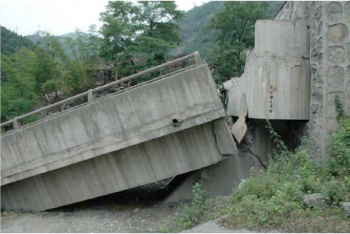
Abutment of Baihwa Bridge.
Xiaoyudong Bridge
As shown in Figures 14–16, Xiaoyudong Bridge was a four-span RC arch bridge. The fault rupture was found in the nearby farm field (Figures 18 and 19) and crossed the culvert underneath the approach (Figure 20). The strong motion of the earthquake on the upper plate of the reverse fault pushed the bridge in the longitudinal direction and caused the collapses of two spans (Figure 15) and severely damaged the rest of the bridge spans. The damage to the bridge, such as the destruction of the embankment (Figure 21), abutment (Figures 17 and 22) and barrier, the shifting of the decks (Figure 23), as well as the fracture of the spandrel elements near the abutment (Figures 24 and 25), can be observed and serve as a witness to the enormous pressure of the strong earthquake motion. However, the foundation of the pier remains intact (Figure 27). The emergency response detour for the Xiaoyudong Bridge was arranged downstream, as shown in Figure 28.

The damage locations of Xiaoyudong Bridge.
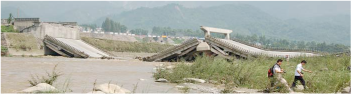
The collapsed spans of Xiaoyudong Bridge.
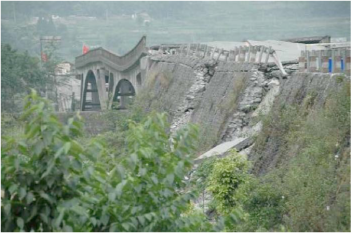
Damaged embankment and bridge spans of Xiaoyudong Bridge.
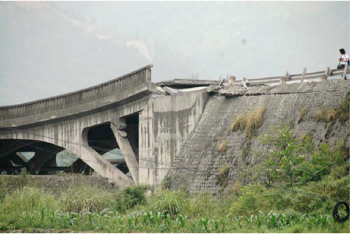
Damaged abutment.
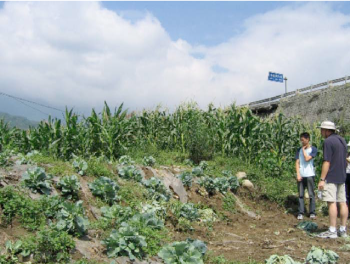
Fault rupture next to Xiaoyudong Bridge.
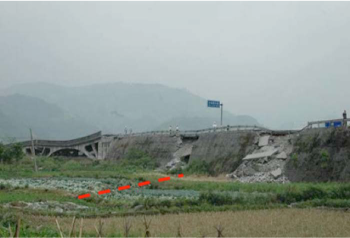
Visible fault rupture (indicated by dotted line).
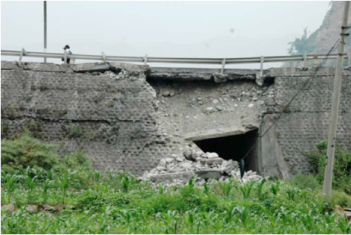
Damaged culvert underneath of the approach.
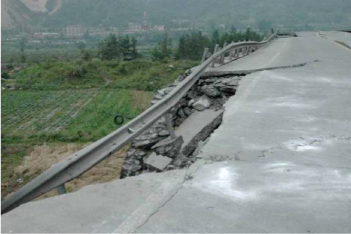
Damage of the embankment.
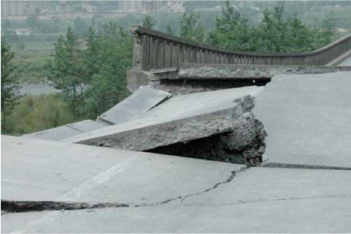
Deck damage at approach.
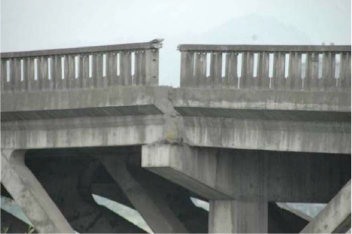
Horizontal displacement of the spans above the pier.
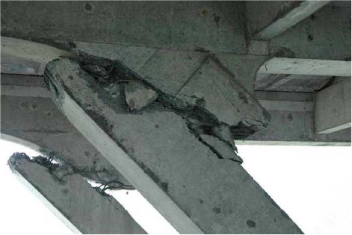
Fracture at the spandrel element.
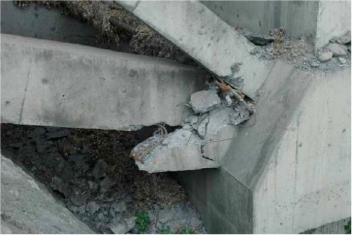
Fracture at the connection between arch and abutment.
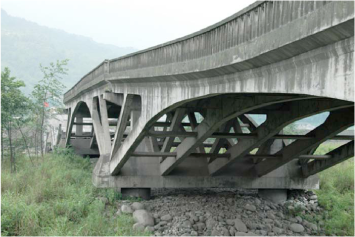
Undamaged foundation of the pier.
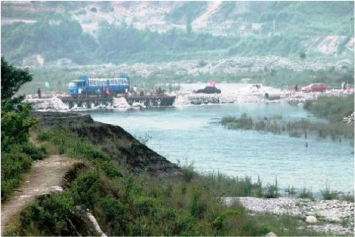
Detour for Xiaoyudong Bridge for emergency response.
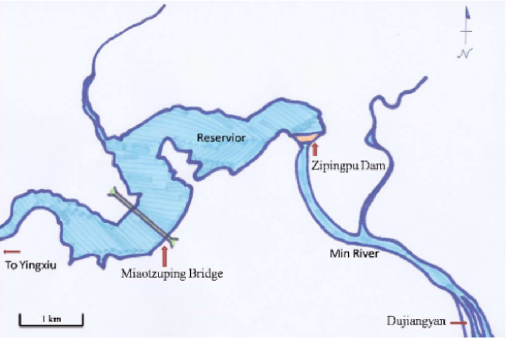
The location of Miaotzuping Bridge.
Miaotzuping Bridge
Miaotzuping Bridge is located at the water reservoir area (Zipingpu dam) near Dujiangyan (Figures 28 and 29). As shown in Figures 30 and 31, this beautiful bridge is 1436 m long with a height over 108 m composed of the main bridge (long span continuous box-girder bridge) and 19 approach spans (T-girder simple supported bridge) (Li et al. 2008). The construction of this bridge was completed but had not yet been opened to traffic. Span shifting had occurred in both longitudinal (300 mm) and horizontal (250 mm) directions causing the damage to the side stoppers (Figures 32 and 33). In addition, the earthquake caused one of the T-girder approach spans to collapse (Figure 34), possibly due to insufficient support length of the cap beam (narrow seat, the bent seats were around 300 mm in length) (Yen et al. 2009). The Chinese Army was temporarily stationed on top of the bridge for safety reasons and to repair the bridge (Figure 35).
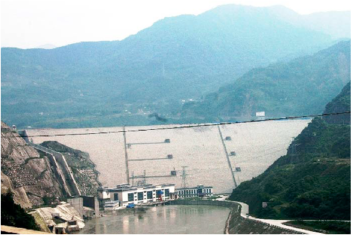
Zipingpu Dam.
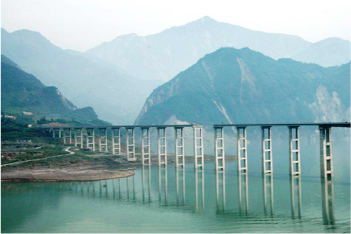
The approaches of Miaotzuping Bridge.
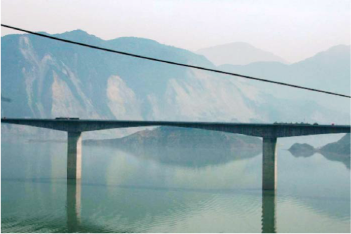
The main spans of Miaotzuping Bridge.
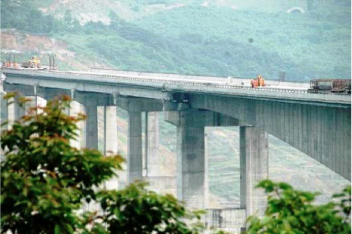
Horizontal shift of the spans.
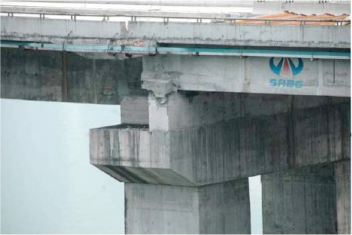
Damage to the side stopper.
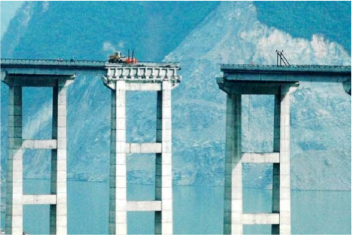
Collapsed span.
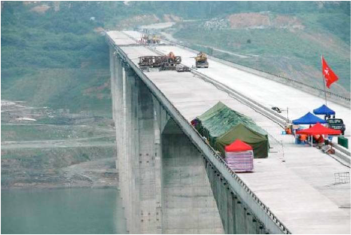
On top of Miaotzuping Bridge.
Bridges on National Highway 213
The rest of the bridges on National Highway 213 suffered different degrees of damage, such as decks shifting, cracks in the bridge support, and destruction of side stoppers and bridge abutments. However, our observation indicated that there was less damage on the piers, such as cracks or buckling. Since bridges play crucial roles in transportation and are critical for emergency response actions, those bridges that were only slightly damaged were temporarily retrofitted by a Bailey bridge or by light steel bracing with speed and weight limits imposed, or were detoured to cross the river at upstream or downstream using tubes and grading (graded sand gravel base) to make a temporary emergency path. Figures 36–41 show a typical highway bridge on Highway 213. Damaged side stoppers and shifting of the decks were observed on all three piers. A 5-ton weight limit and a 20 km/hr speed limit were posted on the temporary Bailey bridge placed on top of the damaged bridge.
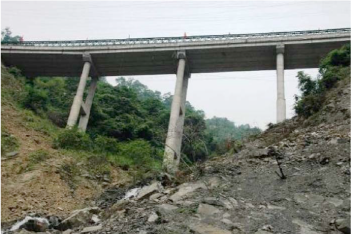
No damage observed on the piers.
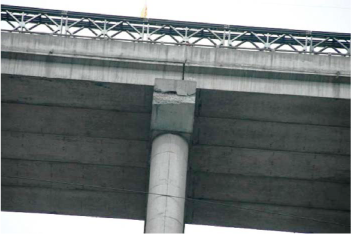
Horizontal shifts of the decks (pier on the right).
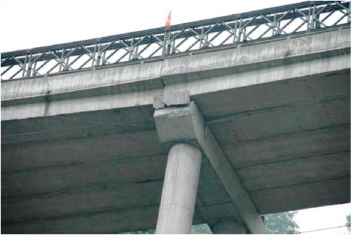
Horizontal shifts of the decks (pier on the left).
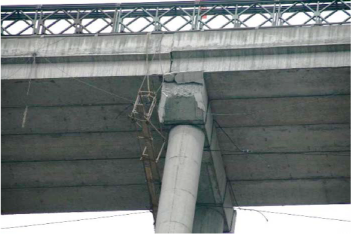
Horizontal shifts of the decks (pier in the center).
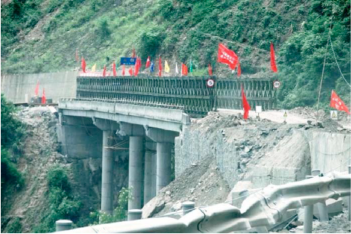
Damage to side stoppers.
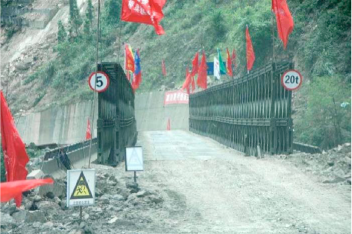
Weight and Speed limits.
The photos of the bridges in Yingxiu are shown in Figures 42–45. The old bridge piers (Figure 44) seem to be stronger than the new ones (Figure 43). However, both old and new bridges suffered damaged side stoppers but did prevent the decks from falling.
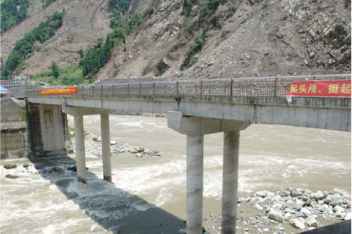
The bridge survived the earthquake (photo by Prof. K.C. Tsai).
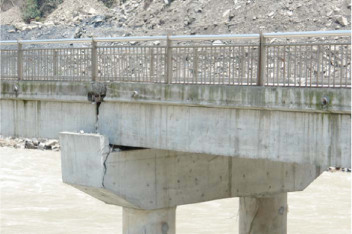
Cracks on the side stopper (photo by Prof. K.C. Tsai).
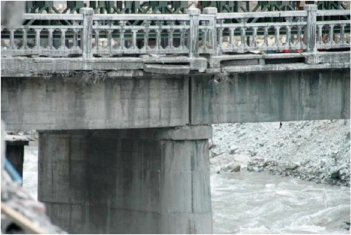
Horizontal shifting of the decks.
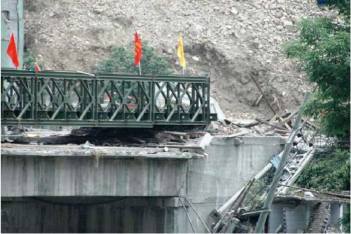
Damage to the abutment.
Figures 46–49 show different kinds of damage to the bridges on Highway 213, including damaged expansion joints (Figures 46 and 47), abutments (Figure 48), barriers and side stoppers. However, there was almost no damage observed to the bridge piers (Figure 49).
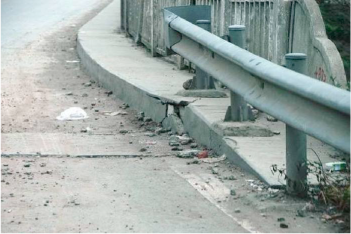
Damaged expansion joint.
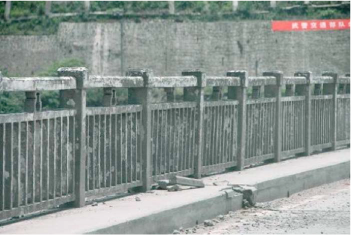
Damaged expansion joint.
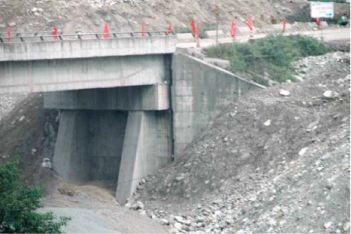
Damaged abutment.
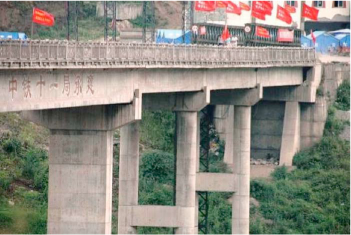
No damage observed on piers.
Bridge at Gaoyuan
As shown in Figures 50–55, the Gaoyuan Bridge was a reinforced concrete bridge with simple supported girders and continuous decks. Due to the strong earthquake motion, the bridge shifted in the longitudinal direction and the span collapsed because of narrow seating. There were also hanging decks found on the collapsed span, as shown in Figures 52 and 54. A damaged side stopper on the cap beam and the destroyed abutment can be seen in Figure 53. The temporary bridge for detour was constructed using wood rods and gravels, as shown in Figure 55.
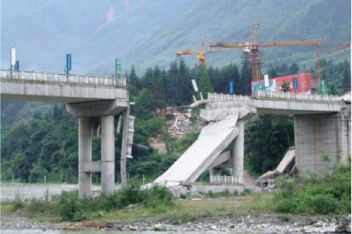
Collapsed span of the bridge at Gaoyuan (photo by Prof. B.H. Li).
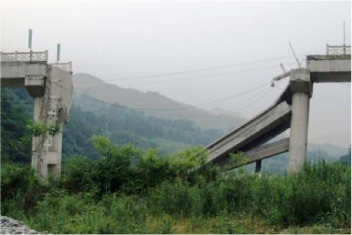
Collapsed span of the bridge at Gaoyuan (photo by Prof. B.H. Li).
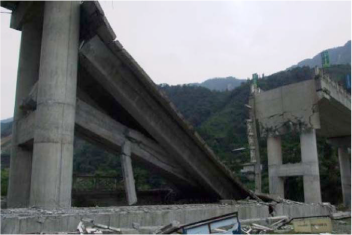
Collapsed span of the bridge at Gaoyuan (photo by Prof. B.H. Li).
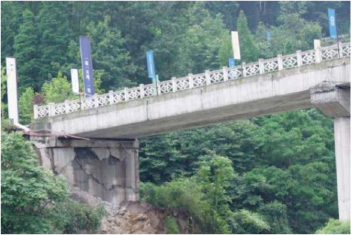
Damaged abutment of the bridge at Gaoyuan (photo by Prof. B.H. Li).
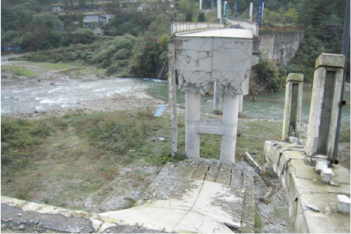
Collapsed span of the bridge at Gaoyuan (photo by Dr. G.Y. Liu).
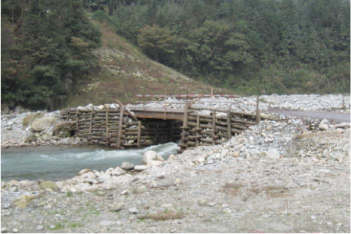
Temporary bridge for emergency detour (photo by Dr. G.Y. Liu).
Arch Bridge at Bailu
The arch bridge at Bailu was more than a hundred years old and built by the Chinese and the French together. It was a masonry arch bridge made of stone and clay. One of the arches was totally collapsed during the earthquake, as shown in Figure 56. A temporary bridge using precast hollow concrete planks for emergency disaster relief was built by the military and village people together and is shown in Figure 57. Since there are fault ruptures found in a school (Figures 58 and 59) nearby within a few hundreds meter distance, the strong ground motion causing the abutment movement should be a factor in failure for this bridge.
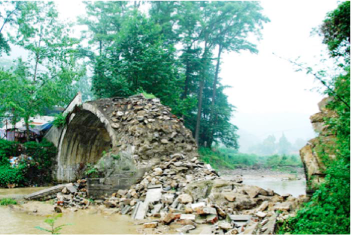
Collapsed arch of Bailu Bridge (photo by Dr. K.C. Lin).
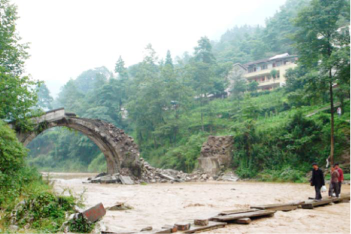
Damaged Bailu Bridge and the emergency detour (photo by Dr. K.C. Lin).
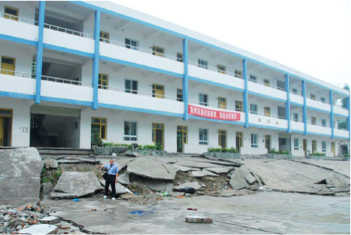
The fault rupture found near Bailu Bridge (photo by Dr. K.C. Lin).
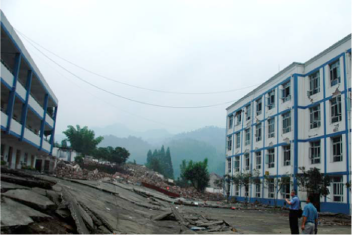
The fault rupture found near Bailu Bridge (photo by Dr. K.C. Lin).
Other Bridges at Different Cities
Most of the bridges at metropolitan areas remained intact, as shown in Figures 60 and 61. However, the bridges at Mianzhu city suffered slight damage to the expansion joints and remained in service with warning signs, as shown in Figures 62 and 63.
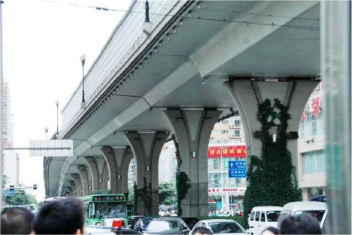
Viaduct at Chengdu.
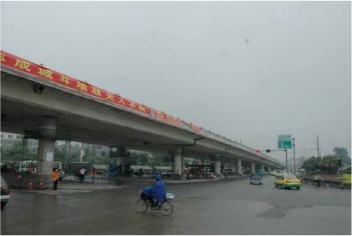
Bridge at Dujiangyan.
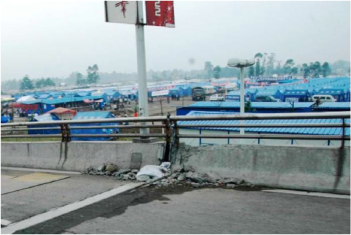
Damage to the expansion joint at Mianzhu.
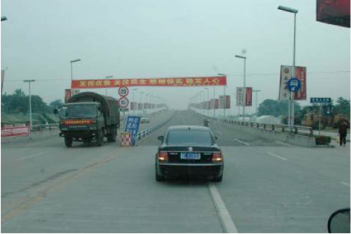
Warning sign for the damaged bridge at Mianzhu.
Damage Causes
The following observations can be obtained from the above-mentioned damaged bridges:
(1) The support length of the pier to prevent the bridge slab from falling was not long enough (narrow seat width). (2) There was no shear key between the girders, only the side stoppers, and most of these stoppers were not strong enough to remain intact. However, they did stop the bridge from falling laterally. (3) The bearing system was inadequate. In particular, there were no isolators such as lead rubber bearings or pendulum friction bearings on top of the pier to support the bridge flexible enough with limited displacement and to dissipate the earthquake energy. (4) There were no restrainers found on these bridges to prevent the spans from falling. (5) Insufficient flexural strength and displacement ductility led to brittle failure. (6) Joint failure was due to poor detailing of the lateral reinforcements and ties. (7) Weak surfaces were often found in the columns because of inadequate cut-offs and lap-splices of the longitudinal reinforcements. (8) Torsion failure, induced by the moment coupling effect and pull-off failure of the bearings in the curved bridge increased the number of fallen spans.
In addition, with a magnitude of MS 8.0, this earthquake likely produced higher seismic forces than the ones used in the current design specifications. Presently, countries that have suffered earthquake damage are updating or have updated their design code to accommodate the latest information. However, issued in 1989, the current seismic design specifications of bridges (JTJ004-89) has been used for more than 20 years without any new modifications regarding such issues as the detail of lap splices, the arrangement of lateral reinforcements, and the falling-prevention system. Meanwhile, none of the lessons learned from recent earthquakes have been referenced into the current code. Therefore, an out-of-date design code might be a major contributing factor to the damage to the bridges caused by this earthquake.
Suggestions
After any earthquake, emergency rescue depends on the bridges and the roads; restoring them or making them usable should be a top priority. If we look at the 1999 Chi-Chi earthquake, for example, the rescue plan included (1) closing the road, (2) provide temporary steel support, and (3) an emergency route. At present, the first stage has been accomplished. The second stage is to repair or to reconstruct the damaged bridges. The purpose of stage one is totally different from that of stage two. Keeping safety in mind, it is crucial to repair or reconstruct these bridges and restore them to their original function or expand their function. To save cost, it is recommended to repair those bridges which received only minor damage. The action plan for the damaged bridges in Sichuan Province can be shown as follows (Liu and Chang 2006):
(1) Replace the superstructure with a continuous steel bridge in order to reduce the self-weight and the corresponding inertial force and bending moment acting on the substructure. (2) Use isolation bearings to reduce the moment demand of the substructure. (3) Extend the seat width by enlarging the cap-beam. (4) Install an unseating-prevention device such as a restrainer or concrete shear key in between the girders. (5) Lengthen the superstructure of the simple-support bridge to avoid falling off.
In addition, regarding the collapsed Baihwa Bridge, the moment-torsion coupling effect was considered to be the most probable cause for the severe damage. Seismic performance of a curved bridge is very complex and is easily affected by biaxial earthquake force. For the superstructure, the horizontal earthquake force combined with the eccentric self-weight will induce a coupling effect of the biaxial bending moment and torsion. For the substructure, the additional moment demand was increased due to the eccentric vertical self-weight. As to the bearing, it uplifted and separated from the superstructure when the live load was located eccentrically and induced a tension force on it. Therefore, in order to obtain a realistic seismic performance, it is recommend to (a) use a steel box girder to reduce the self-weight, (b) strengthen the ductility of the column at the curved part, (c) prevent tension forces occurring at the bearing, and (d) utilize the nonlinear dynamic time-history method to perform the analysis.
Summary
To prevent further disaster, it is very important to repair the damage to the bridges and to retrofit them after the earthquake. In addition, the investigation into the causes of the damage to the bridges can help us to improve the seismic code for future bridges. Learning from past earthquakes and prevent similar damage is as important as the task of retrofitting after an earthquake disaster. Over the past decades, people have learned lessons from the Loma Prieta earthquake (M7.0) in 1989, the Northridge earthquake (M6.7) in 1994, the Kobe earthquake (M7.2) in 1995, and the Chi-Chi earthquake (M7.6) in 1999. The concept of a ductile pier or an innovative device such as lead rubber bearing, pendulum friction bearing, or shear key and restrainer were proposed by researchers and implemented in practice only after several moderate earthquakes had occurred. However, some commonly seen failures, such as insufficient seat width and cutoff lap-splices, were still found in the Wenchuan earthquake. Therefore, it is strongly recommended to adopt the latest knowledge of disaster prevention from other countries, so that the possible loss from an earthquake can be minimized.
Taking Taiwan's experience as an example, although the ductile design concept and the unseat prevention devices for new bridges had been developed since the Northridge and Kobe earthquakes, it was not until the 1999 Chi-Chi earthquake that caused immense damage to the bridges that people realized the importance of the task of retrofitting the existing bridges. Earthquakes are a part of life, and they can not be avoided. However, we can learn from the past and share our knowledge of earthquake engineering with other countries and pursue better seismic design methods (Loh and Tsay 2001). After the Chi-Chi earthquake, we have learned how to react to property damage and to recover from tragedy. Up to now, the localized retrofitting technologies, developed for the general bridges in Taiwan, have been applied to the damaged bridges after the emergency repair work was completed (Christopoulos et al. 2005). Thus, the first stage of the repair and reconstruction of our bridges has been almost accomplished. For those bridges that were not damaged in the Chi-Chi earthquake, we must keep in mind that this kind of earthquake can happen again on this island that has numerous faults. Government agencies launched a large-scale assessment program, commissioning the consulting firms to do a full safety investigation and to retrofit bridges in order to prevent or limit possible damage in the future. Soon the experiences from the past years of retro-fitting and the corresponding state-of-the art technologies will be organized and edited by NCREE and be published in the Seismic Assessment and Retrofit Manual for Bridges.
The Wenchuan earthquake made us realize the importance of bridges and their influence on rescue work. Although lately many record-breaking, high-tech bridges have been built in China, many damaged bridges were found in the mountainous areas, but they attracted little attention due to their low level of importance. Nevertheless, they are a crucial part of the road network. The damage to these small bridges in mountainous areas led to huge economic losses, as well as a high loss of life. Therefore, considering the hazard level of the global road network, government authorities should not only consider the status of the roads, but they should also put more emphasis on the service function of the bridges after an earthquake. There is no doubt that performance-based design must be the basis of any new code being developed.
Footnotes
Acknowledgments
We gratefully acknowledge the Sichuan Association for Science and Technology (SCAST), the Sichuan branch of the Taiwan Affairs Office of the State Council and Sichuan University for their kindness, enormous help, and friendship to our team when conducting the earthquake reconnaissance investigation. The courtesy of Prof. B.X. Li from Sichuan University, as well as Dr. K.C. Lin and Dr. G.Y. Liu from NCREE who provided photos, are acknowledged. We would also like to take this opportunity to express our condolences to those who suffered so much from this earthquake.