







Abstract

Manuscript Reference: Yousef Bozorgnia, Norman A. Abrahamson, Linda Al Atik, Timothy D. Ancheta, Gail M. Atkinson, Jack W. Baker, Annemarie Baltay, David M. Boore, Kenneth W. Campbell, Brian S.-J. Chiou, Robert Darragh, Steve Day, Jennifer Donahue, Robert W. Graves, Nick Gregor, Thomas Hanks, I. M. Idriss, Ronnie Kamai, Tadahiro Kishida, Albert Kottke, Stephen A. Mahin, Sanaz Rezaeian, Badie Rowshandel, Emel Seyhan, Shrey Shahi, Tom Shantz, Walter Silva, Paul Spudich, Jonathan P. Stewart, Jennie Watson-Lamprey, Kathryn Wooddell, and Robert Youngs, Earthquake Spectra, vol. 30, no. 3 (August 2014): 973–987.
The authors would like to thank Dr. Praveen Malhotra (the “Discusser”) for his interest in the NGA-West2 research project and our collection of papers in the August 2014 special issue. The Discusser has raised two points, and our response is organized in the same order, as follows.
Uncertainty of Ground Motion Models
The Discusser indicated that the uncertainty of ground-motion prediction equations (GMPEs) has increased in NGA-West2 as compared to the original NGA project (Power et al. 2008), and he specifically asks: “What is the purpose of increased complexity, if it is not to increase certainty?” The development of GMPEs is a model-building process, and as such, our goal was to capture the key characteristics and features that are important for engineering applications. Therefore, the level of complexity of our GMPEs is dictated by important features of ground motions inferred from both (1) empirical data analysis and (2) data from physics-driven simulations. The GMPEs need to extrapolate well to accommodate conditions often controlling seismic hazard for design applications. For example, if we observe a significant nonlinear site effect in ground motions, we are obligated to capture that effect in our models, although we may use simulations in some cases to help constrain the effect for conditions where the available data are sparse.
The Discusser mentions changes in standard deviation between the NGA-West1 and NGA-West2 models. To quantify these differences, we show in Figure 1 standard deviations for pseudo-spectral acceleration (PSA) at 1.0 s period for a particular set of conditions. When comparing standard deviations between generations of models, it must be kept in mind that in general there are two sources of change: (1) increase in database size, which in NGA includes events from diverse active crustal regions globally; and (2) change in model functional forms.
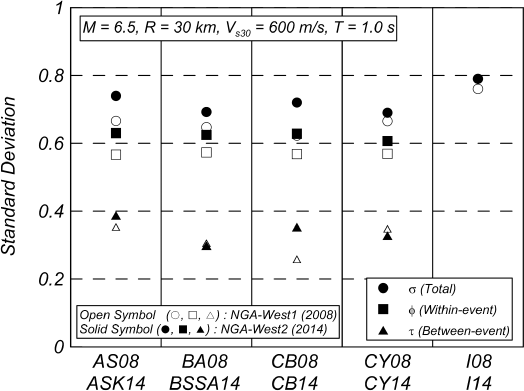
Comparison of the standard deviations of the NGA-West1 and NGA-West2 models. The models presented in this figure are as follows: AS08 (Abrahamson and Silva 2008), BA08 (Boore and Atkinson 2008), CB08 (Campbell and Bozorgnia 2008), CY08 (Chiou and Youngs 2008), I08 (Idriss 2008), ASK14 (Abrahamson et al. 2014), BSSA (Boore et al. 2014), CB14 (Campbell and Bozorgnia 2014), CY14 (Chiou and Youngs 2014), and I14 (Idriss 2014).
The new models generally have more complexity than the old ones. In general one would expect this to lead to decreased uncertainty when working with a fixed data set, unless some of the effects in the model are not well represented in the data set. In our case, however, most of the uncertainties increase, which leads us to conclude that the impact on the uncertainties of the larger data set overwhelms that of the more complex equations.
More detailed comparisons of predicted medians and standard deviations of the NGA-West1 and NGA-West2 models have been presented in the various NGA-West2 papers published in the August 2014 issue of Earthquake Spectra.
Shape of Response Spectra
The Discusser has made several points regarding the shape of pseudo-velocity response spectra (PSV) and poses questions related to: (1) the ratio of the peak PSV to the peak ground velocity (PGV) predicted by the models, and (2) an apparently poor comparison of PSV predicted from the models to NGA-West2 data. The key question asked by the Discusser is: “Why does the shape of the predicted response spectrum not match the shape derived from recorded ground motions?” In the development of both the NGA-West1 and NGA-West2 GMPEs, we have made no a priori assumption regarding the shape of the response spectrum. Therefore, we do not check the resulting spectral shapes against any classical representations of spectral shape. We carry out regressions and develop models at each period; thus, the shape of the response spectrum is an outcome of our analysis and will closely match the spectral shapes of the empirical data. In the same manner, we apply no normalization of the response spectra with respect to peak ground acceleration (PGA), PGV, or peak ground displacement (PGD). In fact, PGD, which is one of the three parameters used by the Discusser to develop his simple tri-partite response spectrum, is one of the least reliable ground-motion parameters as it is very sensitive to the signal processing and filtering of recorded ground motions. For that reason, in the NGA-West2 project the GMPE developers did not provide models for PGD (Bozorgnia et al. 2014).
As shown in the graphs in Figure 2, the ratio of PSV to PGV depends strongly on
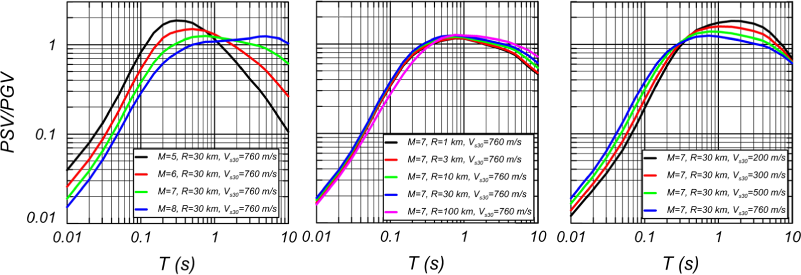
Normalized ratio of pseudo-spectral velocity to peak ground velocity plotted against oscillator period for the geometric mean of four NGA-West2 models: Abrahamson et al. 2014 (ASK14), Boore et al. 2014 (BSSA14), Campbell and Bozorgnia 2014 (CB14), and Chiou and Youngs 2014 (CY14). GMPEs are exercised for vertically dipping strike slip faults, top of rupture depth of zero, hypocentral depth of 7 km, and
The comparison of GMPE median predictions to data, as in the Discusser's Figure 3, is of course a useful exercise, but one that must be carried out carefully, or misleading results can easily be obtained. In the comparison shown in the Discusser's Figure 3, we see an apparent misfit between what the Discusser reports as “400 recorded motions from NGA database” and the median of the NGA-West2 models for the condition of
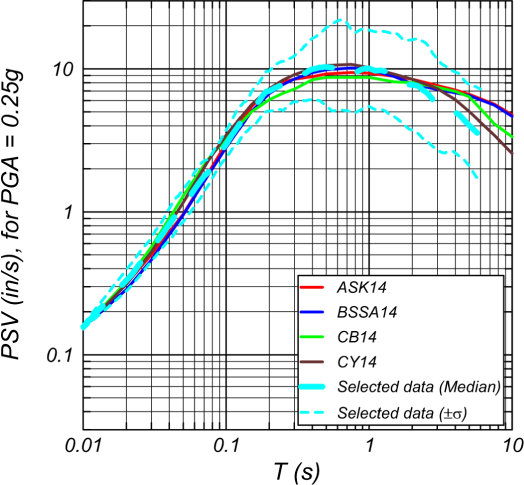
PSV spectra after scaling to PGA = 0.25 g for four NGA-West2 models as compared to NGA-West2 data selected according to the following criteria:
We queried the NGA-West2 database for conditions comparable to those selected by the Discusser in his Figure 1. For
We wish to also make a broader point about comparisons of small subsets of data to models that is relevant to the present discussion. Such comparisons are often misleading due to a fundamental feature of ground-motion variability as having between- and within-event components. Between-event components of variability, typically associated with between-event residuals denoted by ηi for event i, indicate the degree to which the data for event i are high or low relative to a model in an average sense. Non-zero ηi is generally associated with source effects that may be more or less energetic than the average for a given
Viewed another way, modern GMPEs are developed to capture trends with source, path, and site effects. A properly formulated GMPE should not have trends of ηi with magnitude and other source terms, nor trends of ∊ij with distance or VS30. The NGA-West2 GMPEs accomplish this, and the models are unbiased for the
Footnotes
Acknowledgements
We would like to thank Bob Darragh for his constructive comments.