Abstract
The Short family of Bury St Edmunds produced at least eight doctors between the first half of the 17th century and the first half of the 18th. Some of these practised locally and others went on to achieve fame in London or abroad. They included Richard Short (d. 1668), a medical polemicist, and Thomas Short (1635–85) who treated Charles II in his last illness and became the subject of poetry and other literature. The Shorts generated controversy through their adherence to the Roman Catholic faith at a time of persecution and suspicion. Richard Short used medical polemic as a vehicle for advancing his religious views, and his son and nephew became involved in James II's political programme to introduce religious toleration in 1688. After the Revolution the Shorts withdrew from political life but continued in their medical practice and their recusancy. This paper is the first to unravel the family relationships of the Shorts, which previously have eluded most historians.
Introduction: the local and religious context
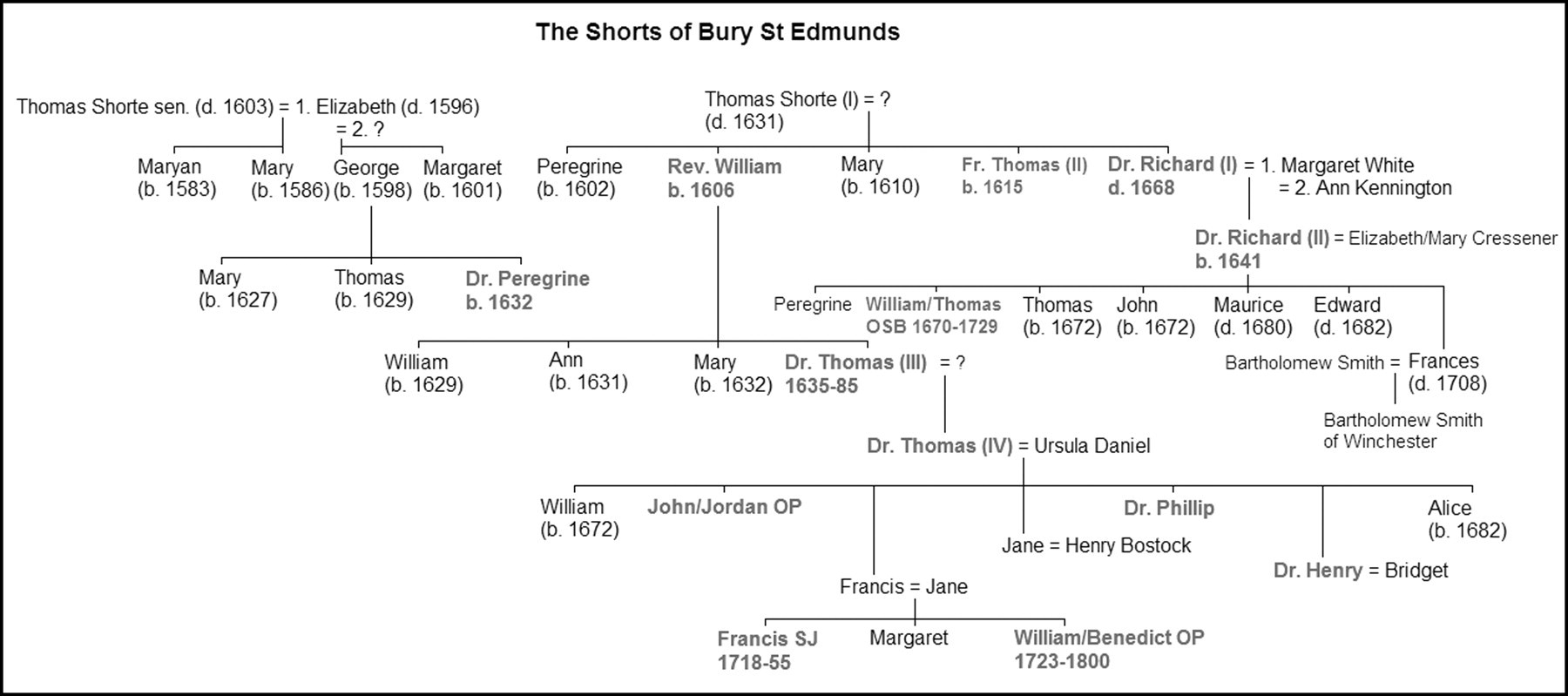
The Short family of Bury St Edmunds in Suffolk (Figure 1) produced at least eight doctors in the second half of the 17th century and the first half of the 18th. Two of these gained fame, one through publication and polemic and the other through his role as a physician to Charles II. However, the Shorts were rather more unusual than at first appears since members of the family persisted in their Roman Catholic convictions at a time when Catholics still feared persecution under the penal laws enacted in the reign of Elizabeth I. In addition to doctors, the family produced several priests and nuns, one rising to high rank in the Dominican Order. In the reign of the Catholic James II, the religious affiliation of the Shorts spilled over into political action and two Dr Shorts became involved in local government in 1688, ultimately with disastrous results. Coming to the notice of the authorities again at the time of the Jacobite rising of 1715, the Shorts maintained their tradition of religious and political dissent alongside their medical practice well into the first half of the 18th century.
In this paper, as well as disentangling Short family relationships from some of the misconceptions of earlier historians, it is suggested that Dr Richard Short (d. 1668) used his 1656 medical treatise, On drinking water as a vehicle to promote his Catholic and Royalist political beliefs and that the same beliefs motivated his son to participate in King James II's attempt to pack Parliament with Catholics and Protestant dissenters in 1687–88. The medicine of the elder Richard Short and of his family was a politicized medicine.
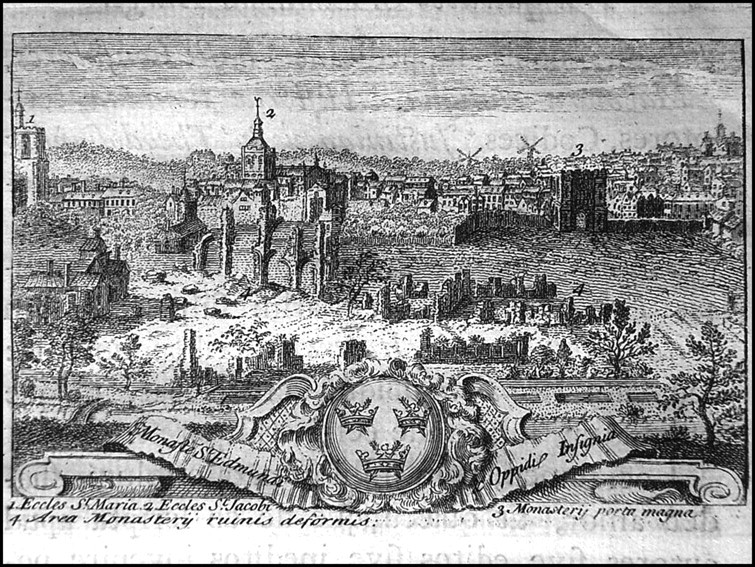
As Catholics, the Shorts belonged to a small minority in the country as a whole, which was very tiny indeed in the small East Anglian market town in which most of them worked (Figures 2 and 3). ‘Richard Short, Dr’ and ‘Perry Short, Dr’ appear in the 1674 presentments to the Quarter Sessions for the crime of recusancy (defined as non-attendance at worship in the parish church) 1 but Bishop Compton of Norwich's census of religious belief in his diocese, carried out in 1676, records only 40 Catholic recusants in the two parishes of Bury St Edmunds out of a total population of 3693 over the age of 14, 2 and in 1681 ‘Dr Thomas Short’ and ‘Richard Short, gentleman’ appear among only six Bury recusants significant enough to feature in a list of the names of papist & reputed papist in the County of Suffolk compiled probably in the wake of the ‘Popish Plot’ scare of 1679. 3
Although Suffolk was a county in which pro-Parliamentarian feeling ran high in the Civil War, not only most figures in Bury's establishment but also the ordinary people remained sympathetic to the Royalist cause. During the 1640s and ′50s, when Presbyterian worship was enforced in the parish churches, the Master of the Grammar School, Thomas Stephens, maintained a secret chapel where the Prayer Book service was read 4 and the list of his pupils from that time included several Catholics and others who later were to support James II's policies in favour of religious toleration, as well as the future Archbishop of Canterbury, William Sancroft (1617–93) who was to refuse to accept William of Orange as his lawful Sovereign. There were moments of Puritan hysteria in the town during the Civil War, most notably the condemnation and execution of 18 people for witchcraft by John Godbold, on the evidence of the ‘witchhunters’ Matthew Hopkins and John Stearne in August 1645, when it was rumoured that a Royalist army was approaching the town. 5 However, Suffolk's ‘Stour Valley Riots’ of 1642 (mob violence directed against the perceived threat of ‘Popery’) never reached Bury itself although accusations that nearby Hengrave Hall was being used by the Catholic Gage family to stockpile weapons were raised in Parliament in January 1642 and the house was harassed by a mob. 6
In such a small town it is virtually unthinkable that the Shorts' religious convictions would not have been public knowledge, yet there is no evidence that, beyond the usual formulaic presentments to the Quarter Sessions, the Shorts suffered much persecution. Furthermore, it was not uncommon in Suffolk and Essex for constables friendly with a Catholic family to ignore them altogether when enforcing anti-Catholic legislation. 7 Recusants did not live apart from their local communities any more than Puritans did before the Civil War and their social networks served as a form of protection from predatory informers.
The Short family: background
Virtually every writer who has attempted to give an account of the family relationships of the two most prominent members of the Short family, Thomas (1635–85) and Richard (d. 1668), has made mistakes. The recurrence of the same Christian names makes the family an awkward one to unravel, and matters are made worse by the destruction by fire in 1782 of the church of Fornham St Geneviève near Bury St Edmunds, where many of the Shorts were buried, and the loss of its parish registers.
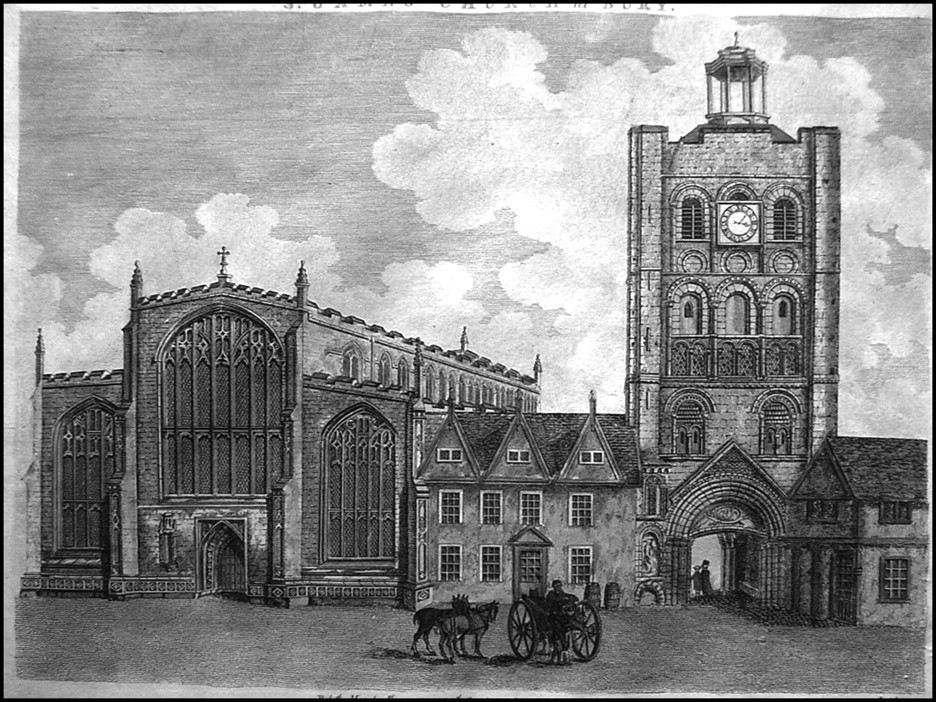
The burial of a ‘Thomas Shorte sen’ is recorded in the registers of the parish of St James, Bury St Edmunds (Figure 4) in 1603, 8 and the Elizabeth Shorte who died in 1596 was probably his wife. 9 The name is spelt ‘Shorte’ and ‘Short’ interchangeably in the registers up to the 1620s; thereafter ‘Short’ takes over. A second Thomas Shorte (d. 1631) 10 was a contemporary of the first Thomas, sometimes distinguished from the first by the suffix ‘gent’ in the parish register. For ease of reference the designation Thomas (I) is used for this ‘Thomas Shorte gent’ since he was the ancestor of the main medical dynasty. No relationship between ‘Thomas Shorte sen’ and ‘Thomas Shorte gent’ can now be established with certainty.
Thomas (I) was the father of William Short (b. 1606), Rector of Euston in Suffolk, and Thomas Short (II) (b. 1615). 11 Thomas Short (II) was admitted a pensioner at Pembroke College, Cambridge, in 1634. He left for the English College in Lisbon in 1636, was ordained a secular priest in 1641 and sent on the English mission in 1644, where he took the name Peregrine as an alias – a common practice among Catholic missionary priests in the 17th century. 12 It seems likely that Thomas (I) was also the father of Dr Richard Short (I) (d. 1668) and of Peregrine Short (b. 1602).
The next generation of the Short family appears in the 1620s. William Short was by this time Rector of Euston, in whose parish register the births of his children are recorded. The descendents of Thomas Shorte senior, together with Thomas (I)'s son Peregrine, remained in Bury. It seems likely that the Peregrine Short born in 1632 was a grandson of Thomas Shorte senior. 13 This Peregrine was a doctor; he was listed as a recusant at Babingley in Suffolk in 165514 and again in Bury in 1674. 1 In the same year, the Hearth Tax Returns recorded that both ‘Dr Perry Short’ and ‘Doctor Short jun’ had large houses with seven hearths in ‘The High Ward, Risbygate Street’ on the far west side of Bury. 15 The ‘Doctor Short jun’ of 1674 is probably Richard Short (II), grandson of Thomas Short (I).
Richard Short (I) and Richard Short (II)
William Short, the Rector of Euston from around 1631 (he is recorded as a mere ‘preacher’ in 1630), 16 was the father of William (b. 1629) 17 and Thomas Short (III) (1635–85). Although John Venn claimed that the younger Dr Richard Short was also a son of William, 18 this is denied by Sylvia Coleman 19 in her 1989 article on the 17th century rectors of Euston and disproved by the St James' parish register which records the birth of Richard as a son of Dr Richard Short (I) in 1641. 20 The author of the Biographical list of Bury Grammar School also wrongly claims that the Peregrine Short, born in 1602, was the father of Richard (I) and Thomas (III). 19 Peregrine died in 1679, aged 77, and had an altar tomb in St James' churchyard.
The elder Dr Richard Short married Margaret White at Euston in 163521 but she died shortly thereafter and he married secondly Ann Kennington (again at Euston) in 1640. Richard began his career as a pamphleteer in 1642 when A discourse concerning the fitnesse of the vesture necessary to be used in taking the Bread & Wine was published in London. 22 Although no copy of the pamphlet survives, it seems likely it was a contribution to the controversy over the wearing of the surplice that wracked the Church of England before and during the Civil War. Judging from Richard's surviving medical work and his family's religious background, it would have argued from the ‘high church’ position that insisted upon the dignity of worship. If so, it was a bold publication for a citizen of Bury St Edmunds at a time of such great tension.
In 1647 Richard wrote another lost pamphlet, The Highway to Peace (again published at London). 23 In this case, the title does not give much away; the pamphlet could have been anything from a spiritual work to a proposal as to how to end the strife between King and Parliament. Finally, in 1656 ‘Richard Short of Bury, Doctor of Physick’ was the author of a medical work entitled Of drinking water, against our novelists, that prescribed it in England, Whereunto is added, of warm drink and is an answer to a treatise of warm drink, printed by John Crook of London.
Richard (I)'s brother, William Short, was deprived of his living at Euston by Parliament in 1645.
20
Before his deprivation, Richard (I) appears to have lived with his brother at Euston since he married each of his wives there and also had his son baptized there. Judging by the titles of his first two pamphlets, Richard (I) was no stranger to political and theological controversy when he published his first and only medical tract. Indeed, On drinking water reads like the work of an accomplished controversialist. Although it is ostensibly an attack on physicians who recommend the drinking of cold water in preference to beer, Richard Short broadens his field of attack to include anyone opposing the dogmatic authority of Hippocrates and Galen in medicine. Its tone is one of extreme conservatism:
This is not possible to obscure, or obliterate the old dogmatical foundations (which so many ages past have crowned with eternity) from the glory of their heredity. Shall, we dream to see more than our fore-fathers did? have we any new oriental light breaking through the Chaos, or darkness of their ignorance? No no! these are but dreams of their own idle Romansies.
24
Instead of such ‘Romansies’, Richard Short insists ‘Galen left us an absolute and perfect Method, in all parts of Physick, and hath left nothing for posteriour ages to write’. 24 Early on, however, the author expresses alarm that innovation in medicine will lead to contempt for all things ancient: ‘My intention is against such, as bring innovations against Hippocrates and Galen, which is not only a great temerity, and undiscreteness; But layes a blasphemous imputation upon all antiquitie’. 24 Richard Short's choice of the word ‘blasphemous’ is significant, since he considered the rebellion of some doctors against Hippocrates and Galen symptomatic of a wider unrest in the country that embraced religious and political aberrations.
In his view, that authority trumps experience, Richard Short spoke for the medical establishment of his time. Richard was unusual, however, in drawing such explicit comparisons between innovations in medicine and the religious climate of Commonwealth England. ‘Have we new Ranters, and Quakers in Physick too?’ 25 the incredulous doctor exclaims, naming the two most prominent groups of religious innovators. It was in the summer of 1655, just before the publication of Richard Short's book, that the Quakers first preached in Bury. 26 Richard Short compares the new doctors to heretics: ‘It hath bin observed many years ago, that the greatest Heretiques were the Eloquentist men’. 27
In the course of his book, rich in classical references, Richard Short gives only one medical example drawn from his own experience. Richard intends to use the example to demonstrate the foolishness of the ‘new learning’ that disputes Galen but it is not another medical doctor who disagrees with him but a Doctor of Divinity:
I had occasion given me to be with a Gentleman, that was taken with a melancholy madnesse, and because he could not sleep for many nights together but raved, I would have administered syrup of poppies, or a decoction of a poppy head; but presently I was runne down by a Doctor of divinity, that had a smattering in Physick, who by noe means would admit of my judgement but affirmed confidently (see how new lights can prevaile in this age) those things which I advised were narcoticall, or stupefying and would fix the humour, or vapour in the braine, causing the disease to be incurable. Good God! to see the ratiocination of this new light!
28
Richard Short concludes with the aphorism, ‘Let not Divines intermedle with Physick, lest they prove bad divines, and worse Physitians’,
29
thus implying a dis-satisfaction with the theological views of the unnamed divine in question. However, the prohibition on a divine meddling with medicine seems not to have applied both ways, as Richard Short is very willing to pronounce on theological matters. When defending the drinking of small beer in preference to cold water, the author declares:
For this is the custom of old men. S. Paul (ut prophanis sacra misceam) uses the very same argument I. Cor. II. 17. We have no such custome in the Church. And an old and inveterate custome is of grand authority in the church of God. For so the great council of Nice cried out let the old custome of the Church take the place. Ancient customes are lawes; not only in physick, and in Philosophy but in civill and Ecclesiasticall matters.
30
Richard Short is not seeking a warrant in scripture for his medical views; rather, he is using the church's veneration of precedent as an analogy for the esteem in which doctors should regard Hippocrates and Galen. However, such arguments from tradition were associated with ‘high church’ apologists who defended the view that the Church of England was founded on scripture and the tradition of the first four centuries rather than on scripture alone – hence the reference to the ‘council of Nice[a]’. They are also consistent with the views of a Catholic and the inclusion of ‘civill’ as well as ‘Ecclesiasticall’ matters among those areas where customs become laws may be an indirect reference to Parliament's claim to make laws, despite having abolished the ancient monarchical constitution.
If Richard Short did intend a political criticism of Cromwell's regime, an apparently innocuous medical work would have been a good place to conceal it. There is at least one reason to believe that Richard was already a Catholic at the time he wrote On drinking water but, whether or not this was the case, Richard would have kept his religious convictions ambiguous if he wanted his work to be published at all.
Richard's son Richard Short (II) was baptized at Euston, indicating that Richard (I) was not yet a recusant in 1641. Although the eighteenth century Catholic historian Hugh Tootell, who wrote under the name of Charles Dodd, recorded that Dr Richard Short (II) was the son of Elizabeth Cressener and Richard Short (I), 31 Elizabeth was in fact the first wife of Richard (II) although the record of the marriage in the parish registers has her name as Mary. The Cresseners were apothecaries and in the 1660s a ‘Marie Cressener’ even issued her own trade tokens in Bury. By Elizabeth/Mary Richard (II) had two sons, Peregrine and William (1670–1729); Peregrine entered the English Benedictine monastery of St Edmund at Paris in 1689 under the name of Thomas Short. 32 Richard (II) had at least five further children who predeceased him; it may be significant that only the burials of these children are recorded in the parish register; as a recusant, Richard (II) would have ensured that his children received a Catholic baptism in private.
William/Thomas Short the monk was born in London and sent to study with Mauritian monks at Pontlevoy in France before he expressed a desire to enter the religious life at the English Benedictine monastery of St Edmund in Paris. 33 From his father Richard (II) he inherited £2000 but his mother Elizabeth/Mary Cressener objected to the sum going to the monastery; the Prior tried to make an agreement with the mother but matters were complicated by the death of his elder brother, Peregrine. William/Thomas inherited Sutton Hall in the parish of Bradfield Combust, southeast of Bury. When he came of age in 1692 William/Thomas repudiated the financial arrangement reached by the Prior and his mother and, after examination by the Lord Chancellor, he made over the hall and money to Sir Thomas Gascoigne of Purlington in Yorkshire. By a deed of 26 March 1692 William/Thomas made over the legacy to Sir Robert Throckmorton of Weston. 34 William/Thomas was in England and registered as a non-juring Papist in the diocese of Winchester in 1715; 35 his nephew Bartholomew Smith, the son of his sister Frances (d. 1708), also lived in Winchester. 36 He may be the ‘son of Dr Richard Short’ in Lady Brouncker's will of 1692 and likely he was also the Thomas Short renting a house from Peregrine Short in 1715. William/Thomas Short remained a deacon and never took priest's orders; in this way he avoided solemn profession and the vow of poverty that would have divested him of his inheritance.
According to Dodd, Richard (II) crossed to the Catholic English College at Douai in France at the age of 12 in order to study Humanities although Dodd assumes Richard to have been 28 years younger than the inscription on his gravestone. If we take the monumental inscription as the more accurate record, Richard may have gone to the English College at Douai in 1654. If this were the case, it may shed light on his father's treatise on drinking water which was published only two years after Richard (I) had sent his son to be educated at a Catholic school on the continent. It seems unlikely that Richard (I) would have done this if he were not already a Catholic; and in this case, On drinking water is indeed the work of a Catholic doctor.
Richard Short (II) was apparently a quiet practitioner of medicine in Bury in the reign of Charles II although, since he is referred to only as ‘Richard Short, gentleman’ in the 1681 list of Papists, he may not have obtained his MD until after that date. Richard (II) first provoked political controversy in the reign of James II when he was intruded into Magdalen College, Oxford as a Fellow by Letters Patent dated 14 March 1688. These excused him from the usual oaths guaranteeing conformity to the Church of England and, among other letters of a similar nature that attempted to assert the ‘Royal Prerogative’ above the statutes of institutions such as the colleges, they provoked the outrage that led to the Petition of the Seven Bishops and, ultimately, the Revolution of November 1688.
However, Richard Short (II)'s involvement in James' political programme was not over. In October 1687 James II established a committee whose task was to purge from local government all who opposed James' Declaration of Indulgence to Catholics and Dissenters of April 1687, as well as to select suitable individuals to replace the ejected officers. The revolution in local government was intended as the prelude to a new Parliament dominated by Catholics and Dissenters since, in Bury St Edmunds and various other boroughs, the Corporation of the borough and the electoral franchise were coextensive. James' friend Henry Jermyn, Lord Dover (1636–1708), took personal charge of the operation in Bury where his family was influential on account of the Jermyns' estate at Rushbrook just outside the town. It was Dover who first suggested that ‘the two Doctor Shorts’ should be approached as possible aldermen in a letter to the new Catholic mayor, John Stafford (1633–1717) on 22 March 1688. 37 Dover described them as ‘good men’ which in this particular context probably meant they were amenable to suggestions from Dover.
Richard Short (II) and his nephew Thomas Short (IV) were sworn in as aldermen on 14 May 1688. 38 The attendance records of the Bury Corporation show that Richard attended all but one of the 12 ‘halls’ held between his oath-taking and the last meeting of John Stafford's Corporation on 12 October 1688, whereas his nephew attended eight. 38 Richard (II) was, indeed, one of the most politically active of the Catholic members of the Corporation. Disaster came on 17 October 1688 when James was forced into issuing his ‘Proclamation for Restoring Corporations to their Antient Charters, Liberties, Rights and Franchises’ that implicitly revoked the charter imposed upon Bury by Charles II in 1684. The Shorts, along with other Catholic members of the Corporation, absented themselves from the next meeting of the Corporation on 22 October.
Retribution was swift; between 26 and 30 November 1688, not long after news of William of Orange's landing at Torbay on 5 November had reached Suffolk, the houses of Catholics in Bury were forcibly searched by self-styled ‘reformers’. 14 Lord Dover's house at Cheveley was attacked on 12 December and on 27 December hysteria gripped the town; as with the witch trials of 1645, it was the unfounded rumour of an approaching army, this time of Irish troops loyal to James II, which intensified the actions of the mob. Several houses of Catholic residents were looted but a conscious decision was made by the town's establishment not to collude with the rioters. They were stripped of their looted goods and confined to the town gaol. 14
Richard Short (II) had apparently foreseen this backlash, for he was already at Douai on 16 November 1688; he must have set sail for the continent even before he knew of William's invasion of England. It may have been that the end of Richard's political career was sufficient to convince him that it was wiser to pursue his academic studies. He studied philosophy for two years at Douai before moving on to take a degree at Montpellier. He then spent time in Italy and Paris before returning to London where, according to Dodd, he was as famous for his care for the poor as for his excellent medical practice. However, Richard Short (II) clearly did not sever his connections with Bury St Edmunds; he died there on 14 December 1708, aged 66, and was buried in St Mary's churchyard. 39
Thomas Short (III), Thomas Short (IV) and the later Shorts
Thomas Short (III) was educated at the Bury Grammar School and matriculated at St John's College, Cambridge at the age of 14, where he was admitted a sizar on 25 February 1650, graduating BA three years later. By royal mandate he obtained his MD on 26 June 1668 and, in December of the same year, he was admitted to the Royal College of Physicians, becoming a Fellow on 26 July 1675. At some point during the 1670s Thomas became a recusant – on 14 April 1679, at the height of the Oates conspiracy, the Royal College of Physicians responded to an order from the House of Lords to examine their members by summoning Thomas to appear before them but the meeting was not quorate and action was not taken. Thomas died on 28 September 1685 and was buried at the entrance to the chapel in St James' Palace. 40 Thomas Sydenham (1624–89) wrote that he found Thomas Short's ‘genius disposed for the practice of physick’ 41 and Gilbert Burnet (1643–1715) was convinced that Short was poisoned by his fellow Catholics when he discovered Charles II had been poisoned by them (as Burnet implicitly believed to have been the case).
Thomas Short gains a mention in Threnodia Augustalis, John Dryden's poem in memory of Charles II, where we learn that Thomas attended the King in his last illness (‘e'en Short himself forsook th'unequal strife’). 42 Sydenham dedicated his Tractatus de podagra et hydrope of 1683 to Thomas Short (III) and his remark on posthumous memory in the prefatory letter made its way into Henry Fielding's History of Tom Jones in 1749: ‘To have the several elements which compose our names, as Sydenham expresses it, repeated a thousand years hence, is a gift beyond the power of title and wealth; and is scarce to be purchased, unless by the sword and the pen’. 43
Thomas Short (III) became the subject of a ‘Pindarick Elegy’ published under the pseudonym ‘Philophilus’ in 1685 and entitled The Universally Lamented Death of the Incomparable Dr Short. 44 The surviving copy of the poem, in the Huntington Library, has the date 23 October 1685 written by hand across the title page which may indicate the date of composition or publication or simply the date when it was acquired by its first owner. The author imagines that Death has become angry that Dr Short has snatched so many individuals from him; Death visits Pluto in Hades and asks permission to kill Dr Short, who soon realizes that his end is near and starts to devote himself to spiritual preparation.
In spite of its fanciful form, the poem provides evidence of several features of Thomas Short (III)'s life and work. We are told in Death's speech to Pluto that Dr Short, ‘not content/With old Arts, strange new Methods does invent/To Save the dwindling Slaves’, which indicates that Thomas, unlike his conservative uncle Richard (I), pioneered new treatments. The poem's author acknowledges the contribution of Dr Short's family to medicine when Death complains ‘So many of that Name/By crossing Us, have won great Fame’. On the news of Dr Short's declining health, ‘His Brother-Sons-of-Art/in his Recovery strove to have some part./Above the rest, great Brown (the double Heir/Of Norwich-Oracle; and Learned Tern)/No Watching, no Sollicitude did spare’. The poet's choice of the term ‘Brother-Sons-of-Art’ is, apart from its obvious connotations in the Hippocratic brotherhood of physicians, a reference to Thomas' brother, Dr Richard Short (II) and his son Dr Thomas Short (IV). The Brown referred to is Dr Edward Browne (1644–1708), the well-travelled son of ‘Norwich-Oracle’, Sir Thomas Browne (1605–82). Edward Browne was Physician to St Bartholomew's Hospital from 1682, 45 whereas ‘Learned Tern’ is probably the son of Dr Christopher Terne (1620–73), the distinguished surgeon. He was Browne's brother-in-law since Browne had married his sister Henrietta in 1672. 46
The author is keen to emphasize Dr Short's charity to the poor, combining his eulogy with a political sideswipe at the Whig party:
And when the Great Sham-Popish-Plot Threw Innocents in Jayl, to starve, or rot, His Profuse Charity dealt, unseen, largess to All; Each Prison was His Hospital.
Although Thomas Short (III) worked as a court physician and died in London, the Thomas Short (IV) living in Bury in the second half of the seventeenth century was probably his son although nothing is known of any marriage contracted by Thomas (III). The involvement of this Dr Thomas Short (IV) in Lord Dover's political experiment has already been mentioned though it seems that Thomas' cousin Richard (II) was the more enthusiastic participant in the Corporation meetings.
The 1715 parliament, worried by the rising in Scotland and the north in favour of James Francis Edward Stuart, required those unable to swear in good conscience the Oath of Allegiance to George of Hanover to register their estates with the local Justice of the Peace. Refusal to swear the oath was not necessarily an indication of Jacobite sympathy since the oath was framed so that it was impossible for a Catholic to swear it without repudiating Papal supremacy and other doctrines. Moreover, some of those who willingly submitted the details of their properties did so as a conspicuous act of loyalty. 47 Nevertheless, the Shorts appear again in these registers which constitute our main source on the family as it moves into the eighteenth century.
Thomas Short (IV) married Ursula Daniel, the daughter of John Daniel of Acton in Suffolk, a Catholic recusant who had been implicated in an alleged plot to blow up Bury St Edmunds by a propaganda pamphlet published at the height of the Revolution of 1688. 14 In 1707 Thomas Short (IV) was accused by the Catholic convert Richard Gomeldon (d. 1718) of the Jansenist heresy – a set of theological views associated with anti-Papal and anti-Jesuit Catholics. 48
Thomas had seven children; it is known that his sons Phillip and Henry became doctors. Phillip is mentioned as such in the will of Ursula his mother, dated 3 September 1728, 49 and Dr Henry Short was recorded as a non-juring Catholic recusant in 1715. 50 Henry married Bridget, who died in 1726. 51 He may be the Henry Short whose De iliaca passione was published at Louvain by A Elzevier in 1708; it is not improbable that a Catholic doctor would have worked abroad.
John Short, mentioned in the Will of his mother Ursula, may be the John (sometimes known as Jordan) Short (1685–1754) who became a Dominican friar at Louvain in 1719 (ordained in 1721). 52 John's brother Francis married Jane, whom he predeceased (she died in 1731). 53 It seems likely that Francis' eldest son was the Francis Short (1718–55) who became a Jesuit in 1737 (ordained 1746) 52 and made use of the name Curtis as his alias. 54 William Short (1723–1800), who was Vicar General of the English Dominicans under the name Benedict 1766–70, may have been another son of Francis Short, the elder of one of his brothers, Phillip or Henry. 55 William joined the Dominican Order in 1741 and was ordained in 1746. 52 Three female members of the Short family also became Dominican nuns. 56
Members of the Short family may have resorted to medicine as a career in the first half of the 17th century because it was a profession in which a Catholic could survive; the Royal College of Physicians regularly incorporated graduates of foreign universities at which the religious tests did not apply to graduands, as they did at Oxford and Cambridge. Notwithstanding Richard Short (I)'s polemic, both religious and political controversy was less likely to arise in the study of medicine than in other areas of academic discourse; a Catholic could effectively conceal himself within medical practice. These reasons may go some way towards explaining why so many members of the Short family entered the medical profession. Yet it also gave them the financial security to be able to play a central role in supporting the small Catholic community in Bury St Edmunds. The significance of doctors in the English Catholic community after the Reformation has yet to be fully studied but an account of this one family will go some way towards illuminating the intersection of medicine, politics and religion in the 17th century
.
Family tree of the Shorts, compiled by the author Bury St Edmunds from the east, 1745. Engraving by George Vertue from John Battely, Antiquitates S Burgi Edmundi (1745) The Abbey Gate, Bury St Edmunds. Proof engraving by George Vertue, 1745, reproduced by kind permission of the Suffolk Record Office, Bury St Edmunds St James' church, Bury St Edmunds, 1779. Engraving by Richard Godfrey