






Abstract
Background
Hot flashes often occur during and after menopause (either spontaneous or surgically induced), in breast cancer survivors and in men undergoing androgen deprivation therapy with gonadotropin-releasing hormone analogues (eg, leuprolide, goserelin) or postorchiectomy. Although the etiology of hot flashes is multifactorial, in men it may be related to a lack of hypothalamic feedback from decreased serum testosterone.1-3 Approximately 75% of men will develop significant hot flashes within 1 to 12 months after therapy has been initiated, which may continue for as long as 30 months or until the time of death. 4 Whatever the reason, hot flashes, although not life threatening, are disruptive during the day and night and may affect the ability to function and quality of life.
Although estrogens have been widely used to treat vasomotor symptoms associated with menopause, alternative therapies are often needed for women with breast cancer. Megestrol acetate, a progestin, has also been effective in both breast cancer survivors and in men postorchiectomy or on androgen ablation therapy. Nonhormonal therapies have also included clonidine, vitamin E, methyldopa, and belladonna alkaloids. Antidepressants that inhibit the reuptake of serotonin and/or norepinephrine have also been evaluated as possible therapy. Although the mechanism of action is not clear, initial beneficial reports with other serotonin reuptake inhibitors have prompted investigations with mirtazapine.3,5
Study Design
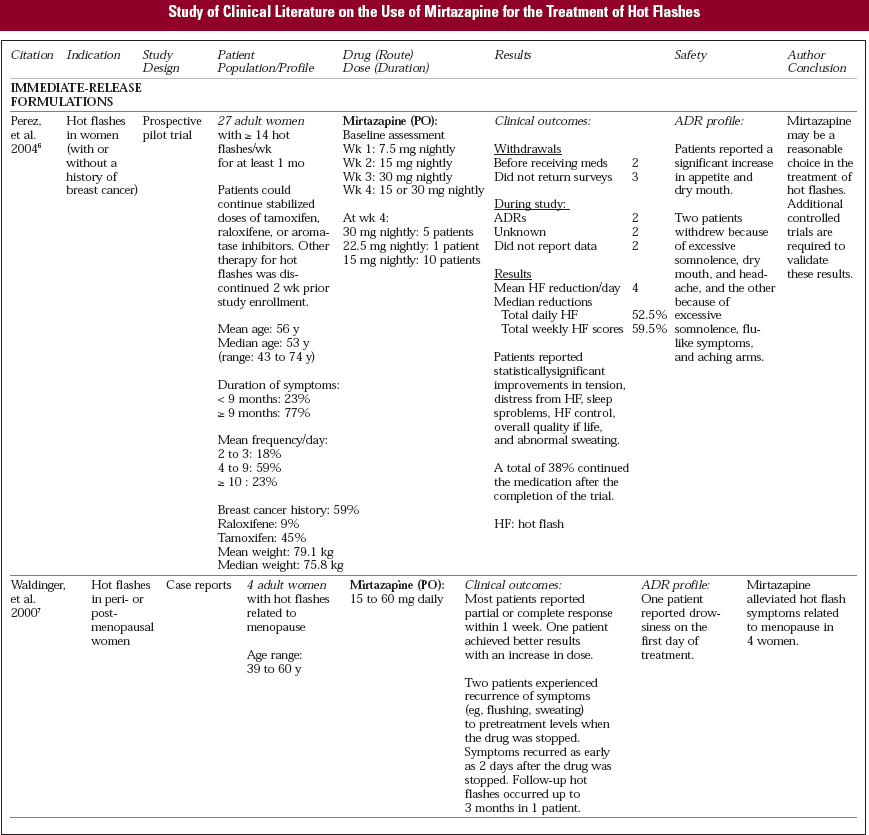
One prospective open trial: 27 women (16 completed the trial). One case series: 4 women.
Patient Population
Adult women experiencing hot flashes/flushes related to menopause.
Dosage and Duration
Mirtazapine has been administered as 7.5 to 60 mg per day. In an open trial, the drug was administered at night to avoid drowsiness effects. It was administered for 4 weeks in trial data and up to 3 months in case reports.
Results
Mirtazapine has been studied in a limited number of women for the treatment of hot flashes related to menopause. In the open trial and case reports, mirtazapine offered some relief of symptoms, both in frequency and severity. In the open trial, median reductions occurred in both total-daily hot flash frequency and total-weekly hot flash scores (52.5% and 59.5%, respectively). Onset of relief usually occurred within the first week.
Safety
Side effects reported in these reports included somnolence, an increased appetite, and dry mouth. Patient withdrawals were due to excessive somnolence, dry mouth, headache, flu-like syndrome, and aching arms.
Study of Clinical Literature on the Use of Mirtazapine for the Treatment of Hot Flashes
Therapeutic Considerations
Initial data note a partial benefit of mirtazapine in the treatment of hot flashes related to menopause. Additional long-term controlled studies will be needed to validate these trial results and determine if mirtazapine will be useful as monotherapy or as adjunctive therapy to existing treatment modalities.