






Abstract
Purpose
The main objective of this study was to evaluate whether emphasizing the importance of clinical workload documentation (CWD) throughout the clinical rotation experience would positively impact student views of documentation.
Methods
A prospective pre- and postsurvey study design was utilized to evaluate 4th-year pharmacy students' views of CWD using personal digital assistants while on clinical rotation at an institution during the 2003 to 2004 (Group A) and 2004 to 2005 (Group B) academic years.
Results
Student perceptions on the value of CWD improved significantly for both Group A (P = 0.003) and Group B (P = 0.033). Students in both groups also reported they had experience or significant experience with CWD after the rotation experience (P = 0.001).
Conclusions
Students' perception of the value and importance of CWD improved significantly throughout the rotation period with emphasis from the faculty.
Keywords
Introduction
As stated by Hepler and Strand, “Pharmaceutical care is the responsible provision of drug therapy for the purpose of achieving definite outcomes that improve a patient's quality of life.” 1 To provide this, they state that one of the necessary goals is “appropriate methods for recognizing, evaluating, and rewarding effectiveness in the provision of pharmaceutical care.” 1 Clinical pharmacy workload documentation is essential, and has been used for many years to document clinical workload and to justify pharmacist positions and services.2–5 With increasing workload demands and more emphasis being placed on patient-focused care, documentation of clinical interventions in a timely and consistent manner is difficult to achieve. Many pharmacists do not receive formal training to document clinical workload during their pharmacy education, and consequently may not participate in clinical workload documentation (CWD) in practice. Literature supports participation of pharmacy students in the CWD process.6–12 MacKinnon looked at interventions performed by pharmacy students on rotation over a 30-week period. 6 Students were taught how to complete the intervention form and what constituted an intervention. A total of 3,320 intervention forms with 5,031 intervention rationales were completed by 93 students, which led to improved medication safety and efficacy for patients. Taylor et al reported 2,873 interventions documented by faculty, residents, and students over a 19-month period, resulting in significant cost avoidance for the institution and allowing resident and student education to continue. 7 In addition, Condren and associates described 4,605 interventions documented over a 1-year period by 4 faculty members, 2 pediatric specialty residents, 1 pharmacotherapy resident, 2 pharmacy practice residents, and 44 students. Of the interventions documented, 91% were accepted and another 4% were partially accepted, resulting in significant impact on patient care. 8
The Accreditation Council for Pharmacy Education (ACPE) states in their Accreditation Standards and Guidelines adopted in 2000 that the advanced practice experience should provide workload documentation experience. 13 In the Accreditation Standards and Guidelines adopted in 2007, they state that an activity that students should be able to participate in during an advanced pharmacy practice experience may include involvement in pharmacy workload performance. 14 More students are expected to be ex posed to pharmacy programs that assess CWD at individual institutions, and these data will be used for pharmacy productivity and performance measures. Clinical rotations provide an ideal experiential setting where the preceptors demonstrate the act of and explain the value of documenting their clinical activities. The students then have the opportunity to document CWD while being observed and coached by the preceptor. Ultimately, this exposure will enable students to become familiar with CWD, to better understand its value, and potentially to foster continuation of this activity when they practice as pharmacists.
Not only can CWD be a good educational experience for students, but students can also impact pharmacy workload productivity while participating in the process.6–12 Currently, there is no published literature evaluating pharmacy students' perceptions of CWD. The primary objective of this study was to assess student perceptions of the importance of CWD. The secondary objective of this study was to evaluate the students' perceptions of using personal digital assistants (PDAs) on rotation for CWD.
Methods
The study institution is a 250-bed private teaching medical center. Four clinical faculty members provide clinical pharmacy services, as well as precept fourth-year pharmacy students. The department of pharmacy started using PDA technology for CWD in June of 2001, after a short pilot period. 15 The program was developed using Pendragon Forms database development software (Version 3.1 and Version 4.0) and was tailored to the institution's needs. At this institution, the definition of clinical workload includes daily clinical monitoring provided for patients, such as renal function assessment; total parenteral nutrition (TPN) assessment and assessment of medication appropriateness; pharmacokinetics; intravenous-to-oral route conversion; drug information; and any intervention necessary to resolve a medication problem identified during monitoring. The CWD program is used to enter any written or verbal intervention, as well as drug information or educational in-services provided to health care professionals and patients. Rotational students are required to document their clinical interventions in the CWD program.
Approval was obtained from the health care institution's Investigational Review Board prior to initiation of the study. A prospective, pre- and postsurvey study design was used to evaluate fourth-year pharmacy students' views of CWD and PDAs. Any pharmacy student completing a rotation with 1 of 4 faculty members at the institution between June 2003 and May 2005 was asked to complete a voluntary, confidential, online survey at the beginning and end of their rotation experience. Students completed the prerotation survey prior to arriving to or on the first day of the rotation, and then completed the postrotation survey on the last day of the rotation. Students were not provided with any definition or explanation of CWD before completing the prerotation survey because the investigators wanted to determine students' baseline understanding of the subject.
During the first week, students were instructed on what constituted an intervention and how to enter an intervention into the PDA program; students then were expected to enter their interventions throughout the rotation. The faculty coached, mentored, and observed the students performing CWD to ensure comprehension of the process. The preceptors checked each intervention to ensure accurate entry and follow-up before it was downloaded into the intervention database, and any discrepancies were discussed with the students. Importance of the documentation was stressed to the students throughout the rotation because the institution uses the interventions for staff and budget justification. At the end of the rotation, an intervention report showing the number of interventions completed by the students and the cost avoidance associated with their accepted interventions was presented to each student to summarize his or her work.
All student survey results remained anonymous to the faculty members. Completion of the pre-and postrotation surveys was not a requirement of the rotation, and students were allowed to withdraw from the study by not completing the survey. Data were only analyzed if the student completed both the pre- and postrotation survey.
The student survey was created by the institution's faculty members (see Figure 1). The pre- and postrotation survey questions included evaluation of student experience with and comfort level performing CWD and perception of importance of documenting CWD. The postrotation survey also included 2 questions about student views on ease of use and likeability of the PDA program. The students were asked to respond to the questions using a 4-point Likert scale from 1 (not important, not comfortable) to 4 (very important, very comfortable). The descriptor used with the Likert scale was dependent on the question (ie, when asking about importance of CWD, choices were not important, important). Students were also asked an open-ended question in the pre- and postrotation surveys concerning their views on the purpose of documenting clinical workload. The survey was built in FrontPage and was accessed by students through a university-hosted Web site. The survey responses were sent to a Microsoft Office Access database for analysis.
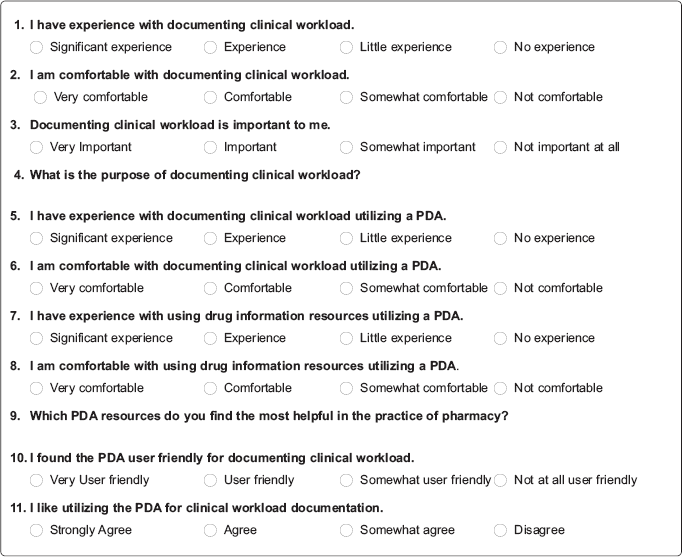
Postrotation survey.
Because of the desire for easy access to drug information resources, students in the 2004 to 2005 academic year (Group B) were supplied with a PDA by the school of pharmacy at the beginning of their third year, whereas students in the 2003 to 2004 academic year (Group A) did not have access to a PDA outside of the rotation unless they purchased one on their own. Group A had access to ePocrates (www.epocrates.com), a free PDA drug information product, while Group B had access to Lexi-Comp and Clinical Pharmacology, which were supplied by the school of pharmacy. In addition, the rotation length was reassessed by the school of pharmacy in 2004, and rotations were increased from 4 weeks to 5 weeks with Group B students. Therefore, pre- and postsurvey results were compared within the separate rotations years, as well as between the rotation years.
Comparisons were made between aggregate data pre- and postsurvey results for each response and question. Data were analyzed using the Mann Whitney U-test.
Results
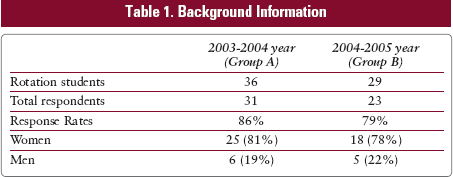
Background information for responders can be found in Table 1. All pre- and postrotation survey result comparisons were statistically significant (P < 0.05).
Background Information
Experience with Clinical Workload Documentation
When answering, “I have experience documenting clinical workload,” 28% of students in Group A responded that they had experience or significant experience prior to their rotation. When answering the same question after the rotation, 100% of students responded that they had experience or significant experience documenting clinical workload (P < 0.001).
In Group B, when answering the same question on the prerotation survey, 13% responded that they had experience or significant experience. When answering the same question after the rotation, 87% responded they had experience or significant experience with CWD (P < 0.001).
Importance of Clinical Workload Documentation
When asked about the importance of CWD prior to the rotation, 78% of students in Group A thought it was important (50%) or very important (28%). On the post-rotation survey, 100% of students thought documentation was important (35%) or very important (65%) (P = 0.003).
When asked about the importance of CWD before the rotation, 79% of students in Group B thought it was important (55%) or very important (24%). On the postrotation survey, 91% of students thought documentation was important (43%) or very important (48%) (P = 0.033).
Purpose of Clinical Workload Documentation
Thirty-one students in Group A answered the open-ended question regarding purpose of documenting clinical workload on the presurvey with a total of 36 responses, and common themes were identified by one of the faculty members. Eight students (25.8%) stated they did not know the purpose of CWD. The remaining students had 23 responses to this question, including determining the value of pharmacist services (22.6%) and tracking interventions (22.6%) (see Table 2). Thirty-one students provided 48 responses on the same open-ended question on the postsurvey. The most frequent purpose of CWD reported was to determine the value of pharmacist services (48.4%), but almost 26% now recognized the role documentation can play with cost savings analysis (see Table 2).
Twenty-three students in Group B answered the open-ended question regarding the purpose of documenting clinical workload on the prerotation survey. Three students (13%) stated they did not know what the purpose was for documenting clinical workload. The remaining students had 30 responses to this question, including tracking interventions (43.6%) and documenting/assessing workload (34.8%) (see Table 2). Twenty-three students provided 31 responses on the same open-ended question on the postrotation survey. Tracking interventions and assessing workload remained important, but almost 35% of students recognized the role CWD can play in cost savings analysis on the postrotation survey (see Table 2).
Purpose for Documenting Clinical Workload Responses
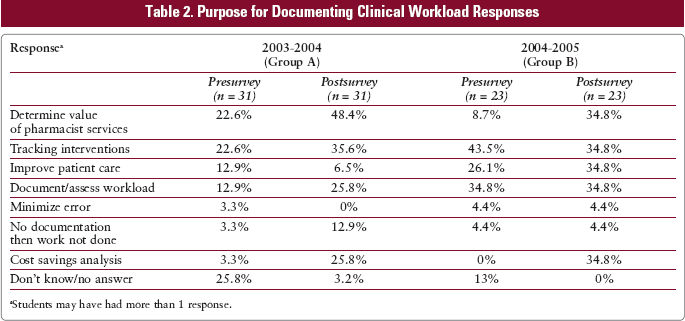
Students may have had more than 1 response.
Use of a Personal Digital Assistant
On the postrotation survey, 87% of students in Group A felt the PDA system was user-friendly or very user-friendly, and only 13% felt it was somewhat user-friendly. Ninety percent of students reported they liked using the PDA for CWD.
Of students in Group B, 83% felt the PDA system was user-friendly or very user-friendly; 87% of students reported they liked using a PDA for CWD.
Comparing the Rotation Years
The average number of interventions completed per student for Group A was 26 interventions and the average number of interventions completed for Group B was 43.4 interventions per student.
Students in Group B felt they had more experience using a PDA for CWD (P = 0.046) and drug information (P = 0.001) when compared with Group A prior to beginning a rotation. Group B also had a higher level of comfort using a PDA for CWD (P = 0.004) and drug information (P = 0.001) prior to their rotation experience at the site. All other comparisons of the prerotation questions were not statistically significant.
In the postrotation survey comparison, Group A felt they had more experience with CWD (P = 0.044) and experience using a PDA for CWD (P = 0.008) than Group B. Group B felt they had more experience using a PDA for drug information (P = 0.038) and also felt more comfortable overall documenting with a PDA (P = 0.045) than the students in Group A. All other postrotation comparisons were not statistically significant.
Discussion
There was a statistically significant improvement in student experience with CWD and in their views on the importance of CWD. This is notable because almost 79% of students had little or no experience with CWD prior to their rotation, and 22% thought CWD was not important or only somewhat important prior to their rotation.
Group B felt they had more experience and were more comfortable using the PDA for CWD prior to starting a rotation at the institution. They also felt they had more experience and comfort using the PDA for drug information. This may be because these students were given a PDA by the school of pharmacy at the beginning of their third professional year and were encouraged to use the PDA for drug information in some of their third-year classes.
Group A felt they gained more experience with CWD and using a PDA for CWD during their rotation experience than Group B. This is interesting because Group A rotations were 1 week shorter than Group B rotations. In addition, as reported in the results section, the average number of interventions completed per student for Group A was smaller than for Group B. It was anticipated that Group B would have felt they had gained more experience based on the duration of the rotation and the number of interventions completed.
There was some discussion as to whether the importance of CWD would increase throughout the year if students had a rotation at the institution or not, so students in the first half of the year were compared with the second half of the year. In Group A, there seemed to be little difference in student responses on experience and importance of CWD as the year progressed. In Group B, a higher percentage of students felt CWD was important and had more experience coming into the rotation. All postsurvey results showed statistically significant improvement, so there is evidence that student views of CWD were impacted, even those with experience.
Limitations
While it was clearly stated that the survey was unrelated to the student's grade, the questions on the postsurvey may have been answered in the way that the students believed the faculty wanted the questions answered. There were also 5 students in Group A and 6 students in Group B who did not complete the survey. Students were not asked why they did not complete the survey. It is possible that they did not complete the survey because they did not see the value of CWD, which would have altered the final results. The students were also not provided a definition of CWD in the prerotation survey, so it is possible that if CWD had been defined for the students, they may have answered the survey differently. Another limitation of the study is that students may have discussed the questionnaire and the required CWD with students who had not yet completed a rotation at the site. Depending on student experience, this may have altered the students' perceptions in a positive or a negative way. The small sample size of each year is also a limitation of the study.
Conclusion
An average of 21% of students starting a rotation at the study institution did not understand the purpose of CWD. By teaching these students the value and importance of CWD, their perception and comfort level with CWD improved during the study. The current ACPE Accreditation Standards and Guidelines do not require this activity; rather, they state that students should be allowed to participate in pharmacy data management systems that include pharmacy workload during their required advanced pharmacy practice experiences. Because it is not a required activity by ACPE standards, not all pharmacy students graduate with this skill.
It is imperative to teach students the importance of CWD. These students hopefully will become advocates of this practice as pharmacists because of their experience at the site.