






Abstract
Purpose
In preparation for the complete decentralization of pharmacists at our institution, we were asked to create a user-friendly intervention program the pharmacists could use on the patient floors.
Summary
The current system was cumbersome; the paper-based system made it hard to retrieve meaningful data and many interventions were not being captured. We felt that personal digital assistants (PDAs), with a tailored intervention program developed with Pendragon forms, would best meet our needs. A form was developed and modified based on the feedback of specific staff. After staff training, the program was implemented in June 2002. In an attempt to simplify the program, more forms were added and current forms were streamlined also based on staff feedback. The program is bridged with a Microsoft Access database and reports generated from this database provide essential information for administration to justify current positions, as well as, new positions. A literature search was performed and evaluated to determine our cost avoidance data (based on published cost avoidance associated with clinical pharmacy interventions). Institution-specific ingredient costs were used for cost savings data. Based on pre-PDA data, the number of interventions increased from an average of 112/mo to 361/mo (322% increase). An increase in the number of accepted interventions was also noted. The total cost savings and avoidance by pharmacists for the 21-month period assessed was $1,827,286: intervention total cost savings and avoidance of $1,580,593 and drug information cost avoidance of $246,693.
Conclusion
This program has increased the documentation of clinical pharmacy services at our institution, while reaping the additional benefit of transferring our total cost avoidance and savings into additional full-time equivalent positions.
The advent of handheld technology has changed pharmacy practice. Pharmacists are now able to have electronic information and documentation tools at their fingertips. PDA technology has been used to provide immediate access to drug information resources, document clinical interventions, record patient medication histories, and document and track medication errors. 1
Documentation of pharmacist cognitive services is an ongoing concern for the profession. Clinical pharmacists are often required to justify their positions by identification and documentation of specific quality and financially oriented interventions. Silva et al compared PDA documentation of clinical interventions by pharmacists and pharmacy residents over a 6-month period of time. 2 Compared to a paper-based intervention documentation process used during the previous 6 months, the number of interventions recorded by pharmacists in the study increased, resulting in potential cost avoidance in excess of $600,000. These findings suggest that PDAs offer an efficient manner of documentation for pharmacists performing cognitive services.
With the availability of this technology, a program was designed to implement a PDA documentation process for management of clinical interventions at our institution. Our community teaching hospital is found within a multisite health care system, with 17 full-time equivalent (FTE) pharmacists, three clinical faculty, and two pharmacy practice residents. In 1999, the health care system made a commitment to improve patient safety. One of the results of this initiative was the installation of the Homerus robot in an effort to decrease dispensing medication errors and increase overall patient safety. As a result of the increased use of technology, patient care services were expanded with decentralized pharmacists who were able to spend less time in drug distribution and more time focusing on clinical activities. This prompted a reassessment of our current intervention documentation system.
Because the pharmacy staff had not been decentralized, the current intervention documentation system was not sufficient to adequately manage the increasing numbers of clinical interventions that would be performed. Pharmacist interventions were documented on various paper forms, with separate forms required for each intervention, as well as, a daily tally of clinical activities. These same interventions could also be entered into the pharmacy computer system. Because we are a community hospital, many of our interventions are communicated to the physician through written notes on the chart. Due to the cumbersome reporting system, not all interventions were being reported. There was no good mechanism for documenting verbal orders, or formal and informal consults, including pharmacokinetics or drug therapy. Also, interventions entered into the pharmacy computer were deleted, once patients were discharged from the hospital, so the data were not available to be analyzed. Furthermore, because the system was mainly paper-based, all intervention forms had to be entered into a database for analysis. This manual process resulted in a significant time lag, making timely, meaningful data difficult to obtain.
Pda Program Development
The pharmacy director recognized the necessity for current, accurate data in quantifying these interventions to help justify the current salary lines, as well as, additional salary lines, to expand the decentralized coverage. The faculty members were charged with developing a user-friendly method of clinical intervention documentation. Because individual pharmacists would be covering more than one patient care area, it was felt the documentation system needed to be mobile. It was also important that any system have the capability for downloading intervention data for automated report generation to eliminate manual data entry and report generation. Additionally, flexibility to support our specific needs was an important requirement.
To accommodate the need for mobility, we decided to use PDA technology. We purchased the Handspring Visor Platinum PDA. We determined the use of Pendragon Forms database development software (Version 3.1 and Version 4.0, Pendragon Software Corporation, Libertyville, IL) would best meet our needs for this project. Pendragon Forms allow the design of customized data collection sheets, utilizing important time savers such as drop down menus and “point and click” technology. It was felt that these features would be essential in the busy decentralized environment.
The faculty developed the project, and a project proposal was submitted for an unrestricted educational grant to cover the cost of hard- and software necessary for the program.
Assessing our current intervention program, we worked with the clinical coordinator and merged all intervention processes into a standardized form that would meet our needs. Because some of the paper intervention forms had not been updated in many years, we designed the new forms to accurately reflect what our pharmacists were documenting, in addition to what they should be documenting. For example, they were not documenting a recommendation to switch a nonformulary medication to a formulary medication, so an intervention was added that would prompt them to document this.
Pendragon Forms were used to build our program, and then bridged the information to an Access database (Office 2000 and Office XP, Microsoft Corporation, Redmond, WA) for convenient analysis. This was a key point, as the previous manual entry process had become a rate-limiting step in obtaining useful, timely data. One important point to note is the database was built so patient identifiers are automatically removed when data are queried for reports. The database is stored on a computer in the secured main pharmacy. Interventions remain on the PDA until they are completed, as patient identifiers are needed, so the outcome of the intervention can be documented. PDAs are also stored in the secured main pharmacy, when not in use.
Because our decentralized pharmacists would be covering more than one area and working a rotating schedule, it was felt more appropriate to assign a PDA to each coverage area, rather than to individual pharmacists. Distributing the PDAs in this manner would assist in communication from day-to-day, as shifts and coverage changed. The faculty members, pharmacy residents, and clinical coordinator were each assigned a PDA as well.
Literature Review: Cost Avoidance Values
A literature search of MEDLINE from 1966 to 2004 was conducted to identify articles published with original economic evaluations of clinical pharmacy services. Search terms were “clinical pharmacy services, pharmacy services, cost, cost-analysis, cost-effectiveness, cost avoidance, and economic outcomes.” In addition, intervention specific search terms such as “pharmacokinetic consult, pharmacokinetic dosing, IV to oral, IV to PO, adverse drug reaction, and renal dosing” were used.
In choosing relevant data to base our program, studies reporting data from institutions, populations, and services similar to our institution were selected. Using published data from these reports, cost figures that were determined to be most applicable to our needs were entered into our database in order to provide cost avoidance information. We were able to use institution-specific ingredient costs, based on our institution's purchasing contracts, for cost-savings. The costs were loaded into our intervention database, allowing savings calculations to be as accurate as possible.
Our literature search identified several articles which were reviewed for pertinence. As described above, we evaluated the articles based on institutions, populations, and/or services similar to our institution. Based on these criteria, three were chosen to provide literature support for our cost avoidance values.3-5 Our institution did not have available data on specific cost avoidance related to the types of interventions we were performing; therefore quantifying the impact of such interventions ourselves was not feasible.
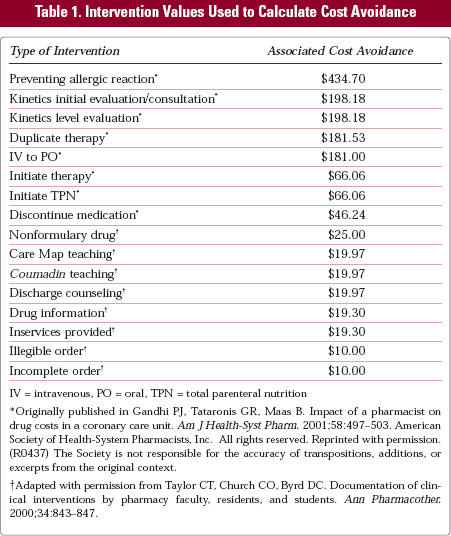
The first article, by Gandhi and colleagues, was deemed pertinent, as our institution cares for a large cardiology population. Ghandhi et al evaluated the impact of clinical pharmacy interventions in a coronary care unit (CCU). 3 Mean drug costs per admission, mean drug category costs per admission, and hospital costs per admission were identified and compared before and after introduction of clinical pharmacy services in the CCU. Interventions associated with these services were documented, and costs from Gandhi et al, based on the ASHP CliniTrend program, were used to estimate the total reduction in drug costs associated with these interventions. Table 1 contains CliniTrend values, as reported by Gandhi, which were used to calculate cost avoidance for specific interventions performed at our institution.
Intervention Values Used to Calculate Cost Avoidance
IV = intravenous, PO = oral, TPN = total parenteral nutrition
Originally published in Gandhi PJ, Tataronis GR, Maas B. Impact of a pharmacist on drug costs in a coronary care unit. Am J Health-Syst Pharm. 2001;58:497-503. American Society of Health-System Pharmacists, Inc. All rights reserved. Reprinted with permission. (R0437) The Society is not responsible for the accuracy of transpositions, additions, or excerpts from the original context.
Adapted with permission from Taylor CT, Church CO, Byrd DC. Documentation of clinical interventions by pharmacy faculty, residents, and students. Ann Pharmacother. 2000;34:843-847.
Data for several interventions that are performed routinely by our clinical staff (faculty, residents, staff pharmacists) were not included in the Gandhi et al article. These interventions included patient teaching and discharge counseling, providing inservices, and dealing with illegible, incomplete, and nonformulary orders. In 2000, Taylor and colleagues reported cost avoidance associated with documentation of clinical interventions by pharmacy faculty, residents, and students at a community hospital affiliated with a college of pharmacy. 4 The researchers assigned cost avoidance values to interventions similar to those performed at our institution based on published literature, hospital specific data, and assigned values from similar intervention documentation systems. 4 From these data, we were able to assess the financial impact of additional interventions routinely performed by our clinical pharmacists. Table 1 also contains values from Taylor et al that were used in our assessment.
Many of the clinical interventions documented at our institution involved identification and prevention of potential drug-drug interactions and adverse drug reactions. The key references we were using to calculate our cost avoidance data did not include these particular situations. In 2002, Lee et al published a study of clinical and economic outcomes of pharmacists' recommendations in the inpatient, outpatient, and nursing home setting at a Veterans Affairs medical center. 5 Among the 15 types of pharmacists' recommendations reviewed were drug interactions and prevention or management of adverse drug reactions. When the researchers assessed the economic impact of the clinical interventions, each recommendation was reviewed independently by two clinical experts to evaluate: the potential to prevent or cause harm, the probability that harm may have occurred, and the health care resources needed to treat any harm which occurred. The average cost avoided per intervention related to the identification of drug interactions in the inpatient setting was $1,647. The average cost avoided per intervention involving the prevention or management of an adverse drug event in the inpatient setting was $1,098. These values were used to estimate the cost avoidance of interventions related to preventing or managing drug interactions and adverse drug reactions at our institution.
As previously mentioned, prevention of medication errors has been a focus at our institution, and pharmacy has made a concerted effort to improve patient safety through the identification and prevention of potential medication errors. In addition to tracking clinical interventions, the PDA program allows tracking of prevented medication errors. Sayles published an editorial in 2004 describing cost savings associated with documentation of pharmacists' interventions within a community medical center. 6 This overview provided average cost avoidance factors for specific interventions performed by the clinical pharmacy staff. Medication-error prevention was determined to have an average cost avoidance per intervention of $1,375 at the described institution. This value was used to estimate the cost avoidance of interventions at our institution that may have prevented a medication error.
Pda Program Implementation
The faculty piloted the PDA intervention forms for all of their clinical intervention documentation beginning in December 2001. Modifications were made to the forms and the process based on faculty experience. In February 2002, select pharmacists were asked to use the PDAs for documentation in order to provide suggestions that would make the process more user-friendly for the staff pharmacists. Based on their feedback, the process of entering the interventions was refined to assure more consistent and accurate entry of data. The pharmacists suggested that the program may be too time consuming, but after discussing this issue with them, it was decided to proceed with the implementation and gather feedback after further program use.
During May 2002, the faculty provided “hands-on” workshops to introduce the program to the pharmacists. A short demonstration was provided, allowing the majority of time for the pharmacists to use the program. To ensure the pharmacists were comfortable with the program and process, we allowed a few weeks after the workshops before fully implementing the intervention program in June 2002.
Continuous feedback from the staff has resulted in several changes and updates to the program. Initially, we had two forms for the PDA intervention program: the Intervention form and the Daily Activities form. The Intervention form consolidated our previous intervention process into one form, as seen in Figure 1. All interventions, including drug information, pharmacokinetic dosing or dosage adjustments based on drug levels are documented in this form. The Daily Activities form is a tally sheet for clinical screening. Data collected include: RPh screening for IV to PO, adverse drug reaction, drug interaction, renal dosing, total parenteral nutrition (TPN) and daily pharmacokinetics monitoring. Completion of adverse drug reaction forms is documented in this section as well.
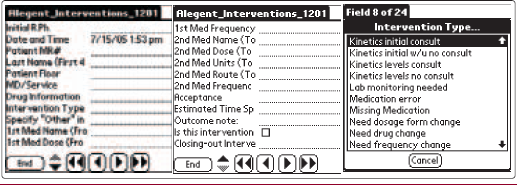
Screen views of the complete intervention form, as well as, the drop down menu for intervention type.
Because this program was developed for our institution, we asked for constant reassessment to meet the needs of the pharmacists. The overwhelming complaints from the pharmacists were too many screens and too much time needed to complete one intervention. Specific problems noted were: not all interventions were readily tied to a patient (ie, drug information), repetitive activities were too time consuming (ie, patients seen daily in the Anticoagulation clinic), and information being asked for was perceived as unnecessary (ie, room number, patient age).
Based on pharmacist feedback, the number of screens on the main intervention program was decreased. We also added two separate forms to save time for the pharmacists. One form was added for the Anticoagulation Service, which is used solely by the pharmacists working with this service (see Figure 2). The purpose was to eliminate the need for the pharmacist to re-enter patient name, location, and medical record number with each patient interaction. Each time the patient is seen, the visit number and time spent with each visit is updated, eliminating repeated patient data entry. The intervention remains on the PDA until the patient is discharged from either the inpatient or the outpatient service.
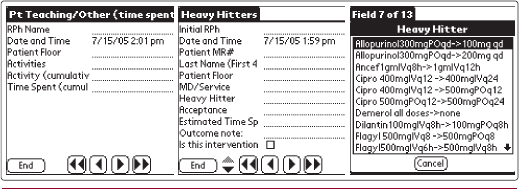
Screen views of the Patient Teaching/Other form, the Heavy Hitters form, and the drop down menu for the Heavy Hitters form.
The second form, Patient Teaching/Other form, allows the pharmacist to document a number of clinical activities, including various types of patient teaching and drug information, without linking the activity to a patient (see Figure 2). Because the patient teaching is completed immediately, we do not need the patient name for follow-up. The pharmacists now document these clinical activities based on the number of activities they complete on each unit and the time spent providing the clinical activities. The information is captured for the nursing unit, instead of specific patients, to assess workload distribution among the decentralized pharmacists.
When these new forms were implemented, formal training was not done. The forms were installed on all PDAs, and we educated each pharmacist as they were available with short, informal, 5-minute trainings. The informal training was not effective, and the staff pharmacists were still not using the new forms, even though completion of the forms was much faster with the modifications, because they still had the perception that the intervention process was too time consuming. This was reported by several of the staff pharmacists and evident by the lack of interventions documented in each of the two new forms.
Because of poor intervention documentation, the entire program was reassessed in the spring of 2003. The Heavy Hitters form was developed (see Figure 2). This form contains the most common interventions performed at our institution, and the number of screens was decreased—making it much faster to use. In the original intervention program, there was a separate screen for all data, including each drug, dose, route, and frequency. The Heavy Hitters form combines all of these drug data into one screen, and makes the program much more user-friendly. In addition, if a patient has more than one intervention, a new intervention can be started from the current intervention, retaining all patient information and eliminating the need to re-enter these data. Our goal was to be able to enter a large majority of our interventions using the Heavy Hitters form. We currently have about 75 commonly used interventions built into this form. These interventions are drug and dose specific (ie, levofloxacin 500 mg IV daily to oral levofloxacin 500 mg daily). Because the Heavy Hitters form was designed at our institution, we can easily add additional interventions.
Formal inservices were scheduled for the staff on the five currently used forms, including the Heavy Hitters form. The original Intervention form and the Heavy Hitters form are used for intervention data. The Daily Activities form is used to tally clinical monitoring of patients. The final two forms are the Anticoagulation Service and Patient Teaching/Other form, which were described previously. We went through each form with the pharmacists and reviewed the proper entry of various interventions. The staff feedback on the Heavy Hitters form has been positive, because it is faster and easier to use.
Report Generation
The reports generated from this database provide essential data for administration. On a monthly basis, reports are generated by a faculty member for the director of pharmacy. These are: accepted clinical interventions with ingredient cost savings and cost avoidance; cost avoidance for daily activities, patient teachings, and drug information. Our average length of stay is 4.5 days, and because our main form of communication with the physicians is note writing, we allow 48 hours for interventions to be addressed. Therefore, when we calculate ingredient cost savings, which is simply the cost of the drug, the drug cost is multiplied by 2.5 days. The director uses these reports for justification of current FTEs, as well as new FTEs, with higher administration.
Historically, clinical intervention documentation has been voluntary at our institution. With the easier forms, use of the program was made mandatory by administration in January 2004 to continue to justify the two new pharmacy positions obtained from previous documentation. The director of pharmacy has incorporated documentation of clinical activities into annual evaluations for the staff pharmacists. An additional report is generated to calculate the number of interventions per pharmacist, which is used for this purpose.
Cost Avoidance and Cost Savings Values
At our institution, from June 1, 2002 to February 29, 2004, the total number of interventions was 7,571 (average = 361/mo). As was previously reported by Wilson AF et al, prior to the implementation of the PDA program, our total number of interventions over a 27-month period was 3,030 (average = 112/mo). 5 This is a 322% increase in the number of documented interventions. We believe this to be due to the updated documentation form used and the implementation of the PDA program.
Since the advent of the PDA program, not only has the number of documented interventions increased, but our acceptance rate has increased by 10%. This may be due to more consistent follow-up of intervention outcome, as well as, the ability to calculate a more accurate acceptance rate. This may also be due to the updated form, which more accurately describes the interventions that are being made at our institution, thus allowing for more accurate documentation. The PDA program allows us to be more diligent in collecting outcomes of the interventions. Because the interventions are tracked via the PDA, the number of interventions which were not evaluable due to loss of follow-up has dropped by 12%. 7 We defined loss of follow-up as interventions with no documented outcome after 48 hours. We believe this is less of a problem with the new system, because the PDA retains active interventions until manually completed by a pharmacist. Interventions not previously documented, such as pharmacokinetics, are being documented more consistently with the mobile program, and may contribute to the increased acceptance rate as well. Eleven percent (n = 831) of interventions were not evaluable due to lack of documented outcome. Of the completed PDA interventions, 88.2% (n = 5,943) were accepted.
Compared to our baseline intervention data prior to the implementation of the PDA program (see Figure 3), it appears the interventions currently being performed at our institution required a higher level of clinical functioning. 5 Prior to the program, the most common interventions were IV to oral conversions, renal dosing, and discontinuation of therapy recommendations. Currently, patient teachings and initiating TPN and other therapies are now among our top 10 interventions. This may be due to improved clinical skills with increased emphasis on clinical interventions, or it may simply be due to a clearer understanding of what should be documented by the pharmacists. Figure 4 shows the top 10 interventions by number of occurrences after PDA implementation.
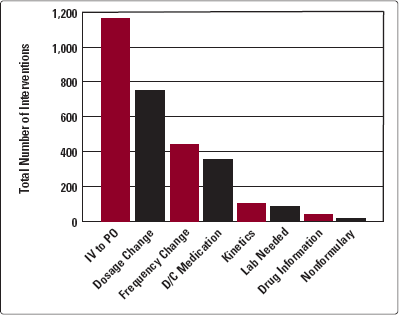
The top 10 types of interventions by total number of interventions over the 27-month period prior to PDA implementation. 7
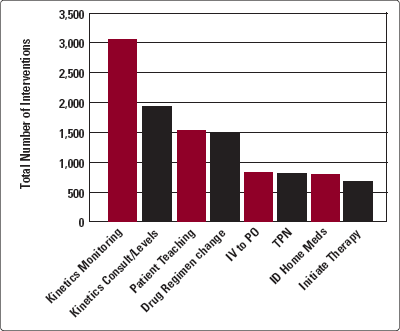
The top 10 categories by total number of intervention over a 21-month period after PDA implementation.
The PDA program requires the pharmacist to enter the amount of time spent providing the intervention (ie, researching the drug information, reviewing the medical record). The amount of time documenting the intervention in the PDA is not included in this time calculation. Following implementation of the PDA program, there has been an increase in the time spent by the pharmacists on each intervention from 8.3 to 10 minutes. With the emphasis on clinical documentation, we feel this may suggest an increased complexity in interventions.
The total cost savings and avoidance by pharmacists for accepted interventions, not including drug information interventions, at our institution for the 21-month study period was $1,580,593. The cost savings and avoidance is considerably higher than the total cost savings and avoidance that was previously reported over a 27-month period ($894,150) prior to the implementation of the PDA program. 5 This is due to increased documentation, as well as, the expansion of the cost avoidance database. Drug information interventions were separated, because the documentation of drug information prior to the PDA use was poor, with a total cost avoidance of $627 over a 27-month period. The number of drug information specific interventions, which was defined as providing a specific response to a health care professional request for medication information, over the 21-month study period was 12,782 (609 interventions/mo). Based on Taylor et al's report, the cost avoidance determined for pharmacists providing drug information was $19.30 per intervention. 2 This resulted in an additional cost avoidance of $246,693 for drug information. The grand total cost savings and avoidance for all interventions, including drug information, was $1,827,286.
We have defined “dollars missed” to mean interventions, which have been lost to follow up, are not evaluable, or are rejected. Over the 21-month study period, there was an additional $220,466 dollars missed ($101,262 rejected and $119,204 lost to follow-up/not evaluable).
Discussion
Overall, the implementation of the PDA documentation program has been a success. The total number of documented interventions and the quality of documented interventions has increased considerably. Furthermore, the total ingredient cost savings and cost avoidance has increased dramatically. The first reason for these changes is the expansion of the cost savings and cost avoidance values for clinical pharmacy interventions. The ability to individualize this program to meet the needs of our particular institution is a tremendous benefit. The value of interventions on the cost of patient care, whether it be cost avoidance or cost savings, are influenced by the setting, environment, and acuity of care at your institution.
An increase in documentation of over 3-fold is the second reason for higher total cost avoidance and cost savings. This may be due to increased accessibility with a mobile PDA and the decentralization of the pharmacists to the patient floors. We believe that the increased acceptance rate and decreased interventions lost to follow-up to be equally as valuable. As previously reported, documentation was made mandatory in January 2004. Interventions reported are through February 2004, so the mandatory reporting for the last 2 months of the reported period may have slightly affected the increase in documentation. The PDA has increased our ability to maintain communication with the staff on pending interventions. Continual evaluation of this program has enabled us to make the PDA program as time efficient and user-friendly as possible, thus increasing documentation.
The documentation of a higher clinical quality of interventions is also believed to have increased our total cost avoidance and savings. The redeployment of clinical staff pharmacists to the floor and the emphasis on clinical documentation are logical reasons for the increase in these numbers. Accessibility to patients, medical records, and other health care professionals has great potential for increasing the number of times information is requested and the depth of patient evaluation.
Summary
The impact of the PDA program is best defined by the recent incorporation of clinical documentation into the evaluations of clinical staff pharmacists. The numeric value placed on each intervention gives administration the justification required to approve additional FTEs and/or resources for our institution. Two new FTEs have been justified with the current clinical workload documentation program and increased the number of clinical pharmacists on the floor. Time spent documenting can positively impact the work environment of our pharmacy staff. This program has increased the documentation of clinical pharmacy services, while reaping the additional benefit of transferring our total cost avoidance and savings into additional FTEs.
Footnotes
Acknowledgement
Elan Pharmaceuticals is appreciated for providing an unrestricted educational grant.