






Abstract
Introduction
In 2006, the Institute of Medicine proposed initiatives to decrease medication errors using hospital monitoring systems for adverse event (AE) surveillance. Serendipitously, several poison center clinicians noticed a trend of inadvertent oral ingestions involving formoterol fumarate and tiotropium bromide. Each product is packaged in capsules for insertion into special pulmonary inhaler devices for chronic pulmonary disease. The National Poison Data System (NPDS) is a near real-time data and surveillance system capable of tracking AEs. Our objective was to assess the feasibility of NPDS to analyze outpatient AEs, employing formoterol and tiotropium ingestions as a model.
Methods
Retrospective review of NPDS data for formoterol and tiotropium mistaken oral ingestions (MOI) (2001–2007). Inclusion criteria were age over 6 years, exposures, all administration routes, all reasons, incorrect dosing route, and all medical outcomes. Primary outcome measures were number of MOI cases and demographics of at-risk patients.
Results
There were 3,919 formoterol and 18,096 tiotropium cases that met inclusion criteria. MOI cases with minor or moderate outcomes were formoterol 82 (2.2%) and tiotropium 131 (0.8%). Neither drug had a major medical outcome or death. Mean age and gender were similar for both medications. MOI was more common among female patients. Health care facility MOIs accounted for 19 (0.5%) formoterol and 35 (0.2%) tiotropium cases. From 2005 to 2007, formoterol and tiotropium cases accounted for 35% to 45% of all NPDS-tracked AEs.
Conclusion
NPDS data analysis revealed the magnitude of AEs for capsule-shaped medications for inhaler use was more common than previously identified.
Keywords
A variety of adverse event (AE) monitoring systems for medication administration target the inpatient population. Other than nurse advice lines, traditional postmarketing surveillance, and the US Food and Drug Administration (FDA) portals (fax, phone, or online at www.fda.gov/medwatch/report.htm), there are few systems designed for providers or patients to self-report (passive surveillance) adverse drug events or reactions in the outpatient setting. In contrast, the medical literature is replete with inpatient monitoring systems composed mainly of computerized databases to identify AEs.2–7 Although passive surveillance has been estimated to underreport AEs by a factor of 20, active surveillance requires that the event be recognized, reported, and recorded in the medical record that is later searched using computerized algorithms. 2 If applied to the ambulatory setting, these systems will miss the case if the patient did not seek medical care for the event. The American Association of Poison Control Centers' (AAPCC) National Poison Data System (NPDS) is an existing system that collects near real-time data from the public and health care professionals.* A toll-free phone number provides 24/7 access to health care providers trained in pharmacology and toxicology who record cases contemporaneously in case management software allowing for AE data collection that otherwise might be unreported. Poison centers' case management software uploads case data automatically to NPDS. The median upload time is 14 [5.3, 55] (median [25%, 75%]) minutes, creating a near real-time national exposure and surveillance system. 8 The 2007 NPDS annual report documented 2.48 million human exposure cases that included over 255,000 therapeutic errors. 8 Of the NPDS therapeutic errors, 5.6% were due to incorrect dosing route.
Anecdotal evidence from poison center clinicians suggested that patients were mistakenly ingesting their capsule-shaped medications intended for inhalers used to treat a variety of chronic pulmonary diseases at a high rate. Our objective was to assess the utility of NPDS to monitor outpatient AEs using these agents -formoterol fumarate (Foradil Aerolizer; Schering Corp., a subsidiary of Merck & Co., Inc., Kenilworth, NJ) and tiotropium bromide (Spiriva Handihaler; Boehringer Ingelheim Pharmaceuticals, Inc., Ridgefield, CT) – as a model.
Methods
We performed a retrospective review (2001–2007) of mistaken oral ingestions of formoterol and tiotropium inhalation capsules. Data were gathered from NPDS, the national repository of calls logged by 61 US poison centers. Case records in this database are from self-reported calls from the public or health care professionals reporting exposures and asking questions about substances, medication reactions, and AEs. 8
Specialists in poison information record data from callers about medication events into NPDS using unique product identifier codes for each medication formulation available from the NPDS products database (POISINDEX System; Micromedex, Thomson Reuters Healthcare, Greenwood Village, CO). POISINDEX contains unique product codes for the 3 formoterol formulations and 1 for tiotropium. Using these unique product codes, we queried NPDS for these exposures from January 1, 2001 to December 31, 2007. Inclusion criteria were human, closed cases, age greater than 6 years, exposures, all routes of administration, all reasons, all medical outcomes, and exposure reason. We included calls from all sites, hypothesizing that few calls would originate from inpatient facilities and that even fewer exposures would occur there. Regarding exposure reason, we selected only cases defined as therapeutic error (an unintentional deviation from a proper therapeutic regimen that results in the wrong dose, incorrect route of administration, administration to the wrong per-son, or administration of the wrong substance) and unintentional misuse (unintentional improper or incorrect use of a nonpharmaceutical substance). 8 We included both reason categories, because pharmaceutical cases are sometimes inadvertently coded to unintentional misuse. For route of exposure, we selected only ingestions with a known medical outcome. We excluded inhalation cases with multiple products and multiple routes of exposure, that is, oral plus inhalational or oral plus dermal exposures, and so on.
NPDS definitions for medical outcomes are as follows: (1) no effect – exposure caused no signs or symptoms; (2) minor effect – minimally bothersome signs or symptoms that resolved rapidly without intervention (ie, self-limited gastrointestinal symptoms, drowsiness, skin irritation, or sinus tachycardia without hypotension); (3) moderate effect – more pronounced or prolonged systemic signs or symptoms than minor, and usually requires treatment, but with no residual disability (ie, rapidly responsive hypotension, disorientation, or isolated brief seizures that respond readily to treatment); (4) major effect – life-threatening signs or symptoms or significant residual disability or disfigurement (ie, repeated seizures, respiratory com-promise requiring intubation, ventricular tachycardia with hypotension, or esophageal stricture).
Only NPDS case data were reviewed. We defined mistaken oral ingestion as any oral ingestion of these medications where the patient was older than 6 years with a reason of unintentional therapeutic error or unintentional misuse.
Study results included patient demographics, frequency of mistaken oral ingestions, and medical outcome. Data are presented using descriptive statistics. Categorical variables are summarized by numbers and proportions (%) with P values calculated using chi-square. Our institutional review board approved the study and waived informed consent.
Results
We identified 3,919 formoterol and 18,096 tiotropium exposures meeting the inclusion criteria. Of these, 3,752 (95.7%) formoterol and 17,707 (97.9%) tiotropium were mistaken oral ingestions as defined above with known medical outcomes. The remaining exposures were dermal, ocular, nasal inhalational, mixed, or unknown route of administration. Mean age and gender for patients experiencing mistaken oral ingestion were similar for formoterol and tiotropium groups individually. More females than males ingested the medication in each group (P < .0001) (
Demographic data and outcomes of mistaken oral ingestion of formoterol fumarate and tiotropium bromide: 2001–2007
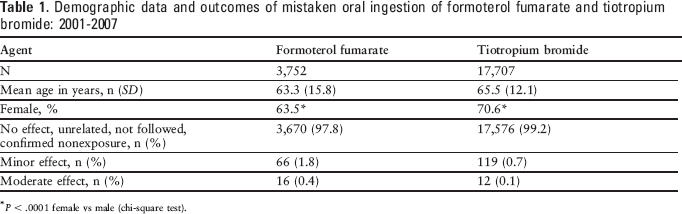
P < .0001 female vs male (chi-square test).
Both medications showed a mean 6-fold increase in exposures over the study period (formoterol: range, 104–671; tiotropium: range, 1,146–7,169) (
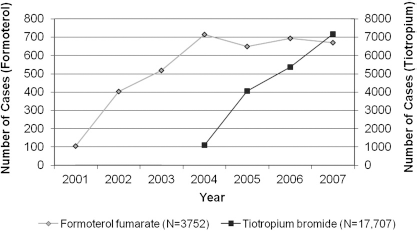
Number of mistaken oral ingestion cases of formoterol fumarate and tiotropium bromide by year: 2001 to 2007.
Medical outcome data were available for all mistaken oral ingestions. Eighty-two (2.2%) formoterol and 131 (0.8%) tiotropium cases reported a minor or moderate effect. Most cases demonstrated no effect, with a fraction of cases coded as unrelated, not followed, or confirmed nonexposure. Neither substance had a major medical outcome or death (
For formoterol, 131 (3.5%) calls originated from health care facilities (HCFs), and 19 (0.5%) exposures occurred in HCFs. For tiotropium, 726 (4.1%) calls originated from HCFs, and 35 (0.2%) exposures occurred in HCFs.
Incorrect dosing route is 1 AE scenario described in NPDS. Using our model for 2001–2007, formoterol accounted for up to 7% and tiotropium accounted for up to 42.9% of all incorrect dosing route AEs reported to NPDS (
Formoterol and tiotropium expressed as number and percent of incorrect dosing route for all medications
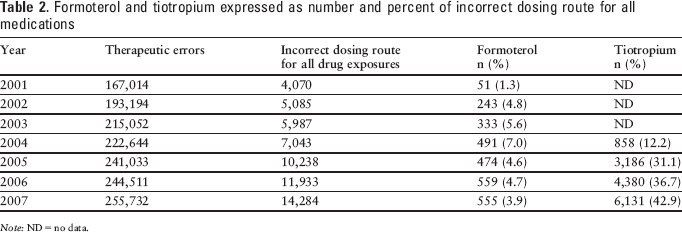
Note: ND = no data.
Discussion
Our data indicate that NPDS contained over 21,000 AE reports of formoterol fumarate and tiotropium bromide mistaken oral ingestions that otherwise may not have come to the attention of the FDA or manufacturers. The data, routinely collected in NPDS, had gone unnoticed by existing computer surveillance algorithms until the increasing case volume had alerted poison center clinicians. Prior to our analysis, Tezky and Holquist suggested that as of April 2005 the FDA was aware of only 32 cases of formoterol and tiotropium mistaken oral ingestion and was planning to alert health care providers of the inadvertent oral administration.9–10 The FDA released a Public Health Advisory in 2008 warning of the mistaken oral ingestion phenomenon. 11 The manufacturers changed the package inserts several times from 2004 to 2006 in an attempt to clarify the method of drug administration.12–16 Further prescribing information for tiotropium was released in 2008 that emphasized inhalational use and not oral ingestion.17–18 Since the 2008 package insert and patient instruction revisions, additional emphasis has not been released. The only changes that have occurred include labeling modifications for formoterol, discussing its role as a long-acting bronchodilator that has no role in acute asthma attacks, and for tiotropium, indicating that it does not increase stroke, heart attack, or death.
Despite the alerts and revisions through 2008, NPDS tracked a continuing rise in exposures. Over the 7-year period of analysis, cases of formoterol mistaken oral ingestion appear to have plateaued whereas tiotropium cases continued to rise steadily with numbers 10-fold greater than formoterol (
Tiotropium sales increased from $146.9 million in 2004 to $1.1 billion in 2007 (over 7-fold increase) with a concomitant rise in product volume from 1.7 million in 2004 to 10.1 million in 2007 (almost 6-fold increase). During the same period, formoterol sales increased from $81.2 million in 2004 to $114 million in 2007 (a 40% increase), whereas product volume rose from 1.4 million in 2004 to 2.1 million in 2007 (56% increase). 19
Potential reasons why mistaken oral ingestions occur are that the printed instructions may be unclear, patients may disregard or may be unable to read them (education level, non-native language, print too small, difficult wording), or the providers and pharmacies may not adequately explain how to use the medications. Another reason may be that patients place the inhalational capsules in pill minders and confuse them with oral medications.
Elderly females were identified as a special risk group, because most formoterol and tiotropium mistaken oral ingestions occurred in this population. Patient education and package insert changes should specifically target this group.
Due to the low oral bioavailability of these inhalational medications, inadvertent ingestion resulted in only mild to moderate effects (ie, nausea, vomiting, drowsiness, abdominal pain, and throat irritation). Treatment is generally supportive and required no intervention. Because both drugs are prescribed as maintenance pulmonary medications, disruption of maintenance therapy can be problematic in chronic pulmonary disease patients.
The low percentage of calls from HCFs (3.5% for formoterol, 4.1% for tiotropium) and the fact that the majority of exposure sites were not an HCF (99.5% for formoterol, and 99.8% for tiotropium) suggest that patients inadvertently ingested their inhalation capsules elsewhere. After these patients presented to outpatient treatment facilities (primary care provider's office or urgent care or emergency department), the health care provider reported the AE to the regional poison center. Although the majority of the AEs occurred outside of an HCF, a small percentage of AEs for formoterol and tiotropium occurred in HCFs, suggesting that health care personnel are also confused about the proper use of these delivery systems.
Tiotropium and formoterol cases accounted for 35% to 45% of the many medications responsible for the 10,000 to 14,000 incorrect dosing route therapeutic errors reported annually to NPDS between 2005 and 2007. Although there were no deaths or major outcomes, and the sequelae were generally benign, the greater risk may be the lack of therapeutic benefit for the patient, increased medication cost because of “lost” doses, and additional health care provider visits due to perceived lack of efficacy. As previously noted, during the study period drug manufacturers made several package insert revisions to clarify administration, but the increasing number of tiotropium cases suggests these have been less effective than anticipated.
Our study is an example of how the nationwide poison center system and NPDS can detect AEs. Once identified, the system may be able to monitor the effectiveness of interventions such as patient education and product labeling changes to mitigate the effects of the AE. Thus expansion of NPDS AE reporting may complement the IOM action areas to reduce and prevent medication errors.
Further studies are recommended to verify that NPDS can track the impact of improved pharmacy and provider-patient communication and patient education by its ability to report on trends in mistaken oral ingestion after interventions and package insert changes.
A limitation of our data is that NPDS and the poison centers receive only unsolicited calls (passive surveillance) and not all exposure reports. The IOM suggests that poison center calls underestimate actual poisoning incidence by approximately 50%, so AEs (including formoterol and tiotropium mistaken oral ingestions) may be twice as high as presently documented. 20 This suggests the need to educate patients, physicians, pharmacists, and nursing staff and to provide the necessary poison center infrastructure to manage AE calls. Second, the AAPCC is unable to verify completely the accuracy of every report. Although detailed reasons are not available in NPDS, it is possible to confirm and obtain additional data from the regional poison centers that reported the cases. Finally, given the self-reported nature of calls to poison centers and no denominator data, it is impossible to define a rate of mistaken oral ingestion. NPDS provides a greater understanding of the previously unknown magnitude of medication errors and AEs associated with formoterol and tiotropium.
Conclusion
In the case of these 2 medications, NPDS and the US poison center system provide an existing model for AE reporting and monitoring for the FDA and pharmaceutical manufacturers. In addition, NPDS can be used to identify AEs in high-risk populations like the elderly and shows promise for tracking the response to future patient education and packaging interventions to reduce AEs. Further work should be done to validate the use of NPDS as a real-time AE monitoring system and to support poison center data collection.
Footnotes
Dr. Varney has no conflict of interest. Dr. Bronstein is Medical Director of the Rocky Mountain Poison Center, Director of Toxicosurveillance for the American Association of Poison Control Centers, and Chair of the National Poison Data System (NPDS) Steering Committee, which is in charge of NPDS system development.
Acknowledgments
Drs. Varney and Bronstein had full access to all of the data in the study and take responsibility for the integrity of the data and the accuracy of the data analysis.
Rocky Mountain Poison and Drug Center purchased the sales data for tiotropium and formoterol from IMS Health. There was no other financial support for this project.