





Abstract
This monthly feature will help readers keep current on new drugs, new indications, dosage forms, and safety-related changes in labeling or use. Efforts have been made to ensure the accuracy of this information; however, if there are any questions, please let me know at
New drugs approved by the US Food and Drug Administration (FDA): November 17, 2011 through December 15, 2011
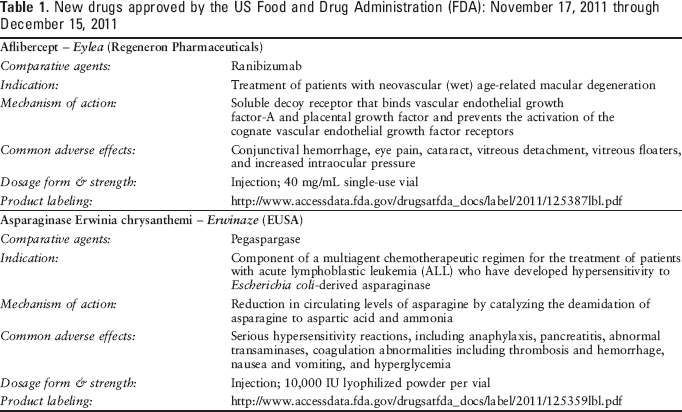
|
|
|
| Comparative agents: | Ranibizumab |
| Indication: | Treatment of patients with neovascular (wet) age-related macular degeneration |
| Mechanism of action: | Soluble decoy receptor that binds vascular endothelial growth factor-A and placental growth factor and prevents the activation of the cognate vascular endothelial growth factor receptors |
| Common adverse effects: | Conjunctival hemorrhage, eye pain, cataract, vitreous detachment, vitreous floaters, and increased intraocular pressure |
| Dosage form & strength: | Injection; 40 mg/mL single-use vial |
| Product labeling: | http://www.accessdata.fda.gov/drugsatfda_docs/label/2011/125387lbl.pdf |
|
|
|
| Comparative agents: | Pegaspargase |
| Indication: | Component of a multiagent chemotherapeutic regimen for the treatment of patients with acute lymphoblastic leukemia (ALL) who have developed hypersensitivity to Escherichia coli-derived asparaginase |
| Mechanism of action: | Reduction in circulating levels of asparagine by catalyzing the deamidation of asparagine to aspartic acid and ammonia |
| Common adverse effects: | Serious hypersensitivity reactions, including anaphylaxis, pancreatitis, abnormal transaminases, coagulation abnormalities including thrombosis and hemorrhage, nausea and vomiting, and hyperglycemia |
| Dosage form & strength: | Injection; 10,000 IU lyophilized powder per vial |
| Product labeling: | http://www.accessdata.fda.gov/drugsatfda_docs/label/2011/125359lbl.pdf |
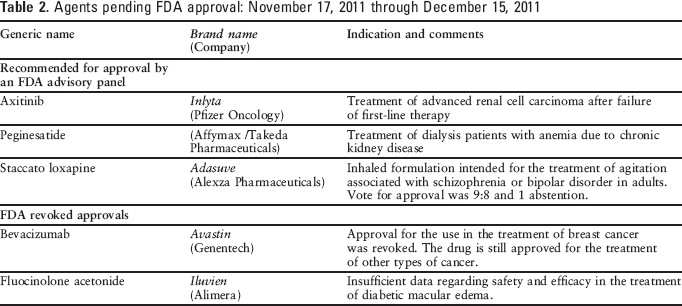
Agents pending FDA approval: November 17, 2011 through December 15, 2011
| Generic name | Brand name (Company) | Indication and comments |
|---|---|---|
|
|
||
| Axitinib | Inlyta (Pfizer Oncology) | Treatment of advanced renal cell carcinoma after failure of first-line therapy |
| Peginesatide | (Affymax /Takeda Pharmaceuticals) | Treatment of dialysis patients with anemia due to chronic kidney disease |
| Staccato loxapine | Adasuve (Alexza Pharmaceuticals) | Inhaled formulation intended for the treatment of agitation associated with schizophrenia or bipolar disorder in adults. Vote for approval was 9:8 and 1 abstention. |
|
|
||
| Bevacizumah | Avastin (Genentech) | Approval for the use in the treatment of breast cancer was revoked. The drug is still approved for the treatment of other types of cancer. |
| Fluocinolone acetonide | Iluvien (Alimera) | Insufficient data regarding safety and efficacy in the treatment of diabetic macular edema. |
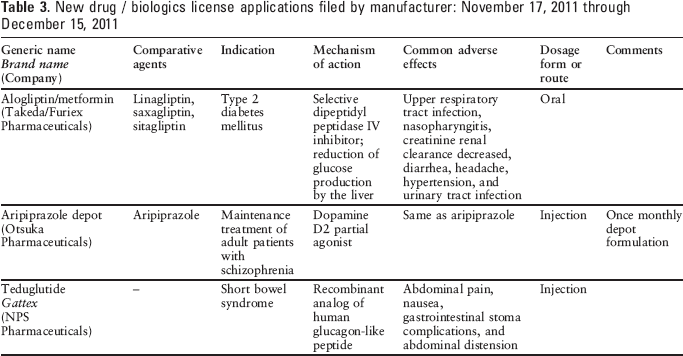
New drug / biologics license applications filed by manufacturer: November 17, 2011 through December 15, 2011
| Generic name Brand name (Company) | Comparative agents | Indication | Mechanism of action | Common adverse effects | Dosage form or route | Comments |
|---|---|---|---|---|---|---|
| Alogliptin/metformin (Takeda/Furiex Pharmaceuticals) | Linagliptin, saxagliptin, sitagliptin | Type 2 diabetes mellitus | Selective dipeptidyl peptidase IV inhibitor; reduction of glucose production by the liver | Upper respiratory tract infection, nasopharyngitis, creatinine renal clearance decreased, diarrhea, headache, hypertension, and urinary tract infection | Oral | |
| Aripiprazole depot (Otsuka Pharmaceuticals) | Aripiprazole | Maintenance treatment of adult patients with schizophrenia | Dopamine D2 partial agonist | Same as aripiprazole | Injection | Once monthly depot formulation |
| Teduglutide Gattex (NPS Pharmaceuticals) | – | Short bowel syndrome | Recombinant analog of human glucagon-like peptide | Abdominal pain, nausea, gastrointestinal stoma complications, and abdominal distension | Injection |
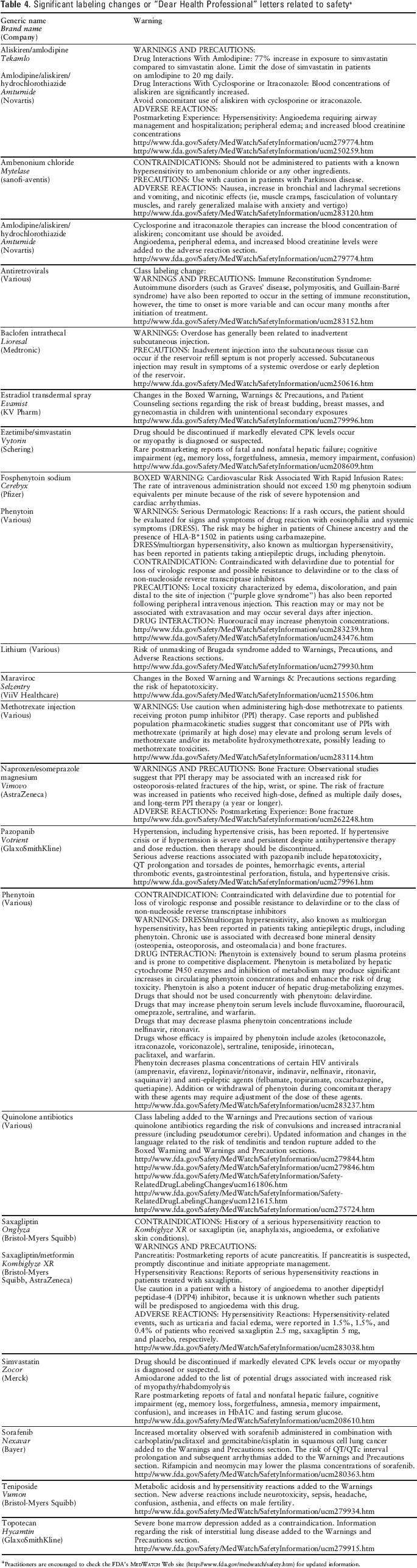
Significant labeling changes or “Dear Health Professional” letters related to safety a
| Generic name Brand name (Company) | Warning |
|---|---|
|
Aliskiren/amlodipine Tekamlo Amlodipine/aliskiren/hydrochlorothiazide Amturnide (Novartis) |
WARNINGS AND PRECAUTIONS: Drug Interactions With Amlodipine: 77% increase in exposure to simvastatin compared to simvastatin alone. Limit the dose of simvastatin in patients on amlodipine to 20 mg daily. Drug Interactions With Cyclosporine or Itraconazole: Blood concentrations of aliskiren are significantly increased. Avoid concomitant use of aliskiren with cyclosporine or itraconazole. ADVERSE REACTIONS: Postmarketing Experience: Hypersensitivity: Angioedema requiring airway management and hospitalization; peripheral edema; and increased blood creatinine concentrations http://www.fda.gov/Safety/MedWatch/SafetyInformation/ucm279774.htm http://www.fda.gov/Safety/MedWatch/SafetyInformation/ucm250259.htm |
| Ambenonium chloride Mytelase (sanofi-aventis) |
CONTRAINDICATIONS: Should not be administered to patients with a known hypersensitivity to ambenonium chloride or any other ingredients. PRECAUTIONS: Use with caution in patients with Parkinson disease. ADVERSE REACTIONS: Nausea, increase in bronchial and lachrymal secretions and vomiting, and nicotinic effects (ie, muscle cramps, fasciculation of voluntary muscles, and rarely generalized malaise with anxiety and vertigo) http://www.fda.gov/Safety/MedWatch/SafetyInformation/ucm283120.htm |
| Amlodipine/aliskiren/hydrochlorothiazide Amturnide (Novartis) |
Cyclosporine and itraconazole therapies can increase the blood concentration of aliskiren; concomitant use should be avoided. Angioedema, peripheral edema, and increased blood creatinine levels were added to the adverse reaction section. http://www.fda.gov/Safety/MedWatch/SafetyInformation/ucm279774.htm |
| Antiretrovirals (Various) |
Class labeling change: WARNINGS AND PRECAUTIONS: Immune Reconstitution Syndrome: Autoimmune disorders (such as Graves' disease, polymyositis, and Guillain-Barré syndrome) have also been reported to occur in the setting of immune reconstitution, however, the time to onset is more variable and can occur many months after initiation of treatment. http://www.fda.gov/Safety/MedWatch/SafetyInformation/ucm283152.htm |
| Baclofen intrathecal Lioresal (Medtronic) |
WARNINGS: Overdose has generally been related to inadvertent subcutaneous injection. PRECAUTIONS: Inadvertent injection into the subcutaneous tissue can occur if the reservoir refill septum is not properly accessed. Subcutaneous injection may result in symptoms of a systemic overdose or early depletion of the reservoir. http://www.fda.gov/Safety/MedWatch/SafetyInformation/ucm250616.htm |
| Estradiol transdermal spray Evatnist (KV Pharm) |
Changes in the Boxed Warning, Warnings & Precautions, and Patient Counseling sections regarding the risk of breast budding, breast masses, and gynecomastia in children with unintentional secondary exposures http://www.fda.gov/Safety/MedWatch/SafetyInformation/ucm279996.htm |
| Ezetimibe/simvastatin Vytorin (Schering) |
Drug should be discontinued if markedly elevated CPK levels occur or myopathy is diagnosed or suspected. Rare postmarketing reports of fatal and nonfatal hepatic failure; cognitive impairment (eg, memory loss, forgetfulness, amnesia, memory impairment, confusion) http://www.fda.gov/Safety/MedWatch/SafetyInformation/ucm208609.htm |
|
Fosphenytoin sodium Cerebyx (Pfizer) Phenytoin (Various) |
BOXED WARNING: Cardiovascular Risk Associated With Rapid Infusion Rates: The rate of intravenous administration should not exceed 150 mg phenytoin sodium equivalents per minute because of the risk of severe hypotension and cardiac arrhythmias. WARNINGS: Serious Dermatologic Reactions: If a rash occurs, the patient should be evaluated for signs and symptoms of drug reaction with eosinophilia and systemic symptoms (DRESS). The risk may be higher in patients of Chinese ancestry and the presence of HLA-B*1502 in patients using carbamazepine. DRESS/multiorgan hypersensitivity, also known as multiorgan hypersensitivity, has been reported in patients taking antiepileptic drugs, including phenytoin. CONTRAINDICATION: Contraindicated with delavirdine due to potential for loss of virologic response and possible resistance to delavirdine or to the class of non-nucleoside reverse transcriptase inhibitors PRECAUTIONS: Local toxicity characterized by edema, discoloration, and pain distal to the site of injection (“purple glove syndrome”) has also been reported following peripheral intravenous injection. This reaction may or may not be associated with extravasation and may occur several days after injection. DRUG INTERACTION: Fluorouracil may increase phenytoin concentrations. http://www.fda.gov/Safety/MedWatch/SafetyInformation/ucm283239.htm http://www.fda.gov/Safety/MedWatch/SafetyInformation/ucm243476.htm |
| Lithium (Various) |
Risk of unmasking of Brugada syndrome added to Warnings, Precautions, and Adverse Reactions sections. http://www.fda.gov/Safety/MedWatch/SafetyInformation/ucm279930.htm |
| Maraviroc Selzentry (ViiV Healthcare) |
Changes in the Boxed Warning and Warnings & Precautions sections regarding the risk of hepatotoxicity. http://www.fda.gov/Safety/MedWatch/SafetyInformation/ucm215506.htm |
| Methotrexate injection (Various) |
WARNINGS: Use caution when administering high-dose methotrexate to patients receiving proton pump inhibitor (PPI) therapy. Case reports and published population pharmacokinetic studies suggest that concomitant use of PPIs with methotrexate (primarily at high dose) may elevate and prolong serum levels of methotrexate and/or its metabolite hydroxymethotrexate, possibly leading to methotrexate toxicities. http://www.fda.gov/Safety/MedWatch/SafetyInformation/ucm283114.htm |
| Naproxen/esomeprazole magnesium Vitnovo (AstraZeneca) |
WARNINGS AND PRECAUTIONS: Bone Fracture: Observational studies suggest that PPI therapy may be associated with an increased risk for osteoporosis-related fractures of the hip, wrist, or spine. The risk of fracture was increased in patients who received high-dose, defined as multiple daily doses, and long-term PPI therapy (a year or longer). ADVERSE REACTIONS: Postmarketing Experience: Bone fracture http://www.fda.gov/Safety/MedWatch/SafetyInformation/ucm262248.htm |
| Pazopanih Votrient (GlaxoSmithKline) |
Hypertension, including hypertensive crisis, has been reported. If hypertensive crisis or if hypertension is severe and persistent despite antihypertensive therapy and dose reduction. then therapy should be discontinued. Serious adverse reactions associated with pazopanib include hepatotoxicity, QT prolongation and torsades de pointes, hemorrhagic events, arterial thrombotic events, gastrointestinal perforation, fistula, and hypertensive crisis. http://www.fda.gov/Safety/MedWatch/SafetyInformation/ucm279961.htm |
| Phenytoin (Various) |
CONTRAINDICATION: Contraindicated with delavirdine due to potential for loss of virologic response and possible resistance to delavirdine or to the class of non-nucleoside reverse transcriptase inhibitors WARNINGS: DRESS/multiorgan hypersensitivity, also known as multiorgan hypersensitivity, has been reported in patients taking antiepileptic drugs, including phenytoin. Chronic use is associated with decreased bone mineral density (osteopenia, osteoporosis, and osteomalacia) and bone fractures. DRUG INTERACTION: Phenytoin is extensively bound to serum plasma proteins and is prone to competitive displacement. Phenytoin is metabolized by hepatic cytochrome P450 enzymes and inhibition of metabolism may produce significant increases in circulating phenytoin concentrations and enhance the risk of drug toxicity. Phenytoin is also a potent inducer of hepatic drug-metabolizing enzymes. Drugs that should not be used concurrently with phenytoin: delavirdine. Drugs that may increase phenytoin serum levels include fluvoxamine, fluorouracil, omeprazole, sertraline, and warfarin. Drugs that may decrease plasma phenytoin concentrations include nelfinavir, ritonavir. Drugs whose efficacy is impaired by phenytoin include azoles (ketoconazole, itraconazole, voriconazole), sertraline, teniposide, irinotecan, paclitaxel, and warfarin. Phenytoin decreases plasma concentrations of certain HIV antivirals (amprenavir, efavirenz, lopinavir/ritonavir, indinavir, nelfinavir, ritonavir, saquinavir) and anti-epileptic agents (felbamate, topiramate, oxcarbazepine, quetiapine). Addition or withdrawal of phenytoin during concomitant therapy with these agents may require adjustment of the dose of these agents. http://www.fda.gov/Safety/MedWatch/SafetyInformation/ucm283237.htm |
| Quinolone antibiotics (Various) |
Class labeling added to the Warnings and Precautions section of various quinolone antibiotics regarding the risk of convulsions and increased intracranial pressure (including pseudotumor cerebri). Updated information and changes in the language related to the risk of tendinitis and tendon rupture added to the Boxed Warning and Warnings and Precaution sections. http://www.fda.gov/Safety/MedWatch/SafetyInformation/ucm279844.htm http://www.fda.gov/Safety/MedWatch/SafetyInformation/ucm279846.htm http://www.fda.gov/Safety/MedWatch/SafetyInformation/Safety-RelatedDrugLabelingChanges/ucm161806.htm http://www.fda.gov/Safety/MedWatch/SafetyInformation/Safety-RelatedDrugLabelingChanges/ucm121615.htm http://www.fda.gov/Safety/MedWatch/SafetyInformation/ucm275724.htm |
|
Saxagliptin Onglyza (Bristol-Myers Squibb) Saxagliptin/metformin Kombiglyze XR (Bristol-Myers Squibb, AstraZeneca) |
CONTRAINDICATIONS: History of a serious hypersensitivity reaction to Kombiglyze XR or saxagliptin (ie, anaphylaxis, angioedema, or exfoliative skin conditions). WARNINGS AND PRECAUTIONS: Pancreatitis: Postmarketing reports of acute pancreatitis. If pancreatitis is suspected, promptly discontinue and initiate appropriate management. Hypersensitivity Reactions: Reports of serious hypersensitivity reactions in patients treated with saxagliptin. Use caution in a patient with a history of angioedema to another dipeptidyl peptidase-4 (DPP4) inhibitor, because it is unknown whether such patients will be predisposed to angioedema with this drug. ADVERSE REACTIONS: Hypersensitivity Reactions: Hypersensitivity-related events, such as urticaria and facial edema, were reported in 1.5%, 1.5%, and 0.4% of patients who received saxagliptin 2.5 mg, saxagliptin 5 mg, and placebo, respectively. http://www.fda.gov/Safety/MedWatch/SafetyInformation/ucm283038.htm |
| Simvastatin Zocor (Merck) |
Drug should be discontinued if markedly elevated CPK levels occur or myopathy is diagnosed or suspected. Amiodarone added to the list of potential drugs associated with increased risk of myopathy/rhabdomyolysis Rare postmarketing reports of fatal and nonfatal hepatic failure, cognitive impairment (eg, memory loss, forgetfulness, amnesia, memory impairment, confusion), and increases in HbA1C and fasting serum glucose. http://www.fda.gov/Safety/MedWatch/SafetyInformation/ucm208610.htm |
| Sorafenih Nexavar (Bayer) |
Increased mortality observed with sorafenib administered in combination with carboplatin/paclitaxel and gemcitabine/cisplatin in squamous cell lung cancer added to the Warnings and Precautions section. The risk of QT/QTc interval prolongation and subsequent arrhythmias added to the Warnings and Precautions section. Rifampicin and neomycin may lower the plasma concentrations of sorafenib. http://www.fda.gov/Safety/MedWatch/SafetyInformation/ucm280363.htm |
| Teniposide Vumon (Bristol-Myers Squibb) |
Metabolic acidosis and hypersensitivity reactions added to the Warnings section. New adverse reactions include neurotoxicity, sepsis, headache, confusion, asthenia, and effects on male fertility. http://www.fda.gov/Safety/MedWatch/SafetyInformation/ucm279934.htm |
| Topotecan Hycamtin (GlaxoSmithKline) |
Severe bone marrow depression added as a contraindication. Information regarding the risk of interstitial lung disease added to the Warnings and Precautions section. http://www.fda.gov/Safety/MedWatch/SafetyInformation/ucm279915.htm |
Practitioners are encouraged to check the FDA's MedWatch Web site (http://www.fda.gov/medwatch/safety.htm) for updated information.