







Abstract
Despite the rapid growth of social media and the enthusiasm surrounding social media advertising (SMA), scant theoretical and empirical knowledge exists on the cross-border effectiveness of SMA and its influence on consumer behavior in the social media environment. This research develops a four-stage belief–value–attitude–behavior framework to understand the intervening role of SMA value and attitude and reflect how consumers react to SMA across cultures and global social media types. The results confirm the mediating effects of value and attitude and reveal that positive attitude toward SMA increases social media–specific behaviors (i.e., message and social interaction behaviors). The moderating effect results of culture reveal a greater impact of infotainment on SMA value and of credibility on SMA value and attitude in the higher-uncertainty-avoidance culture. Infotainment has a larger effect on SMA value and attitude in global content community sites than in global social networking sites, but there is a reverse moderating effect on the impact of credibility. The research provides a better theoretical understanding of consumers’ behavioral responses to SMA in international marketplaces.
Keywords
Despite the enthusiasm of marketers and the increasing scholarly attention (e.g., Berthon et al. 2012; Okazaki and Taylor 2013), the behavioral implications of international social media advertising (SMA) are relatively less understood. (Hudson et al. 2016). A pertinent issue in social media research, in general, is a predisposition toward the study of behavioral responses, such as click-through rates and purchase intention (e.g., Aguirre et al. 2015; Dao et al. 2014), rooted in either the traditional or the Web 1.0 advertising media. The social media environment fundamentally differs from these advertising environments in terms of accessibility, interactivity, and power (shift from firms to consumers) (Berthon et al. 2012). The instant-interactive nature of social media, perhaps its most consequential feature, provides consumers with greater ability to process advertising stimuli than with traditional media (Ko, Cho, and Roberts 2005). This results in more complex and interactive behaviors, such as consumers’ interaction with their social network or with the advertised messages. Therefore, applying the existing wisdom on consumer behavior from traditional or Web 1.0 media to social media would provide limited insights (at best) into international SMA effectiveness.
At the same time, international SMA research is in a nascent stage. Okazaki and Taylor (2013), in their review of international SMA literature, indicate the dearth of theoretical perspectives on which hypotheses could be formulated and empirically tested. This paucity is resonated in and compounded by the scant literature on the effect of international SMA on consumer behavior and the underlying psychological processes (Hudson et al. 2016). This is surprising given the importance attached to understanding the dynamics of international SMA and its impact on consumers (Moro, Rita, and Vala 2016; Okazaki and Taylor 2013). Arguably, the theoretical foundations of Web 1.0 international advertising could be transferred to social media. Knoll (2016), however, cautions against using this approach without empirical evidence, prompting the testing of theoretical frameworks on the interactive behavioral implications of international SMA.
Berthon et al. (2012) suggest that the downstream consequences of social media are dependent on national culture. The authors argue that marketers need to take cultural differences into account when designing their global social media strategies. Barring a few studies that discuss the standardization/adaptation of social media communication and the role of national culture (e.g., Hatzithomas, Fotiadis, and Coudounaris 2016; Hudson et al. 2016), the extant literature provides limited guidance on how SMA is perceived and could be implemented effectively across cultures. Such an insight is particularly important because behavioral models do not necessarily hold across cultures (Ashraf, Thongpapanl, and Auh 2014).
In view of these limitations in the extant literature, our aim is to develop a theoretically grounded framework of international SMA effectiveness in a cross-cultural setting. Using the hierarchy of effects theory (Lavidge and Steiner 1961) and the expectancy value theory of gratifications sought and obtained (Rayburn and Palmgreen 1984) as theoretical foundations, we develop a framework of factors that could intervene with and contingently affect consumers’ interactive behavioral responses to SMA across borders. Specifically, we focus on the intervening roles of value and attitude and the moderating roles of uncertainty avoidance and global social media types in the relationship between SMA infotainment (a term for material that informs and entertains)/credibility and message and social interaction behaviors.
Our research makes several contributions to the literature. First, we advance the research on international SMA effectiveness by proposing an alternative model of consumer behavior rooted in the interactive Web 2.0 environment. Our research is among the first to investigate and advance the knowledge of the effect of interactive SMA on the interactive behavioral responses of message and social interaction in the international context. In the process, we depart from most prior literature, which has focused on marketing outcomes such as purchase intention and electronic word of mouth (Dao et al. 2014; Hsu et al. 2015), because these measures may be unsuitable to assess advertising effectiveness in the social media environment.
Second, we contribute to the international advertising literature by developing a theory-driven framework of international SMA effectiveness. Drawing on the hierarchy of effects theory and the expectancy value theory, we address the call to advance theoretical perspectives on international SMA (Knoll 2016; Okazaki and Taylor 2013). Our framework deepens the theoretical understanding of how consumers evaluate SMA in international marketplaces by examining value and attitude as the underlying processes guiding behavior and investigating the boundary conditions that alter the efficacy of SMA. On a broader level, we add to the development of the two theories in the realm of SMA and their applicability across borders.
Third, we extend the research on uncertainty avoidance (Ashraf et al. 2017; Krautz and Hoffmann 2017) and contribute to the scant literature on the role of national culture in international SMA. This gap in the SMA research is particularly worrisome because limited knowledge exists on the feasibility and efficacy of same SMA strategies across cultures (Hudson et al. 2016). We expand the stream of research on SMA by offering both theoretical insights and managerial guidance on the execution of SMA in different cultures. In the process, we also add to the SMA literature on standardization versus adaptation (Hatzithomas, Fotiadis, and Coudounaris 2016) and to the larger and the ongoing debate on the advertising standardization–adaptation strategy. We also take into account how consumer assessment of SMA could vary across different global social media types, thereby adding to and extending the limited literature on the comparative efficacy of SMA strategies on different types of global social media.
Conceptual Framework
Social Media Advertising
Drawing on the synthesis of the SMA literature (e.g., Knoll 2016; Kumar et al. 2016), in this research we operationalize SMA as firm-generated advertising posted by firms on social media with instant and interactive features that allow consumers to take interactive actions. By nature, SMA is instant and interactive, but certain formats of SMA are more interactive, such as those with built-in quizzes, games, and polls and/or those that allow consumers to explore, like, comment on, follow, and share the ads instantly. Social media advertising provides both consumers and managers with a unique metric of an ad's popularity through the number of likes, comments, and shares it receives in a timely fashion. Social media advertising is unique because, unlike ads on traditional or Web 1.0 media, it appears as the part of the main viewing content of a given social media. Social media itself has shifted the power from firms to consumers, changing them from passive to active elements in the advertising process (Berthon et al. 2012). Thus, SMA fundamentally differs from advertising on traditional or Web 1.0 media, and it might be inappropriate to assess the impact of SMA on behavior with the existing knowledge from other media.
Advertising on social media is achieved in several ways and through different types of social media, such as in the form of long (e.g., on Facebook) or short (e.g., on Twitter) text messages, pictures, videos (e.g., on YouTube), and so on. Firms can create their own YouTube channels and Face-book pages or use the various interactive advertising tools on YouTube and Facebook. Different types of social media have their own unique formats and attributes that offer specific applications for SMA. For example, SMA on YouTube primarily appears in the form of in-stream videos ads (skippable ads before the start of or during a video), and in-search ads (displayed in search results). Whereas in-stream video ads appear incidentally when consumers watch a video, in-search ads appear when they deliberately search for ads or related content on YouTube. Consumers are also exposed to ads when they subscribe to a brand's YouTube channel. Irrespective of the differences in the source of exposure, ads on YouTube provide similar experience and actions/content to consumers. In contrast, ads on Facebook mainly take the form of posts and dynamic product ads. Consumers are exposed to ads on their newsfeed when they like brands’ pages; when ads are shared, liked, or commented on by consumers’ social network; or when firms directly target consumers on the basis of their browsing history and habits. Although ads on Facebook differ from those on YouTube in terms of how consumers are exposed to them, they appear on the newsfeed essentially in the same manner, with identical actions and content.
The Hierarchy of Effects and the Expectancy Value Theories
The hierarchy of effects theory is a systematic response process divided into the sequential stages (Smith, Chen, and Yang 2008) of cognition, affect, and conation. Cognition can take the form of belief, affect takes the form of attitude, and conation takes the form of behavior. The theory of the cognition–affect–conation process is proposed to be the most practical model of connecting various levels of consumer responses and is considered both the basis and an adequate approach to measure the effectiveness of advertising (San Josέ-Cabezudo, Gutiέrrez-Cillán, and Gutiέrrez-Arranz 2008). We employ the theory particularly because it allows for a holistic assessment of both direct and indirect effects of positive dispositions on behavioral responses (Bartsch, Riefler, and Diamantopoulos 2016). Furthermore, it is posited that these theoretical models do not generalize but are contingent (Eisend and Tarrahi 2016). This not only renders the projection of the extant hierarchy of effects domestic frameworks to international context difficult but also strengthens the ground for employing the theory in the contingent settings of varied cultures and global social media types.
The expectancy value theory, in contrast, elucidates how a person's beliefs contribute to the assessment of value through gratifications sought and obtained, leading to the development of an affect state (Rayburn and Palmgreen 1984). The theory is robust and flexible in understanding and linking different stages of consumer evaluation and is frequently employed as a theoretical paradigm in a variety of fields (Shoham, Rose, and Kahle 1998). The theory, through the mechanism of gratifications sought and obtained, delineates the motivation behind the belief–value–attitude sequence of consumer responses. Furthermore, the central tenet of the theory (i.e., the belief–value–attitude link) could be said to be complementary to the belief–attitude–behavior model of the hierarchy of effects theory. Building on this and the flexibility of the hierarchy of effects theory in terms of the number of stages (see Smith, Chen, and Yang 2008), we develop a four-stage framework of belief–value–attitude–behavior and study the mediating and moderating mechanisms to understand consumer reaction to SMA in international marketplaces.
Conceptual Framework Development
We develop a theory-based belief–value–attitude–behavior framework to understand consumer responses to SMA across international markets (Figure 1). We base our choice of factors on both the traditional advertising literature and the unique interactive factors crucial to SMA. To represent the belief or cognition (first) stage of the four-stage framework, we employ SMA infotainment and credibility. The two, apart from being regarded as belief factors in the traditional advertising literature (e.g., C.-L. Liu et al. 2012; Pollay and Mittal 1993; Wang and Sun 2010), are important characteristics and the defining features of SMA (Dao et al. 2014). The second stage is represented by value of SMA. Value, besides being considered a part of cognition in advertising (F. Liu et al. 2012; Okazaki 2004), is also treated as an outcome of belief factors. At the same, value is an antecedent of attitude according to the expectancy value theory (Rayburn and Palmgreen 1984). Therefore, we model value as a mediator in the beliefs factors–attitude relationship. Advertising attitude, a personal utility factor that originates from advertising beliefs (Pollay and Mittal 1993), forms the affect factor (third stage). Attitude, apart from being a consequence of beliefs/value, is also posited to lead to behavioral responses, according to the hierarchy of effects theory, and thus acts as a mediator in the beliefs/value–behavior relationship. Behavioral responses (the conation factors in the hierarchy of effects theory) are represented by social media–specific behaviors of message and social interactions.
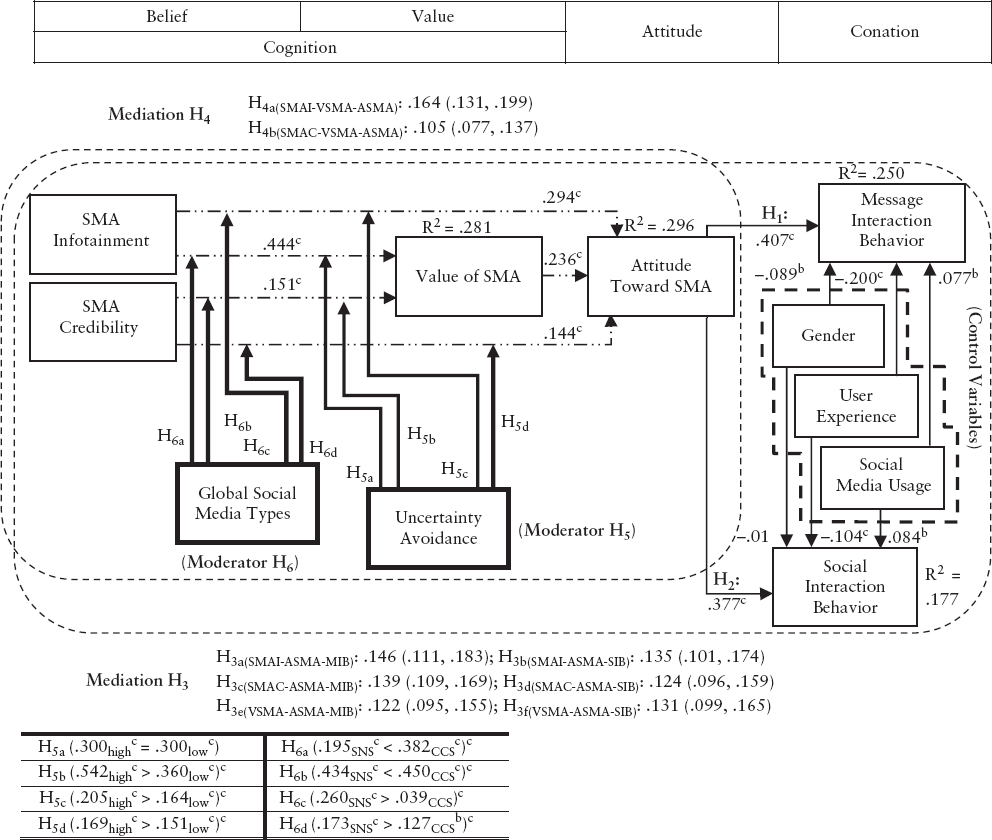
The Research Framework and Direct, Mediating, and Moderating Effect Results
We study message and social interactions as consumers’ behavioral responses to international SMA because of their relevance in the social media environment. Message and social interactions are considered fundamental behaviors in response to interactive Internet advertising (Huang et al. 2007; Ko, Cho, and Roberts 2005; Zeng, Huang, and Dou 2009). They can provide marketers with meaningful insights into consumer opinion (see Nguyen et al. 2014) and could become a powerful determinant of subsequent, more direct consumer responses. Although these two behaviors are the fundamental behavioral responses to interactive marketing stimuli and are expected to play important roles in judging the effectiveness of SMA, studies on their driving forces (in both domestic and cross-border settings) are scarce.
Although we develop a broad four-stage framework of consumer responses to SMA, our primary aim is to investigate how consumers develop SMA-specific behavior and to identify the mediating and moderating effects. Therefore, while we test the entire proposed framework, we hypothesize only the direct effects of attitude on message and social interaction behaviors (the SMA-specific outcomes), the mediating effects of value and attitude, and the moderating effects of uncertainty avoidance and global social media types (discussed next). We contend that although the direct effects of (1) SMA infotainment and credibility on value and attitude and (2) value on attitude must be tested within the proposed framework, these relationships may provide only incremental contributions to the arguments delineating them in the existing advertising literature. Thus, we focus on the relatively richer direct, mediating, and moderating effects and confirm the applicability of a holistic hierarchy of effects theory–and expectancy value theory–based framework of SMA effectiveness across international markets.
Uncertainty Avoidance
International SMA efforts are subject to cultural differences. Culture is expected to influence consumers’ motivation to create, exchange, and enthusiastically engage in their social media newsfeed (Berthon et al. 2012). Among the six dimensions of Hofstede, Hofstede, and Minkov's (2010) cultural typology, we focus on the moderating effect of uncertainty avoidance, which explains whether a culture accepts uncertainty as a source of opportunity or finds ways to reduce it because it is perceived as a threat. Compared with other cultural dimensions, uncertainty avoidance has a unique relevance in the social media environment. In addition to its importance in affecting social media behavior and usage (see Hudson et al. 2016), uncertainty avoidance has a bearing on risk taking, whereas consumers’ perceived risk has been found to affect their behavior on social media (Hajli and Lin 2016). Furthermore, uncertainty avoidance has been shown to affect international advertising outcomes (Möller and Eisend 2010) and social media interactions (Hudson et al. 2016) across cultures.
Global Social Media Types
Social media could be classified as global, regional, and local depending on its reach and coverage. In contrast to regional/local social media sites (e.g., VKontakte in Russia and Eurasian countries; Renren, Youku, or Sina Weibo in China) that are characterized by local users and the use of local languages, global social media has global reach and relevance. Although users of global social media come from diverse cultural backgrounds, they are untethered to time and geography and form a global network–based society (Hampton, Lee, and Her 2011). Okazaki and Taylor (2013) point to a likely emergence of global consumer culture around global social networks due to shared meanings and symbols. This provides the ground to posit that consumers on a global social media site might exhibit similar attitudes and behaviors even in the presence of cultural differences.
All global social media, however, is not the same. One of the defining features of global social media is its different formats or types that possess their own image, personality, and characteristics (Kaplan and Haenlein 2010). Different types of global social media may influence the nature of interactions and affect consumer perception and belief in advertisements (Prendergast, Liu, and Poon 2009). Therefore, we expect that consumers from different cultures will exhibit similar attitude and behavior on a global social media site, but their attitudes and behaviors will vary across different types of global social media because of differences in the nature of global social media and the network society it generates. This makes global social media types an important yet relatively ignored contingent factor in the study of behavioral responses to international SMA (Wang, Min, and Han 2016).
According to Bergh et al. (2011), social media can be divided into three types: content community sites (CCSs), social networking sites (SNSs), and social media platforms. We focus on global CCSs (YouTube) and global SNSs (Facebook) because these are the two most widely used global social media types (Dao et al. 2014). We do not explicitly study the effect of social media platforms because this type of social media is relatively less prevalent (Dao et al. 2014) and Facebook is both an SNS and a platform (Bergh et al. 2011), thereby making the modeling of social media platforms less insightful.
Hypothesis Development
The Effect of Affect/Attitude toward SMA on Conation
Consumer conation, in our research, is represented by message interaction and social interaction behaviors on social media. Message interaction refers to the degree to which consumers engage in processing ads by actively interacting with advertising messages, whereas social interaction entails consumers’ engagement with the advertiser and other users. Message and social interaction behaviors are unique to the social media environment, as they capture consumers’ varied interactivity with the advertising content, other consumers, and advertisers. Thus, these behaviors are quite different from the general responses to any Internet advertising, such as giving, obtaining, and passing information. In the context of SMA, message interaction can be set in motion through actions within the advertising message, such as downloading content, clicking hyperlinks, utilizing search functions, or consuming the multimedia features of the advertisement (Ko, Cho, and Roberts 2005).
A prominent aspect of attitude toward digital advertising is its capability to affect consumers’ exposure, attention, and willingness to click, assess, and react to the advertised message (Okazaki 2004). Consumers with a positive attitude toward SMA are more receptive to it (Hsu et al. 2015) and thus will be more willing to expose themselves to, watch, and pay attention to/follow the ad and the advertised message (see Mehta 2000) on social media. The resultant high involvement with the ad (James and Kover 1992) would make consumers act further in response to the advertised messages (Mehta 2000), such as spending more time to elaborate on the advertised message (James and Kover 1992) and performing more content-gathering-oriented behavior (Zeng, Huang, and Dou 2009). In the context of SMA, these behaviors span a wide range of actions, from the traditional Web 1.0–based functions such as clicking a hyperlink for more information or utilizing search function, to the Web 2.0–based functions such as consuming SMA multimedia features in an instantaneous and interactive fashion (Ko, Cho, and Roberts 2005; Zeng, Huang, and Dou 2009). Drawing from this notion, we contend that a positive attitude toward SMA will lead to an interaction with the advertising message (i.e., message interaction behavior on social media). The hierarchy of effects theory also lends support to the contention that favorable attitude toward SMA will generate (social media–specific) behavior toward advertising. Thus, we hypothesize,
H1: Attitude toward SMA has a positive effect on message interaction behavior.
In the context of SMA, social interaction behavior is conceptualized as consumers’ contribution to social media by means of social interaction with advertisers and other consumers about the advertised product/brand (Ko, Cho, and Roberts 2005; Muntinga, Moorman, and Smit 2011). For example, consumers may provide feedback to the advertiser, participate in online discussions and forums, pass on the advertised message to their social connections, request product problem diagnostics online from advertisers and their social network, and so on.
As we have noted, consumers with a positive attitude toward advertising tend to interact with the advertised message for information and/or purchase decision. However, advertising on social media is not just about the message itself but rather presents a personal channel and currency for user-centered networking and social interaction (Chi 2011), which the traditional or Web 1.0 media environments do not allow for. Consumers can not only comment on the ads and explicitly connect to the advertisers but also share the advertised content with their social connections. These actions enable consumers to get more comments, opinions, advice, or information regarding the advertised product/brand from their social network (Chu 2011). Thus, more benefits, such as more trustworthy information and opinions, can be accessed (Chu and Kim 2011), more opportunities can be identified, and better purchase decisions can be made (Chu 2011). Due to these perceptions, consumers with a positive attitude toward SMA are more likely to respond and react favorably to SMA. This implies a high propensity for engagement (Hsu et al. 2015) that finally drives consumers to habitually interact socially (Chu 2011)—that is, develop social interaction behavior. This assertion is supported by the hierarchy of effects theory, which denotes a positive relationship between attitude and behavior. Accordingly, we propose the following:
H2: Attitude toward SMA has a positive effect on social interaction behavior.
Mediating Effect of Attitude toward SMA
The hierarchy of effects theory contends that affect is the intermediate step between cognition and conation (Lavidge and Steiner 1961). This provides a basis to hypothesize that attitude toward SMA, the affect variable in our research, mediates the effect of the three belief factors on the two behavioral outcomes. This rationale finds support in Smith, Chen, and Yang (2008), in which the authors argue that attitude is formed on the basis of consumers’ beliefs and is a necessary precursor of behavior. In addition, the literature on advertising in general and SMA in particular confirms the important role of advertising attitude as a crucial construct that guides and influences consumer behavioral responses to advertising (see, e.g., Chu 2011). More specifically, advertising attitude is a pathway between advertising belief and behavior (Wang and Sun 2010). It is therefore plausible that attitude toward SMA would mediate the relationship between the three SMA beliefs (i.e., infotainment, credibility, and value) and the two research behavior outcomes (i.e., message and social interaction behaviors). Drawing from this argument and the related evidence, we hypothesize that
H3: Attitude toward SMA mediates the relationships between the three belief factors (i.e., SMA infotainment, SMA credibility, and SMA value) and the two behavioral outcomes (i.e., message interaction behavior and social interaction behavior).
Mediating Effect of SMA Value
As we have argued previously, on the basis of the hierarchy of effects theory, value and the two belief factors (i.e., infotainment and credibility) are posited to directly affect attitude toward SMA. At the same time, the expectancy value theory proposes value as a consequence of belief factors as well as a precursor to attitude, and we model it likewise in our research. We posit that, in addition to the direct effect of infotainment and credibility on SMA attitude, the two belief factors also indirectly affect attitude toward SMA through the value of SMA. Thus, value may also act as a mediator in the relationship between the two belief factors (SMA infotainment and credibility) and the attitude toward SMA. We base our assertion on the argument that consumers first derive a value from their beliefs, and the calculation of this value results in evaluations, referred to as attitude (Tehone, Zo, and Ciganek 2015). That is, value is an intermediate step and provides an alternative pathway from consumer SMA beliefs to subsequent attitude. From these arguments, we posit,
H4: SMA value acts as a mediator in the relationships between the belief antecedents (i.e., SMA infotainment and SMA credibility) and attitude toward SMA.
Moderating Effect of Uncertainty Avoidance
According to Hofstede, Hofstede, and Minkov (2010, p. 191), uncertainty avoidance reflects the idea that people feel threatened by unknown or ambiguous situations and thus form beliefs and develop strategies to avoid these threats. As per their cultural typology, consumers from high-uncertainty-avoidance cultures differ from those from low-uncertainty-avoidance cultures in their beliefs and attitudes. International marketing literature has suggested that consumers from cultures with high uncertainty avoidance are more averse to risk than their counterparts in low-uncertainty-avoidance cultures (Ashraf et al. 2017; Krautz and Hoffmann 2017). Consequently, they have a much lower tolerance for ambiguity and unclear situations, a much stronger need for consensus, clarity, and structure, and a much lower level of acceptance for diversity. Because of these characteristics, people from high-uncertainty-avoidance cultures show a strong need for rules, structure, and formality (Möller and Eisend 2010). They attempt to increase stability and predictability (Akdeniz and Talay 2013), and thus they prefer and seek credible signals (Mazaheri, Richard, and Laroche 2011). Consequently, they gather and process more information (Akdeniz and Talay 2013) and rely more on experts (Möller and Eisend 2010), even if these actions incur greater costs. All these actions help them mitigate ambiguity, uncertain feelings, and potential risks.
Advertising plays the role of providing consumers with rules and structure for future consumption by way of useful information (Wang and Sun 2010). Compared with other sponsored sources, SMA is considered a useful and informative medium that provides helpful, reliable, and high-quality product-/brand-related information because of the comments and/or endorsement by consumers’ social network (see Chu and Kim 2011). High-quality information is particularly valued in high-uncertainty-avoidance cultures (Engelen, Lackhoff, and Schmidt 2013). To reduce perceived ambiguity, uncertainty, and possible risks, consumers in a high-uncertainty-avoidance culture will be eager to search for quality information and be more inclined to look for product advice endorsed by others through SMA (see Singh 2006). This will enable them to precisely comprehend product/brand benefits and help them make better decisions. This suggests that in a high-uncertainty-avoidance culture, where consumers are more sensitive to ambiguity, uncertainty, and risk, the perception of SMA as a useful and reliable information source is expected to be higher. In addition, consumers will sense a greater need to be involved in SMA and have more positive feelings toward it. The more the consumers interact with SMA, the greater their perceived SMA benefits will be in terms of the SMA's usefulness and reliability. Thus, the effect of belief on positive attitudes and value will be greater. In line with these assertions, we propose the following moderating effect of uncertainty avoidance:
H5: In the proposed framework, uncertainty avoidance moderates the effect of belief on attitude and value. Specifically, the effect of infotainment on (a) SMA attitude and (b) SMA value, and the effect of credibility on (c) SMA attitude and (d) SMA value is greater in a high-uncertainty-avoidance (vs. low-uncertainty-avoidance) culture.
Moderating Effect of Global Social Media Types
Between the two most popular global social media types (i.e., CCSs and SNSs), CCSs, with their low requirements of self-presentation and disclosure (Kaplan and Haenlein 2010), focus on specific content rather than users and permit their users to organize, share, or search for specific media content (Bergh et al. 2011). The shared content could be texts (e.g., BookCrossing), photos (e.g., Flickr), videos (e.g., You-Tube), and/or PowerPoint presentations (e.g., Slideshare). Given the characteristics of these sites, advertising on global CCSs should be related to users’ individual needs and interests. For instance, advertising on YouTube in the form of in-search ads closely follows consumers’ search words, and thus the displayed ads are related to the content the consumer originally searched for. The ability to skip YouTube's in-stream ads also enhances consumers’ control over ads and increases their engagement with ads (Knoll 2016). Furthermore, consumers can search for specific product/brand information on global CCSs. In contrast, a search on global SNSs for product/brand information results in highly varied information, most of which is unspecific and unrelated. Ads on CCSs are thus viewed as more relevant and useful in meeting consumers’ needs (Knoll 2016). Therefore, CCSs ads will be noticed and viewed more than ads on other social media (Chu and Kim 2011) and regarded as more advantageous in carrying out users’ tasks and satisfying their entertainment needs. Ultimately, the infotainment of ads on global CCSs will foster better attitude and higher value than those on other global social media, such as SNSs.
Unlike CCSs, global SNSs are more user-centric, with high self-presentation and disclosure, and offer online venues to users to share all types of content with others for networking as well as for building and maintaining relationships (Bergh et al. 2011). Users post personal content and information on their profiles with the purpose of sharing with other users (e.g., adding photos, uploading music, writing notes and messages, placing web links) or consume the content shared by others (Kaplan and Haenlein 2010). Facebook is a renowned global SNS where personal information such as photos and statuses are shared and messages are exchanged with one's social network (Chu 2011; Li, Liu, and Li 2014). LinkedIn is another well-known global SNS oriented toward business networking. Through interactions, users become acquainted and build trust with one another (Li, Liu, and Li 2014). This structures and maintains their social connectivity and gratifies their socialization needs (Chu and Kim 2011). In contrast, socialization on global CCSs, such as YouTube, is mostly limited because of low personal networking and weak ties between consumers. In addition, social support from existing social contacts helps users gain self-status (Taylor, Lewin, and Strutton 2011). Thus, ads on SNSs, which allow for comments on advertised products from users’ social contacts and connections, are perceived as more trustworthy and believable (Chu and Kim 2011). As a result, not only is the information from SMA on global SNSs considered more reliable, but less time and effort is spent on verifying the SMA's trustworthiness. Eventually, a more favorable attitude toward SMA and the value of this advertising format is facilitated on global SNSs than on other global social media such as CCSs. Drawing on these assertions, we propose the moderating role of global social media types:
H6: In the proposed framework, global social media types moderate the effect of belief on attitude and value. More specifically, the effect of infotainment on (a) SMA attitude and (b) SMA value is stronger on global CCSs than on global SNSs, while the effect of credibility on (c) SMA attitude and (d) SMA value is stronger on global SNSs than on global CCSs.
Research Methodology
Environmental Setting and Sampling
We chose Taiwan and Vietnam to represent high- and low-uncertainty-avoidance cultures, respectively. Taiwan has a relatively high-uncertainty-avoidance score of 69, while Vietnam has a lower score of 30 (Hofstede, Hofstede, and Minkov 2010, pp. 193–94). We selected YouTube and Facebook to represent global CCSs and SNSs, respectively, because the two are not only representative of their respective categories in terms of users but also synonymous with global social media (Knoll 2016). Given their reach and relevance, we expect CCSs (YouTube) and SNSs (Facebook) to provide rich insights into the moderating effect of global social media types. In Taiwan, YouTube is the leading CCS, while Facebook is the most popular SNS (SimilarWeb 2017). Social media advertising has become a growing mainstream advertising format in Taiwan (Telecompaper 2016). YouTube and Facebook are also the most popular CCS and SNS, respectively, in Vietnam (SimilarWeb 2017). In Vietnam, SMA has surpassed other online venues of advertising, with 34% local businesses using SMA (Vietnam News 2017).
University students in Taiwan and Vietnam formed the research sampling frame. We chose this segment for several reasons. Compared with those in higher age brackets, university students born in the 1990s are more familiar with information technology (Ashraf, Thongpapanl, and Auh 2014) and are also more open to and more likely to adopt innovative technologies (Yim, Chu, and Sauer 2017). They possess the requisite knowledge, are familiar with, and are most proactive in using such technologies (Ashraf, Thongpapanl, and Auh 2014). These young adults form the largest proportion of Internet users, and university students constitute the majority of this age segment (Pan et al. 2017). Social media has a growing influence on their purchase behavior, and they often prefer to interact with firms online (Hamilton, Kaltcheva, and Rohm 2016). The student segment is consequently often viewed as a reasonable sample in Internet research (Smith et al. 2013). University students are also one of the largest online segments in Taiwan and Vietnam (Kemp 2011, 2012).
More importantly, Bello et al. (2009) state that a university student sample is appropriate for academic studies to concurrently evaluate differences in views and values between countries or cultures, and the results are possibly generalizable to other populations if the research undertakes theory applications with hypothetical predictions (which the current research does). In addition, for cross-cultural studies, samples drawn from university students, rather than the general population, can ensure relative sample consistency and subject pool equivalence, which facilitates comparability across countries because it minimizes the effect of potentially influential extraneous variables (e.g., demographic, social) (see F. Liu et al. 2012). Such a segment allows for isolating and excluding alternative explanations caused by the heterogeneity of samples between cultures, making way for predictions that are more precise as well as a stronger test of theory.
In conclusion, a substantive and nonidiosyncratic result can be obtained from the use of student samples, making generalizability and external validity less of a concern. Therefore, the proximate processes and outcomes specified by Bello et al. (2009) are satisfied. In addition, university students are deemed an acceptable sample (Zellmer-Bruhn, Caligiuri, and Thomas 2016) and are often recruited in cross-cultural marketing research (Ashraf, Thongpapanl, and Auh 2014).
Measurements, Questionnaire Design, and Pretesting
We measured all constructs using prior multi-item scales modified slightly to fit the research environment (Web Appendix A). We measured SMA infotainment and credibility using C.-L. Liu et al.'s (2012) five-item scale and MacKenzie and Lutz's (1989) three-item scale, respectively. We assessed SMA value with a three-item scale by Ducoffe (1995). Attitude toward SMA was measured with a three-item scale adapted from Pollay and Mittal (1993). We measured message and social interaction behaviors using the three-item scales drawn from Zeng, Huang, and Dou (2009) and Huang et al. (2007), respectively. With the aim of minimizing possible systematic errors, we introduced gender, user experience, and social media usage as control variables. User experience is communicated as the years of experience users have with a specific social media website, and social media usage refers to the average number of hours users spend on a specific social media website per day. We assessed all control variables using single-item scales.
All the measurement items originated from English-language works, but the field studies were conducted in Taiwan and Vietnam, where the official languages are Mandarin Chinese and Vietnamese, respectively. The scale items were translated using a back-translation technique to ensure equivalence. We constructed two versions of the questionnaire for use in the survey of the CCS (YouTube) and the SNS (Facebook) samples. The major difference between these two versions was the scale item statements corresponding to YouTube and Facebook. We then pretested the questionnaires among 90 undergraduate students in each country who had at least six months of experience using YouTube/Facebook. The final questionnaire design integrated their remarks and suggestions to ensure its readability and logical flow.
Data Collection
Taiwan and Vietnam both have two parallel university systems (i.e., public and private). To represent the two university systems, data collection took place at one university of each type in Taoyuan, Taiwan, and in Hanoi, Vietnam. The two versions of the questionnaire (either YouTube or Facebook versions) were distributed at the main entrance of each university. The four universities had a population of roughly 10,000 (8,000~12,000) students, and the daily main entrance passerby count for each university averaged to approximately 2,500 students, out of which a minimum of 50% of students were expected to be qualified and willing to participate (based on the response rate of the pretest). One out of every five students passing through the main entrance was requested to participate to achieve a sample size of approximately 250 from each university. Initial verbal filtering questions helped identify qualified undergraduate students with knowledge of SMA and experience in using YouTube/Facebook in the last six months and ensured no duplication of responses in both the surveys. We instructed the respondents to provide their responses focusing on the firm-sponsored advertising they encounter on YouTube (or Facebook).
In Taiwan, 1,080 people were approached (510 for You-Tube, 570 for Facebook), out of which 565 met the criteria and agreed to participate (278 for YouTube, 284 for Facebook). The response rates were 54.5% and 49.8%, respectively. Data screening finally led to 258 usable surveys for YouTube and 218 for Facebook. In Vietnam, 955 people were approached (455 for YouTube, 500 for Facebook), out of which 609 met the requirement and agreed to participate (309 for YouTube, 300 for Facebook). The response rates were 67.9% and 60.0%, respectively. Usable surveys totaled 299 for YouTube and 297 for Facebook. A post hoc analysis revealed that all four sample sizes were acceptable for the research, as the alpha level, statistical power level, and anticipated r were above the minimum values of .05, .8, and .5, respectively.
Data Analysis and Results
We used partial least squares (PLS), in particular, SmartPLS 3.0 (Ringle, Wende, and Becker 2015), to examine scale accuracy, the research framework, and the hypotheses. We elaborate on these in the following subsections.
Sample Characteristics
The Taiwan sample consisted of a comparable number of men and women (47% vs. 53%, respectively) while the Vietnam sample consisted of approximately two-thirds (64%) women, with similar distribution across the Face-book and YouTube samples. The age group of 18- to 22-year-olds dominated the sample in both Taiwan (85.5%) and Vietnam (91.9%). In Taiwan, the highest number of respondents browsed YouTube for 11–30 minutes (33.7%) and Facebook for more than 180 minutes (27.1%) per day. In the Vietnam sample, approximately 25% respondents (the highest) browsed both YouTube and Facebook for a similar time duration (11–30 minutes) per day. Around two-thirds of respondents in Taiwan had used YouTube and approximately half of the respondents had used Facebook for more than two years. In the Vietnam sample, the largest group (approximately 40%) had an experience of less than six months in using both YouTube and Face-book. The full sample characteristics of the individual and integrated data sets appear in Web Appendix B.
Scale Accuracy Analysis
We assessed scale reliability using Cronbach's alpha, composite reliability (CR), and average variance extracted (AVE). All scales exhibited acceptable scale reliability, as the Cronbach's alpha and CR values were above the common cutoff value of .70 and the AVE exceeded the required threshold of .50 in all cases. The scales demonstrated convergent validity, as the factor loadings of all scale items on their corresponding constructs were statistically significant at the .01 level and exceeded the threshold value of .50. We found strong evidence for discriminant validity because the highest item cross-loadings were less than the items’ loadings on their corresponding constructs, the square roots of AVEs for all constructs were higher than their correlations with all other constructs, and the heterotrait–monotrait (HTMT) ratio for all the constructs was less than the threshold value of .85 (Henseler, Ringle, and Sarstedt 2015). The results of the integrated sample appear in Table 1 while the results of Taiwan/Vietnam and SNS/CCS subsamples appear in Web Appendices C and D, respectively.
SCALE ACCURACY ANALYSIS (INTEGRATED DATA SET)

Based on a seven-point Likert scale (1 = “strongly disagree,” 4 = “neutral,” and 7 = “strongly agree”). Notes: VIF = variance inflation factor.
Common Method Bias
We employed procedural remedies prior to data collection to minimize common method bias (CMB) and performed statistical analyses to assess the seriousness of CMB. We designed the questionnaire with caution. For example, the measures of the dependent constructs followed, rather than preceded, those of the independent constructs. We also used remedies such as participant anonymity, no description of the research purpose, alleviation of evaluation apprehension, use of verbal midpoints for measures, prevalidated scales, and reverse-coded items. In the post data collection stage, we employed the post hoc marker variable test (Lindell and Whitney 2001). Following Hultman, Robson, and Katsikeas (2009), we isolated the second-smallest positive correlation among the observed variables, which was .007. We then computed the CMB-adjusted correlations between all pairs of constructs in our research. We found very small differences between the original and the CMB-adjusted correlations (Δr ≤ .007), and the significance of all the correlations remained unchanged. Furthermore, the chi-square difference test revealed insignificant deterioration in fit (Δχ2 ≤ 12). Therefore, CMB was unlikely to be a serious concern in our research.
Testing Multisample Measurement Invariance
The examination of the moderating effects of uncertainty avoidance and global social media types required data sets from four groups (Taiwan, Vietnam, CCS, and SNS). Thus, it was crucial to establish measurement invariance among the four data sets prior to further analysis. Accordingly, we assessed the configural, metric, and scalar invariance among the four data sets. We employed Steenkamp and Baumgartner's (1998) process to test the invariance. Specifically, we assessed the invariance between any sample pair of Taiwan CCS and SNS and Vietnam CCS and SNS. As Web Appendix E shows, and coupled with the fact that all hypothesized factor loadings were highly significant in all the four samples, adequate configural invariance across all four data sets was implied. For metric invariance assessment, the comparisons between Taiwan CCS and SNS and between Vietnam CCS and SNS achieved full metric invariance, while others reached partial metric invariance. As for scalar invariance, although full scalar invariance was not achieved, partial scalar invariance was reached in all four comparisons. In general, the analysis results provided evidence that there was measurement invariance in the four samples.
Hypothesis Testing: Proposed Structural Framework and Direct Effects
We pooled the four data sets together to test the hypothesized direct effect relationships of H1 and H2. We used the squared multiple correlations (R2) to evaluate the explanatory power of the four endogenous variables, and a bootstrapping resampling procedure (500 samples) assessed the hypothesized effects using t-tests. The results are depicted in Figure. 1. As can be observed, the R2 for the four endogenous variables ranged from .177 to .296, indicating 17.7%–29.6% of variance in the four endogenous variables, which is higher than the minimum value of 10% (Falk and Miller 1992), suggesting a satisfactory and substantial model. The hypothesis test revealed that the two hypotheses were statistically significant and in the proposed direction, thus supporting H1 and H2. The results of the nonhypothesized effects (Figure 1) indicated that SMA infotainment and credibility significantly and positively affected the value of SMA and attitude toward SMA, and value had a significant positive effect on attitude. In addition, the analysis of the control variables revealed that gender had a negative significant effect on message interaction behavior and a nonsignificant effect on social interaction behavior. Moreover, user experience had a negative significant effect, whereas social media usage had a positive significant effect, on the two outcome variables.
Hypothesis Testing: Mediating Effects of Attitude toward SMA and Value of SMA
We adopted the bootstrapping procedure (5,000 samples) to formally test mediation (Preacher and Hayes 2004). First, we examined the mediating role of SMA attitude on the relationships between the three cognition antecedents and the two conation outcomes. The results of the bias-corrected 95% confidence interval indicated that the six indirect effects were significant, establishing the mediating effects (H3a–H3f in Figure 1). We then conducted two additional mediation tests to confirm the significance of and provide better insight into these individual mediating effects (Web Appendix F). First, we computed a z-statistic score (Vinzi et al. 2010, p. 526). Six z-statistic scores were obtained, ranging from 3.67 to 5.39 (i.e., higher than the threshold of 1.96), indicating that the three antecedents had a direct and indirect effect through SMA attitude on the two outcomes. Second, we calculated the variance-accounted-for (VAF) value, which represents the ratio of the indirect effect to the total effect (Vinzi et al. 2010, p. 528), to measure the size of the individual indirect effects. The VAF values (in percentages) indicated the amount of total effect of the antecedent on the outcome variable that was explained by the indirect effect. The results revealed the smallest VAF values for the value–message interaction behavior relationship (13.5%) and the greatest for the credibility–message interaction behavior relationship (27.4%). In summary, attitude toward SMA mediated the six individual antecedent–outcome relationships, thereby lending support to H3.
We conducted similar analyses to examine the mediating effect of SMA value in the relationship between the two antecedents (i.e., infotainment and credibility) and the outcome (i.e., attitude toward SMA). The bias-corrected 95% confidence interval results of the bootstrapping procedure (5,000 samples) revealed that the two indirect effects through the mediator, value of SMA, were significant (H4a–H4b in Figure 1). The z-statistic scores of 3.79 and 5.99 indicated that the two antecedents had both direct and indirect effects through value of SMA on the outcome. Furthermore, the VAF values suggested that the indirect effect of value of SMA was weaker on the credibility–attitude relationship (19.8%) than that on the infotainment–attitude relationship (26.3%) (Web Appendix F). In summary, SMA value mediated the two antecedent–outcome relationships, thus offering support to H4.
Hypothesis Testing: Moderating Effects of Uncertainty Avoidance and Global Social Media Types
To examine the moderating effect of uncertainty avoidance, we computed the differences of the corresponding coefficients between the integrated data sets of Taiwan and Vietnam. The integrated Taiwan data set included Taiwan CCS and SNS samples, and the integrated Vietnam data set included similar samples from Vietnam. We employed the multigroup analysis approach proposed by Keil et al. (2000) to test the proposed moderating effects. As Figure 1 shows (see H5a–H5d), with the exception of one path, the effects in the integrated Taiwan data set were significantly stronger than those in the integrated Vietnam data set. The exception was associated with H5a that showed no difference in coefficients between the two data sets. Therefore, the results supported H5b–H5d, but not H5a. To test the moderating effect of global social media types, we merged the Taiwan and Vietnam CCS (SNS) samples into an integrated CCS (SNS) data set. As Figure 1 illustrates, all path coefficients showed significant differences between the two data sets and were in the anticipated direction. Thus, the findings supported H6a–H6d.
Post Hoc Three-Way Interaction Test
Although, as our research shows, global social media types cut across cultural boundaries to exhibit unique contingent effects on SMA, a case could be made otherwise. For instance, Berthon et al. (2012) suggest that how a social media is used is contingent on the culture of the country, and Okazaki and Taylor (2013) call to test this assertion empirically. Taking a cue from the assertions in Berthon et al. and Okazaki and Taylor, and to provide a more in-depth insight, we investigated the contingent effects of culture—in particular, uncertainty avoidance—on the proposed moderating effect of global social media (H6). We primarily tested the three-way interaction between uncertainty avoidance, global social media, and the two belief factors using the PLS multigroup analysis technique. According to the results, uncertainty avoidance, in general, did not moderate the moderating effect of global social media types on direct relationships in the case of the CCS (YouTube), whereas we witnessed a mixed three-way interaction in the SNS (Facebook) condition. The full results of the analysis appear in Web Appendix G.
Discussion and Implications
Social media is transforming the scale and scope of international advertising. Despite this, the research on SMA is relatively rare (Knoll 2016), and research on the behavioral implications of international SMA is even more so (Okazaki and Taylor 2013). We develop a framework of consumer responses to SMA in international marketplaces and identify the intervening processes and the boundary conditions that guide SMA's effect on interactive behaviors of message and social interaction. The findings confirm the intervening role of value and attitude in our hierarchy of effects theory– and expectancy value theory–based framework of SMA belief–value–attitude–behavior. We find support for our argument that SMA effectiveness across cultures is contingent on uncertainty avoidance. We find a stronger effect of SMA infotainment on value and of SMA credibility on value and attitude in a high-uncertainty-avoidance culture (Taiwan) than in a low-uncertainty-avoidance culture (Vietnam). Contrary to our expectation, the effect of infotainment on attitude shows no difference between Taiwan and Vietnam. It is likely that the high-infotainment content of SMA reduces consumers’ need for cognitive closure in low-uncertainty-avoidance cultures, making them more curious and open-minded (see Smith, Chen, and Yang 2008), thus raising their positive attitude toward SMA to equal that held by consumers in high-uncertainty-avoidance cultures. We also find support for our contention that consumers’ responses to SMA are contingent on global social media types. Infotainment is found to have a stronger effect on SMA value and attitude on CCSs than on SNSs, whereas credibility is more powerful in influencing value and attitude on SNSs than on CCSs.
Theoretical Implications
Our research offers several theoretical implications. First, we add to the literature on the behavioral implications of international SMA and to the limited literature on the effect of SMA attitude on behavior (Knoll 2016). Our examination of message and social interaction behaviors advances the research on international advertising on social media, the majority of which either is descriptive in nature (e.g., Berthon et al. 2012; Okazaki and Taylor 2013) or often assesses consumer attitude or perceptions (Hatzithomas, Fotiadis, and Coudounaris 2016; Hudson et al. 2016) rather than behavior. Our findings also contribute to the stream of research on cross-cultural interactive behavior (Lin and Kalwani 2018; Tang 2017). While prior social media research has investigated limited aspects of interactive behavior such as seeking and passing information (Chu 2011; Hsu et al. 2015) and consumption, creation, and contribution (Muntinga, Moorman, and Smit 2011), it has not principally focused on SMA or its international application. In light of this gap, we advance the theory on interactive behaviors in response to international SMA by specifically focusing on message and social interaction, which represent the two forms of interactive behavior.
Second, our research addresses the call to develop and test theory-based frameworks on the implications of SMA in international marketplaces. More than half of the prior research on SMA lacks theory (Knoll 2016), and the scarcity of studies on international SMA is attributed to the limited theoretical perspectives in the field (Okazaki and Taylor 2013). In light of this, the proposed hierarchy of effects theory– and expectancy value theory–based framework adds to the theoretical bases that predict consumer behavior in response to SMA across cultures and global social media types. The modeling of the mediating effect of SMA value and attitude within the belief–value–attitude–behavior framework contributes to the scarce literature on the underlying processes that guide consumer behavior in response to SMA in international marketplaces (Hudson et al. 2016). The findings extend the research on the development and extension of the two employed theories in the social media domain (e.g., Dao et al. 2014) and contribute to the knowledge on their application and consistency in delineating different stages of consumer evaluation across dissimilar cultures (Bartsch, Riefler, and Diamantopoulos 2016; Durand, Turkina, and Robson 2016). This is noteworthy because behavioral models are not necessarily effective across cultures (Ashraf, Thongpapanl, and Auh 2014).
Third, we corroborate the importance of uncertainty avoidance as a boundary condition in cross-cultural consumer behavior models (Ashraf, Thongpapanl, and Auh 2014; Ashraf et al. 2017; Krautz and Hoffmann 2017; Lin and Kalwani 2018; Möller and Eisend 2010). More specifically, we extend the scant literature on the role of national culture in the application of SMA across borders. The majority of prior international social media literature, with the exception of a few studies (e.g., Hatzithomas, Fotiadis, and Coudounaris 2016; Hudson et al. 2016), was not concerned with SMA but with how behavior and attitude on social media vary across cultures in general. In light of this, our research establishes the unique relevance of uncertainty avoidance in international SMA research by validating its contingent role in the social media communication and consumer behavior relationship. This is significant because little understanding exists about the viability and efficacy of the use of the same online or SMA strategies across cultures (Hudson et al. 2016; Tang 2017). The findings are in line with the views held by Berthon et al. (2012) and Hatzithomas, Fotiadis, and Coudounaris (2016) that same SMA strategies may not work across cultures. Thus, on a broader level, our study adds to the stream of research on the standardization versus adaptation of online strategies (Ashraf et al. 2017; Tang 2017) and international SMA (Hatzithomas, Fotiadis, and Coudounaris 2016). Given that high- and low-uncertainty-avoidance cultures differ in how they evaluate SMA, the standardization of SMA across cultures may not yield consistent results. The findings, however, diverge from the view that consumers from high-uncertainty-avoidance cultures are less likely to adopt Internet marketing programs (e.g., Park and Jun 2003). This supports our argument that theoretical understanding established in the traditional or Web 1.0 media context may not be transferrable to the social media environment.
Fourth, our findings provide insight into the moderating role of global social media types. Despite their purported contingent role, global social media types have been largely ignored in the international SMA literature (Wang, Min, and Han 2016). The extant literature, irrespective of domestic or international focus, often studies only one social media type (e.g., Bergh et al. 2011; Hudson et al. 2016) or does not distinguish between global social media types (e.g., Chu 2011; Zeng, Huang, and Dou 2009). Although Dao et al. (2014) do provide an insight into the moderating role of social media types, their study is confined to a single country. In contrast, our research not only corroborates the contingent role of global social media types but also extends its applicability and importance in SMA across cultures. This is evident in the results of the post hoc three-way interaction between global social media types, uncertainty avoidance, and the two belief factors (Web Appendix G). The findings largely indicate that culture (uncertainty avoidance) does not influence the moderating effect of global social media, which lends additional support to our assertion that different global social media types have unique contingent effects on SMA effectiveness across cultures. This also provides support to the existence of cross-country consumer segments, as reflected in the uniformity in consumer behavior along global social media types (Krautz and Hoffmann 2017).
Fifth, the findings on the effect of SMA infotainment and credibility on behavior reinforce the notion that SMA content is important in understanding behavior on social media (Dao et al. 2014; Kumar et al. 2016). In doing so, the research also adds to and extends the literature on the effect of firm-generated SMA content on consumer behavior on social media (Kumar et al. 2016; Tang 2017).
Managerial Implications
Our findings provide important insights and actionable strategies to international managers who aim to employ SMA across cultures and global social media types. According to the results, consumer engagement in interactive behaviors of message and social interaction depends on the perceived value of and their favorable attitude toward SMA. To increase the perceived value of SMA campaigns and develop a favorable attitude, international marketers must focus on the infotainment and credibility aspect of their SMA. Compared with SMA credibility, SMA infotainment has a stronger influence on message and social interaction behaviors. This implies that marketers should develop SMA that is informative and entertaining. Thus, managers charged with the design and content of SMA should prioritize creating SMA content that is rich in up-to-date information and that simultaneously engages, amuses, and entertains consumers. Managerial efforts should also be directed toward creating SMA campaigns that are credible. Increasing the credibility quotient of SMA could be achieved by creating advertising content and disseminating it in a way that consumers endorse the campaign. This would add to its popularity and provide credibility cues to other consumers.
Second, managers should pay attention to the cultural differences across target markets because SMA campaigns need to be adjusted across cultures to be effective in achieving interactive behavioral responses. We find that consumers in low-uncertainty-avoidance markets are less sensitive to both infotainment and credibility than those in high-uncertainty-avoidance cultures. Therefore, managers should place more emphasis on delivering advertising content high in infotainment and credibility in such cultures than in those where consumers are highly risk averse. An approach could be to deliver SMA high in infotainment to low-uncertainty-avoidance consumers using the location-targeting tool of global social media. Concurrently, efforts to increase SMA credibility beyond what may be acceptable in high-uncertainty-avoidance cultures should also utilized to succeed in low-uncertainty-avoidance cultures.
Third, the findings of the effect of global social media types indicate that consumers do not perceive similar levels of SMA infotainment and credibility on different global social media types. Consumers have higher value for and more favorable attitude toward SMA infotainment on CCSs than on SNSs. In contrast, consumers value SMA credibility more and evaluate it more favorably on SNSs than on CCSs. Therefore, it is important to consider the advantages and limitations of one global social media type over another to be more effective in achieving desired outcomes. The findings suggest that separate and distinct advertising approaches on various types of global social media should be used. Specifically, to trigger interactive behavioral responses effectively, SMA on CCSs should focus more on infotainment, whereas SMA on SNSs should be high in credibility.
Fourth, we find that compared with men, women exhibit a higher tendency toward message interaction behavior. Although marketers should use this to their advantage through the targeting tools of global social media, ascertaining gender differences in motivation and sought benefits could help in identifying ways in which message interaction could be increased in men. Managers should also focus on increasing the time consumers spend on global social media because of its positive effect on message and social interaction behavior. One possible method of doing so could be to offer free content or create gaming applications on global social media that make consumers spend more time on brand/fan pages. However, user experience negatively affects message and social interaction behaviors. This suggests that managers could be more successful in their global SMA campaign with less experienced users while they would need to identify ways to motivate more experienced users for more message and social interaction behaviors.
Limitations and Future Research Directions
Our research is not without limitations. In terms of methodological design, we rely on Hofstede, Hofstede, and Minkov's (2010) scores rather than measuring uncertainty avoidance levels in the two samples. Although these scores are frequently employed in studies, and our post hoc analysis of uncertainty avoidance levels in the two samples (Web Appendix H) supports our design, future studies could measure uncertainty avoidance to rule out alternative explanations. Another limitation stems from the double-barrel nature of the item IMEI-1 (Web Appendix A) of the message interaction scale. Future studies could employ better measurement to amply capture the construct. With respect to the research sample, although the use of student sample in our research is justified, studies using samples that are more heterogeneous would be helpful in generalizing our findings.
Furthermore, it is likely that for respondents with a high number of fan page likes, a certain proportion of SMA appearing on their newsfeed/updates would be from these fan pages, which may lead to a more positive attitude toward SMA. Future SMA studies could control for these fan page likes to access more neutral results. In addition, due to our survey design, we cannot distinguish between the effects of different formats of YouTube/Facebook SMA on consumer evaluation across cultures. Given that different formats of SMA on a particular social media type may be perceived differently across cultures, future research could employ experimental design methods to gain insights into consumer responses to different SMA formats across cultures.
Because of the limited scope of our research, there are several important avenues for future research that we could not address. For instance, we account for only one cultural factor, uncertainty avoidance. Future studies could investigate the moderating effect of Hofstede, Hofstede, and Minkov's (2010) other cultural factors and time orientation, as they have a bearing on cross-cultural Internet advertising (see Möller and Eisend 2010). Furthermore, it is probable that consumers from high-/low-uncertainty-avoidance cultures may spend more/less time processing SMA. Therefore, research on the interaction between uncertainty avoidance and the processing time is encouraged to gain deeper insights into cross-cultural differences in consumers’ SMA evaluation. Another interesting avenue of research relates to the findings of the post hoc three-way interaction between global social media types, uncertainty avoidance, and the two belief factors (Web Appendix G). While we largely found no effect of uncertainty avoidance on the moderating effect of global social media types, two out of eight three-way interactions were significant. The findings point to the need for more investigation into how global social media types interact with cultural variables.
Future research streams could also focus on international SMA design and outcomes. The identification and modeling of other possible content-related drivers of SMA effectiveness (Kumar et al. 2016) could benefit the current body of research on SMA design and content. Furthermore, given that interactivity is the fundamental attribute of SMA design, future research could explore the outcomes of different levels of SMA interactivity and their cross-cultural implications. Correspondingly, marketing outcomes of message and social interactions (e.g., brand equity, purchase intention), which form the main motivation for advertisers (Ko, Cho, and Roberts 2005), should be explored to validate SMA expenditure. To address the larger issue of international SMA strategy design, studies on how firms could standardize/adapt SMA in conjunction with other marketing tools to identify/work on cross-market segments could advance the theoretical knowledge on and the actionable strategies for SMA in the global market (see also Hatzithomas, Fotiadis, and Coudounaris 2016).