






Abstract
Objective
To obtain descriptions of the experience of growing up with a cleft-related speech impairment and how it was dealt with.
Design
Semistructured interviews were tape-recorded, transcribed verbatim, and analyzed using a qualitative approach inspired by grounded theory methodology.
Setting
Interviews took place at participants' homes or workplaces or at the university.
Participants
Thirteen young adults (25 to 34 years of age) born with cleft palate with or without cleft lip.
Results
The analysis resulted in the core category Taking charge of communication, which comprised three main categories: Forming an idea of one's speech, Learning about one's communication, and Taking responsibility for communication. The first main category was made up of three subcategories and the other two had two. The categories emerged as parallel processes in the understanding and active handling of communicative interaction.
Conclusions
The participants described the processes that had enabled them to take charge of their communication. Seeing things from the listener's perspective and being open about the cleft and the speech disorder emerged as important parts of taking active responsibility for communication, as well as accepting their present speech and communication. Communicative participation should be assessed more thoroughly to understand the individual needs of people born with a cleft who have a speech impairment into adolescence.
Cleft lip and palate have an incidence of approximately 2 of 1000 live births in Europe (Mossey, 2007). A person born with a cleft involving the palate may develop a speech impairment with signs of impaired velopharyngeal function and compensatory articulation patterns. Signs of impaired velopharyngeal function are hypernasality, audible nasal air leakage, and weak pressure consonants, sometimes resulting in unclear and less intelligible speech. The compensatory articulation patterns most frequently affect consonants normally articulated at a dental or alveolar place, so that they are produced with posterior placement (palatal, velar, or glottal). The speech impairments are most prevalent in the child's preschool years, and some children born with a cleft are more difficult to understand than their peers during this period, especially for people outside their closest family. At about 10 years of age, the majority of the children have typical speech (Grunwell et al., 2000; Park et al., 2000; Lohmander et al., 2006). However, although the exact numbers are difficult to estimate, it is known that some individuals born with a cleft also live with speech impairments as adolescents and adults (e.g., Becker et al., 2000; Van Lierde et al., 2004; Havstam et al., 2008).
In clinical areas other than cleft palate, there has been concern for the way speech impairments influence others' perceptions. This has led to studies of perceptions of impaired speech, and findings indicate that others may draw negative inferences about the personality of the person speaking (Lass et al., 1991, 1993). Another study exploring how hypernasality of differing degrees was perceived found that children reacted with most dissociation to severely hypernasal speech and slightly less to moderate hypernasality (Blood and Hyman, 1977). These findings indicate that at least the first impression of a person with a speech impairment may be less favorable.
Social interaction patterns in individuals born with a cleft were studied by Slifer et al. (2004). They found that, as a group, children and adolescents with a cleft were more passive in communicative situations than controls without a cleft. Since the individuals with speech impairment were not identified for separate analysis, and the ones with severely impaired speech were excluded, it is not possible to infer whether a speech impairment had any impact on the way they communicated with others. It was, however, noted that the individuals who felt socially accepted were more communicative. A similar association between psychosocial functioning and the individuals' own perception of themselves has been found in other studies in which variables of quality of life have been compared with individuals' own satisfaction with their treatment outcome. Positive correlations between satisfaction with appearance and health-related quality of life have been found (Marcusson et al., 2001; Sinko et al., 2005; Oosterkamp et al., 2007); whereas, professional evaluations of appearance or speech have not correlated with the individuals' own reported satisfaction levels for either (Semb et al., 2005; Havstam et al., 2008; Meyer-Marcotty and Stellzig-Eisenhauer, 2009). Another study of 10-year-olds born with a cleft lip and/or palate found that psychosocial resilience had no association with the visibility of the cleft but correlated with adequate emotional functioning, high satisfaction with appearance, and a lower frequency of reported teasing (Billaud Feragen et al., 2009). These findings indicate that a person's self-perception is important for his or her participation in society.
The concept of participation is defined in the International Classification of Function, Disability, and Health (ICF) as “involvement in a life situation” and is influenced by both impairments of body functions and structures and personal and environmental factors (World Health Organization, 2001). The construct communicative participation has been defined by Eadie et al. (2006) as “taking part in life situations where knowledge, information, ideas, or feelings are exchanged” (p. 309). The ICF attempts to integrate the different perspectives of health from biological, individual, and social angles and focuses on the impact rather than the cause of an impairment. It is a classification system that aspires to offer a “common metric” for reporting limitations in a person's everyday life, regardless of the cause of the reduced function or disability. The ICF is used increasingly at a global level, especially in rehabilitation research. In ICF terms, the studies referred to in the paragraph above indicate that environmental and personal factors are of greater importance compared with impairments of body functions and structures. This points to the need for the focus of research to shift from the previous efforts to establish associations between factors, such as being born with a cleft and having an impairment of appearance or speech and adverse effect on quality of life and psychosocial functioning, to efforts to identify the enabling factors that can help individuals cope more effectively with their situation. The British social model of disability views “impairment” as a bodily condition, whilst “disability” is seen to be the result of barriers imposed by society. The model also questions “normalization” as the only appropriate response to impairment (Oliver, 1998).
In recent decades, interest has focused increasingly on the need to understand the meaning of a disability from the perspective of the individual living with that disability. The insider's perspective has been described as an important basis for developing evidence-based practice and evaluating treatment in a more holistic way (Baylor et al., 2005). Within the field of cleft care and research, Strauss and Broder (1991) have advocated methods used within the social science model to study psychosocial aspects in individuals with a cleft lip and palate. A few qualitative studies describing the experiences of being born with a cleft in the participants' own words have been conducted (Patel and Ross, 2003; Chetpakdeechit et al., 2009). These studies relate participants' desire to be like everyone else and the negative effects of experiencing social stigmatization. However, the strategies that individuals born with a cleft may employ, which may enable them to better interact with others, are at present unknown. The aim of this study was to obtain descriptions of the experience of growing up with a cleft-related speech impairment and how it was dealt with.
Methods
Approach
A qualitative method was chosen for collecting and analyzing data, since how individuals might experience growing up with a speech impairment is largely unknown. The research method was inspired by grounded theory because it provides a framework for collecting and analyzing qualitative data and focuses on a person's active processes in social interaction (Glaser and Strauss, 1967). The analytical process was also inspired by the constructivist grounded theory developed by Charmaz (2006) since it emphasizes how the interaction between researcher and participant can aid the formulation and interpretation of theory about the studied phenomenon and focuses on the continuous processes that are involved in the way individuals assign meaning to their reality.
Participants
A total number of 13 young adults, six men and seven women, participated in semistructured interviews. Eight participants were initially strategically selected from a group of individuals who had been born with a cleft involving the palate and treated at the hospital clinic. They were 25 to 31 years of age and had a remaining speech impairment at their last visit to the cleft clinic. They were identified through chart reviews and were contacted by mail with an explanation of the purpose of the study and then by telephone. All those who were approached agreed to participate. Another five participants aged 32 to 34 years were identified by a theoretical sampling procedure (see Analysis section). Saturation was reached after 11 participants, and the addition of two more participants confirmed saturation (Glaser and Strauss, 1967). The type and degree of speech impairment varied, but all the participants exhibited more than slight hypernasality or slight sigmatism (Table 1). There were some individual differences in the surgical treatment of the cleft, but clefts in the lip and palate were closed before 3 years of age, and the cleft in the alveolus was closed at about 8 years of age.
Overview of Participants
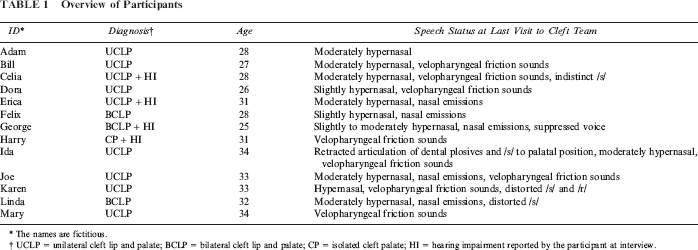
The names are fictitious.
UCLP = unilateral cleft lip and palate; BCLP = bilateral cleft lip and palate; CP = isolated cleft palate; HI = hearing impairment reported by the participant at interview.
Ethical Considerations
The Regional Research Ethics Committee at the University of Gothenburg approved the study. All the participants gave their informed consent to participate. No one indicated a need for psychological support, but a few participants had questions regarding their present speech status. In those cases, they were advised to contact the hospital for a formal speech assessment. To protect participants' identities, the names of participants are fictitious, and information that could lead to identification has been omitted.
Data Collection
Interviews
Data were collected in semistructured individual interviews that lasted for 80 to 120 minutes. All the interviews were conducted by the first author and took place at the participant's home or workplace or at the university, according to the participant's choice. The interviews were audio taped and were informal and conversational in style. Thematic questions concerning the experience of growing up with a cleft and impressions of speech and communication, such as “Could you tell me what it was like to grow up with a cleft” and “How did you feel about your speech?”, were asked with follow-up questions.
Analysis
All the interviews were transcribed verbatim by the first author. NVivo (version 7, 2007, QSR International Pty. Ltd., Victoria, Australia) software was used to organize the data. Initial coding was close to the data with a descriptive approach, in which the content of interview statements was condensed into short phrases (line-by-line coding). To enhance the reliability of these findings, the coding of the first four interviews was performed independently by the first two authors and the content of their codes agreed. In line with the guidelines of grounded theory, data collection and analysis occurred simultaneously (Glaser and Strauss, 1967). After the first four interviews, a tentative organization of the codes was performed. The initial coding resulted in a structure that contained the participants' own impressions of their speech, speech treatment, and reactions to their speech from family, peers, and others. The following four interviews contained further descriptions of communicative situations and a new structure focusing on their impressions of speech and communication and the strategies used to improve them emerged. The first eight informants were 25 to 31 years of age, and the interviews indicated a tendency for the older informants to be better able to describe how they viewed their communication and the consequences of the choices they had made about participating in various communicative situations. As a result, a theoretical sampling procedure (Glaser and Strauss, 1967) followed, in which three new participants who were 32 to 34 years were added. The new informants described in more detail how they looked back on their experiences of having a cleft and how they had come to understand the ways in which they communicated with others and had decided to take a more active role in improving it. This helped to formulate a few more subcategories but did not change the structure as a whole, indicating saturation of categories. Another two informants of the same age confirmed saturation as no new data emerged. The first author was mainly responsible for the analysis, and it was continually discussed by all the authors. To further increase the theoretical sensitivity, memos were written by the first author during the data collection and analysis process. The memos contained first impressions of the interview, written just after it had been completed, and included some preliminary impressions of the participants' descriptions of their speech and communication, which helped to identify tentative categories. The full interview transcriptions from the first four participants and the emerging categories were discussed by the four authors, each contributing their individual clinical and research experience within cleft care, neurological disorders, and public health in an effort to increase reflexivity. The quotations that are presented are intended to facilitate the reader's evaluation of the credibility of the findings. To keep a focus on processes and to facilitate development of theory, an attempt to use gerunds as much as possible was made in coding, memo-writing, and naming codes (Charmaz, 2006). Codes, emerging categories, and subcategories were repeatedly compared with each other (Glaser and Strauss, 1967) to find the similar and separate features and a core category that would contain the processes described by the participants.
Results
Taking Charge of Communication
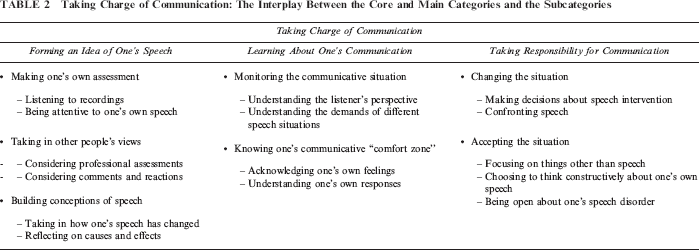
A core category, Taking charge of communication, was defined with three main categories (Table 2). It describes the process of developing a more active approach as one learns more about one's speech and communication, which enables one to make more informed and conscious choices about communication. The three main categories emerged as parallel processes in the understanding and active handling of communicative interaction. The first main category relates to the different modes of Forming an idea of one's speech and is made up of the individuals' own assessment of their speech and their perceptions of other people's views of it. This is then merged with what they could deduce from theoretical reasoning in building a conception of their speech. The second main category was Learning about one's communication, and it refers to the individuals' experience of different communicative situations, with regard to how successful they were and why, as well as understanding one's own feelings and responses and seeing how they could affect one's communicative participation in the short and long term. The third main category was Taking responsibility for communication, and it contains descriptions of how the participants chose to act based on what they knew about their speech and communication and the strategies that could be employed, both for actively changing one's communication and for accepting the situation, making the individual feel more at ease in communicative interaction. The strategies of changing or accepting are simultaneously active in a dynamic process rather than being definitive choices that are made once and for all. By connecting the core category and the three main categories, the following substantive theory was formulated. The experience of growing up with a speech impairment as a result of a cleft (lip and) palate is a process in which the individual moves from a passive role in childhood to an ability to make active choices about speech and communication with increasing age. As individuals form an idea of their speech and learns about their communication, they are gradually able to take informed responsibility for communication.
Taking Charge of Communication: The Interplay Between the Core and Main Categories and the Subcategories
Forming an Idea of One's Speech
Making One's Own Assessment
Listening to recordings was mentioned by all the participants as an important and objective source of information about how they sound. Speech recordings were made both with the aim of analyzing speech on visits to speech-language pathologists and in everyday situations and were often described as revealing; “Particularly when you recorded yourself… you could hear that it was very nasal, there were these ‘Hm’ [imitates nasal emission of air] all the time” (George).
Being attentive to one's own speech as one speaks was mentioned by some participants as a continuous awareness and critique of their own speech production; “I can hear when I don't say S properly and then I want to say the word again” (Celia).
Taking in other People's Views
Considering professional assessments was one important source of knowledge for participants about their speech. They had received information about the speech assessments made on their regular visits to the speech-language pathologists at the cleft team and sometimes the final evaluation had created a lasting impression; “They said that if you want to take it up again you can get in touch at the place where you live and then I felt that maybe it [speech] wasn't quite clear and the thought that it wasn't quite right remained in me” (Celia).
Considering comments and reactions from other people, both family members and peers, was another way of forming an idea about their speech; “When I was younger my parents always thought I was very careless with my speech. They have always heard what I said, but there are others, who are not as used to my voice, who had difficulty hearing. So I've always been told that you should speak slowly and clearly and things like that” (Erica).
Building Conceptions of Speech
Taking in how one's speech has changed was mentioned by all the participants since they had demonstrated speech impairments when they were younger and had seen a gradual improvement up to the present day. Some of them had listened to both earlier and recent recordings on the same occasion on their visit to their speech-language pathologists and described their satisfaction in noticing the often striking improvement in their speech; “I had said the same things and there was a huge difference! I could actually hardly hear what I said on the first recording… fun to hear that, how much you've developed” (Mary). If they had some prevailing impairments in their speech today, it was still perceived as much better than it used to be; “Sometimes… there's one of those, sort of lisping sounds, but it's very rare now, because I can hear that it's getting better and better” (Mary).
Reflecting on causes and effects of why one's speech sounded the way it did was another part of the participants' way of building their conception of their speech. They described reflections on what could be causing their speech impairments and how they themselves could influence the quality of their own speech; “I don't push, I don't use my tongue enough but try to be quick. I think that this is the reason why people might not hear what I say” (Mary). “Your speech was less clear because, on every sound where you needed to build up pressure, you knew you risked letting the air pass up through the palate” (Adam). Most of them were also well aware of the fact that nasal speech and certain articulation impairments are common among individuals born with a cleft palate.
Learning About One's Communication
The participants described how they became increasingly aware of the communicative situations they were in and how the choices they made had consequences for their participation. This awareness emerged as an important part of their insight and maturity in dealing with communicative problems.
Monitoring the Communicative Situation
Understanding the listener's perspective emerged as a crucial condition for the participants' communicative abilities. Some of them were able to express their apprehension about how strangers might perceive communicating with them; “It's difficult for people you don't know to ask you to repeat what you said… because they might think I mind, if they ask again” (Erica).
Understanding the demands of different speech situations was another important part of how participants perceived their communication with others. Several participants reported that telephone calls were particularly demanding, since all the information was conveyed through their speech; “I make an effort when I… make phone calls to the social insurance office, or public authorities like that… friends have said that I have a completely different voice on the telephone compared with when I speak face to face and that's probably because I make an effort so that people can hear what I say over the telephone” (Erica). Another common opinion was that conversations at work required one's full attention; whereas, it was acceptable to relax more at home; “I don't use an even level [in speech], but I try to concentrate [at work]. I think I do it unconsciously, quite unconsciously” (Mary).
Knowing One's Communicative “Comfort Zone”
Acknowledging one's own feelings was part of a process of increasing one's self-knowledge. Many participants had experienced frustration in communicative situations mainly during childhood or adolescence; “It was really hard, not being able to speak [clearly]. So I had great difficulty speaking and I was very irritated when people didn't understand” (Karen). “I didn't like my name. I wished I was called [sister's name] instead of [own name]… because it's much easier to say. But now I like my name” (Erica). Some participants still had a lingering reluctance to speak, particularly in more demanding situations; “We had to find our own trainee posts and that was really difficult, because then you usually had to use the telephone. So then I really felt that barrier and several days could pass when I, well, I thought I'd call, and then I postponed it all the time, ‘No, I'll call tomorrow,’ it was easier to say that than to deal with it” (Karen).
Understanding one's own responses was another part of the participants' developing self-knowledge and it emerged as an important basis for the ability to change patterns of avoidance. Some of them had refused to participate in certain stressful communicative situations, such as speaking in front of the class at school; “I did everything to avoid it” (Mary), but they reached a situation in which the consequences forced them to change; “I was forced, really… I had no choice if I wanted my grade. So we had to stand in front of the class and read and then it [fear] started to fade away” (Mary). “Sometimes I speak very fast, I think. That hit me now. You could imagine that this is because I was insecure about my voice when I was younger, so you rush things” (Harry).
Taking Responsibility for Communication
Changing the Situation
Making decisions about speech intervention had usually come into question for the participants during childhood and adolescence and at that point their parents had played the most active part. As young children, they had a fairly passive role when it came to taking part in interventions that others had chosen for them. As older children or adolescents, they began to make more active choices themselves. One participant recounted how she discarded her speech bulb that she used to compensate for velopharyngeal impairment; “I probably thought it improved my speech, but I thought it felt so disgusting that I'd rather not have it, so I'd rather speak badly” (Celia). As adults, the decision to accept or alter their speech was their own. A few participants had remaining articulation impairments and were aware of the fact that this could probably be altered with speech training. They had had extensive speech therapy in the past and had been very tired of it at the time, and they were now beginning to feel that they had lived with their speech impairments for so long that it had become part of their identity; “If I were to start again and speak the way you should… I am sure I would probably learn… but I don't have the time to speak slowly, to think—it hasn't seemed that important to me” (Ida).
Confronting speech came naturally to some participants and after some hesitation to others. The participants described a growing insight into the way their fear of exposed speech situations restricted them as a result of their learning about their communication, and so they needed to make a conscious effort to “overcome this barrier” (Karen). Different concrete strategies were described; “Talk to the mirror, for example. Talk to yourself. Well, that may sound corny… I practice [overcoming] my own cowardice by talking to myself (Mary); “Talk as much as you can, so people get used to it” (Bill); “I think it's about always trying to place yourself outside your comfort zone and forcing yourself and sort of, in school, making that speech in front of the class instead of faking that you're sick and then, next time, speaking in front of the school” (Harry).
Accepting the Situation
Focusing on things other than speech had helped the participants to deal with the fear of speaking in public, beginning in school. Some of them felt particularly competent in certain fields, and this feeling had helped them compensate for their impaired speech; “For me, it was a question of confidence and, through sport and through school and jobs, I guess I've built my confidence, so I can rely on that instead… If you have a debate in history and you know it best, it's much easier to hold your own and then you don't think about it [speech]” (Harry), “High school was a difficult time… for speech… but I went in for sports and I think I used it as a sort of therapy, I mean, I was really good … and I always came back to that, that I have something that I'm really good at, so I don't have to care about anything else” (Celia).
Choosing to think constructively about one's own speech helped them deal with the knowledge that their speech was impaired; “I still think that I have a trying voice, that I would like to have a clearer voice… But that's only a quick thought, because you just have to accept that we're all different” (Felix). Knowing that one had done one's best facilitated the process of adopting a constructive approach; “Sometimes … when I hear myself… I think I sound strange, but everybody says… that you can't recognize yourself [on recordings]… Sometimes I can feel that I lisp a bit, I don't know why, but otherwise I… feel I can't do much more that I have done, really” (Dora).
Being open about one's speech disorder is part of being open about the cleft as a whole and this emerged as a direct result of the ability to understand things from the listener's perspective. The participants often described how their parents had shown openness, both by explaining the cleft and the speech impairment carefully to them and by being role models in dealing openly with other people's curiosity. This openness then helped the children deal with questions or teasing about their speech themselves; “You knew about it and, if anyone asked, you could point it out and explain what it was. Why you sounded the way you did, or why you spoke the way you did and then there wasn't much more, you defused the whole thing quite quickly” (Joe), “When I was little, they asked and then I said ‘Well, I was born with a hole in my mouth and that's why I sound the way I do’… and that was OK” (Ida). Also as adults, some of them could identify the need to make the person with whom they were communicating feel more at ease by opening the door to questions; “I say ‘But tell me if you don't hear, because it's much more important that you hear than for me to be embarrassed’” (Erica).
Discussion
The participants in the present study described the processes involved in taking charge of their communication. This involved the processes of forming an idea of their own speech and learning about their communication, in terms of both facts and feelings, providing them with information so they could find strategies and take an informed responsibility for their communication. These processes involved a transition from the perspective of the child to a more active adult role and have similarities to the cognitive appraisal processes involved in the theory of stress and coping described by Lazarus and Folkman (1984). The cognitive aspects of learning more about one's own speech and the outcome of different communicative situations had importance for how the participants in the present study chose to take informed responsibility for their speech and communication. Lazarus and Folkman highlight the importance of personal beliefs in the appraisal of a potentially stressful event and in particular how trust in one's own ability to control the outcome of a situation can aid the coping process. Many participants of this study expressed such a belief in their own ability to take responsibility for communication, since they themselves had more previous experience of handling communicative difficulties than people they were communicating with. Seeing their own situation from the viewpoint of the other person could be an incentive to adapt to the listener by making an effort to speak more clearly, or by talking openly about their speech impairment and inviting the listener to let them know if he or she did not understand what they said. In particular the participants who knew that they were difficult to understand described conscious strategies in taking responsibility for the whole interaction, including the possible feelings of awkwardness that the other person could have if they did not understand what was said. Seeing things from the other person's perspective also helped them deal with questions and comments about their speech, both because it made them less emotionally frustrated if they could see a valid reason for the other person's curiosity and because it provided them with insight into how to explain why they sounded the way they did.
The participants' descriptions also contained other challenges that had to be dealt with at different points in time and to differing extents for different individuals. This involved dealing with an impaired appearance and impaired function such as a blocked nose, as well as heredity, cleft treatment, and other people's reactions to the cleft, from close family members and friends to strangers. The participants took more responsibility for their situation and treatment decisions as they grew older. They were also involved in a process of making sense of the cleft from an overall perspective, both intellectually and emotionally. This article focuses on the experience of having grown up with a speech impairment and how it was dealt with.
Unlike many other speech disorders, a cleft-related speech impairment is not an acquired disorder. The participants in the present study described a gradual speech improvement that made them experience their speech as “comparatively good,” even if they did not have “perfect” speech as a final result. The overview of their speech development emerged as an important factor in the process of accepting their speech. One contributory factor in this process was the feeling of having done one's best to achieve the best possible speech. For the participants with articulation disorders, a feeling of not having worked enough on their speech appeared to linger. There is a difference in management between velopharyngeal incompetence, which is mainly treated with surgery, and articulation disorders, which are treated with speech training (e.g., Kuehn and Moller, 2000). Treatment outcome has generally improved over the years and most speech-language pathologists set the goal for their patients to achieve typical articulation in adolescence at the latest (e.g., Riski, 1995), advocating the “aggressive management” of speech disorders (Kuehn and Moller, 2000). However, speech outcome is heterogeneous in the cleft group, and there are individuals who do not realize the goal of normal adult articulation patterns in spite of extensive efforts directed at their articulation. We believe that it is important to be attentive to the overall communicative context for speech-language pathologists who suggest speech intervention, so that a feeling of blame is not conveyed to adolescents with remaining articulation impairments. It is commonly observed in the clinic that parents demand speech training for their children; whereas, the child or adolescent is reluctant. Finding the optimal method and point in time for giving speech training is a challenge for the speech-language pathologist in the cleft team and more research that takes a wider view of the communicative context into consideration is needed. This would be more in tune with current disability research, in which the setting of treatment goals deemed important by professionals has been questioned (Oliver, 1998).
Other people's reactions were central to the way the participants perceived how they communicated and this included the experience of being teased or bullied. The participants had all experienced some teasing, but not all of them described it as actual bullying. Previous research has identified teasing as an important threat to a person's psychosocial functioning (Hunt et al., 2006). Teasing is reported to be a common experience for children with a cleft (Semb et al., 2005; Hunt et al., 2006), and it is often directed at their speech (Noor and Musa, 2007). Some of the participants in this study, however, mentioned being teased about features related to the cleft without attaching any great importance to it. They described teasing as a common experience, regardless of whether or not one was born with a cleft, and they interpreted it as an expression of poor knowledge or insecurity in the person who was making the comments. The question of why some individuals are resilient to comments and teasing has been addressed recently (Billaud Feragen et al., 2009), and the question of whether there is a causal relationship, or only covariation between associated factors such as higher levels of satisfaction with appearance and adequate emotional functioning, remains to be further investigated. The participants in the present study described that being able to talk openly about their cleft and speech at home was helpful for them when they later met with comments and teasing. Talking about it helped them feel more at ease when other people referred to the cleft and gave them the appropriate words to explain their condition.
In the cases in which bullying was mentioned, it appeared to have had a major impact on the way the participants perceived their social experience. The descriptions of it took up a large part of the interview and were recounted with a great deal of emotion. When discussing the possibility of having children of their own who could be born with a cleft, the risk of bullying was mentioned as the greatest threat to the children's well-being. It is also a clinical observation that concern about bullying is sometimes expressed by the parents of children born with a cleft. This conception of bullying as a threat to one's well-being is confirmed by previous research, which has established an association between self-reported experiences of being bullied in school and depression in adulthood (e.g., Brunstein Klomek et al., 2007; Allison et al., 2009). Research has not, however, established an association between perceived external “deviations” and experiencing bullying (Olweus, 1993). The structure of the ICF can be applied here because it highlights the importance of personal factors as compared to the impact of impairments of structure and function for participation in society. The findings in the present study show that, although the first impression of a person with a speech impairment can be negative, it is possible for a person to have a positive experience of his or her communication and social functioning, even though his or her speech is impaired. Finding constructive strategies for dealing with actual bullying is another important area for further research.
Asking about satisfaction with treatment outcome has been a frequently employed measure of how successful cleft care has been during the last decade and dissatisfaction has been found to correlate with poor quality of life, even though no causal relationships have been established (Marcusson et al., 2001; Sinko et al., 2005; Oosterkamp et al., 2007). However, in an evaluation of associations between self-concept and psychosocial adjustment in adolescents with a variety of craniofacial anomalies, dissatisfaction with appearance was found to be linked to low psychosocial adjustment only when it was part of a negative overall view of the self (Bilboul et al., 2006). The findings in the present study indicate that a critical view of one's own speech can make one aware of the need to take active responsibility for communication, and it can thus constitute an important prerequisite for dealing with difficulties rather than being a hindrance to communicative participation. Several, but not all, participants in the present study expressed concern about the situations in which they communicated with others as a whole and described a belief in their own ability to communicate successfully. They described their own previous experiences of communication difficulties as an asset that enabled them to take active responsibility in the communicative exchange. It seems likely that a positive self-image could result in an inclination to actively participate in social encounters and to be able to accept a self-image that includes a speech impairment, corresponding to the findings in the study by Bilboul et al. (2006). The findings in this study indicate that an ability to see things from the other person's perspective and a general openness about the cleft and the speech disorder can contribute to a constructive way of dealing with a speech impairment. However, such associations need to be investigated further.
The few adult patients that are assessed and treated at hospital are the ones who actively seek help because they view their speech as a problem; whereas, the ones who function well are usually not heard. The participants in the present study were not patients at the hospital at present and had terminated their contact with the speech-language pathologists in the cleft palate team. Participants who met the inclusion criteria were selected strategically, and the purpose was not to generalize in a statistical sense but to provide inside experience of the studied phenomenon. We hope that they bring new and interesting information about the processes leading to acceptance of their present situation and well-functioning communication for individuals with cleft-related speech disorders.
The participants in this study were selected because they had had a speech impairment on their last visit to the cleft team clinic and therefore had experience of the studied phenomenon. Although their experiences were individual and they were at different points in their processes of dealing with their communicative situations, they shared common features. Therefore, we believe that the participants of this study add new and interesting information about the personal experience of dealing with a speech impairment. In the selection of participants we chose adults, since it is presumably easier to describe a situation from which one has attained some distance. Moreover, adults usually have more words to describe their feelings and are able to see the long-term consequences of their previous actions. It would, however, be interesting to interview younger individuals born with a cleft to obtain complementary descriptions of the way cleft-related speech impairments are dealt with.
We chose a qualitative method with semistructured interviews, since we wanted to understand how a speech impairment as assessed by speech-language pathologists is understood and dealt with by the affected individuals themselves. We were inspired by grounded theory because we wanted to understand the social processes that are active in how individuals assign meaning to their reality. The first author who conducted all interviews is a speech-language pathologist but had not met the participants as patients in her clinical work. The second and third authors are also speech-language pathologists, which constitutes a risk that their preconceptions govern the interpretation of data. To balance this, the fourth author provided her perspective as a social scientist and a professor in public health with rich experience in qualitative research. To further the development of theoretical sensitivity, the memos that the first author kept of general impressions of interviews and emerging categories and theories were discussed continually with the other authors. In the analysis, we chose to focus on how the participants understood and dealt with their speech impairment because we believed this to have important implications for how cleft teams in general, and speech-language pathologists in particular, understand their patients' situations. Previous research of cleft-related speech impairments have tended to study the perception of impaired speech in isolation (e.g., Blood and Hyman, 1977), and we believe that a qualitative method offers a possibility to study speech in a more holistic environment, which has more relevance for the lives of the affected individuals. The focus on processes shown by the use of active gerunds in all categories (Charmaz, 2006) helped explain how people experience their speech and communication. In addition, the core category demonstrates the increasingly more active way in which the participants understood and dealt with their communication.
The clinical implications of this study are that a simple assessment of satisfaction with speech is not enough to understand individuals' communicative abilities, since the “personal factors” defined in the ICF have important implications for the way they deal with their communicative participation. A thorough assessment of the way they perceive their communication as a whole would add important information and identify individuals in need of more extensive types of intervention to improve it. Since the concept of communicative participation contains several aspects of a person's psychosocial situation, interventions of this kind would benefit from collaboration between all the members of the cleft palate team and educational staff, for example. Interventions to improve speech need to be carefully discussed with the individual. It is important to be attentive to signs of bullying and discuss intervention with the affected person. One possible way to help is to promote openness about the cleft and the speech impairment and also to support the parents in their function as role models for their children.