






Abstract
Objective
Antiretroviral prophylaxis has been found to be effective in preventing vertical HIV transmission to the offspring of infected mothers. Because medicine and the art of public health require benefits to outweigh any plausible risks, our study aimed to explore and quantify preliminary associations between antiretroviral medications and clefting.
Methods
We analyzed 5 years of available data from the Food and Drug Administration's Adverse Events Reporting System (Medwatch program) and calculated reporting odds ratios (RORs) and their associated 95% confidence intervals (CIs).
Results
The medications with the highest effects were efavirenz with an ROR of 196 (95% CI, 86 to 447), lamivudine with an ROR of 60.2 (95% CI, 14.25 to 148), the combination abacavir sulfate/lamivudine/zidovudine with an ROR of 59.3, and nelfinavir with and ROR of 50.5, followed by nevirapine, lopinavir/ritonavir, and lamivudine/zidovudine.
Conclusion
Given the multifactorial etiology of cleft lip and palate, further studies are needed to assess the relative safety of antiretroviral prophylaxis and the specific conditions or potential synergies that might lead to the development of this defect.
Keywords
The introduction of antiretroviral drugs has been proven a watershed in HIV infection therapy, significantly reducing morbidity and mortality. Antiretroviral therapy includes nucleoside reverse transcriptase inhibitors (NRTIs), nonnucleoside reverse transcriptase inhibitors (NNRTIs), and protease inhibitors (PIs). The drugs are prescribed either in isolation or combined during pregnancy to prevent mother-to-child transmission of HIV. It has been documented that in this way, the risk of HIV transmission can be reduced from 15% to 25% to less than 1% (Taylor and Low-Beer, 2001). Such protection confers a lifelong benefit to the offspring, raising antiretroviral “cocktail” therapy to standard of care. However, as with any medication given during pregnancy, one needs to explore potential risks to the offspring. Our research was focused on exploring signals for congenital defects by studying the Food and Drug Administration's (FDA's) Adverse Events Reporting System (AERS) database, a publically available resource of spontaneous adverse effects reports. This database includes voluntary reports from health care professionals through which the FDA has issued warning, made labeling changes, required postmarketing studies, and even ordered product withdrawals (Kessler, 1993). More specifically, we focused on identifying drugs that could possibly contribute to the development of cleft lip and palate (CLP). Reporting odds ratio (ROR) was used as a measure of disproportionality to detect a potential association between systemic medications received during pregnancy and this congenital malformation. Measures of disproportionality comprise, so far, one of few ways in pharmacovigilance by which drug adverse effects can be detected (Wilson et al., 2004). This brief report provides preliminary crude data about a possible link between antiretroviral drugs received during pregnancy and CLP in newborns. Our report, although the first to report this signal, is merely a starting point; further investigations on these drugs' side effects are required to follow.
Methods
Five-year publically available data from April 2004 to October 2009 were used in this analysis to explore signals between reported CLP and systemic medications as reported in the FDA AERS database. This database was set up by the FDA in June 1993 to improve the postmarketing surveillance of drugs on the U.S. market by encouraging health care professionals to voluntarily report adverse events to the FDA or to the manufacturer. The adverse event reports can be submitted either using the downloadable copy of the Medwatch form or directly online. They are not expected to establish causality, but they function as alerts of possible associations (Kessler, 1993). Consequently, Medwatch houses reports from physicians, dentists, pharmacists, and any person who knows of or suspects an association between a drug and a specific adverse effect. Because the database is a rich resource for pharmacovigilance that includes more than 55 million adverse event reports, several methods have been proposed to detect early signals (Ahmad et al., 1996). One such example is FDA's data-mining analysis reporting the disproportionality as EB05 scores. EB05 is defined as the lower limit of the 90% confidence interval for the empirical Bayes geometric mean (Banks et al., 2005). According to the FDA, the higher the EB05 score, the higher the probability of association between the drug and event in the database being analyzed. An elevated EB05 score indicates that the drug-event pair in question had disproportionally more reports in the database than did this event in association with other drugs in the database. Our analyses used a comparable method via a proprietary algorithm developed by Simultek and licensed to the investigators for academic use; the algorithm computes the ROR as a measure of disproportionality. The ROR is defined as the fraction A/C/B/D or A.D/B.C, with A representing the number of suspected events after administration of the suspected drug, B the number of all other events after administration of the suspected drug, C the number of the suspected events after administration of drugs other than the suspected, and D the number of all other events after administration of drugs other than the suspected drugs (Wilson et al., 2004). This study includes only the reported events on cleft lip and palate, not cleft lip or palate. The results were presented in a table including drug market names, drug generic names, RORs, 95% confidence intervals (CIs), and frequencies.
Results
Our analysis of the FDA adverse event database identified several antiretroviral therapies reported to have been associated with the development of CLP (Table 1). Four of these drugs, namely, efavirenz, lamivudine, nelfinavir, and nevirapine, are usually used as monotherapy, whereas abacavir sulfate/lamivudine/zidovudine, lopinavir/ritonavir, and lamivudine/zidovudine are used as combination treatments for the management of HIV. In total, 26 events of CLP were detected related to antiretroviral medications, with significantly high RORs: Efavirenz, lamivudine, nelfinavir, and nevirapine presented RORs of 196.01, 60.23, 50.53, and 27.59, respectively, while the combination therapy of abacavir sulfate/lamivudine/zidovudine, of lopinavir/ritonavir, and of lamivudine/zidovudine also generated RORs of 59.33, 26.47, and 24.94, respectively.
Antiretroviral Therapy-Induced CLP Reports in the FDA AERS Database *
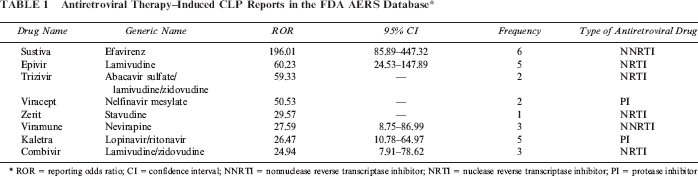
ROR = reporting odds ratio; CI = confidence interval; NNRTI = nonnuclease reverse transcriptase inhibitor; NRTI = nuclease reverse transcriptase inhibitor; PI = protease inhibitor
Discussion
Identifying safety issues related to the use of systemic medications is a challenging process. The safety of a new medication in humans is evaluated during the clinical trials period, starting with small phase 1 trials of volunteers and moving gradually to larger groups of patients in phase 3 trials. However, because of a multitude of reasons, not all adverse effects are discovered in the well-controlled period of clinical trials. Many such effects are discovered only in the postmarketing phase, when the drug is used by large groups of often heterogeneous patients. Knowledge Discovery in Databases (KDD) performs data mining of large databases, such as the FDA AERS database. Such data mining is an efficient way to quantify the strength of adverse effect signals earlier than comparable current methods do (Szarfman et al., 2002; Wilson et al., 2004). KDD introduces efficiency because it captures and manages already collected data, and disproportionality measures have been used successfully to analyze the U.K. Yellow Card program and the World Health Organization Uppsala Monitoring Centre database (Szarfman et al., 2002). Detecting and quantifying signals or preliminary associations without an a priori hypothesis are a preliminary and crude method that always requires validation. Consequently, it is a method to generate hypotheses rather than testing a hypothesis. The method is prone to statistical error, especially type I error; thus, readers should be cognizant of the fact that the RORs calculated in this study should not be interpreted as a definite measure of the associations' strength without further validation in well-controlled prospective or retrospective epidemiologic studies. With regard to the true magnitude of the effect, readers should note that some of the CIs were wide. This is a limitation due to the small sample of CLP reports. In interpreting the ROR and the corresponding confidence intervals, one needs to recognize that the true value of the effect (risk) is captured within the interval with 95% certainty. Having presented the above limitations, the authors believe it is important to raise awareness to the fact that a possible link might exist between antiretroviral medications and clefting. If the association is validated in the future, having such information may have practical value for parents and physicians and may be used during prenatal screening in the first trimester of pregnancy.
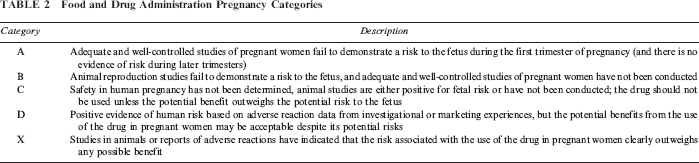
Antiretroviral drugs have been widely prescribed for delaying disease progression in HIV-infected pregnant women and reducing the risk of mother-to-child transmission. Despite their wide use, documented safety data in human pregnancies remain insufficient, and most data for these regimens come from animal studies. Thus far, one report on a high-order experimental animal study has raised concerns regarding a potential association between teratogenicity risk in pregnancy and antiretroviral therapy, as explained later in the discussion. To our knowledge, our report is the first to detect a possible association between CLP development and seven antiretroviral drugs (four NRTIs, two NNRTIs, and two PIs). The Antiretroviral Pregnancy Registry in 2008 received reports of 15 birth defects in 110 total of 444 live births in children born by mothers under efavirenz treatment (Sustiva). One of these cases included severe oblique facial cleft (Ford et al., 2010). In addition, three malformations were identified in 20 monkey fetuses whose mothers were receiving the same drug while pregnant. One of the three malformations had been a cleft palate. No malformations were recorded in the fetuses belonging to the control group (Baker, 1998). Even if a causal relationship between this NNRTI and birth defects has not been established, it is recommended that pregnancy should be avoided in women receiving efavirenz and also adequate contraception measures should be taken for 3 months after discontinuation of the drug due to its long half-life. Efavirenz belongs to FDA Pregnancy Category D, “Positive Evidence of Fetal Risk” (Table 2). This is based on four reports of neural tube defects in infants born to women who were exposed to the drug during the first trimester (Ford et al., 2010).
Food and Drug Administration Pregnancy Categories
The combination of lopinavir and ritonavir (Kaletra) is an HIV-1 protease inhibitor and is indicated for the treatment of HIV-1 infection. The antiretroviral pregnancy registry for this drug reported that in 2 of 207 transplacental exposure cases, cleft palate accompanied with other malformations was present. Kaletra belongs to FDA Pregnancy Category C and should be administered only if the potential benefit justifies the potential risk to the fetus. However, except for these manifestations on Sustiva and Kaletra, there is no other documentation on a possible link between cleft lip and/or palate and any other kind of antiretroviral drugs. It is worth noting that in our research, efavirenz had the highest number of CLP reports (six) and the highest ROR (196.01, p < .05). Most of the studies on congenital abnormalities in infants born by HIV-infected women do not present significant association with antiretroviral medication. According to Townsend et al. (2006), there was no significant difference between infants born by HIV-1-infected mothers under antiretroviral medication as compared with those born by a mother nonexposed to this medication (3.4% presented with birth defects in the former versus 2.2% in the latter case). In addition, no correlation was found between the type of antiretroviral drug used and birth defects or between the time period of drug exposure and birth defects. In a large study of the same group of infants born between 1990 and 2007 from HIV-infected women, it was found that antiretrovirals in utero do not pose a major risk of fetal anomaly. Seven cases of cleft lip and/or palate were described; however, they were identified in terminated pregnancies and were not included in the overall analysis (Townsend et al., 2009). Reassuring are also the data from other studies of antiretroviral use in pregnancy that fail to show a statistical association between CLP and first-trimester drug exposures (Watts et al., 2007; Joao et al., 2010). According to White et al. (1997), the number of congenital malformations in newborns following zidovudine exposure was not different from the relative number among the general population; however, small sample size was one of the limitations of that report.
Cleft lip and palate is a congenital malformation believed to be of multifactorial etiology. It can occur either as isolated clefts or as part of a syndrome. Genetic as well as environmental factors have been shown to hold a pivotal role in the development of the condition (Zucchero et al., 2004). Nutrition is an indispensable factor in embryonic development since maternal food intake defines the embryonic nutritional status. Nutrition has been documented to interfere with the pathogenesis of CLP, as excess or deficiency of some macronutrients, vitamins, or minerals can contribute to the development of this defect (Krapels et al., 2006). Accordingly, it has been suggested that pregnant women should avoid excessive intake of vitamin A and follow a folate-rich diet supplementation, especially during the first trimester (Rothman et al., 1995; Loffredo et al., 2001). The aforementioned factors are not reported in detail in the FDA AERS database. Thus, our analyses report crude RORs and do not control for important confounders such as personal characteristics, diet, genetics, and so forth. It is possible that the reported signals can be fully explained by unmeasured confounding; women under antiretroviral treatment with CLP infants could be predisposed via certain genetic characteristics, could be malnourished, or could be exposed to environmental toxins. However, it is also possible that the observed signals do reflect a high risk of CLP. Epidemiologic studies of appropriate design and adequate sample size are needed to document the effect of antiretroviral medications on the risk of having an offspring with CLP. Currently, the data in support of each claim are insufficient.
As mentioned previously, the usefulness of this study relates to the detection of signals not previously reported via secondary analysis of existing data. The data are in the public domain, and automated KDD algorithms offer economies of scale and increased research efficiency in drug safety surveillance, especially around rare conditions. Since in theory, the AERS database captures postmarketing data for the total U.S. population through spontaneous safety reports from physicians and others, it offers the great advantage of representativeness and power to detect rare signals. Safety surveillance of administrative claims databases offers yet another mechanism of proactive identification of rare adverse effects. Having systems in place for proactive surveillance is crucial for the early detection of drug safety concerns; however, for reasons mentioned previously, these signals always require replication and validation in formal epidemiologic studies. An implication of early signal detection via analysis of AERS or insurance databases may be the subsequent validation attempt in prospective cohort studies or in intercenter clinical environments such as the Americleft or Eurocleft. Informing clinicians early about a possible association between a drug and an adverse effect raises awareness and leads to more formal evaluations. But more importantly, it may potentially lead to the prevention of some cases of CLP.
Conclusions
While none of the antiretroviral drugs is currently classified as safe (Category A of the U.S. FDA pregnancy classification), antiretroviral prophylaxis has been found to be effective in preventing vertical HIV transmission. Because medicine and the art of public health require benefits to outweigh any plausible risks, we explored and documented a preliminary link between antiretroviral medications and clefting. Further studies should be performed to assess the relative safety of these drugs and the specific conditions or potential synergies that might lead to the development of CLP. More research is mandatory given the multifactorial character of this malformation.