






Abstract
Objective
This pilot study aimed to understand cultural perspectives on cleft anomalies in the community of Hyderabad, India, and its rural outskirts.
Design
Interviews focusing on perceptions of cleft lip and palate were conducted using a 21-item interview guide approved by the director of the Gosla Srinivas Reddy Institute of Craniofacial Surgery (GSR).
Settings
Interviews were conducted at GSR, a specialty surgical center located in Hyderabad, India.
Patients and Participants
All patients who presented to GSR with either cleft lip, cleft palate, or cleft lip and palate at the time of this study were included.
Results
Of the 23 families interviewed, 12 mothers believed the cleft was caused by an eclipse, and two believed the scientific explanation their physician offered. Fourteen families were offered no explanation for the cleft lip and/or palate at the time of their first physician visit. No families practiced non-Western methods for treatment of the cleft. One family identified beliefs held in the community that their child with a cleft lip was bad luck.
Conclusion
A commonly held belief in this community in India is that cleft lip, cleft palate, or cleft lip and palate are caused by an eclipse. Physicians appear to be providing families with insufficient education on cleft impairments. Data generated from studies similar to this can be used to design educational protocols that address this gap in community understanding of orofacial clefting.
Cleft lip and/or palate (CL±P) are relatively common anomalies among Asian populations, and the incidence in state of Andhra Pradesh, India, is cited as 1.09:1000 live births (Reddy, 2010). Folklore surrounding facial clefts varies greatly among cultures, ranging from positive views that the child may possess a special, sometimes spiritual, role in the community to negative or even dangerous views that the child represents an omen of bad luck (Cheng, 1990). Popular beliefs regarding the etiology of CL±P have followed general themes such as the belief that it is a result of “God's will” or “fate” (Ross, 2007). The belief that CL±P is the result of the mother's petting a rabbit or consuming rabbit products during pregnancy has resulted in the eponym “harelip” (Cheng, 1990). Studies in the Philippines found community beliefs that CL±P resulted from fetal “malposition” in the womb or “cravings” during the first trimester (Daack-Hirsh, 2010). Beliefs may also be regionally specific. In Egypt, for example, some parents believe their child's cleft is the result of gazing at a camel for too long (el-Shazly, 2010).
There may be a preference for using alternative medicine in the treatment of CL±P among different ethnic and religious communities (Olasoji et al., 2007; Ross, 2007). Practices within Asian/Pacific populations have included the use of various herbs and balms, acupuncture, steam inhalation, coin rubbing, and pinching (Cheng, 1990). Anecdotal evidence from the Gosla Srinivas Reddy Institute of Craniofacial Surgery (GSR) clinic in Hyderabad, India, suggests that alternative treatments, such as burning the child on the abdomen or burying the child up to the head in sand to be left in the direct sunlight for an entire day, have been used in the community for the treatment of cleft anomalies. Identifying the prevalent beliefs that exist in the community concerning CL±P may provide insight into the rationale behind such practices. To establish trust between the physician and patients' families, the clinician must acquire an understanding of parental beliefs (Danseco et al., 1997). Data gathered from studies like this may help identify areas of ideological convergence, divergence, and conflict that will allow physicians servicing this community to develop a working relationship with patients and families.
We performed a study at our city clinic, the GSR, to elucidate the cultural perspectives on CL±P in this community among families of children born with CL±P. The aim of this study was to identify cultural beliefs present in this community regarding CL±P. We also cataloged the pervasiveness of unique rituals in the treatment of CL±P. With this information, we may be able to tailor specific methods for educating this community on cleft care, reduce the incidence of harm against children with clefts, and improve overall outcomes in patients with CL±P.
Methods
Twenty-three families of patients with clefts awaiting surgery at the GSR were interviewed over the course of one clinic week from August 3, 2009, to August 8, 2009. All patients and families present at the GSR hospital during this time were invited to participate. The interviews were conducted using a 21-item interview guide developed for this study by the authors (Fig. 1). The interview guide was designed based on the previous experience of the authors with this population and had not been validated in any previous studies. Verbal interviews were performed by translating the English questions asked by the lead author using the interview guide into the language Telugu. Responses to each question were then translated back into English and recorded by the author. All interviews for this study were conducted by two translators, R.P. and A.P. Both translators were unpaid volunteers and natives of Hyderabad. R.P. conducted the first 20 interviews, and A.P conducted the remaining three interviews. Responses were recorded by the lead author (A.N.). Translators were dressed in plain clothes and had never previously met any of the families of children with clefts. The author was dressed in the hospital uniform and recorded responses on a laptop computer. Before the interviews, families were informed of the purpose of the interview and how the information would be used. Each interview was roughly 10 to 15 minutes. Interviews were conducted in a public setting within the courtyard of GSR. At a later point, the interview notes were reviewed by two individual authors on separate occasions, and each response to each question was categorized into a general theme. The results from this system of interpretation and categorization were compared between the two authors for consistency. This project was reviewed and approved by the chairman of the GSR clinic, which served as the ethical review, and the ethical principles outlined in the Declaration of Helsinki were followed.
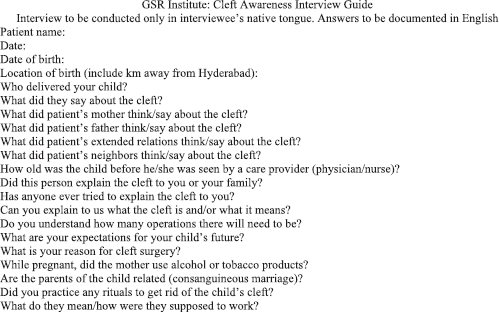
English interview guide that was translated in the Telugu language during interviews.
Results
Demographics
The average age of children with clefts who presented to the GSR was 28 months. The average distance traveled by families to the clinic was 173 km, and most of the children presented with unilateral cleft lip and palate. The members of the family interviewed were typically the mother and other relatives from the extended family, often including the child's grandmother, great aunt, or father. Individual data pertaining to the relationship of these interviewees to the child were not collected.
Birth History
Seventeen patients were delivered with the assistance of a physician at a hospital. Six patients were born at home; five of these were delivered with the assistance of a midwife, and one was delivered with the assistance of the child's grandmother and maternal aunt. Of the six children who were born with no assistance from a physician, two were brought to a physician within the first few days of birth. The greatest time lag between birth and first physician visit was 36 months for one child (average = 3 months).
Cleft Education
For the 17 children born in the presence of a physician, seven of the families received a scientific explanation from their physician for the cause of the cleft. Four families were told of the existence of surgery for repair of clefts; however, these families were not given an explanation with regards to the etiology of the cleft. The remaining six families were not given any explanation.
When asked if any person in the medical field had at any time attempted to explain the cleft to the family, eight responded “no.” Of the 15 remaining families that did receive an explanation at some point, seven cited GSR as the source of information.
Of the six children born in the absence of a physician, four of the care providers attributed the cleft to an eclipse, and two offered no explanation. At the time of the first physician visit, one family received a scientific explanation for the cleft, two were informed of surgery but did not receive information on the cleft's etiology, two received no explanation at all, and one family was told that if the child had not been born of a consanguineous marriage, then the cleft was caused by an eclipse.
Community Beliefs
When asked what the child's mother believed to be the cause of the cleft, 12 cited an eclipse; six were unable to offer any explanation; two cited the scientific explanation the physician provided; and three cited fate, unfortunate circumstance, or “God's will.”
When asked what the child's father's believed to be the cause of the cleft, 12 cited an eclipse, six were unable to offer an explanation, three cited the scientific explanation the physician provided, and two cited unfortunate circumstance or “God's will.”
When asked what the child's extended relatives believed to be the cause of the cleft, 13 cited an eclipse, six were unable to offer an explanation, two cited the scientific explanation provided by a physician, one cited “God's will,” and one family reported that extended relatives considered the cleft to be a sign of “bad luck.”
When asked what the child's neighbors believed to be the cause of the cleft, 14 cited an eclipse, six were unable to offer an explanation, and one family cited multiple explanations from neighbors. These explanations included exposure to an eclipse, excessive traveling by the mother during the first 3 months of pregnancy, and family proximity to a cell phone tower. One family of a 6-month-old child, stated that their neighbors had not yet seen the child, and one other family stated that their neighbors thought the child was bad luck and needed to be “gotten rid of.”
When interviewees were asked if they themselves could explain the cleft, seven were able to provide a scientific explanation, 11 were unable to provide any explanation, three cited an eclipse, one believed it was caused by the parents not being of a consanguineous marriage, and one said she believed the cleft was “bad luck.”
Surgery Expectations
Twenty-one families displayed an understanding of the number of operations required for cleft repair. Two families stated that they did not know how many operations were required to repair the cleft.
When asked about their expectations for the child's life after the cleft had been repaired, 14 stated a general improvement in the child's quality of life. Of the remaining nine families, three stated an improvement in aesthetics alone. Two families cited improvement in speech and aesthetics, one cited improvement in feeding and aesthetics, and one family cited improvement in speech and feeding. One family mentioned an improvement in the child's confidence, and one family commented that they had low expectations for the child's future after the surgery.
When asked their reason for bringing the child for surgery, 12 families stated aesthetic reasons alone, two cited an improvement in aesthetics and feeding, and two cited an improvement in aesthetics and speech. Two cited a general improvement in quality of life for the child. One family cited an improvement in quality of life with specific reference to feeding. One family cited an improvement of feeding alone, and one family said they did not know why they had brought the child for surgery.
Rituals and Alternative Medical Practices
None of the interviewees stated that they had performed any unusual rituals or used any alternative methods for the purpose of treating the child's cleft.
Effect of Early Explanation on Maternal Understanding of Cleft Lip and Palate
Seven families received a scientific explanation for CL±P at the time of delivery. Of these, two mothers believed the CL±P was the result of a scientifically explained process. Four of these mothers believed the CL±P was the result of an eclipse, and one mother stated that she still had no explanation for the cause of her child's orofacial cleft. Of the remaining 16 families that received either no explanation or only information about surgical treatment of the CL±P, none of the mothers had beliefs about the origins of their children's CL±P based on science.
Discussion
Cultural beliefs surrounding craniofacial anomalies is a topic often neglected in the literature. Frequently, physicians and surgeons find themselves serving a community not of their own culture, and as a result must overcome a number of barriers to deliver appropriate care. Although many of these barriers to surgical care involve the established health care infrastructure and is beyond the scope of this article, our data help to illustrate the significant role cultural differences may play.
Specific cultural beliefs on cleft etiology can become barriers to treatment. el-Shazly et al. (2010) identified a fear among some parents that the cleft anomaly was a result of God's will and that repair of the cleft would interfere with God's will. Oginni et al. (2010) described a belief that the cleft anomaly served a protective purpose against the high rate of infant mortality and that treating the cleft would result in the death of the child. The results of this study suggest that Grahanam, translated from Telugu into English as “eclipse,” appears to be the most prevalent belief in the south-central region surrounding Hyderabad, India. Fortunately, the neutral nature of this belief may prevent it from becoming a barrier to treatment.
Extended family and neighbors can also play a significant role with regard to the well-being of children with CL±P. Penn et al. (2009) have explored the role of the grandmother, specifically in South African communities, as having a pivotal role in how various childhood disabilities are viewed and how children with these disabilities are treated. Of note, grandmothers in this community are recognized to have the authority to recommend infanticide. Our study does not evaluate the degree of influence extended families and neighbors have over the health care of children in the community; however, we identified one family that was told by their neighbors that their child was “bad luck” and should be “gotten rid of.” The presence of these beliefs suggests a cultural stigma toward children with CL±P that may serve as a barrier to treatment and may directly threaten the safety of the child.
Our study suggests that not all families of patients with clefts receive early education from community physicians. Although some clinicians were able to provide families with the knowledge that surgery would be able to repair the cleft, the absence of information, such as cleft etiology and incidence, can potentially leave the family feeling sidelined (Kerr and McIntosh, 2000; Hearst, 2007). Delivering this information may help reduce these feelings. Most of the participants in this study stated that a physician was present either at the time of birth or shortly after. This can serve as an opportunity to educate families. Though only two of the seven mothers who received a scientific explanation at the time of delivery carried those beliefs as the cause for their child's cleft lip and/or palate, it should be noted that none of the mothers who received either no explanation or an inadequate explanation at the time of delivery had a science-based belief regarding the origin of their child's CL±P.
Health literacy has been applied as conceptual models describing it as a risk and as an asset. Under both models, improvement in clinical outcomes is cited as the ultimate goal, and health information tailored to the community being served is regarded as a tool for achieving that goal (Nutbeam, 2008). Explorations into the cultural beliefs of a region through studies such as ours can provide information that can be used to create information that is pertinent to the health issue being addressed. Further, the information can be articulated in a way that is culturally sensitive and easily understood by persons within that community.
The focus of educational efforts should be directed toward providing information on incidence, etiology, and treatment of CL±P. Additional information on feeding strategies and other specifics on cleft care could also be explained at this time. Goals should include the following: (1) providing an opportunity for treatment, (2) discouraging alternative healing practices that could cause harm, (3) relieving feelings of isolation or hopelessness, (4) diminishing the social stigma surrounding CL±P, and (5) improving the overall health and hygiene of these patients. Because families potentially seek alternative healing practices for their children, it is important that a scientific explanation for CL±P be offered in a way that fosters a dialogue and dispels beliefs that could endanger the child's well-being (for example, that the child is a bad omen). A discussion on risk factors for development of cleft lip and palate also falls within the range of physician responsibilities. Should the family decide to have another child, it is important that they are aware of the risk of having another child with CL±P as well as any way of potentially reducing the risk of having another child with CL±P, such as taking folic acid supplements. Care should be taken, however, to not instill a sense of self blame in parents as parental beliefs that they are responsible for their child's orofacial cleft have been associated with higher levels of anxiety (Nelson, 2009).
An educational video directed toward the Telugu-speaking community has been developed by Murthy et al. in collaboration with the Smile Train (Murthy et al., 2007). The video is narrated in Telugu and addresses “an eclipse” as the most prevalent community belief. It also provides a clear scientific explanation of cleft etiology, details of cleft surgery, and techniques for proper care of children with clefts. This resource can serve as a model educational tool for primary community education. Caution should be taken in developing similar videos, however, as they may unintentionally bolster misconceptions about CL±P.
The future of community education may exist as short video clips available through the Internet that are specifically designed for each population. These should be narrated in the local language and address beliefs and concerns specific to that community. Any person with a computer would be able to access this resource and deliver information that is accurate and relevant. Although members of the community may not have access to the Internet, we believe it is reasonable to assume that physicians would be able to access this information and share it at patient visits in a fashion similar to that used in telemedicine initiatives (Singh and Das, 2010).
The utility of allowing families of children with clefts to intermingle, as they do on the grounds of our clinic, cannot be overemphasized. One mother we had interviewed admitted that, before coming to the clinic, she believed an eclipse had caused her child's cleft lip. After seeing so many children and families in the clinic, however, she soon began to doubt that an eclipse could have been responsible for so many anomalies. Other families reported encouraging results of surgery, for example, sharing that “after surgery, the children do very well in school.” Certainly, the support families are able to provide one another in this setting plays a critical role in relieving some of the psychosocial stress of having a family member with a facial cleft requiring operative treatment (Kerr and McIntosh, 2000).
Limitations
There are several limitations to this pilot study. Although the cohort of participants demonstrated reasonable diversity in terms of locations of origin within the state, the small sample size and short duration of the study make it difficult to generalize to other communities that may have different beliefs and values about CL±P. Furthermore, all interviews took place at a single center within the city of Hyderabad rather than in the communities from which the participants originated. Performing interviews in the community setting would have likely yielded more information with regards to neighbors' beliefs concerning clefts. Though the translators and researchers were all natives of the community, and it was not likely that participants would withhold potentially embarrassing responses from the interviewers, the fact that the interviews took place in the presence of other families creates the possibility that participants withheld responses they may have felt embarrassed to share, including maternal use of alcohol and tobacco products. Individual interviews with each family member would have been ideal, but unrealistic given the setting.
With regard to data recording, interviewers were instructed to translate questions and responses verbatim; however, it is very likely that there was a degree of interpretation and summarization by translators, which carries a degree of bias on their part.
Our choice in study design is a blend between qualitative and quantitative research. Though qualitative ethnographies exploring our topic have been performed in other communities, none have been performed in this community, and thus we found it necessary to explore broadly the beliefs present in this community, though we admittedly did not do this using true ethnographic method. One of our goals for this research was also to develop a strategy for improving patient family awareness on cleft etiology. One avenue we wanted to explore was primary care physician involvement in early explanation of cleft lip and palate etiology and treatment. Quantitative analysis was necessary to understand the impact of early explanation on maternal beliefs and the prevalence of different beliefs among the families we interviewed.
Unfortunately, we were unable to interview physicians in the community with regard to the kinds of information they were sharing with cleft patients. It is possible that the patients we interviewed had been told about the etiology and treatment of clefts by the primary physician but had selectively remembered the information they found important at the time of the encounter. Future studies would benefit from a survey of physicians in the community with regard to the way they share information on cleft impairments with their patients.
An evaluation of family embarrassment when taking the child out in public, as performed by Weatherley-White et al. (2005), would have yielded valuable information and should be included in future studies. Information on the method by which families were made aware of the clinic from which they would be receiving surgery should also be part of subsequent studies. This information could potentially allow cleft centers to refine their methods for recruitment.
Conclusion
Cultural beliefs regarding cleft lip and palate vary among communities depending on the ethnic and religious makeup of that community. Understanding these beliefs is essential for establishing working relationships with physicians and families of children with cleft lip and palate. As families of children with disabilities often feel isolated in their communities, information regarding incidence, etiology, and treatment may be reassuring to parents. Despite its limitations, our study on the community surrounding Hyderabad, India, provides useful information to local physicians and surgeons about addressing the concerns of families in a culturally sensitive way. Further, information from this study can help identify barriers in providing appropriate care to children suffering from CL±P. Studies should be undertaken in other communities to provide similar information to physicians and surgeons serving those populations.
Footnotes
Acknowledgments
We would like to thank Rina Pingle (R.P.) and Archana Pujala (A.P.) for their incredible assistance in translation. We would also like to thank Dr. Jyotsna Murthy and the Smile Train for being so kind in providing us with the cleft care videos they had developed.