






Abstract
Objective
To characterize Eustachian tube function using the forced response test in young children with cleft palate with or without cleft lip after palatoplasty with tympanostomy tubes inserted prepalatoplasty and compare these results with those of a 1986 study that evaluated a similar population using identical methods.
Setting
Outpatient research clinic.
Patients/Participants
A total of 34 children with cleft palate were tested at an average age of 18.6 ± 4.0 months.
Main Outcome Measures
Passive and active measures for the forced response test.
Results
Of the sample, 13 ears could not be tested, and tests on 24 ears were incomplete. The forced response test showed that the passive Eustachian tube function parameters were similar to those of normal adults and children. The percentage of ears that showed tubal dilation with swallowing was 60%. The active resistance and dilatory efficiency were similar to those of a normal adult population.
Conclusions
A 1986 study of Eustachian tube function in postpalatoplasty subjects with cleft palate (37 ears) aged 15 to 26 months documented Eustachian tube dilation with swallowing in 84% of the ears. In the present study, which focused on a similar population, the frequency of tubal dilation was 60%. Nonetheless, both frequencies are significantly greater than the dilation frequency of 27% reported for 56 ears of subjects with cleft palate tested between 3 months and 18 years with tympanostomy tubes inserted for persistent otitis media with effusion. This suggests that dilation during the forced response test may be a prognostic marker for those children with cleft palate who will resolve their ear disease at an early age.
Orofacial clefts including cleft palate (CP) and/or cleft lip are common congenital abnormalities (Centers for Disease Control and Prevention, 2006) with a prevalence of approximately 1.6 per 1000 live births. In the 1960s, it was reported that infants and children with CP have a near-universal prevalence of persistent otitis media with effusion (pOME) (Manzini and Marenzi, 1964; Stool and Randall, 1967; Paradise et al., 1969). Other studies showed that this prevalence decreased with advancing age. For example, in a prospective study of 150 children with CP enrolled between 2 and 18 months of age, Robinson et al. (1992) reported a 92% prevalence of pOME before palatoplasty and no short-term change after palatoplasty, but a reduced prevalence to 70% at 4 years of age. Almost identical results were reported by Duroux et al. (1993). Moller (1981) described a universal prevalence of pOME at less than 3 years, a decreasing prevalence between 3 and 5 years, and a stable prevalence from 6 years into adolescence that was estimated by others at between 10% and 30% (Gordon et al., 1988). However, it is not known what factors influence the time to resolution of pOME in children with CP.
Like other populations at risk for or with pOME (Beery et al., 1979; Cantekin, 1985; Takahashi et al., 1989; Swarts and Bluestone, 2003), past observations suggest that pOME in patients with CP is consequent to an impaired muscle-assisted opening function of the Eustachian tube (ET) (Bluestone et al., 1975; Doyle et al., 1980). For example, an early study using the inflation-deflation test evaluated the ability to open the ET at applied positive and negative middle ear pressures during swallowing (a maneuver associated with paratubal muscle activity) in older children with CP with tympanostomy tubes inserted for pOME. This study demonstrated poorer ET muscular opening function when compared with an age-matched control group (Bluestone et al., 1975). Using that test and the forced response test (FRT), ET function was evaluated in 56 ears of 41 children and adolescents with CP aged 3 months to 18 years (two were prepalatoplasty; median age, 7 years) with tympanostomy tubes inserted for pOME. The results showed that the ET of these children could not reduce applied positive or negative middle ear pressures when they swallowed, indicative of poor muscle-assisted ET openings, and that 74% of the FRT tests were characterized by a decreased trans-ET airflow of a predilated ET during swallowing, a phenomenon termed tubal constriction and characteristic of extremely poor muscle-assisted ET function (Doyle et al., 1980). In a later study, those tests were used to evaluate postpalatoplasty ET function in 37 ears of 24 children aged 15 to 26 months with tympanostomy tubes inserted prepalatoplasty (Doyle et al., 1986). In that population, 84% of the ears tested increased the trans-ET airflow of a predilated ET (16% constriction) when the children swallowed. Together, and with the acknowledgment that the frequencies of pOME and poor ET function decreases with age, these results suggest that ET constriction in young CP children may be a prognostic marker of disease persistence into late childhood and early adolescence (Doyle et al., 1986), but this hypothesis has not been tested.
Because no study in the last 25 years has evaluated ET function postpalatoplasty using the FRT in young children with tympanostomy tubes inserted prepalatoplasty, the relatively high frequency of tubal dilation with swallowing that was previously reported in this population (Doyle et al., 1986) has not been validated. However, that frequency is an important consideration in developing studies to test the above-stated hypothesis. The purpose of this report was to estimate the parameters of the FRT and the frequency of ET dilation postpalatoplasty in a second group of young children with tympanostomy tubes inserted prepalatoplasty.
Methods
The study was approved by the University of Pittsburgh Institutional Review Board (IRB). Prior to palatoplasty, the parent(s) of nonsyndromic infants with CP were approached during a scheduled visit to the Cleft Palate Craniofacial Clinic at the Children's Hospital of Pittsburgh about enrolling their infant with CP into this longitudinal study. The study design, parental obligations, and study procedures were explained to those parents expressing interest; if in agreement, an IRB-approved informed consent was obtained. In this report, we present the first postpalatoplasty FRT results for those enrolled subjects who have completed that testing session.
The FRT requires the presence of a patent tympanostomy tube (or a nonintact tympanic membrane) with no evidence of otorrhea. Infants seen at the Cleft Palate Craniofacial Clinic of the Children's Hospital of Pittsburgh have bilateral tympanostomy tubes placed prior to palatoplasty. On presentation for testing, otoscopy was done by a study physician to document the lack of otorrhea and the patency of the tympanostomy tube. Tympanometry was also done to document the patency of the tympanostomy tube. For FRT testing, the child was seated in the parent's lap and gently restrained. A hermetically sealed plastic probe was introduced into the ear canal. The probe was coupled to a flow sensor, pressure transducer, and, via a three-way valve, to a variable-speed, constant flow pump as described by Cantekin et al. (1979). For testing, the constant flow pump was set to deliver ≍23 mL/min of airflow to the middle ear. Preliminary studies showed that lesser flow rates did not maintain an open tubal lumen and that higher flow rates caused discomfort. The application of airflow to the middle ear increased its pressure to a point where the ET passively opened (opening pressure; PO). Continued delivery of airflow usually resulted in a semistable system pressure (PS) with the flow rate through the ET being equal to that delivered by the pump (QO). The child was induced to swallow by drinking liquid from a cup or bottle, which caused activity of the two paratubal muscles, the tensor veli palatini and levator veli palatini muscles. The activity of these muscles can be associated with either further dilation or constriction of the predilated ET lumen. These events are measured by recording the preswallow system pressure (PA) and maximum airflow (QA) during the swallow. The pump is then turned off, allowing the ET to passively close (PC). The FRT variables analyzed for this report are those representing the passive characteristics of the ET (PO, PC, and passive ET resistance [RS = PS / QO]) and those representing the active, muscle-assisted function of the ET (ET constriction/dilation, active ET resistance [RA = PA / QA], and ET dilatory efficiency [DE = RS / RA]). Note that DE values less than 1 are associated with ET constriction during swallowing. However, in analyzing the results, the convention from previous studies is to not include DE values less than 1 or the corresponding RA values in calculating summary statistics, and we indicate this as DE* and RA* in calculating the average and standard deviations.
Where possible, this test protocol was done bilaterally. For some ears, the FRT was not done because the tympanostomy tube was occluded or displaced, or otorrhea or acute OM was observed. The results for a number of the testings were not complete, usually because the child failed to cooperate and the test session was interrupted.
The results are summarized as the percentage of tests evidencing an increase in airflow for the predilated ET lumen (ET dilation), the average and standard deviations of PO, PC, and RS for all tests (where recorded), and those summary statistics for RA* and DE* only when ET dilation was documented.
Results
A total of 34 children were studied postpalatoplasty (28 white, four African American, two Asian; 22 boys, 12 girls). The average age at the time of palatoplasty was 14.3 ± 3.4 months, the average time between palatoplasty and FRT testing was 4.4 ± 2.1 months, and the average age at the time of testing was 18.6 ± 4.0 months (range, 14.2 to 31.0 months). One child was classified as Veau I, six as Veau II, 18 as Veau III, and nine as Veau IV. All subjects had their palate repaired using a double-opposing Z-plasty. There is an insufficient sample size to test the effects of these variables on the results of the FRT.
Five left ears and eight right ears could not be tested due to otorrhea, displacement or blockage of the tympanostomy tubes, or a lack of subject cooperation. Additionally, tests on 13 left ears and 11 right ears were incomplete, generally due to lack of subject cooperation. For the left and right ears and the combined data set for both ears, Table 1 reports the values for the tubal opening (PO) and closing (PC) pressures, the passive resistance (RS), and, for ears with documented ET dilation, the active resistance (RA*) and dilatory efficiency (DE*). Also reported is the percentage of tests that evidenced tubal dilation with swallowing, where tubal constriction equals 100% minus percentage tubal dilation. Data are presented for all ears tested, including those with incomplete test results.
Results of the Forced Response Test for the Left, Right, and Total Ears: All Tests
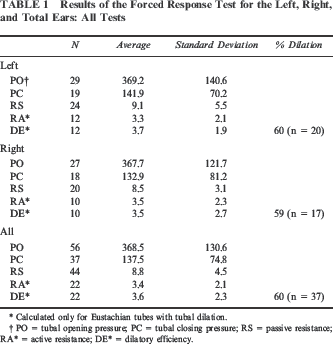
Calculated only for Eustachian tubes with tubal dilation.
PO = tubal opening pressure; PC = tubal closing pressure; RS = passive resistance; RA* = active resistance; DE* = dilatory efficiency.
The results showed that the average values of the variables representing the passive function of the ET were similar to those recorded for normal and abnormal adults and children. The percentage of ears that increased trans-ET airflow during swallowing was 60%. The active resistance and dilatory efficiency were similar to a normal adult population and the older children with CP with tympanostomy tubes inserted for pOME but less than the average values recorded in the previous study for the postpalatoplasty children with CP with tympanostomy tubes inserted prepalatoplasty.
Discussion
The FRT is capable of measuring both the passive and active properties of the ET (Cantekin et al., 1979). For the passive properties, the PO is associated with a mechanical or organic obstruction of the ET lumen, the PC is associated with the intraluminal pressures required to maintain a patent lumen, and RS is associated with the periluminal pressures acting on the tubal lumen. Most ET function tests in infants and children with a history of pOME and tympanostomy tubes (Beery et al., 1979; Cantekin, 1985; Takahashi et al., 1989), including children with CP (Doyle et al., 1980, 1986), show similar values for the passive tubal measures when compared with control subjects without a history of otitis media (Cantekin et al., 1979) and with adult subjects with experimental myringotomies but no extant pOME (Swarts et al., 2011). These results discount an organic or mechanical obstruction of the ET lumen as a cause of pOME in the majority of ears with that disease. In contrast, the active function variables provide a measure of the ability of the paratubal muscles to actively open the ET lumen, and these are abnormal in patients with pOME that has been termed a “functional” obstruction of the ET (Cantekin et al., 1979; Doyle et al., 1980; Cantekin, 1985).
The presence of tubal constriction is an extreme form of poor active function. In one study of 47 children aged 2 to 11 years with tympanostomy tubes for pOME, only 11% could actively dilate their ET during the FRT (Cantekin, 1985); whereas, in a study of 18 otherwise normal adults with unilateral myringotomies, that frequency was 78% (Swarts et al., 2011). In a study of older children with CP aged 3 months to 18 years with tympanostomy tubes inserted for pOME, only 27% evidenced tubal dilation on FRT testing (Doyle et al., 1980), but in a study of young postpalatoplasty children aged 15 to 26 months that frequency was 84% (Doyle et al., 1986). These results suggested to us that tubal dilation on the FRT may be a marker for early resolution of pOME in children with CP.
The present study was designed to validate the frequency of ET dilations in young children postpalatoplasty. For the 37 ears tested, FRT data related to the behavior of the predilated ET during swallowing showed 60% with tubal dilations and 40% with tubal constrictions. These values lay intermediate between those for the older patients with CP with pOME and the young patients postpalatoplasty; the differences in these frequencies (versus the present study) were statistically significant (χ2 = 9.93, p = .002 and χ2 = 5.39, p = .020, respectively). Also, the DE* was less in the current population (DE* = 2.3) when compared with that for infants in the previous study with tests done after their palatoplasties (DE* = 6.9), with the older CP population studied (DE* = 3.4), and with the otherwise-healthy adults with no concurrent ear disease (DE* = 4.4).
In summary, the high frequency of ET dilations reported in the 1986 study of young infants postpalatoplasty (Doyle et al., 1986) was not reproduced in this study, which evaluated a similar population using the same methods. However, the frequency was significantly greater than that reported for older patients with CP with tympanostomy tubes inserted for pOME (Doyle et al., 1980). The reason for the discrepancy in the data for the current and the 1986 studies are unknown, but a variety of factors may have contributed, including differences in the surgeons performing the procedures, differences in the method of palatoplasty, differences in the underlying distribution of palatal cleft type, differences in the technical personnel performing the tests, and preselection of the 1986 study's subjects for their cooperation with the testing procedures.
As evidenced by the number of incomplete tests on both ears, testing in these young patients with CP represents a challenge for the technician, parent, and child. Also limiting the ears tested is the frequency of otorrhea and blocked or displaced tympanostomy tubes. However, the lower frequency of tubal dilation in this population when compared with the 1986 population does not rule out testing the hypothesis that those young children evidencing tubal dilation will resolve their pOME at an earlier age than those evidencing tubal constriction, given that the dilation frequency is significantly greater than that for older children with CP who have tympanostomy tubes for pOME. In that regard, we plan to follow these children by otoscopy and FRT at approximately yearly intervals and to expand our population of young postpalatoplasty children for enrollment and first testing. We suspect that the children will be more cooperative on repeat testing as they age and that the results of the FRT will be more stable and more easily interpretable. If successful, we will be in a position to test the above-stated hypothesis.
Footnotes
Acknowledgments
The authors would like to thank Kathleen Tekely, R.N., for assistance with subject recruiting, and Juliane Banks, Maria Swarts, and Jenna El-Wagga for assistance with data abstraction and formatting.