







Abstract
Nursing and social work education programs are seeking innovative ways to prepare students to function as collaborative members of interprofessional teams upon graduation. Communication is a key linked to a decrease in medical errors, which compromise patient safety. In response to nursing students ‘concerns about clinical experiences in which they had witnessed poor communication with the potential to jeopardize patient care, faculty members identified a communication skills training program designed to improve team performance. Senior nursing and social work students at the beginning of their last semester of school were trained in selected modules of the Team Strategies and Tools to Enhance Performance and Patient Safety (TeamSTEPPS) training program and subsequently trained their student colleagues. The goal was to emphasize communication skills and strategies in a sustainable student trainer model. Qualitative and quantitative data about participant experiences revealed significant improvement in teamwork attitudes and communication skills following the training.
The Institute of Medicine's (IOM) landmark study To Err is Human: Building a Safer Health System (IOM, 1999) brought public awareness to compromised patient safety from medical errors in healthcare settings, citing 98,000 deaths annually. Central to this report was the identified relationship between the ability of health-care professionals to function as collaborative team members and the quality and safety of patient care (Baker, Amodeo, Krokos, Slonim, & Herrera, 2010; Wen & Schulman, 2014). This report generated a demand for action headed by the U.S. government, the media, and the health-care community (Baker et al., 2010). Despite intensive efforts there has been limited success in improving quality and safety for patients in the health-care setting (God-lock, Miltner, & Sullivan, 2017). More recent estimates of compromised patient care and death report 400,000 medical errors annually (Brock et al., 2013; Godlock et al., 2017; Sweigart et al., 2016). Efforts to reduce the incidence of medical errors in the health-care setting have included research funding for safety initiatives, public reporting of data, and use of technology (Godlock et al., 2017). The Hospital Read-mission Reduction Program (HRPP) links payments to the quality of health care by reducing payments to hospitals with excess readmissions (Hekmat, Dehnavieh, Rahimisadegh, Kohpeima, & Jahromi, 2015).
Providing safe health care depends on highly trained individuals with disparate roles and responsibilities acting together in the best interests of the patient (AHRQ, 2014; Goliat, Sharpnack, Madigan, & Trosclair, 2013). The Joint Commission (2017) identified that 70% of medical errors were caused by communication breakdown among health-care team members. The increasing complexity of the patient population and health-care systems demands fine-tuned collaboration among health-care professionals (Clark, Congdon, Macmillan, Gonzales, & Guerra, 2015). To decrease errors, health-care professionals must be educated in strategies that improve information exchange (Hekmat et al., 2015). Based on the recommendations of the Agency for Healthcare Research and Quality (AHRQ; 2014) and the Joint Commission (2017), the IOM (2011), and the American Association of Colleges
To decrease errors, health-care professionals must be educated in strategies that improve information exchange.
A health-care team is defined as two or more individuals who have specialized knowledge and specific roles, make decisions, perform interdependent tasks, and share a common goal such as safe patient care (Wen & Schulman, 2014). The AHRQ, in collaboration with the Department of Defense, developed Team Strategies and Tools to Enhance Performance and Patient Safety (TeamSTEPPS) as the national standard for team training in health care (AHRQ, 2014). A major principle underlying TeamSTEPPS is that through enhanced communication, teamwork among healthcare professionals can be improved. The TeamSTEPPS tool, which combines didactic instruction with simulation exercises, has been shown to improve team behaviors, team attitudes, and patient safety outcomes (Baker et al., 2010; Sweigart et al., 2016; Wen & Schulman, 2014). Although TeamSTEPPS has been used frequently in the hospital setting, there is little literature demonstrating its implementation with preprofessional health-care students in the academic setting. The aim of this project was to examine the effectiveness of the TeamSTEPPS curriculum in improving the teamwork attitudes of senior baccalaureate nursing students.
A STUDENT-LED INITIATIVE
A collaborative research project between nursing and social work students and nursing faculty at a Midwestern college was initiated following student-identified experiences in the clinical setting in which patient safety was potentially compromised by breakdowns in communication between team members. Specific TeamSTEPPS tools and strategies, selected with faculty and student input, were taught to baccalaureate nursing and social work students to provide skills useful in clinical practice as students and later as collaborative members of an interprofessional team. By involving the students in this research, investigators hoped to better understand the relevance of specific TeamSTEPPS tools and strategies for them. The students selected to be trainers had leadership opportunity through training their peers and conducting research.
Method
Institutional Review Board approval was obtained. Two nursing students and one social work student were selected as trainers via an application process in which they submitted a one-page essay on motivation to participate in this leadership opportunity. Two nursing faculty members and the three student trainers then participated in the initial TeamSTEPPS training, of five 2-hour sessions over a 1-month period.
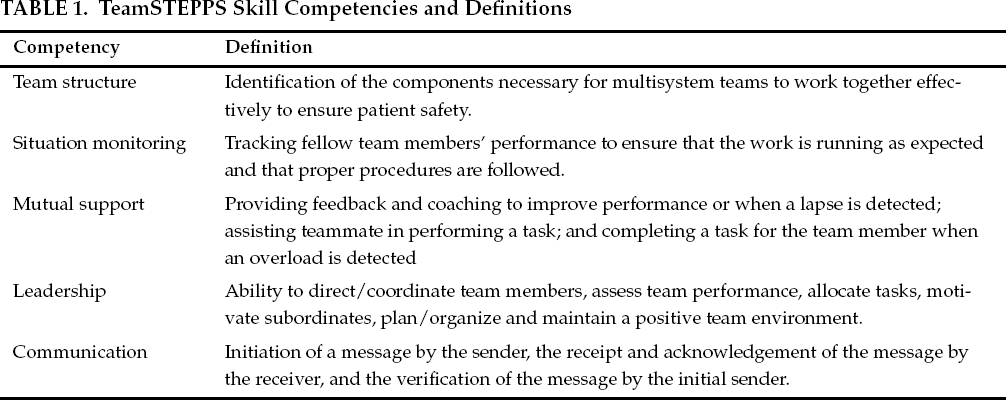
The team was then responsible for training the remaining students. These 2-hour training sessions covered TeamSTEPPS concepts selected by the student trainers, who developed case studies in which lapses in communication potentially compromised patient safety. Participants were invited to role play the scenarios using skills learned from the TeamSTEPPS curriculum. Table 1 describes the TeamSTEPPS competencies selected for the training and specific tools for each concept.
TeamSTEPPS Skill Competencies and Definitions
For the nursing students, training was completed prior to the beginning of a 120-hour precepted clinical experience. For the social work students, training was completed at the beginning of the second semester. To evaluate the project, the TeamSTEPPS Teamwork Attitudes Questionnaire (T-TAQ) was used. Developed to align with the TeamSTEPPS curriculum, the T-TAQ used a 5-point Likert-type scale to evaluate five domains of team attitude in areas related to team structure, leadership, situation monitoring, mutual support, and communication. Additional rich descriptions were obtained following the completion of the training. Study participants were asked to respond to three questions: Things I learned from this training, things I am still wondering about after the training, and potential uses in my future practice.
Results
Quantitative Results
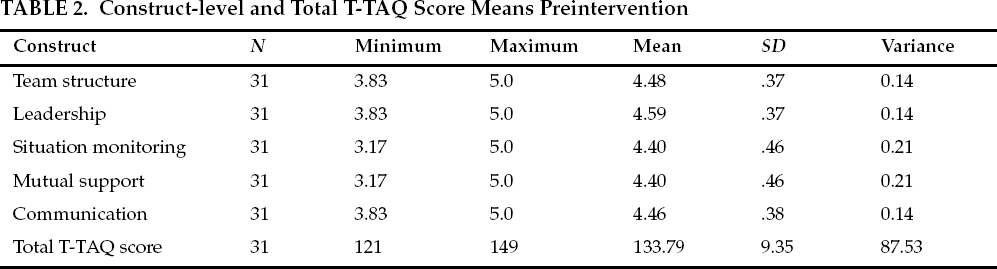
Combined responses from the nursing and social work participants were numerically coded as strongly disagree = 1, disagree = 2, neutral = 3, agree = 4, and strongly agree = 5. Two tables were created to present the average score before and after training for each T-TAQ construct (see Tables 2 and 3).
Construct-level and Total T-TAQ Score Means Preintervention
Construct-level and Total T-TAQ Score Means Postintervention
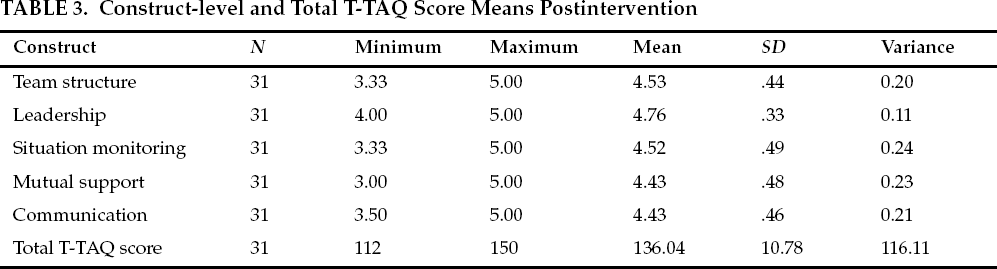
The mean change for each construct was calculated by subtracting the preintervenrion mean value from the posrintervention mean value. The same formula was used to calculate the mean change for the total T-TAQ score. Figure 1 presents the results of these calculations. An increase in the mean value can be seen for four of the constructs (0.05 for Team Structure, 0.17 for Leadership, 0.12 for Situation Monitoring, and 0.03 for Mutual Support); the mean for the Communication construct decreased by 0.03. The total T-TAQ scores also showed an increase of 2.25 points from pre-training to post-training.
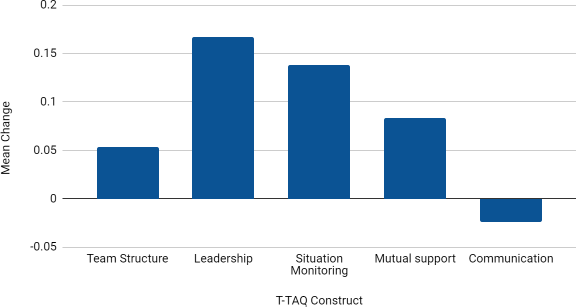
Construct-level change in mean scores from pre-training to post-training.
Paired samples t tests were run to determine the statistical significance of these changes in mean. The changes in mean for the Leadership and Situation Monitoring constructs were statistically significant, with respective p values of .02 and .02. The changes in mean for the constructs of Team Structure, Mutual Support, and Communication were not statistically significant, with respective p values of .44, .29, and .74. The change in mean for the total T-TAQ score was not statistically significant (p = .11).
Data were also analyzed considering the nursing and social work student study participants as two separate subgroups. Table 4 summarizes the data gathered before and after training, which was identical for both groups.
T-TAQ Scores by Sample Subgroups

The nursing subgroup had a negative change in mean T-TAQ score from pre-training to post-training. The social work student subgroup had a positive change in mean T-TAQ score. Paired sample t tests showed that the decrease in mean T-TAQ score for the nursing student subgroup was not statistically significant (p = .60), but the increase in the mean T-TAQ score for of the social work student subgroup was statistically significant (p = .01). An independent t test compared the gain scores of the two subgroups; the average change difference between the nursing and social work students was statistically significant (p = .009).
Figure 2 compares the construct-level change in score (postintervention mean minus preintervention mean) for the nursing and social work student subgroups. For the constructs of Leadership and Situation Monitoring, the average post-training scores were greater than the average pre-training for both subgroups. For the constructs of Team Structure, Mutual Support, and Communication, the average post-training scores were greater than the average pre-training for the Social Work subgroup, and lesser for the nursing subgroup.
Participants ‘narrative comments showed recognition that safety is the optimal goal, and of the necessity to intervene when breaches in communication potentially compromise attaining this goal.
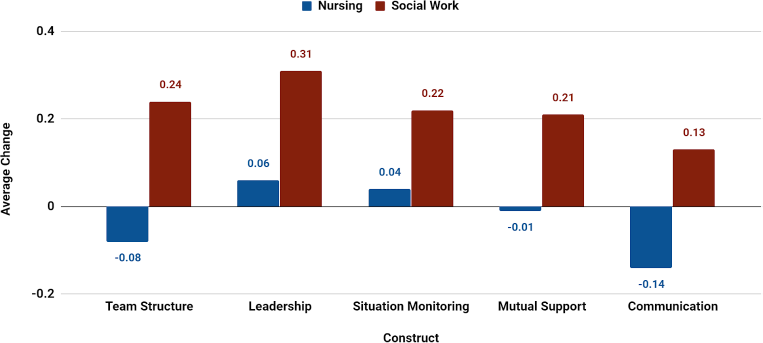
Construct-level change in mean scores for nursing and social work.
Qualitative Results
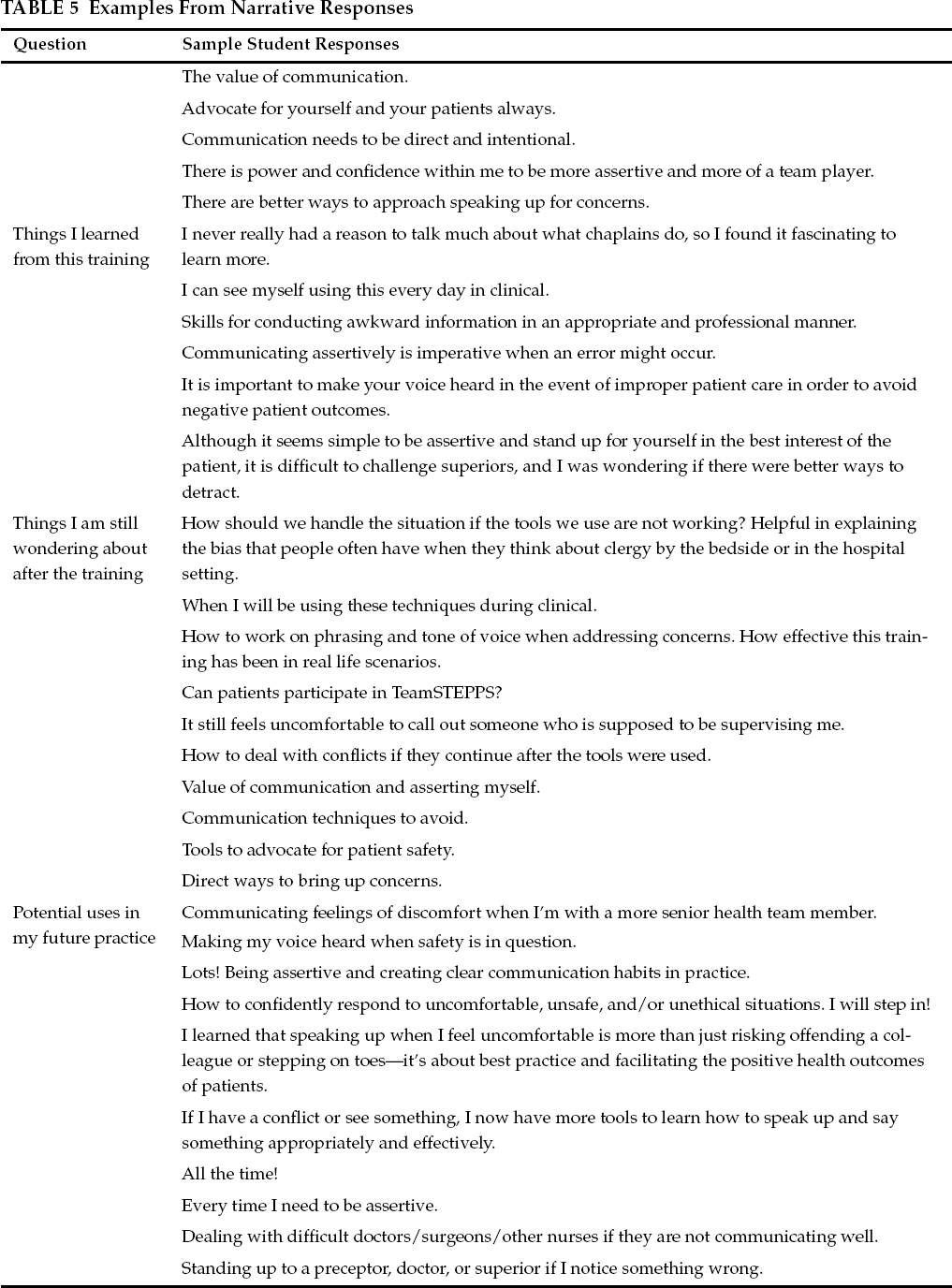
Participants were asked to provide narrative responses to three questions following the Team-STEPPS training: Things I learned from the training, things I am still wondering after the training, and potential uses in my future practice. Table 5 summarizes those responses.
Examples From Narrative Responses
Discussion
Working in highly effective teams is recognized as essential by many health-care disciplines. In this study, TeamSTEPPS provided a framework in the academic setting to guide facilitation of teamwork and communication skills in response to identified student concerns about situations they had experienced in clinical learning experiences that potentially compromised patient safety. Participants ‘narrative comments showed recognition that safety is the optimal goal, and of the necessity to intervene when breaches in communication potentially compromise attaining this goal.
The average mean T-TAQ scores increased in four of the constructs (Team Structure, Leadership, Situation Monitoring, and Mutual Support), indicating benefit from the TeamSTEPPS training. The mean T-TAQ score for the Communication construct decreased, which may indicate already adequate training in communication skills techniques before the training. Overall T-TAQ scores increased from pre-training to post-training. Particularly interesting was data from analyzing nursing and social work participants separately. The nursing subgroup's mean T-TAQ scores did not change significantly from pre-rraining to post-training, while the social work subgroup had a statically significant change.
Participants provided rich descriptions of experiences with communication and teamwork in the clinical setting. They reported that increased time spent in structured teamwork training would contribute to their ability to practice as a collaborative member of an interprofessional health-care team upon graduation. Narrative responses identified that students perceived that the TeamSTEPPS curriculum tools they learned were effective techniques for addressing conflict and working as a collaborative health-care team member. This supports the recommendations of The Interprofessional Education Collaborative (IPEC) that health-care providers are able to engage in conflict resolution and communication that promotes optimal patient outcomes (Hekmat et al., 2015).
Conclusion
Unique to this study is the use of student trainers to train their peers. Student trainers reported value in the leadership and teaching experience gained from this opportunity. Student learners reported value and increased investment in learning material selected by peers, including case studies based on experiences in which fellow students had witnessed poor communication with the potential to jeopardize patient care. Due to the value student study participants reported from using tools learned in this training, this pilot study stimulated nursing faculty to plan ways to sustain the inclusion of TeamSTEPPS training in the baccalaureate nursing curriculum in both simulated and clinical learning experiences, as well as including other academic disciplines. Future plans include developing a curricular model incorporating key principles of TeamSTEPPS that serves to increase interprofessional teamwork and communication across the prelicensure baccalaureate curriculum. Sustainability will be promoted by continuing to train students following a rrain-the-rrainer model. Future development and evaluation methods include investigating the long-term impact of TeamSTEPPS training on students ‘behaviors after they graduate and are practicing health-care professionals.
For interprofessional competencies to become sustainable curricular outcomes in the academic setting, faculty development must be emphasized. Ongoing faculty development in the TeamSTEPPS curriculum will provide role modeling, contributing to development of student understanding of essential team work and communication skills. Faculty development
Student learners reported value and increased investment in learning material selected by peers, including case studies based on experiences in which fellow students had witnessed poor communication with the potential to jeopardize patient care.
Footnotes
Susan L. Huehn, PhD, RN, PHN, she, is an Associate Professor of Practice and Department Chair in the School of Nursing at St. Olaf College Her research interests are implementation of effective communication strategies to prepare professional nurses who are ready to practice on collaborative interprofessional teams.
Mary Beth Kuehn, EdD, RN, she, is an Associate Professor of Nursing at St. Olaf College in Northfield, Minnesota. Her research interests include lived experience of nursing faculty in the academic workplace.
Genesis M. Fukunaga Luna Victoria she is a senior nursing student at St. Olaf College. She is a student leader. As well as participating in this research study, she participated in a research study exploring nursing students ‘understanding of poverty utilizing simulation.
Disclosure. The authors have no relevant financial interest or affiliations with any commercial interests related to the subjects discussed within this article.
Funding. The author(s) received no specific grant or financial support for the research, authorship, and/or publication of this article.