






Abstract
Background
Interleukin 6 (IL-6) is a cytokine involved in different physiologic and pathophysiologic processes, and circulating levels of IL-6 differ greatly between individuals, but the results have not always been concordant among diverse populations. The aim of present study was to determine the prevalence of the 3 polymorphisms (−174G/C, −597G/A, and −634C/G) in the IL-6 gene promoter region and their effects on inflammatory markers in normal Han Chinese population.
Methods
A total of 232 subjects (143 men and 89 women; mean age, 51.37 ± 17.63 years; range, 22-88 years) of unrelated healthy Han Chinese in Jinangsu area (south of China) were enrolled. Genotyping of the 3 polymorphisms were performed by polymerase chain reaction and restriction fragment length polymorphism combined with gel electrophoresis and then confirmed by direct sequencing.
Results
Among the 232 individuals studied, 231 carried the GG wild type of -174G/C; only 1 carried the GC genotype. For -597G/A polymorphism, individuals all carried the GG wild type; the GA or AA genotypes were not detected. The frequencies of -634C/G genotypes CC, CG, and GG were found to be 59.48%, 37.07%, and 3.45%, respectively, the derived allele frequencies for the C and G alleles were 78.02% and 21.98%. There were no significant differences in age, sex, body mass index, or lipids parameters between the -634 CC and CG+GG genotypes. However, individuals with CC genotype showed lower levels of high-sensitivity C-reactive protein and IL-6 than those with CG+GG genotype.
Conclusions
IL-6 -174G/C and -597G/A are rare, but -634C/G is common in Han Chinese population, and the -634G allele is associated with circulating levels of IL-6 and C-reactive protein.
Published studies have shown that increased levels of IL-6 are associated with a variety of disease states, such as Alzheimer disease, atherosclerosis, cardiovascular disease, cancer, non-insulin-dependent diabetes mellitus, osteoporosis, sepsis, periodontitis, and systemic-onset juvenile chronic arthritis.7–19
Circulating levels of IL-6 differ greatly between individuals. 20 This difference is due to both genetic and environmental influences. 21 The human IL-6 gene is located at chromosome 7p21 and contains 5 exons, and the IL-6 coding sequence contains only a few very rare polymorphisms. 22 This fact has led to the hypothesis that the observed differences in IL-6 concentration among individuals are influenced by variation in the IL-6 gene promoter region. 20
Fishman and coworkers 7 first reported a G to C polymorphism at the -174 position of the IL-6 promoter and its effect on IL-6 levels in patients with juvenile chronic arthritis. Carriers of the GG genotype had higher IL-6 levels at rest, and in constructs expressed in HeLa cells, the G allele showed a significantly higher luciferase activity. In the same study, IL-6 levels were found to be nearly twice as high in healthy controls with the GG genotype as in those with the CC genotype. This report was followed by a number of studies that either supported23,24 or failed to confirm the original hypothesis. 25
Ethnic differences were highly noted for IL-6 polymorphisms. -174C allele was found to be completely absent in Japanese 26 and rare in the Afro-Caribbeans and Asian Indians,7,27 while significantly increased in the Finnish white. 28 In China, different communities showed different frequencies of IL-6 alleles.29,30
Based on these findings, we detected -174G/C (rs1800795), -597G/A (rs1800797), and -634C/G (rs1800796) polymorphisms in the IL-6 gene promoter region in healthy individuals in Jinangsu area (south of China). The aim of present study was to determine the prevalence of the 3 polymorphisms and their effects on inflammatory markers in normal Han Chinese population.
Methods
Subjects
Two hundred thirty-two cases (143 men and 89 women; mean age, 51.37 ± 17.63 years; range, 22-88 years) of unrelated healthy Han Chinese in Jinangsu area (south of China) were enrolled. All the subjects were healthy and had no cardiovascular and cerebrovascular disease. Diabetes, cancer, hepatic disease, and other diseases that can affect serum inflammatory markers and lipids metabolism were also excluded. There was also no history of cigarette smoking among these subjects. Individuals were selected after careful physical examination, chest radiograph, electrocardiography, and urine and blood tests. The study has been approved by the Medical Ethics Committee of Affiliated Hospital of Nantong University, and written informed consent was obtained from all participants.
Genotyping Protocols
DNA was extracted from peripheral blood by using a commercially available kit. Sequence amplification was performed by using polymerase chain reaction (PCR). The primers were 5#2032;-AGTGGGCTGAAGCAGGTGA-3#2032; (sense) and 5#2032;-CTTTGTT GGAGGGTGAGGG-3#2032; (antisense). This set encompasses the region of interest in the IL-6 promoter and should generate a 617-base-pair (bp) product. The reaction volume was 50 μL in each well of a 96-well plate, with final reaction component concentrations of 0.4 mmol/L for each of the 4 dNTPs, 2.0 mmol/L MgCl2, 0.2 pmol/L for each of the primers, 0.1 mg/L for genomic DNA, and 1.25 U Taq polymerase (Sangon, Shanghai, China). The PCR program consisted of initial denaturation at 94°C for 5 minutes and 40 cycles of denaturation at 94°C for 30 seconds, annealing at 55°C for 30 seconds, extension at 72°C for 1 minute, and a final extension at 72°C for 7 minutes.
Genotypes were resolved by using restriction endonuclease digestion. For -174G/C, 15 μL amplification products were digested with NlaIII to detect allele G (617 bp) and allele C (86 + 531 bp); for -597G/A, products were digested with FokI to detect allele G (617 bp) and allele A (117 + 500 bp); and for -634C/G, products were digested with BsrBI to detect allele C (617 bp) and allele G (131 + 486 bp). The sizes of the digestion products were then determined by electrophoresis on 2% agarose gel stained with ethidium bromide by 2 independent observers blinded to clinical details. Positive and negative controls were used to ensure accuracy. Fifty amplification products were sent to direct DNA sequencing.
Biochemical Analysis
Venous blood samples were obtained after at least a 10-hour overnight fast and then centrifuged at 2500 revolutions per minute for 30 minutes at 4°C and immediately stored −80°C until analysis. Measurements of high-sensitivity CRP (hs-CRP), total cholesterol (TC), high-density lipoprotein cholesterol (HDL-C), low-density lipoprotein cholesterol (LDL-C), and triglycerides (TGs) were performed as described previously. 31 Interleukin 6 was measured by a high-sensitivity enzyme-linked immunosorbent assay assay from R&D Systems (Minneapolis, MN).
Statistical Analysis
All continuous variables are expressed as mean and SD. Student t test was used to compare continuous variables from 2 groups. Genotype and allele frequencies were obtained by direct count. Differences in the distribution of alleles and genotypes between the groups and deviation from Hardy-Weinberg equilibrium were assessed by χ2 test. All significant tests were 2-tailed and were considered statistically significant at P < 0.05. SAS software (version 8; SAS Institute, Cary, NC) was used in all statistical analyses.
Results
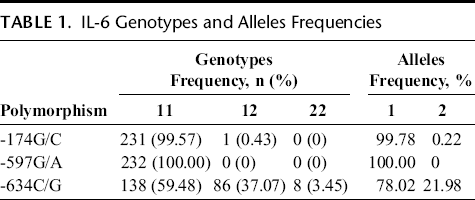
Table 1 summarizes the distributions of genotype and allele frequencies of 3 IL-6 promoter polymorphisms. Among the 232 individuals studied, 231 carried the GG wild type of -174G/C; only 1 carried the GC genotype, and the CC genotype was not detected at all. For -597G/A polymorphism, individuals all carried the GG wild type; the GA or AA genotypes were not detected. The frequencies of -634C/G genotypes CC, CG, and GG were found to be 59.48%, 37.07%, and 3.45%, respectively; in total studied subjects, the derived allele frequencies for the C and G alleles were 78.02% and 21.98%. Fifty samples sent to direct DNA sequencing were consistent with the results by PCR and restriction fragment length polymorphism. The -634C/G genotype distribution among the subjects was in agreement with the predicted Hardy-Weinberg equilibrium values (χ2 = 1.5111, P = 0.2190). Because of the distribution of -174G/C and -597G/A genotypes, the effects of the 2 polymorphisms on serum lipids, lipoproteins, and inflammatory markers were not pursued.
IL-6 Genotypes and Alleles Frequencies
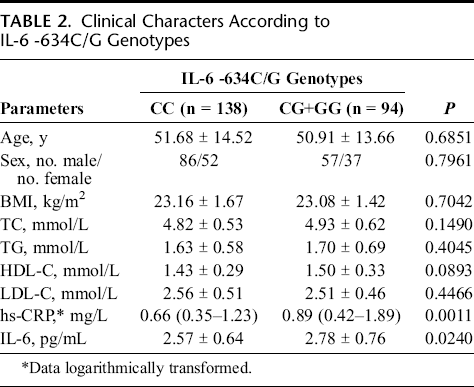
The effects of the different IL-6 -634C/G genotypes on clinical parameters are shown in Table 2. Because the numbers of individuals with GG genotype were small, the carriers of the G allele (CG+GG) were pooled into 1 group. There were no significant differences in age, sex, or body mass index (BMI) between the 2 genotypes. Also, no significant differences were observed on TC, TG, HDL-C, and LDL-C between the 2 genotypes. However, individuals with CC genotype showed lower levels of hs-CRP and IL-6 than those with CG+GG genotype.
Clinical Characters According to IL-6 -634C/G Genotypes
Discussion
The IL-6 signaling pathway plays a critical role in a number of acute and chronic diseases. 32 Circulating levels of IL-6 vary widely within populations, 20 and genetic factors are thought to play a major role, along with environmental factors, particularly inflammation. 21 The present study sought to investigate genetic variation in the promoter region of IL-6, a factor upstream influence IL-6 transcription, and the quite different prevalence of the 3 polymorphisms was found. Namely, -174G/C (99.57% GG, 0.43% GC, and 0% CC) and -597G/A (100% GG, 0% GA, and 0% AA) polymorphisms are extremely rare, whereas -634C/G (59.48% CC, 37.07% CG, and 3.45% CG) is common in normal Han Chinese population.
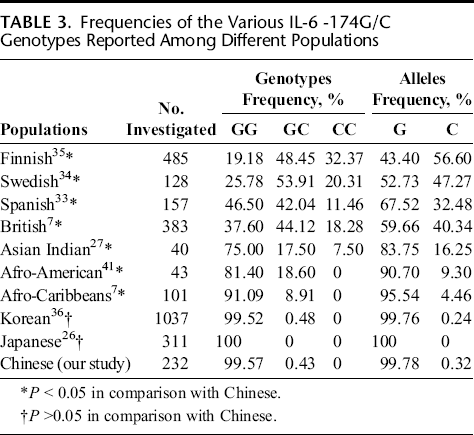
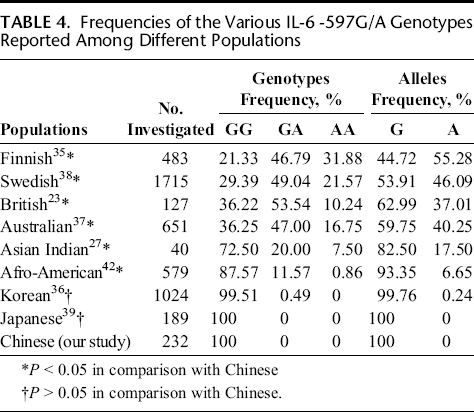
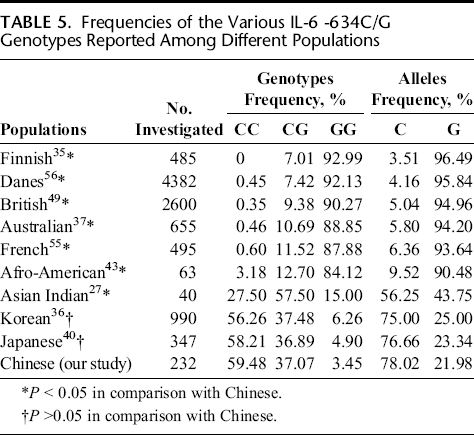
As shown in Table 3, a different genetic background was found in Eastern Asians and whites with respect to the allele frequencies of the IL-6 promoter polymorphisms. The C allele frequencies of IL-6 -174G/C reported in whites (32.48%-56.60%)7,33–35 are much higher than those found in Koreans (0.24%), 36 Japanese (0%), 26 or in the Chinese population (0.32%) in our study. Similarity, whites have higher A allele frequencies (37.01%-55.28%)23,35,37,38 of IL-6 -597G/A than Koreans (0.24%), 36 Japanese (0%), 39 or Chinese (0%) in our study (Table 4). In contrast, the frequencies of the C allele of IL-6 -634C/G in whites (3.51%-6.36%) are much lower than those in Korean (75.00%), 36 Japanese (76.66%), 40 or Chinese (78.02%) in our study (Table 5). It is of note that the C allele frequency (9.30%) 41 of -174G/C and the A allele frequency (6.65%) 42 of -597G/A in African-American are similar to those in Eastern Asian populations, whereas the C allele frequency (9.52%) 43 of -634C/G in African-American is similar to those in whites. Asian Indians have these allele frequencies 27 that are intermediate to those of the white and African-American/Eastern Asian populations. Data confirm previous reports about evolutionary trees suggesting that European and southwest Asian (Indian) populations diverged from the Chinese population, with an estimated genetic distance of at least 20,000 years. 44 High frequency population-specific alleles are particularly useful for mapping genes responsible for disease susceptibility and other traits in a population. 45 The IL-6 -634C/G polymorphism might be a more useful marker for an association study in Eastern Asians than in whites.
Frequencies of the Various IL-6 -174G/C Genotypes Reported Among Different Populations
Frequencies of the Various IL-6 -597G/A Genotypes Reported Among Different Populations
Frequencies of the Various IL-6 -634C/G Genotypes Reported Among Different Populations
In the present study, no significant differences in age, sex, BMI, or lipid parameters were found between CC and CG+GG genotypes of IL-6 -634C/G. The G allele carriers (CG+GG) had significantly higher circulating levels of CRP than CC genotype. The present findings are in agreement with the existing reports from multiple studies conducted in Japanese and Koreans.40,46,47 However, in postmenopausal white women, CRP concentrations were higher at CG genotype than GG genotype, 48 whereas no significant association was found with -634C/G and CRP levels in 3052 healthy UK men 49 and 160 white patients with coronary heart disease. 50
The present study also found a positive correlation of the -634G allele carriers and higher serum levels of IL-6. Our results are consistent with previous studies conducted in Japanese and Koreans.17,51,52 On the other hand, -634C allele was associated with the increased IL-6 levels in whites.23,53 However, the association was inconsistent among studies; in white male patients with myocardial infarction and in dyslipidemia, no relationship was detected between IL-6 -634C/G polymorphism and circulating IL-6 levels.54,55 These discrepancies might be due to some confounding factors such as study design, race, population size, sex, age range, disease status, and so on. In particular, the -634C allele is common in Eastern Asian populations, whereas in whites the -634C allele is rare; CC homozygote is not found in some studies of the white population.35,48,53,56
Interleukin 6, as a principal upstream mediator of the acute-phase proteins, regulates CRP gene expression.1,5,6 In whites, -174G/C polymorphism has been shown to be associated with circulating levels of IL-6 and CRP.7,24,57 However, as previously described, the -174C allele is extremely rare, and the -634C allele is common in Eastern Asian populations, whereas in whites the -174C allele is relatively frequent, and the -634C allele is less frequent.7,33–35 In fact, our results along with the previous reports in Japanese and Koreans indicate that -634C/G is associated with circulating levels of IL-6 and CRP in Eastern Asians. Accordingly, the association of IL-6 polymorphism with higher serum CRP is due to an increase in IL-6 gene transcription and the consequent effects of increasing levels of IL-6 on CRP gene expression. However, there is a significant difference in the IL-6 promoter polymorphisms distribution among people of different races. Functional genomic studies are needed to verify the relevance of polymorphisms in the IL-6 promoter to inflammatory markers in Han Chinese population.
In conclusion, IL-6 -174G/C and -597G/A are rare, but -634C/G is common, in Han Chinese population, and the -634G allele is associated with circulating levels of IL-6 and CRP. The results provide essential genetic backgrounds for studying the association of IL-6 -634C/G polymorphism with inflammatory diseases.