







Abstract
Fetal and infant autopsy yields information regarding cause of death and the risk of recurrence, and it provides closure for parents. A significant number of perinatal evaluations are performed by general practice pathologists or trainees, who often find them time-consuming and/or intimidating. We sought to create a program that would enable pathologists to conduct these examinations with greater ease and to produce reliable, informative reports. We developed software that automatically generates a set of expected anthropometric and organ weight ranges by gestational age (GA)/postnatal age (PA) and a correlative table with the GA/PA that best matches the observed anthropometry. The program highlights measurement and organ weight discrepancies, enabling users to identify abnormalities. Furthermore, a Web page provides options for exporting and saving the data. Pathology residents utilized the program to determine ease of usage and benefits. The average time using conventional methods (ie, reference books and Internet sites) was compared to the average time using our Web page. Average time for novice and experienced residents using conventional methods was 26.7 minutes and 15 minutes, respectively. Using the Web page program, these times were reduced to an average of 3.2 minutes (P < 0.046 and P < 0.02, respectively). Participants found our program simple to use and the corrective features beneficial. This novel application saves time and improves the quality of fetal and infant autopsy reports. The software allows data exportation to reports and data storage for future analysis. Finalization of our software to enable usage by both university and private practice groups is in progress.
INTRODUCTION
Autopsy examination of previable fetuses, stillborn, and live-born infants provides information regarding cause of death and the risk of recurrence for future pregnancies, and it helps give closure to grieving parents. For example, the identification of Beckwith-Weidemann Syndrome (BWS) via a proper fetoplacental examination can direct clinicians to discuss the risks of its recurrence with parents, as some 15% of BWS cases are familial [1]. The pathologists who perform these autopsies are largely subspecialty trained in pediatric pathology and practice in children's hospitals or academic centers. However, a significant number of perinatal evaluations are performed by general practice pathologists or trainees, who often find them time consuming and/or intimidating. Among the most challenging factors are appropriate assessments of fetal and neonatal growth parameters and maturational features.
We sought to create a program that would enable specialists as well as general pathologists and trainees to perform these examinations with greater ease and speed and to produce reliable, informative reports.
METHODS
The development of a novel application that uses gestational age (GA)/postnatal age to generate anthropometric norms involved the creation of two separate programs. Originally, a script was written in Visual Basic for Applications (VBA) in Microsoft Excel. This program was implemented locally and enabled users to input infant autopsy measurements and, almost instantaneously, view the infant measurements as displays in Microsoft Word and Excel tables. Initially, a PubMed search for “fetal anthropometry” was conducted to find the most up-to-date anthropometric data tables and reference publications, including pediatric and perinatal pathology textbooks. References were selected based on their sample sizes, applicability of data in tables, and dates published [2–7]. The various ranges established for the program were constructed using these resources in combination and thereby allowed a broad spectrum for GA, from fetal (stillborn) and preterm birth GA, to neonatal, to 1 year postnatal age, to be accessible from the database.
The anthropometric values within these sources' tables were converted to a format that could be readily utilized using Optical Character Recognition in Adobe [8] and then entered into an Excel spreadsheet for use, via a VBA macro.
Next, a user interface was developed within Excel (Figs. 1 and 2).
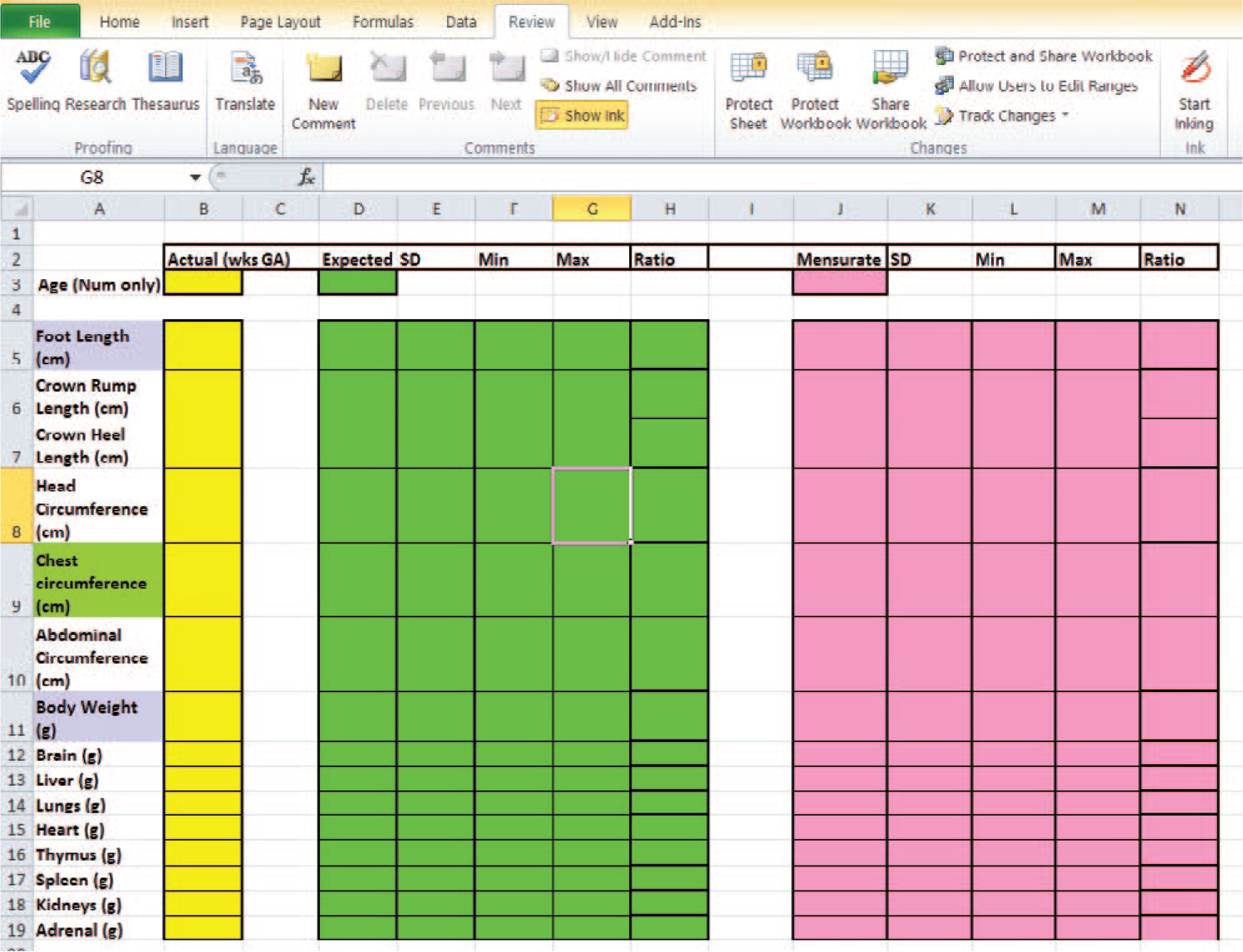
Excel spreadsheet user interface. Entries are placed in yellow boxes. A color version of this figure is available online.
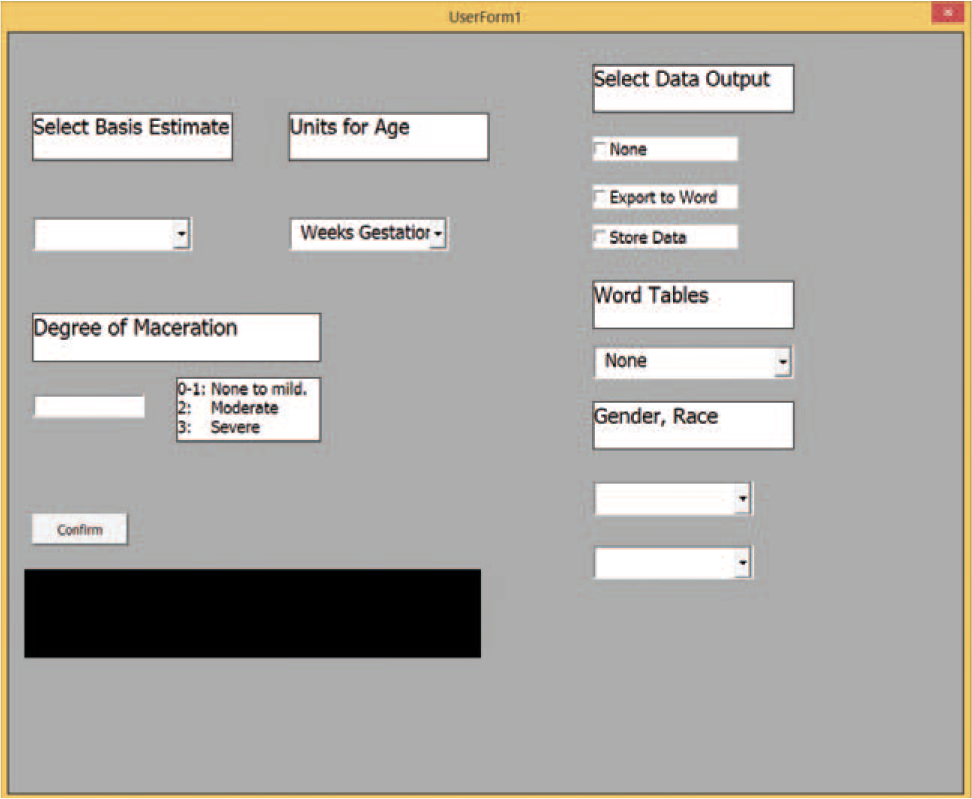
Excel form generated when user executes the anthropometry macro. A color version of this figure is available online.
The premises behind this program, and the more sophisticated World WideWeb–based platform, are similar in that users' entries are compared to data tables from previous large-scale studies. Both programs were designed to factor in the following entry designations and parameters:
Entry of live birth versus stillbirth status at delivery. After the specific entry is made, the program generates the appropriate correlative reference tables for use and viewing.
Selection of degree of maceration, when applicable. After the user selects the description that most closely matches a given case, the program generates organ weight tables that are adjusted for degree of autolysis.
Derivation of mensurate age based on user input of foot length and/or GA. The program is designed to display the tables of expected ranges for anthropometry and organ weights that are most closely aligned with the user's entry choice(s).
Therefore, after initial entry of these parameters is completed and the user clicks on “Confirm” to activate the program, the program finds the GA within the stored data tables. If the user specified a means for evaluation, such as foot length in millimeters, the program begins with this foot length and sequentially searches for the GA matching this measurement and the correlative (numerical) 95% confidence intervals for the anthropometric values and organ weights for this specifically identified GA. These values are then reported in an Excel table and exported to Word in tabular and report format.
Successful development of an Excel macro was followed by development of a more sophisticated Web page. Microsoft Webmatrix, a development environment that is compatible with numerous Web programming languages, was used to develop the site. First, an “index.html” page was created in Hypertext Markup Language (HTML). The site was designed to assume a stillbirth entry by default; however, a checkbox was placed at the top of the site to allow users to choose live birth options. Below this button, entry fields for birth age, weeks or months alive (eg, corrected GA), infant measurements, and demographics, as well as additional fields for database storage, were added (Fig. 3).
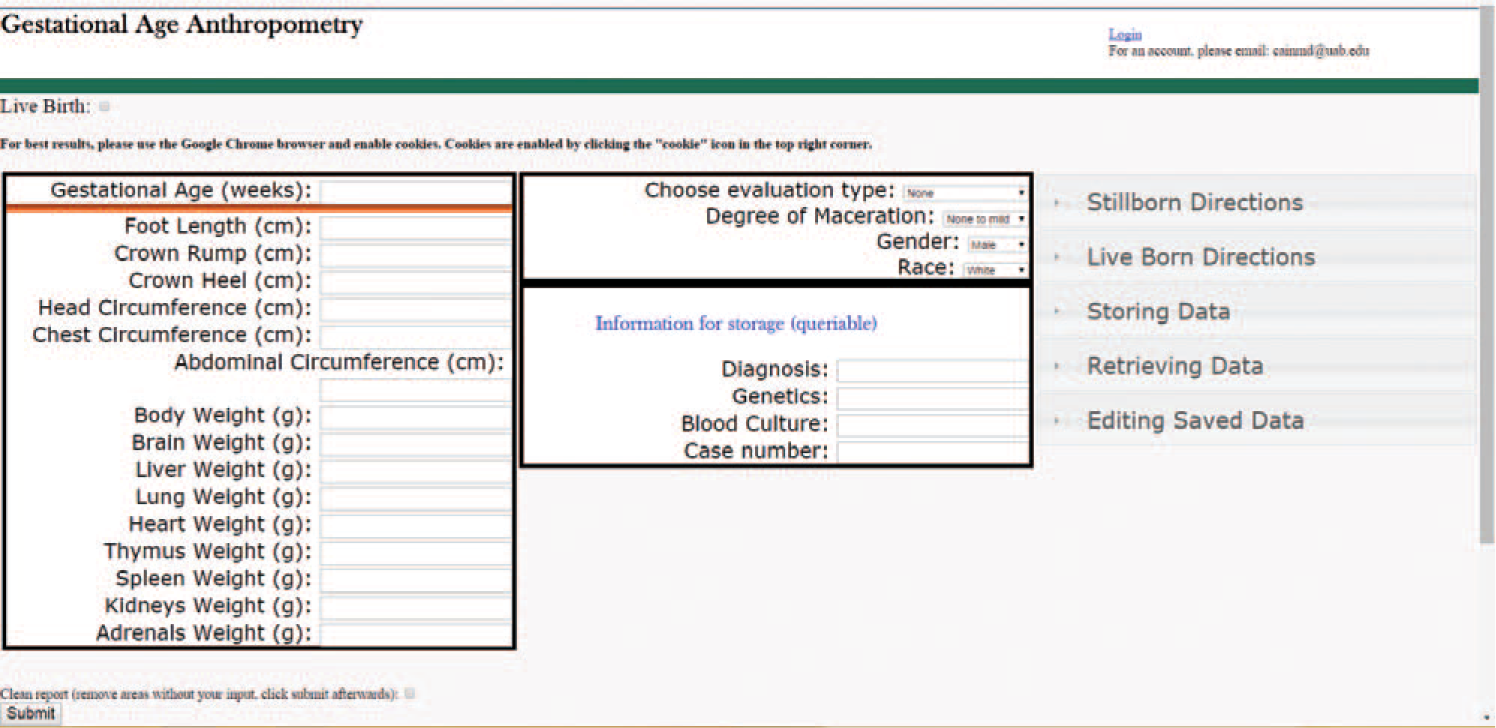
Gestational age anthropometry Web page prior to case entry. A color version of this figure is available online.
The page's functionality, such as searching a table or clicking a button, was linked to a script written in JavaScript (JS). JS is the “Web's assembler language” and, as such, is the native programming framework for all Web browsers, both in desktop and mobile platforms. JS enables actions such as clicking buttons or dynamically changing images [9]. Additional functionality can be added by script tag loading, that is, with no need for download and installation, as illustrated by the inclusion of JQuery, a popular JS library that contains many convenient functions to manipulate user interface components [10]. The Web page software used the previously mentioned data tables, along with additional tables from the sources listed in the references. All of these tables were loaded directly into the JS code as multidimensional arrays that are searchable through parameters provided by the user. The program was constructed not only to extract the proper values from each of these tables but also to determine which tables were most applicable. For example, the postnatal growth curves of a preterm versus a full-term infant are different; hence, the program was built to adjust for these differences. The ability to search for a mensurate age based on a measurement, such as head circumference or foot length, was equivalent to the same procedure in the Excel application, except that the Web application was able to search all stored tables for the corresponding applicable range. For example, at the Web site, if a full-term but exceptionally small live-born infant was queried, the program was enhanced to enable it to search the full range of GA tables and generate values that are most compatible with the queried infant's body habitus. Once a user finishes entering parameters and clicks “Confirm,” the script was programmed to execute and evaluate the entries and then generate both age-appropriate expected normal ranges and the anthropometric norms that are most compatible with the entered values. The Web page application was also designed to display results in both tabular and report format and programmed to post results as tables using Google Visualizations [11]. The results table function was constructed to include clickable headings that can change the order or position in which values are displayed. The resulting report was programmed for display inside a text box that could be copied into a local document (Fig. 4).
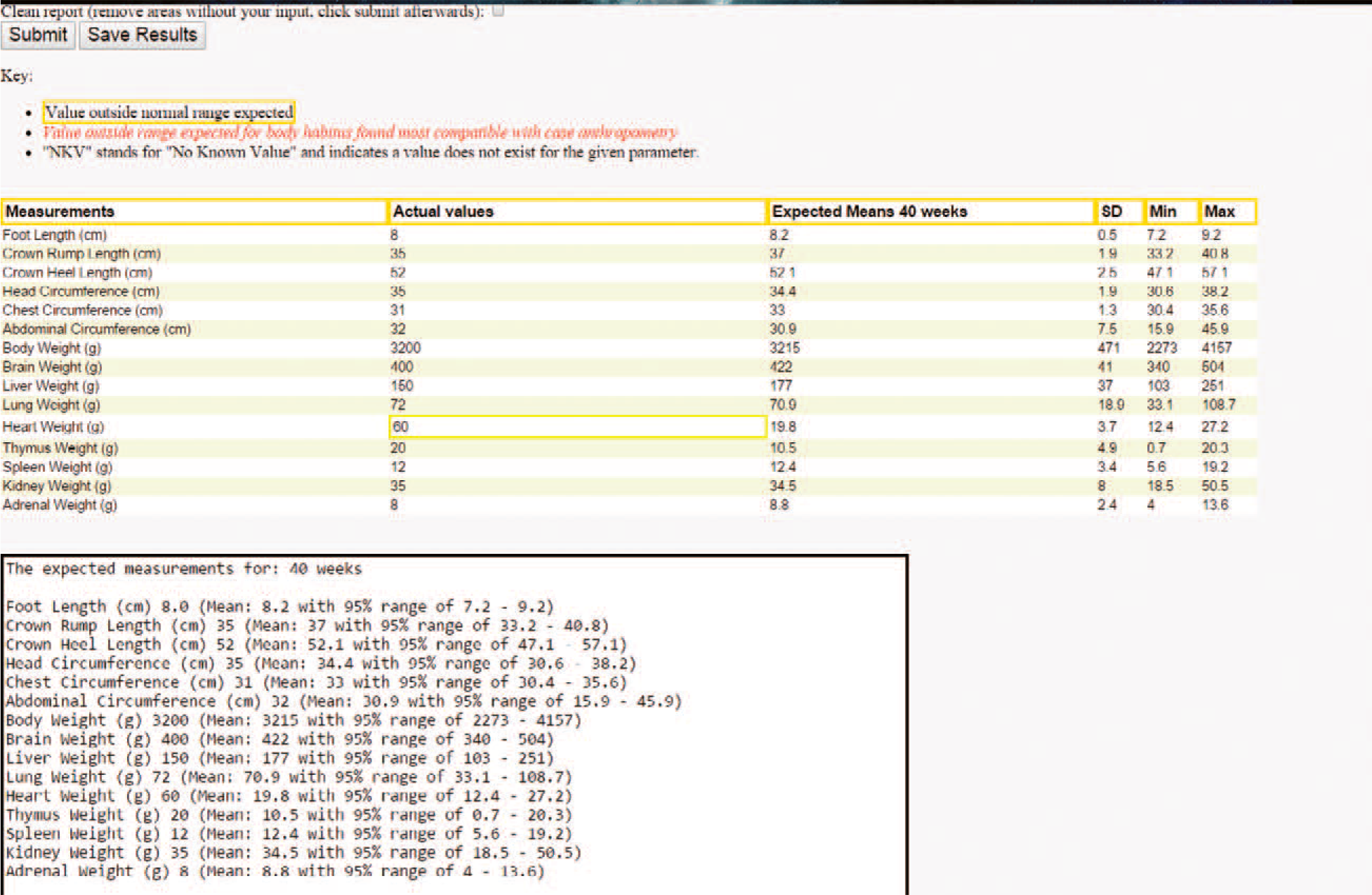
Example of results and table generated by Web page application upon entry of a 40-week gestational age (GA) infant autopsy case measurements and weights. Note highlighted heart weight value. The yellow highlight signifies that the observed value is outside the normal range expected for GA and body habitus. A color version of this figure is available online.
After the basic Web page functions were created, the site was extended to include a secure, no-SQL database known as S3DB [12]. The S3DB database is hosted by a server at the University of Alabama at Birmingham and maintained by the Informatics Division in the Department of Pathology. Our index page allows users to log in to this database and, after entering values for evaluation, also allows users to save values to their respective, secure individual or institutional accounts. The S3DB login connector is a separate script hosted on GitHub for free usage [13]. S3DB saves these entries and organizes them into a queryable format for future use. Furthermore, S3DB utilizes a governance model design that enables users with an account to permit other users to see their data, with options for “view only” or editing privileges. The granularity of the governance model provided by S3DB also permits a user to limit other users' access to a single database entry, as well as the type of entry to which a user may have access or editing privileges (Fig. 5).
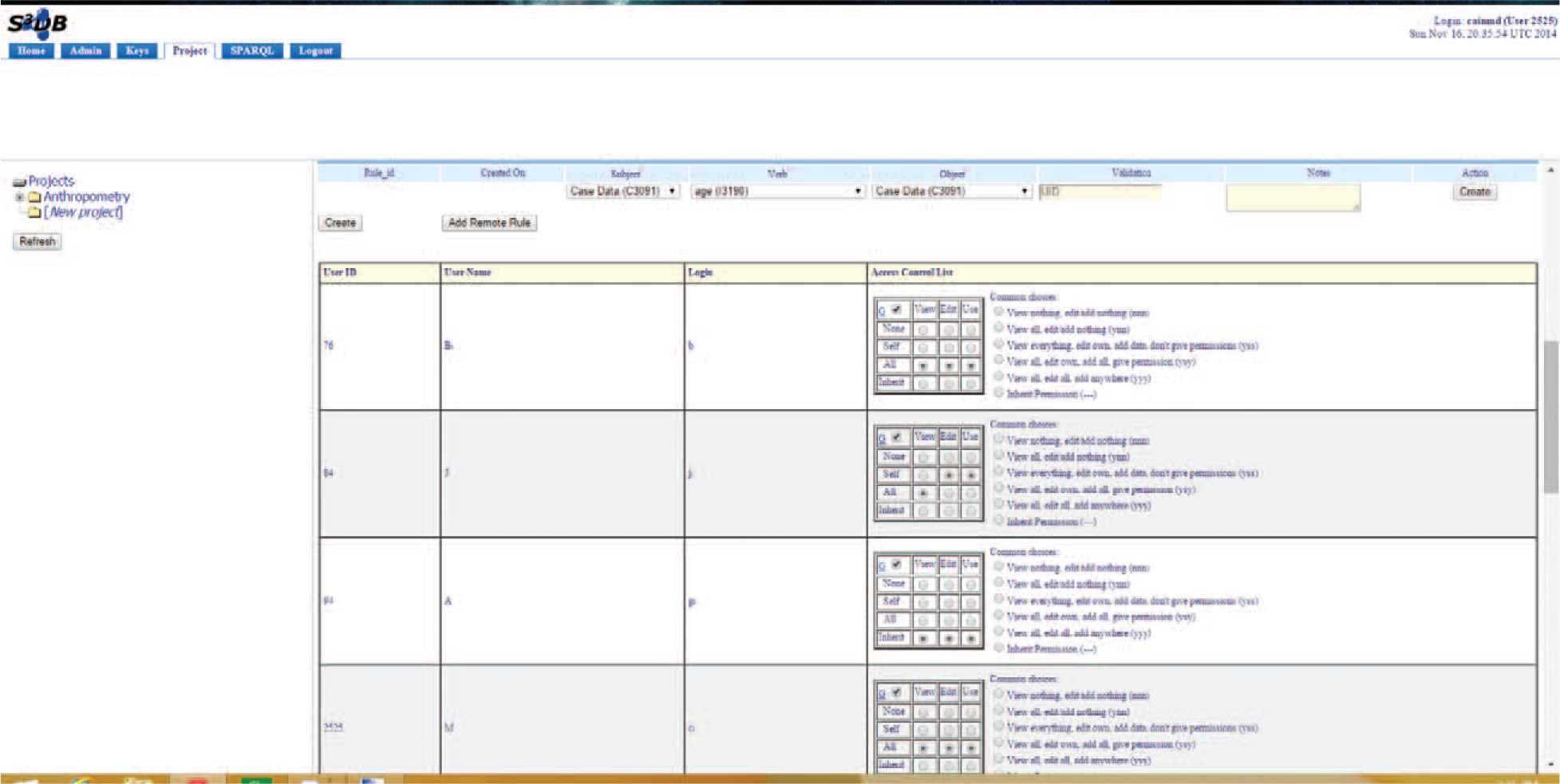
Permissions page for S3DB no-SQL database. A color version of this figure is available online.
The Web site expansions further enabled users to conduct complex queries of their saved data in a SQL query format. For example, the query function was constructed to enable a user to search for a specific piece of case information, such as a case number, or to conduct a more complex search, such as a combined query involving age and foot length range. Moreover, the program was set up to permit the results of users' searches to be exported to Excel for further analysis.
After the Web site and database were set up, the page's files were loaded onto GitHub, a free community repository with web-hosting capabilities [14]. In addition to providing free hosting, this GitHub repository also enables users to “fork” (technical term for making a copy of) the Web site and modify elements for their own local use. The “forking” capability permits the creation of separate Web addresses at which modifications can be viewed. For example, the data tables were left open to users so that table values could be modified and tailored for individualized or institutional use. Therefore, if a hospital preferred to use organ weight ranges from a source(s) other than that provided in the table, the various alternative ranges could be entered to replace those previously programmed into the site. However, any such modification(s) affect only the tables of the specific individual's or institution's Web address. Should another user or institution also wish to apply the new parameters and tables, they can request to do so by going to the newly created Web address.
Finally, we asked several pathology trainees to compare use of our new software to the standard method of determining mensuration and expected ranges for organ weights for their cases by looking up and recording values from conventional anthropometry and weight tables and graphs. The original Excel version of the application was evaluated by both upper- and junior-level residents. Two first-year residents also agreed to compare all three methods (standard manual, our Excel form, and the new Web page) and to submit a survey. Initially, the Excel version was run locally on a drive shared residents in the University of Alabama at Birmingham pathology department. Residents were asked to give feedback about usability and to report any technical issues. After the Excel version was refined by user feedback, the program was tested for workflow speed and accuracy and compared to conventional methods, such as manually looking up values in a table. Statistical significance was evaluated using Student t-tests.
RESULTS
We successfully developed two separate programs, an Excel program and a Web page program, that generate anthropometric norms. Using conventional methods, a novice resident acquired infant GA norms in 26.7 minutes compared to 15 minutes for an upper-level resident. Using the Excel program, first-time users took an average of 7.2 minutes and 3.2 minutes thereafter to acquire normal values. The difference in mean time for novices' acquisition of values using standard methods versus first-time program users was statistically significant (P = 0.046). The difference between means acquisition times for upper-level residents using conventional methods versus our software was also significant (P = 0.02).
The two first-year residents who completed a survey comparing our Web page to the Excel form and to conventional methods reported that the Web version was significantly easier. Average time for first Web page use was 2.1 minutes, further supporting the survey results. Each resident evaluated 3 cases and had an average Web page time of 1.5 minutes/case, compared to 9.5 minutes/case for standard methods (P = 0.26). While the sample size was small, these averages were statistically significant, and residents were unanimous in their support for the anthropometry Web page. Trainees' feedback indicated that the Web page saved residents the most time on complicated cases in which anthropometry measurements did not agree with the clinically reported GA. Comments also indicated that the Web page application saved time and reduced errors because it automatically generated a report for the user. Furthermore, several residents and attending pathologists on the Autopsy Pathology Service, all of whom were not part of this study, noted that several of their cases would have benefitted from the program's corrective features, such as evaluating mensurate age by foot length or corrected GA.
Of note, our Web page has been in place at the authors' institution since early 2013 and has been used for more than 90 perinatal autopsies. To date, 16 residents and 8 attending physicians have used the software. Initially, residents used the Web page to generate norms and develop a Provisional Anatomic Diagnosis, and the attending pathologist manually compared the results to tables. In this evaluation, the “gold standard” was the experienced pathologist (OMFP, board-certified pediatric pathology subspecialty and highly experienced in perinatal pathology) using our institution's previous means of evaluation to validate the software. The software results were thoroughly compared for the first 6 months to ensure accuracy. During this evaluation period, it was found that the results were reliable. In addition, the reference pathologist (OMFP) has periodically continued to assess the validity and applicability of the program when used for cases staffed by other autopsy attending pathologists as well and has not identified deficiencies.
DISCUSSION
We successfully developed software that can be deployed locally or accessed via the Internet that accurately generates anthropometric norms. Both the Excel and Web-based platforms provide users with the ability to evaluate mensurate age based on measurements, transfer results to documents, and save data. Each version has its own benefits, as discussed in the following.
The Excel macro provides a user-friendly program that generates norms that can directly export values into Microsoft Word in both report and tabular format. It also provides the means to store secure, organized data on a local hospital drive so that institution-specific calculations and statistics can be derived. The Excel program is also commonly available to pathologists through Microsoft Office. Furthermore, Excel spreadsheets are portable and can be password-protected if the information needs to be moved or shared. Our results indicate that this program saved residents significant time and improved the accuracy of the reports.
Our Web-based software confers additional benefits in that it uses more tables; covers a broader age range; is more accessible; represents a more easily used interface with a sophisticated, online no-SQL database for data storage; and permits easier software modification. Currently, our Web site is capable of evaluating infants as young as 12 weeks' GA and up to the first year of life. Users can determine corrected age with the Web application and accurately determine age-adjusted preterm infant measurements/weights, if appropriate. University of Alabama residents have been unanimous in their support of this page, and it is currently the means by which residents find anthropometric norms. This program saves significant amounts of time in the preparation of Provisional Anatomic Diagnoses; in addition, the charts allow attending pathologists to quickly review gross weights and measures and identify any abnormal values. The program also improves the accuracy of reports because users simply copy the tables and Web reports into their Final Anatomic Diagnosis rather than manually transferring values from conventional tables. The S3DB database provides online secure access to individual data by the respective individual user and enables users to establish norms at their respective hospitals and review hospital infant autopsy trends by gender, ethnicity, and other variables. Currently, users can save a wide range of values beyond simple anthropometry. However, the S3DB database also gives users abilities to share data with other individual sites, if academic collaboration or expert review of center trends is desired. The data storage capabilities will likely be expanded as the website is improved; however, one of the goals is to enable users to have the ability to expand this range on their own, with the ability to “fork” the website. The software and automatic storage features also allow data exportation to reports. The authors would contend that combining the S3DB database with the capability to customize the Web page maximizes the potential of this Web page as a multi-institution research tool. Users who do not agree with the preset norms can alter these parameters and still save and share data. Ideally, this customization feature will appeal to individuals who would have otherwise sought a different solution to fast and efficient autopsy reports.
As noted earlier, the option to “fork” the website on GitHub provides an individual or institution with a powerful means to generate a tailored program with a unique, secure Web address and one that more closely corresponds to the population served. The possibilities for customized software currently include the alteration of reference tables; the user can create hybrid tables from multiple sources, if a set of values is not satisfactory for his/her use, if these values fit the code parameters. For example, if an individual wants to use a different set of head circumference (HC) values for live-born infants between birth and age 1 year, the user will need to have a set of data that provides HC in months to replace each value in the table.
Currently, there are few sources that have developed Web pages to help generate fetal norms; however, our design deviates significantly from these sites. One such example, which displays the most similarities to our own work, is the Web page developed by John Archie [15]. This Web page contains growth curves as well as the option to enter case data to generate a specific expected measurement/weight for a given GA, along with standard deviations and percentiles, based on compiled data. The Archie dataset covers a broader range of case variables, such as bone and intestine lengths. However, the Archie Web page does not feature results in paragraph format for reports, and it does not allow customization of ranges, data storage, or the option to share case information with other users. Furthermore, our Web page utilizes a different set of norms based on prematurity or maceration. Users can also set an evaluation parameter to find a GA that is more compatible with the body habitus (ie, foot length or body weight).
We submit that this program and the Web page applications have immediate and long-term benefits for anatomic pathologists, but several future goals are envisioned. First, the user interface currently supports computer, phone, and tablet access; however, all of these devices need to use the Google Chrome browser to run properly. We plan to expand compatibility to all browsers, including older versions of Internet Explorer. Parts of this Web page will be rewritten using Twitter Bootstrap to facilitate universal compatibility and enhance the user interface [16]. Second, the online database interface will be redesigned to facilitate more rapid and easier data storage and retrieval options. These design alterations will include further use of Twitter Bootstrap and the ability to remain logged in to the Web site. We would like to expand our data querying system. The current system permits searches for simple items, such as age range or birth weight, but the ability to search for combinations of criteria would likely be a useful feature (eg, search for all live-born infants with HC >95% or specific syndromes or associations). Furthermore, the incorporation of a larger data set with stringent inclusion criteria into the software should help with narrowing the expected ranges for severely premature infants. For example, if a user enters data on an infant younger than 20 weeks of GA, the two standard deviations used to generate the ranges is very broad because of limited data for this age. While the lack of information for severely premature infants somewhat limits the accuracy of our software for those reports, it still provides an average that can be used for comparison. The fact that this data deficit exists helps support the fact that these cases do not represent the majority of fetal autopsies. Therefore, our software is applicable and accurate for most cases. One caveat to potential users is that the database should not contain specific patient identifiers. Our database was not designed to hold Personal Health Information and is not compliant with the Health Information Portability and Accountability Act (HIPAA) regulations. Because of the complexities of developing a HIPAA-compliant system, future iterations will not be designed to include this capability. Furthermore, this Web page operates independent of any crurent Laboratory Information Systems. The reports and tables that are generated will need to be copied to the final diagnostic document and then submitted to the patient's medical record. Finally, the software may potentially be expanded to calculate an estimated GA based solely on body and organ weights. Currently, Web pages exist that allow for estimates in utero by using measurements, such as femur length. If we include stored case data and published literature, this calculation would be feasible through comparisons of each measurement and weight. In conclusion, we are enthusiastic that our program and Web site will not only improve the quality of autopsy reports with the added benefit of time savings but also facilitate interinstitutional research through convenient data sharing and collaboration.
Our Web site can be found at http://cainmd.github.io/anthropometryData/. Instructions are available in Appendix 1.
Footnotes
ACKNOWLEDGMENT
We would like to acknowledge the University of Alabama at Birmingham pathology residents for continually providing useful feedback to improve our webpage.
WEB PAGE USAGE
Users will need to run Google Chrome, a free Internet browser, and use the following link:
The following steps can be used to generate anthropometric values.